Kansas Department for Aging and Disability Services
TOPEKA–Kansas Department for Aging and Disability Services (KDADS) Secretary Kari Bruffett announced Wednesday that the U.S Department of Health and Human Services’ Administration for Community Living has awarded the agency $245,000 each year for three years to expand and strengthen its Senior Medicare Patrol program, or SMP.
SMP is a statewide project designed to protect, detect and report Medicare and Medicaid fraud, waste and abuse. Through education, outreach, one-on-one assistance and problem resolution, Medicare and Medicaid beneficiaries are educated and counseled on how to protect themselves, and how to identify and report scams and healthcare fraud or abuse.
“Kansas SMP trains volunteers who assist with educating consumers on how to avoid becoming ensnared in Medicare and Medicaid fraud through the agency’s Commission on Aging. Kansas SMP currently has more than 80 trained volunteers and we are looking for more,” Secretary Bruffett said. “This fiscal year the program has achieved an all-time high of reaching out to and educating more than 3,216 Medicare consumers in one
quarter.”
The new SMP grant funds will be used to foster statewide program coverage by expanding the volunteer base to ensure SMP counseling and assistance is available throughout Kansas.
The expansion will include a new initiative to partner with Kansas nutrition providers to provide information about Medicare fraud to customers receiving home-delivered meals, such as Meals on Wheels, and congregate meals.
Collaborating with meal providers in three service areas (Meals On Wheels of Shawnee and Jefferson Counties Inc., Aging Projects Inc., and Mid-America Nutrition Program Inc.), the agency is working toward expanding SMP into Wichita as well as much of the Western half of the state by the end of the year.
The program will also launch an initiative with Landon Center on Aging at KU Medical Center to provide training for staff and community members, which will be taped and distributed to other KU Med locations. This includes providing Medicare fraud training to medical interns.
The SMP team has scheduled a number of outreach events this summer across the state.
The KDADS website will have additional information about these events in the coming weeks.
Emergency responders on the scene of the suspicious package call on Tuesday in Manhattan
MANHATTAN – Law enforcement officials in Riley County were called to a report of a suspicions package at a home near the intersection of 12th and Bertrand in Manhattan.
Manhattan Fire Department, EMS, Riley County Police Department Bomb team and HAZMAT responded to the possible explosive device call just before 4:30 p.m. on Tuesday.
The investigation revealed that the item was a legal commercial firework mortar round. Officials disposed of the large firework. There were no injuries.
The city’s infrastructure, in its current form, is not sustainable. That is the message City Manager Toby Dougherty presented to a joint meeting of the Hays City Commission and the Hays Area Planning Commission on Tuesday night.
Hays City Manager Toby Dougherty
For the past five months, city staff has been conducting a fiscal analysis as a group project for the city of Hays.
The city wanted to expand on the Strong Towns model, which says community development is focused too much on the automobile and the current path is unsustainable. According to Dougherty, cities have lost track of “what creates wealth and what creates a liability.”
“New infrastructure is being built without revenues to maintain it,” Dougherty said. “Parks, police, fire (and) public resources staff is all growing at an unsustainable level.”
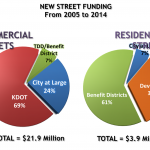
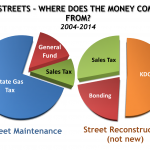
Since 1950, the city has built 84 percent of its infrastructure, he said. Now those streets are beginning to age and will need to be replaced — and the funding sources to pay for the reconstruction are disappearing. Dougherty said the fuel tax is the only steady source of funding the city has left to count on.
In the past, the city has used money from the Kansas Department of Transportation, sales tax and bonds to pay for infrastructure projects.
“We aren’t paying much for these streets. We’re getting these streets given to us,” Dougherty said, “and yet we have to accept the liability.”
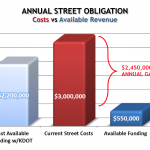
According to the data collected, the annual costs of city streets is $3 million, compared to the $550,000 it receives in funding — leaving an yearly gap of $2,450,000. Click here for the entire presentation.
The water and sewer infrastructure is in the same dire situation as city roads.
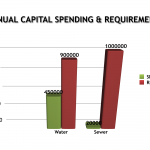
Dougherty said the city should be spending $900,000 a year on water line maintenance — currently the city spends $450,000. The city should be spending $1 million on sewer per year — but now the city spends almost nothing.
As a result, Dougherty said rates will have to increase.
“We are way too far behind the curve to try to play catchup with water and sewer construction,” he said, adding a rate increase is unavoidable.
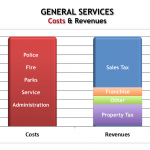
Part of the issue, he said, is that the sale tax funds the general fund, but while the sales tax brings in outside money, “there is very little connection between the drivers of growth and the revenues to pay for it.”
Much of the growth has been residential and because houses do not raise sales tax revenue, there is now a gap.
“What a lot of people in the community see as progress,” Dougherty said, “we could see as a liability if we’re not directly generating revenues from that.”
Adding to the problem, he said, is the level of service being provided to the community.
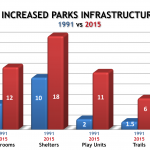
In 1994, the city created a comprehensive plan, based on what residents wanted. It called for the creation of a sports complex, water park and bike lanes, among others — amenities the city now must maintain.
One of the examples Dougherty gave was the recently completed West 41st reconstruction project, comparing it to upgrading East Eighth.
The 41st Street reconstruction cost $3.8 million to accommodate 2,600 vehicles per day. East Eighth street would cost $2.5 million for 7,280 vehicles per day. In addition, the residential nature of 41st offers no additional sales tax to the city, while East Eighth’s commercial status is revenue-producing.
Dougherty said city staff is calling for a course direction, and they will begin to evaluate costs and needs of projects.
Dougherty called Tuesday night’s presentation the first step in that course change and said it is now up to the Hays City Commission and the planning commission to evaluate the situation and devise solutions.
The city of Hays will take bids for the purchase of approximately $1.01 million of General Obligation Bonds, Series 2015A on Thursday, June 11, at the city commission meeting. Commissioners must approve an ordinance and resolution to authorize issuance of the bonds.
Final versions of the ordinance and resolution, as well as final payment terms on the bonds, will be made available by George K. Baum & Co., the city’s financial advisor, and Gilmore & Bell, P.C., the city’s bond counsel after the sale of the bonds and before the commission meeting.
The bonds will be paid from special assessment revenues received by the city as property owners within the Golden Belt 5th Addition and 46th Street 2nd Addition improvement districts pay their tax bills.
Finance Director Kim Rupp reported last week the city received a Standard & Poor’s AA rating on the bonds.
The other agenda item for Thursday’s meeting is to hear and consider accepting the 2014 audit by Adams, Brown, Beran and Ball.
The meeting starts at 6:30 p.m. in Hays City Hall, 1507 Main Street.
Kansas legislators locked in increasingly tense discussions about how to balance the budget and end the longest legislative session in state history said there is no longer any serious talk about expanding Medicaid eligibility this year. JIM MCLEAN HEARTLAND HEALTH MONITOR
Legislators locked in increasingly tense discussions about how to balance the budget and end the longest legislative session in Kansas history said there is no longer any serious talk about expanding Medicaid eligibility this year.
“Given all the time we’ve wasted, it is incredibly disappointing that we couldn’t find the time to deal with this issue,” said Rep. Jim Ward, a Wichita Democrat and the Legislature’s most vocal advocate of expansion.
Currently, non-disabled adults without children aren’t eligible for the state’s Medicaid program, called KanCare, no matter how poor they are.
Expansion would make all Kansan adults with incomes up to 138 percent of poverty eligible. That’s $16,105 in annual income for an individual and $32,913 for a family of four.
The U.S. Census Bureau estimates that 324,000 Kansans age 19 to 64 have incomes that would qualify them for coverage under expansion. Of those, about 131,000 are uninsured.
For the third consecutive session, what appears to be a powerful coalition led by Kansas hospitals has failed to gain traction on the issue due in large part to its connection to the Affordable Care Act, which many Republicans who control the Legislature continue to oppose.
GOP leaders blocked hearings on expansion during the 2012 and 2013 sessions. They allowed a hearing this year, but only to prevent expansion supporters from forcing a surprise vote on the House floor.
‘The problem at hand right now’
Rep. Susan Concannon, a Beloit Republican and vice chair of the health committee, said that while the expansion issue deserves more consideration, it has been overtaken by circumstances. The budget and tax negotiations already are difficult and contentious. Adding Medicaid expansion to the mix would make it even harder to reach consensus on a plan to end the session.
“We want to just take care of the problem at hand right now and make sure that we don’t have to furlough state employees and that we fill this budget hole that we have,” Concannon said.
That may be the mindset of most legislators, but it hasn’t prevented several contentious issues from becoming part of the tax and budget negotiations. Proposals to impose what amounts to a lid on local property taxes, repeal hundreds of millions of dollars in sales tax exemptions and provide tax credits to business that fund private school scholarships have been included in tax packages negotiated by a House-Senate conference committee.
Rep. Tom Sloan, a Lawrence Republican, is one of the few legislators still urging consideration of an expansion plan this session. He provided legislative leaders with an updated version of the Medicaid expansion plan developed by the Vision 2020 Committee, which he chairs. It would impose fees on a wide range of health providers to generate the state’s $68 million annual cost of expansion and provide $39.1 million to help balance the fiscal year 2016 budget.
A week ago, Sloan said the plan was being discussed.
“It has not been dismissed out of hand,” he said.
But Concannon said the proposal quickly ran into opposition from the expansion supporters it was designed to appease because of the assessments it would have imposed on doctors, chiropractors, podiatrists, pharmacists, optometrists, nursing homes, hospitals and mental health providers.
“I don’t think it’s a good idea to tax the very people who are providing the Medicaid care,” she said. “We have a hard enough time getting providers to participate in the Medicaid program.”
Polls find support for expansion
Cindy Samuelson, a spokesperson for the Kansas Hospital Association, said that while the organization appreciated Sloan’s efforts to keep the issue alive, “We continue to stand by our study that expansion pays for itself.”
The hospital association’s study estimated that expansion by 2016 would cost the state an additional $312 million over the next five years. But it also said that savings in other programs and tax revenue from jobs and economic activity associated with expansion would more than offset the additional cost to the state.
In addition to funding studies that document the economic benefits of expansion, KHA has funded several statewide polls, each of which has found strong bipartisan support for it. The most recent poll, conducted in April by a firm that predominately works for Republican candidates, showed that 64 percent of likely Kansas voters supported expanded Medicaid eligibility, including 58 percent of the Republicans surveyed.
Support climbed to 69 percent when respondents were told that expansion would attract more than $2 billion in additional federal funding to the state. And it remained at 58 percent when the surveyors asked a series of questions that made it clear that expansion was connected to Obamacare.
“We were pleased to see that even using this language, Kansans overwhelmingly still supported KanCare expansion,” Samuelson said.
Rep. Dan Hawkins, a Wichita Republican who chairs the House health committee, said the Kansans who responded to the survey don’t have access to all the information that he and other legislators have about the state budget and the cost of Medicaid expansion. Based on that information, Hawkins said he isn’t convinced that the costs of expansion would be as manageable as the hospital association and other supporters claim.
“It’s not the connection to Obamacare. For me, it’s really the cost,” Hawkins said, explaining that he believes the cost of expansion would be much higher than the hospital association estimates, more in the range of $125 million a year.
“We’re in a fiscal nightmare here,” Hawkins said, referring to the Legislature’s ongoing struggle to agree on a tax plan to raise the roughly $400 million necessary to balance the 2016 budget. “Adding that (expansion) would just compound things even more.”
Samuelson said hospitals will continue to lobby for KanCare expansion until the gavel falls on the session. But, she said, “In the unfortunate event that expansion does not occur this session, the hospital community will continue to push forward and explore options to develop a Kansas solution that will meet with the Legislature’s approval.”
Jim McLean is executive editor of KHI News Service in Topeka, a partner in the Heartland Health Monitor team.
LAWRENCE, Kan. (AP) — The Lawrence City Commission has approved new regulations for taxi companies that do not apply equally to ride-sharing companies such as Uber.
The Lawrence Journal-World reports that, among other things, the regulations will require background checks for taxi drivers and sets required insurance rates.
The vote on Tuesday comes after the Kansas Legislature passed a new law that limits how cities can directly regulate ride-sharing companies.
Taxicab owners say the state law regulates ride-sharing companies less strictly than taxicab companies.
Uber stopped operating in Lawrence in April after the legislative debate over regulating ride-sharing companies. Since the law passed, the company is again listing Lawrence as a city it serves.
PLAINVILLE — Plainville Police Officer Cody Deutscher responded to a 911 call at 4:24 a.m. Sunday at the Plainville Short Stop convenience store, 601 S. Washington.
According to reports, a man — described as between 5-8 and 6-feet tall and dressed in black — had entered the store and pointed a handgun at Michael Downing, store clerk. Downing reached for the gun and was shot in the right hip.
Downing, 40, was taken to Rooks County Health Center by Plainville EMS. The Plainville Police Department reported he was released Tuesday.
Plainville Police James Officer James Phlieger, lead officer for the incident, said the assailant ran across the highway and headed west through a residential section of Plainville.
The Rooks County canine officer was dropped off at the scene and picked up a scent that headed west. As of 7:25 a.m., the assailant has not been apprehended.
The Kansas Bureau of Investigation has responded to assist with the investigation. The Plainville Police Department believes this was an attempted robbery.
More information will be released as it becomes available.
A public hearing is scheduled for Wednesday, June 10, by the Hays Area Board of Zoning Appeals for an exception for a special use permit to convert a motel to studio apartments.
The request by Steven R. Mongeau of Rooks County Holdings, LLC and Vigneshvarai, LLC, is for the former Budget Inn Motel , 810 E. 8th Street.
According to Mongeau, the proposed apartments would be leased at street market rate with a blend of students, seniors and working residents.
The apartment styles would be efficiency to accommodate one occupant, and one bedroom to accommodate a maximum occupancy of two.
Mongeau is also requesting the existing office space with a drive‐through, as well as Rooms 128‐138 (facing Vine Street) be available for office/retail uses.
Drought tolerant landscaping is planned for the inoperable pool area.
Rooks County Holdings has completed similar conversion projects in Stockton.
The public hearing is scheduled for 8:15 a.m. June 10 in the city commission chambers at Hays City Hall, 1507 Main.