JoNel Lohmeyer, 78, Hays, died Wednesday, November 4, 2015 at her home in Hays.
She was born November 22, 1936 in Beatrice, Nebraska the daughter of Charles “Wes” and Margaret (Martin) Diggs. She graduated from Beatrice High School in 1954. On November 24, 1957 she married Rollin Lohmeyer in Beatrice.
She worked at a nursery, was a homemaker and Mother, worked for Gabel’s Bakery in Hays and in food service at the Hays High School Cafeteria, until her retirement. She was a member of the Trinity Lutheran Church in Hays and volunteered for numerous church functions and funeral dinners. She enjoyed baking, gardening, and antique cars, and her family loved her delicious cinnamon rolls. She loved her family, especially her grandchildren whom she loved caring for and spending time with.
Survivors include her husband of 58 years, Hays, three daughters; Sue Morelock of Manhattan, KS, Sara Brandt and husband Larry of Dumas, TX, and Amy Gasper and husband Troy of Victoria, KS, two brothers; Charles Diggs and wife Rachel of Glen Carbon, IL and Max Diggs and wife Norma of Omaha, a brother in law Gene “Les” White of Barnston, NE, a sister in law Ida Lohmeyer of Beatrice, NE, seven grandchildren; Megan Pfannenstiel and husband Tyler of Hays, Grace Brandt of Denton, TX, Hilary Brandt of Dumas, TX, Madalyn Morelock of Manhattan, Sam Brandt and fiancé Felisha Montez of Dumas, TX, Dalton Gasper and fiancé Laramie Broshar of Hutchinson, and Dylan Gasper of Victoria, four great grandchildren and numerous nieces and nephews.
She was preceded in death by her parents, a sister Eva White, a brother Rex Diggs, an infant daughter, and a brother in law Dewayne Lohmeyer.
Funeral services will be at 1:30 pm on Monday, November 9, 2015 at the Trinity Lutheran Church, 2703 Fort Street, Hays, KS. Burial will be in Oak Grove Cemetery in DeWitt, NE. Visitation will be from 5:00 until 7:00 pm on Sunday at the Hays Memorial Chapel Funeral Home, 1906 Pine St. and from 12:30 until 1:30 pm on Monday at the church.
Memorials are suggested to the Trinity Lutheran Church or to Hospice of Hays Medical Center, in care of the funeral home.
Condolences may be left for the family at www.haysmemorial.com.
A key legislator has expressed support for a proposal that would allow behavioral health treatment facilities to hold people in crisis situations for up to 72 hours in an effort to keep them out of jail and out of a state hospital.
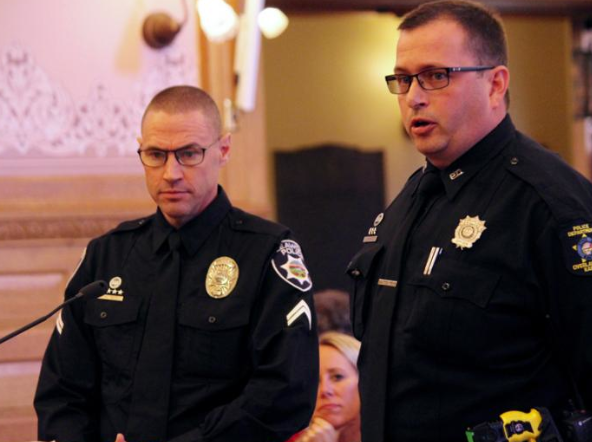
Photo by Dave Ranney Ken Whiteside, left, an officer with the Leawood Police Department, and Tom Keary, an officer with the Overland Park Police Department, testify Tuesday before the Joint Committee on Corrections and Juvenile Justice Oversight.
“We have to get serious about there being alternatives to locking people up when the driving force behind their involvement with the criminal justice system is mental illness and/or substance abuse,” said Rep. John Rubin, a Republican from Shawnee and chairman of the Joint Committee on Corrections and Juvenile Justice Oversight, which met at the Statehouse.
Rubin said he expects the proposal, which is still in draft form, to be debated during next year’s legislative session.
“The concept is a good one, and I think it will have broad support,” he said. “But the devil is in the details, and it’s those details that are going to have to be worked out.”
The proposal would give Kansas communities the option to open secure receiving centers that would be allowed to hold people who appear to be seriously mentally ill and in crisis for up to 72 hours.
The admissions would be involuntary, and patients would not be allowed to leave early unless they are assessed as unlikely to harm themselves or others.
Under current law, involuntary patients cannot be held for more than 24 hours — 48 hours on a weekend — without first being taken to court and having a judge decide whether they pose a danger to themselves or others.
These patients often end up in jail or in a state hospital because they are uncooperative and have nowhere else to go.
“Taking someone to jail has been the solution for law enforcement for years,” said Tom Keary, a crisis intervention officer with the Overland Park Police Department. “But it’s not a solution, because that person isn’t going to be effectively treated while he’s in jail. He’s going to recidivate, and we’re going to be dealing with him again.
“We’ve got to get away from that. We’ve got to take a problem-solving approach.”
‘No wrong door’
Julie Solomon, chief strategic management officer at Wyandot Mental Health Center in Kansas City, Kan., said many of these people could avoid jail and hospitalization if police had the option of taking them to a receiving center with a crisis stabilization program.
More than half of these patients, she said, could be stabilized and safely released within 72 hours.
The proposal, Solomon said, would give police a “no-wrong-door option that they don’t have now.”
Although some mental health advocates have panned the proposal, arguing that it would lead to individuals losing their civil liberties due to mental illness, those who spoke at Tuesday’s committee meeting support the measure.
“I absolutely believe that this will help us stem the tide of folks who find themselves in crisis situations, ending up incarcerated or being taken to one of the state hospitals,” said Wyandotte County District Court Judge Kathleen Lynch. Lynch, Solomon and Keary are part of an informal coalition of law enforcement, district court and mental health officials from Wyandotte, Johnson, Douglas and Shawnee counties that crafted the proposal during the last 18 months.
As yet, it’s unclear how the proposed receiving centers would be funded, how they would be licensed and whether they would be available in the state’s rural areas.
KCK pilot project suggested
Sen. Steve Fitzgerald, a Republican from Leavenworth, said he’s in favor of directing the Kansas Department for Aging and Disability Services to launch a pilot project “in and around the Kansas City metropolitan area, make it work and expand it into the rest of the state.”
The current approach, he said, “is stupid. It’s infantile; it offends my sense of how the system should run.” Fitzgerald dismissed concerns that allowing a treatment facility to hold someone who’s experiencing a mental health crisis would infringe upon their civil liberties.
“If you’re insane, do you have civil liberties? No, you don’t,” he said. “If you’re insane and you can’t make rational choices, then you don’t have civil liberties. You are judged to be incompetent by a court, and a guardian is put in charge of your affairs. “So the real question for me in all this is: How can we be sure you’re insane?” Fitzgerald said.
Dave Ranney is a reporter for Heartland Health Monitor, a news collaboration focusing on health issues and their impact in Missouri and Kansas.
KANSAS CITY, Mo. (AP) – The World Series champion Kansas City Royals have exercised their $8 million option on All-Star closer Wade Davis and a $5.25 million option on All-Star shortstop Alcides Escobar, while declining a $3 million option on outfielder Jonny Gomes.
The moves Thursday came one day All-Star outfielder Alex Gordon declined his $13.75 million player option and the Royals declined options on outfielder Alex Rios and starting pitcher Jeremy Guthrie.
Davis took over as the closer when Greg Holland required Tommy John surgery late in the season. He wound up saving four games in the playoffs, and recorded the final out in the 12th inning of Game 5 against the New York Mets to wrap up the World Series.
Escobar, a Gold Glove finalist, was MVP of the AL Championship Series.
A four-count indictment was unsealed today in the U.S. District Court of the Northern District of Ohio charging four men with conspiring to travel to Yemen to provide thousands of dollars to Anwar Al-Awlaki in an effort to support violent jihad against U.S. military personnel in Iraq, Afghanistan and throughout the world.
The indictment was announced by Assistant Attorney General for National Security John P. Carlin, U.S. Attorney Steven M. Dettelbach of the Northern District of Ohio, U.S. Attorney Barry R. Grissom of the District of Kansas and Special Agent in Charge Stephen D. Anthony of the FBI’s Cleveland Division.
Yahya Farooq Mohammad, 37; Ibrahim Zubair Mohammad, 36; Asif Ahmed Salim, 35; and Sultane Room Salim, 40, were each indicted on one count of conspiracy to provide and conceal material support and resources to terrorists, one count of providing material support and resources to terrorists and one count of conspiracy to obstruct justice. Farooq Mohammad and Ibrahim Mohammad both face an additional count of conspiracy to commit bank fraud.
“According to the allegations in the indictment, Farooq Mohammad, Ibrahim Mohammad, Asif Salim and Sultane Salim conspired to provide and did provide material support to Anwar Al-Awlaki in response to his calls to support violent jihad,” said Assistant Attorney General Carlin. “The National Security Division’s highest priority is counterterrorism and we will continue to pursue justice against those who seek to provide material support to terrorists.”
“The charges in this case outline a plan to send thousands of dollars to a known terrorist, a plan which came to fruition shortly before one of the most notorious attempted attacks in recent memory – an attack supported by that same terrorist,” said U.S. Attorney Dettelbach. “This indictment is a testament to the perseverance of those who stand watch over our nation and is a clear message to those who support terrorism – we will not forget and you will face justice.”
“In today’s world, Kansas is not far removed from the battlefields of the war on terror,” said U.S. Attorney Grissom. “We will do everything in our power to prevent funding and material support from finding its way from the heart of America to terrorists in foreign lands.”
“These individuals conspired and then acted on their radical beliefs by providing support to a known terrorist organization,” said Special Agent in Charge Anthony. “The identification of their conspiracy and the subsequent investigation demonstrate how members of the FBI’s Joint Terrorism Task Force continue to work with our international law enforcement partners to mitigate terrorist’s threats in order to protect our citizens.”
Farooq Mohammad was an Indian citizen who was an engineering student at Ohio State University between 2002 and 2004. In or around March 2008, he married a U.S. citizen. His brother, Ibrahim Mohammad, was also an Indian citizen who studied engineering at the University of Illinois Urbana-Champaign from 2001 through 2005. In or around 2006, he moved to Toledo, Ohio, and married a U.S. citizen. He became a lawful permanent resident of the United States in or around 2007.
Asif Salim was a U.S. citizen who studied at Ohio State University between 2000 and 2005. He became a resident of Overland Park, Kansas, in 2007. His brother, Sultane Salim, is also a U.S. citizen who resided in the Chicago-area from 2006 through 2012, until he moved to the Columbus area.
According to the indictment, from January 2005 through January 2012, the four defendants conspired to provide money, equipment and other assistance to Anwar Al-Awlaki. Al-Awlaki, a key leader of Al Qaeda in the Arabian Peninsula, was designated a global terrorist in 2010. The indictment also alleges that the defendants’ support was to be used in furtherance of violent jihad against the U.S. and U.S. military in Iraq, Afghanistan and throughout the world.
The defendants made various financial transactions in 2008 and 2009, and communicated about raising funds for a trip to the Middle East. Allegations in the indictment charge that Farooq Mohammad and Ibrahim Mohammad obtained money by opening credit cards and withdrawing money with no intention of repaying the amounts obtained from the financial institutions.
The indictment further alleges that on July 22, 2009, Farooq Mohammad travelled with two other people to Yemen to meet Awlaki. They were unable to meet with Awlaki, so instead travelled to Sana’a, Yemen, to meet with one of his associates. Farooq Mohammad and his two fellow travelers gave the associate approximately $22,000 to be given to Awlaki.
An indictment is only a charge is not evidence of guilt. A defendant is entitled to a fair trial in which it will be the government’s burden to prove guilt beyond a reasonable doubt.
If convicted, the defendants’ sentence will be determined by the court after reviewing factors unique to this case, including the defendant’s prior criminal record, if any, and the defendant’s role in the offense and the characteristics of the violation. In all cases, the sentence will not exceed the statutory maximum and in most cases it will be less than the maximum.
The case is being investigated by the FBI. This case is being prosecuted by Assistant U.S. Attorneys Matthew W. Shepherd and Christos Georgalis of the Northern District of Ohio, Assistant U.S. Attorney David Smith of the District of Kansas and Trial Attorney Gregory Gonzalez of the National Security Division’s Counterterrorism Section.
Hays Area Children’s Center, in cooperation with Hays Interagency Coordinating Council, will offer free developmental screenings for children in Ellis and Rush counties.
Screenings will be Friday, Nov. 6, at Messiah Lutheran Church in Hays.
The screenings are for children ages birth to 3. Children ages 3 to kindergarten-age can be screened at no cost if parents have a specific concern about the child’s development.
The screenings help track progress in several developmental areas, including speech, language, vision, hearing, thinking, motor skills and personal-social behavior. Parents who have any concerns about their child’s development are encouraged to make an appointment, as screening can help catch possible problems at a younger age and lead to better outcomes.
To make an appointment or for more information, call Hays Area Children’s Center, (785) 625-3257.
Appointments should be made at least 24 hours in advance, as some paperwork is required.
PRATT – The Kansas Department of Wildlife, Parks and Tourism (KDWPT) will auction off surplus buffalo at the Maxwell Wildlife Refuge on Wednesday, November 18, 2015 beginning at 11 a.m., according to a department media release.
Corrals are located 6 miles north and 1.75 miles west of Canton in McPherson County. Those interested in bidding are encouraged to arrive early to receive a bidder number. The auction is open to the public, and lunch and concessions will be served.
This year, a total of 56 buffalo will be auctioned, including five cows, seven yearling heifers, 10 yearling bulls, eight two-year-old bulls, 13 heifer calves, nine bull calves, and two cow/calf pairs.
Cash and personal checks if accompanied by a notarized authorization letter from the issuing bank will be accepted.
KDWPT reserves the right to reject any or all bids. Buyers must pick up the bison the day of the sale or make arrangements with the refuge manager prior to the sale. Animals become the buyer’s responsibility upon settlement on sale day. Load-out assistance is available until dusk the day of the sale. Stock racks and trailers should be covered or lined because bison transport best in dark conditions.
The sale will be outside and will take place rain or shine, so attendees are encouraged to dress accordingly. For more information, contact Maxwell Wildlife Refuge manager Cliff Peterson at (620) 628-4592, or wildlife and parks office in Wichita at (316) 683-8069.
Gene Policinski is senior vice president of the First Amendment Center
The great debate over the 2016 presidential primary debates is distracting and disappointing at the least, in free speech terms.
Distracting in that the most-talked about issue at the moment is concern over news media bias and news media credibility, an issue that while troubling is hardly new — or news — to many Americans.
Disappointing in that the purpose of a free and open debate — which is an exchange of differing political views without government intervention or limitation, and is at the core of why we have such strong protection for free speech — thus far seems more than an afterthought than outcome.
Lost in the national kerfuffle, which along with criticism of moderators includes debate hall temperatures and the process for taking bathroom breaks, is a real discussion over improving an already weakened process so that it informs rather than simply inflames.
A starting point for serious talk about using such debates as part of our commitment to free speech, petition and assembly is to acknowledge that the primary season — as opposed to the limited series of debates once presidential candidates are nominated — sets out what well may be an impossible task.
Take an increasingly common double-digit set of primary candidates onto a TV stage to face multiple questions on complex issues in just a few hours. Try to keep the focus on those issues and solicit real responses, even as campaign strategists and the financial dynamics of running for office today pressure candidates to simply stick to their generic talking points and attempt to motivate donors — or get national attention — with dramatic statements and rhetorical flourishes. Add in personal attack time, whether directed at the moderators, the news media or opponents.
Such a system doesn’t need First Amendment protection for free speech. Let’s just borrow the ropes, ring and format from professional wrestling and issue a whistle to someone who — as proposed in the latest GOP attempt to “reform” the debate structure — declares the appropriate party preference.
In 1858, the Lincoln-Douglas U.S. Senate debates in seven Illinois cities set out a format that at least put the responsibility for quality exchange of views on the candidates themselves. Future Republican president Abraham Lincoln and incumbent Sen. Stephen Douglas, a Democrat, alternated as the opening speaker for 60 minutes, with the other candidate then speaking for 90 minutes, and the first speaker closing with 30 minutes to respond.
To be sure, even then the news media role was controversial. Accounts say newspapers in Chicago sent stenographers to produce transcripts to be published in full, but that some partisan editors using the text edited their candidate’s words, while letting the opponent’s rough language stand. Scholars also note that from plying supporters in the attending crowds with liquor and food to increasingly personal attacks by both Lincoln and Douglas as debates progressed, there was much to criticize in even this iconic series.
As vocal critics of today’s debates hold forth, some do see the events as acceptable, if not admirable. The Newseum Institute and the online talk leader TYT Network recently co-sponsored a discussion at the Newseum about how millennial voters will consume news of the 2016 elections. Panelists said young voters see lighter questions, along with serious inquiries, as more in keeping with how their generation shares all kinds of news and information.
Free speech matters most when we have something worth saying, regardless of whether the views are popular or not. In a political contest, this constitutional right and duty shouldn’t be wasted on trivial talk or spiteful spats. The news media’s role in a political debate should be to encourage, enable and on occasion, to press candidates with piercing inquiry to be specific, clear and definitive about positions or policy — or journalists have no real reason to be on stage.
The First Amendment provides us with the right to freely debate public policy with the intent of making our nation a better place in which to live. Moderators asking silly questions or candidates hijacking the process simply to shriek for attention or to shill for donor support is just wrong.
Gene Policinski is chief operating officer of the Newseum Institute and senior vice president of the Institute’s First Amendment Center. [email protected]
TOPEKA, Kan. (AP) — A 42-year-old Hiawatha woman last seen in Topeka has been missing now for four months.
The Topeka Capital-Journal reports that Brandy Carter-Meyer was last seen at the Topeka Rescue Mission on July 3. Topeka police say she was entered into the National Crime Information Center as a missing person on Oct. 30.
A missing persons flier describes Carter-Meyer as 5 feet 4 inches tall and 125 pounds, with brown hair and blue eyes.
The far-right Republicans who have commandeered the Kansas Republican Party and taken control of the executive and legislative branches of state government are strikingly out of touch with the vast majority of Kansans, including members of their own party, according to the recent annual survey conducted by the Docking Institute of Public Affairs, Fort Hays State University.
H. Edward Flentje is professor emeritus at Wichita State University.
The survey indicates that this partisan faction has advanced policies over the past five years that are out of sync with the preferences of Kansans on a broad range of issues, such as block grants for schools, guns on college campuses, Medicaid expansion, same-sex marriage, immigration policy, and election fraud, among others.
However, these partisans are most dramatically insulated from Kansans’ views on what they claim as their signature achievement, their actions to eliminate the state income tax. According to the survey Kansans express opposition to this radical tax policy on a number of fronts.
For starters, 61 percent of survey respondents say that this tax policy has been a failure in terms of economic growth; 30 percent say it has been “a tremendous failure.” Only one in nine Republicans surveyed said that the tax policy has been a success.
Those surveyed also do not believe their tax burden has been reduced. When asked to consider sales, property, and state income taxes, 74 percent say their tax burden has increased. Only 5 percent say it has decreased. These respondents must be aware that income tax cuts have resulted in two rounds of hundred-million dollar state sales tax increases plus tax shifts onto property taxes totaling well into the hundreds of millions.
Nearly two thirds of those surveyed say taxes on top income earners should be increased, a preference in direct opposition to sales tax boosts advocated by Governor Sam Brownback and legislative leaders. The one tax that reaches those with higher incomes is the income tax. Sales taxes shift the tax burden from those with higher incomes onto those with lower incomes.
Over half of the Kansans surveyed also express support for exempting food from the state sales tax, an action that would soften the impact of sales tax increases on those with lower incomes. However, the dire condition of state finance caused by income tax cuts forestalled such proposals in the legislature.
Survey respondents expressed displeasure with the performance of Brownback who has championed the tax plan as his legacy. Dissatisfaction with the governor’s performance has ballooned to 69 percent, up from 31 percent during his first year in office. Over half of Republicans surveyed express dissatisfaction with Brownback.
Positive appraisal of Brownback has fallen every year since the tax cuts first passed in 2012, to the point that only 18 percent of the respondents in this year’s survey express satisfaction with his performance. A meager 30 percent of the Republicans surveyed expressed satisfaction with Brownback’s performance.
What is going on here? Kansas voters elected and reelected these right-wing lawmakers to office in 2010, 2012, and 2014. What explains this chasm between what Kansans say they want and the actions of their elected representative? Several factors are in play.
Interest group funding of thousands of campaign postcards attacking challengers aided these incumbent officeholders. The $17 million in undisclosed, outside money that flooded the 2014 U.S. senate race and demonized the opposition swayed uncertain voters. Some voters were more motivated by social issues such as abortion than state taxes. Primary elections and restrictions on election access also gave advantage to an energized minority. And too many eligible voters simply did not vote.
Only Kansas voters can bridge this gulf between the governed and those governing.
H. Edward Flentje is professor emeritus at Wichita State University.
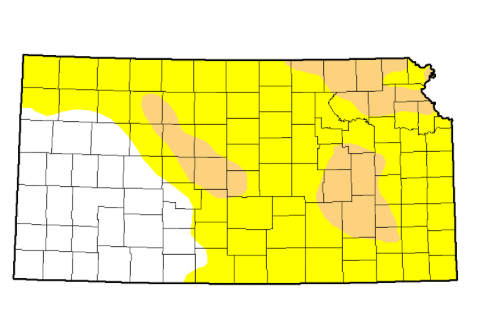
WASHINGTON – Weekly moisture totals were much lower across the northern and central Plains as compared to areas to the south and east.
However, in southwestern Kansas, 0.6-1.5 inches of rain, locally to 2.5 inches, plus heavy rains from last week, were enough to eliminate the D0/Abnormally dry conditions in Kiowa, Cheyenne, and Prowers counties in Colorado, and Greeley and Hamilton counties in Kansas, according to a media release from the USDA.
In southern Nebraska and eastern Kansas, light to moderate (0.3-0.9 inches) rains generally kept conditions stable, although a reassessment of short-term tools led to a slight redraw of the D1/Moderate drought areas in Kansas and D0/Abnormally dry condition in southwestern Nebraska.
WICHITA, Kan. (AP) — Media outlets have sued Kansas Gov. Sam Brownback and others in his administration seeking public disclosure of agency records related to the appointment of a magistrate judge in Reno County.
The Associated Press, The Hutchinson News and the Kansas Press Association filed the open records lawsuit late Wednesday in Shawnee County District Court. The Kansas Press Association represents more than 230 member newspapers throughout the state.
The governor’s spokeswoman, Eileen Hawley, declined to comment on the pending litigation.
At issue is the state’s refusal to release documents submitted by candidates seeking appointment to the position of Reno County magistrate judge left vacant by the retirement of Randall McEwen.
Media attorney Nathanael Berg says the public has an interest in who’s selected to be magistrate judge and how they are selected.
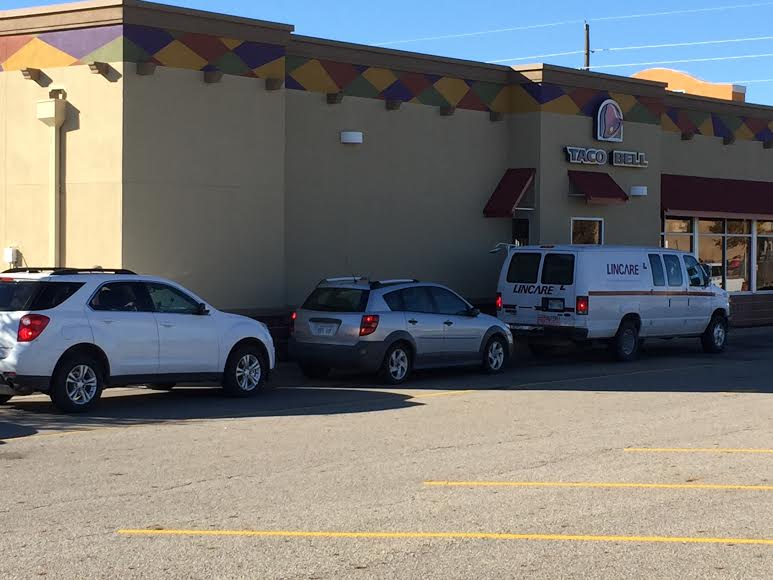
Cars lined up at the Hays Taco Bell on Thursday morning — thanks to a Royal with wheels.
Taco Bell offered a free breakfast sandwich if a player stole a base in the first or second game of the 2015 World Series — and Kansas City’s Lorenzo Cain’s obliged with the theft of second in the sixth inning of Game 1.
The promotion ran from 7 to 11 a.m. Thursday, with customers offered a free Crunchwrap sandwich.