MANHATTAN, Kan. (AP) — A Kansas State University professor has been nominated for two Grammy awards for his solo performance on an album with the Kansas City Chorale.
Bryan Pinkall, assistant professor of music, and the Kansas City Chorale were nominated in the categories of Best Choral Performance and Best Engineered Album for their album “Rachmaninoff: All-Night Vigil.”
The Topeka Capital-Journal reports (https://bit.ly/1PsCesQ ) the album was released last March and debuted at No. 1 on the Classical and Traditional Classical Billboard charts.
Pinkall previously served as manager of performance operations and direction for the Emmy-winning 2014 Sochi Olympic Winter Games Opening Ceremony. He also managed the production of Pope Francis’ Mass in Philadelphia in 2015.
Sedgwick County law enforcement and emergency personnel were called Sunday morning to the private lake in western Sedgwick County on a report that a small boat had capsized. The Wichita Eagle reports (https://bit.ly/1KyuvSC ) that two men were duck hunting in the boat when it capsized.
One of the men swam to shore of the private lake, which is a few miles south of Cheney Reservoir.
Emergency rescue crews located the second person, who had drowned.
Divers from WFD/SCFD continue to search a pond near 391st St W and 4th St N for a missing boater who fell through the ice after capsizing. — WichitaFireDept (@WichitaFireDept) January 24, 2016
WFD/SCFD joint rescue team responding to an ice rescue in the 300 block of N 391st St W near Cheney. — WichitaFireDept (@WichitaFireDept) January 24, 2016
WICHITA, Kan. (AP) — A Kansas woman serving a federal sentence for enslaving mentally ill residents at a Newton group home is seeking an early release from a federal medical center.
Linda Kaufman and her husband, Arlan Kaufman, were convicted about a decade ago of forcing residents to work naked at their farm and perform sexual acts over a 15-year period, while billing their families and the government for “nude therapy” sessions.
The Topeka Capital-Journal reports that Prison Warden Jody Upton has extended to victims an opportunity to comment on a request submitted by Linda Kaufman for “compassionate release” from Carswell Federal Medical Center in Fort Worth, Texas.
Linda Kaufman’s served about a decade and otherwise won’t be out of prison until 2018.
Her husband lost a 2012 appeal of his 30-year sentence
WICHITA, Kan. (AP) — Wichita State University and a dormitory resident whose room is infested with bed bugs are at odds over who should pay an exterminator for a second round of treatments
Freshman Londyn Bobbitt says she first found bed bugs in November in her room at Fairmount Towers.
KAKE-TV reports that her room was treated, but that she found the bugs again last week. The school began treating her room again Thursday but says she’s responsible for the $800 bill.
Wichita State housing director Scott Jensen says the pest control company is “very confident” that the bugs were eradicated.
Bobbitt insists there’s no way she brought the bed bugs out or back into her room. For now, Bobbitt says she’ll continue sleeping on her desk while fighting the university. Bed bugs live on blood.
TOPEKA, Kan. (AP) — Lawmakers seeking assurances about the computerized system that determines eligibility for social service and Medicaid programs were told it’s unclear when the system will begin working.
A recent audit showed the Kansas Eligibility Enforcement System is more than two years behind schedule and set to exceed its original budget by at least $46 million.
The Topeka Capital-Journal reports (https://bit.ly/1PsCrMT ) lawmakers focused on the social services budget met recently to evaluate an audit of the system.
Rep. Stephanie Clayton asked Glen Yancey, chief information officer at the Kansas Department of Health and Environment, how long it will take for the KEES system to come online. Yancey said he didn’t know but he could provide an estimate in three months.
Yancey has cited changing federal requirements as a partial explanation for delays.
KANSAS CITY, Mo. (AP) — As head of the governing board of Kansas’ state university system, Shane Bangerter figured the panel was in a no-win situation last week when faced with the need to adopt guidelines for how gun owners will be able to carry concealed firearms onto campuses and into some buildings next year.
Opposition to the law permitting concealed carry has been fierce on the system’s six campuses, largely on public safety grounds. That disapproval is counterbalanced by a Legislature that holds strong gun rights majorities in both the House and Senate, controls the universities’ purse strings and has pushed to let gun owners carry their weapons as many places as possible.
Wednesday’s action by the board of regents drew approval from both sides. But the divide over guns at college is likely to continue simmering through July 2017, when the law passed in 2013 takes effect.
“Obviously not everybody’s going to be happy,” Bangerter said. “But it is what it is, and we’re doing our best to follow the law.”
Over time, he said, the unease will blow over. But a faculty adviser to an anti-gun student club, worried that guns on campus could spawn violence during intense classroom discussions or suicides among despondent students, thinks Bangerter is mistaken.
“That just implies it’s no big deal,” said Allan Hanson, a University of Kansas anthropology professor who counseled KU’s “Keep Guns Off Campus” group. “What I hope will blow over will be this law.
“This is a really, really dangerous, uncalled for and stupid law.”
In Kansas, where gun owners can carry concealed without a license or training, public universities as of July 2017 must allow anyone 21 or older to have concealed firearms on campus in buildings without security measures including metal detectors — an option widely considered cost-prohibitive for the majority of campus buildings. The regents last week directed the universities to develop more detailed policies by the fall for the safe storage and handling of guns on campus, and to determine which buildings will see beefed-up security.
State Sen. Forrest Knox, a southeast Kansas Republican and a leading gun rights advocate, praised the regents’ handling of the matter.
“They’re complying with the law and being reasonable,” said Knox, from Altoona.
Kansas and at least seven other states allow carrying a concealed weapon on a college campus, according to the National Conference of State Legislatures. Missouri and 18 other states ban concealed carry on campus, but lawmakers in Missouri have proposed legislation to lift the ban. Two dozen states leave the decision to the college or university.
The Kansas law’s supporters argue gun-free zones attract mass shootings. But opposition on the affected campuses left the Kansas regents “serving two masters,” said Chapman Rackaway, a political science professor at Fort Hays State University, among the schools the regents oversee.
“When the two come into conflict, it’s a tough place for the regents to be in,” Rackaway said. He said the board made a good decision in letting each university draft concealed-carry policies unique to their campus.
At Fort Hays, the westernmost and most rural of the affected Kansas schools, Rackaway said reaction to the law has “ranged from disinterest and ambivalence to outright fear.”
“What nobody is saying is, ‘This is going to make our campus safer,'” he said.
At southeast Kansas’ Pittsburg State University, 21-year-old senior David Haag said he has felt unnerved by U.S. campus shootings in recent years and isn’t mollified by Kansas’ broadened concealed carry law, fearing that “shootings will increase.”
“I’m not a fan of it in any form. Not one bit,” said Haag, a senior communications major from Topeka. Before the law takes effect, “I’m trying to graduate.”
Knox, the lawmaker, countered that campus shootings have been more about the shooter’s “criminal behavior” than about concealed carry, insisting the Kansas law “just allows law-abiding citizens to provide for their own protection.”
In a free presentation about using worms to recycle organic food waste, Dr. Jean Gleichsner, associate professor of agriculture at Fort Hays State University, will explain at the next Science Café how composting is simple and effective, beginning at 7 p.m. Tuesday, Jan. 26, at Gella’s Diner, 117 E. 11th.
“The benefit of using worms is that the worms will produce a high quality compost and fertilizing liquid,” said Gleichsner. “It saves water, energy and landfills, and helps rebuild the soil.”
Gleichsner’s presentation, “Vermiculture: Let Worms Eat Your Garbage,” is sponsored by the FHSU Science and Mathematics Education Institute and is open to the public.
HUTCHINSON. – It only took an all female jury 30-minutes to find a Kansas man who served time in prison for child sex crimes was a violent sexual predator.
They got the case against Charles Smith, 29, after the defense rested Friday morning. The only evidence the defense presented to the court was the plea agreement that Smith signed in the case involving a sexual relationship with a 15-year-old in 2009.
District Attorney Keith Schroeder objected citing relevancy, but Defense Attorney Ben Fisher noted that the victim in the case considered them to be boyfriend and girlfriend.
Schroeder fired back that it was still a crime under Kansas’ law, since Smith was 22 and she was only 15 at the time.
Smith was originally charged with aggravated indecent liberties with a child, but the state dropped it to indecent liberties with a child as part of the plea agreement.
He also entered a plea to a second count of failing to register as a sex offender.
As part of the same agreement, the state dropped a second count of failing to register.
The state Thursday presented evidence that based on test given to Smith, he is considered a moderate to high risk of committing another sexual crime within the next five years.
He was involved in a rape case in North Carolina and also convicted of sexual battery in South Carolina.
The original Reno County case involved Smith bringing a 15-year-old with him from North Carolina and she was a runaway from Texas.
The two apparently had sex while living in Hutchinson but also while in North Carolina.
After the six-member jury came back with their decision, District Judge Trish Rose ordered Smith to Larned State Hospital where he’ll remain indefinitely while getting treatment as a sex predator.
MANHATTAN – The Kansas Department of Agriculture (KDA) is seeking individuals to participate in Petfood Forum Asia in Bangkok, Thailand, from March 29–April 1, 2016.
In an effort to help Kansas small businesses in the pet food and pet care market, this conference will allow the representatives to explore export opportunities, conduct market research and begin to establish a network of contacts.
KDA plans to take a group of five representatives of Kansas companies within the pet food industry. Interested individuals should complete the application forms available on the KDA website at bit.ly/KDAInternationalMarketing. Pet food related companies meeting the Small Business Administration’s definition of a small or medium-sized business are invited to apply to participate. Applications are due by January 29, 2016.
The dog and cat food sector contributes approximately $2.53 billion annually to the Kansas economy, and supports more than 1,900 jobs in Kansas. “The pet food industry is a priority area of economic growth for Kansas agriculture,” said Kansas Secretary of Agriculture Jackie McClaskey. “There is great potential in opportunities available internationally and we are pleased to help small businesses in Kansas explore the export market by providing programs that encourage growth.”
Petfood Forum Asia is a premier networking and educational conference for global pet food manufacturing industry professionals held in conjunction with Victam Asia/FIAAP Asia Pacific (Feed Ingredient and Additives), one of the largest agri-feed trade shows in the world. Participants will meet with the industry’s leading suppliers of equipment and ingredients, and observe exhibitions displaying the latest technology available that is used in the manufacture and processing of feeds for animals, pets, and aquatics.
Attendance at Petfood Forum Asia is supported by a State Trade and Export Program (STEP) grant, funded in part through a cooperative agreement with the U.S. Small Business Administration, which helps Kansas non-exporters get started and existing exporters to export more. Since the grant’s inception in 2012, more than 30 Kansas small businesses have participated and achieved $9.2 million in actual export sales.
For more information, contact KDA Agribusiness Development Director Lynne Hinrichsen at [email protected] or (785) 564-6757.
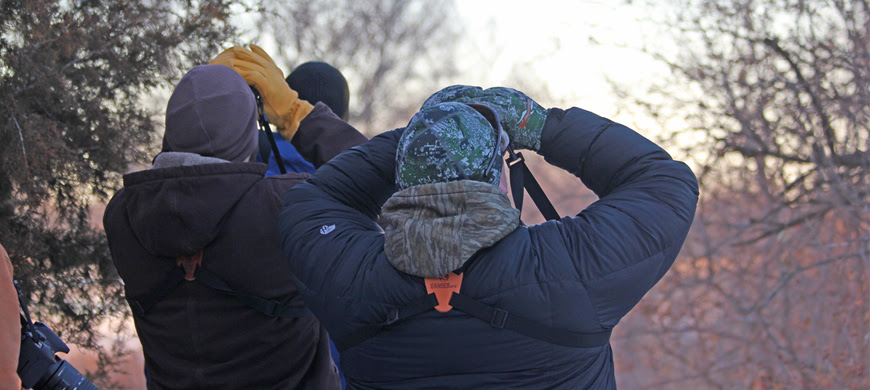
PRATT–Cardinals, sparrows, bluejays and doves might be the extent of your bird identification knowledge, and that’s okay, but wouldn’t it be neat to know what kind of bird is plucking those bugs off your bumper? Or what kind of bird is building a nest in your favorite tree out back? For birders, keeping a running tally of the species they identify is an ongoing challenge. And for Sam Schermerhorn, Wamego, who competed in the youth category of the 2015 Kansas Birding Big Year contest, that tally was 225 species observed during the year. Schermerhorn won his category, comparing respectably to the overall winner, Andrew Burnett, who observed 317 species, an outstanding total for the state.
For three years running, the Kansas Department of Wildlife, Parks and Tourism has hosted a Birding Big Year contest where participants join in a friendly competition to see who can identify the most bird species in a calendar year. The competition is divided into three age categories: youth (17 and under), adult (18-64), and senior (65+), with the adult category being broken down into three skill levels.
The results for 2015 were spectacular:
ADULT DIVISION
Advanced
1st – Matt Gearheart, 288
2nd – Pete Janzen, 262
3rd – E.J. Raynor, 259
4th – Brett Sandercock, 256
5th – Carol Morgan, 231
Intermediate
1st – Andrew Burnett, 317
2nd – Sue Newland, 283
3rd – Malcom Gold, 277
4th – Nick Varvel, 275
5th – Tom Ewert, 245
Novice
1st – Don Merz, 287
2nd – Jennifer Hammett, 252
3rd – Todd Becker, 172
YOUTH DIVISION
1st – Sam Schermerhorn, 225
2nd – Ella Burnett, 194
3rd – Joshua Keating, 142
4th – Jacob Keating, 137
5th – Emma Littich, 91
SENIOR DIVISION
1st – Mick McHugh, 267
2nd – Dan Larson, 241
3rd – John Row, 208
OVERALL WINNERS
1st – Andrew Burnett (Erie) – Adult, Intermediate, 317 species
2nd – Matt Gearheart (Lenexa) – Adult, Advanced, 288 species
3rd – Don Merz (Horton) – Adult, Novice, 287 species
4th – Sue Newland (Wakarusa) – Adult, Intermediate, 283 species
Apart from bragging rights, winners of the 2015 contest will receive prizes donated from several sponsors, including Bass Pro Shops, Cabela’s, The Coleman Company, Acorn Naturalists of Tustin, Calif., and the KDWPT Education Section.
The winners of each category will also each receive matted and framed original ink drawings of native Kansas bird species, drawn and donated by Dr. Robert Penner of Ellinwood, as well as a signed copy of Penner’ book, Birds of Cheyenne Bottoms. Dr. Penner is the land steward and avian projects coordinator for the Nature Conservancy at Cheyenne Bottoms.
Whether it’s time spent outdoors, or time spent with the ones you love that will get you out the front door, consider making birding an item on your to-do list this year. And take a kid with you.
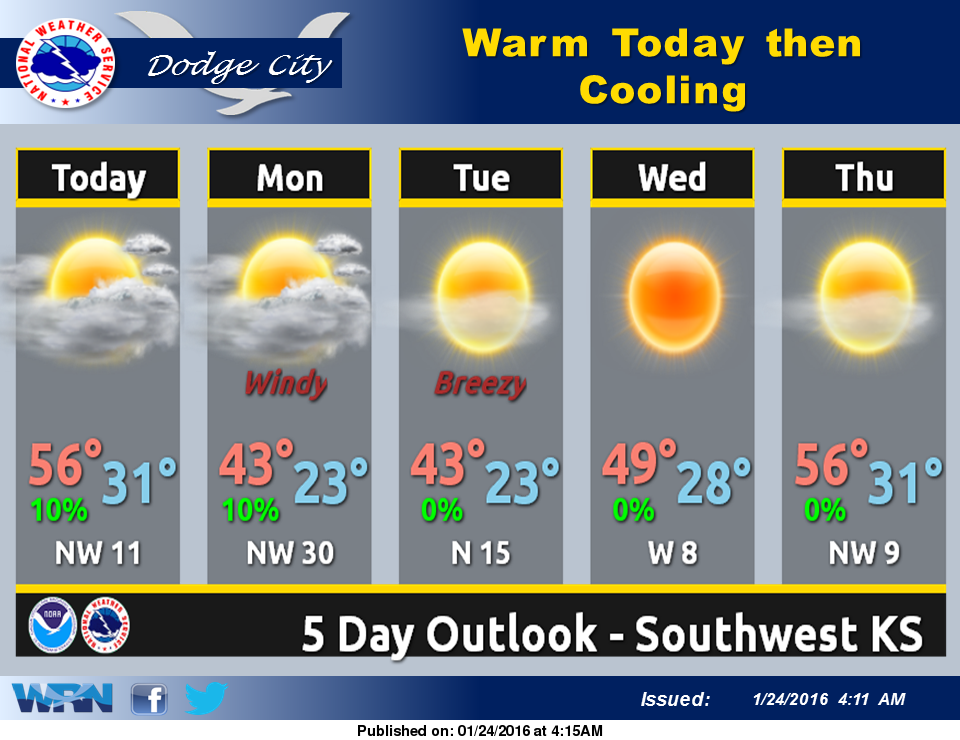
A warm front will lift into Kansas today with mild temperatures. An upper level disturbance will then bring a cold front across the Central Plains tonight into Monday with strong winds. There is a slight chance of rain and snow late Sunday night into Monday morning.
The rest of the week will see a warming trend as snow melts, with highs in the 40s and then in the 50s by the end of the week.
Today: Areas of freezing fog before 9am. Partly sunny, with a high near 46. Light and variable wind becoming south southeast 5 to 8 mph in the morning.
Tonight: A slight chance of rain and snow between 9pm and 11pm, then a slight chance of snow after 11pm. Mostly cloudy, with a low around 27. East northeast wind 7 to 17 mph becoming north northwest after midnight. Chance of precipitation is 20%.
Monday: A 20 percent chance of snow before 8am. Mostly cloudy, with a high near 40. Windy, with a north northwest wind 20 to 26 mph, with gusts as high as 36 mph.
Monday Night: Partly cloudy, with a low around 22. Blustery, with a northwest wind 15 to 20 mph decreasing to 9 to 14 mph after midnight.
Tuesday: Sunny, with a high near 41. Northwest wind 10 to 15 mph.
The Kansas Court of Appeals ruled that the Kansas Constitution’s Bill of Rights provides a right to abortion. JENNIFER MORROW / FLICKR–CC
In a sweeping decision, the Kansas Court of Appeals on Friday ruled that the Kansas Constitution’s Bill of Rights provides a right to abortion and blocked a Kansas law banning the second-trimester abortion method known as “dilation and evacuation.”
The ruling represents a major victory for abortion rights activists, who contended the ban increased the complexity and risk of second-trimester abortions. And it marks the first time a Kansas appellate court has found a right to abortion in the Kansas Constitution.
Signifying the importance of the case, all 14 judges on the court weighed in. The court split down the middle, with seven judges voting to uphold a lower court ruling temporarily blocking implementation of the Kansas ban and seven voting to reverse the lower court. When an appeals court is equally divided, the trial court’s ruling is upheld.
Kansas Attorney General Derek Schmidt said the state would request immediate review by the Kansas Supreme Court.
Writing for the faction voting to strike down the ban, Judge Steve A. Leben said that “(t)he rights of Kansas women in 2016 are not limited to those specifically intended by the men who drafted our state’s constitution in 1859.”
Leben also noted that Kansas has banned what’s known as the intact D&E abortion procedure since 1998. “By combining that ban with a new one on the D&E abortion procedure,” he wrote, “Kansas has simply attempted to do in two statutes what the United States Supreme Court held Nebraska could not do in one—ban both D&E and intact D&E abortions.”
The case was brought last year by two Overland Park doctors, Herbert Hodes, and his daughter, Dr. Traci Nauser, who operate one of three abortion clinics in Kansas. The pair challenged the D&E ban, which the Legislature enacted last year.
Kansas Gov. Sam Brownback issued a statement saying he was “deeply disappointed in the court’s decision to allow dismemberment abortions of a living child to continue in the State of Kansas. The court’s failure to protect the basic human rights and dignity of the unborn is counter to Kansans’ sense of justice.”
“Seven judges have chosen to create law based upon their own preferences rather than apply the law justly and fairly,” the statement continued. “I support the Attorney General in his call on the Kansas Supreme Court for a swift decision protecting the unborn.”
Nancy Northup, president and CEO of the Center for Reproductive Rights, which represented Hodes and Nauser, said in a statement that the ruling was “a landmark victory for Kansas women, whose rights and health have been under siege for far too long.”
“The state Court of Appeals has rightly affirmed that Kansas women have the right to safely and legally end a pregnancy under their state constitution, free from political interference,” she said.
Planned Parenthood of Kansas and Mid-Missouri, which was not a party to the case but has been involved in other battles challenging Kansas abortion restrictions, issued a statement congratulating Hodes and Nauser.
“Their brave fight blocked enforcement of a medically dangerous ban on the safest, most commonly used form of second trimester abortion,” the statement said, calling the Kansas ban “an irresponsible attempt to restrict women’s access to safe, legal surgical abortions.”
D&E accounts for about 9 percent of all abortions in Kansas, although nearly all second-trimester abortions are performed using the procedure. Anti-abortion activists call it “dismemberment abortion” but it’s known medically as dilation and evacuation, or D&E.
The Kansas ban allowed D&E in only three situations: where it was necessary to preserve the life of the mother; where the pregnancy’s continuation would cause the mother “substantial and irreversible” physical harm; or where the fetus was already dead. Doctors found to violate the law were subject to criminal prosecution.
The law was based on model legislation from the National Right to Life Committee and was the first of its kind in the nation. Oklahoma passed an identical ban after Kansas, and other states, including Missouri, have considered similar bills.
The Oklahoma ban was also challenged and blocked by a lower court. The case is pending on appeal.
The challenge to the Kansas law was unusual in that it was based not on the U.S. Constitution and the U.S. Supreme Court’s landmark abortion decision, Roe v. Wade, but on the first two sections of the Kansas Constitution’s Bill of Rights.
Section 1 of the Kansas Bill of Rights provides, “All men are possessed of equal inalienable rights, among which are life, liberty, and the pursuit of happiness.” Section 2 provides, “All political power is inherent in the people, and all free governments are founded on their authority, and are instituted for their equal protection and benefit …”
In rooting the right to abortion in the Kansas Constitution, Leben said that the right to liberty “fits squarely within both the federal abortion-rights cases and the broader substantive-due process case law within which the federal constitutional right to abortion has taken form.”
In July, Shawnee County District Judge Larry D. Hendricks reached a similar conclusion when he issued a temporary injunction blocking the law from taking effect. Hendricks ruled that the Kansas Bill of Rights “independently protects the fundamental right to abortion.”
In his decision, Hendricks also determined that alternatives to D&E weren’t reasonable, “would force unwanted medical treatment on women, and in some instances would operate as a requirement that physicians experiment on women with known and unknown safety risks as a condition (of) accessing the fundamental right of abortion.”
The state appealed, arguing that the Kansas Constitution contains no reference to abortion and the Kansas Supreme Court has never recognized a state-law right to abortion. It also contended the law only banned one abortion method and other safe alternatives were available.
The full court of 14 judges heard oral arguments in December. Appeals are typically heard by a three-judge panel of the court.
Leben was joined in his opinion by five other judges. A sixth judge, G. Gordon Atcheson, wrote a separate concurring opinion.
Judge Tom Malone wrote a dissenting opinion joined by six other judges. In his dissent, Malone said that he would not find an independent state-law right to abortion in the Kansas Constitution.
“Based on this finding, and because the plaintiffs’ claims are brought solely under the Kansas Constitution, it follows that the plaintiffs have failed to establish a substantial likelihood of prevailing on the merits of their claims,” he wrote.
Dan Margolies, editor of the Heartland Health Monitor team, is based at KCUR. You can reach him on Twitter@DanMargolies.