HUTCHINSON -Two Kansas teens suspected of several automobile burglaries in the city of Nickerson were in court Wednesday for the formal reading of charges.
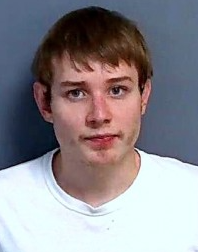
Kyle Nisbeth, 19, is now charged with 20 felony and misdemeanor counts, including several counts of auto-burglary, burglary of a non-dwelling, several counts of theft, including the theft of two firearms, one a shotgun and the other a rifle. He remains in jail on a bond of $57,500.
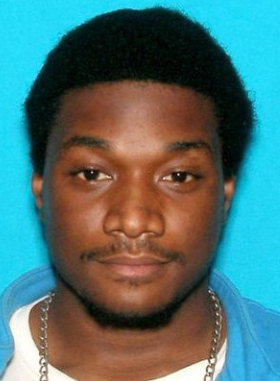
Quentin Zumalt, 19, is charged with eight counts of auto burglary and eight counts of misdemeanor theft.
Zumalt, who is free on bond, appeared with his attorney Stan Juhnke and they waived the reading of the charges.
During the investigation of these burglaries by the Patrol Division of the Reno County Sheriff’s Office a possible suspect vehicle was found in the driveway of a residence in Nickerson.
After talking to the residents the vehicle was seized as evidence, because there were items visible in the vehicle that appeared to be from the recent burglaries and the vehicle was identified as one of interest in other recent crimes in Reno County.
Ultimately 8 burglary reports were taken over $7200 worth of property was reported as stolen and some of that property has been recovered.
The cases against the two suspects will now moved to a future waiver-status docket next month.
PAOLA, Kan. (AP) — Authorities say a former northeast Kansas dispatcher has been charged with felony possession of methamphetamine.
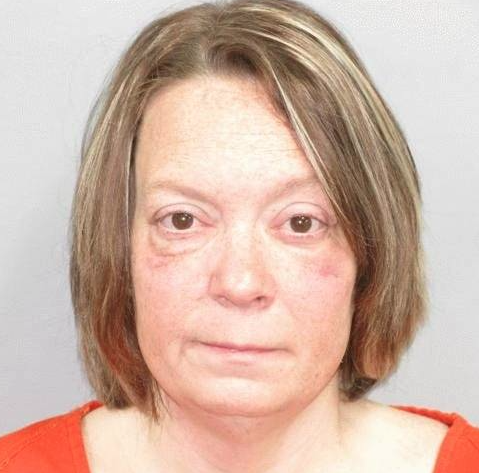
The Kansas City Star reports that Debbie Henson was a dispatch supervisor with the Miami County Sheriff’s Office until Kansas Bureau of Investigation agents arrested her this month. The sheriff’s office says she’s no longer employed by the agency. It wasn’t immediately known if she had an attorney.
Besides the drug charge, Henson faces one count each of possession of drug paraphernalia and official misconduct, both misdemeanors.
Henson was with the sheriff’s office for about 18 years.
LOS ANGELES (AP) — Three Powerball tickets will be splitting the record $1.6 billion jackpot. A California lottery official says winning tickets in last night’s drawing were sold in Tennessee, Florida and Chino Hills, California, near Los Angeles.
We have a winner in California! A jackpot-winning ticket was sold in Chino Hills. We’re still awaiting results from other states.
The frenzy over the largest Powerball jackpot in history paid off for the state of Kansas.
Kansas Lottery officials say sales for the Wednesday’s Powerball drawing were a record $9.68 million. The previous record was $6.77 million, set just last Saturday.
Lottery spokeswoman Sally Lunsford says the state recorded $5.31 million in sales in Kansas on Wednesday alone.
Three winning tickets were sold for Wednesday’s Powerball but none were in Kansas. However, two $1 million Powerball winning tickets were sold in the state, one in the southwest and one in south central Kansas.
The winning numbers were 4-8-19-27-34 and the Powerball was 10.
WICHITA, Kan. (AP) — A Wichita man has been sentenced to nearly 16 years in prison after being convicted of killing his longtime girlfriend.
The Wichita Eagle reports that Sedgwick County District Court Judge Warren Wilbert sentenced Darnell D. Hall Jr. to 190 months in prison Wednesday after he pleaded guilty to second-degree murder last month. The judge also ordered the 23-year-old man to pay $5,000 in restitution.
Hall is convicted of shooting 23-year-old Sabryna Guerrero-Newman twice in the abdomen during an argument at a residence in January 2015. He then dragged her limp body to her car, which was later found several blocks north.
Several of Guerrero-Newman’s relatives said in court that they had forgiven Hall for the killing but thought he deserved the maximum prison sentence of 200 months.
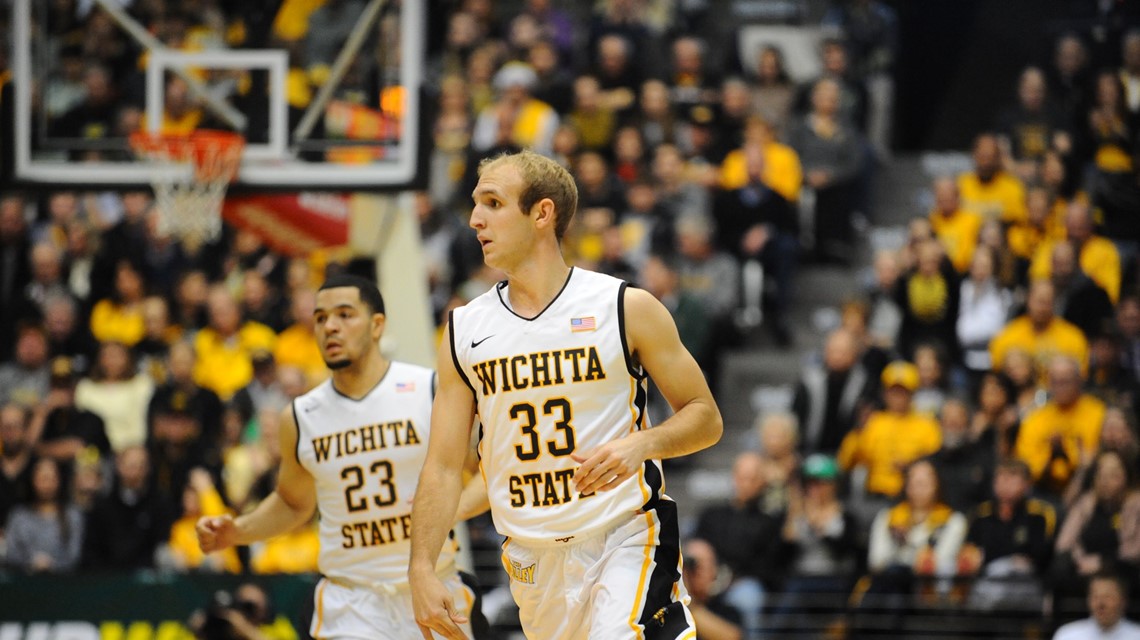
SPRINGFIELD, Mo. (AP) – Markis McDuffie scored 16 points on 8-of-9 shooting and collected nine rebounds as Wichita State broke open a close game and beat Missouri State 78-62 Wednesday night.
Wichita State (11-5, 5-0 Missouri Valley) led 37-36 at the half then used a 16-3 run out of the break to go up 53-39 on Rauno Nurger’s jumper with 12:38 to play.
Conner Frankamp hit consecutive 3s and Evan Wessel buried a 3 to make the score 62-44.
Missouri State (6-11, 2-3) sped to a 15-4 lead early when Dequon Miller hit a 3 with 13:58 to play before halftime. The Shockers battled back and Rarshard Kelly’s tip-in basket with 28 second before halftime gave Wichita State the lead for good.
Frankamp and Ron Baker each had 14 points for the Shockers as they shot 32 for 67 (47.8 percent) from the floor.
Miller scored 17 points for the Bears while Camyn Boone and Ryan Kreklow each had 10.
TOPEKA, Kan. (AP) — An audit of the Kansas Department for Children and Families won’t include an investigation into whether the agency discriminates against same-sex couple.
The Wichita Eagle reports that the Legislative Post Audit Committee deadlocked on the proposed anti-gay discrimination investigation and eventually decided to delay the issue until its April meeting. The audit the panel approved Wednesday will focus on safety and privatization.
Sen. Michael O’Donnell, a Wichita Republican, says the audit will be the “most comprehensive” of the foster care system in the state’s history.
But Rep. Jim Ward called the decision “simply unbelievable.” The Wichita Democrat had proposed an audit of discrimination claims after several couples came forward in recent months. He accused lawmakers of voting to “cover up evidence of discrimination in a major state agency.”
NEW YORK (AP) — Chipotle says it will start a marketing push in February to begin its road to recovery after a series of food scares, and that it’s confident it can win back customers over time.
The remarks from executives come after Chipotle’s sales plunged 30 percent in December. Its troubles began after an E. coli outbreak came to light at the end of October. Several weeks later, norovirus sickened dozens at a Chipotle in Boston.
Health regulators say one person who ate at a Chipotle restaurant in Kansas also became ill in a late November E. coli outbreak that sickened five people in three states.
Kansas Department of Health and Environment spokeswoman Sara Belfry said the person ate at Chiptole’s Shawnee Mission Parkway location the week of Nov. 23. No other details were released.
Last week, Chipotle Mexican Grill Inc. said it was subpoenaed by federal authorities as part of a criminal investigation tied to a different norovirus outbreak in California over the summer.
At an investment conference in Florida, Chipotle executives said Wednesday the Denver company is taking measures to reduce the risk of another food scare to “near zero.”
LAWRENCE, Kan. (AP) — The University of Kansas has chosen a University of Iowa woman as the program director for its new Sexual Assault Prevention & Education Center.
The university announced Wednesday that Jennifer Brockman will start her new job Jan. 20. Brockman currently is executive director of the University of Iowa’s Rape Victim Advocacy Program, which serves 250,000 people in eight counties. She coordinated primary sexual assault prevention and education for four institutions of higher education and many secondary schools.
Kansas’ new center will coordinate the university’s sexual assault prevention and education programming. It also will assess those efforts and create new programming. Brockman is the center’s first employee.
The center is one of several changes recommended by the Chancellor’s Task Force on Sexual Assault, which submitted its final report in May 2015.
KANSAS CITY, Mo. (AP) – Chiefs offensive coordinator Doug Pederson says his interview for the vacant head coaching job in Philadelphia went “great,” but he insists he is focused on the New England Patriots.
The Chiefs visit the reigning Super Bowl champions for a playoff game Saturday.
Pederson interviewed for the Philadelphia job Sunday. He started nine games at quarterback for the Eagles in 1999, and began his NFL coaching career under Andy Reid in 2009 as a quality control coach.
Pederson followed Reid to Kansas City in 2013 as his offensive coordinator.
The Eagles have also interviewed Tom Coughlin, Duce Staley, Pat Shurmur and Ben McAdoo. Bears offensive coordinator Adam Gase also interviewed before taking the job in Miami.
A state law will make it legal to carry concealed weapons into campus buildings beginning in July 2017, and to prepare for that change, the Docking Institute of Public Affairs at Fort Hays State University conducted a survey to gather opinions from faculty and staff at universities throughout the Kansas Board of Regents system.
The results showed that a strong majority — 70 percent — would prefer to see the law changed so that handguns are not allowed inside campus buildings. Overall, the majority of respondents indicated that allowing concealed carry on campus by all groups would make them feel less safe. Only 53 percent said they would feel less safe if they carried a concealed handgun. In contrast, 82 percent said they would feel less safe if students were allowed to carry concealed handguns on campus.
The Kansas Legislature passed two laws in recent years that will open campus buildings to the concealed carry of guns effective on July 1, 2017.
In 2012, the Legislature passed the Personal and Family Protection Act, overriding local gun ordinances statewide and allowing concealed-carry permit holders to carry their weapons in almost all public buildings. Guns could be banned only if a building had adequate security measures to keep all weapons out. Some public locations, including universities, were allowed a temporary exemption from the new law, postponing concealed carry until 2017. In addition, in 2015 the Legislature passed a follow-up measure allowing anyone who can lawfully own a gun to carry it loaded and hidden without a concealed-carry permit.
With the prospect of concealed carry becoming a reality on university campuses next year, the Regents and officials at the state universities have begun to prepare for the change, and feelings have run high on both sides of the issue.
The Regents Council of Faculty Senate Presidents, in collaboration with the Regents University Support Staff Council, commissioned the Docking Institute to gather faculty and staff opinions and policy preferences regarding guns on their campuses.
Faculty senate presidents from seven of the Regents universities (Emporia State University, Fort Hays State University, Kansas University, Kansas University Medical Center, Kansas State University, Pittsburg State University and Wichita State University) helped obtain email addresses of all faculty and staff employed at their respective universities. The survey instrument was constructed by researchers at the Docking Institute and sent back to the presidents for review and modification.
The survey was launched on Dec. 3, 2015, and a total of 20,151 faculty and staff were invited to participate. Data collection ended on Jan. 4, and 10,886 responses were received, resulting in a response rate of 54.0 percent. There is no margin of error because all faculty and staff were invited to participate in the study.
“The healthy response rate from each institution and the overall response rate of 54 percent are proof of the concern campus employees have with the current weapons policy,” said Dr. Lorie Cook-Benjamin, associate professor at Fort Hays State, president of the FHSU Faculty Senate and chair of the Council of Faculty Senate Presidents. “The survey’s results clearly show that a majority of our employees want to see the law amended so guns are not allowed on campus.”
Some key results from the survey:
When asked their policy preference regarding concealed handguns on campus, the majority (70 percent) of respondents preferred amending the law so that guns are not allowed on campus, and 7 percent favored keeping the current law but extending the exemption past 2017. Nearly one-fifth favored keeping the current law and allowing the exemption to expire, which would then allow guns on campus. The 4 percent who responded “Don’t Know” suggests that few do not have an opinion on this issue.· More than half (54 percent) of respondents said they would favor their university expending the necessary resources to implement “adequate security measures,” 23 percent said it would depend upon the cost, 16 percent said they would not favor their university expending the necessary resources, and 7 percent said they did not know. The law allows concealed weapons to be banned if those security measures are in place, but it is problematic whether the measures would be affordable and whether they would be manageable on a campus where large crowds must pass quickly from building to building.
When asked how seeing a screening station as they enter a university facility would affect their sense of safety, almost half (45 percent) of respondents indicated they would feel safer, 24 percent said they would feel less safe, 24 percent said it would not affect their sense of safety, and 7 percent said they did not know.
Overall, the majority of respondents favored the prohibition of guns in all buildings, at sporting events and in open areas of campus. Respondents were slightly more likely to favor allowing concealed carry by faculty and staff than students or visitors.
Respondents were slightly more likely to favor prohibiting guns at sporting events than all other areas. Respondents were most likely to favor allowing concealed carry in open areas of campus by all groups and in faculty offices by faculty and staff.
With the exception of campus police or public safety offices (63 percent), about 43 percent supported allowing the secure storage of handguns on campus, assuming guns are allowed on campus. There was slightly less opposition to secure storage in locked vehicles, and relatively few opposed secure storage in campus police or public safety offices. Opinions regarding the secure storage of shotguns and hunting rifles were similar.
The vast majority of respondents (90 percent) favored requiring a permit to carry a concealed gun on campus, 7 percent favored allowing concealed carry without a permit, and 4 percent said they did not know.
About half of respondents said they would be less likely to work at their university if concealed carry were allowed. Only 8 percent indicated they would be more likely to work at their university, and 42 percent said it would not affect their decision.
Most respondents (68 percent) indicated they at least occasionally teach material that challenges some students’ views and deeply held beliefs in ways that some may find uncomfortable. Similarly, 70 percent said they discuss material that challenges views and deeply held beliefs in ways that others may find uncomfortable.
Overall, the majority (70 percent) of respondents indicated allowing guns on campus would negatively impact their course and how they teach; 20 percent disagreed.
Two-thirds (66 percent) of respondents said that allowing guns in the classroom limits their academic freedom to teach the material and engage with students in a way that optimizes learning, while 24 percent disagreed.
Three-fifths (60 percent) of respondents agree they are concerned that they will need to change how they teach their course if guns are allowed in the classroom. Twenty-four percent disagreed.
More than half (57 percent) of respondents indicated allowing guns on campus would negatively impact the service and/or outreach work they conduct with clients/community members on campus; 27 percent disagreed.
Fifty-six percent of respondents said they are concerned that they will need to change how they provide services and/or outreach work they conduct with clients/community members on campus if guns were allowed; 28 percent disagreed.
Nearly half (47 percent) of respondents agreed that allowing guns on campus would negatively impact how they conduct their research; 31 percent disagreed.
Forty-four percent of respondents agree they are concerned that they will need to change how they conduct their research if guns are allowed.
Nearly half (46 percent) believe that allowing concealed carry on campus would increase campus crime levels, 16 percent thought it would decrease campus crime, 22 percent said it would not affect campus crime, and 16 percent said they did not know.
Respondents were most confident in their campus police or security force’s ability to maintain a safe environment, with 68 percent indicating they are at least somewhat confident.
Respondents had the least confidence in their campus police or security force’s ability to enforce a gun-free policy, with only 46 percent being at least somewhat confident.
Respondents were most evenly divided in their level of confidence with their campus police or security force’s ability to respond quickly to an active shooter, with 59 percent expressing that they are at least somewhat confident.
The majority (91 percent) of respondents indicated their primary work occurs on campus. Only 9 percent said their primary work occurs off campus.
The full FHSU survey is available as a pdf on the Docking Institute website: [email protected].
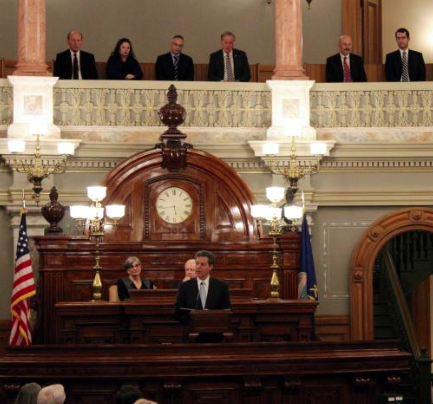
Photo by Susie Fagan/KHI News Service In his State of the State speech Tuesday night, Gov. Sam Brownback announced the creation of a task force to “address the problems of health care delivery in rural Kansas.” Seated behind Brownback are Senate President Susan Wagle, left, and Speaker of the House Ray Merrick. –
Kansas Republican Gov. Sam Brownback didn’t specifically mention Medicaid expansion in his State of the State speech Tuesday night to a joint session of the Legislature.
Still, he made it clear that he remains opposed to expanding eligibility to cover more than 150,000 low-income adults, many of whom are uninsured.
Seeming to acknowledge that the closure of Mercy Hospital in the southeast Kansas community of Independence had increased interest in expansion, Brownback said “Obamacare” was the main reason for the hospital’s financial struggles and those of other rural providers.
“It was Obamacare that cut Medicare reimbursements to rural hospitals,” Brownback said, referring to the Affordable Care Act.
“It was Obamacare that caused the problem. We should not expand Obamacare to solve the problem.”
Nationally, hospitals supported the ACA and the Medicare reimbursement reductions it included because they expected that increasing the number of Americans with private insurance and expanding Medicaid would more than offset those reductions. Kansas’ rejection of expansion has denied hospitals and other health care providers in the state much of that offsetting revenue.
Not expanding Medicaid has cost Kansas providers $920 million and counting, according to the Kansas Hospital Association, which keeps a running total of the cost on its website. Insisting that expansion isn’t the solution to the struggles of rural providers, Brownback said he’s open to other proposals. He announced the creation of a working group to “address the problems of health care delivery in rural Kansas.”
Brownback named Lt. Gov. Jeff Colyer, a plastic surgeon and the primary architect of KanCare, the state’s privatized Medicaid program, to lead the group in crafting a plan for his consideration “by this time next year.”
“I believe this working group should have frontline stakeholders involved, including a rural hospital administrator and a rural physician, at the same time as top policymakers,” Brownback said.
Brownback said the working group would welcome input from “diverse organizations.” But he said it would be unrealistic to rely on “yet another false Obamacare promise.”
“We can and should find a Kansas solution that will improve rural health care access and outcomes,” he said.
Shortly before the governor’s speech, the hospital association distributed an editorial to Kansas media written by Terry Deschaine, a former hospital CEO and current member of the board of trustees at Sumner Regional Medical Center in Wellington.
Deschaine countered the governor’s arguments against expansion, saying it would “inject some much-needed cash into rural hospitals like Wellington’s.
“As a former hospital administrator and current hospital board member, I implore our state leaders and lawmakers to expand KanCare,” Deschaine wrote.
“While not a silver bullet, expanding KanCare is an important part of preserving access to hospital care across Kansas — and particularly in rural communities like Wellington.”
A recent report commissioned by the Sunflower Foundation said that Medicaid expansion would lower state spending in several areas by enough to cover the annual $53 million cost of expansion, perhaps with money to spare.
The hospital association is working on an expansion bill modeled on so-called red-state plans adopted in other states headed by Republican governors. Association officials say they hope to have the bill introduced by next week.
Jim McLean is executive editor of KHI News Service in Topeka, a partner in the Heartland Health Monitor team.
TOPEKA–Kansas Lt. Governor Jeff Colyer, M.D., a Hays native, has announced the selection of nine members for the Rural Health Working Group. As requested by Governor Sam Brownback in his State of the State address, the working group will address the problems of health care delivery in rural Kansas. The working group will present a proposal to Governor Brownback in early 2017.
“The Rural Health Working Group brings together a wealth of professional knowledge and personal experience to address rural healthcare access and outcomes with Kansas solutions,” Lt. Governor Colyer said in a news release. “As a fifth generation rural Kansan and physician, I understand that rural hospitals are often the lifeblood of their community. We must continue to form Kansas solutions to sustain rural health care.”
Working group members have diverse backgrounds and include frontline stakeholders, rural hospital administrators, policy makers. The inaugural meeting will be held during the 2016 legislative session.
Rural Health Working Group members include Dr. Jenifer Cook, a rural physician. Since completing her residency, Dr. Cook has worked in 18 Kansas towns outside of Wichita. Within the past year, she has worked in Russell, Larned, Greensburg, Clay Center and Pratt.
Rural Health Working Group Members
Chair
Lt. Governor Jeff Colyer, M.D.
Members
Senator Mary Pilcher-Cook, Public Health and Welfare Chair
Representative Daniel Hawkins, Health and Human Services Chair
Senator Mitch Holmes, Rural legislator, St. John
Representative Jim Kelly, Rural legislator, Independence Linda Stalcup, Stevens County Hospital CEO, Hugoton Dr. Jenifer Cook, Rural Physician, Russell
Kari Bruffett, Kansas Health Institute Director of Policy
Secretary Susan Mosier, Kansas Department of Health and Environment