BARTON COUNTY -Officials won’t know until later whether they will be able to recover $48,600 that was wired to a Georgia Bank by Barton County Treasurer Kevin Wondra.
It appears he fell for one of the latest email scams.
Wondra wired the money after receiving an email that he thought was from Barton County Administrator Richard Boeckman, an email that Boeckman says did not come from his office.
Boeckman says that besides not following protocol, there were many red flags that should have let the Treasurer know that something was not right.
“I would not have had the authority to authorize this amount of money,” said Boeckman. “For this amount, it would have gone to the commissioners, been approved as an agenda item, and been encumbered. Obviously nobody checked,” he said.
“Also nobody asked what account to pay this from. No invoice, the money wasn’t encumbered, no agenda item, a lot of reasons why this should have caused questions to be asked.”
After officials became aware of the scam, Boeckman says they immediately took steps to make sure that other county, general fund money was not at risk.
Boeckman said Thursday morning that he remained cautiously optimistic that the county will be able to get their money back since there were other counties that received the same type of email. Because of that there is a chance that the Georgia bank put a fraud hold on the transaction but that will not be known until later.
Ellis County ranked second in 2015 oil production in Kansas.
KU News Service
LAWRENCE — Oil production fell sharply in Kansas during 2015 as oil prices continued to drop, although natural gas production fell only a fraction of 1 percent despite noticeable gas price declines, according to estimates from the Kansas Geological Survey at the University of Kansas.
Following a steady increase in oil production for the state as a whole from 2006 to 2014, production fell more than 8 percent to just below 45.5 million barrels in 2015 — down from 49.5 million barrels in 2014. At the same time, the number of oil and gas wells drilled in the state declined almost 64 percent, from 5,765 in 2014 to 2,080 in 2015.
“Kansas crude oil production began a dramatic downturn in October 2014 when monthly production was 4.4 million barrels,” said KGS geologist Lynn Watney. “Production in February 2016 was down to just over 3 million barrels — a decline that rivals the fall in late 1998 and 1999.”
“The current decline is another one for the record books, having impacted the industry, communities, states and countries alike,” he said.
The average monthly oil price fell to $39 per barrel in 2015 from $82 in 2014. As a result of the combined drop in production and price, the cumulative value of Kansas oil declined from $4 billion in 2014 to $1.8 billion in 2015.
Production in eight of the top-10 oil-producing counties fell. The two exceptions were Harper County, which led the state for the first time, and Finney County, which moved from fifth to third following a 6 percent rise in production.
Harper County rose from the state’s 33rd highest producer in 2010 to first in 2015 when annual production there rose to 3.4 million barrels. Most of the oil — and natural gas in the county is produced from the Mississippian limestone play using horizontal drilling with multistage hydraulic fracturing activities, popularly known as “fracking,”
“About 1,100 horizontal wells have been drilled in Kansas over several decades,” said KGS geologist David Newell. “However, 2010 marked the beginning of a new era in south-central Kansas where staged massive hydraulic fracturing was extensively used in long-reach horizontal wells.”
The focus of drilling in the play, colloquially known as the “Mississippi lime,” shifted from Barber County into Harper County in 2014. Barber County dropped from fourth in 2014 to ninth in 2015.
Ellis County, which has led the state in oil production in all but two years since 1966, dropped to second place as production there fell more than 10 percent, from 3.35 million barrels in 2014 to 3 million in 2015.
“Ellis County is a well-established producing area that now has many marginal wells,” Watney said. “Falling production levels there parallel the rate of the state’s production decline, which have brought production back to 2002 levels.”
Besides Harper, Ellis and Finney, the top-10 producing counties in 2015, in order, were Barton, Russell, Ness, Rooks, Haskell, Barber and Logan. Oil production was reported in 91 of the state’s 105 counties, with about 44 percent from the top 10.
Even though natural gas production in Kansas declined less than 1 percent — from about 288 billion cubic feet (bcf) in 2014 to 285 bcf in 2015 — production declines continued at a brisker pace in the state’s largest gas area, which is also one of the largest in the world.
“The Hugoton Gas Area in western Kansas, which accounts for a vast majority of the state’s gas production, has experienced a long-term, steady production decline of 7 percent a year since the late 1990s,” Watney said. “However, natural gas production from the Mississippian limestone play in Harper County increased to more than 30 bcf in 2015, up from about 5 bcf in 2011 just after the drilling boom hit the area.”
As Harper County moved up to first in the state in oil production, it also jumped from fifth to second in natural gas production, with an increase in natural gas production of 24 percent. Most of the wells in the Mississippian play produce both oil and gas.
Stevens County continued to lead the state in production, with a nearly 1 percent increase in 2015 following an 11 percent decline in 2014. Most of the natural gas there is produced from the Hugoton Gas Area. Grant County, which had a 6 percent increase, was third.
The other top-10 natural gas producing counties, in order, were Barber, Kearny, Haskell, Finney, Morton, Stanton and Seward. All had decreased production except Stanton, which had a slight increase. Gas production was reported in 55 of the state’s 105 counties, and about 74 percent was in the top-10 producing counties.
Production in southeastern Kansas, where natural gas is produced mainly from shallow coal beds, continued to decline. Coal bed methane (CBM) accounted for 9.1 percent of natural gas production in Kansas in 2015. Peak CBM production, in 2008, was about 49 bcf compared with just under 26 bcf in 2015.
The average monthly price of natural gas in 2015 was $2.63 per thousand cubic feet (mcf), and the cumulative value in Kansas was $755 million. In comparison, the average monthly price in 2014 was $3.92 per mcf, and the cumulative value in Kansas was $1.3 billion.
“Although natural gas and oil production in Kansas are virtually equivalent with regard to their energy content, the income generated from natural gas is presently only a fraction of that from oil,” Newell said.
The University of Kansas is a major comprehensive research and teaching university. The university’s mission is to lift students and society by educating leaders, building healthy communities and making discoveries that change the world. The KU News Service is the central public relations office for the Lawrence campus.
SALINE COUNTY – Law enforcement authorities in Saline County are investigating teen brothers in connection with a burglary.
Devin Murrell, 18, and Xavier Murrell, 15, both of Salina are accused of breaking into a storeage warehouse in the 700 Block of Duvall just before 5 a.m. on Tuesday, according to Salina Police Captain Chris Trocheck.
There was damage to a doorframe, shelves, the air conditioner and ductwork.
Damage is estimated at $2,500, according to Trocheck.
There was also apparently an attempt to break in an adjoining business Wilson Security, 750 Duvall, but the suspects were not successful.
Devin Murrell also faces requested charges in connection with using a pellet gun to damage windows in a home, and a vehicle earlier in the week.
WICHITA, Kan. (AP) — Kansas Secretary of State Kris Kobach has told a federal court he is changing interagency policies that will improve the state’s ability to verify proof of citizenship for people who register to vote at motor vehicle offices.
The notice filed shortly before midnight Wednesday comes a day after a federal court ruled thousands of Kansans who did not provide such documents must be added to voter rolls for federal elections. The judge stayed her ruling until May 31 so the state could appeal.
Kobach contends the new policies were being implemented prior to that ruling.
Motor vehicle offices now accept and scan documents proving U.S. citizenship. Another change gives the secretary of state’s office and county election officers internet access to check whether motor vehicle offices possess such documents.
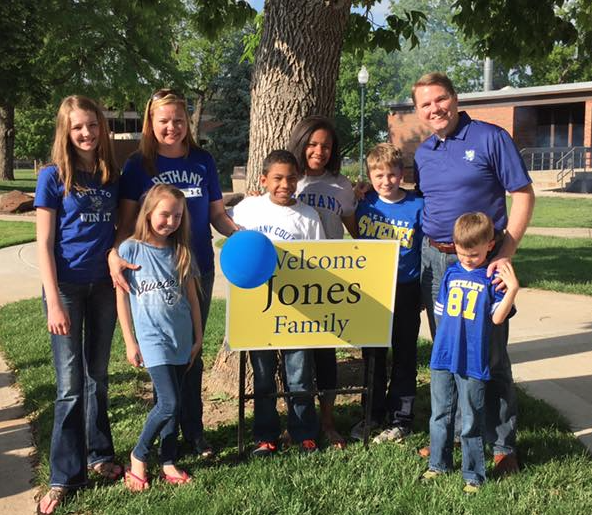
The Jones family at Wednesday’s picnic- courtesy photo Bethany College
LINDSBORG –Bethany College held an outdoor picnic in the school’s amphitheater on Wednesday evening to welcome new school president William Jones and his family to the community.
From an early age Will Jones, 43, was told, “You will be a college graduate.” Some may have taken that for granted, but for somebody like Jones who grew up in Kensee Hollow, Kentucky, the son of parents who dropped out of school, his mother in the eighth grade and father in the ninth grade, it was a life changing statement, the school shared in a media release.
And it is part of what has inspired him to lead Bethany College as its 14thPresident. The Board of Directors announced his appointment as the College’s new President on Friday, May 13 at a campus forum.
“A school like Bethany College saved my life,” he said. “Bethany is a good fit for me and I am right for Bethany and Lindsborg. I am excited to engage Bethany College alumni in the lives of the Bethany students.”
His passion for higher education and his life’s journey have guided him throughout his career. In his most current role as Vice President for External Relations at LaGrange College in LaGrange, Georgia, Jones has led record fundraising and enrollment growth. During his six-year tenure there he launched a branding and marketing campaign that won regional Emmy and Addy awards, grew the undergraduate population by 25 percent, and raised the alumni-giving rate by 58 percent.
He also led the effort in starting a Master’s program in Philanthropy and Development, one of only six such graduate programs in fundraising in the country. He led in the development of curriculum, helped recruit the faculty, and taught fundraising and marketing courses in the program. He also founded a national roundtable at LaGrange College that brings 20 chief advancement officers at independent colleges from across the country together to learn more about fundraising and marketing.
William Jones- photo Bethany College
“It is with great institutional and personal pride that I congratulate Will Jones on being named the next president of Bethany College,” LaGrange College President Dan McAlexander said. “His creative intelligence, boundless enthusiasm and impeccable personal integrity will make him a great leader of the historic institution.”
His fundraising experience and success reaches beyond LaGrange. He led successful efforts at both Goshen College and at Berea College. His appeal to Bethany as its next President included more than only his fundraising background, according to Corey Peterson, new chair of the Bethany Board of Directors.
“We are excited to have Will, Amy, and their family join the Bethany and Lindsborg family,” Peterson said. “Will brings a proven ability to lead, especially in the important areas of fundraising and student enrollment. His skills, work ethic, faith, along with a transparent and servant leadership approach are exactly what we need as Bethany moves forward.”
The Bethany College Board of Directors began its search for President in November when it engaged the search firm AGB and consultant Richard Torgerson to help lead the search. The committee, consisted of board members, Dr. Marie Friedemann, Corey Peterson, Bob Mooney, Jim Martin, and Sean Patty; along with faculty members, Dr. Mark Lucas and Dr. Kristin Van Tassel; staff member, Vicki Cornett; and community member Ted Kessinger, participated in an exhaustive national search that produced a large pool of candidates. The committee assessed the candidates and invited semi-finalists to Wichita for the first round of interviews. Three candidates were ultimately brought to campus in May and one name was advanced to the board for approval.
“Will is an extraordinary leader with proven skills in fundraising and enrollment management that will help usher in a new era of growth and prosperity for our institution,” Patty, chair of the search committee, said.
Jones and his wife Amy, who has a master’s degree in special education from Eastern Nazarene College in Quincy, Massachusetts, have six children and are excited about becoming part of the Bethany and Lindsborg community. Jones and his family enjoy taking an active role in campus life by attending events and hosting students, faculty and staff to their home.
“I hope that in addition to wearing the title of President of Bethany College, I will also earn titles of mentor, colleague, confidant, counselor and friend,” he said.
I’ve had numerous recent conversations, with reporters, editors, and various politicos, that have directly addressed the question of whether Governor Sam Brownback is delusional in clinging to policies that (a) do not work and (b) damage the state in myriad ways.
Burdett Loomis
Let’s start with one formal definition of delusional: “Maintaining fixed false beliefs, even when confronted with facts.”
“Delusional” is a strong word, but it’s in the air, propelled in part by Donald Trump. But his delusions are fleeting, quirky, and – so far – innocuous.
Brownback is a different story. Still, one might object to labeling the governor delusional. But that discussion is already taking place, and not just in private conversations. Indeed, a Google search for “Brownback delusional” obtains almost 100,000 hits. Not quite “Trump delusional” with its 500,000-plus links, but a lot.
The examples of arguably delusional behavior are legion (Brownback as presidential candidate?), but most revolve around the state of our economy and the impact of the 2012 tax cuts in both stimulating growth and reducing income taxes to zero.
While some of governor’s legislative allies assiduously spin the facts of Kansas revenues, for Brownback and his enablers, such as the Kansas Policy Institute, spin has lurched into delusion.
At the start of the 2016 legislative session the governor flatly stated, “The tax plan is working. I hope we don’t have a tax policy debate during this legislative session.” In other words, don’t even think about increasing revenues in the face of immense shortfalls.
By virtually all accounts, in January, 2016, the tax plan was not working. In terms of revenues, income tax reductions had proven a huge failure. As former GOP governor Mike Hayden recently observed, Brownback’s myopic partisanship has driven Kansas into a “financial ditch.”
Of course, when in a ditch, the first, most rational action is to stop digging.
Notably, that’s just what Oklahoma is doing, as Republican Governor Mary Fallin and many of her fellow partisans in the legislature have addressed a fiscal crisis by embracing the federal Medicaid funding that they had previously rejected. This constitutes reality-based thinking.
Back in Kansas, however, delusion rules. We can’t adopt a privatized Medicaid scheme, because it might, somewhere down the road, cost the state a few bucks. So what have we done? Raise taxes on the poor.
Only a substantial 2015 sales tax increase kept revenues from plummeting even more disastrously. Moreover, our sales tax on food has reached historic highs, often topping nine percent in many localities, driving many Kansas shoppers to Missouri.
Brownback’s reaction? Echoing his infamous 2014 campaign line, “the sun is shining in Kansas,” he responded to recent declines in revenue estimates and actual receipts by claiming, “This is an economic problem, not a tax policy problem.” Nonsense. Kansas remains mired near the bottom of regional economies and below the national average, largely because its declining revenues have necessitated extensive, brutal cuts, most recently amounting to almost $100 million.
Medicaid reductions alone will amount to more than $57 million, which will trigger federal reductions of $72 million. The administration claims that recipients will not lose access to care. Losing $72 million of federal funds is stupid. Asserting that $129 million in cuts won’t reduce access is simply delusional.
And this is just the tip of the iceberg. For example, declining Kansas welfare numbers are labeled a great success, while in reality various rules have likely driven many families off welfare. In Orwellian fashion, the failure to serve the poor is seen as a victory.
Sadly, for Sam Brownback and the state of Kansas, delusion reigns as the order of the day.
Burdett Loomis is a political science professor at the University of Kansas.
Gov. Sam Brownback announced more than $97 million in budget cuts Wednesday, including $56 million from the state’s privatized Medicaid program known as KanCare. FILE PHOTO / HEARTLAND HEALTH MONITOR
Gov. Sam Brownback trimmed more than $56 million from Medicaid in Kansas as part of larger budget cuts announced Wednesday, raising concerns that health care providers may decide not to take unprofitable patients.
About $38.2 million of the $56.4 million in budget cuts comes from reducing reimbursements by 4 percent for providers who treat patients covered by KanCare, the state’s privatized Medicaid program launched in 2013. The remaining $18.2 million comes from cuts in other areas of the Medicaid program.
The cuts come after the Kansas Legislature adjourned earlier this month, leaving more than $80 million in cuts up to Brownback in order to balance the budget.
Providers offering home and community-based services to Kansans with disabilities are exempt from the reductions, as are critical access hospitals and hospitals in counties defined as rural, densely settled rural and frontier. However, all 127 of the state’s community hospitals will be subject to a $3.5 million cut in a program intended to increase provider participation in KanCare.
Cindy Samuelson, a spokesperson for the Kansas Hospital Association, said the cuts break a promise Brownback made to health care providers when he sought their support for privatizing Medicaid.
“When Governor Brownback began the KanCare program, he emphasized that his Medicaid reform program would allow the state to avoid Medicaid rate cuts,” Samuelson said. “The governor’s proposal to now cut Medicaid rates is a broken promise.”
In addition, Samuelson said, the rate reductions will add to the financial pressures hospitals are operating under due to reductions in Medicare reimbursement rates and the loss over the last years of nearly $1.2 billion in federal funds because of Brownback’s rejection of Medicaid expansion.
Dennis Cooley, a Topeka pediatrician, said that while a 4 percent reduction may not sound like much, primary care doctors
Dr. Dennis Cooley, a Topeka pediatrician, says the Medicaid cuts are particularly concerning because about a third of Kansas children are covered by the program. CREDIT FILE PHOTO / HEARTLAND HEALTH MONITOR
typically have slim profit margins because of the need to keep professionals on staff and pay for technology like electronic health records. They already receive less to care for Medicaid patients than they do for Medicare patients, and about half as much as they would for patients with commercial insurance, he said.
“From a financial standpoint, you’re losing money, so you just can’t see Medicaid patients,” he said.
The cuts are particularly concerning for pediatricians, Cooley said, because about one-third of Kansas children are covered by Medicaid. In the past, his practice and others have had to limit their Medicaid patients so they could balance them financially with patients with private insurance, he said.
If enough providers decide they can’t afford to take new Medicaid patients or even drop out of the program altogether, that creates concerns about access to care, Cooley said. Not every public health department can provide primary care services, he said, and parents who can’t find a doctor for their child may only seek care if the health issue is serious enough to merit an emergency room visit.
“It’s the kids I’m dealing with that are going to suffer,” he said, adding that “it’s short-sighted” to cut Medicaid reimbursements.
A Kansas provider earns only 78 percent as much, on average, for a patient insured by Medicaid as one insured by Medicare. The ratio is even less for obstetric providers, who earn about 72 cents for every $1 they would be reimbursed for treating a Medicare patient.
As of 2014, Kansas reimbursement rates for most Medicaid services were near the middle compared to other states, tying for 24th overall. Its reimbursements for obstetrics were on the low end, however, tying for 35th.
Rachelle Colombo, director of government affairs for the Kansas Medical Society, said providers are still evaluating the effect that the Medicaid reimbursement cuts will have on their practices. But she said some may decide not to serve Medicaid patients if the reduction is too steep.
“It’s certainly not going to promote more provider participation,” she said.
Other budget reductions to health programs include:
$378,000 from safety net clinics. Cassie Sparks, a spokeswoman for the Kansas Department of Health and Environment, said the Legislature had allocated $378,000 more than Brownback had suggested in last year’s budget. KDHE will work with the Kansas Association for the Medically Underserved to recoup that money.
$330,000 from the KDHE immunization program. Federal Medicaid reimbursements were higher than expected, Sparks said, so KDHE could return that money to the state general fund and still buy the same number of vaccines.
$250,000 in unspecified cuts to non-Medicaid programs under the Kansas Department for Aging and Disability Services.
$78,000 from an unfilled position in KDHE’s Office of Inspector General. KDHE still is attempting to recruit someone to fill that job and will find resources to pay the person’s salary if a suitable candidate is found, Sparks said.
$250,000 from senior care programs through KDADS.
Some of the remaining reductions to Medicaid come from policy changes. For example, KDADS expects to save $1.3 million by limiting the range of household duties a support worker can perform if a person recieving in-home resides with a non-disabled person, said Angela de Rocha, a KDADS spokeswoman.
KDADS estimates it can save an additional $1.3 million by paying providers only for days when they work rather than paying them a daily rate to be on call, de Rocha said.
Megan Hart is a reporter for KHI News Service in Topeka, a partner in the Heartland Health Monitor team. You can reach her on Twitter @meganhartMC
257 communities exhibiting Playability to be recognized as part of 2016 Playful City USA Program
Hays is being honored with a 2016 Playful City USA designation for the first time.
Celebrating its 10th anniversary, the national recognition program honors cities and towns across the country for making their cities more playable. The City of Hays has made the creation and maintaining of public parks a priority and is committed to ensuring that neighborhood park services are within a maximum walking distance of one-half mile for all Hays residents.
“The City of Hays manages several different parks and amenities for the residents of Hays, and is continuously creating more opportunities for children to get the play they need and deserve. Through the multitude of programs offered for children to enjoy and thrive, we are thrilled that the tremendous effort by our Parks Departments is being recognized with this outstanding achievement,” said Rick Rekoske, Director of the Hays Convention and Visitors Bureau.
Rekoske
Communities across the country are creating innovative ways to bring back play and attract residents through family friendly activities. Interactive sidewalk art, designated play spaces on trails and the transformation of schoolyards into active play areas are just a few examples of how cities are becoming more playful.
“We are thrilled to recognize these communities that have invested their time and efforts to put kids first,” said
Ka BOOM! CEO James Siegal. “Balanced and active play is crucial to the well-being of kids and the communities that they thrive in. By integrating play into cities, the leaders of Playful Cities USA are working to attract and retain the thousands of families that want homes in close proximity to safe places to play.”
To learn more about these cities, see the full list of the 257 communities named 2016 Playful City USA honorees, or to gather more information on the Playful City USA program, visit www.playfulcityusa.org.
DETROIT (AP) — Fiat Chrysler is recalling about a half-million Jeep Wrangler SUVs worldwide because the driver’s air bag may not inflate in a crash.
The recall covers Wranglers from the 2007 through 2010 model years, including 392,000 in the U.S.
Another 7,400 2011-2016 Wranglers in the U.S. with right-hand-drive also are affected.
The company says excessive exposure to dust and dirt from off-road driving can cause electrical problems in the steering column air bag wiring. If that happens, a warning lamp will come on and owners should contact their dealer.
Fiat Chrysler says it’s not aware of any related injuries. The problem was discovered by a company investigation.
Dealers will install a new steering wheel back cover and steering column shroud. The company says it will notify customers when parts are available.
The Sunflower Foundation announces three appointments to its Board of Trustees by Kansas Attorney General Derek Schmidt.
The appointees are Liz Sosa of Garden City, Andrea Krauss of Russell, and Les Lacy of St. Francis. Each will serve a three-year term on the board, expiring in June 2019.
Sosa serves as CEO of Public Square Communities, a business that facilitates citizen-led community development by engaging and mobilizing the education, human services, business and government sectors. She oversees business development, strategic partnerships and leads the organization’s housing pilot initiative.
Additionally, Sosa serves on the Western Kansas Community Foundation board and is a former member of the Kansas Hispanic and Latino American Affairs Commission. She holds a bachelor’s degree in business and leadership from Fort Hays State University.
Schmidt also re-appointed Andrea Krauss of Russell to a second three-year term on the board, which will expire in June 2019. Krauss is secretary and treasurer of John O. Farmer, Inc., and currently serves as the Sunflower board’s treasurer.
Schmidt also re-appointed Les Lacy of St. Francis to a third three-year term on the board, which will expire in June 2019. Lacy is vice president for regional operations at the Great Plains Health Alliance, and currently serves as the Sunflower board’s secretary.
The Sunflower Foundation was formed in 2000 as part of a settlement between Blue Cross and Blue Shield of Kansas, the Kansas attorney general, and the Kansas insurance commissioner. The foundation supports work to improve the health of Kansans through grant programs, awards and related activities. The nine-member Board of Trustees governs the foundation’s work and oversees the long-term goals of the foundation. Eight of the members are appointed by the attorney general, and one member is appointed by Blue Cross and Blue Shield of Kansas. The voluntary trustees serve three-year terms and can serve up to three terms.
HaysMed recently recognized Jill Zordel as its inaugural Wellness Champion Award winner. The Wellness Champion Award celebrates and recognizes a HaysMed associate who promotes healthy lifestyle choices and engages others in wellness activities.
Criteria for the award includes commitment to healthy lifestyle choices and motivating others to do the same, displaying an energetic passion for promoting health and wellness and striving to build a culture of wellness at HaysMed.
Zordel committed to a healthier lifestyle in 2015 and has lost over 40 pounds. She gave up soda and began eating more fruits and vegetables along with working out. She is up every day at 3 a.m. in order to drive to Hays to get her 5 a.m. workout in before going to her job as a Clinical Nurse Assistant at the DeBakey Heart Clinic.
Her habits are inspiring fellow associates to join her at the gym. She even offers to give them a morning wake up call to join her.
“We have many Associates at HaysMed that are incredible role models for leading a healthy lifestyle,” said Stephanie Howie, Director of CHI. “We hope recognizing their efforts will encourage others to adopt a healthier approach to living.”
Zordel has been an associate of HaysMed for a year and a half.

 BARTON COUNTY -Officials won’t know until later whether they will be able to recover $48,600 that was wired to a Georgia Bank by Barton County Treasurer Kevin Wondra.