Two people dead after Tuesday plane crash in the Kansas City suburb of Lee’s Summitt-photo courtesy KCTV5
LEE’S SUMMIT, Mo. (AP) _ Authorities say two people have died after single-engine plane crashed at a suburban Kansas City airport.
Lee’s Summit police Sgt. Chris Depue says the crash happened at 6:10 p.m. Tuesday at Lee’s Summit Municipal Airport. Responding crews found the Piper 28 on the west side of the airport tarmac. Depue says the victims were the only people in the plane. No other injuries were reported.
Authorities say the flight originated from Iowa and the FAA is investigating the
First responders on the scene of Tuesday’s plane crash photo courtesy KCTV 5
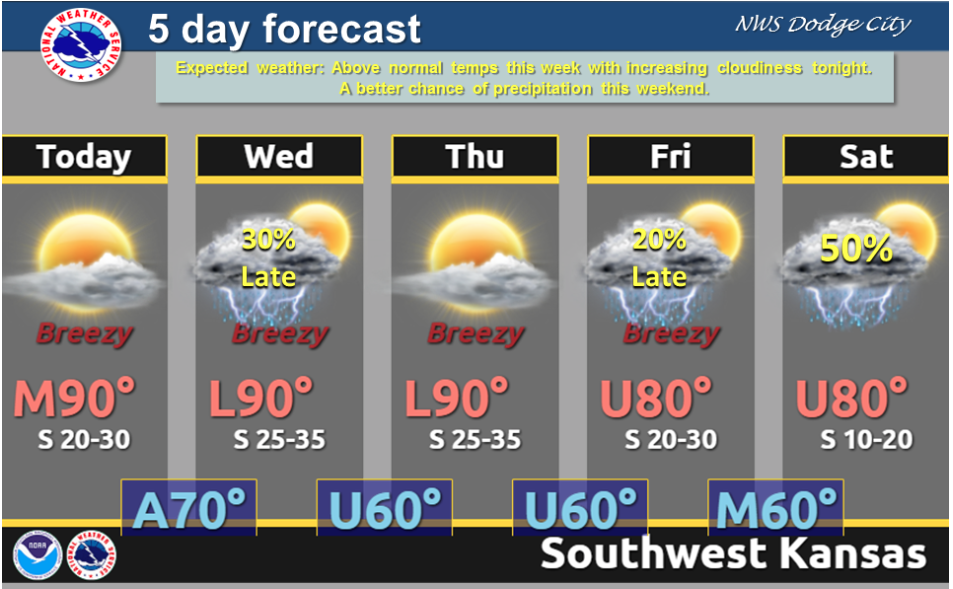
Today Partly sunny, with a high near 92. Breezy, with a south wind 9 to 14 mph increasing to 17 to 22 mph in the afternoon. Winds could gust as high as 34 mph.
Tonight A 30 percent chance of showers and thunderstorms, mainly between 1am and 4am. Mostly cloudy, with a low around 70. South wind around 14 mph.
ThursdayA 10 percent chance of showers and thunderstorms before 7am. Mostly sunny, with a high near 91. Breezy, with a south wind 14 to 21 mph, with gusts as high as 33 mph.
Thursday NightPartly cloudy, with a low around 67. South wind 11 to 16 mph.
FridaySunny, with a high near 90. Breezy, with a south wind 13 to 21 mph, with gusts as high as 31 mph.
Friday NightA 20 percent chance of showers and thunderstorms. Partly cloudy, with a low around 65.
SaturdayA 40 percent chance of showers and thunderstorms. Partly sunny, with a high near 83.
At 3 p.m. on Tuesday, it was 96 degrees in Salina to tie a record for September 20 of 1955. At 4 p.m. on Tuesday it was 95 degrees in Russell to tie a record for the date in 1981.
KANSAS CITY –Five Kansas City area women and one man have been indicted by a federal grand jury for their roles in a marriage fraud conspiracy, according to Tammy Dickinson, United States Attorney for the Western District of Missouri.
Delmar Dixon, 48, Traci R. Porter, 44, her daughter, Tierra Ofield, 23, Stephanie Harris, 21, Shakeisha Harrison, 36, and Kakeland Barnes, 36, all of Kansas City, were charged in a 14-count indictment returned under seal by a federal grand jury on Aug. 31, 2016. That indictment was unsealed and made public Tuesday upon the arrests and initial court appearances of all six defendants.
The federal indictment alleges that Dixon, Porter, Ofield, Harris, Harrison and Barnes participated in a conspiracy beginning in 2007 in which they were paid to marry African nationals so that their spouses could obtain lawful permanent resident status in the United States.
According to the indictment, Dixon arranged marriages between African nationals (from Kenya and Tanzania) and U.S. citizens. Dixon allegedly introduced the African nationals to U.S. citizens who were willing to enter into fraudulent marriages with them, including but not limited to Dixon’s co-defendants.
Dixon allegedly charged the African nationals $1,000 upfront for such introductions. The African nationals were allegedly required to pay the U.S. citizen spouses, including Porter, Harrison, Ofield, Harris, and Barnes, $500 at the time of the wedding, $500 after the completion of the wedding and $250 each month after the wedding until the immigration process was complete.
After the African nationals and U.S. citizen spouses were married, according to the indictment, they filed immigration documents in order to obtain lawful permanent resident status for the African nationals. Conspirators allegedly represented their marriages as valid and legitimate through false statements on immigration forms, including by claiming the couples resided together, and making false and misleading statements about their marriages to federal officials. Dixon coached the African nationals and his co-conspirators on how to make their marriages appear legitimate, the indictment says, advising the couples to get to know each other and make it appear as if they were residing together.
According to the indictment, on Nov. 24, 2015, Harris married a confidential informant working with Homeland Security Investigations (HIS) in Kansas City. (Because the marriage was staged by HSI, it is not legally valid.) From the fall of 2015 until the present, Harris accepted monthly payments from the confidential informant and pressured him for other financial benefits.
On Jan. 23, 2016, Dixon allegedly accepted a payment from an undercover agent working with HSI in Kansas City. The payment was for the introduction of the agent to a potential spouse he could marry for the sole purpose of obtaining immigration benefits for the undercover agent. Dixon introduced the undercover agent to Barnes, who allegedly indicated to the agent that she was willing to enter into the marriage for the sole purpose of obtaining immigration benefits for the undercover agent and that she understood it was just a business transaction. On Feb. 19, 2016, Barnes and Dixon allegedly accepted payments from the undercover agent for their ongoing cooperation in the marriage arrangements. Barnes allegedly accepted another payment from the undercover agent on July 19, 2016.
In another instance cited in the indictment, Porter married a Kenyan national twice. The two had to end their first marriage because a federal investigation revealed the Kenyan national was still legally married in Kenya. Porter and the Kenyan national remarried after his divorce from his prior wife was granted.
In addition to the conspiracy, Dixon, Porter, Harrison and Harris are each charged with one count of marriage fraud.
Dixon, Porter and Harrison are each charged with one count of making a false statement relating to naturalization, one count of unlawfully procuring citizenship or naturalization and one count of false swearing in an immigration matter.
The Voss Advanced Leadership Undergraduate Experience at Fort Hays State University has selected its 2016-2017 scholars.
To complete the program, students will plan and implement a project in either civic/non-profit leadership, corporate leadership or leadership research. Mentors will coach students throughout the academic year. Scholars are awarded a $350 stipend each semester.
VALUE is a year-long, co-curricular experience designed to challenge and develop leadership skills in upperclassmen. The program has two objectives: to teach students how to put ideas in to action and implement, execute and transform a vision into reality; to promote teamwork and collaborative skills in order to be successful.
Applicants must be juniors or seniors in good academic standing who have completed the Leadership Studies certificate and are willing to commit themselves to a deep degree of scholarship and service. Faculty and staff can also make nominations.
Scholars are listed alphabetically by hometown:
Council Grove (66846): Colin McIver is a sophomore majoring in management information systems.
Dodge City (67801): Jarid Malick is a junior majoring in organizational leadership.
El Dorado (67042): Kaylie Towles is a senior majoring in organizational leadership.
Harvard, Neb. (68944): Brianna Schuck is a senior majoring in biology and organizational leadership.
Leavenworth (66048): Megan Rust is a sophomore majoring in organizational leadership.
Liberal (67901): Marisol Regalado is a senior majoring in organizational leadership.
Salina (67401): Rachel Guillot is a junior majoring in organizational leadership.
Taylor Hanus is a junior majoring in organizational leadership.
WICHITA, Kan. (AP) — Kansas agriculture groups have formed a group to push for the lifting of a trade embargo with Cuba.
The Wichita Eagle reports that Engage Cuba’s Kansas State Council includes representatives of the Kansas Wheat Commission, Kansas Soybean Association, Kansas Farm Bureau, Kansas Livestock Association and the Kansas Corn Growers Association.
The state council is part of Engage Cuba, a coalition of private U.S. companies and organizations working to build support for congressional action to end the ban in order to sell more grain and other commodities in Cuba.
Jay Armstrong, past chairman of the Kansas Wheat Commission, said in statement that a level playing field with Canada and Europe is critical for U.S. wheat farmers to fully realize their export potential to Cuba.
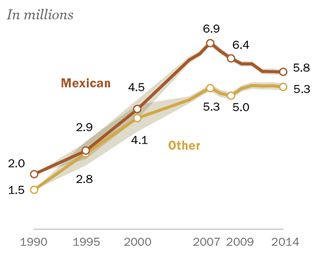
The number of immigrants in the U.S. illegally has changed little since the Great Recession began, dropping to 11.1 million in 2014 from 11.2 million in 2012 and 11.3 million in 2009, according to a study released Tuesday by Pew Research Center.
The population peaked at 12.2 million in 2007. Pew, which reached conclusions by subtracting the estimated number of legal immigrants from census data on the foreign-born, found that a declining number of Mexicans has had a profound impact in parts of the country.
WHERE ARE THEY FROM?
The number of Mexicans in the U.S. illegally has dropped sharply since the Great Recession began to 5.8 million in 2014, unchanged from 2012 but down from 6.3 million in 2009 and a peak of 6.9 million in 2007. Last year, Pew said more Mexicans were returning to Mexico than arriving.
The drop in Mexicans is nearly offset by an increase in Asians, Africans and Central Americans. The number of Central Americans in the U.S. illegally hit 1.7 million in 2014, up 110,000 from 2009. The number of Asians in the country illegally jumped by about 130,000 during the five-year period to 1.4 million, with notable increases of people from India, China, the Philippines and South Korea.
Mexicans still account for 52 percent of people in the U.S. illegally in 2014 down from 56 percent in 2009 but still the largest nationality by far.
WHICH STATES ARE SEEING THE BIGGEST CHANGE?
The number of people in the U.S. illegally dropped in seven states from 2009 to 2014 due to fewer Mexicans— Alabama, California, Georgia, Illinois, Kansas, Nevada and South Carolina. California had the biggest numerical drop, down 190,000 to 2.3 million.
The number of immigrants in the country illegally grew in six states during the same period — Louisiana, Massachusetts, New Jersey, Pennsylvania, Virginia and Washington. Louisiana saw an increase from Mexico. Increases in the five other states were due to higher numbers from countries other than Mexico. New Jersey and Pennsylvania had the biggest numerical increases, up by 50,000 each.
Mexico was still the leading birth country for people in the country illegally in at least 38 states. El Salvador is the leading birth country for those living illegally in the District of Columbia, Maryland and Virginia. The Philippines is the leading source in Alaska and Hawaii. Brazil is the top sender for Massachusetts, India in New Hampshire, and Guatemala in Rhode Island.
Most people in the country illegally lived in six states — California, Texas, Florida, New York, New Jersey and Illinois — in that order. Nevada had the highest share of its population made up of people in the country illegally (7.2 percent), followed by Texas (6.1 percent), California (6 percent) and New Jersey (5.4 percent).
HOW LONG HAVE THEY BEEN HERE?
People in the country illegally are more likely to have been here a long time. That’s particularly true in western states with deeply established Mexican populations.
The median length of time in the country for those in the U.S. illegally was 13.6 years in 2014, up from 7.1 years in 1995.
The median length of time in the U.S. for residents there illegally was 15.6 years in California.
Only five states had a median length of stay shorter than 10 years — Hawaii, Louisiana, Massachusetts, Missouri and Ohio.
Dr. Paul Adams, dean of the College of Education at Fort Hays State University, will present “Proxima b — To Be, or Not to b, a Habitable Planet?” at the Science Café at 7 p.m. Tuesday, Sept. 27, at Gella’s Diner, 117 East 11th St. in Hays.
“Proxima b” features information on the first exoplanets (planets orbiting a star other than the sun) that were found beginning about 20 years ago.
Learn about these giant gas balls and a potentially habitable planet at the presentation.
The presentation, sponsored by FHSU’s Science and Mathematics Education Institute, is free and open to the public.
MANHATTAN, Kan. (AP) – Kansas State coach Bill Snyder is a chameleon when it comes to his offenses, seemingly able to dissect his players in such a way that he can always rebuild them to play to their strengths.
Have a star running back in Darren Sproles? Give him the ball 40 times a game. A prolific passer in Jake Waters and a sure-handed wide receiver in Tyler Lockett? Air it out.
This year, the Wildcats have again focused on their ground game but in a good way.
In their season opener, the Wildcats ran for nearly 100 yards against an eighth-ranked Stanford team that was determined to stop their rushing attack. Charles Jones still averaged more than 5 yards per carry, and Justin Silman and Dalvin Warmack provided different looks when they were in the game.
Kansas State has another tune-up for Big 12 play Saturday night against Missouri State. The program from the Football Championship Subdivision has only allowed 103 yards rushing in a 2-0 start.
It should be another barometer of the Wildcats’ growing ground game.
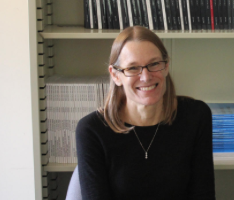
Jean Hall, director of the University of Kansas Institute for Health and Disability Policy Studies, will lead a team of partners from nonprofit organizations and government agencies to improve physical activity, nutrition and oral health for Kansans with disabilities. The team received a $1.5 million grant from the Centers for Disease Control and Prevention for its work. CREDIT ANDY MARSO / HEARTLAND HEALTH MONITOR
By ANDY MARSO
University of Kansas researchers plan to use a $1.5 million federal grant to help Kansans with disabilities catch up to their non-disabled peers in several health categories.
Jean Hall, director of KU’s Institute for Health and Disability Policy Studies, will lead a team of partners from nonprofit organizations and government agencies to improve physical activity, nutrition and oral health for Kansans with disabilities.
Kansas is one of 19 states to get the grants from the Centers for Disease Control and Prevention.
Hall said the CDC required grant recipients to focus some attention on increasing physical activity, and her team members chose nutrition and oral health as the other areas they wanted to address.
“Based on survey data from the state, those are really big issues,” Hall said.
‘A good start’
Research compiled by Hall’s team shows that Kansans with disabilities are five times more likely to report that they had a heart attack than non-disabled peers, and 75 percent are overweight.
Additionally, almost 36 percent of Kansans with disabilities surveyed reported having no dental care in the past year, compared with 23 percent of non-disabled Kansans.
Hall said her group will work with partners like Oral Health Kansas as well as disability caregivers and health care providers to make dental care, healthy foods, and workout facilities and equipment more accessible to Kansans with intellectual and developmental disabilities or physical disabilities that limit mobility.
Todd Brennan, a case manager with Jenian in Johnson County, said focusing on those three areas would be “a good start” for his clients with intellectual and developmental disabilities.
Dental care in particular is elusive for that population, because many Kansans with intellectual and developmental disabilities need to be sedated for treatment. That’s expensive work, and most Kansans with intellectual and developmental disabilities are on Medicaid, which pays about 40 cents on the dollar compared to private dental insurance.
Brennan said Johnson County is down to one dentist who will do it, after the state cut Medicaid reimbursements another 4 percent.
“This is an issue for all types of health care professionals,” Brennan said in an email. “The best doctors, dentists and psychiatrists often will not take a Medicaid patient. We see it all the time.”
Brennan said the grant “sounds encouraging” but predicted Hall’s group would bump up against systemic problems that would make it difficult to provide disabled people the same health care as their non-disabled peers.
For example, Brennan said doctors recently canceled surgery for a client with a broken foot because of her “disruptive behaviors.” He had been trying for months, unsuccessfully, to get that client psychiatric care to address those behaviors.
Dentist shortage a factor
Hall said a general shortage of dentists in the state makes it challenging for Kansans with disabilities to access oral health care, and that will factor into her team’s work.
“There’s not a lot we can do,” Hall said. “We can only work with the providers that are there.”
r several years, Oral Health Kansas has pushed for the Legislature to allow licensing for mid-level “dental therapists” who would be allowed to perform more dental work than hygienists but less than dentists.
The Kansas Dental Association, an advocacy group for the state’s dentists, has opposed the legislation.
Hall said the change might improve oral care for Kansans with disabilities.
“To the extent we could advocate for the mid-level providers, if that were a good solution, we’d certainly do that,” Hall said.
Hall also said low Medicaid reimbursements for dental care are “penny wise and pound foolish” if they reduce access to care because studies have shown that unmet dental needs lead to costly medical problems.
People with disabilities who don’t get proper dental care also are much more likely to suffer oral pain, she said, which limits the foods they can eat.
“That ties back to the nutrition,” Hall said.
Hall said her team will encourage more physicians to ask Kansans with disabilities about their activity level and let them know it’s OK to recommend more activity, just as they would for non-disabled patients.
She said all Kansans have a stake in the success of the five-year grant program.
“If you improve health outcomes for people with disabilities in the state, everyone’s health care costs go down,” Hall said. “It’s pretty simple. And besides, wouldn’t you want your neighbor to be as healthy as you are?”
Andy Marso is a reporter for KHI News Service in Topeka, a partner in the Heartland Health Monitor team. You can reach him on Twitter @andymarso
LAS VEGAS (AP) — A coalition of 21 states is suing the U.S. Department of Labor over a new rule that would make more higher-earning workers eligible for overtime pay.
Nevada Attorney General Adam Laxalt filed the lawsuit in Texas on Tuesday, urging the court to block implementation before the regulation takes effect on Dec. 1.
The measure would repeal the so-called “white collar exemption” and more than double the salary threshold under which employers must pay overtime to their workers.
Laxalt said the rule would burden private and public sectors and represents inappropriate federal overreach.
Officials from the labor department didn’t immediately respond to requests for comment.
Other plaintiffs include Alabama, Arizona, Arkansas, Georgia, Indiana, Iowa, Kansas, Kentucky, Louisiana, Maine, Michigan, Mississippi, Nebraska, New Mexico, Ohio, Oklahoma, South Carolina, Texas, Utah and Wisconsin.
TOPEKA, Kan. (AP) — U.S. Rep. Keith Ellison has introduced federal legislation that would require schools with to provide fuller disclosure of their campus gun laws.
The Lawrence Journal-World reports that the proposed law would require federally-funded universities to publish their gun policies on their websites and in other promotional materials.
Presently, Kansas law allows concealed carry by anyone who is legally eligible to own a gun.
Ellison introduced the legislation after Minnesota resident Marti Priest contacted Ellison with concerns regarding the University of Kansas’ lack of disclosure its campus gun rules. Priest was worried for her son Erik Nelson after a professor disclosed that the school would comply with the states conceal carry law.
University of Kansas officials say they have yet decided what their specific policy will be.
TOPEKA—A rare dairy farm operation in Ellis County, a mid-century parking garage in Wichita, a trail segment in Marion County, and a farmstead in Cowley County are among the latest nominees to the National Register of Historic Places. At its regular quarterly meeting held at the Kansas Historical Society in Topeka on Saturday, August 13, 2016, the Historic Sites Board of Review voted to forward eight nominations to the Office of the Keeper of the National Register in Washington, D.C. There professional staff members will make evaluations. If they concur with the board’s findings, the properties will be included in the National Register. The board also voted to list 10 properties to the Register of Historic Kansas Places, bringing the total number of state register-only properties to 180.
Nominated to the National Register of Historic Places:
Brungardt-Dreiling Farmstead
2567 Golf Course Road, Victoria vicinity, Ellis County
Brungardt-Dreiling Farmstead home
As the most prominent dairy farm operation in the Victoria area, the Brungardt-Dreiling Farmstead is an outstanding example of what the Volga German immigrants achieved after their initial years of poverty and struggle and their entrepreneurial success in both agriculture and business in the Herzog/Victoria area. The house is significant as an excellent local example of Queen Anne architecture. The barn is a fine example of the gambrel-roof barn style that emerged in the 1920s and 1930s. The other farmstead buildings are significant as they contribute to the whole of the farm operation. The period of significance extends from 1903 when Andreas Peter Brungardt purchased the property to 1960 when the farmstead acquired its current appearance.
Donahue’s Santa Fe Trail Segment
Durham vicinity, Marion County
Remnants from the Santa Fe Trail, which was active from 1821 until 1880, Donahue’s Ruts are located near Durham. In Marion County the trail years ended in 1866 with the arrival of the railroad. This trail segment was part of the primary route of the Santa Fe Trail before it split between the Mountain and Cimarron routes farther west. This land saw the majority of traders who followed the route between Santa Fe and Missouri as part of the route connecting two major campsites: Lost Spring and Cottonwood Creek.
Fourth & Broadway Historic District
401-424 N Broadway; 105 & 121 E 4th Street, Pittsburg, Crawford County
Located at a prominent intersection in the center of the town’s original plat, the seven buildings in Pittsburg’s Fourth & Broadway Historic District form one of the most intact concentrations of historic buildings in Downtown Pittsburg. Founded in 1876, Pittsburg’s growth was spurred by coal mining and zinc smelting. By the turn of the 20th century, Crawford County was the largest coal-producing area of the state, and Pittsburg was recognized as the center of the coal region. The historic district includes a pair of large office buildings that were occupied by many prominent mining companies, as well as their financiers and lawyers.
Knightley’s Parking Garage
303 S Broadway, Wichita, Sedgwick County
Upon opening in March 1950, Knightley’s Parking Garage (named for the garage’s manager) was Wichita’s largest garage, providing downtown visitors a place to park and shop or work within a close proximity. Architects Overend & Boucher, with structural engineer George Hartwell, designed the five-story, 500-car garage, embracing the latest technological advances in concrete construction. The garage is a rare surviving example of a Modern style post-war, privately-owned, and attendant-operated garage, in contrast to self-park garages that became dominant in the 1950s. The garage also served as home to the offices of Lauck Oil Company for more than 25 years.
Marysville Union Pacific Depot
Hedrix Avenue, Marysville, Marshall County
Designed by California architect Gilbert Stanley Underwood, Marysville’s Union Pacific Railroad Depot (1928-1929) is located adjacent to the former railyards on 7th Street, two blocks north of the downtown business district. The asymmetrical stucco, brick, and terra cotta building is of the Spanish Revival style. The single story steel-framed building nd is roofed with red clay tiles. The depot is significant for its association with the growth and development of Marysville. Regular passenger service was suspended in 1955, after which time the building continued to house offices for the railroad. The Union Pacific intended to demolish the structure in 2015 but a joint effort between the City of Marysville and the Union Pacific Depot Preservation Society saved it from demolition, and work commenced to restore the building and make it a community asset.
Rosberg-Holmgren-Clareen Block
109-113 N Main Street, Lindsborg, McPherson County
Swedish immigrants constructed the Rosberg-Holmgren-Clareen Block, an excellent example of early permanent commercial structures on Lindsborg’s Main Street. Between these three nearly identical buildings were numerous enterprises, most of which were family businesses that provided essential goods and services to residents for decades. The business owners were active members of the community and all were first or second generation immigrants. The three buildings are Commercial style with Italianate detailing distinguished by their brick corbelling, ornate metal window hoods, cast-iron storefront columns, and wood-framed transoms.
Santa Fe Hospital
600 SE Madison Street, Topeka, Shawnee County
The Santa Fe Hospital Association, founded in 1884, built the existing structure in 1930 to replace a former hospital at this location. The largest of the railroad’s hospitals, the Topeka site not only provided patient care but also served as the association’s home, the railroad’s chief surgeon, and the medical dispensary. The building’s period of significance spans from its construction in 1930 to 1966, reflecting the date of federal legislation creating Medicare and the hospital opening its doors to the public. Renamed Memorial Hospital in 1972 the hospital closed in 1989 after filing for bankruptcy; the last of Santa Fe’s seven hospitals to do so.
Weigle Barn
14097 189th Road, Burden vicinity, Cowley County
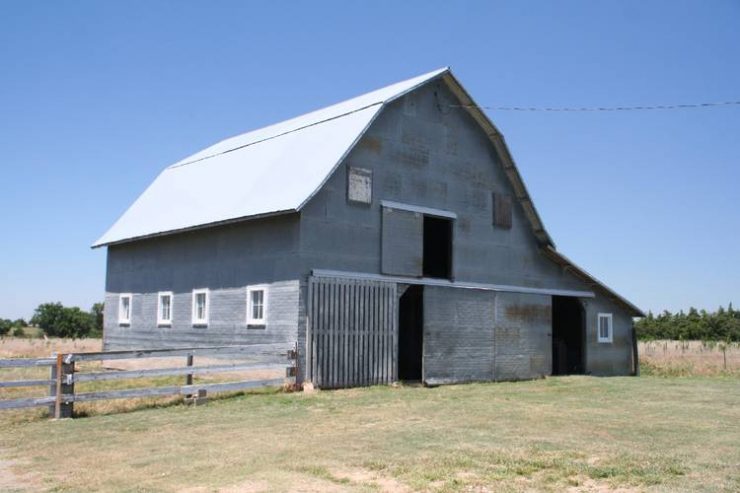
First constructed circa 1890 by Jacob Weigle, the Weigle Barn is an example of early agricultural buildings in Cowley County. The barn is a unique a timber-framed bank barn with a milled-lumber gable-roof addition (circa 1920). The Weigles’ L-shaped barn was constructed to house livestock and store grain and feed. This barn and its associated livestock pens continue to function as the center of farming operations for the Weigle family.
Listed in the Register of Historic Kansas Places:
Cross & Morgan General Store
406 S New York Avenue, Sylvan Grove vicinity, Lincoln County
The Cross & Morgan General Store is the only extant resource from the original town of Sylvan Grove. Established in 1876, Sylvan Grove was best known for its flour mill, which was in business until 1886 when a disastrous Saline River flood destroyed it. The townspeople reestablished Sylvan Grove in its present location one quarter mile to the northeast in 1887 near the soon-to-be constructed Union Pacific Depot. For nearly 10 years (circa 1877 to 1887), the Cross & Morgan General Store supplied the residents of the early town.
Radical United Brethren Church
333 Elmore Street, Lecompton, Douglas County
Lecompton’s United Brethren Church was organized in 1858, and by the early 1880s, it was one of four denominations in the town of approximately 300 people. When the church split from the main denomination in 1889, Lecompton’s congregation of 100 found themselves without a place to gather. As a result the congregation constructed a wooden building in 1892 that burned in 1906. That church was constructed atop the former building’s foundation. This stone building served the local Radical United Brethren congregation through 1927. From 1933 to 2003, this building served as Lecompton’s City Hall and Community Building.
Kansas Power Company Plant
709 W Trail Street, Dodge City, Ford County
Dodge City’s first waterworks and electricity plant began operation in 1886. Beginning in 1890 the two public services were combined and operated out of a single brick building, then relocated in 1897 to an old waterworks building on West Trail Street. Over the next several decades the physical plant evolved in name, function, and form, especially after the city erected a separate waterworks building in 1910 when they took over operation of that service. In 1927 the electricity plant became known as the Kansas Power Company, and by 1932 it gained its current form. It was also in 1932 that a new electricity plant was constructed to the east of Dodge City. The Trail Street plant was used as a reserve facility through the 1990s.
The National Register of Historic Places is the country’s official list of historically significant properties. Authorized by the National Historic Preservation Act of 1966, the National Park Service’s National Register of Historic Places is part of a national program to coordinate and support public and private efforts to identify, evaluate, and protect America’s historic and archaeological resources. Eligible properties must be significant for one or more of the four criteria for evaluation. Properties can be eligible if they are associated with events that have made a significant contribution to the broad patterns of our history. They can be eligible if they are associated with the lives of persons significant in our past. Distinctive construction can qualify properties for the National Register if they embody the characteristic of a type, period, or method of construction, or represent the work of a master, or possess high artistic values, or represent a significant and distinguishable entity whose components may lack individual distinction. Lastly, properties may be eligible for the National Register if they have yielded or may be likely to yield information important in prehistory or history. The National Register recognizes properties of local, statewide, and national significance.
The Register of Historic Kansas Places is our state’s official list of historically significant properties. Properties included in the National Register are automatically listed in the State Register. However, not all properties listed in the State Register are included in the National Register. The same general criteria are used to assess the eligibility of a property for inclusion in the state register, but more flexibility is allowed in the interpretation of the criteria for eligibility.
Related Internet Links:
National Register of Historic Places: nps.gov/nr
Kansas Historical Society (National and State Registers): kshs.org/14638
To read drafts of these nominations and links to photographs, see this link: kshs.org/14633 (This is a temporary link to these documents.)



 high as 34 mph.


 FHSU University Relations and Marketing