ENGLEWOOD, Colo. (AP) – C.J. Anderson is disputing a report that his knee injury will end his season.
The Denver Broncos running back panned a report Thursday from the NFL Network that he had “told people close to him that he’s done for the year.” Anderson angrily denied the report on Twitter but later deleted his comments, saying he would “stay off social.”
Anderson and the Broncos (5-2) are expecting to find out later Thursday the extent of his injury and how many games he’ll miss.
Anderson rushed for 107 yards and a touchdown in Denver’s 27-9 win over Houston on Monday night despite injuring his right knee on his second carry.
Rookie Devontae Booker will start Sunday against the Chargers (3-4).
TOPEKA – Kansas tourism professionals presented several awards at the 2016 Kansas Tourism Conference awards banquet held October 19, 2016 at the Embassy Suites in Olathe, Kan. The Kansas Department of Wildlife, Parks and Tourism (KDWPT) presented the following awards:
Governor’s Tourism Award – Jerry Moran has been a long-time supporter and ambassador of the Kansas tourism industry. He served as the first chair of the Governor’s Tourism Council, leading the way for recognition of tourism’s role in the economic vitality of our state. He has actively supported federal policy encouraging travel and supports ongoing efforts to expand agritourism as an enhanced revenue opportunity for Kansas farmers and ranchers. What’s more, he has visited every county in the state. The award recognizes Kansans for outstanding contributions to the travel and tourism industry and is presented to an individual or group that demonstrates cooperation, sustainability, quality and accountability in their support of the growth of tourism in Kansas.
Kansas Tourism Partnership Award – The 24/7 Travel Stores were honored for requiring that all employees take the “Kansas At Your Service” hospitality training program. The 24/7 Travel Stores front- line staff are typically the first to greet travelers crossing our state and are an important piece to the tourism industry by offering the best service possible. The award recognizes the importance of collaboration in the successful development of tourism in Kansas.
Kansas’ Finest Award – El Dean Holthus, Smith Center , community advocate and proprietor of the Home on the Range Cabin; Tobe Zweygart, St. Francis, historian and tour guide of the Arikaree Breaks; Cheryl Unruh, Emporia, author of Flyover People; Charlie Meade, Dodge City, special duty marshal and walking guide; and Hannah Heatherman, Ottawa, student and Bike Across Kansas committee member. The Kansas’ Finest award recognizes and honors advocates who promote the state’s attributes and maintain an abiding love for the sunflower state, exhibiting passion, perseverance, and pride in promoting destinations with statewide significance and national or international relevance.
“These awards highlight the vital role of dedicated individuals and organizations in growing the tourism industry in Kansas. Through their partnership, Kansas tourism will continue to be a significant part of the state’s economy,” said Linda Craghead, KDWPT Assistant Secretary for Parks and Tourism.
The Travel Industry Association of Kansas (TIAK) also recognized its membership’s top marketing talent. TIAK Marketing Awards focus on overall marketing initiatives and recognize state-level winners only.
People’s Choice: Marysville Convention & Tourism was honored for its first annual Light Up Marysville Christmas lighting contest as an integrated marketing campaign. More than 50 local residences and businesses participated in the event.
In-House Designed Visitor Guide: Visit Wichita won for its 2016 Official Wichita Visitors Guide, designed to be a one-stop, absolute source for guests visiting the city. Visit Topeka received second place with their Visit Topeka Visitor Guide, and Honorable Mention went to Geary County Convention & Visitors Bureau for their Junction City/Geary County Visitor Guide.
Outsourced Visitor Guide: eXplore Lawrence was awarded for its 2015-16 Unmistakably Lawrence Visitor Guide, which integrated the printed guide with digital identity. Merriam Visitors Bureau received second place with their 2016 Merriam Community & Visitors Guide, and Kansas City Kansas Convention & Visitors Bureau received Honorable Mention for their 2016 Kansas City, KS Visitors Guide.
Online Marketing: Visit Topeka was recognized for its redesigned website with its new responsive design that improves mobile functionality and increases social engagement. Crawford County Convention & Visitors Bureau received second place for its redesigned website that reflects the diverse offerings of the destination, and eXplore Lawrence received Honorable Mention for its Social Lounge to increase social media engagement and inspire travel to and within Lawrence.
Integrated Campaign: Emporia Convention & Visitors Bureau was honored for its promotion of the Dirty Kanza 200 Bike Race, increasing awareness and attention to the sport. Kansas City Kansas Convention & Visitors Bureau received second place for their “SelfieMadeSummer” Campaign educating visitors on what there is to do in Kansas City, Kansas, and Kansas Turnpike Authority received Honorable Mention for its K-TAG Campaign to increase usage of its electronic toll collection program.
Print Marketing: Kansas I-70 Association won for its “70 Things to do on I-70” publication, which provided a clean and updated brochure listing attractions, events and things to do along I-70. Wamego Area Chamber of Commerce received second place for their Tourism Rack Card, a two-sided die-cut rack card featuring Wamego attractions and top events, and Visit Wichita received Honorable Mention for their Meeting Planner Guide to combat the lack of knowledge about Wichita within the meetings industry.
Community Awareness: Kansas Turnpike Authority was honored for its 60th Anniversary Video celebrating the good work, achievements and benefits of the Kansas Turnpike. Merriam Visitors Bureau received second place for its 10-year open house celebration of the Merriam Historic Plaza, and eXplore Lawrence received Honorable Mention for its Unmistakably Lawrence Pokemon Go Guide to familiarize locals with the Unmistakably Lawrence brand.
Traditional Multi-Media: Visit Wichita won for the launch of its largest and most comprehensive campaign in its history, emphasizing the reasons to visit Wichita. eXplore Lawrence received second place for its Cradle of Basketball promotional video. There was no Honorable Mention in this category.
“The travel industry is a vibrant part of the Kansas economy and I am very pleased that we were able to honor the creativity of tourism professionals from Goodland to Kansas City, Wichita to Marysville. These individuals work hard every day to promote our state as a destination for visitors and their marketing expertise received some well-deserved recognition through these awards.” said TIAK president Suzan Barnes.
Editor’s note: Reporters from the KHI News Service and the Topeka Capitol Journal collaborated for a six-month exploration of how the state’s legal system deals with people with mental illness. This is one of the stories in a four-day series.
For more than 20 years, the Douglas County jail was almost a second home for Kenneth Brouhard.
The Lawrence man was in and out of the facility nearly 30 times between 1990 and his last conviction for aggravated sexual battery about three years ago.
He might still be trapped in that cycle if not for an intensive mental health treatment program that helped him break it.
“I’ve been in and out of the Douglas County jail since it’s almost been opened (in 1999),” he said. “I didn’t want to be looked at just as a criminal. I just wanted to be done with all my troubles.”
Photo by Jim McLean/KHI News Service Kenneth Brouhard says an intensive mental health treatment program provided while he was in the Douglas County jail helped him break a cycle of crime and incarceration.
Brouhard was fortunate that his encounter with the criminal justice system was in a county that offered such a program for inmates. For many others with mental illness, a county jail was the last place they could expect to find the help they needed.
“Joe,” a Johnson County man who asked not to be identified, was arrested in 2003 after hitting his wife on the back when she tried to pull him out of bed in the morning. At the time, he was being treated for depression.
“My wife had reason to believe when she called 911, she was going to get help getting me to the hospital,” he said.
Instead, he spent 10 days on suicide watch in the county jail. He didn’t start improving until he was discharged for treatment at Shawnee Mission Medical Center.
“The real thing that I look back on is that people who are in mentally perilous positions, especially if they don’t have a lot of resources, they get medication and not much else” in jail, he said.
Treatment and training
County jails have become the default mental health provider in many communities since the 1990s, when Kansas and many other states closed state hospital beds with the idea that people with mental illnesses could be better treated in their communities.
The new system worked well for many Kansans with mental illness, although others struggled to get the help they needed and instead found themselves ensnared by the criminal justice system.
Some Kansas counties are responding to the problem. Douglas County has a standing contract with the Bert Nash Community Mental Health Center in Lawrence to provide mental health care to those in the county jail who need it.
Sgt. Kristen Dymacek, public information officer for the Douglas County Sheriff’s Office, said everyone processed into the jail gets a mental health assessment. Any who exhibit symptoms are then seen by a Bert Nash clinician.
The county also provides special mental health training to its jail staff and sheriff’s officers. The officers are trained to spot symptoms of mental illness so that they can divert people in crisis to treatment rather than charging them with a crime and hauling them to jail, Dymacek said.
Even so, she said, the number of people with mental illness serving time in jail continues to increase.
Brouhard, the Lawrence man who had been in and out of the Douglas County jail since 1990, said the treatment he received while incarcerated was helpful. But it was a more intensive, outpatient program operated by Bert Nash that really made a difference.
After Brouhard was released from jail, staff at the mental health center helped him find housing and buy work boots. They also checked in from time to time, which helped him avoid turning to alcohol again when his symptoms worsened earlier this year, he said.
“If I didn’t have that kind of help, I wouldn’t be here right now,” he said.
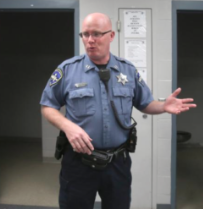
Photo by That Allton/Topeka Capital-Journal Capt. Travis Wright, who oversees the Atchison County jail, says some people with mental illnesses frequently return to the jail. The community doesn’t have many inpatient options for people with mental illnesses.
Like Douglas County, corrections officials in Johnson County have more resources to work with as they strive to improve mental health care and avoid a repeat of what happened to “Joe.”
Robert Sullivan, criminal justice coordinator in the county manager’s office, said the Johnson County Mental Health Center, district attorney’s office and sheriff are examining six years of arrest data. They hope to use the research to keep people with mental illnesses out of jail or at least shorten the time they spend there, he said.
“We find that they stay in jail about twice as long as the general population,” he said. “We’re trying to figure out what those issues are and what levers we can pull.”
The jail pays for a two-week supply of psychotropic medications, which released inmates can pick up at a local pharmacy. Staff also work to set inmates up with an appointment at Johnson County Mental Health Center and to find housing if they need it.
Fewer resources
Some police departments and courts have started programs to avoid arresting people with mental illnesses or to help them avoid incarceration if they comply with treatment orders and other conditions. Those programs are limited to some of Kansas’ largest counties, however, and smaller communities have few alternatives to jail.
Fifty miles from the suburbs of Johnson County, Travis Wright oversees the jail for the Atchison County Sheriff’s Office. He said some people with mental illnesses have been through the county jail so many times that they greet him when their paths cross at the store.
Wright would prefer if the faces weren’t so familiar. Atchison County inmates had an average of 4.6 jail stays in 2014, with some inmates being booked in only once and some returning almost as soon as they were released. Like Brouhard in Douglas County, many of the “repeat customers” have mental health issues that drive them back to the jail over and over again, he said.
“I was shocked at it,” he said. “I couldn’t believe (the average) was that high.”
Unfortunately, Wright said, police and sheriff’s deputies don’t have the resources to reach people before their conditions deteriorate. Mental health care is available in Atchison County, but people who experienced a crisis in the evening or on a weekend have nowhere to turn, he said.
When Wright started overseeing the Atchison County jail 10 years ago, police could take people in crisis to St. Luke’s Cushing Hospital in Leavenworth for inpatient care, Wright said. When that hospital stopped treating involuntary patients, they went to Rainbow Mental Health Facility in Kansas City, Kansas, which now has only eight beds. Right now, the only option is Osawatomie State Hospital, where demand for space is high, he said.
“Getting them to take anybody is like pulling teeth,” he said.
The problem of finding inpatient mental health treatment has been more severe in eastern Kansas than in the western counties, said Sandy Horton, executive director of the Kansas Sheriffs’ Association. Osawatomie State Hospital is only admitting involuntary patients, and some who have court orders for involuntary treatment have waited days in jails or emergency rooms.
Often, law enforcement officials would rather send someone to the state hospital for treatment than charge them with a minor crime, Horton said, but they can’t do so if there isn’t space available.
“I’m hearing a lot of the sheriffs express concern,” he said. “Nobody wants to hold somebody in jail because they have a mental health issue.”
The problem isn’t confined to eastern Kansas, however. Gove County Sheriff Allan Weber said his department contracts with Trego County because it doesn’t have a jail, but was responsible for a man with apparent mental health issues who was arrested for lewd behavior in March. The county attorney had to get a court order to have the inmate committed to Larned State Hospital after he went on a hunger strike, Weber said.
A staff member at Larned State Hospital said the facility couldn’t admit the inmate without an evaluation from a community mental health center, which wasn’t possible because he refused to talk to the mental health staff, Weber said.
Deputies then drove him to a mental health center in Pratt, about 55 miles away, where a different mental health agency determined the inmate was a danger to himself, he said.
“I asked the (Larned) employee to assist us in getting something set up. I was not happy when he stated that it was not his job. I am sorry, but I think that is the wrong answer,” he said. “Trying to help someone with mental health issues, especially if they are incarcerated, is a joke.”
The man only stayed at Larned State Hospital for about a week and returned to finish his sentence, Weber said. After his release, the inmate said he intended to hitchhike to California, and family members have no idea where he has gone or what condition he is in, he said.
“It’s a screwed-up mess,” Weber said.
Varied approach to screenings
No one knows exactly how many inmates in Kansas jails have a mental illness or whether they receive treatment because the state doesn’t track the results of inmate screenings and counties vary in how they approach the issue. The 20 jails that responded to a survey KHI News Service sent to all county jails estimated anywhere from 3 percent to 50 percent of their inmates had a mental illness.
Some facilities, such as the Shawnee County jail, have a standard form asking inmates about signs of serious mental illness, such as feeling hopeless, believing someone is conspiring against them or going long periods without sleep.
Others, however, rely on the inmate to disclose a mental health problem or take action only if inmates appear likely to hurt themselves or others.
Kingman County Sheriff Randy Hill said jail employees monitor inmates for signs but can’t offer treatment because most inmates stay less than 48 hours. Programs are limited to groups like Alcoholics Anonymous and religious services, he said.
Small counties aren’t the only ones that can’t offer all services that inmates may need. All Riley County jail employees have received mental health first aid training, but any mental health treatment that inmates receive there is “minimal,” said Capt. Kurt Moldrup, jail division commander. Inmates with current mental health prescriptions continue to get their medications and some are prescribed new ones, he said, but they don’t have access to other treatments.
“They receive some help through staff, as well as our contracted medical provider who can and does prescribed appropriate psychotropic drugs as needed,” he said.
Kyle Kessler, executive director of the Association of Community Mental Health Centers of Kansas, said most community mental health centers work closely with jails in the areas they serve. A few haven’t been able to offer services because state funding doesn’t cover mental health centers’ work with inmates and not all counties have enough of a tax base to support a partnership, he said.
The state doesn’t fund mental health treatment at the local level, though county jails can bill Medicaid under certain circumstances, such as if an inmate has a severe disability or is pregnant. Most inmates have short sentences, however, giving jail employees little time to arrange reimbursement.
Doug Bonney, legal director of the American Civil Liberties Union of Kansas, said the group has received some complaints about jail inmates not receiving treatment. Sheriffs have said they sometimes didn’t know they needed to provide medication and subsequently agree to get it for the inmate, he said.
“I haven’t run into any sheriffs that say, ‘I don’t care,’” he said. “I have run into some that say, ‘We don’t have any money.’”
‘A new emphasis for us’
Not all counties struggle to fund basic mental health services for inmates, however. Capt. Jared Schechter, commander of the support division in Sedgwick County, said the jail created a mental health management unit about three years ago. The unit has a clinician, registered nurses, social workers and case workers, as well as security staff who are trained in mental health, he said.
In addition to managing medications, the unit’s services include discharge planning and teaching social skills, coping skills, symptom management and basic self-care, if needed. Inmates in the unit have at least three group therapy sessions per week.
“This was a large undertaking and something which was done to create a better environment for our inmates with severe and persistent mental health issues,” Schechter said.
Other counties also have been able to expand their treatment offerings in recent years. Paula Hopkins, who works for Horizons Mental Health Center, provides mental health services at the jail in Reno County. A few years ago, the jail only contracted for mental health care a few hours a week, but that changed to having a full-time clinician when the new jail opened in August 2015, she said.
The partnership allows inmates who already were Horizons clients to continue receiving therapy and medication if they are admitted to the jail, Hopkins said. The mental health center and jail share information so a person who dropped out of receiving mental health services before being arrested can restart them, she said.
They also have made it a standard practice to schedule Horizons clients for a follow-up appointment after they get out of jail, and to give other inmates information about how to make an appointment and get their prescriptions filled, Hopkins said.
“This is a new emphasis for us,” she said.
Some less-populated counties also are trying to keep inmates from coming back. Harvey County Sheriff Townsend “T.” Walton said the jail offers programs such as anger management classes and assistance with resumes and is working on case management for those with more extensive needs.
“This has been an ongoing challenge for lack of funding and available resources,” he said.
Other jails aren’t able to offer so much support. Shannon T. Moore, jail administrator for Coffey County, said employees talk with inmates about the importance of continuing their treatment after release, but the inmates often choose not to do so.
“Staff and counselor try to impress on them how important it is for them to continue counseling and to take their medication,” she said. “However, we have found that they walk out of the facility and quit both and we then get them back into the facility.”
‘Not an answer’
Some question whether efforts to improve care through the jails are missing the point, however. Marion County Sheriff Robert Craft said he is concerned that jails are being pushed to house more inmates with mental illnesses because of budget cuts to mental health treatment and fewer beds in treatment facilities.
Most corrections workers have only limited mental health training, and it isn’t realistic to expect them to become mental health workers, he said.
“Locking those persons in a jail facility only designed, built and staffed to house and control inmates, with no ability to help or to treat the illness is not an answer,” he said. “That path only shifts the burden of care and places an undue liability and expectations on those not qualified or trained to handle the illnesses, in a facility that in most, if not all, cases is not designed or built to provide that care.”
Susan Crain Lewis, president and CEO of Mental Health America of the Heartland, said many people with mental illnesses who are arrested are picked up for relatively minor offenses, such as trespassing or public urination. Some law enforcement agencies are able to divert people to mental health treatment, she said, but jail may be the safest place for the person if treatment isn’t available nearby.
“That is profoundly problematic, that somebody has to be charged to be safe,” she said.
Craft said the state could ease the burden on jails by opening small-scale regional mental health treatment facilities scattered across the state.
It also needs to invest more money in the community mental health centers and supportive services, like housing, Horton said.
“People don’t understand it’s not just medication. That’s just part of it,” he said. “The problem with everything we’re talking about is it all takes money.”
Meg Wingerter is a reporter for KHI News Service in Topeka, a partner in the Heartland Health Monitor team. You can reach her on Twitter @meganhartMC
Neil Biery of Hays passed away Wednesday, October 26, 2016 in Hays.
Funeral services will be 11 AM Tuesday, November 1, 2016 at Brock’s-Keithley Funeral Chapel and Crematory 2509 Vine Hays, KS 67601. Inurnment will be at 2 PM at the Kansas State Veterans’ Cemetery in WaKeeney with military honors courtesy of the Hays VFW.
TOPEKA, Kan. (AP) — The Kansas Supreme Court is weighing the legality of a Kansas City suburb’s so-called “driveway tax” in a case that has statewide implications.
The Lawrence Journal-World reports that the court heard arguments Wednesday about Mission’s approach to raising money for road repairs.
A funding mechanism adopted in 2010 typically generated nearly $800,000 annually. It based collections on the number of vehicles coming and going from a property, including homes and businesses in the northeast Johnson County city of about 9,500 people.
The key issue is whether it’s a fee, as the city argues, or a type of tax that cities are generally barred from imposing under Kansas law. The legal challenge comes from the Heartland Apartment Association Inc., which represents apartment owners and managers in the state.
NEW YORK (AP) — Federal regulators have approved new broadband privacy rules that make internet service providers like Comcast and Verizon ask customers’ permission before using or sharing much of their data.
The Federal Communications Commission’s measure was scaled back from an earlier proposal, but was still criticized by the advertising, telecommunications and cable industries.
Cable and phone companies want to grow revenue from ad businesses of their own, and the new rules could make doing that more difficult.
They say it’s confusing and unfair that the regulations are stricter than the Federal Trade Commission standards that digital-advertising behemoths such as Google and Facebook operate under. The FCC does not regulate such web companies.
FCC officials passed the rules on a 3-2 vote, its latest contentious measure to pass on party lines.
Police on the scene of Wednesday’s shooting-photo courtesy KAKE
WICHITA, Kan. (AP) — Authorities say a man has been fatally shot during an argument in a strip mall parking lot.
Police Lt. Nikki Woodrow said in a statement that the shooting happened late Wednesday afternoon. The Wichita Eagle reports that witnesses told police that two men argued before the victim was shot in the chest and the right leg. He was taken to a Wichita hospital, where he was pronounced dead.
Police say the suspect left in a vehicle with California tags. The vehicle was recovered later but the suspect wasn’t immediately arrested.
PHOENIX, Ariz. – Former Fort Hays State standout defensive back Nathan Lindsey has signed to play for the Arizona Rattlers of the Indoor Football League in 2017. Lindsey played two years at FHSU from 2013 to 2014.
Following his senior year, Lindsey signed as a free agent with the Detroit Lions. After the Lions released him in 2015, he has enjoyed time in arena football with both the Cleveland Gladiators and Cedar Rapids Titans. For the 2016 season with Cedar Rapids, he had 28 tackles, three interceptions, and two forced fumbles.
Lindsey was an All-Super Region 3 and All-MIAA selection at Fort Hays State during his senior year when he had 41 tackles and three interceptions. He added a kick return for a touchdown that year, averaging 41.5 yards per return on four attempts. As a junior he had 44 tackles and one interception.
LAWRENCE — The University of Kansas has endorsed applications for five students for prestigious fellowships for study in the United Kingdom.
Jesse Burbank, Abigail Fields, Shegufta Huma and Kevin Tenny are applying for the Marshall Scholarship; Huma, Tenny and John (Ike) Uri are also applying for the Rhodes Scholarship.
“To spend time with these students is inspirational and uplifting,” said Bryan Young, director of the KU Honors Program. “We have exceptional students at the University of Kansas, and we are fortunate to have the faculty and staff who are dedicated to their intellectual growth.”
Marshall Scholarships provide funding for graduate study at any university in the United Kingdom, while the Rhodes Scholarship provides expenses for one to three years of study at the University of Oxford in England.
Regional panels review applications for both scholarship programs. Finalists are invited to participate in interviews in November.
KU students have previously won nine Marshall and 26 Rhodes scholarships. The nomination process is coordinated by the Office of Fellowships & Scholarships in the University Honors Program.
John (Ike) Uri is the son of Larry and Therese Uri of Concordia. Uri is majoring in sociology with minors in economics, philosophy and Russian business communication. Uri’s involvement at KU includes serving as the executive director of the Center for Community Outreach and as a volunteer coordinator for the Plymouth Language Program. He has worked as a research assistant for the DeBruce Foundation in Kansas City and has served as a regular contributor to the Midwest Voices panel in The Kansas City Star. A member of the University Honors Program, he was also selected for the prestigious University Scholars Program in 2015.
Jesse Burbank is the son of Lt. Col. Jeffrey and Leslie Burbank of El Paso, Texas. Burbank is a triple major in economics, history and political science. Burbank’s involvement at KU includes the Model UN, the Red Cross Club and the Student Senate Elections Commission. A member of the University Honors Program, he participated in the 2015 “London Review” Study Abroad program. During the past two summers, he interned in the office of Kansas State Attorney General Derek Schmidt.
Abigail Fields is the daughter of Amy and Marko Fields of Minneapolis, Minnesota. Fields is majoring in ecology and evolutionary biology and French. A member of the University Honors Program and the Global Scholars Program, she has served as co-president of the campus environmental group Environs and a member of the campus Sustainability Leadership Board. Fields’ interests lie in sustainable urban agriculture, and she has completed the Permaculture Design Certificate through the Kansas Permaculture Institute.
Shegufta Huma is the daughter of Mohammad Anwar and Anjuman Ara of Bel Aire. Huma is majoring in political science and minoring in Spanish. Huma’s involvement at KU has included Student Senate, the Women of Color Collective, the Muslim Student Association and Margaret Amini Scholarship Hall. A member of the University Honors Program, she was also selected for the prestigious University Scholars Program in 2015. In spring 2016 she interned with Washington, D.C., with the Leadership Conference on Civil and Human Rights.
Kevin Tenny is the son of Robert and Karen Tenny of Leawood. He is majoring in chemical engineering and has worked in the labs of Professor Michael Detamore and Professor Trung Nguyen at KU. In addition, he has completed two summer National Science Foundation Research Experience for Undergraduates programs at Iowa State University and at the University of South Carolina and a third internship at the Massachusetts Institute of Technology. His research goals are focused on electrochemical engineering. He is a member of the KU Student Senate. A member of the University Honors Program, he has received KU certifications in Service Learning, the Global Awareness Program and the Research Experience Program. In 2016, he was named a Goldwater Scholar.
Eagle TV and FHSU’s Sternberg Museum of Natural History again are teaming up to offer the Halloween Spooktacular.
The event will be from 2:30 to 4 p.m. at the museum, and will be hosted by Eagle’s Scott Boomer and Mike Koerner. The parade of costumed trick-or-treaters will be replayed on Eagle Ch. 14 and also available on DVD.
There will be candy and flashlights — and complimentary toothbrushes, as well, provided by Lifetime Dental Care of Hays.
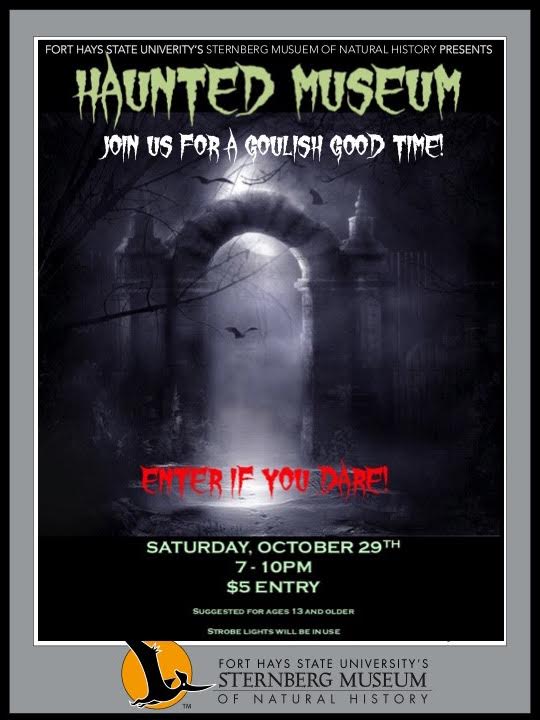
With Halloween weekend comes ghoulish good times, and Fort Hays State University’s Sternberg Museum of Natural History will be adding some fright to your weekend with the Haunted Museum.
The Haunted Museum will last 7 to 10 p.m. Saturday and is open to the public with a $5 entry fee. Ian Trevethan, Sternberg Museum Outreach Coordinator emphasized this is not an event for little kids.
“If we are going to do a haunted house … we’re going to do it right,” Trevethan said. “We’ve had kids in the past half to stop halfway through because they could not handle it.”
Because of the depth of spookiness involved in the Haunted Museum, the age recommendation is for ages 13 and older.
“We are going to utilize what we have, we have dinosaurs, we have skeletons, we all ready have spooky sounds, and all the lights will be off,” Trevethan said.
This year’s Haunted Museum is different from last year’s, which was the second most successful Haunted Museum in the history of the event according to Trevethan.
“Last year, I got a lot of feedback and most of it was positive, but some critiques were that it was not that scary,” Trevethan said.
Last year Trevethan said they went with an over arching theme of “Gotham” based of the DC Comics life of Batman.
“If you really weren’t a nerd, you just really didn’t get it so we had to change it,” Trevethan said.
This year, Trevethan left it in the hands of the four FHSU student groups to decided their own themes.
“Every theme is different,” Trevethan said. “I’ve heard American Horror Story Freak Show, Walking Dead and Five Nights at Freddy’s — so its more than just your typical zombies.”
The FHSU student groups participating are the FHSU Biology Club, Halo, Circle K International, and US4U. Each group has 15 representatives helping out with the Haunted Museum.
“The idea was to let the students get involved more,” Trevethan said.
The Haunted Museum will be the scariest its been, he added.
“With the route, we feel we can give the people the experiences that they want in a haunted house,” Trevehan said. “Almost every floor that is used is used to its entirety.”
After the tour is completed, people will be able to vote for which FHSU student group had the scariest stop on the tour.
For those with medical conditions, strobe lights and fog machines will also be in use.
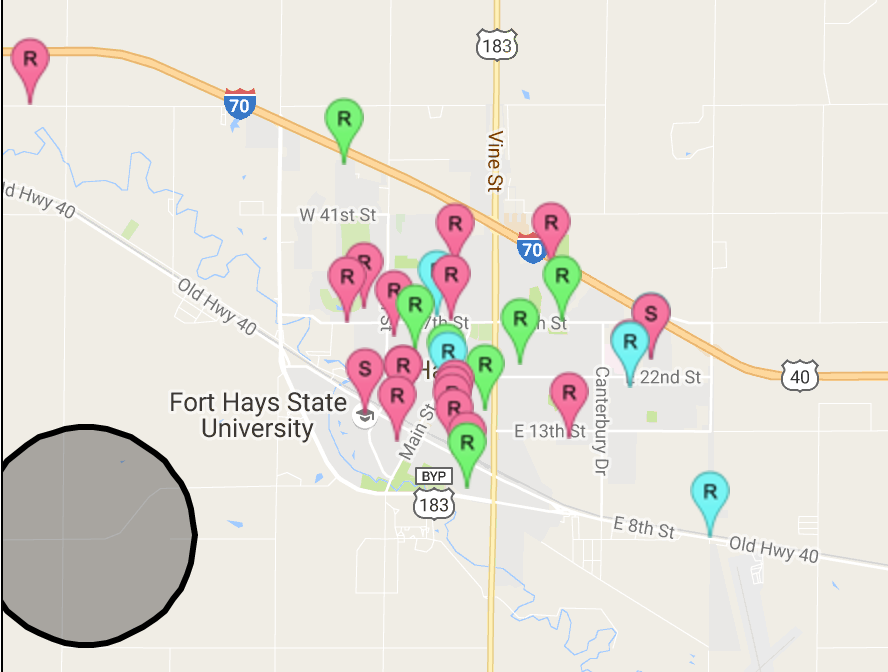
TOPEKA – The Kansas Bureau of Investigation advises parents to perform a check for registered offenders in their neighborhoods, and areas their children plan to trick-or-treat, prior to Halloween festivities.
Parents and guardians can search online at www.kbi.ks.gov/registeredoffender to determine where registered offenders reside. The site allows searches within three miles of an address for registered sex offenders, drug offenders and other violent offenders. You can also perform searches by name, zip code and county, or sign up to receive alerts if an offender registers in your community.
The Kansas Offender Registration Act (KORA) does not prevent registered offenders from participating in any Halloween activity unless they are on parole or probation and it is specifically restricted. Registered offenders are able to pass out candy, decorate their houses, wear costumes, and attend any festival, party or parade. However, schools, churches, malls and other private properties may have their own stipulations prohibiting offender participation.
Approximately 11,000 offenders are registered in Kansas and live and work among our communities. While being aware of the offenders near your home, school or workplace is good practice, being mindful of your surroundings and remaining vigilant is equally as important.
The KBI offers these additional tips:
– An adult should accompany children at all times, especially if trick-or-treating at unknown residences.
– Children should not enter residences or structures of individuals unknown to them.
– Teens and older children should stay in groups, and be instructed to check in frequently with a parent or guardian.
– If out after dark, carry flashlights or wear reflective clothing.
– Ensure candy is in its original packaging before allowing children to eat it.
Halloween should be an enjoyable time for families, though safety must also be a priority.







 Neil Biery of Hays passed away Wednesday, October 26, 2016 in Hays.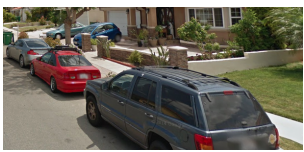






 John (Ike) Uri is the son of Larry and Therese Uri of Concordia. Uri is majoring in sociology with minors in economics, philosophy and Russian business communication. Uri’s involvement at KU includes serving as the executive director of the Center for Community Outreach and as a volunteer coordinator for the Plymouth Language Program. He has worked as a research assistant for the DeBruce Foundation in Kansas City and has served as a regular contributor to the Midwest Voices panel in The Kansas City Star. A member of the University Honors Program, he was also selected for the prestigious University Scholars Program in 2015.
 Jesse Burbank is the son of Lt. Col. Jeffrey and Leslie Burbank of El Paso, Texas. Burbank is a triple major in economics, history and political science. Burbank’s involvement at KU includes the Model UN, the Red Cross Club and the Student Senate Elections Commission. A member of the University Honors Program, he participated in the 2015 “London Review” Study Abroad program. During the past two summers, he interned in the office of Kansas State Attorney General Derek Schmidt.
 Abigail Fields is the daughter of Amy and Marko Fields of Minneapolis, Minnesota. Fields is majoring in ecology and evolutionary biology and French. A member of the University Honors Program and the Global Scholars Program, she has served as co-president of the campus environmental group Environs and a member of the campus Sustainability Leadership Board. Fields’ interests lie in sustainable urban agriculture, and she has completed the Permaculture Design Certificate through the Kansas Permaculture Institute.
 Shegufta Huma is the daughter of Mohammad Anwar and Anjuman Ara of Bel Aire. Huma is majoring in political science and minoring in Spanish. Huma’s involvement at KU has included Student Senate, the Women of Color Collective, the Muslim Student Association and Margaret Amini Scholarship Hall. A member of the University Honors Program, she was also selected for the prestigious University Scholars Program in 2015. In spring 2016 she interned with Washington, D.C., with the Leadership Conference on Civil and Human Rights.
 Kevin Tenny is the son of Robert and Karen Tenny of Leawood. He is majoring in chemical engineering and has worked in the labs of Professor Michael Detamore and Professor Trung Nguyen at KU. In addition, he has completed two summer National Science Foundation Research Experience for Undergraduates programs at Iowa State University and at the University of South Carolina and a third internship at the Massachusetts Institute of Technology. His research goals are focused on electrochemical engineering. He is a member of the KU Student Senate. A member of the University Honors Program, he has received KU certifications in Service Learning, the Global Awareness Program and the Research Experience Program. In 2016, he was named a Goldwater Scholar.