Now, whether you are a fan of Democratic former Kansas Gov. John Carlin or not, he last week provided a little common-sense campaign advice that you have to hope all candidates for the Legislature are taking seriously.
Because while it is important for Democrats, it is probably more important for Republicans, especially those seeking seats in the House.
His advice: Tell the voters you make your pitch to for a vote for House or Senate that the state’s budget/tax/education problems aren’t going to be solved in just one or two sessions of the Legislature.
That’s from a guy who has experience running a state as governor (1979-1987), as a House member (1970-1979) and running the Kansas House of Representatives as its Speaker for two of those years. Oh, and he’s been politically tumble-dried a time or two so he is also very practical. He knows government from the inside and outside.
His advice to candidates—especially for the House—is that all of them, presumably Democratic first, but also Republicans (though he obviously favors the moderate Republicans who vote along with Democrats on occasion) tell voters that the state’s fiscal and other problems aren’t going to be fixed in two years, and that voters ought to realize that there are going to be some uncomfortable votes ahead.
He’s undoubtedly right. The budget shortfalls, the taxation of Kansans, providing adequate state aid for public schools, providing health care for poor Kansans and their children—these aren’t issues that can be wrapped up quickly. Not during one two-year House term, and probably not in the first three, or maybe even four, years of a State Senate term.
So, the newly elected lawmakers do their best, changes tax rates that thousands of Kansans (those LLCs, farmers and the self-employed) are going to wince about—but know need to be raised or at least imposed—and get voted out of office after one term?
That’s a possibility, and one that Carlin thought that candidates ought to explain to their voters.
Now, let’s see what needs to be done.
The tax experiment that Gov. Sam Brownback supported apparently hasn’t worked. The state didn’t see a dramatic economic boost through exempting more than 300,000 of us from state income tax. The school finance issue has essentially frozen spending on educating the kids. The highways…well, they’re apparently third-best in the nation, but it’s hard to know how long that is going to last. And, health care for the state’s poor is going downstream, and hospitals in western Kansas are in financial jeopardy.
Lots to fix, and there’s probably more, but the fixes aren’t going to be easy or politically popular when for most Kansans and probably most Americans politicians get graded on what the tax bill adds up to.
The focus will, of course, be on those two-year House terms, because about the time the state starts seeing fiscal/governmental daylight, those newly elected members will stand for re-election.
Anyone figure that we’re going to see bumper stickers in 2018 reading “I’m nearly done raising your taxes, so re-elect me to the House”? Probably not.
But it’s clear that fixing a government that has been rolling downhill for the past four years isn’t going to be done quickly; there are going to be good decisions and bad decisions and anyone expecting a two-year fix is probably over-optimistic.
So, how does this work out? Hard to say whether voters now are ready to see that their newly elected House and Senate members are going to inconvenience them for at least two years and ought to get second terms.
After all, when’s the last time you asked for two dates?
Syndicated by Hawver News Company LLC of Topeka; Martin Hawver is publisher of Hawver’s Capitol Report—to learn more about this nonpartisan statewide political news service, visit the website at www.hawvernews.com.
TOPEKA, Kan. (AP) — Kansas officials have voted to approve $33,000 for the settlement of a wrongful death lawsuit filed after a man died at a small lake northwest of Hays.
The Topeka-Capital Journal reports that 65-year-old Tony Bieker and his wife were staying at Antelope Lake in July 2011.
Authorities say Tony’s boat became stuck at least 50 yards from shore. He was unable to dislodge the boat and decided to wait for daylight to flag down help.
A Kansas Department of Wildlife, Parks and Tourism officer arrived during the night and ordered Bieker to get his boat out of the water. Bieker unsuccessfully tried to get the boat free and began swimming to shore, but only made it halfway before going under. Bieker was pronounced dead at a hospital.
Bieker’s wife filed a lawsuit against the state and the officer. The State Finance Council voted to approve the $33,000.
ENID, Okla. – Colton Bobek led the Fort Hays State Men’s Golf team at the Ranger Invitational at Meadowlake Golf Course with a two day score of 149 (75, 74). The seven over par was good enough for a three way tie for 10th-place.
Dalton Ayers finished 17th overall for FHSU with back-to-back scores of 77 for a total of 154. Marcus Wiley also posted mirrored scores on day one and day two as he shot 80 on each day and came in 25th overall. Jake Weller come in tied for 26th overall with scores of 84 and 79, while Issiah Grover rounded out the scoring for the Tigers with rounds of 84 and 80.
Host school Northwestern Oklahoma State claimed the team title with a combined two day score of 589. University of the Southwest took the runner up spot shooting 591, and South Dakota School of Mines took third overall with a score of 596. The Tigers missed the top five by four strokes as they came in sixth with a team score of 626.
Brock Ehlers from South Dakota School of Mines took home the individual crown with a two day score of 141.
By Randy Gonzales
FHSU University Relations and Marketing
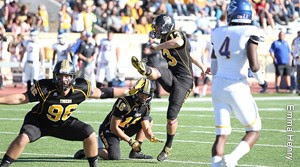
HAYS, Kan. — Former Tiger placekicker Drew O’Brien, the all-time leading scorer in Fort Hays State football history, has signed to play the 2017 season with the Salina Liberty, a member of Champions Indoor Football, a 16-team professional league. A Hays native and graduate of Thomas More Prep-Marian High School, O’Brien will reunite with former Tiger teammates linebacker Brock Long and running back Edward Smith, returnees from the Liberty’s inaugural season this past spring.
O’Brien, a four-year starter for the Tigers, broke FHSU’s 49-year-old school scoring record in the eighth game of his senior season. He finished his career with 244 total points and is on the top 10 list of numerous kicking and punting categories at FHSU. In 2015, O’Brien and Long were members of a record-setting Tiger team that qualified for postseason action for the first time in 20 years. Fort Hays State finished 8-4 to tie the school record for most wins in a season.
After setting single-season records of 171 tackles and 21.5 tackles for loss at FHSU last fall, Long went on to lead the CIF in tackles per game during the Liberty’s indoor spring season. Smith last played for the Tigers in 2014, when he led the team in rushing. In his first season with the Liberty, Smith was fourth in yards per catch among CIF players.
The CIF represents an area that stretches across the mid-United States from Michigan to New Mexico and from North Dakota to Texas. The Liberty is a member of the Central Division along with the Dodge City Law, the Wichita Force and the Duke City Gladiators out of Albuquerque, N.M.
MANHATTAN, Kan. (AP) — The committee searching for Kansas State University’s next president has selected 15 candidates to interview for the position.
The Manhattan Mercury reports that 81 people applied for the position. Regent Dennis Mullin, who heads the Kansas Board of Regents’ committee, says the number of applicants and the number of qualified candidates were higher than expected.
Mullin says he hopes the committee can select someone in early November or by Thanksgiving Day at the latest.
Former president Kirk Shulz announced in March that he was leaving the university to become the president of Washington State University. An interim president has been serving since late May.
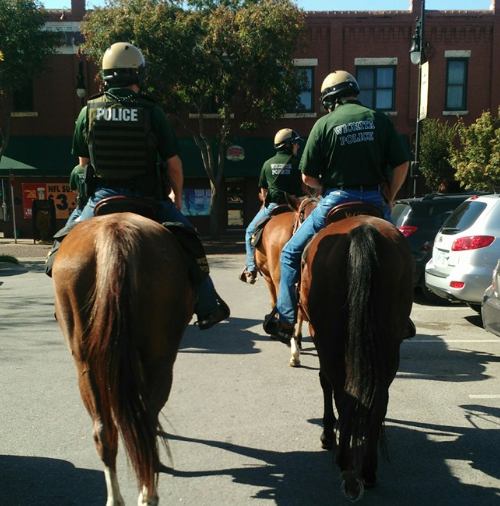
Wichita Police Department Mounted unit in Old Towne- photo Wichita Police
WICHITA, Kan. (AP) — Authorities are seeking a Wichita woman who is accused of nearly hitting a group of mounted police officers.
The Wichita Eagle reports that a collision was narrowly avoided early Sunday when the woman exited a parking lot in the city’s Old Town district at a high rate of speed.
Wichita police Sgt. Wendell Nicholson says the mounted officers tried to stop the woman’s Jeep at a stoplight but the woman sped past officers. Nicholson says one of the officers was forced to back his mounted horse so he would not be struck by the vehicle speeding past them.
Police are seeking the woman on suspicion of aggravated assault of a law officer.
The Fort Hays State football team is once again receiving votes in the latest American Football Coaches Association poll released Monday. The Tigers picked up six votes after their win over Missouri Western Saturday. They were the second highest vote getter two weeks ago before losing to Washburn.
Northwest Missouri State remains No. 1 with Emporia State jumping up two spots to No. 10. The Hornets host the Tigers Saturday at Welch Stadium.
Central Missouri is the highest team receiving votes not in the rankings.
Rank
School (1st votes)
Rec.
Pts.
Prev.
Week 8
Next Game
1.
Northwest Missouri St. (30)
8-0
750
1
D. Lindenwood (Mo.), 47-12
Oct. 29 vs. Pittsburgh St. (Kan.)
2.
Grand Valley St. (Mich.)
8-0
717
2
D. Hillsdale (Mich.), 35-17
Oct. 29 vs. Findlay (Ohio)
3.
Shepherd (W.Va.)
7-0
692
3
D. Concord (W.Va.), 21-7
Oct. 29 at West Liberty (W.Va.)
4.
Sioux Falls (S.D.)
8-0
649
6
D. Concordia-St. Paul (Minn.), 51-17
Oct. 29 at Minnesota St.
5.
Harding (Ark.)
8-0
614
7
D. East Central (Okla.), 35-7
Oct. 29 vs. Southwestern Oklahoma St.
6.
California (Pa.)
7-0
598
8
D. Gannon (Pa.), 35-14
Oct. 29 at Mercyhurst (Pa.)
7.
North Alabama
5-1
541
10
D. North Greenville (S.C.), 52-21
Oct. 29 at Delta St. (Miss.)
8.
Texas A&M-Commerce
6-1
540
9
D. Angelo St. (Texas), 62-14
Oct. 29 vs. West Texas A&M
9.
Ashland (Ohio)
7-1
507
11
D. Kentucky Wesleyan, 70-14
Oct. 29 at Michigan Tech
10.
Emporia St. (Kan.)
7-1
448
12
D. Pittsburg St. (Kan.), 41-36
Oct. 29 vs. Fort Hays St. (Kan.)
11.
LIU-Post (N.Y.)
8-0
432
14
D. American International (Mass.), 22-7
Oct. 29 vs. Pace (N.Y.)
12.
Indiana (Pa.)
6-1
414
13
D. Clarion (Pa.), 42-17
Oct. 29 at Gannon (Pa.)
13.
Midwestern St. (Texas)
6-1
361
4
Lost to West Texas A&M, 35-27
Oct. 29 vs. Texas-Permian Basin
14.
Valdosta St. (Ga.)
6-1
350
16
D. Delta St. (Miss.), 56-27
Oct. 29 at Florida Tech
15.
Azusa Pacific (Calif.)
7-1
325
17
D. Simon Fraser (B.C.), 57-0
Oct. 29 vs. Central Washington
16.
Assumption (Mass.)
7-1
285
18
D. New Haven (Conn.), 38-24
Oct. 29 at Stonehill (Mass.)
17.
Tuskegee (Ala.)
6-1
258
5
Lost to Kentucky St., 10-9
Oct. 29 at Central St. (Ohio)
18.
North Carolina-Pembroke
7-1
253
20
D. Catawba (N.C.), 41-31
Oct. 29 at West Virginia St.
19.
Wayne St. (Mich.)
7-1
221
22
D. Saginaw Valley St. (Mich.), 42-14
Oct. 29 at No. 22 Ferris St. (Mich.)
20.
Fairmont St. (W.Va.)
8-0
201
23
D. Virginia-Wise, 58-3
Oct. 27 vs. No. 25t Notre Dame (Ohio)
21.
Minnesota-Duluth
7-1
174
24
D. No. 21 Bemidji St. (Minn.), 54-47
Oct. 29 at Minnesota-Crookston
22.
Ferris St. (Mich.)
6-2
115
25
D. Lake Erie (Ohio), 42-10
Oct. 29 vs. No. 19 Wayne St. (Mich.)
23.
Newberry (S.C.)
7-1
98
NR
D. Brevard (N.C.), 34-7
Oct. 29 vs. Lenoir-Rhyne (N.C.)
24.
Wingate (N.C.)
7-1
55
NR
D. Carson-Newman (Tenn.), 29-16
Oct. 29 at North Greenville (S.C.)
25t.
Notre Dame (Ohio)
7-1
27
NR
D. West Liberty (W.Va.), 30-14
Oct. 29 at No. 20 Fairmont St. (W.Va.)
25t.
Southwest Baptist (Mo.)
7-1
27
NR
D. St. Joseph’s (Ind.), 61-37
Oct. 29 vs. Missouri S&T
Dropped Out: Henderson St. (Ark.) (15), Florida Tech (19), Bemidji St. (Minn.) (21).
Others Receiving Votes: Central Missouri, 20; Colorado School of Mines, 19; Henderson St. (Ark.), 19; Edinboro (Pa.), 8; Bemidji St. (Minn.), 7; Central Washington, 6; Fort Hays St. (Kan.), 6; West Alabama, 5; Florida Tech, 4; Southern Arkansas, 2; Colorado Mesa, 1; Truman St. (Mo.), 1.
KANSAS CITY, Mo. – Fort Hays State had two of the three MIAA Football Athletes of the Week named on Monday. Both earn the distinction for the second time this year as Sie Doe, Jr. was named the Defensive Athlete of the Week and Brandon Brown was named the Special Teams Athlete of the Week.
Sie Doe, Jr. had another big weekend with 11 tackles, two sacks, and a forced fumble in Fort Hays State’s 35-27 win over Missouri Western. With the two sacks, Doe tied the single season record at FHSU now with 12 on the season. His record-tying sack was a big key to the win, forcing a fumble on the sack that FHSU recovered with 8:25 to go in the game. The Tigers scored a touchdown just two plays later to gain breathing room with a 28-19 lead. He was one of four Tigers to reach double figures in tackles for the game.
Brown averaged 43.5 yards per punt in the 35-27 win for Fort Hays State over Missouri Western. He punted eight times with two resulting in drives starting inside the 20 and three resulting in touchbacks. His longest punt of the game was a 78 yarder for a touchback, tying the second-longest punt in FHSU history. He averaged 54.4 yards on kickoffs with three touchbacks, and went 5-of-5 on extra-point conversions.
Garrett Fugate of Central Missouri was named the Offensive Athlete of the Week, joining Doe and Brown for the weekly honors.
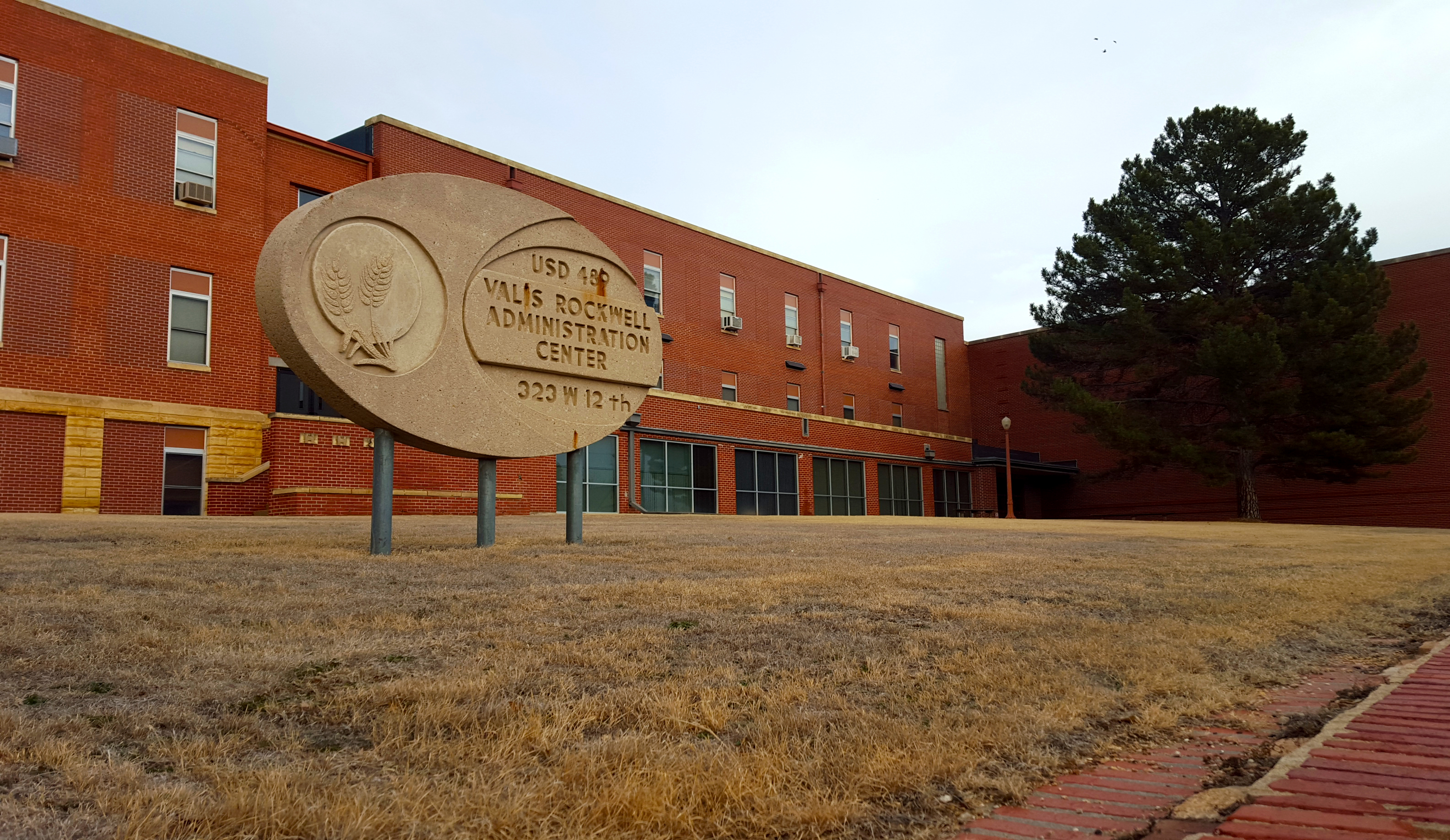
At 6:30 p.m. Monday at the Rockwell Administration Center, the Hays USD 489 Board of Education will review the presentations that three architectural firms presented to the board during last week’s special board meeting.
The board heard from Hollis and Miller; Schaefer, Johnson, Cox, Frey Architectural Firm; and DLR Group on Oct. 17 as each firm made a 35-minute presentation on how they would get a bond issue to pass for USD 489 after last June’s bond election failed.
Each firm had prior experience of having successful bond elections, which prompted the board to bring them in for their presentations.
Hollis and Miller focused on how the company is 100-percent focused on education; SJCF focused on why bonds are not successful; and DLR showed what they can bring to the table that the other firms cannot.
The board will review each of the presentations before speaking with the firms again about returning to Hays for another presentation.
Also up for discussion will be the request proposal for the Hays High School HVAC system, which was drawn up by Integrated Consulting Engineers Inc.
Hays High School is in need of a total HVAC replacement, district officials have said.
Also on the agenda:
The board will vote on the Hays High roof storm repair bid
Let Eagle Communications take you to Paw Patrol LIVE in Topeka on Wednesday, Nov. 30.
You can win four tickets to the show so everyone in your family can enjoy. You can expect singing, dancing, clapping, and joining in — Paw Patrol needs YOU to be a part of the show!
Editor’s note: Reporters from the Topeka Capital-Journal and KHI News Service collaborated for a six-month exploration of how the state’s legal system deals with people with mental illness. This is the first in a four-part series.
Photo by Derek Pinkston Complaints of underfunded and overcrowded facilities date back to the establishment of the first state asylums in Kansas. Kansas policymakers “grudgingly” appropriated $500 in 1866 to build the state’s first asylum in Osawatomie.
America has a long history of criminalizing mental illness.
Well into the 20th century, courts, not clinicians, committed people with mental disorders to state hospitals, where too often they were warehoused and received little if any meaningful treatment.
A report written in 1948 for the Kansas Board of Health titled “A Study of Neglect” concluded that “a seriously mentally ill person (in Kansas) is almost a criminal before the law.”
The report — written by Harry Levinson, a psychologist of national stature who began his career at the Menninger Clinic, and two colleagues — also noted that more than one-third of the approximately 46,000 Kansans who had entered state mental health hospitals between 1866 and 1946 had died in them.
The Levinson report and another issued about the same time by a special commission formed by former Kansas Gov. Frank Carlson that included Dr. Karl Menninger prompted the first of several sweeping reforms of the state hospitals and the mental health system in Kansas.
Today, the system is inarguably better as a result. But as this series of stories, “Mental Health on Lockdown,” to be published over the next several days illustrates, many Kansans with mental illness continue to find themselves ensnared in a criminal justice system that is largely ill-equipped to provide them with the treatment that they need.
Photo by Derek Pinkston The Osawatomie State Hospital campus includes gravestones marked with numbers. A report written in 1948 for the Kansas Board of Health noted that one-third of the approximately 46,000 Kansans who had entered state mental health hospitals between 1866 and 1946 had died in them.
Financial and human cost
The criminalization of mental illness is a both a national and state issue.
In Governing magazine, Jane Wiseman, director of a nonprofit government and management consulting firm, recently asserted that “America’s jails are the central address for the mentally ill.”
She and co-author Stephen Goldsmith, a former Indiana district attorney and deputy mayor of New York who now teaches at the Harvard Kennedy School of Government, provided evidence to back up their assertion.
“There are 10 times more people with mental illness in the criminal justice system than are being treated in psychiatric hospitals,” Wiseman and Goldsmith wrote. “As a society, we pay an extremely high financial and human cost for criminalizing behavior better addressed by diversion into mental health treatment. Incarceration costs for those with mental illness run from 60 percent to 20 times higher than those for other inmates.”
Kansas taxpayers are helping to foot that bill. Medical and mental health care spending made up $53 million of the $194 million Kansas Department of Corrections fiscal year 2015 budget.
An estimated 37 percent of inmates in the state prison system have a mental disorder, up more than 120 percent since 2006, according to Viola Riggin, director of health care services for KDOC.
The number of inmates diagnosed with severe and persistent mental illness also is going up, Riggin said, noting that the treatment they receive has improved greatly since inmates brought a series of lawsuits against the state in the 1970s seeking better mental health care.
“There was a tendency to simply lock them down,” said Bill Rich, a professor at the Washburn University School of Law who represented inmates in some of those lawsuits.
Today, county jails in Kansas also have become de facto mental health treatment centers. About 20 percent of the inmates serving time on any given day in the Johnson County jail have some kind of mental illness, according to Sheriff Frank Denning.
“I have been running the largest mental health hospital in the state of Kansas,” he said in an interview about mental health courts for this series.
Sheriffs in several smaller counties say they don’t have the resources to emulate Denning. They’re struggling to handle the increasing numbers of people with mental illness in their jails.
In addition to county jails, many hospital emergency rooms have become repositories for Kansans with severe mental illness waiting for an open bed at Osawatomie State Hospital, which was forced to restrict admissions in 2014 due to staff problems and to reduce its capacity in 2015 to make renovations ordered by federal inspectors.
At the same time, millions of dollars in state budget cuts over successive years have hindered the ability of community mental health centers to respond to the growing crisis.
History of neglect
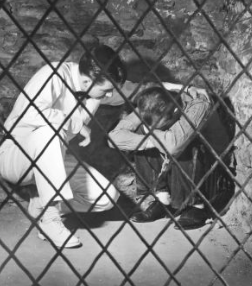
Photo by Kansas State Historical Society By the early 1950s, Kansas had gone from last in per capita spending on treatment for mental illness to near the top of state rankings. Throughout 1960s and 1970s, with the reputation of the Menninger Clinic growing, Kansas was seen as a national leader in mental health.
Complaints of underfunded and overcrowded facilities date back to the establishment of the first state asylums in Kansas. The 1948 report for the state board of health briefly recounted the history, noting that Kansas policymakers “grudgingly” appropriated $500 in 1866 to build the state’s first asylum in Osawatomie. But from the day it opened, the six-room facility lacked the space to care for the growing number of “broken” Kansans in need of help, according to the report.
“Slowly the state stirred to meet its responsibilities — always slowly, always too late,” the report said of the construction a second asylum in Topeka in 1879 and a third in Larned in 1913.
Eventually, the report said, “the state belatedly agreed its institutions should not be asylums, but hospitals, and that a determined effort should be made to cure the mounting number of patients.”
But that commitment was short-lived, according to the report, which described the failure of state leaders to sustain it in colorful and unequivocal language.
“There was ever a reluctance on the part of consecutive, uniformly dispassionate legislatures to grant funds to meet even the most urgent needs,” it said. “At times the hospitals were allowed to become political footballs, staffed by incompetents, mired in the filth of political corruption and rocked by scandals. There was no money to pay decent help, to build adequate buildings. There was only money enough to give them meager sustenance so that they could continue to be burdens to the state, useless to themselves, and a continuing sorrow for their troubled families.”
Then, as now, many in need of mental health treatment “languished in jails” while awaiting admission to overburdened state hospitals, according to the report.
Stung by the reports and a flood of critical newspaper stories, Kansas lawmakers in 1949 heeded Carlson’s call to nearly double what the state was spending on its state hospitals for people with mental illness.
“The condition of our state hospitals with respect to equipment, medical care, humane custody, sanitation and personnel requires immediate positive action,” Carlson said as justification for his $15 million request, which would be about $150 million today when accounting for inflation.
“The original scope of our mental hospitals was limited almost entirely to the custodial care and confinement of the insane,” he said in his annual budget message to lawmakers. “But recent advances in the field of psychiatry and modern methods of treatment for the mentally ill give new hope to those afflicted. Their return to useful active life in the state and community is desirable from every standpoint.”
Carlson’s reform initiative resulted in rapid improvements thanks largely to a partnership between the state and the Menninger Clinic, then in Topeka, which expanded its psychiatric training program and assigned students to work rotations in the state hospitals to gain clinical experience.
Dr. Roy Menninger, a former president and chief executive of the Menninger Foundation, said the initiative helped create a “model for psychiatric training that was gradually assimilated by medical schools all over the country.”
By the early 1950s, Kansas had gone from last in per capita spending on treatment for mental illness to near the top of state rankings. Throughout 1960s and 1970s, with the reputation of the Menninger Clinic growing, Kansas was seen as a national leader in mental health.
But starting with the lawsuits filed in the 1970s over the quality of mental health care in state prisons and continuing through the 1980s, much of that progress was lost. A sweeping reform bill that the Kansas Legislature passed in 1990 aimed to reverse that slide by emphasizing treatment in a growing network of community mental health centers over that provided in state hospitals.
However, that commitment also wasn’t sustained.
David Johnson was named chief executive of the Bert Nash Community Mental Health Center in Lawrence in 2001. By that time, he said, “it had already been years since the state grants had been increased.”
With the reform bill, lawmakers intended to use the money saved from closing state hospitals to instead boost community mental health centers. But that funding increase wasn’t sustained.
Repeating history
The reforms of the early 1990s accelerated the trend toward deinstitutionalization. Since then, the closure of Topeka State Hospital and the shuttering of psychiatric units at several private hospitals have eliminated approximately 5,000 mental health beds.
People in the mental health field acknowledged that many of those acute-care beds were no longer needed. But Roy Menninger and others said some of that lost capacity was needed to backstop community treatment centers that weren’t prepared to care for patients with severe mental illness displaced by the changes.
“The system wasn’t ready for that, especially the seriously ill patients. So they were not adequately treated from the very beginning,” Menninger said.
A series of funding cuts in recent years exacerbated by another $30 million reduction this year have further hindered the ability of community mental health centers to provide adequate care to severely ill patients.
“Over the last several years it’s seemed to me that we have had a slow dismantling of the mental health system across Kansas,” said Tim DeWeese, executive director of the Johnson County Mental Health Center.
It also seems that way to Lenexa Police Capt. Wade Borchers. His officers are encountering more people with mental illness engaging in antisocial if not criminal behavior.
“The ones that get left holding the bag, really, are law enforcement,” Borchers said. “And we are not getting people (with mental illness) the help like we did 10 to 15 years ago. That’s just a bottom-line fact.”
Police and sheriff’s departments in higher-populated, urban Kansas counties are attempting to proactively deal with the issue by putting their officers through an intensive training program where they learn how to defuse encounters rather than allow them to escalate into situations that result in arrests and jail time. But many smaller departments can’t take advantage of training because they don’t have enough staff to cover for officers who must take up to a week off to participate.
Awareness of the problem is growing among state and local officials. Tim Keck, interim secretary of the Kansas Department for Aging and Disability Services, is working to regain federal certification for Osawatomie State Hospital and restore approximately $1 million in monthly Medicare payments.
Also, in a year in which many state budgets were cut, Kansas lawmakers approved salary increases for state hospital workers in an attempt to help KDADS solve chronic staffing problems at the institutions.
Still, advocates and mental health providers caution that a piecemeal approach won’t solve the problems, which are longstanding and systemic. They say nothing short of a comprehensive and adequately funded set of reforms, such as those spelled out in a 2015 report from a special committee to the KDADS secretary, will do the job.
Jim McLean is executive editor of KHI News Service in Topeka, a partner in the Heartland Health Monitor team.

 Now, whether you are a fan of Democratic former Kansas Gov. John Carlin or not, he last week provided a little common-sense campaign advice that you have to hope all candidates for the Legislature are taking seriously.