Claudia Rae Cook, age 72, of Great Bend passed away Thursday, October 20, 2016 in Great Bend.
Arrangements are pending with Brock’s-Keithley Funeral Chapel and Crematory 2509 Vine Hays, KS 67601.
Claudia Rae Cook, age 72, of Great Bend passed away Thursday, October 20, 2016 in Great Bend.
Arrangements are pending with Brock’s-Keithley Funeral Chapel and Crematory 2509 Vine Hays, KS 67601.
Maxine Joyce Roudebush, age 70, of Hays passed away Monday, October 17, 2016 in Hays. She was born October 13, 1946 in Warren, Pennsylvania to Gairld and Mary (Bischoff) French. She married Thomas Roudebush January 11, 1973 in Westminster, California.
Maxine was a homemaker and had worked as a Nurse’s Aide as well.
She is survived by her husband, Thomas of Hays; three sons, Sam Hull and wife Judy of Hays, John Santana and wife Tammi of California and Thomas Roudebush and wife Kris of Wichita, Kansas; a daughter, Terri Rice and husband Larry of Sapulpa, Oklahoma; two brothers, Gary French of Idaho and Ron French of California as well as numerous grandchildren and great grandchildren.
She was preceded in death by her parents; a daughter, Mary Rice and a sister, Janet Jones.
Private family services will be held at a later date with arrangements in care of Brock’s-Keithley Funeral Chapel and Crematory 2509 Vine Hays, KS 67601.
Condolences may be left by guest book at www.keithleyfuneralchapels.com or emailed to [email protected].

KSHS
FORT HAYS—Through first person portrayals, visitors can learn how the people of Fort Hays lived and died. They can also discover more about local legends like Elizabeth Polly, known as the Blue Light Lady, when Fort Hays State Historic Site presents Graveside Conversations.
This popular annual event will be held at Fort Hays from 7:30 to 10 p.m. Saturday, October 29. Reservations are required. To schedule contact (785) 625-6812 or [email protected]. Admission is $3 adults, $1 students. Kansas Historical Foundation members and children five and younger admitted free.
Fort Hays is located at 1472 U.S. Highway 183 Alternate, Hays. For more information, visit kshs.org/fort_hays.
Fort Hays State Historic Site is one of 16 state historic sites operated by the Kansas Historical Society, a state agency.
 Kansas Corporation Commission
TOPEKA — The Cold Weather Rule, designed to help Kansans who are behind on their utility payments avoid disconnection during the winter months, begins Nov. 1 and remains in effect through March 31.
“The Kansas Corporation Commission encourages Kansans who are past-due on their utility bills and at risk for disconnection to prepare for the colder weather by contacting their utility company to make the necessary payment arrangements,” said Commission Chairman Jay Scott Emler.
The Cold Weather Rule, first enacted by the Commission in 1983, prevents or limits utility companies from disconnecting a customer’s natural gas or electric service during periods of extreme cold. Utility companies are prohibited from disconnecting a customer’s service when temperatures are forecast to be at or below 35 degrees over the next 24 hours. In addition, the rule requires utility companies to offer a 12-month payment plan to allow consumers to maintain or re-establish utility service.
Any residential customer with a past due balance will qualify for payment arrangements under the Rule. However, it is the customer’s responsibility to contact the gas or electric company to make those arrangements.
Payment plan conditions to maintain or restore service require that customers agree to pay 1/12th of the total amount owed, 1/12th of the current bill, the full amount of any disconnection or reconnection fee, plus any applicable deposit to the utility. The remaining balance must be paid in equal payments over the next 11 months, in addition to the current monthly bill.
The Cold Weather Rule applies only to residential customers of electric and natural gas utility companies under the KCC’s jurisdiction. More information about the Cold Weather Rule may be found at https://kcc.ks.gov/pi/cwr_english.htm.
Kansans may also contact their local utility company or the KCC’s Office of Public Affairs and Consumer Protection at (800) 662-0027.
 KDWPT
KDWPT
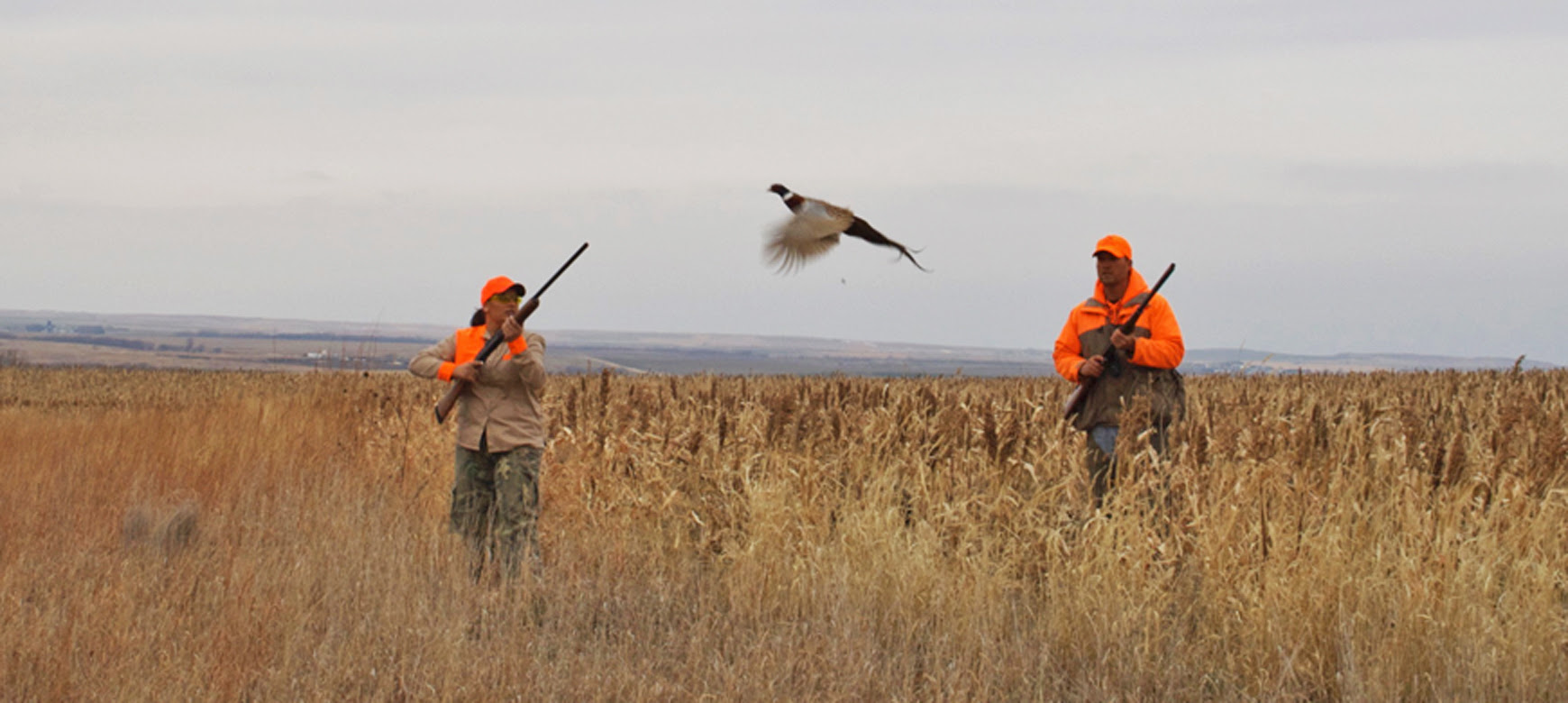
PRATT – Hunting prospects for the 2016-2017 upland bird seasons are better than they’ve been in years. After years of severe drought, precipitation over the last two years has restored habitat conditions and, in many areas, provided ideal nesting and brood-rearing conditions for pheasants and quail. Bird hunters ready to plan a hunting trip this fall should look no further than www.ksoutdoors.com, where they’ll find the official “2016 UplandBird Hunting Forecast,” the “2016 Kansas Hunting Atlas” and the “2016 Kansas Hunting and Furharvesting Regulations Summary.” All can be viewed online and/or downloaded. A printed version of the forecast is available at all KDWPT offices, and printed versions of the atlas and regulations summary can be found wherever licenses are sold.
Pheasant and quail numbers were much better last year than in previous years, but overall harvest was still below average. After reviewing data gathered through various field surveys this spring and summer, biologists are predicting this improving trend to continue. Bird numbers may be spotty due to low breeding bird numbers in some areas last spring and local weather conditions this summer, but overall, prospects are good.
Best pheasant hunting will be found in northwest and southwest regions of the state. The best quail hunting, which in some areas could be better than we’ve seen in many years, will be found in the southcentral and southwestern regions of the state. More specific information can be found in the complete forecast online at www.ksoutdoors.com, click on “Hunting” then click on “Reports and Forecasts.”
By clicking on “Where to Hunt,” hunters can view the 2016 Kansas Hunting Atlas, which shows locations of all state and federal public wildlife areas, as well as the more than 1 million acres enrolled in the Walk-in Hunting Access program.
All licenses and permits can also be purchased online by clicking on “Licenses and Permits,” and they are available over the counter at all KDWPT offices and more than 600 vendors across the state. Resident hunters age 16-74 are required to have a hunting license to hunt pheasants and quail, unless exempt by law. All nonresident hunters must have a nonresident hunting license, unless they are hunting on land they own.
The Kansas pheasant and quail seasons open Nov. 12, 2016 and close Jan. 31, 2017. The daily bag limit for pheasants is four roosters with a possession limit of 16. The daily bag limit on quail is 8 per day and the possession limit is 32. Start planning now because opening day will be here before you know it.
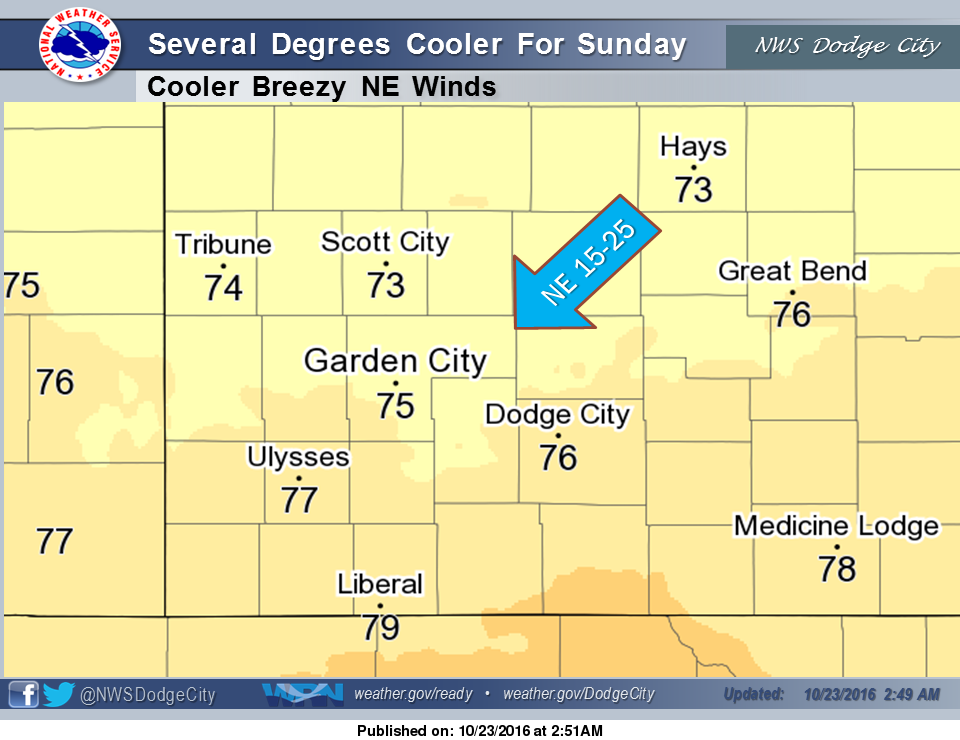
 Dry conditions remain in the forecast to end the weekend across the region, and today looks to once again have plenty of sunshine. A cold front working through the area will usher in north winds across the area, with high temperatures this afternoon in the 70s.
Monday will be similar to today. An upper level disturbance moving through the region Tuesday into Tuesday night will bring a chance for some showers. Temperatures are expected to remain in the 70’s though the entire week.
Today: Sunny, with a high near 73. West wind 6 to 15 mph becoming northeast in the afternoon.
Tonight: Clear, with a low around 43. East northeast wind 5 to 8 mph.
Monday: Sunny, with a high near 74. East northeast wind 6 to 13 mph becoming southeast in the afternoon.
Monday Night: Partly cloudy, with a low around 55. South wind around 9 mph.
Tuesday: Partly sunny, with a high near 81. South wind 9 to 16 mph, with gusts as high as 26 mph.

By ANDY MARSO
Judy Talbot is trying to get her daughter out of a state facility for Kansans with intellectual and developmental disabilities. Zack Zbeeb is trying to get his son into one.
But both ultimately have the same goal: to do a “medication washout” to determine whether the prescription drugs their autistic kids take are helping to control their recent dangerous psychotic episodes or actually causing them.
Zbeeb, from Wichita, wants his 15-year-old son to be weaned off his medications at a place like Parsons State Hospital and Training Center.
“We felt this was an appropriate place for my son to be in a 100 percent structured setting,” Zbeeb says.
Talbot got her 32-year-old daughter into a state facility, the Kansas Neurological Institute, in August after her daughter spent a week strapped to a bed in a hospital emergency room.
She thought KNI might be able to do a medication washout. Instead her daughter has received mainly nursing care, not the kind of specialized attention needed to adjust her medication regimen.
“She’s been there all this time and hasn’t seen a psychiatrist,” Talbot says.
Talbot and Zbeeb’s children both fall into a care gap for Kansans with a combination of developmental disability and mental health issues.
Providers on both sides say they’re ill-equipped to care for people with that combination of ailments, especially given cuts to Medicaid, which is one of the main sources of health insurance for people with developmental disabilities and mental illness.
Advocates for Kansans with developmental disabilities say they’re often excluded from mental health treatment facilities based on assumptions that they won’t be able to participate in counseling.
Zbeeb and Talbot both say the default treatment has been to medicate their children with various antipsychotic drugs, and both believe the drugs may be doing more harm than good at this point.
Eric Atwood, a psychiatrist at the Family Service and Guidance Center in Topeka, says that’s possible. Medications often are added during times of acute psychosis, he says, so as people begin taking multiple drugs “you end up with a complicated regime and it’s very difficult to know what’s doing what.”
A 2011 study found that people taking more than one antipsychotic medication were less likely to have a bad reaction to a medication washout than they were to the addition of another antipsychotic.
A medication washout might be the right call in some cases, Atwood says. But it’s not a decision that should be taken lightly.
“The question is, is it appropriate to clear the slate and see how one functions without any medication,” Atwood says. “That is always a very individualized decision between the patient and/or their caregivers and the treatment team.”
A new approach
Zbeeb says his family and his son’s caregivers have agreed that he should try a medication washout and that Parsons is the right place to wean his son off the medications and try a new approach. But Parsons, KNI and the state’s two mental health hospitals in Osawatomie and Larned are considered providers of last resort.
Amerigroup, the company that administers his son’s Medicaid coverage under KanCare, has told him his son must first try a psychiatric residential treatment facility, or PRTF, before the state facilities. There are about a dozen PRTFs across the state that provide inpatient rehabilitation for children and adolescents with mental health problems.
Zbeeb says he called one such facility, Prairie View in Newton, and was told his son could not be admitted because his IQ was too low. Employees there also said they would not do a medication washout.
He thinks he can get his son admitted at a different facility, Lakemary Center in Paola, but it has a waiting list and he fears Lakemary will not keep his son long enough to wean him off his medications.
“When you want to take off these medications, you cannot do it in a short period of time,” Zbeeb says, adding that it could take five to seven months.
Atwood says Lakemary is unique as a PRTF that specializes in treatment for children with developmental disabilities coupled with psychiatric illness.
He was not surprised to hear Zbeeb’s son might have to wait months to get in.
“We’ve had waiting lists for virtually all of the PRTFs,” Atwood says.
Looking for answers
Because of age restrictions, Lakemary and the other PRTFs are not a fit for Talbot’s daughter.
At KNI she has around-the-clock support and the care of a team that includes nurses, psychologists and behavioral technicians — but no psychiatrist, which is the medical specialty with the most expertise in antipsychotic medications.
KNI and Parsons serve Kansans with intellectual and developmental disabilities. Osawatomie State Hospital and Larned State Hospital serve Kansans with severe and persistent mental health problems.
Talbot says KNI employees have been unwilling to try to “reset” her daughter’s medications. She says her daughter would see a psychiatrist from outside the facility soon and Talbot would explore making a medication washout part of her plan to transition back to her home.
“I just don’t want to be thrown out there and have the same thing (happen),” Talbot says, referring to her daughter’s extended emergency room stay in August.
Eric Harkness, president of the Kansas chapter of the National Alliance on Mental Illness, is a former psychiatric pharmacist who has taken antipsychotic medications himself.
Harkness says any change in antipsychotic medication should be done in close consultation with a physician or an advanced practice registered nurse.
“It is my understanding that if an antipsychotic medication is improperly discontinued or stopped, a psychotic rebound is highly likely,” he says.
A medication washout should be done by slowly eliminating only one medication at a time, he says, while taking note of dosage, what time of day it was taken and any changes in mood or behavior.
While a medication washout can be done at home, an inpatient facility is a better setting, Harkness says.
Access to such facilities in Kansas is limited, especially for adults with intellectual or developmental disabilities. A new 72-bed hospital in Olathe, Cottonwood Springs, opened last year.
But that’s the exception. Kyle Kessler, executive director of the Association of Community Mental Health Centers of Kansas, says there has been an “incredible reduction of inpatient community beds” in recent years as hospitals close psychiatric units in favor of more profitable services like oncology.
Talbot says she plans to work with her daughter’s KanCare company, Sunflower Health Plan, to find a medication solution for her daughter. Sunflower Health Plan partners with a subcontractor, Lifeshare, which specializes in caring for people with developmental disabilities.
Lifeshare uses a program called Pathways designed to help people with disabilities live independently, in part by managing their emotional and behavioral health.
Andy Marso is a reporter for KHI News Service in Topeka, a partner in the Heartland Health Monitor team. You can reach him on Twitter @andymarso
 KDWPT
KDWPT
TOPEKA–According to research done for the Kansas Department of Wildlife, Parks and Tourism (KDWPT), travel and tourism in the Sunflower State continued a six-year growth trend with solid gains during calendar year 2015. Visitation moved upward to 35.4 million, a gain of 900,000 over 2014 and equivalent to everyone from Texas, Nebraska and Missouri visiting Kansas once a year.
Traveler spending increased to $6.5 billion in 2015, about what all Americans spent on food for July 4th and $261 million more than 2014. Lodging expenditures, food and beverage sales and retail spending showed the strongest growths. The figures are based on a report by Tourism Economics, a company that specializes in analyzing and reporting on economic impacts of tourism.
“The variety of attractions and experiences in our state increasingly have become destinations for non-residents and visitors from many foreign countries,” said Linda Craghead, KDWPT Assistant Secretary for Parks and Tourism. “Not only that, Kansans themselves are awakening to our amazing opportunities to travel and enjoy the many things the great Sunflower State has to offer. The benefits to our economy are enormous. If our tourism industry were a single business, it would rank #402 on the Fortune 500 list.”
When indirect and induced impacts are included, Kansas travelers in 2015 generated $10.4 billion in total business sales. The growth of travel spending has averaged 5.5% per year since 2009, a total increase of $1.8 billion. Kansas travelers directly and indirectly sustained 94,126 jobs in 2015, with a combined income of $2.9 billion.
The benefits of tourism extend to state and local governments, as well. Tourism-supported direct and indirect tax revenues in 2015 surpassed $1 billion and included $588 million in state and local governmental revenues. Of the $272 million in state revenues, $186 million accrued from sales tax collections. Local governments received $316 million in tax receipts from travel-generated activity. If the state and local tax revenues from visitor activity were absent, each Kansas household would need to pay $525 to replace those revenues.
Tourism Economics, an Oxford Economics Company, conducted an economic impact study of tourism in Kansas using the most current data from 2014.
BARTON COUNTY –Two people from Russell were injured in an accident just after 8:30p.m. on Saturday in Barton County.
The Kansas Highway Patrol reported a 1997 Toyota Avalon driven by Jonathan A. Mikail, 38, Kansas City, was northbound on U.S. 281 four miles west and ten miles north of Hoisington.
The Toyota hit a deer that in the roadway.
The deer was thrown into the windshield of a southbound 2008 Chevy Silverado driven by Arthur R. Budig, 49, Russell,
Budig and a passenger Stephanie A. Budig, 43, Russell, were transported to Clara Barton Hospital.
Mikail and two additional passengers in the Silverado were not injured.
All were properly restrained at the time of he accident, according to the KHP.

LAWRENCE, Kan. (AP) — A 27-year-old Kansas man faces charges after his 9-month-old stepdaughter was abandoned in Lawrence.
The Kansas City Star reports that Marquis Young is charged in Douglas County with attempted first-degree murder and child abuse. He is also accused of violating his probation.
Police said Young was the stepfather of a 9-month-old girl found abandoned the morning of July 7 in an apartment complex trash receptacle in Lawrence.
The baby spent almost two weeks in the hospital before she was released into state custody.
Young is being held on a $100,000 bond. His next court appearance is Oct. 27.
NEW YORK (AP) — AT&T is buying Time Warner, owner of the Warner Bros. movie studio as well as HBO and CNN, for $85.4 billion in a deal that could shake up the media landscape.
The merger combines a telecom giant that owns a leading cellphone business, DirecTV and internet service with the company behind some of the world’s most popular entertainment. It’s the latest tie-up between the owners of digital distribution networks — think cable and phone companies — and entertainment and news providers, one aimed at shoring up businesses upended by the internet.
The deal would make Time Warner the target of the two largest media-company acquisitions on record, according to Dealogic. The highest was AOL’s disastrous $94 billion acquisition of Time Warner at the end of the dot-com boom.
 EMPORIA, Kan. (AP) — A former Emporia driving school instructor faces charges accusing him of sexually abusing a teenager.
The Emporia Gazette reports that Robert L. Jones of Emporia was charged this week in Lyon County court with aggravated sexual battery of a 16-year-old. The criminal complaint says the alleged crime occurred in August.
Jones has been fired from his position as director of an Emporia driving school, which was has also been shut down.
Jones’ next court appearance is scheduled for Nov. 14.
A phone number for a lawyer listed for Jones rang unanswered Saturday.
By Jeremy McGuire
Hays Post
The TMP Lady Monarch Volleyball team is making their second straight trip to state. TMP defeated Southwestern Heights, Hugoton and Lakin to punch their ticket. Further details to come later this evening.