Ella Mathilda (Deines) Fabrizius was born January 15, 1918 to David and Elisabeth (Dietz) Deines on the family homestead in rural Barton County near Galatia, Kansas. She died October 1, 2016 at Trego County Lemke Memorial Hospital Long Term Care at the age of 98.
Ella was baptized March 17, 1918 and was confirmed in 1932 at St. Paul’s Lutheran Church in Galatia. She attended Barton County Public School (Haig) in Galatia receiving her 8th Grade diploma May 28, 1931. In 1938, she moved with her parents to rural Trego County where she joined Zion Lutheran Church at Trego Center and worked for neighbors, caring for children, cooking, washing, cleaning, and milking. She married Rubin Fabrizius, at Zion, October 12, 1941, and they began their family and farming/ranching operation. Rubin was inducted in to the United States Army on October 28, 1942 and was honorably discharged October 7, 1945. During these years Ella alternated living with her parents and Rubin’s parents 6 months at a time with their first child Ruben Gene (born August 20, 1942) until he returned.
Ella spent the next 57 years as a homemaker, farming and ranching with Rubin, south of WaKeeney, until their retirement in 2002 moving to WaKeeney. Those years were filled with work, family and worship. She was a member of Zion Lutheran Ladies Aid, now WELCA, Society of Germans from Russia, and a lifetime member of Trego County Lemke Memorial Hospital Auxiliary.
Ella was an accomplished seamstress and cook. Her butterscotch pie was equal to her sister-in-law and closest friend Helen who she loved to visit with over the telephone, always speaking in German. She had a sweet way of endearing herself to others and was known and loved as “Aunt Ella” to a great many nieces and nephews and loved children, especially babies. Ella was a self-taught beautician who cut, permed, “finger-waved”, curled and braided the hair of all her family members. She sewed countless beautiful clothes for herself and her family including elegant prom dresses for her daughters, and loved looking at pattern books and envisioning how they would be fashioned with fabric choices. She also enjoyed quilt making and embroidery, but her greatest treasure was her family.
Ella was a devoted wife and mother, mother-in-law, grandmother, great-grandmother and great-great-grandmother, her legacy of kindness, hard work, honesty, loyalty, faith, generosity and love of family is unsurpassed, and she leaves beautiful memories of a long and wonderful life.
Ella was preceded in death by her husband, Rubin of 72 years, March 4, 2014; her parents; infant daughter, Mary Jane; brothers, Louis, Herbert and Emil Deines; infant sister, and sisters, Marie Wilhelm, Tabea and Rachel Fabrizius; granddaughter, Julie Fabrizius-Clerihue, grandson, Matthew Fabrizius; daughter-in-law; Connie Fabrizius; and great-great-grandson, Jaxon Daniels.
Ella survived by five sons, Ruben (Gene) and wife Judy, John, Paul, Curt, Carl and wife Sarah, all of Trego County; two daughters, Ruth Tinkler & husband, Delton, and Sara Sherwood and friend Don Flax, all of Trego County; a brother, Paul Deines of WaKeeney; 18 Grandchildren, Rebecca Karlin and husband Mark of Aurora, Co, Andrea Fabrizius and Andrew Fabrizius of Peoria, AZ, Heather Tuttle of WaKeeney, Heidi Tuttle & fiancé Andrew of Salina, Holly Decker & husband Travis of Russell, Jeremiah Tuttle of Fort Collins, CO, Tyler Fabrizius & friend Kyra Turley of WaKeeney, Olivia (Fabrizius) Peterson and husband Kyle of Lindsborg, Amelia Fabrizius of Hesston, Isaiah Fabrizius of Lindsborg, Rubin and Eli Sherwood of WaKeeney, Ella Sherwood of Hays, Emily Keen & husband Chris of Colby, Tracy Braun & husband Travis of Victoria, Joshua Sherwood & wife Amber of Gardner, and Summer Sherwood of Wichita; 21 great-grandchildren, Candace Karlin of Chicago, Madison Karlin of South Bend, IN, Amani Fabrizius of Peoria, Kristian Tuttle of San Diego, Madeleine and Camrie Tuttle of WaKeeney, Mollie Buchholz of Ellis, Ashton, Liberty & Bo Decker of Russell, Dru, Ellie & Jace Keen, Colby, Colton Braun of Victoria, Hugh Turley and Adell Fabrizus of Wakeeney, Tia, Rylee & Brayden Sherwood of Gardner, Acelyn & Promise Robert of Wichita; three great-great-grandsons, Maxuim, Justin and Riley Daniels; and many nieces and nephews.
Funeral service will be 10:00 a.m., Thursday, October 6, 2016 at Zion Lutheran Church, Trego Center – South of WaKeeney, KS. Visitation will be Wednesday evening from 5:00 to 7:00 at the church. Memorial contributions are suggested to Zion Lutheran Church. Contributions made to the church can be sent to Schmitt Funeral Home, 336 North 12th, WaKeeney, KS 67672.
Words of comfort may be left online at www.schmittfuneral.com by signing the guest book.
One-hundred thirty-nine years ago, a man laid a large cut stone onto the empty dusty plain. He had a dream, not only of a house but of a culture, a town and a university — a dream that wouldn’t be fulfilled in his lifetime, but after 139 years, we are all living in the realization of that vision.
That man was Martin Allen, and brick by brick, just like his home, Hays City would take shape, modeled after his vision. But much like the city, his home would see decades of prosperity, dampened by periods of grief.
Allen built his home a mile north of the few hundred residents that called Hays City home, a stalwart of modernity in an area that was anything but.
Sketch of Martin Allen Home from 1887 Kansas Atlas pg 294. Courtesy of Ellis County Historical Society
Accounts over the years attribute many dates to the home’s construction, but recent research by the Ellis County Historical Society, verified by contemporary news stories say work on the house began in 1877. At the time, Hays City had not yet been incorporated, and still mostly devoid of the Volga Germans that in the following years would leave an indelible mark on the area.
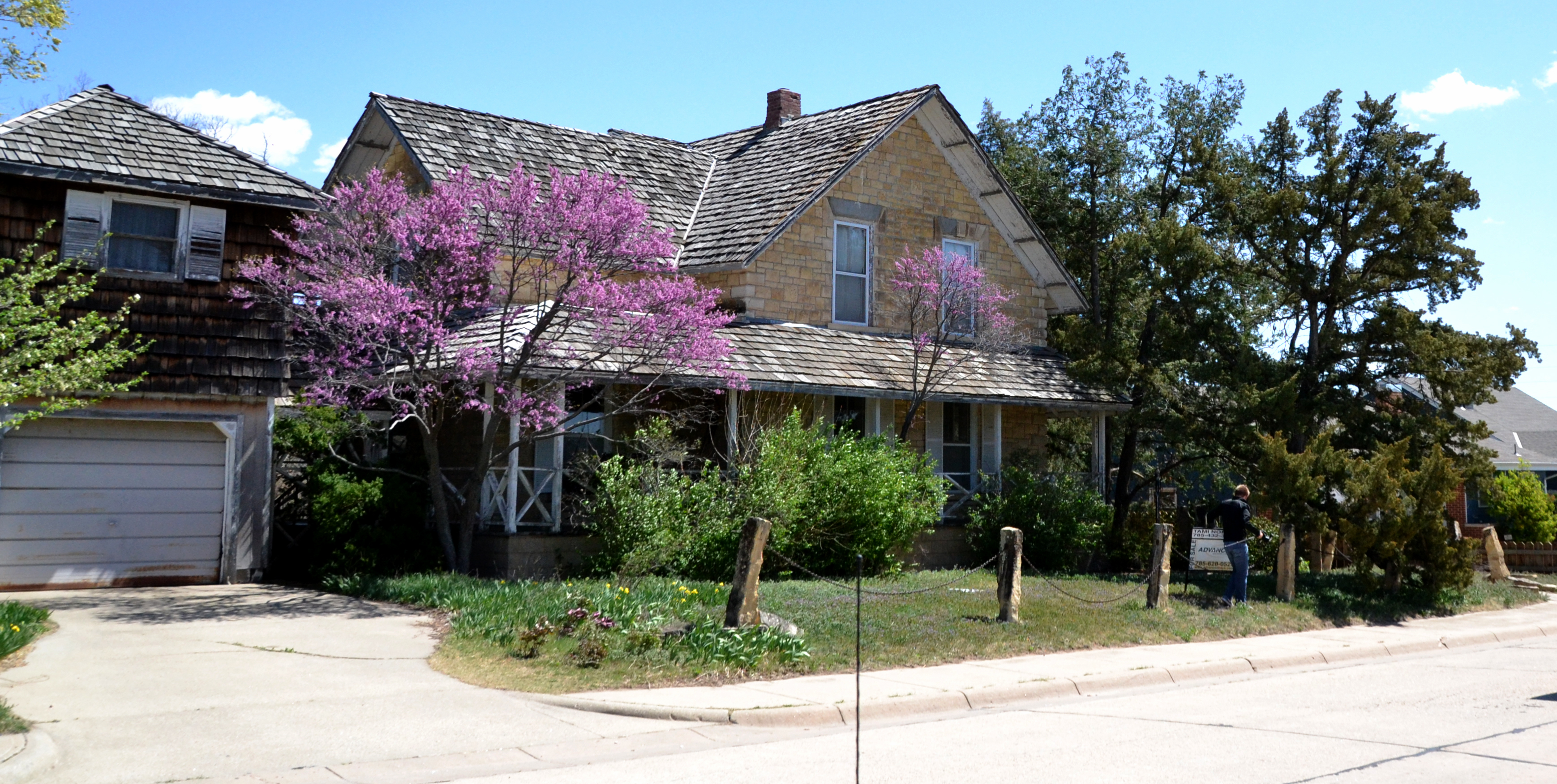
Originally, the home was known as Contest Grove, a moniker given after the battle to secure the land and home by Allen, but for most people today it is known as the Cody House, named for a man who is a local legend in his own right.
By the time Cody secured ownership, the colorful name had been dropped in favor of a pedestrian-sounding address, 2704 Woodrow Court, but his impact on the historic house remains to this day.
“Our family moved to hays in 1965,” said Loren Shaiken, daughter of the late Dr. John Cody, who recalls moving into the home at around 9 years old, after a summer of staying with friends of the family while the young family was looking for a permanent residence.
“At that point, it was in, as I recall, quite disrepair,” she said.
Before ownership by the Cody family, the home had been rented out by the Miller family. They obtained ownership and, by most reports, cared little for the house or its history.
But Cody would quickly bring the house back into shape adding a wrap-around porch and garage with a workshop above.
He would use that space as his studio over the years painting and writing on various topics, work that would make him known worldwide.
Cody also tore out the attic, adding an upstairs bedroom — accessed by a spiral staircase in the center of the room — and finished the basement, adding another bedroom and bathroom, completing that work by 1970. Until recently, that was the last time major work had been done on the home.
While living in the home, Cody founded the High Plains Mental Health Center and became world renowned as the Audobon of Moths.
He also spent time teaching at Fort Hays State University, a school that was first dreamed by Allen. Cody’s wife Dorothy was also affiliated with the university, serving as its first physician.
Dr. John Cody
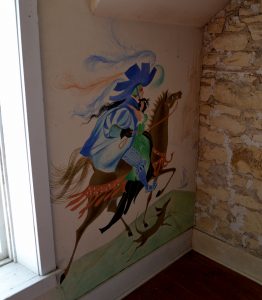
Mural inside the Cody House, painted by Dr. John Cody in the upstairs bedroom.
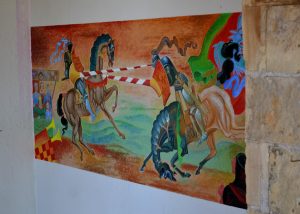
Mural inside the Cody House, painted by Dr. John Cody in the upstairs bedroom.
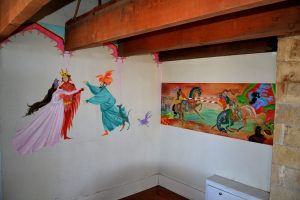
Mural inside the Cody House, painted by Dr. John Cody in the upstairs bedroom.
Cody had worked as a medical illustrator early in his career, a talent that can be seen in the murals in the upstairs bedrooms with knights and princess painted with meticulous precision.
“He’s a remarkable man, probably the most interesting man that ever lived in Hays,” said Hays resident Pete Felton, also known worldwide for his unique stone sculptures.
As with all things, the Cody’s long ownership of the home came to pass in June of last year and the home went on the market, again sparking interest in the home and its unique history.
“The history alone of that house makes it very desirable,” said Kris Munsch, assistant professor in the Department of Applied Technology at FHSU, who calls himself and old house “connoisseur.”
“When you look around and you imagine in your mind, whoever’s lived there over the years, coming in you think of the days when it was horse and carriage up to the last people that lived there. All the stories those walls tell. I hope that isn’t lost in that house, whoever buys it,” Munsch said. “That’s important because it’s so historical to our community, to our university. It just tells such a story. That’s why it’s worth the time and effort to rebuild.”
If the home could share its story, it would likely tell of its stretch as a solitary pillar overseeing Hays as the town crept toward it, eventually enveloping it within its boundaries. Empty space around the home, in fact, is still in the memories of longtime Hays residents.
“When I was a kid, it would be in 1943, during World War II, I went out there with a friend of mine and there was nothing there. I mean the house was bare, there was no grass, there was no trees, no plants, nothing,” Felten said.
Looking back, he said, he wishes he had taken a picture to contrast with what is there now.
From the time of that old memory, until the Cody’s ownership, building in the area began. When Shaiken lived in the home, Wilson Elementary School was already nearby and homes began to surround the house.
“At that time 32nd Street was the very last street. After that, is was fields,” Shaiken said. “That was pretty rural out that direction.”
“The problem was, after World War II, Realtors starting building houses on everybody’s front lawn,” Felten said. “All the big lawns are gone. It was out there pretty much by itself after the war, and then they said we have all this space, let’s build houses around it — so it became crowded. It’s a shame, but it happens all the time.
“Now it’s just crowded onto a little street there and you have to find it.”
“It was just like this stone house that nobody was tending to when my parents bought it,” Shaiken said.”It was really a desolate looking place,” she said of the big two-story stone structure with ranch style homes all around. “I remember a sense of pride because the house had been so neglected when we bought it and then pretty quickly my parents did a lot to it.
“This house is so much a part of my life.”
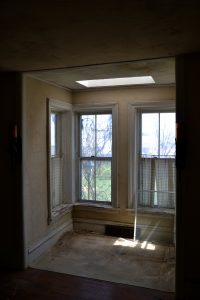
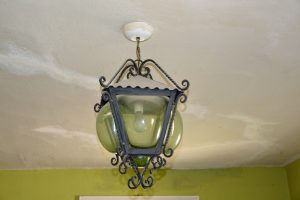
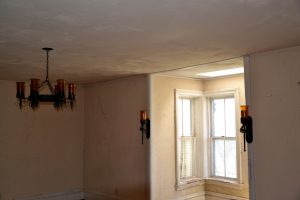
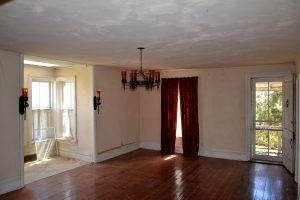
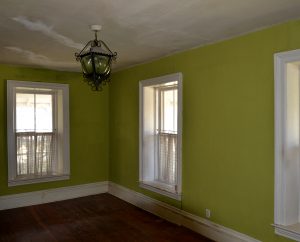
Inside the Cody House.
Inside the Cody House.
Inside the Cody House.
Inside the Cody House.
Inside the Cody House.
DAMAGE, REPAIR, DAMAGE, REPAIR
A home of any age needs constant repair, and even a home made from 3-foot-thick cut stone has, over the years, become wanting of some exterior work.
Many of the limestone lintels have fallen out over the years, cracks along the exterior walls have grown larger as parts of the house are settling faster than others, and plaster and woodwork inside shows its age.
But, structurally, it is sound and, despite many cosmetically unappealing aspects, the house still stands ready to be a home.
“That house is absolutely worth saving. That house has sat there for over 100 years with a limestone foundation. It’s not going to go anywhere if some steps are taken to make sure it can last another 100 years,” Munsch said.
He received a call last year to evaluate the home with a couple that was interested in purchasing the property.
The deal ultimately did not go through, but it left him full of ideas of what could be done with the house, through renovation or restoration.
To the outside renovation and restoration may be the same, but Munsch notes there is a very big distinction.
“There’s been some things have been done to that house over the years that they’re cool, but they don’t fit the period,” he said.
If the home were his project, he said, there are some things he would take out to return the house to its original look.
“There’s a fine line that you draw that becomes too modern and with a house like that. I hope that somebody can get that house and do a combination of restoration/renovation,” Munsch said.
“So let’s say a couple that has moderate skills go in there. They could hire some of the major work done,” he said, noting a major project like a new roof and installing drainage systems would likely need to be hired out.
“What you have got to really do look at the mechanical. Those things that are going to save the house. … It doesn’t do a lot of good to have nice pretty cabinets if the roof is leaking,” he said.
Despite that, Munsch said the house is in livable condition and could last another 500 years if proper repairs take place, but modern conveniences must be considered, as well.
“It’s kind of like somebody that restores an old vehicle. It doesn’t have a purpose because it’s too nice. I would never want that house to be so nice you can’t live in it. It’s the same thing with cars — you want a car that you can take out and use,” Munsch said.
Shaiken also equated the home to an antique vehicle.
“It’s like the chassis of a classic car. You would like somebody to come in and put a motor under the hood and still have that beautiful classic car on the outside,” she said.
“You have to balance,” Munsch said.
The cost of bringing the home into the modern age depends on the difference of restoration or renovation he said.
“If a person was going to go in there and make it a renovation project, you may spend a little less because you may not do the things that I would do.”
Many of the additions over the years, Munsch noted, are not in line with the original build, but the historical aspect of the tenants after Allen should be considered in renovation or restoration plans.
“The Codys are just as important as the Martin Allens because of their history with the house. You don’t want just eliminate them out of the middle,” he said. “You want to keep that historical part of them living there as well, so I think there is a lot of combinations that could be done over the years.”
BUILDING THE HOME TODAY
The main reason the home still stands in solid shape is the material with which it was built. While homes today are built with wood, at the time of construction, the stone bricks were a more practical solution that would be difficult to reproduce.
“It would be possible,” to build a house like this today, Munsch said, but difficult.
“Where would you find a mason that is willing to set those kinds of stones? You’re not going to find it.”
The building materials would also be hard to find on the market today.
“You could get the limestone probably, but you’re not going to find limestone with that character,” he said.
But at the time of the homes construction, the stones used would have been easy to acquire, and the most cost-effective material of the day.
In 1872, a quarry was opened about a mile west of the college, and it quickly became in high demand because lumber was very expensive, according to Felton.
The stone was used to build homes, business in the area, including the college.
Those local quarries are no longer in operation, so stone would need shipped – a costly proposition in itself — and the stone now has become expensive.
“It’s an expensive material instead of a cheap material,” Felten said.
The skills need to build a home out of stone, however, are relatively simple.
A builder during the time of the home’s construction would often begin by placing stones directly on the ground.
“It was a technique that was low-tech and a lot of the people around here had some experience. You can learn about all there is to know about it in one day,” Felten said.
He recalls a story of a man who worked at the nearby quarry and would bring a brick or two home every day. In five years, he had a house.
That building still stands as is currently used as a dentist office in Hays. And work on those old homes requires little training, as well.
“If somebody hasn’t already fixed it up, it’s going to be a burden, but kind of a fun thing because you can always do it yourself. It’s not complicated,” Felten said.
Despite the time and effort required a home made with stone offers something rare in new construction.
“They are really great, because if you have a stone house, you don’t feel the wind. It just protects you from the wind all of the time,” Felten said. “They’re really nice for calmness. … They feel secure.”
Martin Allen. Photo courtesy Ellis County Historical Society.
MARTIN ALLEN: HIS HOME, HIS LEGACY
The truly unique history of the house is felt by every resident in the area. When Martin Allen arrived in Hays City, there was little in the area outside of the nearby military fort, but quickly it became more — in no small part to his efforts as a real estate agent, horticulturist and champion for the university that would later become Fort Hays State University.
“Martin Allen was really influential in Hays, in order to promote himself a little bit he gave land for the courthouse in Hays,” Felten said.
Although that gift wasn’t entirely altruistic — he owned land around the area and wanted to sell it — the courthouse became, and remains the center of government for Ellis County.
While buildings and the school are impressive reminders of his vision, one of the more pressing issues facing early settlers was finding a stable source of food.
“He tried to grow everything he can find. He said if you’re gonna live out here on the plains, you gotta learn what grows,” Felten said.
Allen planted a large number of plants and trees around his home, meticulously testing suitable plants for the area. A bit of that legacy can even be seen today, with many trees still lining Fort Street having been planted by Allen himself.
His most lasting legacy, however, is none other than the university that has grown into a regional center for higher learning. Now called Fort Hays State University, when the idea was presented it was known simply as “Allen’s Folly.”
“When the word came out they were going to sell the land that the old Fort Hays was on, he ran for the Legislature to prevent that. So they could keep it in one piece and start an agriculture experiment station,” Felten said.
That land is still used by the university, with another large parcel becoming Frontier Park.
While the idea for the college directly came directly from Allen, he would be forced off of his land by mortgage holders in 1898 and soon moved to land owned by his son in Colorado. He would die months later, four years before the founding of the university.
His efforts, however, did not go completely unrecognized as one of the first buildings on the campus was named in his honor – a name that remains to this day.
His name is also attached to another well-known, but less cheerful piece of property in Hays – Mount Allen cemetery.
One of his daughters, Clara, died of scarlet fever in 1874, leaving Allen to search for a final resting place.
“He wasn’t about to bury her on Boot Hill, where all the desperados were, so he gave a piece of land to the city and they named it Mount Allen and it became our cemetery,” Felten said.
Clara would be the first burial in the cemetery, and his wife, Elizabeth would also be laid to rest there.
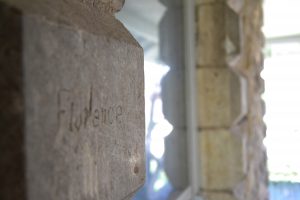
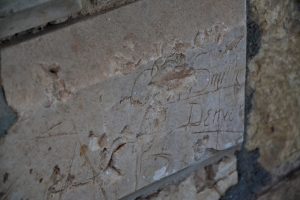
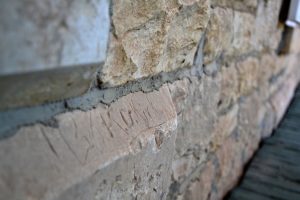
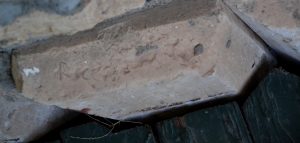
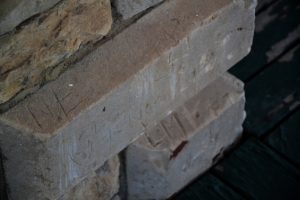
Inscription on the exterior of the house at 2704 Woodrow Court.
Inscription on the exterior of the house at 2704 Woodrow Court.
Inscription on the exterior of the house at 2704 Woodrow Court.
Inscription on the exterior of the house at 2704 Woodrow Court.
Inscription on the exterior of the house at 2704 Woodrow Court.
A NEW LIFE FOR THE HOME<
As the home sat empty after John and Dorothy Cody relocated, several ideas were floated. Munsch hoped FHSU would purchase the home to be renovated by students as a project, then used as a home by the university. The Ellis County Historical Society thought it could be a museum to share the history of the area.
Ultimately, fate stepped in and the house will continue as a private residence, just as it was intended so long ago.
As Jayson van Wooten was searching for a home he noted a listing that he believed to be the Cody home, not immediately recognizing the house with the overgrowth of plants and trees that had popped up over the years.
He had been searching for homes within his price range and, as a designer, wanted to find a home he could renovate, but loved the idea of a house with history attached to it.
“All of a sudden, this one popped up,” he said.
After realizing it was the Cody house, he immediately texted his real estate agent and was anxious to tour the property.
“I have to come see it,” he told her. “It’s mine. I knew instantly this is gonna be the house.”
When he first arrived, even in need of repair, he said the house “instantly felt like home.”
Even before talking to a bank, he put in an offer on the home that was accepted. He then secured funding and began planning.
“The thing that I liked about it is the Codys have had it for 40 maybe 50 years and hadn’t done a whole lot since they moved in,” van Wooten said.
His vision for the house recognizes the history the Allens and the Codys left behind, noting the unique features added by the Codys.
“It was pretty bare bones, because they had a pretty minimalist ascetic too, it seems like,” van Wooten said. “The things they had done to the home had given me liberties to do a little more exciting things.”
Normally, a home of such importance would be on the National Register of Historic Places, which would limit the amount of changes that could be done on the property.
“I can mix elements that speak of the home, but also of contemporary living and, at the same time, preserve the character of the house,” van Wooten said.
He moved into the home recently and has already tackled the project identifying exterior and interior work that will preserve the home for the foreseeable future. So far, the repairs are only cosmetic in nature, as experts who have toured the home have noted how sound the structure remains, despite its age.
“Everybody that has seen the house, all of the contractors, are surprised how good of shape it is in,” van Wooten said. “They have had great stewards and caretakers of the house living here.”
Perhaps 100 years from now, the home will be known as the van Wooten house after he adds his own history to the impressive stone building. But for now, looking back is enough to inspire awe and humility.
“I’ll move into the old house any day in that condition than I would a brand-new one, because that one has the character, the stories, the history. Martin Allen sitting in that house saying we should build a university or a school. That’s where we’re sitting right now. You can’t buy that,” Munsch said.
“The good days the bad days, the storms, the tornadoes on the horizon. That’s why that house is cool.”
The Kansas Department of Transportation has reopened U.S. 83 in Sheridan County from the Thomas County line to the K-23 junction as of Monday, Oct. 3.
The 11-mile stretch was closed for approximately six months for a $15.2 million reconstruction project that was funded by T-WORKS, the statewide transportation program approved by the Kansas legislature in 2010.
Norman G. Medina, age 58, passed away on Sunday, October 2, 2016 at the Scott County Hospital in Scott City, Kansas. He was born on January 26, 1958 in Scott City, Kansas, the son of Jess and Dolores Torrez Medina. He was a resident of Scott City, Kansas since 2013 moving from Garden City, Kansas and was the owner and operator of his trucking company, Pure Country and then worked for CHS for the past 6 years.
He was a member of the St. Joseph Catholic Church in Scott City, Kansas. Norman was also a member of Vets for Veterans and the Patriot Guard.
On May 16, 2010 he married Cynthia Bitner in Reno, Nevada. She survives.
Survivors include his Wife – Cynthia Medina of Scott City, Kansas, Three Sons – Justin & Kristy Medina of Jacksonville, Florida, Jared & Glenda Medina of Hawaii, Steven & Leslie Medina of Belleville, Kansas, Two Daughters – Jennifer Medina of Michigan, Audrey Medina of Scott City, Kansas, Mother – Dolores Medina of Great Bend, Kansas, One Brother – Jess & Carmen Medina of Sublette, Kansas, Two Sisters – Rita & Dennis Smith of Weskan, Kansas, Sara & Gary Pletcher of Great Bend, Kansas and Twelve Grandchildren.
He was preceded in death by his Father and One Sister Celia Jane Medina.
Memorial Services will be held at St. Joseph Catholic Church in Scott City, Kansas at 10:30 a.m. Tuesday, October 11, 2016 with Fr. Bernard Felix presiding.
Memorials may be given to the Heartland Cancer Center % Price & Sons Funeral Home in Scott City, Kansas.
Inurnment will be at Tuesday, October 11, 2016 at 3:00 p.m. CDT in the Weskan Cemetery in Weskan, Kansas.
Lawrence A. “Lon” Proffitt, of Hays, age 74, passed away Wednesday, September 28, 2016, at the Las Colinas Medical Center in Irving, Texas. He was born June 15, 1942, in St. Louis, Missouri to Joseph Martin and Marjorie (Finlay) Chiri- Proffitt. He married Shirley Ann (Bollig) on October 13, 1962 at Liebenthal, Kansas.
He was an auto-diesel mechanic, fabricator and worked part time at The Auman Company. He was a veteran of the U S Navy. He lived in Russell for 32 years, moved to Ypsilanti, MI for 11 years, retired in 2012 and moved to Hays. He was a member of Immaculate Heart of Mary Catholic Church, Hays, Russell American Legion, Russell 3rd Degree Knights of Columbus Council #3034 and 4th Degree Assembly. He was a past Grand Knight and Past Faithful Navigator of the Knights of Columbus and a past member of the Russell County Rural Fire Department. Lon developed a passion for reading later in life, enjoyed watching movies and spending time with his family.
Survivors include his wife, Shirley Proffitt, of the home; five sons, Charles Proffitt and wife, Melissa, Denver, CO; Joseph Proffitt and wife, Tammy, LaCrosse, KS; David Proffitt and James Proffitt and wife, Tatjana, all of Irving, TX; Jacob Proffitt and wife, Shanda, Hays, KS; two daughters, Laura Forslund and husband, Andrew, Oakley, KS; Mary Hoisington and husband, Matthew, Great Bend, KS; one brother, Joel Chiri, Lady Smith, British Columbia, Canada; one sister, Patricia Seaman, Joplin, MO; 15 Grandchildren and five great grandchildren.
He was preceded in death by his parents and his step father, Benjamin Proffitt.
Service are 10:30 A.M. Friday, October 7, 2016 at St. Joseph Catholic Church, Liebenthal, Kansas. Burial in St. Joseph Cemetery Liebenthal, Kansas with military honors by the Hays V.F.W. Post No. 9076.
A vigil service is at 6:30 P.M. Thursday, followed by a 3rd and 4th Degree Knights of Columbus rosary at 7:00 P.M. Thursday, all at Cline’s-Keithley Mortuary of Hays, 1919 East 22nd Street, Hays, Kansas 67601. The 4th Degree Knights of Columbus will stand honor guard from 6:00 to 7:00 P.M. Thursday, at the mortuary.
Visitation is from 5:00 to 8:00 P.M. Thursday, at Cline’s-Keithley Mortuary of Hays and from 9:30 to 10:30 A.M. Friday, at St. Joseph Catholic Church Liebenthal, Kansas.
Memorial to St. Joseph Church or St. Joseph Cemetery Liebenthal, Kansas.
Condolences can be left by guestbook at www.keithleyfunerlchapels.com or via e-mail to [email protected] .
It’s made for a lot of news stories—though we’re betting they probably didn’t crowd the advertisements out of your local newspaper—this citizenship-voter business in Kansas.
And it might finally be over…if the Secretary of State and the ACLU can get a federal judge to agree to the wording of a letter to thousands of Kansans that they sure enough can vote in November and that the election folk are going to count those votes.
It has taken more than a year and who knows how much money for Secretary of State Kris Kobach to try to enforce a law that the Legislature probably shouldn’t have passed and the governor probably shouldn’t have signed into law that requires proof of U.S. Citizenship for people to vote in Kansas.
It was a couple years ago that someone thought it was a good idea to have just documented American citizens voting on the people who run the nation, the state, the county, city and drainage district in which we live.
That proof of citizenship requirement probably meant that thousands of Kansans either had to dig through mom’s storage closet to find a birth certificate to prove they were born here, or maybe locate a passport if you are a foreign traveler or a citizenship certificate if you were born in another country.
The Kobach-American Civil Liberties Union agreement on a form letter letting those folks who don’t readily have, or maybe don’t know how to secure, a birth certificate that they can vote will end the turmoil.
That federal court decision also does away with Kobach’s proposal for a dual ballot system. While federal law doesn’t require proof of citizenship to vote on federal races, the now overridden Kansas law does require proof to vote on state and local issues. Kobach’s idea? You could vote on federal offices, but not Kansas offices or issues without that proof of citizenship.
Sounds a little strange that if you can vote for the president you can’t vote for a Trego County commissioner, but that’s the way Kobach wanted it.
Now essentially stricken down, it means that probably about 18,000 Kansans now can spend the time in the booth to vote for everything on the ballot, federal and state and local, the whole works.
What’s it all mean?
Finally, if you are a Kansan, and we know who we are, you get full voting privileges. We gotta figure that if some foreign nationals somehow made it across the U.S. border, and found their way here to live, then they can vote.
That issue apparently settled, we now get to speculate how many of those new, full-ballot voters are actually going to vote in the November election.
Lots of those folks registered to vote when they got new driver’s licenses and registered without having to show citizenship. And, there are federal election registration forms that don’t require proof.
Now, are those folks going to vote? Nobody’s sure. Kobach estimates that statewide, after a county court judge issued a temporary ruling just the Friday before the primary election that they could vote the whole ballot, only 73 of those affected Kansans actually bothered to make the drive in to vote.
With more than a month’s notice now—and that letter that is still being parsed out—there may be thousands of Kansans who will be officially notified that they can vote on everything, and that trip to the polling place will actually be worth the gas.
With that vote-denying business out of the way, we gotta wonder what’s next?
Did we hear someone in the halls of the Statehouse mutter about that other registration duty of the Secretary of State? Wonder if there’s a majority of a quorum of legislators and the governor passing a law that requires notaries to be right-handed, or weigh at least 150 pounds?
We’ll see…
Syndicated by Hawver News Company LLC of Topeka; Martin Hawver is publisher of Hawver’s Capitol Report—to learn more about this nonpartisan statewide political news service, visit the website at www.hawvernews.com
YODER – Sixty-three new law enforcement officers were congratulated by Craig Floyd, president and CEO of the National Law Enforcement Officers Memorial Fund, during their graduation from the Kansas Law Enforcement Training Center on Sept. 30.
The new officers were members of the 241st basic training class at the center. Located one mile west and one mile south of Yoder, near Hutchinson, the center is a division of University of Kansas Professional & Continuing Education.
The graduates, who began their training June 20, represented 48 municipal, county and state law enforcement agencies from across Kansas.
Graduates receive certificates of course completion from KLETC and Kansas law enforcement certification from the Kansas Commission on Peace Officers’ Standards and Training, the state’s law enforcement licensing authority. The training course fulfills the state requirement for law enforcement training. Classroom lectures and hands-on applications help train officers to solve the increasingly complex problems they face in the line of duty.
Established by the Kansas Legislature in 1968, the center trains the majority of municipal, county and state law enforcement officers in Kansas and oversees the training of the remaining officers at seven authorized and certified academy programs operated by local law enforcement agencies and the Kansas Highway Patrol.
About 300 officers enroll annually in the 14-week basic training program. The center offered continuing education and specialized training to as many as 5,600 Kansas officers each year. Funding for the training center is generated from court docket fees from municipal and state courts. No funds from the state’s general revenue are used to operate the center.
Northwest Kansas graduates who granted permission to release their names are listed below by agency:
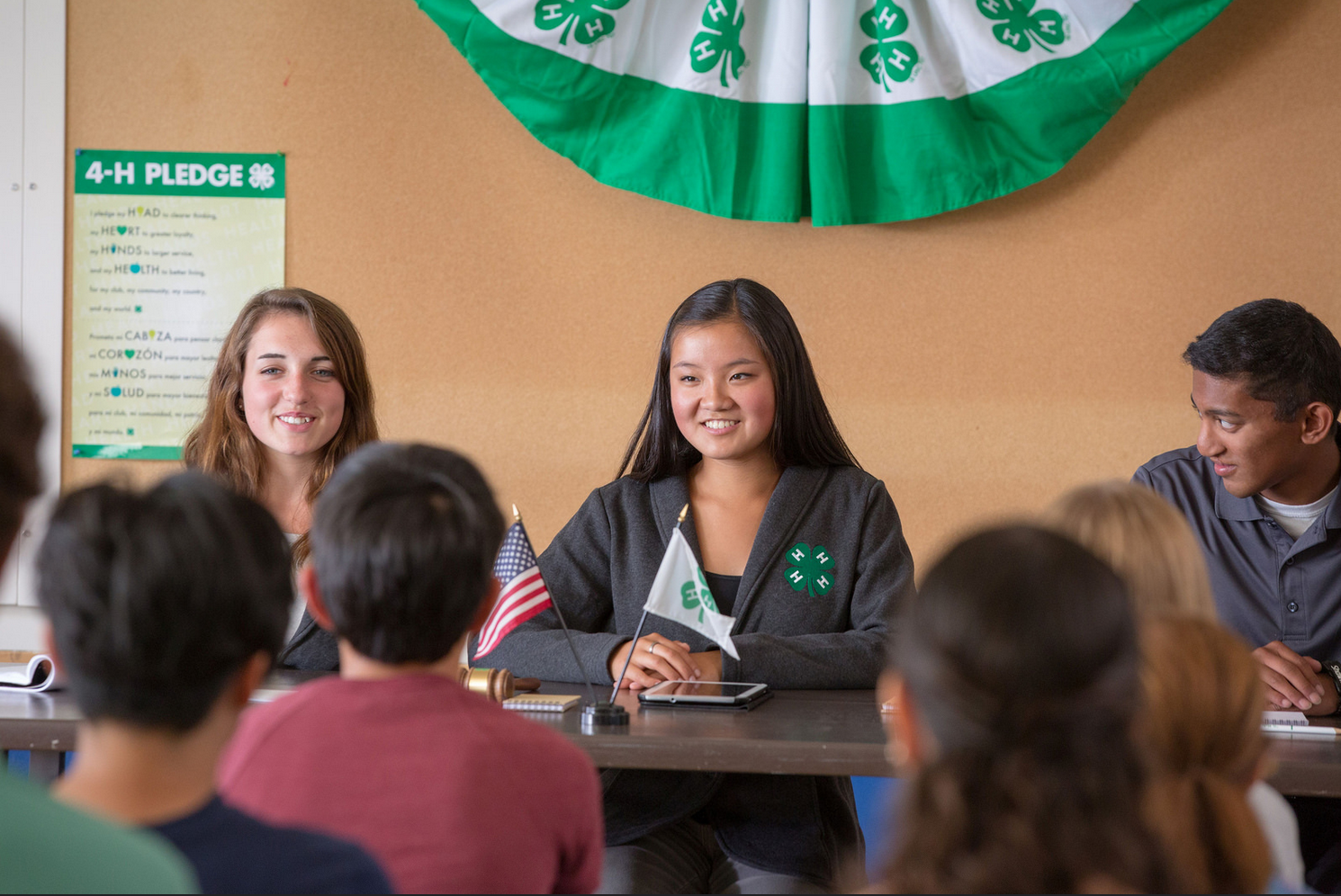
Kansas 4-H is celebrating National 4-H Week Oct. 2-8, 2016. More than 86,000 youth in Kansas are learning leadership and other skills through the state’s 4-H programs.
K-State Research and Extension
MANHATTAN – 4-H is built on a belief in the power of young people, that every child has valuable strengths and real influence to improve the world around them. The organization provides the kinds of experiences to grow into true leaders. K-State Research and Extension encourages all Kansans to celebrate Kansas 4-H true leaders during National 4-H Week, Oct. 2-8, 2016.
“True leaders are young people who have confidence; know how to work well with others; can endure through challenges; and will stick to a job until it gets done,” said Diane Mack, K-State interim department head and state 4-H Program Leader. “In Kansas 4-H, we believe true leaders aren’t born – they are grown.”
During National 4-H week, Kansas 4-H will highlight life skills, such as confidence, leadership, responsibility, compassion and curiosity, through its new brand campaign 4-H Grows Here. The campaign engages youth to learn these life skills by doing – through guidance, tools and encouragement from adult mentors and by putting youth in the driver’s seat to make great things happen.
4-H is America’s largest youth development organization – empowering nearly six million young people across the U.S. In Kansas, more than 86,000 youth participate in the 4-H program through hands-on projects in areas like science, health, agriculture and citizenship. 4-H clubs have evolved to include special interest (SPIN) clubs focusing only on a particular project, in-school enrichment programs, after-school programs and 4-H camps.
Join the conversation this week by using the hashtags #4HGrown, #4HGrowsHere and #TrueLeaders on social media. Share with us your 4-H experience and the positive impact it has made on your life. For more information on how to join 4-H, visit www.Kansas4-H.org or contact your local K-State Research and Extension office.
Lack of understanding and critical thinking on the part of some in the environmental movement has compromised their effectiveness as self-appointed protectors and guardians of our planet.
Whenever we improve our critical thinking skills it becomes easier to see through deception and exaggeration that has characterized the promotions of some environmental organizations and the mass media’s coverage of their issues.
If we examine the issue of critical thinking, one of the first things we must realize is that correlation is not causation. I know I am wandering into a deep subject for such a shallow mind as mine, but bear with me.
Correlation means two things tend to happen at the same time. Causation means one thing is known to cause another.
Because two things happen at the same time doesn’t mean one is causing the other. We need proof, including a reasonable theory showing the path by which one thing causes another to occur.
Global warming and pollution of the water supply with herbicides for example – common environmental concerns – have resulted when correlation of two things was mistaken for causation. To avoid future errors, radical environmentalists must be responsible for proving that one thing is actually causing another to happen.
They just can’t say it. That doesn’t make it so.
In today’s world, much remains unexplained. Cancer is one disease that comes to mind.
This dreaded disease might be due to genetic conditions, nutrition, a health problem in childhood, prolonged stress or a combination of these factors. One day scientists may find a cure for this disease, but that day has not arrived.
Trends don’t always predict the future. During the early ‘70s some scientists predicted the advent of another ice age. During the ‘80s temperatures increased and some experts said we’d experience catastrophic global warming. The cold winter of 1993-94 prompted a new wave of hysteria about another ice age.
Today’s projected cataclysms are the continued fear of global warming and the melting of the polar ice caps. Predictions of resource depletion are another reason for concern. Most of these are based on projections of past trends. Trends only serve as a guideline of past events and cannot document exactly what will happen down the road.
Another element of critical thinking is reliance on fact rather than opinion. So often in our society, the “squeaky wheel gets the grease.” The loudest or most controversial opinion receives the most attention.
This has definitely been true in the environmental movement where claims of upcoming calamities receive extensive media coverage. To make sure experts with a minority view don’t mislead the public, seek relevant facts and make up your own mind.
One reason apocalyptic abusers thrive is the general public rarely relies on its long-term memory. People are unlikely to remember a doomsayer’s dire predictions of a few months ago, much less 10 or 20 years back. We must remember yesterday’s false alarms and the people who sounded them if we are to respond to future calls to action.
While few people enjoy risk in their lives, we can’t live without it. Everything we do has risk attached even ordinary events like walking down the steps (falling and breaking bones) or crossing the street (being hit by a truck).
Remember the risk of drowning (16 in a million), or dying in a home accident (90 in a million), or being killed in an auto accident (192 in a million) greatly exceeds the alleged environmental risks being hawked by some organizations.
Throughout our lives we make choices. We must decide between the black pair of shoes and the brown. We must decide on catsup, pickles or mustard on our hot dog.
The same can be said about our environment. We have to choose our priorities. We can’t do everything at once. To do so could produce unintended consequences that could harm the world in which we live.
Instead, we must apply the same prudence we apply to other significant aspects of our lives. The importance of environmental issues doesn’t exempt them from this discipline. Their importance makes careful planning and efficiency all the more necessary.
John Schlageck, a Hoxie native, is a leading commentator on agriculture and rural Kansas.
With Wed., Oct. 5 being International World Teachers Day and the Every Student Succeeds Act soon to go in effect, the personal-finance website WalletHub conducted an in-depth analysis of 2016’s Best & Worst States for Teachers.
In order to help educators find the best teaching opportunities in the country and draw attention to the states needing improvement in this regard, WalletHub analyzed the 50 states and the District of Columbia across 16 key metrics, ranging from “average starting salary” to “pupil-teacher ratio” to “school safety.”
Best States for Teachers Worst States for Teachers
1 New Jersey 42 Rhode Island
2 Massachusetts 43 South Carolina
3 Illinois 44 North Carolina
4 Minnesota 45 Maine
5 Wyoming 46 South Dakota
6 Virginia 47 Mississippi
7 New York 48 Oregon
8 Texas 49 Arizona
9 Utah 50 West Virginia
10 Connecticut 51 Hawaii
Kansas ranked 32nd out of the 51 analyses.
Best vs. Worst
Wyoming has the highest average starting salary for teachers (adjusted for cost of living), $46,626, which is 1.9 times higher than in Hawaii, the state with the lowest, $24,334.
Michigan has the highest median annual salary for teachers (adjusted for cost of living), $70,042, which is two times higher than in Hawaii, the state with the lowest, $34,063.
Nevada has the lowest projected number of teachers per 1,000 students by year 2022 (indicating competition), 26.83, which is 3.3 times lower than in North Dakota, the state with the highest, 87.59.
Vermont has the lowest pupil-teacher ratio, 10.6, which is 2.3 times lower than in California, the state with the highest, 24.3.
Vermont has the highest public-school spending per student, $25,286, which is 3.4 times higher than in Indiana, the state with the lowest, $7,538.
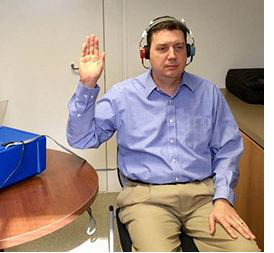
Free adult hearing screenings, sponsored by the Kansas Masonic Foundation, will be offered this fall and next spring in six western Kansas communities by Fort Hays State University.
In addition, services for adults with swallowing difficulties, called dysphagia, will be offered in several other Kansas communities throughout the spring semester. Both services will be provided by graduate students from the Department of Communication Sciences and Disorders and the FHSU Herndon Clinic.
“The FHSU Herndon Clinic in the Department of Communication Sciences and Disorders is very fortunate to have recently received a $250,000 grant from the Kansas Masonic Foundation to support adult speech, language and hearing services in western Kansas,” said Marcy Beougher, speech-language pathologist and an instructor in the department.
The first hearing screening will be from 9 a.m. to 2 p.m. Friday, Oct. 7, at the Masonic Center, 600 Cedar Dr., Scott City. No appointment is necessary. Screenings will be conducted on a first-come, first-served basis.
Each site will have four stations, each with an FHSU graduate student providing screenings, supervised by Beougher. Each screening will take approximately 15-20 minutes.
“Many of these sites have never had a free hearing screening scheduled in their local community, so our hope is to provide a worthwhile service to many adults who would not have otherwise had the opportunity,” said Beougher.
The location of the screenings are listed by date. Exact times and locations for the later sites will be announced soon.
Oct. 7: Scott City Masonic Center, 9 a.m.-2 p.m.
Nov. 4: Medicine Lodge Dec. 2: Hoisington Feb. 3: Hill City
March 10: Hugoton April 7: Goodland
Beougher and Kori Haberman, CSD graduate assistant, are organizing the hearing screenings.
“We are very thankful to the Kansas Masonic Foundation for this opportunity to bring a much-needed service that also provides excellent clinical experience for our FHSU graduate students,” said Beougher.
“We believe it will be a win-win situation for all involved.”
For more information, visit fhsu.edu/herndon-clinic/ or contact the FHSU Department of Communication Sciences and Disorders at 785-628-5366.
SHAWNEE COUNTY –Law enforcement authorities in Shawnee County are investigating an attempted
On Saturday, suspects made a burglary attempt at Dennison State Bank, 3640 SW Fairlawn in Topeka.
The suspect was captured on surveillance cameras.
Police asked that Anyone with information on this suspect please Email the TPD Criminal Intelligence Unit ([email protected]) or TPD DET Jesse Sherer ([email protected]) or call #785 368 9694 or Crime Stoppers at #785 234-0007
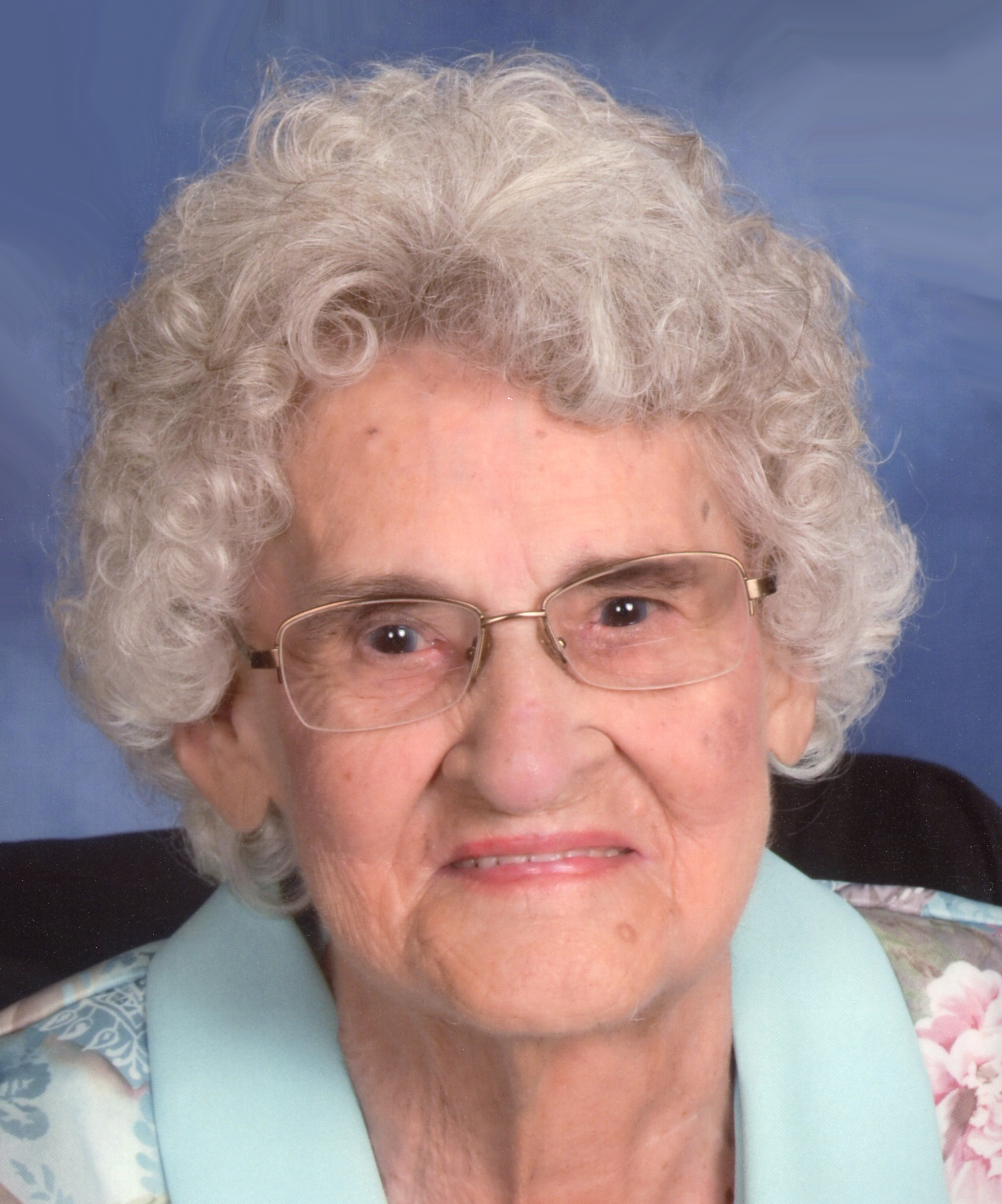
 Ella Mathilda (Deines) Fabrizius was born January 15, 1918 to David and Elisabeth (Dietz) Deines on the family homestead in rural Barton County near Galatia, Kansas. She died October 1, 2016 at Trego County Lemke Memorial Hospital Long Term Care at the age of 98.