GREAT BEND – It’s sure easy to work up an appetite during duck season, and no one may know this more than the staff at the Kansas Wetlands Education Center (KWEC) located at the southeast corner of Cheyenne Bottoms along K-156 Highway. To show their appreciation for the contributions duck hunters make to waterfowl conservation, KWEC staff invite all duck hunters to enjoy a free breakfast on opening day in the Low Plains Early Duck Zone, Sat., Oct. 8, 2016. A free breakfast of biscuits and gravy, coffee and juice will be served from 8 a.m. to 11 a.m.
“Hunters are an important constituent for the past, present, and future of Cheyenne Bottoms,” stated Curtis Wolf, KWEC site manager. “It is great to be able to celebrate this tradition.”
The free breakfast is sponsored by Great Bend Regional Hospital, with the help of the KWEC, Kansas Department of Wildlife, Parks and Tourism, and Ducks Unlimited.
After filling up on good eats, hunters can learn about Cheyenne Bottoms’ history, peruse through items in the Cheyenne Bottoms Ducks Unlimited Chapter raffle and silent auction, visit waterfowl identification and hunting information booths, and enjoy some friendly shooting competitions with the Laser Shot hunting simulation system.
Hunters can also get their waterfowl boats safety inspected for free, courtesy of KDWPT Boater Education staff.
Contact the KWEC at (877) 243-9268 for more information.
OMAHA, Neb. (AP) — Outdoor gear giants Bass Pro and Cabela’s will combine in a $4.5 billion deal announced Monday.
The deal will give Cabela’s shareholders $65.50 cash per share, but it creates uncertainty about jobs in the retailer’s home state of Nebraska. The combined companies plan to keep some operations in Sidney and Lincoln, Nebraska, but it’s not immediately clear how many jobs might be lost.
Bass Pro CEO Johnny Morris says he hopes to continue growing the Cabela’s brand alongside his own Springfield, Missouri, based chain.
Capital One will take over running Cabela’s credit card unit as part of the deal. Activist investment firm Elliott Management began pushing for significant changes at Cabela’s last fall.
Cabela’s employs about 2,000 people in the western Nebraska town of Sidney, which has about 7,000 residents.
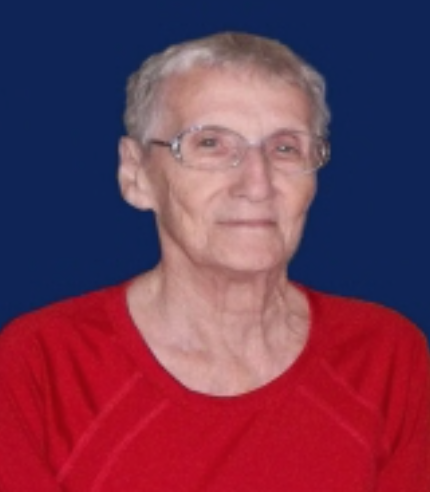
Marie Celine “Tiny” (Carrier) Albers passed away Friday, September 23, 2016 at Wheatland Nursing Center in Russell, Kansas at the age of 87. She was born on December 6, 1928 in Cloquet, Minnesota to the late Dennis and Marcella (Shanda) Carrier. She graduated from Cloquet High School and on April 12, 1947 she was united in marriage to Roy C. Albers in Reno, Nevada.
Tiny moved to Palco, Kansas in 1949 where she and Roy began working and raising their family. She was a homemaker and worked for Baxter-Travenol Laboratories in Hays, Kansas until their closing, she also waitressed at the Palco Café for many years. She loved music and watching sports, especially basketball, football, and golf. She was a member of Sacred Heart Catholic Church in Plainville, Kansas.
Tiny is survived by her son Dr. Robert Albers of Albuquerque, NM; daughter Marie Albers of Commerce City, CO; daughter-in-law Christine Albers of Olathe; brother Ki Carrier and wife Helen of Klamath Falls, OR; sister Mae Storts of Longview, WA; grandchildren Jennifer Kysar of Luray, Wade Albers of Lenexa, Mark Paonessa and wife Elisa of Moore, OK, and Michael Albers of Bartlesville, OK.
She was preceded in death by her parents Dennis and Marcella Carrier, husband Roy Albers, son Dennis Albers, daughter-in-law Lynne Albers, brothers Albert, Kenny, and Willie Carrier, and sisters Blanche LaVoie and Kathy Paup.
A Mass of Christian Burial will be held at 2:00pm on Saturday, October 8, 2016 at Sacred Heart Catholic Church in Plainville. Inurnment will follow in the Pleasant View Cemetery near Palco. Visitation will be from 4:00-8:00pm on Friday at the funeral home with Rosary Service at 7:00pm.
Native Kansan Karen Madorin is a local writer and retired teacher who loves sharing stories about places, people, critters, plants, food, and history of the High Plains.
Mother Nature must’ve guffawed til her sides ached as she read scores of first day of fall memes flooding the internet. How ironic that fellow lovers of colorful leaves, cozy sweaters, pumpkin patches, and simmering soups wiped dripping sweat from brows in 90 plus temps on the cusp of our favorite season. For folks who’ve eagerly awaited brisk mornings and hoodies, last week’s sultry heat didn’t just set us back; it wilted spirits. Don’t worry, though. We’ll recover as soon as morning thermometers hover in the thirties or low forties.
It’s interesting to read friends’ posts during this hinge between summer and autumn. It doesn’t take long to know who loves frosty winters, pastel springs, simmering beach-weather summers, and my favorite– fall. When I scan Facebook, I see clearly why some of my friends and I connect. We love this time of year that others see as a harbinger of doom.
We love nature’s colors as foliage morphs from green to yellow, orange, bronze, and crimson. We love gunmetal grays that dominate skies this time of year. We love native grass hues as they switch off chlorophyll production and turn on dormant mode. We love watching birds stage in voracious hordes in preparation to migrate. We love those crazy cricket serenades that foretell dropping temperatures. We love high school football games with its scent of freshly buttered popcorn.
We love knowing hunting seasons have begun so our freezers will soon be full of freshly harvested game. We love standing over the stove to stir soups that smell of onion, garlic, tomatoes, basil, oregano as they simmer and perfume our homes. We love kneading flour, yeast, eggs, oil, and water into crusty breads we’ll bake, slice, and toast with cheese to eat with our soup or chili. We love others who understand our quirky fixation with this time of year.
I understand why some dread this season. Daylight shortens. Calendars mark the beginning of regimented activities, the end of lazy days at the pool, the last days of garden production, and the beginning of paying a rising winter heat bill. Despite recognizing others’ distress, I can’t help but wake up smiling when the autumnal equinox tells me summer is over. It means my favorite birds, sandhill cranes, will soon return, winging and singing their song across russet and golden fields on their way to New Mexico’s playas. I’ll hear their ancient cry and imagine elk bugling in the background though I know that hasn’t happened across our state for nearly a century.
My fellow autumn lovers are nesters, folks who love snuggling tight at homes with loved ones. This season appeals to those who savor each diminishing sound as cooling nights shut down summer’s harsh decibels. This begins a time of introspection and contemplation. Summer will return for those in mourning. For those of us celebrating its end, ignore the heat and brew a pot of cider. Raise your mug to toast golden days ahead.
Native Kansan Karen Madorin is a local writer and retired teacher who loves sharing stories about places, people, critters, plants, food, and history of the High Plains.
Catching rainbow trout in Kansas seems like an oxymoron; sort of like polar bear hunting in West Virginia or whale watching at Yellowstone Lake. Kansas is known for its walleye, crappie and catfish, but trout?
Wildlife and fisheries programs here in KS are funded largely by revenue from license sales that comes back to the state from the federal government. That money is reallocated back to Kansas according to the number of hunting and fishing licenses sold each year, so the more licenses sold, the more money we get back. In the 1990’s, Kansas began a trout stocking program as a way to generate more fishing license sales in the off-season, and as a way to create more fishing opportunities during the fall and winter.
Steve Gilliland
I spoke with David Breth, Fisheries Program Specialist with the KS Dept of Wildlife Parks and Tourism KDWPT) who oversees the trout stocking program. This year there will be approximately 36 lakes and water impoundments across Kansas stocked with trout. Seventeen of those are private lakes owned by towns or cities that are enrolled in the Community Fisheries Assistance Program (CFAP), meaning they purchase their own fish, but allow the KDWPT to manage the lakes. The rest of the lakes and reservoirs stocked with trout are state owned and operated.
Although KDWPT operates 5 fish hatcheries here in Kansas, none are equipped to hatch and raise trout, which are especially sensitive to environmental factors such as temperature, water quality etc, so it’s more cost effective to purchase trout from commercial hatcheries for the stocking program. Last year a Colorado hatchery supplied all trout for the western half of the state and trout for the eastern half came from a hatchery in Missouri.
Rainbow trout are the easiest and least expensive trout for hatcheries to raise, making them also the least expensive to buy, plus they tolerate warm temperatures better than other trout, so the bulk of the trout stocked here in Kansas are rainbows. However, brown trout are also put into the seep stream below Kanopolis Reservoir and into ponds in the Mined Land Wildlife Area in extreme southeastern KS. Browns are more sensitive to water temperatures and need cool water, and both those locations offer just that. Water in the seep stream comes from the bottom of Kanopolis reservoir, and the lakes and ponds that make up the mined land area are old strip mine pits that are very deep. Trout in most locations are not expected to live through the hot Kansas summers, but trout in these 2 locations often survive.
All locations are stocked twice a month from November through March; waters in the southwestern region are stocked November through April. A complete stocking schedule can be found on the KDWPT website, www.ksoutdoors.com. Click on “fishing” at the top, then click “special fishing programs” on the left. The “trout program” will appear in a box toward the center of the screen. All available information on the trout fishing and stocking program is available there including license and permit requirements which vary from region to region.
Over the past 10 years, over 1.5 million trout have been stocked in Kansas lakes through the program; that averages out to be over 150,000 per year.The state record rainbow trout weighted 15.72 pounds, was 28.5 inches long and was caught in Kill Creek Park Lake in Johnson Co. by Josh McCullough from Spring Hill. The state record brown trout came from the Kanopolis Seep Stream, weighted 4.18 pounds, was 20.25 inches long and was caught by McPherson resident Daniel Schrag.
I know fishermen who do not keep any of the trout they catch because they deem them to be less desirable fish, and yes, compared to walleye and crappie, which is kinda’ like comparing a Volkswagen to a Cadillac, I would agree. But trout is a very mild tasting fish that actually contains higher than average amounts of good Omega 3 fatty acids and vitamin B12. Trout is also known to help reduce bad cholesterol and to help lower high blood pressure.
I don’t ever order trout in a restaurant because it always comes with the head still attached and I’m not real crazy about my meal looking back at me. However trout can be filleted just like any other fish, and can be battered and pan fried or deep fried just like catfish, or can be basted with herb butter and baked. The way I see it, I have now officially removed all excuses for not fishing here in Kansas this winter. So check out the website for trout stocked near you, then grab a kid and enjoy some great fall and winter trout fishing as you continue to Explore Kansas Outdoors!
Steve Gilliland, Inman, can be contacted by email at [email protected].
Elmer Mermis, 86, of Russell, Kansas, died on Thursday, September 29, 2016, at the Apostolic Christian Home in Sabetha, Kansas.
Elmer was born on June 01, 1930, in Gorham, Kansas, the son of Alex and Elizabeth (Kisner) Mermis. He grew up in Gorham and graduated from Gorham High School in the class of 1949. After high school he joined the U.S. Army and served in Austria during the Korean war. After the war he met, fell in love and was united in marriage to Dolores Hammerschmidt on September 04, 1954 in Victoria, Kansas. From this union Elmer and Dolores were blessed with 5 children Robert, Karen, Donna, Glenn and Mary. He worked most of his adult life for the Union Pacific Railroad as a section hand, machine operator, and section foreman. After retiring from the railroad he worked as a janitor at St. Mary’s Catholic Church and several banks in the area. He was a lifetime member of St. Mary’s Catholic Church as well as a member of the Knights of Columbus, Russell V.F.W., American Legion and TOPS. He enjoyed fishing, polka dancing, playing computer games, leading wedding marches, singing old German songs, playing cards and attending the activities of his children and grandchildren. Most of all he enjoyed spending time with his family.
Surviving family include his wife Dolores of Sabetha, Kansas; daughter Karen Ulrich (Dale) of Sabetha, Kansas; daughter Donna Vlcek (Jim) of Russell, Kansas; son Glenn Mermis of Phoenix, Arizona; daughter Mary Nuss (Monte) of Russell, Kansas; daughter-in-law Carol Mermis of Salina, Kansas; 15 grandchildren, 32 great grandchildren and 1 great grandchild on the way.
He was preceded in death by his son Robert Mermis, brothers Edwin Mermis, Ralph Mermis and Alphonse Mermis; sisters Evelyn Warfield, Sr. Concepta (Loretta) Mermis, Henrietta Sommers and Alice Milke; daughter-in-law Stacey Mermis; grandsons Bryan Mermis, Timothy Mermis; and great grandson Gabriel Haverkamp.
The funeral mass celebration of Elmer’s life will be held at 10:00 A.M. on Wednesday, October 05, 2016, at St. Mary’s Queen of Angels Catholic Church in Russell, Kansas. Burial will follow the funeral mass at St. Ann’s Catholic Cemetery in Walker, Kansas. Vigil and Rosary will be held at 7 P.M. on Tuesday, October 04, 2016, at the Catholic Church. Visitation will be from 9 A.M. to 5 P.M. on Tuesday, October 04, 2016, at the mortuary. Memorials may be given to St. Mary’s Queen of Angels Catholic Church or Nemaha County Home Health-Hospice and sent in care of the mortuary. Pohlman-Varner-Peeler Mortuary of Russell, Kansas, is in charge of the funeral service arrangements.
PLAINVILLE – Over 130 Rooks County Health Center employees and nearly 20 county police, fire and EMS personnel participated in the 2016 RCH Competency Fair last month.
The fair is an annual day-long event where RCH staff review and show proficiency in various department specialties. It is also designed to help refresh skills on some jobs that may occur infrequently.
Speaking about the success of the training, Pam Harmon, Director of Nursing at RCH said, “Thanks to everyone that helped make this such a huge success. Thanks to all the employees that made the sacrifice of staying after their shift to complete their assigned competency trainings as well as those who came in during the day who had to work a shift that night. We really appreciate all of our staff who make RCH such a huge success. This type of dedication is what keeps our hospital growing and patients coming back.”
This 3rd annual competency fair included new programs reflecting the addition of the new on-site MRI unit which is expected to go live in December. The fair was expanded to include fire, law enforcement and EMS personnel who were trained on how to respond to an incident in the MRI suite, the type of equipment that must be removed when entering the MRI area and when it would be safe to proceed.
“The safety of RCH employees and community service personnel are a top priority” stated Mike Sinclair, RCH CEO said. “We were very pleased with the turnout and response and will be offering more training as the time to go live on the MRI gets closer. We are excited and grateful to be able to include the county emergency responders in our training because these are the men and women who will help safeguard our building and equipment.”
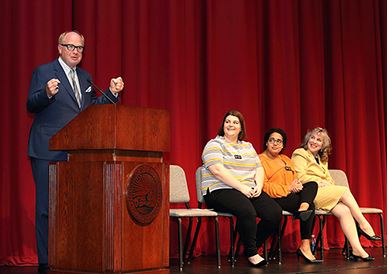
Steve Shields speaks at the announcement of the $100 million Journey Capital Campaign at Fort Hays State University on Wednesday, Sept. 28. Listening, from left, are Emily Brandt, president of FHSU’s Student Government Association; Vivian Agnew, SGA vice president; and FHSU President Mirta M. Martin. Shields, co-chair of the Journey Campaign, is president and CEO of Action Pact Development LLC, Manhattan, Kan., Atlanta, Ga., and Milwaukee Wis.
FHSU University Relations and Marketing
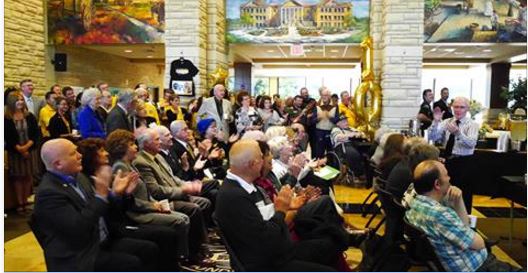
As part of its homecoming week activities, Fort Hays State University and the FHSU Foundation announced last Wednesday a $100 million, five-year capital campaign called “Journey,” the largest in the university’s history.
“The Journey Campaign is the largest, most aggressive campaign in school history,” said Jason Williby, president and CEO of the FHSU Foundation, announcing the campaign at a news conference this morning in the Beach/Schmidt Performing Arts Center in the university’s Sheridan Hall.
The campaign has four pillars, he said:
• $45 million for scholarships.
• $39 million for programs in the academic colleges, the Sternberg Museum of Natural History, the FHSU Alumni Association and Forsyth Library.
• $8 million for athletics.
• $8 million for student life.
“Our university is an amazing institution, filled with world class faculty and staff, students with tremendous potential, on a beautiful campus with many first-class facilities,” Williby told about 150 people gathered for the kickoff.
“That doesn’t mean we can’t improve, but to improve we need your support,” he continued. “Private dollars have never been more important to higher education than they are today. Help us continue to make Fort Hays State exceptional.”
The campaign’s goal of $100 million was announced by campaign co-chair Steve Shields, president & CEO of Action Pact Development LLC, Manhattan, Kan., Atlanta, Ga., & Milwaukee Wis., which specializes in organizational transformation, design, development and strategic planning in the senior living sector.
Fort Hays State, he said, has always had a tradition of relationships between people of the campus, between the campus and city, between faculty and staff, but it is not locked into traditions that stop growth and relevance.
“We’re now the third largest university in Kansas,” he said. “You want to know why that is? Based on that value of believing in people and connectedness to people and diversifying how we reach people and teach and educate and produce young people to lead the world.”
“We have diversified. We’re not afraid of new. We’re not afraid of failure. We’re not afraid of innovation. We’re not afraid of creating. We’re a nimble university, and we’re the only one I know of that can completely be described like that.
“We need to view ourselves like that, and we need to adopt that for ourselves, and by 2050 I have no doubt this will be the largest university in Kansas but most importantly it will be the most effective university in Kansas.”
That is why, he said, that he has “absolute confidence that this Journey Campaign” will meet its $100 million goal.
“We are living in unprecedented times,” said University President Mirta M. Martin, fresh off the plane from a trip to China. “With unprecedented times come unprecedented, valiant efforts to protect our future. That is why we are here today, to safeguard our values, to safeguard our future, to safeguard our university.”
We are here, she said, so that future leaders produced by Fort Hays State, like past generations, are able to live the American Dream.
Two members of that next generation also spoke: Emily Brandt, Beloit senior and president of the Student Government Association, and Vivian Agnew, Haysville senior and SGA vice president.
“Donors give students the ability to be student leaders, achieve their dreams, and do the impossible without having to worry about the costs associated with living on our own for the first time,” said Brandt.
She continued, “Donors are the reasons students succeed. They are the reason that you are sitting in front of us today and the reason that students on our campus are able to do more, be more and achieve more.”
“We thank donors for their unwavering support and kindness, for their gifts of time and encouragement,” said Agnew. “We thank them for making FHSU the destination of choice and a place that all Tigers can call home.”
Two other co-chairs, Jessica and Tyler Thompson, Kansas City, were unable to attend the kickoff.
Friday’s dedication ceremony at Dane G. Hansen Scholarship Hall
FHSU University Relations and Marketing
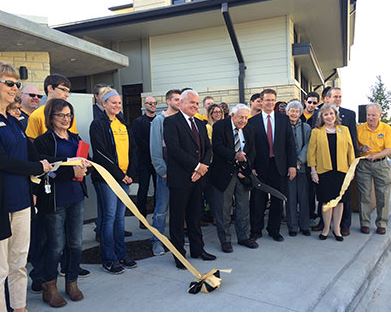
Homecoming 2015, ground was broken. Homecoming 2016, Fort Hays State University’s $3.95 million Dane G. Hansen Scholarship Hall was dedicated in a ceremony this morning.
Appropriately for a residence hall dedicated to aspiring entrepreneurs, the ribbon was cut by the Hays Area Chamber of Commerce Ambassadors at the close of the ceremony, just before the 16 Hansen Hall residents present conducted tours of the building.
Jason Williby, president and CEO of the FHSU Foundation, opened the ceremony with thanks to the major donor that made the scholarship residence hall possible, the Dane G. Hansen Foundation, Logan, which provided $3.5 million of the cost.
“I want to thank the trustees of the Hansen Foundation for believing in Fort Hays State University, for sharing our vision, for investing in the future of northwest Kansas,” said Williby before introducing FHSU President Mirta M. Martin.
“Thank you all for being here today to celebrate the beginning of the next stage of our journey,” said President Martin. “First and foremost, I would like to thank the Dane G. Hansen Foundation and its trustees. Without their belief this dream would not be a reality. Today marks the beginning of the next journey of Fort Hays State University.”
She described the journey as one of pride, emotion and dreams, “but these dreams will become a reality because of individuals like the trustees of the Dane G. Hansen Foundation, who invest in the future of our nation.”
“And the future of our nation are these guys right here,” she said, indicating the Hansen Hall residents in attendance. These students, she continued, will be the leaders and the entrepreneurs of the future who will “become part of the economic engine of Kansas and of the world.”
Doug Albin, a trustee of the Hansen Foundation, said he was asked to speak on two topics, why his foundation would invest in a project like this and “what outcomes we hope to see from it.”
On the first topic, he said, he believes that Hansen Hall reflects the person who created the foundation and funded it from his own entrepreneurial efforts.
“There are a lot of things that might make a person an entrepreneur,” said Albin, “but one thing that I really like about what I’ve heard about him as a person — I never met him — but one of the things I have heard said about him is he saw needs around him and he did what he needed to do to meet those needs.”
Turning to the second topic, he said, “So what we really hope to do in this building is reflective of what Mr. Hansen tried to do, and that was be an entrepreneur himself and help others do the same.”
Indicating the hall’s residents, he continued, “The unique thing here for these students is that I think your ideas will really help each other as you collaborate. I think that will get you a lot further than if you are just out and around on your own.”
The hall, which provides a nationally unique living and learning space for students with a passion for entrepreneurship, is open to qualifying students from all majors, a point made by Dr. Mark Bannister, dean of FHSU’s W.R. and Yvonne Robbins College of Business and Entrepreneurship.
“Our aim is to inspire students from across campus so that they can create their own careers,” he said. “We want to help them develop entrepreneurial skills by providing them with entrepreneurial experiences and associations. Hansen Hall will make a significant contribution to this process by providing a place where students who share an entrepreneurial mindset can share ideas, hopes and dreams and begin building networks.”
The 12,775-square-foot, three-story building provides individual bedrooms for 32 students and a resident assistant.
Students must complete an application that evidences their passion for entrepreneurship. They may have participated in entrepreneurial classes or activities in high school or college or been part of a startup business or worked in a family business.
Students selected to live there will be required to complete coursework for a 12-hour certificate in entrepreneurship. Students who are accepted pay a lower housing cost than available in other campus housing.
The students participate in weekly entrepreneurship activities, including presentations by entrepreneurs, tours of startup and innovative businesses, visits to business accelerators and events such as Kansas Startup and the Faulkner Entrepreneurship Challenge.
The first group of residents include students majoring in finance, management, graphic art, computer networking, entrepreneurship, construction management and fine arts majors. They range from freshmen to graduate students.
Bannister said that institutions around the country have undertaken similar housing initiatives, but the difference is that they charge students a premium for the privilege.
“At Fort Hays State, we and the Hansen Foundation have taken a different path,” he said. “Our focus is on developing our students, so we have created a scholarship and learning opportunity for these students. The price for admission is not additional dollars, but a demonstration of commitment to their entrepreneurial aspirations through success in their coursework and in completing the certificate program.”
Hansen Hall is the first of its kind among Kansas Board of Regents institutions. It also includes a community room, study areas and collaboration rooms equipped with the latest teaching and learning technologies and spaces designed to stimulate teamwork.
A conceptual feature is the expectation that the overall environment will serve as an incubator for student-based start-up businesses with the intent of benefiting the region, Kansas and America.
“We and our friends and supporters have built one of the fastest-growing entrepreneurship programs in the entire country,” said Henry Schwaller, director of the university’s Center for Entrepreneurship.
“Our focus in entrepreneurship, as in so much else here at Fort Hays State, is on hands-on learning,” he continued. “The Hansen Scholarship Hall extends that focus into their living environment. Students from across many disciplines and departments can associate with each other and foster ideas and creativity toward the common goal of becoming entrepreneurs in their various fields.”
One of the hall’s residents closed out the program. “Living in a community that supports your passion and determination is one of the biggest motivators one can have,” said Gracie Defore, a Wellington junior majoring in tourism and hospitality management. She is taking a minor in leadership studies and earning a certificate in entrepreneurship.
She described the first residents of Hansen Hall as representatives of various majors, groups, organizations and interests from all across campus. But they all share a couple of traits: They are active in the life of campus and community, and they are leaders.
“The students who live in this hall are all very involved individuals. Almost everyone in this hall is a student leader of one kind or another, whether it be in residential life, holding an on-campus or off-campus position, or being involved in sports,” she said.
She also addressed the impact of having a place like Hansen Hall.
“The sense of community that is present in this building is one that cannot be matched by a larger living facility on campus,” she said. “Having such a tight-knit group of the most elite students on campus fosters the creativity needed to build the next generation of ideas in this world.”
The FHSU Alumni Association is celebrating its 100th anniversary this year.
By DIANE GASPER-O’BRIEN FHSU University Relations and Marketing
Arris Johnson stopped in his tracks, looked up at the large murals above him and smiled.
“Seeing those brings back a lot of memories,” said Johnson, a Fort Hays State University graduate and retired professor from his alma mater.
That’s what homecomings are for, recalling memories for alumni ranging from graduates from the era of the 94-year-old Johnson, who began his career at FHSU when he enrolled there in 1939, to those who received their diploma just last spring.
That’s why the FHSU Alumni Association, celebrating its 100th anniversary this year, chose Homecoming 2016 as its venue to unveil the fourth in a six-part series of historical murals in the Memorial Union.
The murals, the work of FHSU’s Joel Dugan, assistant professor of painting in the Department of Art and Design, are appropriately named “The Journey.”
“The last one hundred years have been a journey,” FHSU President Mirta M. Martin said at Friday morning’s ceremony. “That journey is going to take us into the next hundred years.”
The first three murals, unveiled this past summer, represent places, Dugan explained. “These next three are about the people,” he said.
The fourth FHSU mural by Joel Dugan was unveiled Friday.
The latest mural is an image depicting students forging their legacy by hand carving the seal of the university atop a hill on the west end of campus. The last two murals will be revealed next summer.
Friday, people stood around long after the mural unveiling to reminisce.
“What a great opportunity for each of us to come here and share in those memories and history,” said Mitch Hall, a cattle rancher from Harper who graduated in 2005 and now serves as president of the alumni board.
“Each one of us has some unique opportunities and experiences over the last century we have shared,” Hall said. “Throughout our history, this institution has continued to bring good people together to find ways to make good things happen. Now, we’re going to continue that. That’s why we’re all here; we have a deep-seated love for this university.”
The alumni association has come a long way since its start. But, says current executive director Debra Prideaux, the organization’s mission remains the same.
“Our main mission years ago and today is to serve and engage the Tiger alumni,” said Prideaux, a Tiger alum herself. “We’re very excited that the association has been able to maintain ties to this great university and to strengthen friendships across the world.”
While the alumni association has been recognizing its centennial all year, the celebration promised to reach a peak at the past weekend’s homecoming when hundreds of alumni came back to campus for homecoming festivities.
The alumni association as it is known today was founded in the late 1920s by Nita Landrum, whose husband had come to Hays to teach history at the Kansas State Teachers College of Hays. Her husband died eight years later, but Nita Landrum stayed in Hays to raise her two young daughters.
Nita Landrum worked in several capacities on campus and was appointed executive director of the alumni association by President William A. Lewis in 1924. The basement of her home was first used as an office for the association before it moved to campus in 1928.
Now, there are more than 63,000 graduates in the FHSU Alumni Association’s database.
Coincidentally, this year’s homecoming activities began during the same week that the Kansas Board of Regents announced that FHSU, with its all-time high enrollment of 14,658, has become the third-largest university in Kansas.
“A very influential person in my life told me to come to Fort Hays State, that it was probably the best kept secret in the state of Kansas,” said Hall, who served two terms as student body president during his undergraduate days at FHSU. “I called him last week and told him ‘I think the secret’s out.’ ”
Keeping up with this historical growth is an ongoing challenge, but a welcome one, Prideaux said.
“As that Tiger base continues to change, we also have to continue to assess the needs of the Tiger community and adapt to changing lifestyles,” she said.
Prideaux said she and her staff believe in the same philosophy as the alumni association did back in the early days.
“They made arrangements for homecoming and the annual commencement dinner. They had a quarterly publication for alumni news and celebrated class reunions. They were engaged with the alumni audience,” she said. “Now, we look forward to the next 100 years as we begin a future full of new beginnings, which will commence immediately in 2017.”
In addition to serving as the official record keeper of FHSU graduates — all throughout the United States and 75 foreign countries — the alumni association sponsors numerous events, offers a variety of scholarships, keeps alumni up to date with both written and electronic communication and sets up reunions at homecoming.
There are several new programs on the horizon, Prideaux said, including the Tiger Mentorship program that kicked off last weekend. Alumni will meet FHSU students and act as mentors for them throughout their college careers.
“In the early years, it was the importance of that connection to the university that holds today,” Prideaux said. “We have a very strong engagement with our alumni base, and we look to strengthen those relationships and the friends at homecoming.”
Seven alumni were honored with awards given out at homecoming. Among those will be the Nita M. Landrum Award for alumni or friends who have provided sustained volunteer service for the betterment of the alumni association or FHSU.
“What an honor,” said Dennis Spratt from Lawrence, a 1971 graduate and this year’s Nita M. Landrum Award winner.
Spratt sponsors numerous alumni events in Lawrence because “that’s my way of giving back,” he said. “It’s so easy to do because of the leadership we have here at Fort Hays State.”
Prideaux, the long-time leader of the alumni association, first became associated with Fort Hays State University in 1983 when she moved with her 9-year-old daughter from Salina to Hays, where Prideaux’s parents lived.
She enrolled at FHSU as a non-traditional student, and “it wasn’t long that I had opened the door to a whole new world — the Tiger family — that I didn’t know existed,” she said.
Prideaux earned both bachelor’s and master’s degrees from Fort Hays State and worked in several capacities at the university before taking over as executive director of the alumni association in 1997.
“I’ve had ties with Fort Hays State for many, many years,” Prideaux said. “Through all that experience, my daughter became a Fort Hays State Tiger at 9 years old.”
Prideaux’s daughter, Lola Baalman, earned two degrees from Fort Hays State and is now married with four children of her own. Her husband, Mitch, also is an FHSU graduate. And their children, ranging from 7 to 14 years, are familiar with their parents’ alma mater as well.
“The kids have come to camps here; they’ve walked this campus, attended Tiger athletic events,” Prideaux said of her grandchildren, who live in Hoxie. “We hope that one of, if not all, their kids will become Fort Hays State Tigers some day.”
If Prideaux has her way, her youngest grandchild will become a Tiger alum somewhere in the early 2030s.
“These are exciting times, not only for the association but for the university at large. The best is yet to come, ” Prideaux said.
“There is no place better on this earth,” she added, “than Fort Hays State University.”
PITTSBURGH (AP) – Ben Roethlisberger threw five touchdowns passes for the fifth time in his career and the Pittsburgh Steelers throttled the Kansas City Chiefs 43-14 on Sunday night.
A week after suffering the franchise’s worst loss in 27 years, the Steelers (3-1) responded by overwhelming the erratic Chiefs (2-2).
Alex Smith went 30 of 50 for 287 yards and two inconsequential fourth-quarter touchdowns after things were well out of hand. Spencer Ware ran for 82 yards but also fumbled in the first quarter that kick-started Pittsburgh’s record-setting run. The Chiefs allowed four sacks to a team that came in with an NFL-worst one on the season and could do little right.
Kansas City running back Jamaal Charles ran one time for 6 yards in his first game since tearing the anterior cruciate ligament in his right knee last October. It was perhaps the lone bright spot in a loss that played in stark contrast to a romp over the New York Jets last week in which the Chiefs forced eight turnovers.
Pittsburgh’s 43 points were the most allowed by Kansas City in a regular season game since Andy Reid took over in 2013.

 KDWPT
KDWPT














 For more information on the Journey Campaign and the FHSU Foundation, visit