We have a brand new updated website! Click here to check it out!

Blue Sky Addition stalls after final plat fails at Ellis Co. Commission meeting

By JONATHAN ZWEYGARDT
Hays Post

The discussion over a proposed residential subdivision south of Hays quickly turned to a discussion on water and septic systems at Monday’s Ellis County Commission meeting.

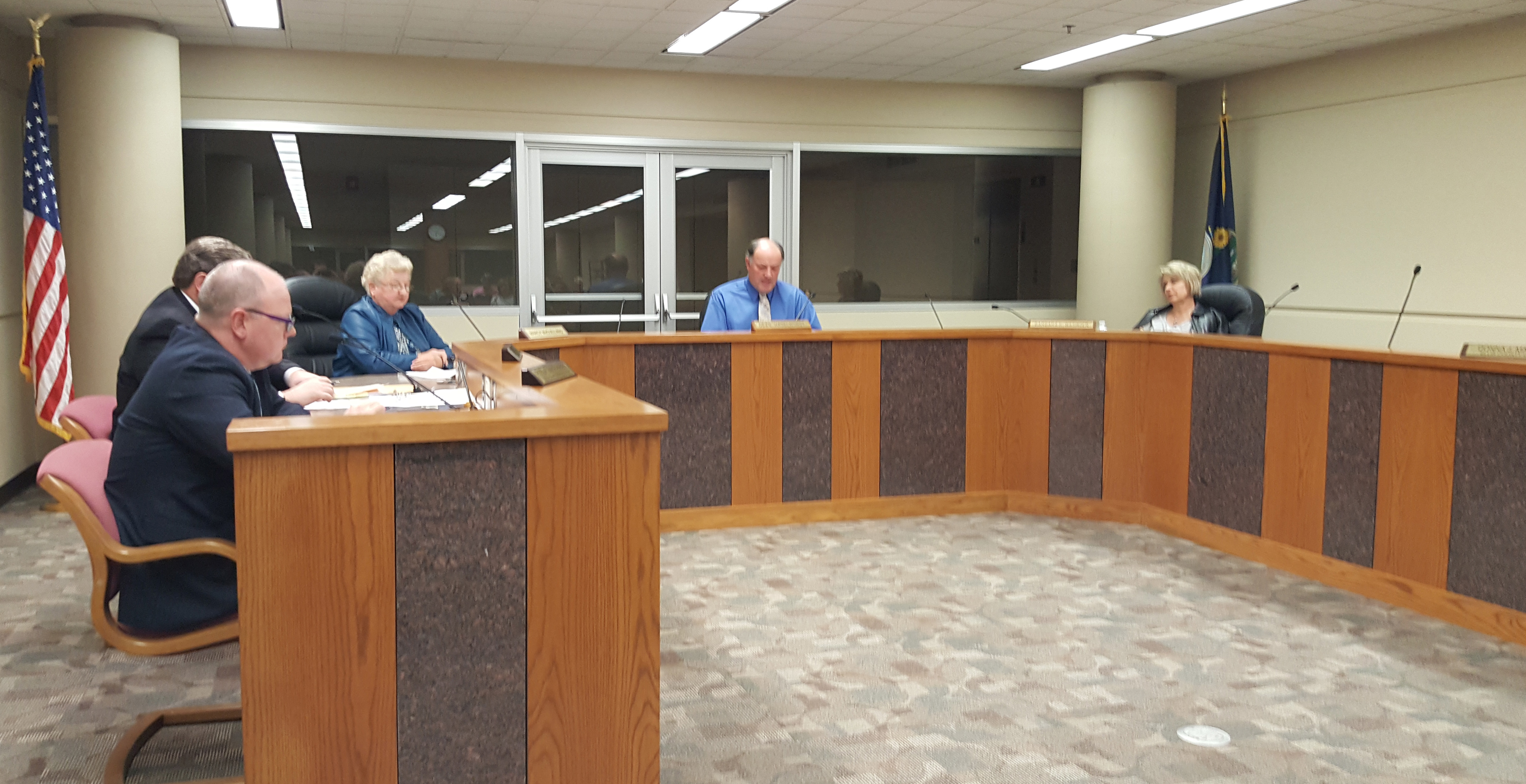
In an effort to resolve the issue of the Blue Sky Acres residential development south of Hays on Highway 183, the county commission placed the final plat back on the commission’s agenda for Monday’s meeting. The move was made, at the request of the commission, even after a motion on the measure failed to get a second at a prior meeting.20161121_174007

After much discussion and input from the public, the commission voted 1-to-1 on the final plat, defeating the measure. Commissioner Barb Wasinger and County Counselor Bill Jeter recused themselves because of conflicts of interest.

At the meeting, Commissioner Marcy McClelland, who chose not to second a motion to vote on the final plat the Nov. 7 meeting, read a prepared statement saying she has concerns about the environmental impact.

“Where is the water from these six new septic systems going?” McClelland said. “We all know it goes down in the ground.”

McClelland said she has suffered times without water and has a well contaminated. She said she “chose to look beyond the dollar signs to the health, safety and welfare of the citizens of Ellis County.”

County Commissioner Dean Haselhorst estimated the six new houses would generate approximately $20,000 per year in tax revenue.

McClelland added the septic systems could possibly contaminate the existing water wells used by residents in the VonFeldt Addition, which is directly east of the proposed residential subdivision.

Haselhorst said he has not experienced any problems and added the new systems are much more efficient than the systems put in in the 1970s in the VonFeldt Addition.

“I still have a septic system on Canterbury, along with seven other homes along Canterbury. They have been there since 1976,” Haselhorst said “We’ve had no issues with that.”

Property owner Mary Alice Unrein said she has consulted with the Kansas Water Office, and they have told her the proposed septic systems would not contaminate the groundwater. Unrein even changed the layout of the plat from eight lots to six – increasing the size of the lost from 2 acres to 2.5 acres at the urging of the County Zoning and Planning department in an effort to avoid any issues with septic systems.

Unrein claimed the current property owners in the VonFeldt Addition “will contaminate themselves first” because they do not have the updated septic tanks in place.

“There’s no way, they (KWO) told me, that I will be contaminating any of their property, at all, or their water,” Unrein said.

Terry Krannawitter lives in the VonFeldt division and disputed Unrein’s claim about the septic systems and said he has a new system and knows of another resident in the area with one as well.

He is also concerned with the amount of water available in the area.

“That’s one of the reasons we are fighting, to try to keep our survival out there,” he said.

Krannawitter, when asked, said he does not have a plan at the moment to deal with the possibility of running out of water. He said if that happens that will have to connect to another water source.

“That’s my concern,” said Krannawitter “That this doesn’t happen before we run out of water. … If the wells go dry or there’s contamination, all we have left out there is firewood.”

Unrein has talked with the Trego County Rural Water District about bringing water from the line just a mile west of the property to that area.

Haselhorst suggested the residents in VonFeldt reach out to Unrein and the RWD and work together to bring water to that area. It could be an answer to their water issues.

“If that option was available, I think I’d want to get on board with Mary Alice,” he said.

But McClelland and her husband, Tom, contend if drought conditions persist, the RWD could shut off water to the residential locations in the district.

Haselhorst said that after talking with the RWD, they have connected more than 300 homes to water and Doonan Peterbilt north of Hays is also on the Trego RWD.

Haselhorst said, “I think rural water would be a much more sustainable source than what a water well is.”

Unrein says she had a water well service test a well on the property that can provide water to 10 homes. She also owns 135 acres in that area and can “do what I want” with water on her land and “drill as many domestic as I want to on my land.”

“They’re going to have to start solving their problem theirselves,” said Unrein.

Tom Drees, serving as legal counsel for the commission, said the proposal has been approved by the county zoning and planning department, the Kansas Department of Health and Environment and the KWO.

He added the objection by McClelland based on the possible contamination from a septic system is “almost a policy decision.”

McClelland said she is not opposed to septic systems and said they will have to be used for future development in the county.

During the vote, Haselhorst voted in favor of the plat and McClelland voted in opposition, causing Wasinger to say “oh, my God.”

County Administrator Phillip Smith-Hanes said the commission will send a letter to the city informing them of the county commission’s decision.

Because the property is in the extraterritorial jurisdiction the city’s planning commission already approved the plat.

In other business, Director of Fire and Emergency management Darren Myers updated the commission on the process of updating the dispatch equipment. He said some of the equipment is more than 20 years old and must be replaced. They plan to bringing information to the commission next month.
HPD Activity Log Nov. 15–Nov. 17

hpd top sponsor jan 6

cleland pharm hpd activity log

hpd bobs bail bonds bottom 2 jan 6

The Hays Police Department responded to 20 traffic stops and 7 animal calls Tue., Nov. 15, 2016, according to the HPD Activity Log.

Water Use Violation–600 block E 13th St, Hays; 12:04 AM; 12:09 AM
Battery – simple–4300 block Vine St, Hays; 12:09 AM
Driving Under the Influence–600 block W 8th St, Hays; 1:53 AM
Warrant Service (Fail to Appear)–2200 block Vine St, Hays; 2:37 AM; 3:24 AM
Animal At Large–20th and Allen St, Hays; 8:43 AM
Found/Lost Property–100 block W 12th St, Hays; 8:59 AM
Assist – Other (not MV)–1000 block Fort St, Hays; 10:02 AM
Drug Offenses–1900 block Vine St, Hays; 11/14; 11/15
Found/Lost Property–27th and Canterbury, Hays; 11:50 AM
MV Accident-City Street/Alley–500 block Elm St, Hays; 2:53 PM
Phone/Mail Scam–500 block W 33rd St, Hays; 10 AM
Suspicious Person–3400 block Vine St, Hays; 4:21 PM
Mental Health Call–200 block E 7th St, Hays; 5:07 PM
Lost Animals ONLY–1400 block Fort St, Hays; 5:46 PM
Lost Animals ONLY–2900 block Willow St, Hays; 7:13 PM

The Hays Police Department responded to 12 traffic stops and 8 animal calls Wed., Nov. 16, 2016, according to the HPD Activity Log.

MV Accident-City Street/Alley–27th and Hall, Hays; 7:50 AM; 7:51 AM
Theft of Services–2700 block Vine St, Hays; 8:24 AM
Abandoned Vehicle–1400 block Montgomery St, Hays; 8:24 AM
Animal At Large–300 block E 22nd St, Hays; 9:07 AM
MV Accident-Personal Injury–4300 block U183 St, Hays; 11 AM; 11:02 AM
Animal At Large–200 block E 13th St, Hays; 11:38 AM
Burglary/storage unit–1100 block E 13th St, Hays; 11:44 AM
Assist – Other (not MV)–1400 block W Granite Rd, Long Island; 11:52 AM
Criminal Damage to Property–1100 block E 13th St, Hays; 12:50 PM
Criminal Damage to Property–1100 block E 13th St, Hays; 11/11 3 PM; 11/16 12:51 PM
Animal At Large–1100 block Centennial Blvd, Hays; 1:23 PM
Juvenile Complaint–300 block W 12th St, Hays; 1:40 PM
Disturbance – Noise–500 block E 6th St, Hays; 3:25 PM
Civil Dispute–2200 block Drum Ave, Hays; 4:08 PM
Burglary/vehicle–300 block E 19th St, Hays; 11/14 3 PM; 11/16 4:25 PM
MV Accident-Private Property–4300 block Vine St, Hays; 5:15 PM; 5:30 PM
Suicidal Subject–2200 block Canterbury Dr, Hays; 4:30 PM
Civil Transport–2200 block Canterbury Dr, Hays; 8:24 PM
Drug Offenses–200 block W 27th St, Hays; 8:25 PM
Civil Dispute–1100 block Downing Ave, Hays; 8:44 PM
Aggravated Battery–1000 block E 8th St, Hays; 10:30 PM
Drug Offenses–1200 block Donald Dr, Hays; 8:25 PM; 10:35 PM

The Hays Police Department responded to 22 traffic stops and 11 animal calls Thu., Nov. 17, 2016, according to the HPD Activity Log.

Traffic Stop–400 block W 27th St, Hays; 1:05 AM
Abandoned Vehicle–400 block W 11th St, Hays; 8:01 AM
Civil Dispute–300 block Main St, Hays; 8 AM
Animal At Large–2900 block Hillcrest Dr, Hays; 12:15 PM
Dead Animal Call–Hays; 1:39 PM
MV Accident-Private Property–2300 block E 13th St, Hays; 3:02 PM
Animal At Large–3300 block Hall St, Hays; 3:57 PM
Animal At Large–2500 block E 13th St, Hays; 4:30 PM
MV Accident-Private Property–4400 block Vine St, Hays; 4:46 PM
MV Accident-Hit and Run–400 block W 18th St, Hays; 4:30 PM; 4:35 PM
Animal Bite Investigation–1700 block Marjorie Dr, Hays; 5 PM; 5:40 PM
MV Accident-Private Property–1200 block Vine St, Hays; 6:25 PM; 6:45 PM
Disturbance – Noise–500 block Halladay St, Hays; 7:48 PM; 8 PM
Theft (general)–3500 block Canal Blvd, Hays; 10:10 PM; 10:18 PM
Driving Under the Influence–400 block W. 7th St, Hays; 11:25 PM

hpd top sponsor jan 6

Health law’s uncertain fate creates heartburn for health industry

screen-shot-2016-11-22-at-8-03-14-amBy JULIE ROVNER
Kaiser Health News

Six years into building its business around the Affordable Care Act, the nation’s $3 trillion health care industry may be losing that political playbook.

Industry leaders, like many voters, were stunned by the election of Donald Trump and unprepared for Republicans’ plans to “repeal and replace” Obamacare.

In addition, Trump’s vague and sometimes conflicting statements on health policy have left industry officials guessing as to the details of any substitute for the federal health law.

“It will be repealed and replaced,” Trump said Sunday in an interview on CBS’ “60 Minutes.” At the same time, he vowed to preserve popular provisions of the law like ensuring that people with pre-existing conditions can get insurance and allowing young adults to stay on their parents’ health plans.

Charles (Chip) Kahn, chief executive of the Federation of American Hospitals, said that before the election, health groups had not been meeting with Republicans about a rewrite of the law “because the working assumption was we had a program that wasn’t going anywhere. That working assumption is now no longer operative.”

Upending the health law plays havoc with a health industry that had invested heavily in strategies geared to the ACA’s financial incentives. The flipped script initially left some industry groups speechless. Others issued bland statements pledging cooperation with the next administration as they awaited greater clarity from the next president.

Said Donald Crane, who heads CAPG, a national trade group for physician organizations: “Nobody was ready for this. We didn’t have a Plan B.”

Reason to worry
The results appear to have rattled the fragile industry coalition that the Obama administration carefully crafted to support the law. Looking ahead, some health sectors might have even more reason to worry.

The hospital industry may be the most vulnerable to proposed changes, which could result in millions of Americans losing health coverage, both through the insurance exchanges and expansion in the Medicaid program for those with lower incomes.

Hospitals cut a deal with Congress and the Obama administration in 2009, when the Affordable Care Act was being drafted. They agreed to substantial cuts in Medicare and Medicaid reimbursement, anticipating that those cuts would be offset by increases in paying customers who were newly insured.

“If you’re a hospital, you’ve sort of made this deal that you’re going to get more coverage [so you] accepted Medicare cuts,” said Dean Rosen, a longtime Republican congressional staffer who now represents hospital, insurance and other health interests in Washington. “What’s going to happen now?”

If expanded coverage under Obamacare goes away, Kahn said, then those cuts should be restored, “because those were done with the notion that uninsured people were going to have coverage.”

Other sectors of the industry appear either at somewhat less risk or could even come out ahead under Trump and a Republican Congress.

While the pharmaceutical industry would stand to lose paying customers if the law was changed in a way that people lose insurance coverage, it could actually be a winner under a Republican president and Congress. That’s because the industry will be less at risk of the price controls that Democrats were vowing to try to impose. Trump mentioned drug prices a few times on the campaign trail, but references to drug pricing are not on the health agenda outlined on the transition website.

Insurers express mixed feelings about a potential repeal. The government-run online marketplaces where consumers can purchase federally subsidized coverage are a key pillar of Obamacare. But many insurers have complained about losing money in those marketplaces because too many sick people are signing up and healthier consumers are sitting out.

Some industry executives predict that the marketplaces will be curtailed and Republicans will try to shift some of that coverage to state Medicaid programs. One of the biggest growth opportunities for insurers under Obamacare has been the expansion of Medicaid managed-care contracts under which private firms take responsibility for a large group of low-income enrollees for a fixed amount of money.

That privatization of Medicaid could accelerate under the Trump administration, some experts predict.

“Whether it’s Medicaid managed care or the private insurance model, these companies get their money either way,” said Paul Ginsburg, a health economist and professor at the University of Southern California. “I don’t see much of a threat to insurers.”

The picture is even rosier considering the insurance industry dodged a debate about a government-run public option, backed by Democratic presidential nominee Hillary Clinton, that would have competed directly against private health plans.

‘Starting from zero’

The proposed changes extend beyond the health law. Many insurers expect Republicans to champion an expansion of privately run Medicare Advantage plans. These alternative plans often offer additional health benefits not covered by traditional Medicare, but they were targeted in the health law for cutbacks because back then they were more expensive to the government than traditional Medicare.

“Medicare Advantage is poised to be the big winner consistent with Republican support of privatizing Medicare,” said Ana Gupte, a health care analyst at Leerink Research.

Nothing on health care is bound to change right away. Republicans have promised to put their early focus on the health law, but even with a quick vote on repealing major parts of it, they are expected to set a lengthy transition period that keeps the current framework in place while a replacement plan is developed. At that point, Republicans will encounter many of the tough choices Democrats struggled with while writing the landmark 2010 health law. They spent more than two years trying to craft intricate compromises among industry leaders.

“The Republicans will face the same issues as the architects of the Affordable Care Act,” Crane said. “How do we fund it? Whose scalp do you take? And how do you get the most people covered for the lowest cost at the highest quality?”

Jeff Goldsmith, a health industry consultant in Charlottesville, Va., said the Republicans are “starting from zero in dealing with this. They have no idea about the subtleties.”

Some industry leaders are encouraged that Trump has softened his talk of “repeal and replace” and seems open to keeping at least some of the provisions of the health law.

Bernard Tyson, CEO of Kaiser Permanente, a large health system and insurer based in Oakland, Calif., took some comfort from Trump’s own words.

He “said no one in this country should suffer unnecessarily because they can’t afford health care. That tells me we have room to work here,” Tyson said. “I believe when they get under the hood of the Affordable Care Act, I think we may start to see and hear different conversations.”

Ginsburg predicts that Trump might apply his marketing skills to health reform.

“If you really want to continue with 20 million people having coverage,” Ginsburg said, “it will kind of look like the Affordable Care Act. There will be rebranding, but a lot of the elements will remain.”

Kaiser Health News (KHN) is a nonprofit news organization committed to in-depth coverage of health care policy and politics. The Washington, D.C.-based news service is a partner of KHI News Service.

Burdett man killed in Monday morning accident near Great Bend

A Burdett man died in a two-vehicle accident Monday morning west of Great Bend.

According to the Barton County Sheriff’s Office, at 10:50 a.m. Monday morning, officers responded to a report of an accident on U.S. 56 just west of Great Bend. The crash report indicates a 2009 Chevrolet Tahoe driven by 38-year-old Brett E. Hamby, Burdett, was westbound on U.S. 56 when his vehicle crossed left of center into the eastbound lane striking a 2001 Kenworth truck driven by 57-year-old Larry D. Lienemann of Doniphan, Neb.

The accident caused U.S. 56 to be closed for nearly three hours.

Hamby was pronounced dead at the scene. Lienemann was not injured.

The case is still under investigation by the sheriff’s department.

Kansas cheerleader suspended over KKK Snapchat pic

LAWRENCE, Kan. (AP) — A University of Kansas cheerleader has been suspended from cheering after a photo was posted on her Snapchat account linking the Ku Klux Klan with President-elect Donald Trump.

The Kansas City Star reports that the photo shows three members of the cheer squad wearing sweaters with “K” representing “Kansas” on their chests. White letters across the photo read “Kkk go trump.”

Associate athletic director Jim Marchiony says university officials were made aware of the social media posting during the men’s basketball team’s 83-63 victory over UAB. Marchiony says the male cheer squad members haven’t been suspended. Their involvement is under investigation.

KU Athletics said in an official statement that a Twitter user reported the Snapchat photo to the school. A tweet from the school described what happened as “unacceptable.”

HHS senior Hannah Norris furthers music career by releasing new album

hannah-norris-band
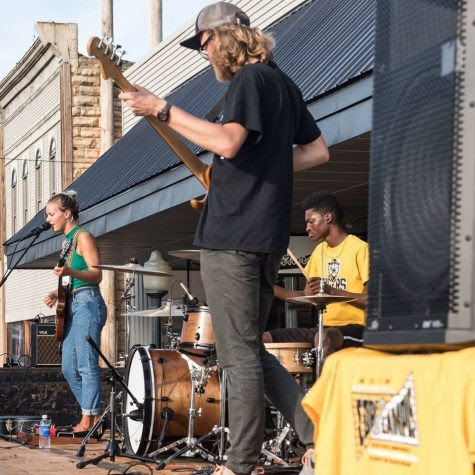
Hannah Norris and the Band play at a FHSU event in downtown Hays.

By ANNISTON WEBER
HHS Guidon

Starting at open mic nights and moving to larger venues like Wild West Fest, senior Hannah Norris now has her own band and several released albums.

Norris not only writes her own songs, but plays a variety of string instruments including the guitar, ukulele, banjo, mandolin and a little bass guitar.

“I started considering performing as an actual career when I started writing my own songs,” Norris said. “I realized that even if I didn’t make it as a touring musician, I could still be involved with music by writing it.”

Norris’s band, called “Hannah Norris and the Band,” consists of August Phlieger, a Fort Hays State University student, and Nathan Purdue, a science teacher at Hays Middle School.

“I went through several different lineups of people before my band was fully formed,” Norris said. “We’ve been performing more in the last few months than I did for a long time. We’ve played all over town, in Natoma, out at the fair, and we’re getting ready for a few dates out in Lawrence and Kansas City.”

Having a band, Norris said, has altered her sound in the best way possible.

“I always look forward to doing more shows and working on future albums with them,” Norris said.

Norris said she has been fortunate enough to play at a wide range of venues.

“I absolutely love playing bars because they have a lot of energy and it feels like you have to really prove yourself to get people to listen sometimes,” Norris said. “One of the most exciting performances was by far Wild West Fest each year I’ve done it. It’s a huge stage and you really pick up on all the energy. Another memorable performance of mine was at the K-State student radio station because they broadcasted it live and filmed the whole thing.”

The songwriting processes is what Norris said she most enjoys about making music.

“Usually, I get all the lyrics down first and then put music to it, but this last album turned out quite a bit different,” Norris said. “For this last one, I would pick out each aspects I liked out of different songs I listen to and try to put them together in a working combination. It can be very slow and time consuming, but ending up with a song I genuinely love is so worth it.”

“Ending up with a song I genuinely love is so worth it.”

— Norris

While Norris said the music she listens to for inspiration has shifted genres, she hasn’t changed the overall feel of her own songs.

“When I first started out, I was really into folk music,” Norris said. “My influences were Bob Dylan, Laura Marling, Simon and Garfunkel and the Beatles. Lately, it’s moved to a lot into more rock, like Led Zeppelin, Patti Smith, T. Rex, Kurt Vile, and Jefferson Airplane.”

Norris said the influence from Kurt Vile can be heard in one of her most recent songs.

“So far the song is still untitled,” Norris said. “I think it’s got some really solid lyrics and I love the bass line that Nathan came up with for it.”

On Oct. 31, “Hannah Norris and the Band” dropped their album, “Heartbreaker”. This will be the third album Norris has released.

“It’s much different than anything I’ve put out before,” Norris said. “Sometimes it may come across as kind of weird because I wrote about people, conversations, and situations that I interact with on a day-to-day basis. I’m sure it’s strange hearing about yourself in a song, especially if it’s not written very favorably.”

The entire album recording process was done over the span of one weekend.

“We spent 24 hours just in the studio and came out with nine tracks,” Norris said.

Songs Norris have written are available on hannahnorris.bandcamp.com.

“All of my previous works can be found on Spotify and iTunes and my third album will be up there soon,” Norris said.

Norris said even if she doesn’t make performing music a career, she wants to still be involved with songwriting.

“Music is a very intrinsic part to my personally and I’m very glad I can be involved with it,” Norris said.

Kansas gun case pits federal law against state’s rights

WICHITA, Kan. (AP) — The convictions of two men who relied on a Kansas law to protect them from prosecution for federal firearms violations have raised questions about the legal basis for gun control.

The National Firearms Act is a part of the Internal Revenue code enacted under Congress’ power to levy taxes. The prosecution of Shane Cox and Jeremy Kettler raises the question of whether that taxing authority can be used to regulate firearms that stay within state borders.

A jury found them guilty of federal firearms violations in a case with Second Amendment and state rights implications that even the judge overseeing it expects to ultimately end up before the U.S. Supreme Court.

Their defense attorneys contend their clients believed the Kansas law made their activities legal.

Affidavit: Wichita man was tortured before he was killed over meth deal

WICHITA, Kan. (AP) — A probable cause affidavit says a Wichita man was tortured before he was killed over the loss of $185 in a methamphetamine deal.

The document obtained Monday from the court by the Associated Press details the sexual torture of both 33-year-old Scottie W. Goodpaster Jr. and a woman who survived.

Four people have been charged with kidnapping, murder and other charges, and a fifth person was charged with kidnapping and robbing the female victim.

The woman told police she was made to watch Goodpaster’s ordeal on Nov. 5. The body of the missing man was found about a week later in rural Harvey County.

A staple gun was used to put staples into his eyes and mouth, and a knife was used to cut his ear and genitals.

Texas woman accused in Kan. slaying, baby abduction to be charged

WICHITA, Kan. (AP) — A Dallas woman accused of faking a pregnancy, killing a friend in Kansas and stealing her baby will soon learn what charges she will face.

Prosecutors in Kansas say a final charging decision will be announced Tuesday morning. Yesenia Sesmas is jailed in Dallas on a Kansas warrant.

Sesmas told KUVN-TV of Dallas-Fort Worth that Laura Abarca-Nogueda had agreed to turn over her newborn daughter to her but reneged on the agreement. In the interview in the Dallas County jail, the 34-year-old woman admitted that she killed Abarca-Nogueda in Wichita but said she didn’t mean to.

Abarca-Nogueda’s boyfriend found her body Thursday and a frantic search ensued for the missing 6-day-old baby, Sophia. She was found Saturday in Dallas and has been reunited with family members.

Americans who live near border say Trump’s wall is unwelcome

TRUMP USE editorial onlyBy FRANK BAJAK
Associated Press

LOS EBANOS, Texas — Forget Donald Trump’s Great Wall.

The people who live in the bustling, fertile Rio Grande Valley, where the U.S. border meets the Gulf of Mexico, think a “virtual wall” of surveillance technology makes a lot more sense. It’s already in wide use and expanding.

Erecting a 40-foot concrete barrier across the entire 1,954-mile frontier with Mexico, as Trump promised during the presidential campaign, collides head-on with multiple realities: geology, fierce local resistance and the question of who pays the bill.

People cackled at Trump’s idea that Mexico would willingly deliver the billions required. Mexican officials say they won’t. So few locals were surprised when the president-elect seemed to soften his position five days after the election, saying the wall could include some fencing.

“The wall is not going to stop anyone,” Jorge Garcia said.

Garcia expected to lose access to most of his 30-acre riverside ranch after the U.S. Border Fence Act was enacted a decade ago under President George W. Bush. Garcia is still waiting to see if the Border Patrol will put a fence or wall on the sliver of land it surveyed and promised to pay $8,300 for.

Under the law, 652 miles of border barrier were built, mostly in Arizona. The 110 miles of fences and fortified levees that went up in Texas are broken lines, some as much as a mile and a half from the river.

The Garcias believe they and the rest of Los Ebanos’ villagers were spared because the erosion-prone clay soil is simply too unstable.

Geology conspires against wall-building up and down the Rio Grande Valley. Its accomplices are a boundary water treaty with Mexico and endangered-species laws. Catwalks and tunnels had to be built into border barriers to accommodate ocelots and jaguarundi, two species of wild cat.

The plentiful breaks in the border barrier, meanwhile, include an entire flank of the River Bend golf club and resort in Brownsville — “gaps of privilege” for the well-connected, according to one critic.

Other landowners fought the Border Patrol in court.

“The wall might make mid-America feel safer, but for those of us that live on the border, it’s not making us feel any safer when we know that people can go over it, around it, under it and through it,” said Monica Weisberg-Stewart, security expert for the Texas Border Coalition, a consortium of regional leaders.

A poll conducted in Southwest border cities in May found 72 percent of residents opposed to a wall. The Cronkite News-Univision-Dallas Morning News poll had a 2.6 percent error margin.

Local politicians have found inventive ways to make wall-building palatable. A 20-mile stretch in Hidalgo County consisted of a fortified levee topped with a fence. In 2010, that levee held back flooding. The cost was about $10 million a mile, though.

In the Nov. 8 election, only three Texas border counties — all sparsely populated — went for Trump. The rest are solidly Democratic and back President Obama’s more lenient immigration policies.

The U.S. side of the border is quite safe, Weisberg-Stewart said. “We are not in a war zone.”

In fact, cross-border trade has been booming. In 2014, more than $246 billion worth of goods and 3.7 million trucks crossed the Texas-Mexico border, according to the coalition.

While much of the border’s Mexican side has been afflicted by drug cartel-related violence, crime in the Rio Grande Valley, home to 1.3 million people, has been consistently lower than other Texas cities.

The Border Patrol’s buildup after 9-11 is one reason, argues a former chief, David Aguilar. Since 2004, the year he was named to the job, the number of agents on the southwest border has climbed from 9,500 to more than 17,500.

Meanwhile, the number of border apprehensions is down from a peak of 1.6 million in 2000 to 409,000 in the year ending in September. Nearly half were caught in the Rio Grande Valley.

The Great Recession that began in 2008 made the U.S. less attractive to Mexican migrants, and Central Americans fleeing violence and poverty in their homelands now account for more than half the arrivals.

Many migrants In the Rio Grande Valley turn themselves in at border bridges. After processing, released migrants are given court dates in destination cities where relatives typically await. Others are sent to detention centers for further interviews about their asylum claims.

The Border Patrol nevertheless credits surveillance technology for curbing illegal entries, including tower-mounted surveillance cameras, motion sensors and laser pointers.

Since 2013, the agency has also had five blimp-like aerostats that float from 1,000 to 5,000 feet above the valley on tethers and are equipped with remote-controlled cameras. High-flying Predator drones are additional eyes in the sky, patrolling vast areas of southwest borderlands since 2011.

At a community center in McAllen, Texas, a 21-year-old Guatemalan who is eight months’ pregnant was bound for Kansas after turning herself in. Ingrid Guerra said she was fleeing an abusive relationship. The father of her other child, a 2-year-old who stayed behind with Guerra’s mother, was killed in a drunken brawl, she said.

“Back there,” Guerra said of Guatemala, “they kill at the drop of a hat.”

Copyright Eagle Radio | FCC Public Files | EEO Public File