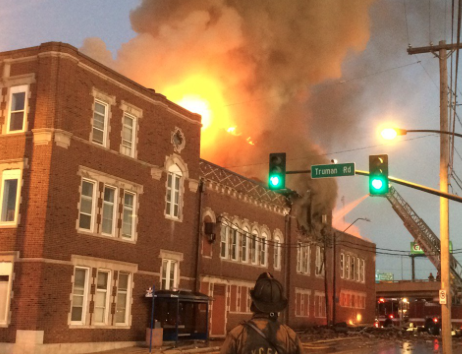
KANSAS CITY, Mo. (AP) — An explosion and fire has destroyed a historic Kansas City church.
The Kansas City Star reports that fire crews were called to the Evangelic Center Church in downtown Kansas City early Sunday morning. The fire department says the church was unoccupied when the fire broke out, and no injuries have been reported.
Kansas City Battalion Chief James Garrett said there had been an explosion and a partial building collapse at the church. He says authorities also closed nearby roads while crews battled the fire, which created a plume of smoke that was visible from miles away.
The fire department says firefighters haven’t yet determined the cause of the explosion and fire.
The church opened in 1904 for Masonic functions as the Scottish Rite Temple.
Golden Belt Bank is requesting submissions for its Lights, Camera, Save! video contest. The contest, organized by the American Bankers Association Foundation, is a national, bank-driven competition that encourages teens to use video to communicate the value of spending and saving money responsibly and translate this message to their peers.
To participate, students ages 13-18 create an original video, no longer than 90 seconds, on saving and using money wisely. They submit their video and entry form to Golden Belt Bank. Complete instructions and rules are available at goldenbeltbank.com.
Golden Belt Bank will host the local round of judging. The first place winner will receive a $500 cash prize and be entered into the national competition. Prizes of $250 and $100 will be awarded to the second and third place finishers.
Videos will be judged on their quality, message, content, and the criteria set forth by the contest’s official rules.
Lights, Camera, Save! is a great opportunity for teens to harness their creativity, learn about using money wisely, and communicate these lessons with their peers. As a community bank, Golden Belt Bank understands the importance of financial education and is thrilled to participate in a contest that helps build a generation of smart money management.
To learn more about Lights, Camera, Save, and to download the Contestant Submission Packet, visit goldenbeltbank.com.
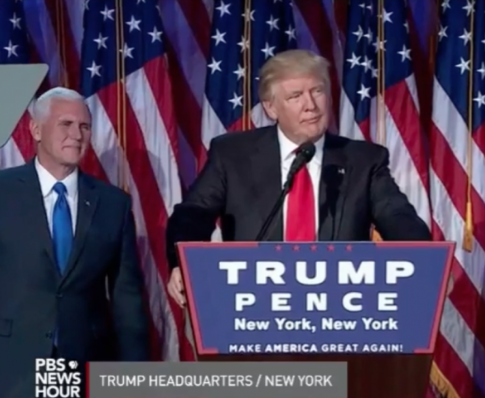
Donald Trump has suggested giving states fixed federal grants for Medicaid. On the other hand, hospitals and insurers represent a powerful lobby seeking to maintain the status quo. PBS NEWS HOUR
ByJAY HANCOCK & SHEFALI LUTHRA
The Affordable Care Act transformed the medical system, expanding coverage to millions, injecting billions in tax revenue, changing insurance rules and launching ambitious experiments in quality and efficiency.
Less of that might disappear under President-elect Donald Trump’s pledge to “repeal and replace Obamacare” than many believe, say policy analysts. Republicans promising change might not quickly admit it, but in some respects Obamacare’s replacement may look something like the original.
“It gets into a questions of semantics,” said Mark Rouck, an insurance analyst for Fitch Ratings. “Are they really repealing the act if they replace it with new legislation that has some of the same characteristics?”
Problems that helped give rise to the health law — rising costs, an aging population, mediocre medical results — haven’t gone away. The ACA pushed insurers, hospitals and employers to launch their own reimbursement reforms, which are largely unaffected by who runs Washington.
Even fierce health-law opponents may pause at the political risk of taking benefits from millions who gained coverage since its implementation. Subsidies for the middle class to buy insurance may remain — even if they’re not the Obamacare tax credits applied through online marketplaces, said Joseph Antos, a health economist at the American Enterprise Institute.
“The idea that they’re just going to wipe that money away is pretty unlikely,” he said. “They don’t want to be in a position of saying they’re just kicking millions of people out in the street.”
Others disagree.
“I think they go away,” said Ana Gupte, a health care analyst for Leerink Partners. “The subsidies … are at risk” along with the ACA’s requirement that everybody have health coverage, she said.
Topping the list of ACA provisions likely to survive under Trump is the requirement that employers cover workers’ children up to the age of 26, analysts said. The measure is widely popular and not especially expensive.
A health law crafted by Republicans might also retain the ACA’s protections for people with preexisting illness seeking coverage, said Glenn Melnick, a health economist at the University of Southern California.
That could include relaxing the ACA’s limit on how much insurers can charge and allowing them to adjust premiums based on an individual’s health, he said. However, that might put the price of insurance out of reach for many.
The health law’s payment reforms might also survive in some form. The ACA prompted hundreds of experiments to control costs by rewarding doctors for efficiency and fixing payments for episodes of care or treating entire populations.
“Part of what I would expect to hear from [the new administration] is we want more value out of the entire system,” said Daniel Steingart, a hospital analyst at Moody’s Investors Service. “All of that jibes pretty closely” with ACA payment experiments by the Department of Health and Human Services, he said. “I can foresee a scenario where they gradually expand all those programs.”
Republicans have criticized HHS’s innovation lab, which presides over accountable care organizations and many other payment tests. But they may find it more appealing under their own supervision, said Rodney Whitlock, a strategist and former top Republican health advisor in the Senate.
“You can really want to curtail it — until maybe you’re in charge,” he said. “Then maybe you would like it.”
In any case private insurance companies, employers and hospitals are likely to continue their own payment reforms, analysts said.
“Private industry is really taking that and running with it,” said Gupte. To be sure, health policy and financing are likely to look substantially different in a Trump administration, experts said.
The ACA’s biggest coverage expansion came through the Medicaid program for the poor and disabled, which added more than 15 million people. Trump has suggested giving states fixed federal grants for Medicaid, which could lead to a substantial reduction in coverage or benefits.
Even partial cuts in Medicaid funding and subsidies for private plans would hurt hospitals, which have benefited from the health law’s revenue infusion.
“If you’re running a health system and you now have more insured people through a Medicaid expansion or exchange customers — if even a portion of those go away, that might be your [profit] margin for the year,” said Benjamin Isgur, who heads the Health Research Institute at PwC, a consultancy.
On the other hand, hospitals and insurers represent a powerful lobby seeking to maintain something that looks like the status quo.
“There’s a bigger role [hospitals] can play, a much more cost-effective role we can play if we have a long-term strategy” as part of a consistent health reform program, said Bill Ryan, a spokesman for the Einstein Healthcare Network, a Philadelphia-based hospital system. “And stopping and starting seems to be a crazy way to do this.”
Other aspects of health care will probably stay the same in the near future no matter what Congress does, analysts said.
Health costs continue to grow faster than the economy’s ability to pay for them. Partly as a result, high deductibles — what patients pay before insurance kicks in — have become widespread in employer and individual plans alike. Neither have much to do with the health law, said Don Berwick, who was acting Medicare administrator early in the Obama administration.
Republicans “managed to make the public think Obamacare was causing all the trouble. That is absolutely wrong,” he said. “They could repeal it tomorrow and still have a broken delivery system and costs would continue to go up.”
Now Republicans face the same challenge, said Mark McClellan, who ran Medicare in the George W. Bush administration.
“It’ll be a different path, but the urgency of finding ways to transform health care — to give care that’s more personalized in prevention and less costly and more accessible, especially to people of limited means — the pressure to do that is not going to go away,” he said. “It’s going to increase.”
Kaiser Health News is a national health policy news service. It is an editorially independent program of the Henry J. Kaiser Family Foundation.
KHN Senior Correspondents Julie Appleby and Jordan Rau contributed to this story.
TOPEKA—When he accepted his party’s nomination to be a candidate for President of the United States, Alfred M. Landon clearly stated his platform. “The time has come to pull together,” he began. “The whole American people want to work at full time and at full pay. They want homes, and a chance for their children, reasonable security, and the right to live according to American standards. They want to share in a steady progress. We bind ourselves with a pledge we shall not ignore, thrust aside, or forget, to devote our whole energy to bringing these things about.”
Alfred M. Landon (1887-1969) was born in Pennsylvania, spent his boyhood in Ohio, and moved to Kansas when he was 17. He followed in his father’s footsteps, managing oil fields until he was elected the state’s 26th governor in 1932. With the nation engulfed in the Great Depression, he was the only Republican west of the Mississippi River to win a gubernatorial contest. His party selected him as the standard-bearer in the 1936 election.
Nancy Landon Kassebaum
Nancy Landon Kassebaum (1932) was an infant when her father became governor. She studied diplomacy and worked for U.S. Senator James B. Pearson. When he chose not to seek reelection in 1978 she entered the race and won. She was the first woman to represent Kansas in the U.S. Senate and the first woman in the Senate elected on her own right.
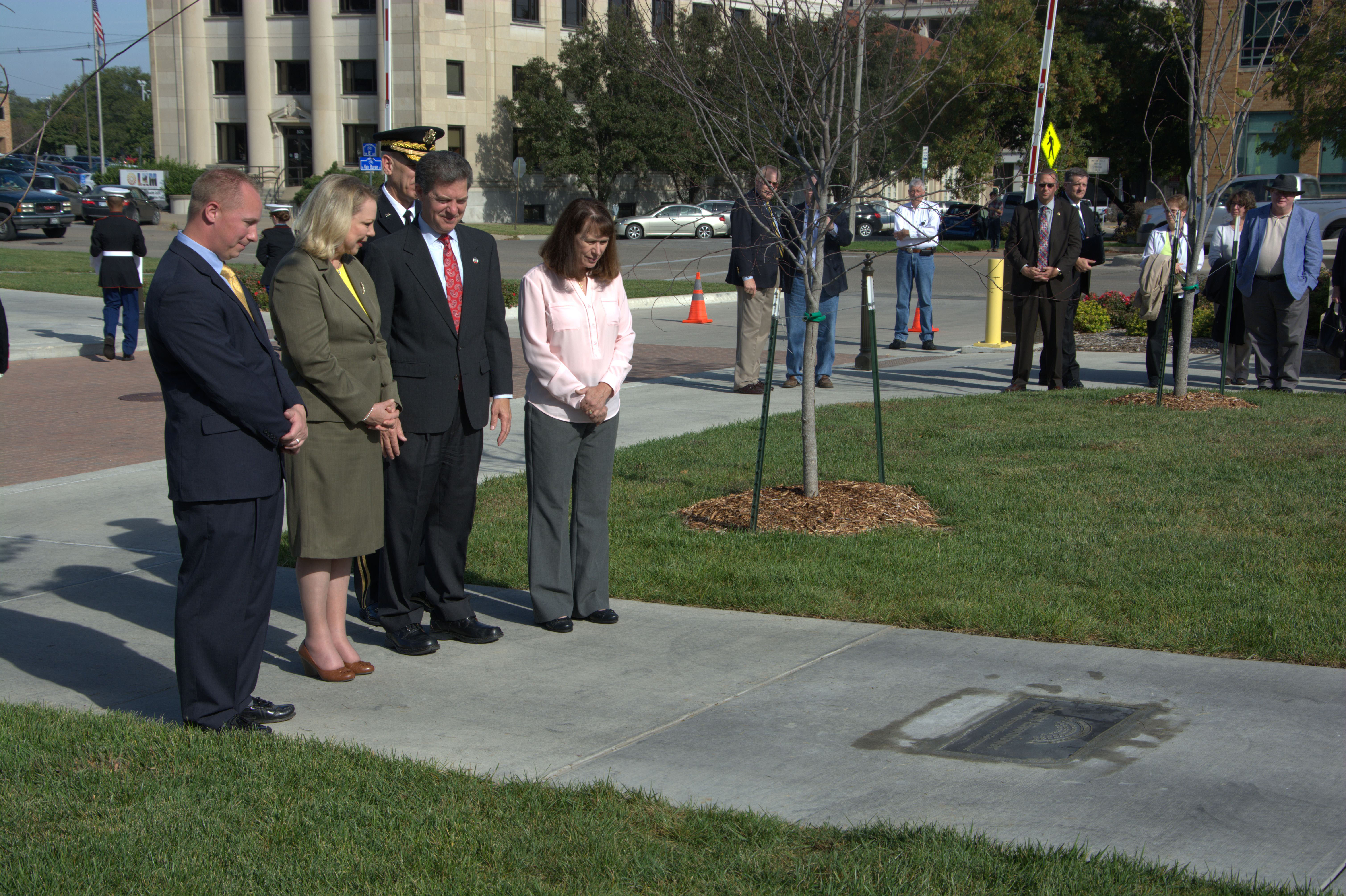
The public is invited to join in celebrating Alfred M. Landon and Nancy Landon Kassebaum as the newest inductees into the Kansas Walk of Honor. The program will be held at 10 a.m. Friday, November 18, 2016, at the Kansas State Capitol. Their bronze plaques will join 14 other notable Kansans.
The walk was established in 2011 and highlights people who contributed on a state and national level and have significant connections to Kansas. The previous honorees are Clyde Cessna, Walter Chrysler, Samuel Crumbine, John Steuart Curry, Charles Curtis, Bob Dole, Amelia Earhart, Dwight D. Eisenhower, Fred Harvey, Jack Kilby, Joseph McCoy, Karl Menninger, Gordon Parks, and William Allen White.
The Kansas Historical Foundation, a 501(c) (3), serves as the caretakers of funds for the Kansas Walk of Honor. People can donate to this fund. The Historical Foundation, which supports the Kansas Historical Society, established the walk fund so people can offer donations to cover the cost of plaques.
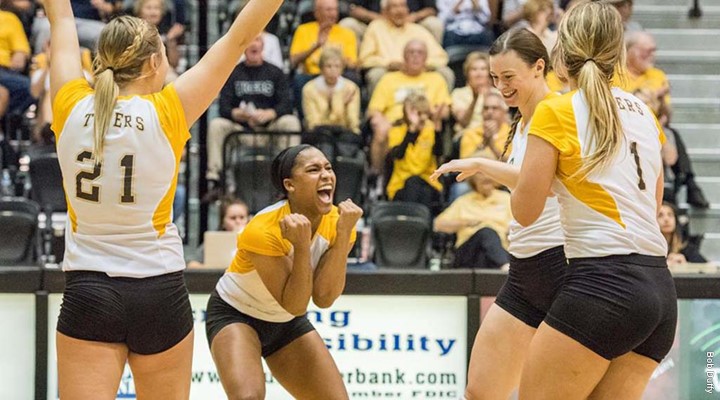
KANSAS CITY, Mo. – Fort Hays State Volleyball received the No. 5 seed for the MIAA Tournament as the bracket was released on Saturday evening. FHSU tied Central Missouri for fourth in the conference standings, but UCM held the tiebreaker on FHSU for the No. 4 seed. Therefore, the Tigers head to Warrensburg, Mo. for the opening round on Tuesday evening at 6 pm.
Fort Hays State did all it could to take the No. 4 seed in the tournament by defeating Southwest Baptist on Saturday, but the hopes were dashed later in the evening when Central Missouri pulled out a five-set win over Northwest Missouri State. FHSU needed an NWMSU win to host a first round game and NWMSU had three match points, but UCM rallied and denied FHSU from hosting.
Fort Hays State reached the 25-win mark for the first time under head coach Kurt Kohler on Saturday, just the third time the program has reached that accomplishment in its NCAA Division II history. A win in the opening round of the MIAA Tournament would push the 2016 squad to the second-most wins alone in Fort Hays State’s NCAA history. They have matched the 25 wins of the 2003 squad. The 31 posted by the 2004 team is the only mark better.
Fort Hays State split the regular season meetings with Central Missouri. The Tigers won 3-1 in Hays, but the Jennies won 3-0 in Warrensburg. The win for FHSU in Hays was one of the biggest of the season, knocking off a No. 6 nationally ranked Jennies team. UCM was ranked No. 15 for the meeting in Warrensburg and currently holds the No. 16 ranking in the nation.
The Tigers have played well down the stretch of the regular season, winning five of their last six contests. FHSU enters the match at 25-8, while UCM is 22-9. Both finished 11-7 in the MIAA. The winner will potentially play either No. 1 seed Nebraska-Kearney or No. 8 seed Emporia State in the tournament semifinals on Friday at the site of the highest remaining seed in the tournament.
The tournament schedule is below.
Tuesday, November 15, 2016 (at higher seed)
Game 1: #8 Emporia State at #1 Nebraska-Kearney 7 p.m.
Game 2: #5 Fort Hays State at #4 Central Missouri 6 p.m.
Game 3: #6 Northwest Missouri at #3 Central Oklahoma 7 p.m.
Game 4: #7 Missouri Western at #2 Washburn 7 p.m.
Friday, November 18, 2016 (at higest remaining seed)
Game 5: Winner Game 1 vs. Winner Game 2 TBA
Game 6: Winner Game 3 vs. Winner Game 4 TBA
Saturday, November 19, 2016 (at same location as Friday matches)
Game 7: Semifinal Winners TBA
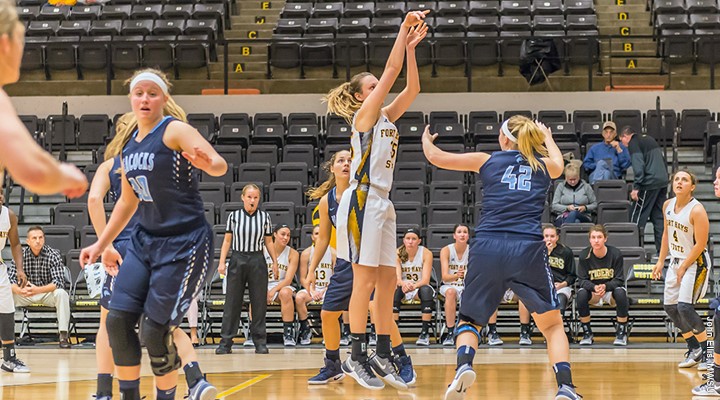
SIOUX FALLS, S.D. – Fort Hays State fell in its season opener to Southwest Minnesota State by a score of 84-60 on Saturday evening. A close game throughout the first half, FHSU went cold shooting the ball in the second half while SMSU heated and ran away with the game.
The Tigers and Mustangs went back-and-forth in the first half with 12 lead changes and eight ties. SMSU found a bit of separation by the end of the half, leading by five at the break 39-34. The Tigers shot well in the first half at 53.6 percent, while holding the Mustangs to just 41.4 percent. The free-throw line was the difference for SMSU before the break, where it was 13-of-14 compared to just 3-of-5 for FHSU.
Fort Hays State closed within four points twice early in the second half, but a 10-0 run by SMSU from the 15:14 to 13:40 marks quickly changed the complexion of the game. The Tigers would never cut the lead back inside double digits as the Mustangs shot the ball well after the break and cruised to the final 24-point margin. SMSU shot 56.3 percent from the field in the second half, which included a 5-of-10 effort beyond the 3-point line.
Hadley Gillum had the hot hand for FHSU, finishing with 20 points. He was 9-of-12 from the field and 2-of-2 at the free-throw line. Rob Davis was the only other Tiger in double figures with 11 points. After a hot shooting first half, FHSU cooled to just 37.5 percent shooting in the second half. The Tigers struggled from 3-point range all night, going just 1-of-10 beyond the arc. FHSU finished at 46.2 percent shooting from the field for the game. Turnovers were also a sticking point for FHSU, committing 19 compared to just eight for SMSU.
The Tigers face host University of Sioux Falls on Sunday evening (Nov. 13) at 5 pm in their second game at the NSIC/MIAA Challenge.
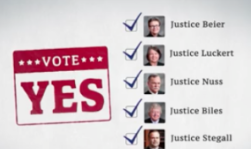
TOPEKA, Kan. (AP) — Now that Kansas voters have decided against removing any state Supreme Court justices, the court will turn its attention to cases involving education funding, capital punishment and abortion that led critics to try to remake the court.
Efforts to remove four of the seven justices started with critics of past rulings overturning death sentences in capital murder cases.
The justices plan to hear arguments in December in the case of a man sentenced to die for killing his estranged wife and three other family members in northeast Kansas.
Abortion opponents and conservative Republicans also wanted to remove the justices ahead of major rulings on abortion and school funding cases.
The court has yet to hear the abortion case, but a ruling on education funding is expected by early next year.
PHILADELPHIA (AP) — A college student in Oklahoma has been temporarily suspended amid racially charged outbursts at schools and universities across the country following Donald Trump’s presidential election.
The Associated Press and other media outlets identified more than 20 reports of racist incidents at schools since Tuesday, including a group chat aimed at black freshmen at Trump’s alma mater, the University of Pennsylvania.
Penn President Amy Gutmann says the chat contained “violent, racist and thoroughly disgusting images and messages,” and Penn is “appalled” its students were added to the GroupMe account. She says Penn police have been working with the FBI.
University of Oklahoma President David Boren said in a statement the student at his school responsible has been temporarily suspended. The school will investigate further.
RENO COUNTY – Two people were injured in an accident just before 7p.m. on Saturday in Reno County.
The Kansas Highway Patrol reported a 2010 Toyota pickup driven by Destiny Lynn Schulze, 19, Deer Park, TX., was northbound on Kansas 14 two miles south of South Hutchinson.
The pickup drifted off left edge of roadway.
The passenger grabbed the steering wheel and pulled it back to the right. The pickup entered the east ditch and turned over.
Schulze and the passenger Hannah Alyese Hall, 19, Harris, TX., were transported to Hutchinson Regional Medical Center.
Both were properly restrained at the time of the accident, according to the KHP.
Southwest Minnesota State jumped out to a 5-0 lead hitting their first two shots of the game before Fort Hays State put together a 12-0 to take a lead they would never give up. The Tigers led by seven twice in the first quarter but then went on a 4:40 scoring drought extending into the second quarter, allowing the Mustangs to stay with in five points at the end of the first quarter 15-10.
Once the Tigers broke out of the shooting drought they took off. Fort Hays outscored the Mustangs 25-13 in the second quarter to take their biggest lead of the game to the locker room 40-23. The Tigers were powered by eight three pointers in the first half by six different players. Fort Hays defensively forced 15 first half turnovers leading to a 12-1 scoring edge off of turnovers.
Highlights
The Tigers defense didn’t relent in the second half allowing a single point in the first five minutes of the third quarter and building their lead to 49-24. Fort Hays would push their lead as high as 30 in the third quarter and lead 59-32 heading into the fourth and cruised to an 83-49 victory.
Coach Tony Hobson
Jill Faxon led four in double figures with 16, Emma Stroyan scored 14 and Taylor Rohlfs and Kacey Kennett each added 12. Fort Hays hit 13 three pointers in the game while shooting 49% overall. Freshman Lauren Hedlund led the Mustangs with 12.
Emma Stroyan
Fort Hays moves to 2-0 on the season and head to St. Cloud, Minnesota to take for another two game classic, playing St. Cloud State on Friday and Bemidji State on Saturday. Southwest Minnesota State falls to 0-2.
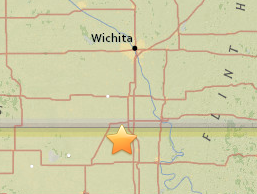
SUMNER COUNTY -A pair of earthquakes measuring a magnitude of 2.5 hit south central Kansas on just before 9p.m. on Friday, according to the U.S. Geological Survey.
Both quakes were centered approximately 19 miles southeast of Caldwell.
On November 5, a 2.9 quake hit just before 4:30 a.m. and was centered approximately seven miles northwest of Conway Springs.
There are no reports of any damage or injuries.
A 3.3 magnitude quake was recorded at 2:54 a.m. Friday near Geary in west-central Oklahoma, followed by a 3.0 magnitude quake at 5:12 a.m. near Medford in the north. At 9:50 a.m., a magnitude 3.0 earthquake struck close to Luther in central Oklahoma.
No damage or injuries have been reported. Geologists say damage is unlikely in earthquakes below magnitude 4.0.
A 5.0 magnitude earthquake on November 6, damaged structures in Cushing, Oklahoma, but no damage was reported at the oil terminal.
KEARNEY, Neb. – Shaquille Cooper rushed for a season-high 152 yards and a touchdown, Charles Tigner added another 95 on the ground with three touchdowns and Fort Hays State outscored Nebraska-Kearney 20-7 in the second half and beat the Lopers 27-17 Saturday afternoon at Cope Stadium at Foster Field.
Fort Hays State (7-4) finishes with their third straight season of seven or more wins, a first in program history.
Chris Brown Postgame Press Conference
Shaquille Cooper Postgame Interview
Charles Tigner Postgame Interview
Game Highlights
The Tigers (7-4) rushed for a season-best 299 yards as they win their fifth straight over the Lopers and fourth straight in Kearney.
Tigner scored on runs of 41, one and 29 yards, all out the wildcat package. Cooper’s 12-yard touchdown run with 4:02 to play capped a nine-play, 75-yard drive after Nebraska-Kearney (1-10) had cut the lead to three.
Fort Hays State struggled throwing the ball. Backup quarterback Brad Schencker completed 7-of-19 passes for 36 yards with no touchdowns and interceptions.