We have a brand new updated website! Click here to check it out!

MORAN: 21st Century Cures Act provides hope this holiday season

U.S. Sen. Jerry Moran, R-Kan.

By U.S. Sen. Jerry Moran, R-Kan.

The bipartisan 21st Century Cures Act (Cures Act), which was passed by Congress and signed into law this month, provides a measure of hope this holiday season for those suffering from devastating illnesses. This legislation represents a significant investment in the future of our country, with funding to accelerate the discovery and development of new cures and treatments for rare disorders, cancer, Alzheimer’s and many other diseases. It provides a significant increase in federal support for lifesaving biomedical research at the National Institutes of Health (NIH) that will impact the life of every American – certainly every American family.

Right now half of all men and a third of all women in the United States will develop cancer in their lifetime. The Cures Act’s ‘Cancer Moonshot’ provision will hopefully change those statistics and reduce both the prevalence of and the costs associated with cancer. It will focus on accelerating research, making therapies available to a wider range of patients and improving early-state detection – with the ultimate goal of preventing the disease altogether.

The best way to improve outcomes for Americans with diseases is consistent support of medical research. As a member of the Senate Appropriations Health Subcommittee, this has been a top priority of mine as we make funding decisions. NIH-supported research over the last several decades has raised life expectancy, improved the quality of life and lowered overall health care costs for millions. Given the progress we have made over the last century and the great potential current research holds, we must continue our commitment to advance cures and treatments.

Medical research also helps us develop new pharmaceutical strategies to fight diseases, and this legislation brings a patient-focused view to drug development. We need reforms at the FDA that speed up the approval of new medicines and medical equipment without sacrificing the FDA’s standards in the process of curing and treating Americans – especially as prescription drugs are increasingly used to treat diseases.

After visiting several of Kansas’ community mental health care centers and both Larned and Osawatomie State Hospitals, I have developed a greater appreciation of how critical it is to prioritize mental health treatment. Opioids have been a topic of conversation in the Senate for the last several years as millions across the country – in both urban and rural areas – struggle with addiction. Important sections of the Helping Families in Mental Health Crisis Act, which represent some of the most significant reforms to the mental health system in more than a decade, are included in the Cures Act. It is a much-needed follow-up to the Comprehensive Addiction and Recovery Act, which I supported and which became law earlier this year, to help curb the spread of opioid abuse in communities across the country.

For the more than 11.5 million Americans living with a debilitating mental illness, the Cures Act will bring relief by focusing on improving mental health treatment and access, increasing funding for suicide prevention efforts, and combining a number of important mental health reforms to coordinate system-wide efforts.

The Cures Act also accelerates opportunities for smart, talented individuals across the country who wish to devote themselves toward the cause of improving Americans’ health and quality of life. To attract and retain the best and brightest researchers, NIH must be able to rely on sustainable funding from Congress. While the broad, bipartisan support for the Cures Act is a significant achievement, I intend to build on that success by continuing to support NIH. Over the last two years, the Health Appropriations Subcommittee I serve on has reprioritized funding by $4 billion, and I will continue working with my colleagues on the Senate NIH Caucus to encourage a greater understanding of how investing now will save our country billions in health care costs in the future.

In addressing these priorities, the Cures Act is the kind of policy change that truly impacts every American. It is progress we can be thankful for this holiday season as we gather with our loved ones and remember how precious our time together is. We all know someone who has suffered from a deadly disease, and this new law gives hope to families across the country that treatments and cures are on the way.

Sheridan Co. farm places in state sorghum yield contest

screen-shot-2016-12-20-at-9-25-06-amSELDON – Jeff Wessel of Seldon recently won third place in the Irrigated Conventional-Till division of the 2016 National Sorghum Producers (NSP) Yield Contest in Kansas. The Beckmans and Wessel won with Pioneer hybrid 84G62, 85G46 and 85G03, which yielded 188.44, 154.05 and 130.31 bushels per acre.

The Beckmans and Wessel earned one of the 66 Kansas titles won by growers planting Pioneer hybrids. The NSP awarded 102 Ks. titles in this year’s contest. Growers planting Pioneer hybrids dominated the contest and won 65 percent of all Kansas awards presented. Pioneer sorghum growers won 18 of 26 national titles awarded in 2016.

First-, second- and third-place national honors were awarded in each of the eight divisions: irrigated no-till, irrigated reduced till, irrigated conventional till, irrigated double crop, dryland no-till, dryland reduced till, dryland conventional till and dryland double crop.

“Pioneer brand sorghum hybrids continued to demonstrate their strong agronomic profile and yield potential in the 2016 NSP Yield and Management Contest,” said Liesel Flansburg, DuPont Pioneer marketing manager. “Our high-yielding products, coupled with the very best management practices, are providing top yield results for sorghum growers across the United States.

“We continue to invest in sorghum research to improve our products and the defensive traits that protect top yields,” she said. “Our team in the field is ready to help growers find the right Pioneer brand sorghum product and management practices for their production acres in 2017.”

Exploring Kansas Outdoors: Oh, you mangy critters!

BullCityBlack500x125 (1)

I trapped until deer rifle season, figuring to set out more traps this week, weather permitting. I had one spot I was very anxious to trap but couldn’t get into earlier because the farmers milo was not yet cut. What makes this spot special is a brushy draw about 30 yards wide and over 300 yards long that’s situated in the middle of a quarter section with milo stalks on one side and new wheat on the other. A drainage runs through the middle of the field and through the middle of the draw, making it low in the middle and much higher on each end. There is always lots of coyote sign on this property no matter what crops are there or how they are situated, and this year is no exception.

Steve Gilliland
Steve Gilliland

A month ago I was getting antsy to get back there and was able to drive in as far as the top of the draw, as some of the milo was cut. I parked there and decided to go for a stroll to look things over and get an idea of how to work it this year. As I strolled slowly along I caught a coyote slipping out just ahead of me and disappearing into the standing milo.

Sunday afternoon I finally got out there and set five traps, one at each end of the draw, two along one side where the drainage enters the draw and one on the far side of the property. Monday morning I had a coyote at the far end where milo stalks, new wheat and the brushy draw come together. As I approached the coyote, its fur and especially its head were an odd dirty color. When I examined it, I found a few small bare spots and notice its tail was partially bare; it had mange and its pelt was of no value. Tuesday morning I had a coyote at the near end where milo stalks, wheat and brush all came together. At first glance the fur on that coyote looked good, but a closer look showed me the fur on one hip was very thin; it also had the beginning stages of mange. Wednesday morning I had a coyote in the trap at the very back of the property. Its fur was the same strange color as the first and it had bald spots all over its body and its tail was nearly bare. All three coyotes had different stages of mange and I’m surprised any of them had survived the recent cold weather.

I spoke with Matt Peak, Fur Bearer Biologist with the Kansas Dept of Wildlife, Parks and Tourism about mange in Kansas coyotes. The simple explanation is that tiny mites burrow into the coyotes skin, making it scratch fiercely trying to relieve the itch, and causing bare spots to appear all over its body where fur has been rubbed off. That resulting condition is known as mange. Coyotes with mange in the spring will pass it on to their pups. Adult coyotes can survive the spring and summer with mange but pups contracting it from the adults will die. Matt said some coyotes seem to have a natural immunity to contracting the mites, so not all coyotes, even in the same area will get mange. I caught three beautiful coyotes this year not more than one and a half miles from this spot.

Adult coyotes with mange in the winter will almost certainly die from the cold, having rubbed off the thick fur necessary for survival. Mange also stresses a coyote, making it difficult for them to hunt and thus prone to starvation. The cold will not kill the mites as they are burrowed under the skin and will die only if the coyote dies. Matt told me no conclusive studies have been done as to whether a higher coyote population aid in the spread of mange, nor has any particular weather trend been proven to facilitate mange. Three coyotes caught on the same property in as many days is pretty respectable and I was feeling pretty good about my trapping ability, until Matt and I discussed the fact that coyotes stressed with mange are also seriously looking for an easy meal and will throw caution to the wind and put themselves into situations they normally might avoid or at least be more wary about. So catching mangy coyotes is probably not worthy of bragging rights.

Sadly, the pelts from mangy coyotes are worthless. I hate that, but my killing them is actually way more humane than allowing them to suffer and die from the cold and from starvation. I have this to say to folks who are against hunting and trapping; if hunting and trapping were to cease, nature would control populations of all wildlife, but it would be through very ugly means like disease and starvation, plus as populations soared, many animals would be indiscriminately shot by farmers and ranchers and simply allowed to lay where they fell. I’ll take my way thank you! Continue to Explore Kansas Outdoors.

Steve Gilliland, Inman, can be contacted by email at [email protected].

BullCityBlack500x125 (1)

CMS, Kansas at odds over disability services payment change

BY ANDY MARSO

A federal agency has instructed Kansas to halt a change in how the state reimburses providers of home and community-based support services, or HCBS, for people with disabilities.

But state officials say concerns expressed by the Centers for Medicare and Medicaid Services are based on false information.

“KDHE (the Kansas Department of Health and Environment) and KDADS (the Kansas Department for Aging and Disability Services) have asked CMS to reconsider the letter they sent because the letter is factually inaccurate,” Brandt Haehn, the commissioner of HCBS, said in a phone interview this week.

Disability service providers say CMS has it right and the state should pause a policy change that is making it difficult for some of them to stay in business.

At stake are Medicaid payments to hundreds of providers across the state who bill under the residential pay policy for services to Kansans with disabilities.

Until this year, they had been averaging payments based on their clients’ assessed needs on a 30-day-per-month schedule, regardless of whether they served the clients each day.

State officials announced their intention in May to allow billing only for actual days served. The change was part of cost-cutting measures to close a midyear budget gap.

Service providers said the change, which took effect Oct. 1, would cause an unsustainable hit to revenue.

Derek Laney, the CEO of a Johnson County provider called Kansas Focus, said this week in a phone interview that’s still the case.

“It’s a roughly 35 to 40 percent cut in reimbursement,” Laney said.

The policy change was one of two KDADS made to HCBS during the budget-balancing.

James Scott, an associate regional administrator in the Kansas City CMS office, sent a letter to state officials in October, saying they should halt implementation of the other change — known as the “capable person” policy — until CMS has reviewed it.

Megan Buck, another administrator in the Kansas City CMS office, sent a similar letter Nov. 8 to state officials about the residential pay policy change.

Buck wrote that the state must halt the residential pay change until it provides CMS more information about how it will affect “efficiency, economy and quality of care and sufficiency.”

Mike Randol, KDHE’s Medicaid director, responded with a Dec. 12 letter asking Buck to reconsider.

When the HCBS program began in 1991, the payments for residential care were never intended to be averaged over 30 days, Randol wrote.

Therefore, Randol wrote, the state is operating under Medicaid policies already approved by CMS.

Laney disputed that, saying the state had been processing payments on the 30-day average basis for years. He likened it to schools spreading teacher salaries over a calendar year, without regard to breaks.

Laney said CMS officials contacted him last week to ask if he could produce any evidence that the state had used that policy for residential pay.

“I was able to do that with two provider manuals,” Laney said.

Haehn said the state has been in contact with CMS since Randol’s letter went out but has not received an official answer on whether the federal agency will reconsider its order.

Any action by CMS to halt the policy change would be too late for one Johnson County provider. Vickie Vermillion operated Cornerstone Supports in Olathe until last month, providing supports for 19 adults with developmental disabilities.

She decided to close the company rather than try to adjust to the new residential pay policy, because reimbursement rates were already low.

Vermillion said via email this week that even if the state heeds the CMS request, she would not be able to reopen after helping her clients find other providers and her staff find other work.

Chad VonAhnen, executive director of Johnson County Developmental Supports, said his public agency had to request money from county commissioners to hire more staff to absorb some of Vermillion’s clients.

VonAhnen said the state had not told his agency about the Nov. 8 letter from CMS or the back-and-forth state officials are having with federal officials about the residential pay policy change.

He said he received a copy of the Nov. 8 letter last week from the Disability Rights Center, which obtained it through a federal Freedom of Information Act request.

“We haven’t seen any changes either from the state or from the (KanCare) managed care organizations on halting the implementation,” VonAhnen said. “We have a lot of questions.”


Tenure v. adjunct: A closer look at Kansas university professors

adjunct-vs-tenure-graphic-sarah-krugerBy BENJAMIN FELDERSTEIN

Natalie Grant has been second guessed her entire life. Her peers have doubted her. Her potential has been questioned.

Since Grant became an academic adviser at Wichita State in 2001, she knew she wanted to pursue something greater in academics.

In 2007, Grant was hired as an instructor in Wichita State’s School of Social Work, where she began her long journey to fulfill her teaching dreams. While Grant was an instructor, she taught several classes in the Social Work curriculum, as well as studied to earn her doctorate. Now after being hired as an assistant professor in 2011, Grant is well on her way to earning tenure at WSU.

“I have fought hard to prove myself and to achieve,” Grant said. “While it is not something I go into great detail about with students, it does allow me to empathize and understand the processes of growth and achievement.”

Nationally, adjunct teachers are on the rise. David Wright, associate Vice President for Academic data systems at WSU reports that since 2009, adjuncts and non tenure-track staff members have increased by more than 9 percent. Comparatively, tenure and tenure eligible numbers have decreased.

Having been a part of both the tenure and non-tenure side of teaching, Grant acknowledges advantages to both. Each bring different perspectives to the classroom.

“I was kind of groomed onto the tenure track” Grant said. “The University was like, ‘Let’s do this, let’s get your Ph.D.’”

Grant was encouraged by her department chair Linnea Glenmaye to pursue her doctorate. When Glenmaye moved on to work in the Provost’s office, the current chair, Brien Bolin continued pushing Grant toward the tenure track and ultimately worked within the system to solidify Grant’s tenure-track position.

“I have always known that in order to be a professor, I needed a doctorate,” Grant said. “Having been with the University for seven years prior to entering the doctoral program, I had multiple conversations with professors and leaders within the institution. I went through an extensive decision making process as to how I wanted to complete it.”

Grant is the mother of three children, as well as the caretaker of her grandmother. She needed a Ph.D. program that fit into her life.

After a long deliberation period, Grant enrolled in WSU’s Educational Leadership program. This program was the most practical for Grant to continue caring for her family and still pursue her career goals. WSU’s website explains the program as beginning to work in the real world.

Members in the program work with a mentor in order to identify strengths and weaknesses within your desired program. The program is two years long, and is designed to put you in a group that becomes your “learning family” for the duration of the program.

“It gave me all the opportunities I wanted for my education, deepened my knowledge of WSU, and really gave me a much stronger focus on my goals within my career at WSU,” Grant said.

Professor Requirements

In order for an assistant professor to earn tenure at Wichita State, he or she must meet several criteria. It includes a probationary period of seven years, which takes more than just meeting that seven-year mark. Decisions regarding tenure are made on the academic credentials on the candidate hoping to receive tenure.

When a professor or administrator searches to find a job at a university, Glinmaye, who is now WSU’s associate Vice President for academic affairs, said he or she applies for the position with the knowledge of it being a tenure or non-tenure position.

“A new staff member’s offer letter includes whether or not the position is tenure eligible,” Glinmaye said. “It would also include a date for mandatory tenure promotion review.”

During an assistant professor’s sixth year at WSU, he or she has a tenure review period to determine if he or she is upholding the standards of the university and ready to receive promotion and tenure.

Grant said the beginning of the tenure review process provides a confirmation of her life’s goals. It is crucial for her to maintain her position at WSU and remain a leader on campus.

“If I do not receive tenure, I lose my position, my job, everything I have fought to achieve for the last 15 years,” Grant said. “My family would be displaced and a questioning of my path in life would occur.”

Tenure decisions can be made by a variety of entities; specific departments tend to have requirements for tenure-track hires on their own. For example, WSU’s school of social work has an entirely separate set of guidelines for receiving tenure than, say, the business school.

Tenure is not only granted based on a professor’s prior accomplishments. It is given with the idea in mind that the future of the professor’s career will be as bright as his or her past. The hope is that a tenured professor will continue contributing research to the University as well as providing opportunities for scholarship.

“(Tenure) is a badge of honor, it’s a respect thing, it legitimizes you in the institution you are with,” Grant said.

Tenure vs. Adjunct


Both adjunct and part-time professors provide clear advantages to their classrooms. A professor that is either tenured or on the tenure-track has the ability to focus his or her time on either teaching or doing research to further legitimize their university. Meanwhile, adjunct professors have the ability to bring knowledge from outside jobs to increase their students’ knowledge inside the classroom.

At WSU there were 420 adjuncts and non-tenure track teachers at the school in 2010, while that number grew to 442 in 2015 (5.2 percent increase). Meanwhile, tenured professors have fallen off, as there were 407 in 2010 and 392 in 2015 (3.7 percent decrease).

This trend of growing adjunct numbers is consistent at the University of Kansas as well, as tenured professors have dropped from 904 to 879 (2.8 percent decrease) at KU in the past year, and part-time instructor numbers have risen from 509 to 530 (4.1 increase).

According to the Atlantic, the number of full-time-tenured faculty has decreased nationally by nearly 10 percent since 1975 and sits around 18 percent now. Meanwhile, part-time faculty figures are on the rise, growing more than 15 percent in that same time.

Kansas State has 1,088 members of its faculty, with 546 of those members already having tenure, and another 243 are on the tenure track. K-State’s 73 percent is the highest amongst the three major universities in the state of Kansas.

Glenmaye said while adjuncts can be economically beneficial to a university, it is not the driving motive behind the increasing hires.

“I think our hiring practices have been stable over a fairly long period of time,” Glenmaye said. “Departments are hiring adjuncts when either tenured professors cannot teach a class or there is a very specific need to be met.”

Glenmaye continued to say there are times when community professionals are more qualified to teach a course than a tenured faculty member. She also said it is possible that as the number of online classes increase, adjuncts might be hired more to instruct those classes.

On the tenure-track, Grant is doing research to supplement her academic curriculum. Grant has published six articles in the past five years, adding legitimacy to her department and the university.

“We are also scholars that study deeply into our subjects,” Grant said. “We have a much better understanding of the impact and intention of the material because of the research.

Electrical Engineering and Computer Science Chairperson at the University of Kansas, Victor Frost, echoes the sentiment that tenured professors are invaluable to their university, as all of their time and energy is put into either their class or the betterment of the institution.

“Being a research-one university, tenured faculty are doing more than just teaching,” Frost said. “They’re involved in research and creating knowledge, which is very often brought into the classroom.”
While KU’s EECS program only has tenured faculty on its staff, Frost acknowledges the value of having part-time professors with constructive jobs as well.

“Anything that brings practical examples into the classroom is a benefit to the students,” Frost said.

Frost said the EECS department has always used tenured faculty. He went on to say that guest lecturers are occasionally brought into classrooms to provide real world cases to the students.

Matt All is an adjunct professor at the KU Law School. He is also the senior vice president of the general counsel at Blue Cross/Blue Shield of Kansas. All teaches insurance law at KU and has taught other classes such as Indian Gaming Law.

KU’s law school had not been teaching insurance law, and Edwin Hecker, the law dean at the time, got in touch with All to begin teaching the class in 2002.

All said that his teaching position has helped with his day jobs as well, crediting the classroom with making him a better lawyer and insurance regulator. He said there is a strong link between what happens in his classroom and what he deals with on a daily basis in the real world.

Especially when it comes to law school, All said that students find there is often a lot more ambiguity and gray-areas outside of the classroom than in the cases they read in textbooks. All has the ability to bring real-life examples of that ambiguity into a teaching environment to give his students a preview of what to expect.
“What I find is that their eyes light up when I talk to them about what being a lawyer is like, and what different types of career paths they can choose,” All said. “I can describe how a legal issue actually manifest itself into a real-life situation.”

While All brings outside instances into the classroom, he admits that it is not the most important part of being an instructor. He said he advises new instructors that “war stories” cannot supplement a real syllabus. Stories and scenarios from day jobs should only be used as supporting material. All said understanding the material you are going to teach is crucial to your success and the success of your students.

“As an adjunct, you have to teach them the basic material and respect that and use your experience and material as a compliment to that,” All said.

The number of adjuncts found at major universities is trending upward around the country. Adjuncts and tenure professors both bring a unique perspective to their classroom that benefits the students in different ways. Glenmaye said that adjuncts and tenure professors are important to making a University run.

“Adjuncts are not being hired in lieu of (tenure professors),” Glenmaye said. “I don’t think there is any sense here at Wichita State that adjuncts are seen as a replacement, they are a compliment.”

Benjamin Felderstein is a University of Kansas senior from Rockville Centre, New York, majoring in journalism. 

KHP: 2 hospitalized after chase, Mercedes-Benz hits tree

DOUGLAS COUNTY – Two people were injured in an accident just after 11:30 p.m. on Friday in Douglas County.

The Kansas Highway Patrol reported a 1998 Mercedes-Benz driven by Trey A. Patterson, 24, Topeka, was westbound on North 175th Road ten miles east of Overbrook during a pursuit by law enforcement for speeding.

The driver lost control of the vehicle. It left the roadway to the south and struck a tree.

Patterson and a passenger Amber J. Heidinger, 24, Scranton, were transported to the hospital in Lawrence.

Both were properly restrained at the time of the accident.

Details on possible charges were not available early Saturday.

What’s in your dry cleaners’ degreaser?

EPA LOGOEPA

WASHINGTON, D.C. – The U.S. Environmental Protection Agency (EPA) is proposing to ban certain uses of the toxic chemical trichloroethylene (TCE) due to health risks when used as a degreaser and a spot removal agent in dry cleaning.

“For the first time in a generation, we are able to restrict chemicals already in commerce that pose risks to public health and the environment,” said Jim Jones, assistant administrator for the Office of Chemical Safety and Pollution Prevention. “Once finalized, today’s action will help protect consumers and workers from cancer and other serious health risks when they are exposed to aerosol degreasing, and when dry cleaners use spotting agents. I am confident that the new authority Congress has given us is exactly what we need to finally address these important issues.”

EPA identified serious risks to workers and consumers associated with TCE uses in a 2014 assessment that concluded that the chemical can cause a range of adverse health effects, including cancer, development and neurotoxicological effects, and toxicity to the liver.

Specifically, EPA is proposing to prohibit manufacture (including import), processing, and distribution in commerce of TCE for use in aerosol degreasing and for use in spot cleaning in dry cleaning facilities. EPA is also proposing to require manufacturers, processors, and distributors to notify retailers and others in their supply chains of the prohibitions

EPA’s assessment also found risks associated with TCE use in vapor degreasing, and the agency is developing a separate proposed regulatory action to address those risks. Last week, EPA announced the inclusion of TCE on the list of the first ten chemicals to be evaluated for risk under TSCA. That action will allow EPA to evaluate the other remaining uses of the chemical. Today’s action only proposes to ban certain uses of the chemical.

Comments on the proposed rule must be received 60 days after date of publication in the Federal Register.

Once published, the proposed rule and supporting documents will be available Federal Register docket at: https://www.regulations.gov/ by searching for HQ-OPPT-2016-0163.

Learn more about TCE: https://www.epa.gov/assessing-and-managing-chemicals-under-tsca/trichloroethylene-tce

Suspect in Kan. deputy’s rape charged in Mo. woman’s sex assault

Newman-Caddell -photo Jackson Co

OLATHE, Kan. (AP) — One of two men charged with kidnapping and raping a Kansas sheriff’s deputy has been charged with sexual assaulting a Missouri woman in February while the woman’s 2-year-old daughter was in the same bed.

Prosecutors say Brady Newman-Caddell was charged Friday in Jackson County, Missouri, with first-degree rape, two counts of sodomy and first-degree child endangerment.

DNA evidence from the October assault of a non-uniformed Johnson County, Kansas, sheriff’s deputy linked him to the February attack in Independence, Missouri. The deputy was abducted from the parking lot of the detention center in Olathe, Kansas, as she was headed to work and released about two hours later.

The second suspect in the deputy’s rape has not been charged in the Missouri assault.

Newman-Caddell’s Kansas attorney, Michael McCulloch, declined to comment.

Kansas man sentenced for killing friend during drug-fueled argument

Thomas-photo Sedgwick Co.

WICHITA, Kan. (AP) — A Wichita man has been sentenced to six years and five months in prison for killing a friend during a drug-fueled argument.

The Wichita Eagle reports that 27-year-old Joshua Thomas was sentenced Wednesday on one count of voluntary manslaughter in the death of 35-year-old Brandon Walters. He was shot March 3 inside his home but staggered outdoors before dying in his front yard.

An affidavit says a witness told authorities Thomas and Walters fought over clothing and laundry. Thomas was captured in April after an hours-long standoff.

In court, Walters’ mother, Marcia Walters-Hardeman, described the killing as a “willful and brutal act.”

Defense attorney Quentin Pittman says Thomas “feels horrible” but that Thomas and Walters both were using narcotics and that Walters had attacked Thomas with a knife.

New trafficway may threaten Kansas Turnpike revenue

TOPEKA, Kan. (AP) — Kansas Turnpike Authority officials say they are keeping a close eye on traffic between Kansas City and Lawrence out of concern that the recently completed South Lawrence Trafficway could take revenue away from the Turnpike

Authority spokeswoman Jeri Biehler tells the Lawrence Journal-World increases and decreases in traffic have been observed at toll plazas in that area.

Biehler says the section of the Turnpike between Kansas City and Topeka is the busiest stretch of the entire roadway. The completion of the South Lawrence Trafficway allows motorists to shave off several miles of their trips and pay a minimal amount in tolls or pay no toll at all.

Kansas man who died of hypothermia identified

JOHNSON CITY, Kan. (AP) — Authorities have identified a 52-year-old man as the person who died of hypothermia over the weekend in western Kansas as temperatures dropped well below zero.

Funeral officials at Dykes Memorial Chapel in Walsh, Colorado, identified the man as Kyle Edward Christiansen.

The coroner, Dr. Hubert Peterson, said Christiansen died from hypothermia. The temperature was minus 11 to minus 16 degrees outside where his body was found, and the wind chill was minus 30.

Peterson believes Christiansen died between midnight and noon on Sunday after being outside for several hours. He says the precise time of death was difficult to determine because Christiansen’s body was frozen solid.

The Stanton County Sheriff’s Office didn’t immediately release any information.

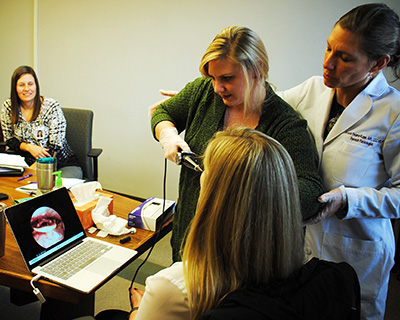
FHSU CSD Department receives fiberoptic endoscopic equipment, training

fhsu-csd-fees-training-1-web
FEES training course at FHSU

FHSU University Relations and Marketing

Fort Hays State University’s Department of Communication Sciences and Disorders was able to purchase portable Fiberoptic Endoscopic Evaluation of Swallowing (FEES) equipment thanks to a Kansas Masonic Foundation grant awarded at the end of the spring 2016 semester.

Carolina Speech Pathology, Apex, N.C., recently conducted a FEES training course on FHSU’s campus for three communication sciences and disorders faculty, five graduate students, one undergraduate student and one practicing speech language pathologist.

The department has also recently signed a contract with Mobile FEES LLC, Lee’s Summit, Mo.

“This company contracts with many skilled nursing facilities in central and eastern Kansas to provide this service to their residents,” said Jacque Jacobs, program specialist in the department.

Jacobs said this will extend the services the department is able to offer in the area of speech-language pathology (SLP).

“With this new partnership with the department at FHSU, SLP faculty along with SLP graduate students will now be able to offer this service to skilled nursing facilities in western Kansas,” she said.

Copyright Eagle Radio | FCC Public Files | EEO Public File