SHERMAN COUNTY – Two people died in an accident just after 11p.m. on Monday in Sherman County.
The Kansas Highway Patrol reported a 2007 Chevy pickup driven by Tyler L. Gilmore, 27, Columbia, MO., was westbound on Interstate 70 just west of the Brewster exit, 18 miles west of Goodland.
The vehicle rear-ended a 2007 Buick LeSabre driven by Kendall Leroy Morris, 42, Colby, which was westbound in the driving lane.
The Buick went into north ditch, overturned several times.
Morris and a passenger Aletha Ann Morris, 73, Goodland, were pronounced dead at the scene and transported to Bateman Mortuary.
Another passenger in the Buick Kermit Lee Morris, 79, Goodland, was transported to Goodland Regional Medical Center.
Gilmore was not injured.
Aletha Morris was not wearing a seat belt, according to the KHP.
RENO COUNTY – A Kansas man is in trouble with the law after he allegedly cashed two Dillon’s company checks at one of their stores in Hutchinson.
Derrick Doherty, 37, Hutchinson, was arrested on Sunday for forgery and two counts of theft by deception.
Police say he took the checks from the Dillon’s Offices in the 2700 block of East 4th Street in Hutchinson and he is accused of stealing a donation box from Trinity United Methodist Church at 1602 North Main.
Doherty is charged with theft for that case and was also advised of criminal trespass at the church.
Doherty posted bond and should make a court appearance later this week.
NESS COUNTY – Law enforcement authorities in Ness County are investigating the theft of a pickup.
On Sunday, the Ness County Sheriff’s Office was contacted by Kansas Highway Patrol Troopers saying that they had a pickup stopped in Stafford County that belonged to a business in Ness City, according to a social media report.
After making contact with the owner it was determined that the pickup, trailer, and several other items had been stolen.
The driver and two passengers were arrested for the theft and other local charges.
The charges are pending through the Ness County Attorney. No names were released late Monday.
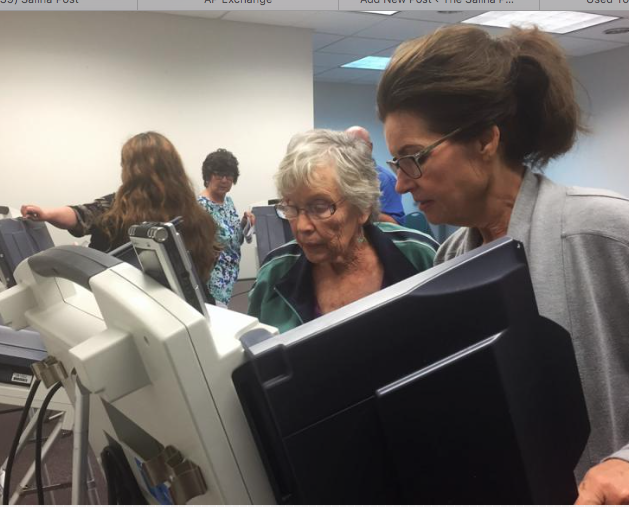
Photo by Jim McLean/KHI News Service Carolyn Megree of Spring Hill and Rene Pfaltzgraff of Paola try out an electronic voting machine at a training for poll workers in Miami County
By JIM MCLEAN
Kansas doesn’t have a reputation for corruption like Chicago, where political bosses stuffed ballot boxes and sometimes raised the dead to alter the outcome of elections, or like Florida, home of the infamous hanging chad from Bush v. Gore.
But concerns about tampering appear to be on the rise, at least among Kansas Democrats, because of unusual voting patterns in the 2014 elections and persistent reports about the vulnerability of electronic voting machines.
“Apparently, they (voting machines) are not that hard to hack,” said Beth Clarkson, a Wichita State University statistician who believes the machines may have been used to alter results in some large Kansas precincts in 2014.
Clarkson, who is appealing a recent district court ruling denying her access to Sedgwick County voting records, bases her concerns on Kansas voting patterns that resemble those linked to possible fraud in several Republican presidential primary contests across the country in 2012.
Two California researchers uncovered the patterns in the presidential primary states. When Clarkson saw their report, she downloaded their data and re-tested their methods.
“I took a look at the data and I took a look at their analysis and I got the same results they did,” she said.
Convinced their methods were sound, Clarkson applied them to the 2014 U.S. Senate race in Kansas won by Pat Roberts over challenger Greg Orman. The results confirmed the same unusual voting patterns — late surges of partisan votes in large precincts that could have been generated by rigging electronic voting machines.
“Statistics never tell you what the cause is,” Clarkson said, only that there is a relationship between the numbers and certain explanations. But based on her preliminary findings, she said the 2014 voting patterns are “possibly indicative of fraud.”
Clarkson’s findings re-ignited speculation about how Republican Gov. Sam Brownback eked out a win over Paul Davis on that same night. So, as this year’s elections approached, Democrats in particular began urging supporters to use paper ballots when possible.
“It’s much easier to tamper with those electronic machines, and we suspect that there has been some of that going on,” Sen. Laura Kelly, a Topeka Democrat, said at a recent candidate forum. “So, I think if people want their vote to count, they ought to use paper.”
Confidence in machines
Miami County Clerk Janet White said concerns about electronic voting machines are overblown. She has confidence in the aging but well-maintained machines used at the county’s 13 polling places because of the security measures she has put in place.
Photo by Jim McLean/KHI News Service Douglas County Clerk Jamie Shew leads a training session for poll workers. Shew refuses to use electronic voting machines, believe that paper ballots are more secure.
“None of these machines are hooked to the internet, so they’re really not hackable,” White said, motioning to a group of machines set up for a poll-worker training class.
The machines and the cards used to activate and record the votes cast on them are closely monitored before, during and after each election.
“So, we really have got some safety measures in place,” she said. “Without knocking somebody over the head, I really don’t think you’re going to be able to mess with our elections.”
Renee Pfaltzgraff, of Paola, is among the volunteers that White is training to work the polls. She said she’s not concerned about the security of her vote.
“I’ve used them (the machines) for several years, and the ballots are very simple to navigate through,” Pflaltzgraff said. “You have an opportunity to change an answer if you want to change it. So, I’ve never had any issues with the machines.”
But some Kansas voters do have issues with the machines. When Topeka resident Vern McFalls read about Clarkson’s findings, his thoughts immediately went back to his experiences as a poll worker on the night of the 2014 general election.
“Something definitely went awry that night,” McFalls said, explaining that some of the voting machines at his polling place seemed to be “acting up” hours after the polls closed.
“Maybe I’m wrong, but just my gut feeling tells me something wasn’t right,” he said. “If it were left up to me, I’d never go near another electronic voting machine again. I mean, it’s just too easy (to manipulate them). It’s just too easy.”
Producing a paper trail
Organizations that monitor elections also continue to have issues with the machines, particularly models that don’t generate paper trails. The use of electronic voting machines by states, like Kansas, that don’t require post-election audits also are a concern to organizations like the Verified Voting Foundation and the Common Cause Education Fund, which in a 2012 report listed Kansas among the states least prepared to catch and address voting problems.
Douglas County Clerk Jamie Shew refuses to criticize colleagues that continue to use electronic voting systems. But he prefers paper ballots.
“As an election official, I like the security of having that paper-based system,” Shew said. “Regardless of what happens, I have a ballot I can hand a voter, they can vote and if need be I can hand-count it if none of the (scanning) equipment works.”
He said the county’s system makes it easier for him to audit results if necessary.
“There just is a confidence in having that paper ballot, not only for the voter but for the person administering elections and for the poll workers,” Shew said. “It provides us with the ability to audit throughout the whole process.”
Voters who have concerns can request paper ballots even in counties that use electronic systems, Shew said. But supplies of paper ballots are usually limited in those counties. So, those wanting one might want to call ahead to their county election office before showing up at the polls.
Jim McLean is executive editor of KHI News Service in Topeka, a partner in the Heartland Health Monitor team.
TOPEKA, Kan. (AP) — Two of Kansas’ largest counties are looking for funding to keep their sex education programs going after state officials declined to apply to renew federal grants.
The Kansas City Star reports that Wyandotte and Johnson counties have used money from Personal Responsibility Education Program grants since 2010 to provide sex education courses in area schools with the goal of preventing teen pregnancy and sexually transmitted diseases.
Earlier this year, Kansas Department of Health and Environment officials told the two counties that the state wouldn’t apply for the grants this year.
Department spokeswoman Cassie Sparks says it opted not to apply for funds so it could stop operating as a middle-man by passing money along to local departments. Sparks says the local departments will have a transition period to apply for funds.
Wyandotte and Johnson county officials say they weren’t prepared for the transition.
FHSU Sports Information
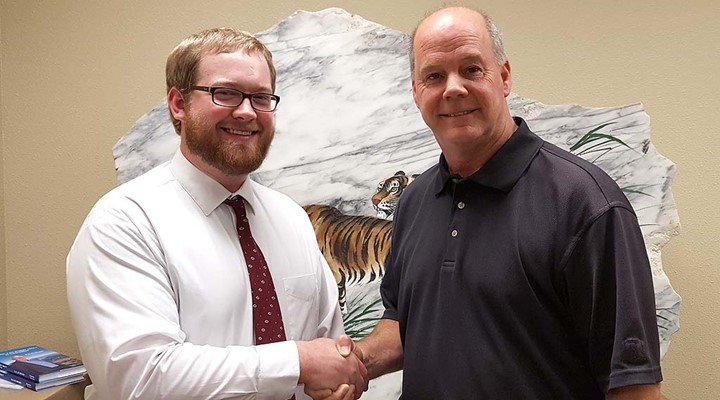
HAYS, Kan. – Fort Hays State announced the hiring of Seth Kincaid as Assistant Sports Information Director and Head Men’s Golf Coach. Kincaid joins the Tiger family after two years as a graduate assistant in sports information at Northwest Missouri State University.
Kincaid with FHSU Director of Athletics Curtis Hammeke
Kincaid will assist in all aspects of the sports information office at Fort Hays State alongside 12th-year Sports Information Director Ryan Prickett. “I am very excited with the addition of Seth to strengthen our day-to-day operations in the sports information office,” Prickett said. “It is great to add someone who understands the daily workload of sports information directors at the NCAA Division II level and has been a part of the MIAA for two years already. With the ever-increasing workload, pace, and demands of the athletic media relations profession, the addition of Seth helps us address our current and future expectations.”
A native of Olathe, Kan., Kincaid got his start as a high school beat writer at The Jackson Sun in Jackson, Tenn., before spending two years as a graduate assistant in sports information at Northwest Missouri State University in Maryville, Mo. (2014-16). He was responsible for five sports at Northwest, including women’s soccer, cross country, track and field, women’s basketball and softball. In addition, Kincaid was the secondary contact for the 2015 NCAA Division II National Champion football team and the primary contact for the Bearcat men’s basketball team during their run to the 2016 NCAA Division II Sweet 16. He was also the PA announcer for women’s soccer and softball.
Kincaid takes over as head men’s golf coach at FHSU, succeeding Sean Dreiling who guided the program for two years. Dreiling also served as an assistant coach for the men’s basketball program for four years.
“With a need for continuity in our golf program and assistance in our sports information department, we feel Seth is capable of providing both,” FHSU Director of Athletics Curtis Hammeke said. “His passion for golf and his expertise in various areas of sports information make him a great fit for this position.”
Kincaid earned a bachelor’s degree in Mathematics from Union University in Jackson, Tenn., in 2012 before completing a master’s in Athletic Administration at Northwest Missouri State in 2016. He and his wife, Amber, recently celebrated the birth of their daughter, Ellison.
MIAMI (AP) — The Latest on the Zika virus in Florida (all times local):
The CDC has issued a new advisory that says pregnant women should not travel to the so-called Zika “transmission area” in Florida and pregnant women who live there should take steps to prevent mosquito bites and sexual spread of the virus.
The Centers for Disease Control and Prevention issued the advisory Monday after Florida Gov. Rick Scott said there are 10 new infections of the Zika virus likely transmitted by mosquitoes, bringing the total in the state to 14.
The new cases are clustered in the same square-mile neighborhood in Miami-Dade County identified last week. Florida health officials say they believe active transmissions of Zika are occurring only in that area.
The CDC says men and women who have visited this area since June 15 should wait at least eight weeks before trying to conceive. Because Zika infection has been found to linger in sperm for months, men with Zika symptoms should wait at least six months before trying to have a baby with their partner.
Many Kansas families have students going to college this month. With the necessities of college life—clothing, electronic equipment, more clothing, more electronic equipment…remembering to pack everything is always a challenge. But in the rush to pack, don’t forget to add “insurance” to the list of necessary items.
The following insurance tips for both parents and college students originate from information compiled by the Kansas Insurance Department and the National Association of Insurance Commissioners.
Auto Insurance
Check for details with your agent. If your student is taking a vehicle to school, check with your local agent about the current vehicle insurance policy. If you ask about the rates for the college’s city that may help you decide whether to keep the student’s car on the family’s auto policy.
Look for the good student discount. Make sure your insurance company is notified each semester if your student maintains good grades. Getting a good student discount on the vehicle’s premium saves money.
Make it easier to report an accident. Installing the WreckCheck mobile smartphone application from the NAIC gives both the student and parents an outline of what to do immediately following any vehicle accident. The free app helps you create an accident report.
Renters Insurance
Know your landlord doesn’t protect your personal property. You should realize that a landlord’s insurance policy doesn’t cover a renter’s personal belongings. Also, make sure to take photos or video of the possessions, and store an inventory list in a secure location.
To print an easy-to-use home inventory checklist and get more tips about disaster preparedness, visit www.ksinsurance.org. Smartphone users can complete an electronic property inventory by using the myHOMEScr.APP.book application from the NAIC.
Finally, ask if your homeowners insurance policy will cover the belongings in the student’s car or rental trailer before he/she gets to campus.
Identity Theft
Know the limits of identity theft insurance. With constant cyber security concerns, identity theft coverage is certainly a consideration. Identity theft insurance is limited, however. It can’t protect parents or students from becoming victims of identity theft, and it doesn’t cover your direct financial losses. It does provide coverage for the cost of reclaiming a person’s financial identity —making phone calls, making copies, mailing documents, taking time off from work without pay, and hiring an attorney.
The primary policyholder of your homeowners policy should check first to see if the policy includes identity theft insurance while the student is away from the family home. If a student is renting an apartment, ask if his/her renters insurance covers identity theft, or if that could be added to the policy.
Health Insurance
Realize health insurance options. Nearly all young adults up to age 26 can now stay on their parents’ health insurance plans because of federal health laws.
At school, students should have copies of their insurance cards and know how/where to seek medical treatment.
If the student is insured through a network of medical providers, check to see if he/she will be in or out of the network service area while at school. That will make a difference in how much you or your student will have to pay for out-of-pocket charges.
Dental and Eye Care
Routine dental care and eye care generally are not included as part of a health insurance plan. Also, most health insurance plans do not cover expenses related to periodic eye examinations, glasses or contact lenses, but most will cover medical care as a result of an eye disease or injury.
Preparing to go to college can be stressful for both students and parents. However, knowing that the student and his/her belongings have proper insurance coverage relieves some of that stress.
For more, visit our department’s website at www.ksinsurance.org, call our Consumer Assistance Hotline at 800-432-2484 or see our videos on YouTube.
Ken Selzer, CPA, is the Kansas Commissioner of Insurance.
The proposed pavilion would be built on the east edge of Union Pacific Park, 10th and Main.
DHDC
Downtown Hays Development Corporation (DHDC) is pleased to announce it has received a $100,000 grant from the Dane G. Hansen Foundation.
These funds will support the Downtown Pavilion Project,a partnership between DHDC, Fort Hays State University (FHSU) and the City of Hays.
DHDC seeks to revitalize and develop the downtown area through a variety of plans, programs and initiatives.
DHDC is currently in the process of constructing a 40′ x 80′ Pavilion in Downtown Hays. The structure will serve as a gathering place in downtown. In addition to the pavilion, an outbuilding with restrooms is to be constructed.
The Downtown Hays Pavilion will turn an unused space into a place for people to meet and enjoy downtown Hays. Activating this unused space would be a game changer for Downtown Hays.
“Building a new pavilion aligns with the Hays Kansas Comprehensive Plan adopted by the city of Hays in 2012,” Sara Bloom, DHDC Executive Director said.
”The plan names Downtown as a key district and highlights the importance of continuous improvements and growth in the area. A pavilion square is also named as a key component to improving the downtown district and the connection between Downtown Hays and FHSU. We look forward to completing this vision for the area.”
The $100,000 provided by the Dane G. Hansen Foundation will be used to match private donations already secured by DHDC.
All of the funds would be used towards construction materials since all labor for the project would be provided free of charge by FHSU students in the Applied Technology Department enrolled in the Construction Management Program, and city of Hays employees.
“Our goal is to provide a four-season gathering place for the community,” Bloom said. “A place for summer picnics and family get-togethers; a place for visits with Santa and hot chocolate beneath a warm blanket; a place for a local choral performance. We want the pavilion to be utilized by groups throughout the community.”
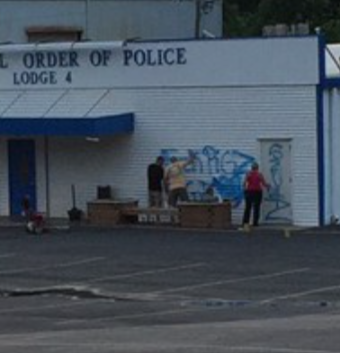
Volunteers clean the FOP building on Sunday- photo courtesy KCTV
KANSAS CITY, Kan. (AP) — A prison parolee has used his own money to help pay for the cleanup of a vandalized police lodge building in Kansas City, Kansas.
The Kansas City Star reports that someone who lives near the Fraternal Order of Police building called Sunday to report seeing someone spray-painting the building. The spray-painting included an obscene reference to pigs and gang-type symbols.
Police spokesman, Officer Cameron Morgan, said the paint was barely dry Sunday night when people showed up to help with the cleanup. He says the parolee pitched in money for cleaning chemicals.
TOPEKA, Kan. (AP) — Kansas is reporting that its tax collections fell nearly $13 million short of expectations in July.
The Department of Revenue reported Monday that the state collected $425 million in taxes last month, compared with the state’s official projection of nearly $438 million. The shortfall was 2.9 percent.
Tax collections have fallen short of expectations for 10 of the past 12 months. Kansas has struggled to balance its budget since Republican legislators slashed personal income taxes in 2012 and 2013 to stimulate the economy.
A shortfall in tax collections in June prompted Brownback’s administration to delay $260 million in state aid payments to public schools. It also diverted money for highway projects and funds within the Department of Corrections to avoid a deficit when the 2016 fiscal year ended June 30.
TOPEKA, Kan. (AP) — The Latest on the Kansas primary election
Green Party presidential nominee Jill Stein is seeking a spot on the Kansas ballot in November as an independent candidate.
The Kansas secretary of state’s office said Monday that Stein’s campaign submitted petitions with about 10,000 signatures in hopes of getting her on the ballot.
In Kansas, only recognized political parties can list their candidates’ affiliations on the ballot.
The state recognizes only the Republican, Democratic and Libertarian parties.
To gain recognition, a party must submit petitions with the signatures of almost 17,400 registered voters. To keep it, a candidate for statewide office must capture at least 1 percent of the vote.
Candidates of unrecognized parties must run as independents and file by petition. An independent presidential candidate’s campaign must collect signatures from 5,000 registered voters.
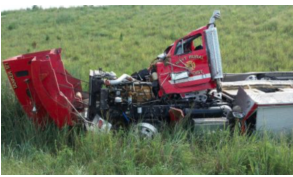
HOYT, Kan. (AP) — Mourners have gathered to remember a northeast Kansas firefighter who died after a fire truck overturned while it was headed to a parade.
Dozens of agencies lined up Monday morning to honor 47-year-old Mike Schultz, of Hoyt, at his funeral.
The Kansas Highway Patrol says the crash happened Wednesday east of the Prairie Band of Potawatomi Nation Reservation. The patrol says Schultz was driving northbound on U.S. 75 when the truck blew a tire near Mayetta.
The truck veered off the highway and crossed the median and the southbound lanes before striking and embankment and overturning.
The patrol says Schultz was taken to a hospital, where he was pronounced dead. The patrol says a second firefighter was injured.

 SHERMAN COUNTY – Two people died in an accident just after 11p.m. on Monday in Sherman County.