Year: 2016

Area dentists say reversing Kansas Medicaid cut a priority going into session
By ANDY MARSO
KHI

At 59 years old, Bill Miller is starting to have neck and back problems. Thirty-two years of bending over to check patients’ teeth and gums will do that, he said.
Miller is the only dentist in Hill City, a community of about 1,500 people northwest of Hays. He has treated Medicaid patients his entire career, even as reimbursements increasingly have lagged the cost of providing care.
Earlier this year the state cut those reimbursements another 4 percent as part of a host of emergency budget-balancing measures. Miller said that has him seriously considering dropping out of the Medicaid program.
“I realize the state’s in a world of hurt right now as far as their budget, but it’s a big problem,” he said. “I don’t know how it’s going to be solved.”
As the Legislature prepares to reconvene Jan. 9, Gov. Sam Brownback and lawmakers have a few ideas for restoring the 4 percent cut but have yet to agree on any specific plan amid larger budget problems.
Meanwhile, medical providers are weighing whether to continue seeing Medicaid patients — decisions that have the greatest impact in specialties like dentistry, and in rural places like western Kansas where many patients already drive hours to find care.
“It certainly is something that I am seriously considering not participating in in the future,” Miller said. “Just the economics of it — there’s no way to make it work and be profitable at all.”
Different ideas for restoring cuts
It’s not the first time Medicaid reimbursements have been cut in recent years.
Gov. Mark Parkinson, a Democrat, slashed them by 10 percent in 2009, when the state was trying to weather the Great Recession. But he and the Legislature restored the cut within months by passing a sales tax increase.
Brownback said in August that the 4 percent cut could be reversed if the Legislature agreed to increase a hospital tax, which would pull down more federal Medicaid money. Last month he reaffirmed that remains his preference.
“We still would like to do something like that,” Brownback said.
Legislators have been cool to that idea so far. Rep. Dan Hawkins, a Republican from Wichita who chairs the House Health and Human Services Committee, said that wasn’t the right way to find the $40 million needed to restore the cuts.
“Basically you’re going to tax the hospitals to give back to the hospitals,” Hawkins said. “Yeah, you’re going to pull down some federal dollars with that, but really we’re taxing them to give back to them. And why would we do that? I’m not sure that makes much sense.”
Instead, Hawkins suggested increasing a fee levied on the three managed care organizations (MCOs) that administer Kansas Medicaid, or KanCare.
That fee increase also draws down federal money — in this case, Hawkins said, enough to both pay back the MCOs and restore the $40 million cut.
“I think that’s a place we could look at that would not really affect anybody,” Hawkins said.

MCO tax also has consequences
That particular fee, though, also applies to private-sector insurance companies that run managed care plans, including health maintenance organizations, or HMOs.
The Legislature passed a bill last year that gave those companies the ability to sell HMO-like plans without paying the fee, but Hawkins said a couple of them —Blue Cross and Blue Shield of Kansas and Aetna — still sell the traditional HMO plans that would be subject to the fee increase.
Brownback said that should be taken into account, but he didn’t rule out including Hawkins’ idea as part of a plan to restore the 4 percent cuts.
“We’d have to see what kind of mix to do and its impact on the MCOs, but there is a way to do this and that’s what we proposed even at the end of the last legislative session,” Brownback said. “I think we ought to do something like that, and we’ll see if the Legislature is open to it or not.”
“It’s not just the 4 percent cut. It’s been drastic underpayment for a long time.”– Bill Miller, a dentist in Hill City, on low Medicaid reimbursement rates for dentists
Mary Beth Chambers, a spokeswoman for Blue Cross and Blue Shield of Kansas, said her company would be less affected by a fee increase than some other insurers, because it only sells the HMO plans on the individual market and they make up a small part of the total business.
“Our stance is that any time taxes or fees are put on insurance companies, those costs, as administrative costs, get passed on to those buying the insurance,” Chambers said. “So we would caution legislators to keep that in mind.”
Hawkins said another option is to repeal a provision of Brownback’s signature 2012 tax plan that exempted about 330,000 business owners from paying any tax on “pass-through” business income.
That idea was part of a budget-balancing bundle promoted last week by a coalition of advocacy groups at the Statehouse.
Hawkins said repealing the business tax exemption would bring in about $260 million, of which $40 million could be diverted to restore the Medicaid cuts. But the state faces a budget gap of about $350 million in the current fiscal year and about $600 million in the next fiscal year, which begins July 1 — and that could swallow new tax revenue.
Brownback has opposed proposals to roll back the 2012 cuts in the past. His office has said it is working on a budget plan to be released soon.
Dental coverage waning
The 4 percent Medicaid cut hit a variety of providers: hospitals, nursing homes, psychiatrists and others.
But opposition has been particularly strong from dentists, who have not seen an increase in their Medicaid reimbursement rates since 2001. Even before the 4 percent reduction, Medicaid paid about 40 cents on the dollar compared to private dental insurance.
Nick Rogers, an Arkansas City dentist and president-elect of the Kansas Dental Association, told the Robert G. (Bob) Bethell Joint Committee on Home and Community Based Services and KanCare Oversight last month that the cut was likely to be a “final straw” for dentists who were leaning toward getting out of Medicaid.
He said access to dental care was already an issue for people on Medicaid in his part of the state — especially for Kansans with disabilities.
“These patients have the most complex needs, consume a disproportionate amount of our time — clinically and administratively — and have the lowest reimbursement,” Rogers said. “At some point in the near future, regardless of my social responsibility, we will be forced to discontinue our involvement (in Medicaid).”
Rogers said his practice was getting referrals for patients with special needs who live more than two hours away. His testimony echoed comments made months earlier by John Fasbinder, a Prairie Village dentist who also treats disabled Medicaid patients.
Melinda Miner, a dentist from Hays, told the committee that the dental provider networks in western Kansas are close to collapsing in many communities.
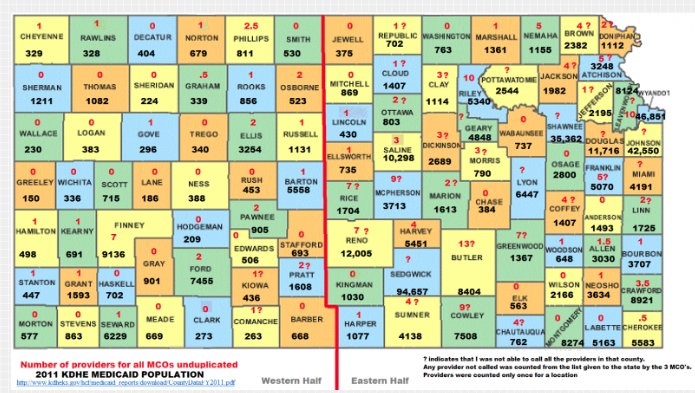
After contacting dentists throughout the region, Miner compiled a map showing more than 20 western counties without a single dentist who accepts Medicaid.
In an email to KHI News Service, Miner said she is among two dentists in Hays who have decided to stop taking it. She provided the names of two other dentists, one in Leoti and one in Great Bend, who she said have also dropped out of the program and eight more western Kansas dentists who she said are considering dropping out.
Miller, the dentist from Hill City, is one of them.
“I think everybody is,” he said. “And it’s not just the 4 percent cut. It’s been drastic underpayment for a long time.”
Getting out
Craig Sandlin is the office manager for his wife, Joanne Brown, the Leoti dentist. He confirmed that they stopped taking Medicaid patients as of the end of November.

Sandlin said the move affected more than 2,500 people and he’s not sure how far they will have to travel to find a dentist who takes new Medicaid patients.
“The problem is there’s nobody in western Kansas anymore,” Sandlin said. “Everybody has gotten out.”
Michael Jones, a dentist in Russell, said he’s limiting his intake of new Medicaid patients to “very, very few” and is strongly considering not taking any more.
As the only dentist in a county of more than 6,000 people, Jones said he has all the patient load he needs and, at 57, is “no spring chicken.”
He said he treats Medicaid patients at a financial loss, but does it as a service to the community. A young dentist just starting out, with potentially more than $100,000 in student debt, would not have that option, Jones said.
He said it would be tough to find someone to replace him when he retires.
“Selling the small, rural practice is very difficult,” Jones said.
Sandlin said that once dentists get out of Medicaid, it will be hard for the state to bring them back, even if the reimbursement rates do increase.
He and his wife are paring staff now, and it would take more than a restoration of the 4 percent cut to convince them to rehire — in fact, it would take a substantial increase.
“That’s the problem they’re not realizing,” Sandlin said of state policymakers. “Once these doctors are out, you’re going to have to put a big carrot out there to get them back in. Because we’ve staffed to be out.”
Andy Marso is a reporter for KHI News Service in Topeka, a partner in the Heartland Health Monitor team. You can reach him on Twitter @andymarso
LETTER: Defense of fossil fuels ignores the evidence

 I’m not surprised that Ed Cross again is trying to defend the oil and gas industry as good stewards of the environment and with the importance of its products to our way of life (“Petroleum: Commodity essential to our life”, December 6). The industry has a vested interest in maintaining our dependence on fossil fuels and debunking their role in causing climate change. Exxon’s executives have known for nearly 40 years that burning fossil fuels was the primary cause of the climate change we’re experiencing today, but chose to sow doubt on peer-reviewed research done by climate scientists and misinform the public about the issue (www.goo.gl/xF7XUW).
Wouldn’t it be better to formulate your opinion on human-caused climate change based on research conducted by climate scientists published in peer-reviewed journals, rather than misleading information provided by the fossil-fuel industry from studies it paid for and published in journals disseminated by organizations with a political agenda?
Climate change is a complex subject for those of us who aren’t climate scientists. If you want to learn more about climate change, check out the series of easy-to-understand 6-minute videos at www.goo.gl/NPxuQG by Katharine Hayhoe, an atmospheric scientist at Texas Tech University. Or read the 2014 Intergovernmental Panel on Climate Change Synthesis Report Summary for Policy Makers (www.goo.gl/iFNBhb). To see the effects of climate change around the world, watch Leonardo DiCaprio’s documentary, “Before the Flood.”
The options for addressing climate change don’t have to be regulatory like the Obama Administration’s Clean Power Plan. The Carbon Fee and Dividend is a market-based proposal designed to price fossil fuels to account for their health, environmental, and economic costs (www.goo.gl/XRh899).
Helen Hands, Hays
SCHLAGECK: A minute with Marshall


Record crops, low commodity prices and stalled trade negotiations spell troubled times for Kansas farmers and ranchers heading into 2017.
Like many other small businesses, inputs to produce a bumper crop generally entail an abundance of costs as well. Except for lower fuel prices, most agricultural inputs remain high and continue to rise.
Drive through rural Kansas and you’ll see huge piles of red and gold grain lying on the ground. Talk to farmers and ranchers and they’ll tell you their near economic prospects don’t look good.
“Insight” visited with Congressman-elect Roger Marshall at the recent Kansas Farm Bureau convention to ask him what could be done to remedy some of the ailments in farm country.
Marshall campaigned on a platform of bringing Kansas farmers a voice on the House Ag Committee. He labeled himself a “fifth generation farm kid” and said, “I do know what the back side of a tractor feels like and I hauled a lot of hay in my day.”
He’s practiced as an OB-GYN and served as Chairman of the Board of Great Bend Regional Hospital. Marshall says some of his best knowledge about agriculture was learned while he served as a board member of the Farmer’s Bank and Trust in Great Bend.

“Times are tough in agriculture,” Marshall says. “And there are no simple solutions.”
Beefing up our trade policy would help the Kansas farmer, he says. While he understands president-elect Trump is against the Trans-Pacific Partnership (TPP) in its present form. He is committed to free and fair trade and that may leave room to work.
Many farmers, ranchers and other ag leaders realize if this nation engaged in more free trade it would drive up prices.
“If we passed TPP tomorrow, it’d mean $400,000 a day of additional cattle sales to the Pacific-rim countries,” Marshall says.
Positive trade deals could provide Kansas farmers and ranchers with an opportunity to remain competitive in today’s global marketplace. If the United States stays on the sideline, others will continue to sign trade agreements with China, India, Japan and many other developing countries who would welcome Kansas’ high quality feed grains, protein, value-added products and manufactured goods.
Marshall also believes decreasing regulations in agriculture, banking and health care could drive the cost of inputs down.
“The new administration is going to come in and say, ‘halt and desist’ to the Environmental Protection Agency,” the congressman-elect says. “I expect (legislation on) Waters of the United States (WOTUS) to slow down or stop all together.
“When you look at the law that talks about navigable streams, as near as I can tell, water running in a ditch is not navigable where I come from.”
Tax reform is another way to help this country’s economy and that of Kansas farmers and ranchers, Marshall says. He believes a reduction in corporate taxes will spur companies and individuals to invest money and grow businesses.
Rebuilding this nation’s infrastructure could also invigorate this nation’s economy.
“Buckle in because we’re going to start to work on Jan. 4,” Marshall says. “Congress will no longer conduct two and three-day work weeks. Our new president expects us to produce and we expect to operate as a Congress of action. We’re going to turn our economy around.”
John Schlageck, a Hoxie native, is a leading commentator on agriculture and rural Kansas.
HAWVER: Stomping out fires instead of preventing them


Well, we have a brand-new plan to balance the state budget starting July 1, but instantly, it has become an “us vs. them” political scrap that is likely to put the state Legislature into several fights that it’s too early to handicap.
The plan presented last week by a coalition of groups—interested in financing schools, building highways, taking care of the needs of the poor and paying state employees who are vital to meeting those needs—pencils out nicely to raise money for those purposes.
The Kansas Center for Economic Growth pulled together a wide range of interest groups to assemble a new tax regimen for the state and included taxing those 330,000 LLC-owning Kansans who don’t pay taxes now, reshuffling the tax rates to see the wealthy paying more taxes, cutting the sales tax on food, and boosting the tax on gasoline by 11 cents a gallon.
Instantly, Gov. Sam Brownback’s office slapped the venture, saying it will raise taxes on Kansans. That’s generally a bad political thing to do.
Oddly, few are looking back to the 2012 massive tax cuts at how nice it felt for a year or two, while the state had balances in its budget to make negligible the effects of less money coming into the treasury.
Anyone else thinking that with the knowledge that the state was going to start taking in less money, it would have been a good time to start looking for efficiencies, for sharing of government resources, for finding ways to save money so that those shrinking revenues would cover the cost of services that Kansans want?
Well, that didn’t happen. That’s why the shrinking revenues—for both the current half-over fiscal year and the upcoming two years that Gov. Sam Brownback will present his budget for in January—are scary.
Oh, the governor and Legislature managed while revenues have been dropping the past couple years to cut their way out of a deficit. The Legislature made some cuts in spending, the governor made some cuts in spending, but there really hasn’t been much of a plan for reducing spending or finding efficiencies in government that would match costs with the tax revenue available to finance those costs.
Kansans have seen what amounts to stomping out fires instead of preventing them in the first place.
But, that’s where we are now, legislators say, and some of those new legislators who won election in November are recalling that the job ahead of them didn’t seem nearly so big last spring as it did after their election and the estimates of state revenue for the current and upcoming years subsequently were revealed.
Now, that Center for Economic Growth plan has an interesting wrinkle. Do all the tax increases and shuffling to boost state revenues when the Legislature opens before dealing with the immediate $350 million shortfall for the current fiscal year. An interesting idea. Patch the roof before you dry out the carpet. Probably the way you’d manage your business or household.
With about one-third of the total Legislature being new this year, those newbies are likely to see the advantage of making long-term policy first, essentially creating solid ground to work from in the future, and then dealing with the emergency budget shortfall once the future is secure.
But, doable? Probably not likely, because the Legislature tends to deal with immediate problems, and two-year House terms and four-year Senate terms and a new governor in 2018 tend to make looking into the future very far difficult.
The roofing project might sound logical, but the culture of the Legislature tends to want to dry out the carpet first.
Syndicated by Hawver News Company LLC of Topeka; Martin Hawver is publisher of Hawver’s Capitol Report—to learn more about this nonpartisan statewide political news service, visit the website at www.hawvernews.com.
Sunny, cold Tuesday
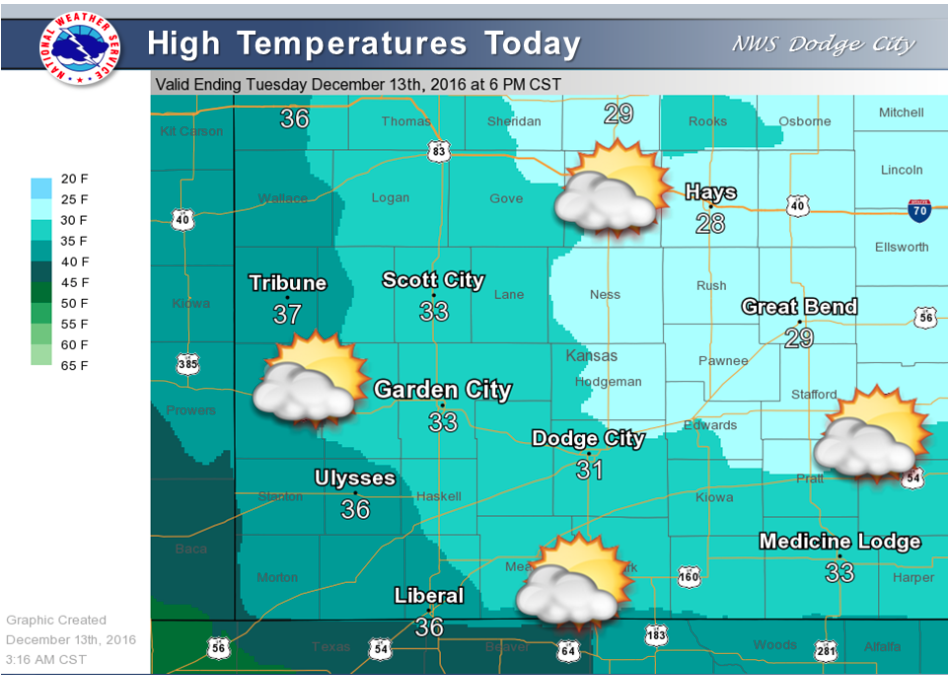
Today Mostly sunny, with a high near 28. Wind chill values as low as -4. North wind 5 to 10 mph becoming light and variable.
Tonight Partly cloudy, with a low around 13. Wind chill values as low as 5. South southeast wind around 5 mph becoming calm after midnight.
Wednesday Mostly sunny, with a high near 29. Wind chill values as low as 3. Light east northeast wind becoming northeast 9 to 14 mph in the morning.
Wednesday NightMostly cloudy, with a low around 12. Wind chill values as low as 3. Light and variable wind becoming south southeast around 6 mph after midnight.
ThursdayPartly sunny, with a high near 33. South southeast wind 7 to 12 mph increasing to 13 to 18 mph in the afternoon.
Winds could gust as high as 29 mph.
Thursday NightMostly cloudy, with a low around 24.
FridayPartly sunny, with a high near 47.
Governor to tour winner of Exporter of the Year


OFFICE OF THE GOV.
CLAY CENTER–Gov. Sam Brownback will tour GT Manufacturing Inc., the 2016 winner of the Governor’s Exporter of the Year Award, on Thu., Dec. 15. The award is presented to a single Kansas business every year for excellence in international trade and marketing.
During the visit, the Governor will tour the company’s assembly and shipping/receiving buildings, as well as participate in a ceremony where he will present the Governor’s Exporter of the Year Award to President of GT Manufacturing, Dennis Pedersen.
GT Manufacturing is responsible for manufacturing and exporting quality grain dryers out of Clay Center. Known as the worldwide leader in the batch grain dryer field, the company was started in 1953. GT Manufacturing contributes its success to its employees’ workmanship, quality and service.
The Governor’s Exporter of the Year Award brings statewide recognition to Kansas companies committed to expanding sales in international markets. The award also serves to encourage the growth of the state’s international commerce by showcasing successful exporters as role models to the Kansas business community.
The tour of the facility will begin at 10:40 a.m. on Dec. 15 and the award ceremony will begin at 12:15 p.m.
SW Kansas man dies in head-on semi crash

KIOWA COUNTY – A Southwest Kansas man died in an accident just before 2:30p.m. on Monday in Kiowa County.
The Kansas Highway Patrol reported a 1996 Lincoln Town Car driven by Martin Kruse, 58, Dodge City, was eastbound on U.S. 54 five miles west of Bucklin.
The vehicle went left of center and hit a semi head-on.
Kruse was transported to the Kiowa County hospital where he died.
The semi driver Kendall Turner, 55, Larned, was not injured.
Kruse was properly restrained at the time of the accident, according to the KHP.
Kansas man hospitalized after shooting himself in the leg

SHAWNEE COUNTY -A Kansas man was injured in an accident with a gun on Monday evening in Shawnee County.
Just before 6:30 p.m. first responders were dispatched to a residence in the 2900 Block of Highland Court in Topeka for report of a person suffering from a gunshot wound, according to a media release.
The man was transported to a local hospital with non-life threatening injuries.
He told crime scene investigators he dropped the gun, which discharged and hit him in the leg.
Name of the victim was not released late Monday.
Top Kan. lawmaker: Governor focused on job with Trump not state budget

TOPEKA, Kan. (AP) — The Kansas Senate’s top Republican says she and other lawmakers suspect Gov. Sam Brownback isn’t proposing a long-term fix for the state’s budget problems because he’s focused on getting a job in President-elect Donald Trump’s administration.
Senate President Susan Wagle of Wichita and other lawmakers have grown frustrated by Brownback’s decision to wait until January to remedy a $350 million budget shortfall for the current fiscal year.
Wagle told reporters Monday that legislators “are very concerned the governor is looking for a ticket to D.C.”
In the fiscal year that begins July 1, the state’s shortfall is expected to exceed $580 million.
Lawmakers begin work in January. Brownback’s office said Monday he will announce a plan to balance the budget then, but would consider proposals from Wagle or others beforehand.
Kansas ethanol plant sold as company deals with bankruptcy


BRYAN THOMPSON HEARTLAND HEALTH MONITOR
HUGOTON, Kan. (AP) — A Kansas energy company has sold its Hugoton cellulosic ethanol plant for $48.5 million as it deals with bankruptcy.
The Wichita Eagle reports that Abengoa Bioenergy Biomass of Kansas is a unit of the Spanish alternative energy company Abengoa. It sold the plant, which produces ethanol from cellulose, to Synata Bio.
The Kansas unit is selling off several assets through bankruptcy court, including a traditional grain ethanol plant in Colwich.
The U.S. Energy Department gave the Kansas company a more than $130 million loan guarantee in 2011 to help with the constriction of the plant.
Dog credited with saving Kansas family from fire


WELLINGTON, Kan. (AP) — A Wellington family says their dog saved them from a house fire.
James Mceachern says his dog, Kratos, woke the family up when their house caught fire early Friday.
 He said Kratos is normally quiet but came to his bedroom door “and really started raising Cane so I got up to see what was going on.”
Mceachern says he got up and noticed there was fire coming out the attic vent. He then got his wife, son and two dogs out of the home and called 911.
He says he believes without the dog’s vigilance “the smoke would have got us before the fire did.”
The cause of the fire is under investigation.
Listen to Tiger Talk with Fort Hays State basketball coaches Tony Hobson and Mark Johnson

Click below to listen to Tiger Talk with “Voice of the Tigers” Gerard Wellbrock and Fort Hays State women’s basketball coach Tony Hobson and men’s coach Mark Johnson.
Tiger Talk airs on Monday evening at 6 p.m. on Tiger Radio Mix-103.