TOPEKA, Kan. (AP) — Kansans responded to Gov. Sam Brownback’s request for input on school finance with scores of ideas and observations, ranging from a substitute teacher who recommended dropping school sports to another person who floated a sales tax for education.
The governor issued his call in August and accepted input through November to a special email address. The governor’s office opened the emails to inspection on Friday.
The Topeka Capital-Journal reports the missives came ahead of a legislative session at which lawmakers aim to craft a new school finance formula.
In a statement, Brownback said educators, parents and students submitted quality proposals.
CLAY COUNTY, MO.- A Kansas man was injured and arrested after an accident just before 11p.m. on Friday in Clay County.
The Missouri State Highway Patrol reported a 2013 Chevy passenger vehicle driven by Christopher I. Campbell, 53, Manhattan, was northbound on Interstate 435 at Randolph.
The vehicle traveled off the right side of the road and struck a guard rail.
Campbell was found to be intoxicated and transported to North Kansas City Hospital.
A passenger in the vehicle Carol Jastersten, 49, Kansas City, refused treatment at the scene.
Campbell was arrested for DWI, Carless driving, no driver’s license, no license plates on the vehicle and he was not wearing a seat belt, according to the MSHP.
LENEXA – The U.S. Environmental Protection Agency recentlyreleased a plan that serves as a national call to action, urging all levels of government, utilities, community organizations, and other stakeholders to work together to increase the safety and reliability of drinking water.
“Ensuring that all Americans have access to safe drinking water is an absolute top priority for EPA,” said EPA Administrator Gina McCarthy. “We must work collectively to seize opportunities for progress, partnership, and innovation in order to continue to provide our citizens with the safest drinking water in the world.”
The plan includes six priority areas and identifies proposed actions for each area:
Building capacity for water infrastructure financing and management in disadvantaged, small, and environmental justice communities: Actions include launching a national initiative to promote regional partnerships, reinvigorating training programs for system operators, sharing best practices and establishing an online water funding portal.
Advancing oversight of the Safe Drinking Water Act: Actions include electronic reporting for Safe Drinking Water Act compliance data, releasing triennial EPA reviews of state programs, and developing indicators to identify troubled systems.
Strengthening source water protection and resilience of drinking water supplies: Actions include updating and acting on source water vulnerability assessments, building collaborative local partnerships for watershed protection, developing an initiative to enhance community resilience to climate and extreme weather events, launching source water monitoring pilot projects and promoting water efficiency and reuse.
Addressing unregulated contaminants: Actions include strengthening the effectiveness of the health advisory program, prioritizing work on contaminants that pose the most significant risk, and promoting the development of low cost and innovative technologies that may remove a broad range of contaminants.
Improving transparency, public education, and risk communication on drinking water safety: Actions include strengthening transparency and public education, developing indicators to enhance how data is presented on the internet and improving risk communication tools.
Reducing lead risks: Actions include the consideration of critical options in revising the Lead and Copper Rule and continuing work to improve implementation of the current rule through enhanced oversight, identifying best practices on lead service line replacement, and revising guidance for schools.
The plan reflects input from state, local, and tribal government officials; drinking water utilities; community groups; and environmental organizations. While EPA and partners have already begun to take some actions, others will require additional resources and further stakeholder engagement. EPA recognizes that partnership and collaboration across all levels of government, utilities, the private sector, and the public will be essential to the success of the plan.
In tandem with the development of the plan, the President’s Council of Advisors on Science and Technology (PCAST) undertook a study on science and technology for drinking water safety. The PCAST’s recommendations complement and support EPA’s plan.
Today, nearly every American depends on 152,000 public drinking water systems and consume more than one billion glasses of tap water a day.
EPA has established drinking water standards for more than 90 contaminants, and compliance data show that more than 90 percent of the nation’s water systems consistently meet those standards. While America’s drinking water remains among the safest in the world, the drinking water sector faces a growing array of challenges including aging infrastructure, limited funding and management capacity, emerging contaminants, pollution of source water, and the impacts from drought and other climate events. These challenges can be particularly acute in small and disadvantaged communities.
KANSAS CITY, Mo. – A former federal employee was sentenced in federal court on Friday for using stolen money order receipts in a fraud scheme to avoid paying his medical bills, according to Tammy Dickinson, United States Attorney for the Western District of Missouri.
Byron G. Gorman, 52, was sentenced by U.S. District Judge Dean Whipple to four years in federal prison without parole. The court also ordered Gorman to pay $18,000 in restitution.
Gorman, who pleaded guilty on May 24, 2016, was employed as an information technology specialist for the U.S. Department of Agriculture’s Office of Inspector General, assigned to the Heart of America Regional Computer Forensics Laboratory in Kansas City, where he was being trained to become a computer forensic examiner. Gorman was terminated from federal employment on June 22, 2015.
Gorman admitted that he used stolen money order receipts – taken by Gorman as he participated in a criminal investigation – as fraudulent evidence in court, both to defend himself against a lawsuit against him by his creditors and in his own lawsuit against his creditors.
Gorman was a defendant in a civil collection lawsuit in Buchanan County, Mo., in which a judgment had been entered against him and a garnishment of his wages had been ordered to recover monies owed on medical bills incurred at the Heartland Regional Medical Center in St. Joseph. On Sept. 28, 2012, Gorman’s creditors filed a second civil collection lawsuit against him in Buchanan County to recover monies owed on additional unpaid medical bills.
On May 22, 2012, Gorman participated in the execution of a federal search warrant at the offices of a private business in Kansas City, Kan. Gorman was there to search for computer-related evidence. He found and took five blank U.S. Postal Service money order receipts belonging to the private business and used them to facilitate the scheme to defraud Heartland Regional Medical Center.
Gorman used the stolen money order receipts and other fraudulent documents created as evidence in his defense. Gorman claimed that he had submitted postal money orders to his creditors, but the payments had not posted. As evidence, he provided the five stolen money order receipts, which were filled out to make it appear that money orders had been made out to Heartland Regional Medical Center, as well as a number of forged letters displaying the names and purported signatures of postal employees.
Gorman also used the stolen money order receipts and other fraudulent documents he created as evidence in a lawsuit he caused to be filed against his creditors. Gorman placed the names and forged signatures of the actual persons onto letters purporting to be from the U.S. Postal Service and the U.S. Federal Trade Commission onto two letters and two certified mail receipts as part of his wire fraud scheme.
As an examiner in training, Gorman did not perform any computer forensic examinations unless under the supervision of a fully certified Heart of America Regional Computer Forensic Laboratory (HARCFL) examiner.
Upon learning of the allegations regarding Gorman, the Heart of America Regional Computer Forensic Laboratory did a complete and thorough review of any cases which Gorman may have assisted in the examination of computer forensic evidence. No inconsistencies, errors or issues were noted with any evidence. The Heart of America Regional Computer Forensic Laboratory is a fully accredited laboratory facility following a strict protocol for the examination of evidence and the training protocol for examiners in training.
Listen to Mike Cooper interviewing Cardiologist Dr. M. Javed Ashraf, MD , from the DeBakey Heart Institute at HaysMed, with the topic of “Heart Health” by clicking the link above and then clicking the play button
Sen. Moran (R-Kan.) with Secretary of Transportation nominee Chao
OFFICE OF SEN. MORAN
WASHINGTON – U.S. Senator Jerry Moran (R-Kan.), member of the Senate Committee on Commerce, Science, and Transportation, met Tuesday with President-elect Donald Trump’s nominee for Secretary of Transportation, Elaine Chao.
“Secretary Chao’s many years of experience will be an asset to President-elect Trump’s administration, enabling us to work together to tackle the challenges that lie ahead for our infrastructure and transportation systems,” Moran said in a statement. “Her background and track record of service to our country make her a strong choice to lead the Department of Transportation.
“I shared the unique challenges facing Americans in rural communities, the impact of the agriculture economy on Kansas transportation and the needs of Kansans living in larger cities like Wichita, Kansas City and Topeka. We discussed the opportunity for significant reforms in the general aviation industry and the FAA’s certification process given Wichita’s role in aviation manufacturing and Wichita State University’s efforts in aviation research and development. I look forward to working with Secretary Chao to answer the call of Kansans and Americans to modernize the roads, bridges and infrastructure we all depend on every day while remaining accountable to the American taxpayer.”
City Commissioner Lance Jones (right) asks City Attorney John Bird (left) about the possibility of Sunday liquor sales in Hays.
By BECKY KISER Hays Post
Proponents of Sunday liquor sales in Hays, which was voted down by residents several years ago, said a policy change would help increase the amount of sales taxes collected in Hays. Sales tax revenues have been on a downward trend and Hays uses that money to finance its general fund — the only city in Kansas to do so.
City Commissioner Lance Jones has asked City Attorney John Bird about the history of Sunday liquor sales in Kansas and how to make it happen in Hays.
“I think with sales tax declining and finding new ways to increase revenue, I think this is something we ought to look at,” Jones suggested during Thursday night’s city commission meeting.
Bird said he had done some research about the issue.
“Ellis County was one that did not opt to be a dry county way back when Kansas came out of Prohibition in the 1940s. In the 2000s, there was a movement to allow Sunday liquor sales. Up until then, counties that were wet still could not have retail sales of liquor on Sundays and on some holidays. Liquor stores were mandated to be closed.
“Following public interest, the city of Hays passed an ordinance to allow Sunday liquor sales. The ordinance allows for a petition to be filed if signed by 5 percent of the residents who voted in the last general election. It’s then put on the general ballot.
“A petition succeeded during the April 2004 election, and they overturned that ordinance.
“There is not a prohibition against doing it again. If a commission decided to pass that ordinance, there’s no legal reason you cannot do that. It would then be subject to petition again and, potentially, another election,” Bird explained.
Sunday liquor sales are allowed in incorporated areas of Ellis County, including Ellis and Victoria.
“I know we don’t lose a lot of revenue to Victoria or Ellis in Sunday liquor sales, but to me it’s kind of hypocritical that you can go into Gella’s in Hays and come out of there with a growler or keg of beer, but you can’t buy it at the liquor store,” Jones said.
He asked City Manager Toby Dougherty to put the issue on a future work session agenda for discussion.
By KARI M. BRUFFETT and CHENG-CHUNG HUANG Kansas Health Institute
With the election of Donald Trump, the future of Medicaid expansion under the Affordable Care Act (ACA) in Kansas and in other states is uncertain. Expansion advocates remain hopeful that the Kansas Legislature will take up the issue, as this year’s elections produced new legislators who had expressed support for expansion.
To provide policymakers with updated information at a time of uncertainty, the Kansas Health Institute (KHI) has released an issue brief entitled, Projected Costs and Enrollment of Medicaid Expansion in Kansas: Updated Numbers, which revises its 2012 estimate of expansion enrollment and costs by taking into account changes that have occurred since the original estimate was released.
KHI now estimates that if Medicaid were to be expanded in Kansas starting in 2018:
Approximately 152,000 Kansans—including 98,000 adults—would enroll in KanCare. About 80,000 potential new enrollees are currently uninsured, while the remaining 71,000 have insurance and would be expected to switch to KanCare.
Annually, state costs would start at $68 million and nearly double by the seventh year. The state’s share of expansion costs from 2018 to 2024 could total approximately $729.7 million over seven years, or $1.1 billion over 10 years.
Fall winners of Fort Hays State University’s faculty awards for service, scholarly activity, and teaching have been announced, and presented during surprise visits to the classroom by Fort Hays State University Provost Graham Glynn.
Dr. Eric Gillock, professor of biological sciences, won the Outstanding Teacher Award. Dr. Trey Hill, assistant professor of psychology, was honored with the Outstanding Scholarly Activity Award, and Dr. David Fitzhugh, assistant professor of health and human performance, received the Outstanding Service Award.
All three recipients received a $500 check. The checks were presented by Glynn and Deron O’Connor, president of Commerce Bank, which provided $100 of each of the $500 awards.
Three other faculty members will be recognized for teaching, scholarly activity and service in the spring 2017 semester. Together with this semester’s winners, these six faculty members will constitute the pool from which the Faculty Member of the Year will be chosen. That winner will be announced at the Fall Convocation in August. The Faculty Member of the Year Award carries a $1,000 cash prize.
Each of the five colleges of the university nominates outstanding faculty members to receive the awards. Recipients are selected by the academic deans who serve on the Academic Council.
Gillock, was cited for the wide variety of classes he teaches, “a tribute to his broad experiences in biology and science.” The presentation also noted that he has been nominated several times for the FHSU Pilot Award and “frequently receives the ‘Top Professor’ Award from Mortar Board.”
Hill has three publications in peer-reviewed journals and has co-edited a textbook on cognitive psychology. He has served as a faculty sponsor for two student publications in the Academic Leadership Journal in Student Research and has sponsored more than 20 student presentations. He is also a mentor for Kansas Academy of Mathematics and Science students each year.
Fitzhugh’s work as chair of the Athletic Training Program selection committee and several others was a major factor in his selection for the Service Award. He also participates in various community organizations, including Boy and Girl Scouts, as a volunteer at High Plains Sport Medicine, teaching CPR classes and providing coverage at local high school football games. In March, he will receive the Kansas Athletic Trainer of the Year award from the Kansas Athletic Trainer Society.
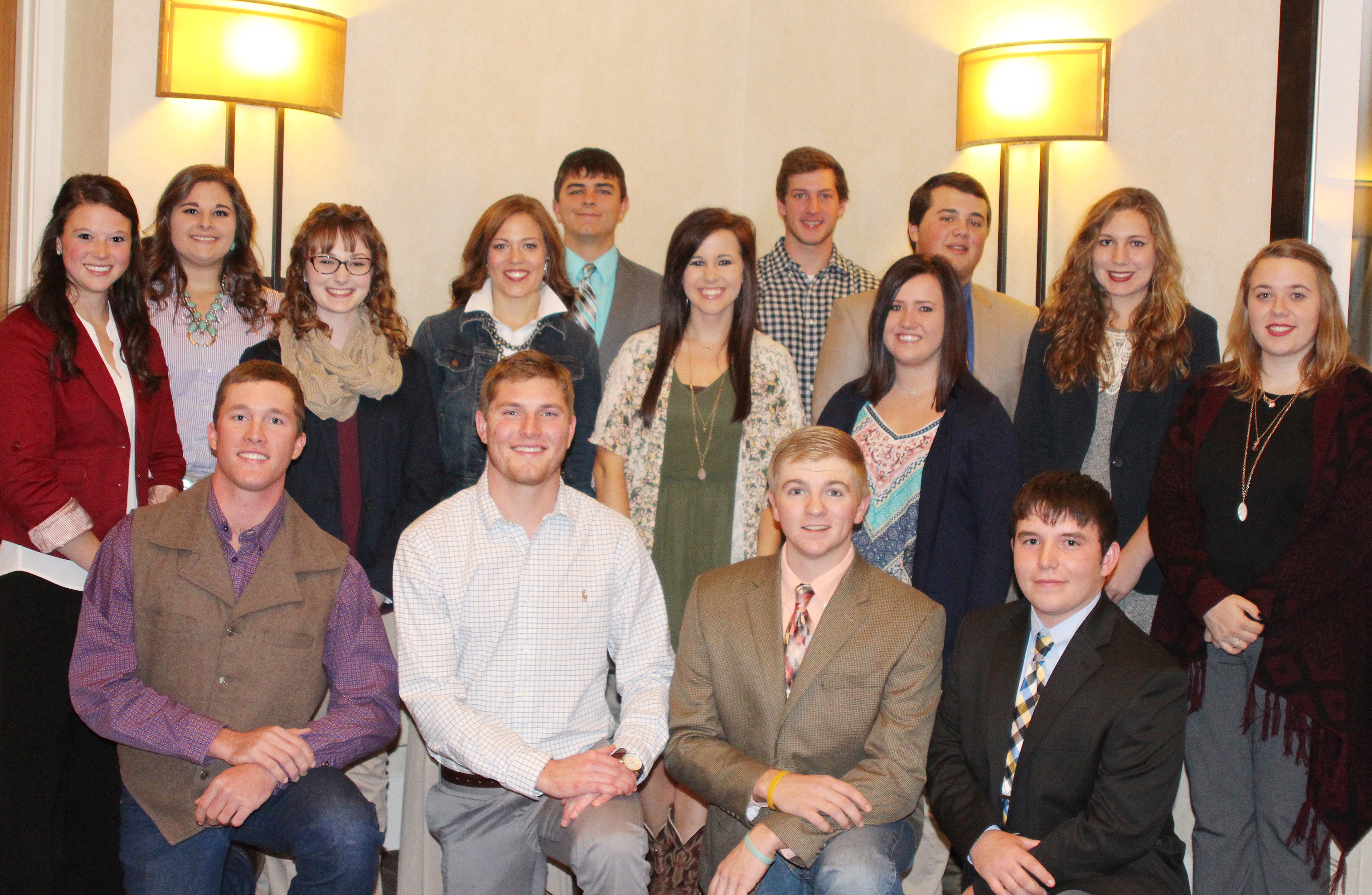
Pictured (standing, L to R) are Leah Scholz, Lancaster; Taylor Nikkel, Maple Hill; Brittney Houck, Americus; Kenzie Curran, Farlington; Reid Beeman, Olpe; Jacqueline Clawson, Meade; Sam Morgan, White City; Cade Hibdon, Princeton; Karley Stockton, Meade; Madelyn Mushrush, Strong City; Bailey Corwine, Lyndon; (kneeling, L to R) Ethan Bellar, Howard; Hayden Walker, Sharon Springs; Hadley Schotte, Marysville; and Campbell Martin, Bucklin.
KLA
WICHITA – Twenty-six scholarship winners for the 2016-17 school year were recognized during the annual Kansas Livestock Association Convention November 30 in Wichita. A total of $27,100 was presented by the Kansas Livestock Foundation and its partners.
Three Kansas State University veterinary school students were chosen to each receive a $1,500 Ralgro Wheels for Bucks scholarship from Merck Animal Health and KLF. Jessica Eisenbarth is the daughter of Connie and David Eisenbarth of Hoyt. She is a third-year veterinary student. Megan McLaughlin, also a third-year veterinary student, is the daughter of Julie and Daniel McLaughlin from Olathe. Ellen Unruh is the daughter of Edward and Darla Ouellette of Rantoul and is a fourth-year veterinary student. This award recognizes K-State veterinary school students with a career goal of being a large animal veterinarian.
Six Kansas students each have been awarded, through KLF, $1,000 Wheels for Bucks Scholarships. Morgan Gantz is the daughter of Mark and Angela Gantz of Perry. She is a sophomore at Cloud County Community College majoring in agricultural economics and business. Samuel Morgan, the son of Steve and Nancy Morgan from White City, is a junior at Emporia State University majoring in business and finance. Leah Scholz is the daughter of Trent and Lori Scholz of Lancaster. She is a junior majoring in pre-veterinary medicine at K-State. MaRyka Smith is the daughter of Lisa and Kevin Smith from Hoyt. She is a senior at K-State majoring in pre-veterinary medicine. Karley Stockton, daughter of Kris and Sharon Stockton from Meade, is a junior majoring in animal science at K-State. Katelyn Thomson is the daughter of Dan and Cindy Thomson of Riley. She is a junior at K-State majoring in pre-veterinary medicine. This scholarship is presented to students entering or returning to a Kansas community or senior college and pursuing a degree in agriculture or a related field. WFB scholarships are funded by Merck’s donation of $1.00 for each used Ralgro wheel turned in to KLA.
Hadley Schotte of Marysville has been awarded the $1,000 Cattlemen’s Scholarship from GoBob Pipe & Steel and KLF. Schotte is the son of Pat and Kelly Schotte. He is a freshman at Hutchinson Community College majoring in animal science. This scholarship is awarded to a student entering or returning to a Kansas community or senior college and pursuing a degree in agriculture or a related field.
Cade Hibdon has been awarded the $1,000 Cancrete Cattle Waterers Scholarship through KLF. Hibdon is the son of Darren and Julie Hibdon from Princeton. He is a freshman attending Butler Community College and majoring in agribusiness. This scholarship is presented to a student entering or returning to a Kansas community or senior college and pursuing a degree in agriculture or a related field.
The $1,000 Glenn & Clyde Lindstrom Scholarship has been awarded through KLF to Braden Mishler, the son of Brian and Janet Mishler from Arnold. He is a sophomore at K-State majoring in agricultural engineering. This scholarship is awarded to a student of sophomore level or above attending a Kansas junior or senior college and pursuing a degree in agriculture. Preference is given to students residing within the boundaries of Unified School District 400 in northern McPherson and southern Saline counties.
Four $1,000 Hampel Oil Scholarships have been presented to K-State students. Austin Baalman, son of Duane and Michaela Baalman from Oakley, is a junior majoring in agricultural economics. Jerica Hall is the daughter of Jerry and Stephanie Hall from Independence. She is a junior majoring in animal science. Tyler Marr, the son of Tom and Sherry Marr of Formoso, is a junior majoring in agronomy. Hayden Walker is the son of Bryce and Tracy Walker from Sharon Springs. He also is a junior majoring in agronomy. This scholarship is awarded to students entering their junior or senior year at K-State or Fort Hays State University and pursuing a degree in agronomy, agribusiness or ag economics. Preference is given to applicants with a career goal of being actively engaged in a farming or feedyard enterprise.
Five students from across the state have received $1,000 “Youth in Agriculture” scholarships from KLF. Ethan Bellar is the son of Mike and Peggy Bellar from Howard. He is a freshman at Pratt Community College majoring in farm and ranch management. Bailey Corwine of Lyndon is the daughter of Matt and Kathie Corwine and Charles and Heather Sharp. She is a sophomore attending Allen Community College and majoring in agricultural communications. Taylor Nikkel, daughter of Mark and Janice Nikkel of Maple Hill, is a freshman at K-State majoring in agricultural economics. Madelyn Mushrush is the daughter of Joe and Connie Mushrush of Strong City. She is a freshman at K-State majoring in animal science. Jacqueline Clawson is the daughter of Dan and Tamra Clawson from Meade. She is a sophomore at K-State majoring in agricultural economics and business marketing. Funded by the KLF Club Calf Sale held during the Kansas Junior Livestock Show, these scholarships recognize students entering or returning to a Kansas junior or senior college and pursing a degree in agriculture or a related field.
Three students attending K-State each were awarded a $1,200 Kansas CattleWomen (KCW) Scholarship. Kenzie Curran is the daughter of Joe and Kim Curran of Farlington. She is a senior majoring in agricultural communications and journalism. Brittney Houck, the daughter of Jeff and Lori Houck from Americus, is a junior majoring in mass communications and animal science. Sarah Jones is the daughter of Michael and Debra Jones from Riverton. She is a senior majoring in food science. This scholarship, funded by the KCW silent auction, is awarded to students entering or returning to a Kansas community or senior college and pursuing a degree in dietetics, food safety, agriculture or a related field.
Reid Beeman was awarded the $500 Fred H. Woodbury Memorial Scholarship through KLF. Beeman is the son of Preston and Jeanna Beeman from Olpe. He is a freshman at Fort Scott Community College majoring in agriculture. This scholarship is presented to a student attending a Kansas junior or senior college and pursuing a degree in agriculture. Preference will be given to students residing within Chase, Franklin, Lyon, Osage or Wabaunsee county.
The $500 Lallemand Animal Nutrition Scholarship has been presented to Campbell Martin. He is the son of Eric and Holly Martin from Bucklin. Martin is a freshman majoring in agriculture at Hutchinson Community College. This scholarship is awarded to student attending a Kansas junior or senior college and pursuing a degree in agriculture or a related field.
Charles C. Haynes is director of the Religious Freedom Center of the Newseum Institute.
On Dec. 4, the two-year struggle by the Standing Rock Sioux Tribe to protect their sacred land and water ended — at least for now — when the Obama administration denied the easement needed to complete the Dakota Access Pipeline.
The cancelled route, located one half mile from the tribe’s reservation in North and South Dakota, would have allowed the pipeline to cross under the Missouri River, a action that the tribe believes would threaten their life-giving water and destroy sacred sites.
Human rights advocates are savoring the moment. In the long, ugly history of persecution, exploitation, broken treaties, unkept promises and adverse court decisions, the victory at Standing Rock is a rare win for Native American religious freedom.
What is considered sacred by indigenous peoples — including, in this case, water, burial sites, sacred gathering spaces — has been, at various times in our history, debased, mocked, bulldozed or completely ignored by government officials and courts. In fact, for much of our history, many Native American ceremonies were illegal and people were imprisoned for practicing their religion.
The First Amendment’s Free Exercise clause is supposed to protect all religious groups, including those with rites and rituals rejected, feared or misunderstood by the majority. But the Supreme Court has often failed to treat Native American religious practices on a level playing field with other religious claims. In fact, Native Americans have never won a Free Exercise case at the U.S. Supreme Court.
Consider the 1988 Supreme Court decision in Lyng v. Northwest Indian Cemetery Protective Association. At issue was a plan by the U.S. Forest Service to build a road and harvest timber in a section of the Six Rivers National Forest considered sacred by the Yurok, Karok and Tolowa tribes.
Although the justices acknowledged that the development plan would effectively destroy an entire religion, the Court ruled 5-3 that the constructing the road would not violate the free exercise of the tribes. As a result, Native Americans now have little recourse under the Constitution as they battle to preserve sacred sites on federally owned land.
Centuries of religious tradition can be wiped out — and invoking the First Amendment does nothing to prevent it.
Against the backdrop of this sad history, Native American protesters — calling themselves “water protectors” — gathered by the thousands and would not be moved. Representatives from more than 300 tribes flocked to Standing Rock, joined by human rights activists, veterans and ordinary citizens who know injustice when they see it.
Sprayed with water cannons in freezing weather, pelted with rubber bullets, tear gas and concussion grenades, the water protectors attempted to open a bridge barricaded by police, arguing that the barrier blocked emergency services from reaching their camp and the nearby Standing Rock Sioux Reservation.
Fortunately, tribal elders defused that confrontation. But more serious conflicts were anticipated after state officials gave the protesters a Dec. 5 deadline to leave the area; an order protesters promised to defy. The Obama administration’s action on Dec. 4 ended the standoff, handing Native Americans a rare religious freedom victory.
Not surprisingly, proponents of the Dakota Access Pipeline are outraged. Energy Transfer Partners, builders of the pipeline, accused the Obama administration of “currying favor with a narrow and extreme political constituency” by halting the project. North Dakota Republican Rep. Kevin Cramer described the move as a “chilling signal to others who want to build infrastructure.”
Given the political clout of pipeline supporters, the tribes are aware that their victory is fragile — and could be undone after Jan. 20. A spokesman for Donald Trump has already announced that the president-elect supports completing the pipeline and will revisit the Obama administration’s decision once he is in the White House.
What the new administration will soon discover, however, is that the Standing Rock Sioux Tribe, supported by hundreds of tribes from across the country, will not fold their tents and quietly disappear. If construction resumes, threatening sacred water and land, the protest camps will grow in size and strength.
The Trump administration will face a stark choice: Once again remove Native Americans by force — or, at long last, protect Native Americans to preserve and practice their religion on land they hold sacred.
Charles C. Haynes is vice president of the Newseum Institute and founding director of the Religious Freedom Center. [email protected]
Photo by Andy Marso/KHI News Service House Republicans voted Monday for Rep. Ron Ryckman Jr. of Olathe to replace Rep. Ray Merrick as House speaker. But GOP House members also voted for several more moderate Republicans to serve in leadership roles under Ryckman.
By ANDY MARSO
Republicans in the Kansas House and Senate elected coalitions of center and center-right members Monday to lead their chambers in the upcoming session.
The shift from uniformly conservative leadership teams reflects gains that moderate Republicans made in the August primaries, especially in the House.
House Republicans voted for Rep. Ron Ryckman Jr. to replace Rep. Ray Merrick as House speaker, a change that will become official after a confirmation vote by the full House when the session opens Jan. 9.
For the past two years, Merrick had appointed Ryckman to chair the critical House Appropriations Committee. Both are conservatives from Johnson County.
But GOP House members voted Monday for several more moderate Republicans to serve in leadership roles under Ryckman, including Rep. Don Hineman of Dighton as House majority leader and Rep. Tom Phillips of Manhattan as assistant majority leader.
Ryckman said it was time for a more open, collaborative environment in the House and promised debates even on politically fraught issues like expanding Medicaid under the Affordable Care Act, commonly called Obamacare.
“I think things have changed with the presidential race,” Ryckman said. “But we’ll listen to the health care industry and see what their ideas are. We need to have a chance to have all these ideas debated, especially people who ran on certain issues.”
Ryckman earned 57 of the 85 House Republicans’ votes to defeat Russ Jennings, a moderate Republican from Lakin, for the speakership.
Jennings’ 28 votes give him and the other moderates leverage to vote with the chamber’s 40 Democrats and have a majority on issues where they align.
But as he conceded Monday to Ryckman, Jennings said House Republicans should repair rifts that have emerged in the last few years.
“The time has come to turn the page and to be one caucus,” Jennings said.
‘A state of flux’
However, tight margins in several other leadership votes suggest that might be easier said than done.
Hineman and Phillips both defeated more conservative members by votes of 44-41, getting one more vote than the bare minimum they needed.
Rep. Scott Schwab, a conservative from Olathe, was easily elected House speaker pro tem. Two more moderate GOP legislators — Kent Thompson, House majority whip, and Susan Concannon, House caucus chair — rounded out the leadership team.
Rep. Dan Hawkins, a conservative from Wichita, lost to Phillips in his bid for a leadership job.
He said the full slate of votes means Ryckman will have to govern with moderates and Hawkins’ position as chairman of the House Health and Human Services Committee “probably is in a state of flux now.”
“I would imagine that Ron has to put together his team,” Hawkins said. “Elections have consequences, and this election pretty much showed it’s going to be a fairly blended leadership team.”
On the Senate side, the leadership change was more subtle but also shifted toward the center.
Sen. Susan Wagle from Wichita was easily re-elected to be Senate president, pending confirmation from the full Senate, and another conservative, Sen. Jim Denning, was unopposed in his bid to be Senate majority leader.
But Sen. Jeff Longbine, a center-right Republican from Emporia who has expressed discontent with the chamber’s tax and budget votes, was elected vice president and Sen. Vicki Schmidt, one of the chamber’s most moderate Republicans, was elected assistant majority leader.
Longbine said it was time to unite a Senate Republican caucus split into factions labeled “moderate” and “conservative” since the 2012 primary campaigns in which several GOP Senate leaders were ousted by more right-wing challengers.
“I would like to remove those (labels),” Longbine said. “We need to understand that we are a diverse body and we represent diverse districts. But at the end of the day there are 31 Republicans, and we need to govern like Republicans and realize that we need to discuss our differences, come to a consensus and pass legislation that will benefit the majority of the state.”
Sen. Elaine Bowers, another center-right Republican, was elected majority whip.
Democrat changes
While Republicans were trying to build unity after years of contentious votes forced by several budget crises, House Democrats found themselves divided over their leadership.
Rep. Tom Burroughs of Kansas City made a run to retain his position as House minority leader but deadlocked in a 20-20 vote with Rep. Jim Ward from Wichita, an outspoken critic of Gov. Sam Brownback, his administration and previous Republican House leaders.
One vote later flipped to make Ward the new minority leader in the House, where Democrats’ numbers will increase from 28 to 40.
Sen. Anthony Hensley of Topeka, the Legislature’s longest-serving member, was chosen to remain the minority leader in the 40-member Senate, where the Democrats’ numbers will increase from eight to nine.
Andy Marso is a reporter for KHI News Service in Topeka, a partner in the Heartland Health Monitor team. You can reach him on Twitter @andymarso


 EPA
EPA


 Listen to Mike Cooper interviewing Cardiologist Dr. M. Javed Ashraf, MD , from the DeBakey Heart Institute at HaysMed, with the topic of “Heart Health” by clicking the link above and then clicking the play button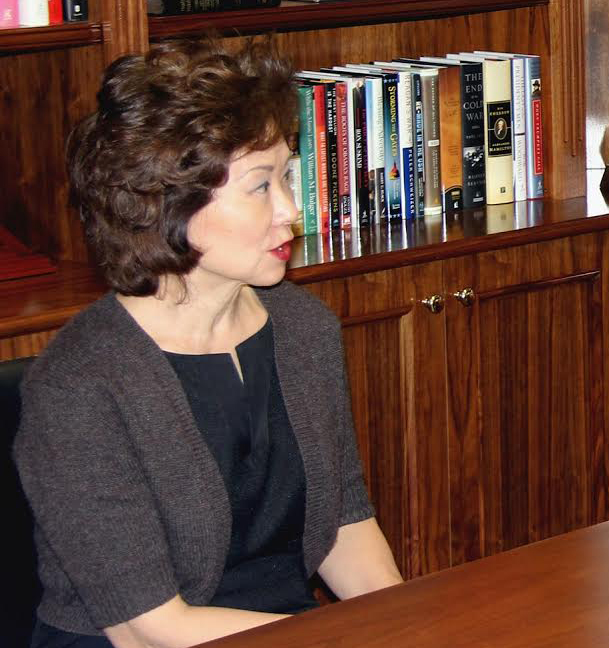



 By KARI M. BRUFFETT and CHENG-CHUNG HUANG
 Listen as the ‘Voice of the Chiefs’ Mitch Holthus recaps Thursday’s win over the Oakland Raiders.