We have a brand new updated website! Click here to check it out!

Medicaid fund could be tapped again to cover Kan. budget shortfall

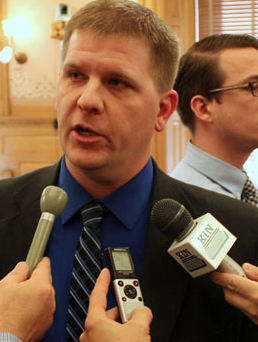
Photo by Stephen Koranda/Kansas Public Radio File With only a week remaining before the end of the 2016 budget year, Kansas faces a $45 million shortfall. Budget Director Shawn Sullivan is considering several emergency contingencies, including sweeping some or all of the cash from a Medicaid drug rebate fund.

By JIM MCLEAN

Kansas officials have borrowed a record $900 million from the state’s investment fund but still may need to implement a series of emergency measures to end the 2016 budget year in the black.

Shawn Sullivan, director of Republican Gov. Sam Brownback’s Budget Office, said that the $900 million certificate of indebtedness approved Wednesday by the State Finance Council will be used to manage anticipated cash flow problems in the 2017 budget year, which starts July 1.

But with only a week remaining before the end of the 2016 budget year, the state is facing a $45 million shortfall.

And that could grow if June tax revenues come in short of projections. Sullivan is considering several contingency plans, including sweeping some or all of the cash from the Medicaid drug rebate fund.

A change in federal law triggered by the Affordable Care Act allows states with Medicaid managed care programs to collect refunds on prescription drug claims. Prior to the ACA, states that contracted with private insurance companies to operate their Medicaid programs were ineligible for the rebates.

Kansas privatized its Medicaid program in 2013 and renamed it KanCare. When the budget year ends June 30, Sullivan said he expects the balance in the drug rebate fund to be in the neighborhood of $40 million to $45 million.

“As a last resort, I may transfer a portion of the ending balance to the State General Fund for 2016,” he said in an email to the KHI News Service.

Sullivan said he will make a decision next week once he knows how close June revenues will come to meeting projections. Revenues fell more than $74 million short of projections in May.

The drug rebate money is currently earmarked to pay for anticipated increases in KanCare claims in the 2017 budget year, Sullivan said. If the demand for services grows as anticipated, any money transferred from the fund would have to be repaid. If the anticipated growth doesn’t occur, the state may not have to replenish the fund.

The Brownback administration transferred $55 million from the drug rebate fund in 2014 to help bridge a $280 million shortfall. That money wasn’t repaid because rebate payments exceeded projections the following year, Sullivan said.

Jim McLean is executive editor of KHI News Service in Topeka, a partner in the Heartland Health Monitor team.

Supreme Court places new limits on drunken driving test laws

duiWASHINGTON (AP) — The Supreme Court has placed new limits on state laws that make it a crime for motorists suspected of drunken driving to refuse alcohol tests.
Justices ruled Thursday that police need a search warrant before requiring drivers to take blood alcohol tests. But the court declined to require a warrant for breath tests, which it considers less intrusive.

The ruling came in three cases where drivers challenged so-called implied consent laws in Minnesota and North Dakota as violating the Constitution’s ban on unreasonable search and seizure. State supreme courts in each state had upheld the laws.

Drivers in all 50 states can have their licenses revoked for refusing drunken driving tests. The court’s ruling affects laws in eleven states that impose additional criminal penalties for such refusals.

In March, Kansas Attorney General Derek Schmidt asked the state Supreme Court to put on hold recent decisions that declare state DUI-related statutes unconstitutional until the U.S. Supreme Court decides a similar case later this spring.

In a series of four cases announced on February 27, the Kansas Supreme Court overturned state statutes related to DUI, most notably a statute making it a crime for a person suspected of DUI to refuse to submit to a breath test to determine blood-alcohol levels.

Kansas man arrested for alleged attack on a woman in her home

Miller
Miller

SALINE COUNTY – Law enforcement authorities in Saline County are investigating a suspect for an alleged attack on a woman in her home.

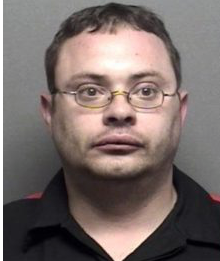
David J. Miller, 32, Salina, battered and tried to strangle a woman in her 20s around 11 p.m. Monday night at a central Salina, according to Police Captain Mike Sweeney.

Miller left the home before police arrived. The woman suffered bruises to her face, head, and forearm.

She was transported to Salina Regional Health Center for treatment and released.

Miller was booked into the Saline County Jail late Wednesday morning on requested charges of aggravated battery and criminal threats

Thomas County man hospitalized after pickup hits power pole

KHPTHOMAS COUNTY – A Thomas County man was injured in an accident just after 5p.m. on Thursday.

The Kansas Highway Patrol reported a 2005 Dodge Dakota driven by Johnny J. Garcia, 44, Brewster, was westbound on County Road 12 six miles west of Colby.

The pickup left the roadway, entered the left ditch and struck a power pole.

Garcia was transported to the hospital in Colby.

He was not wearing a seat belt, according to the KHP.

Temporary blindness linked to smartphone use in the dark

phoneLONDON (AP) — Doctors have an unusual warning for anyone prone to checking their smartphones in the dark: make sure you use both eyes.

In a letter published in Thursday’s New England Journal of Medicine, doctors in London detailed the cases of two women who inexplicably suffered temporary blindness lasting up to 15 minutes.

But soon after walking into an eye specialist’s office, the mystery was solved. Dr. Gordon Plant figured out that the women habitually looked at their smartphones with one eye while lying in bed in the dark, with the other eye covered by the pillow.

That mismatch meant that when they put down their phones, the eye adapted to the light took time to catch up to the dark-adapted eye, resulting in temporary blindness that Plant described as harmless.

Kansas man hospitalized; semi forces Mercedes into a ditch

KHPSHAWNEE COUNTY – A Kansas man was injured in an accident just after noon on Thursday in Shawnee County.

The Kansas Highway Patrol reported a 2016 Freightliner semi driven by Mitchell Thornburrow, 22, Manhattan, was westbound on U.S. 24 two miles west of Rossville.

The semi went off the road into the right ditch. The driver overcorrected causing the truck to go on its side and a 1991 Mercedes Benz 190-E driven by Michael McGinnis, 50, Topeka, into the ditch.

McGinnis was transported to Stormont Vail.

Thornburrow was not injured. Both drivers were properly restrained at the time of the accident, according to the KHP.

Veteran infielder Infante clears waivers, becomes free agent

KANSAS CITY, Mo. (AP) – Veteran infielder Omar Infante cleared waivers Thursday and became a free agent.

Infante was designated for assignment June 15th by the Kansas City Royals, who chose to pay him the nearly $14 million remaining on his contract rather than let him ride the bench as a utility player.

Infante spent his first six seasons in Detroit. He later played for Atlanta, earning an All-Star nod with the Braves in 2010, and briefly spent time in Miami before returning to the Tigers for two more seasons.

But after signing with Kansas City, the career .271 hitter began a slow decline, his bat speed and fielding ability no longer what it was in his prime. He hit only eight homers with the Royals, two fewer than his final season with Detroit.

Kan. man arrested for vehicular homicide after fatal crash

Fatal crash in Hutchinson

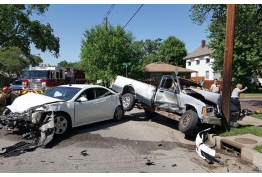
HUTCHINSON – A Kansas man who was involved in a fatality accident on May 12, has been arrested for vehicular homicide and having no insurance.

Everette Hardy, 25, Hutchinson, was eastbound on 14th Avenue, failed to yield at a stop sign and collided with southbound pickup driven by Jack B. Johnson, 80, at the intersection of Poplar Street, according to Police

Johnson was transported to Hutchinson Regional Medical Center for treatment of injuries and was later transported to a Wichita hospital where he died on June 3.

Hardy was cited at the time for disobeying the stop sign, but now faces the much more serious charge.

Bond in the case set at $5,100. Unless he makes bond, he should make a first court appearance Friday.

Hays farmer: 2016 wheat harvest ‘considerably better than most’

kansas wheat harvest combine

By JORDAN HILDEBRAND
Kansas Wheat Harvest Report

The heat is rising and the combines are rolling across Kansas. Harvest is starting to climb up the western region of the state. Praise continues to mount for the yields, test weights and condition of the wheat.

Steve Binder, a farmer near Hays, said that most farmers in the area would be done in about five days. Binder said that this year’s harvest is “considerably better than most.” Yields are ranging around 40-45 bushels an acre on continuous acres and 60-65 bushels an acre on summer fallow. Test weights are hovering around 59 pounds per bushel and moisture is ranging from around 9-10 percent. Binder said that T-151 has performed well for the farm this year.

Rick Wolting, manager of the Farmway Coop in Lincoln reported seeing yields all over the board ranging from 40-80 bushels an acre. Trucks began hauling wheat into the location last week and Wolting estimates that the area isn’t quite half done.

Test weights have also ranged from around 58-65 pounds per bushel and Wolting’s location has seen up to 13% protein content.

kansas wheat

Wolting said, “This year we’ve seen a lot better yields because more farmers sprayed fungicide which resulted in better plant health.”

Harvest started Tuesday for Richard Randall, a farmer from Scott City. Yields and test weights are performing “extremely well” for Randall. Test weights have been over 60 pounds per bushel and yields have been well above average for the area.

“Mother Nature’s given us a good crop,” Randall said. “We just hope we can get it out of the field in time.”

The 2016 Harvest Report is brought to you by the Kansas Wheat Commission, Kansas Association of Wheat Growers and the Kansas Grain and Feed Association.

3-year-old girl drowns in Kan. backyard pool at daycare

drowningWICHITA, Kan. (AP) — Wichita police say a 3-year-old girl drowned in a pool at her daycare provider’s home.

Police Sgt. Nikki Woodrow says the girl and a 5-year-old were playing in the backyard Thursday morning.

The 3-year-old somehow got into an above-ground pool that was about 4 feet high. She died at the scene.

Woodrow said the daycare provider and three other children were in the house when the girl drowned. She says it’s unclear how long the girl was in the pool and an investigation is continuing.

Westar seeks change in transmission costs; could reduce rates

WestarTOPEKA, Kan. (AP) — Westar Energy is seeking a change in its transmission costs that would reduce customers’ rates by about $18 million.

In March, the Kansas Corporation Commission approved a $25 million increase to the utility’s transmission delivery system. That came a day after the Federal Energy Regulatory Commission approved a settlement between Westar and the KCC after determining the company collected too much money from customers.

The Topeka Capital-Journal reports those two decisions prompted Westar to update its transmission costs Tuesday, reducing charges to customers by $18 million.

Westar spokeswoman Gina Penzig says the when customers see the reduced costs will depend on when the KCC acts on the utility’s request. She says if the request is approved, customers in average households should save about $1.50 a month.

INSIGHT KANSAS: Voters may throw the bums out

Kansas voters may be ready to throw the bums out in upcoming elections. Why? Because many Kansans see their state government as one big mess!

Nearly three of every four Kansans recently surveyed gave poor marks to the performance of Kansas government. Kansans also rated state performance low on managing taxpayer money, assuring quality education, providing a safety net for vulnerable residents, and maintaining the state’s infrastructure.

H. Edward Flentje is professor emeritus at Wichita State University.

These low ratings suggest voters are fed up with the far-right Republican lawmakers who have been running state government for the last four years and are ready to change direction in upcoming elections. All 165 legislative seats are on the ballot in the August 2 primary and November 8 general elections.

Many incumbent lawmakers, mostly Republicans, are waving goodbye on their own, leaving seats more open to competition. Since their prior election, eight state senators and 32 state representatives are not seeking reelection or vacated their offices earlier for personal reasons. Those departing are not backbenchers but include key leaders: in the senate, the vice president, majority whip, and seven committee chairs; and in the house, the speaker, speaker pro tem, and six committee chairs.

Most immediate action begins in Republican primary contests. Fifteen state senate seats are being contested in August. Ten of the 22 incumbent Republican senators seeking reelection will face primary opponents, and five of the ten seats vacated by incumbent Republicans have contested primaries.

Thirty-seven Republican house seats have contested primaries with 21 of 71 GOP incumbents facing primary challenges. Fifteen of the 16 seats vacated by incumbents have primary races.

In contrast, Democrats have 13 contested primaries statewide, six in the senate and seven in the house. No senate incumbent seeking reelection faces a primary challenger; three house incumbents do have primary contests.

Newcomers will fill no fewer than ten of 40 seats in the senate, and 32 of 125 seats in the house. If all incumbents lose in contested primaries, an unlikely possibility, half the senate and nearly half the house could turnover.

Republican primary voters should do some homework before voting. They should remember that in primary contests of 2012 and 2014 they opted for candidates aligned with Governor Sam Brownback and his tax experiment. That experiment has produced a series of unbalanced budgets and unfair tax increases, a mountain of new state debt, and lagging economic growth, as well as fiddle-faddling delays on school finance.

If Republican primary voters are now ready to change course, two short cuts are suggested: First, scrutinize every one of the 31 Republican incumbents who are seeking reelection in contested primaries. Except for a handful, these incumbents consistently supported Brownback, his reckless tax experiment, and other measures that have given him the highest disapproval ratings in the nation.

Second, ask a simple question of both incumbents and newcomers in contested primaries: Do you support Brownback and the direction he is taking state government? If you get a weaseling response, look for another candidate.

So, Kansas voters, the next step in changing course depends on you. Legislative candidates have stepped forward. Sixty-five contested primaries are on the ballot. Advance voting begins on July 13, less than three weeks away. Do your civic duty. Engage with candidates and vote.

H. Edward Flentje is professor emeritus at Wichita State University.

Copyright Eagle Radio | FCC Public Files | EEO Public File