CLEVELAND (AP) – Francisco Lindor hit one of Cleveland’s four solo homers and drove in three runs, and the Indians completed a four-game sweep of the World Series champion Kansas City Royals with a rain-delayed 7-0 victory Sunday.
Corey Kluber (5-6) allowed two hits and was pulled after the sixth inning when the game was delayed by inclement weather for 3 hours, 10 minutes.
Lindor, Carlos Santana and rookie Tyler Naquin homered in the fifth. Mike Napoli connected in the fourth.
The Indians moved past the Royals into first place in the AL Central on Saturday. Cleveland has won five straight overall and six of seven against Kansas City this season.
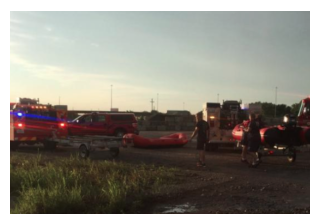
Crews search for the body last week photo courtesy KWCH
WICHITA, Kan. (AP) — Authorities have found a body downstream from where they’d been searching for a missing 11-year-old boy who fell into a Kansas creek.
The Wichita Eagle reports that Wichita police Deputy Chief Hassan Ramzah says the body was found Saturday by a kayaker. Ramzah couldn’t confirm the identity of the body, other than to say it was a male.
Officials say Devon Dean Cooley fell into Gypsum Creek on May 27. Crews have continued searching for the boy, and say the unidentified body was found about a mile downstream from the search area.
Cooley’s family issued a statement late Saturday saying they believe the body to be Devon’s but also acknowledging the absence of official confirmation.
Police say the body likely won’t be identified until a coroner’s investigation is completed.
SHAWNEE COUNTY – One person was injured in an accident just before 4p.m. on Sunday in Shawnee County.
The Kansas Highway Patrol reported a 2013 Volkswagen driven by William T Selesky, 42, Bolivar, CA., was eastbound on Interstate 70 one mile east of Valencia.
The vehicle hit the median then crashed into a deep ravine creek.
Selesky suffered a possible medical condition and was transported to Stormont Vail.
He was properly restrained at the time of the accident, according to the KHP.
Kansas Department of Aging and Disability Services
MELISSA HELLMANN, Associated Press
TOPEKA, Kan. (AP) — Funding designed to keep Kansas seniors out of nursing homes by offering in-home services such as cooking and cleaning is set to be cut as the state deals with a budget shortfall.
Some advocates for seniors worry that the 30 percent reduction to the Senior Care Act program will affect more than 4,500 elderly Kansans.
A spokeswoman for the state Department of Aging and Disability Services says family and community members will help seniors whose services are reduced or eliminated.
Opponents say the move will drive elderly people into nursing homes and onto Medicaid, which will cost the state more money in the long run.
ENGLEWOOD, Colo. (AP) – The Denver Broncos say star cornerback Aqib Talib is recovering after being shot in the leg at a Dallas nightclub.
Team spokesman Patrick Smyth said the team has been in touch with the cornerback and that he’s doing OK. Smyth said the team was gathering more information.
Last week, Talib said he was looking forward to the trip Monday to the White House where President Barack Obama will honor the Broncos for winning the Super Bowl. It’s unknown if he’ll still be able to make the trip.
The Broncos’ three-day mandatory minicamp starts Tuesday.
Talib, a former standout for the Kansas Jayahawks, is entering his ninth NFL season and has been named to the Pro Bowl the last three seasons.
PRATT – There are no hard and fast rules when it comes to tick prevention – the only guarantee is that ticks will be around – but a proactive approach can minimize the potential for lifelong health issues, and reduce these pests to a simple, minor annoyance.
Tick numbers usually peak in early June, but depending on spring temperatures, they can be common from April through July. If you spend time in the woods and in grassy areas, you’re going to attract ticks. And we know that in addition to being bloodsucking pests, they can spread serious blood-borne diseases such as Rocky Mountain spotted fever and Lyme disease. So how do you protect yourself?
Start by wearing light-colored clothing with long sleeves and pants. Keep the pant legs tucked into your socks. Do periodic checks and be sure to examine yourself after your outing.
Use a repellent. Most people who spend time outdoors are familiar with the ingredient DEET, contained in many commercial insect repellents. It can be sprayed directly on your skin, and repellents that contain 20 percent to 30 percent DEET will repel ticks for several hours. Permethrin is another option. Unlike DEET, which only repels ticks, permethrin causes muscle spasms, paralysis, and death for ticks if they touch it or consume it. Permethrin-based products currently on the market can also last up to six washes, making a bottle go a long way. And the best part? It’s odorless; however, because of its potent abilities, permethrin can only be applied to clothing and fabric.
Permethrin-based sprays can be purchased at most major retailers and is roughly the same price as popular repellents containing DEET. Look for a spray that contains at least 0.5 percent of permethrin. Pre-treated clothing containing permethrin is also available.
When treating clothing with permethrin on your own, be sure to read the instructions carefully. Apply the spray in a well-ventilated area, or outside. Then, let clothes air-dry by hanging them up on a line, or by leaving them out on a porch or outdoor table. Once dry, the treated clothing can be worn immediately.
The next time you embark on an outdoor adventure, make sure you’ve got the right spray and prevent these tiny critters from creating big problems.
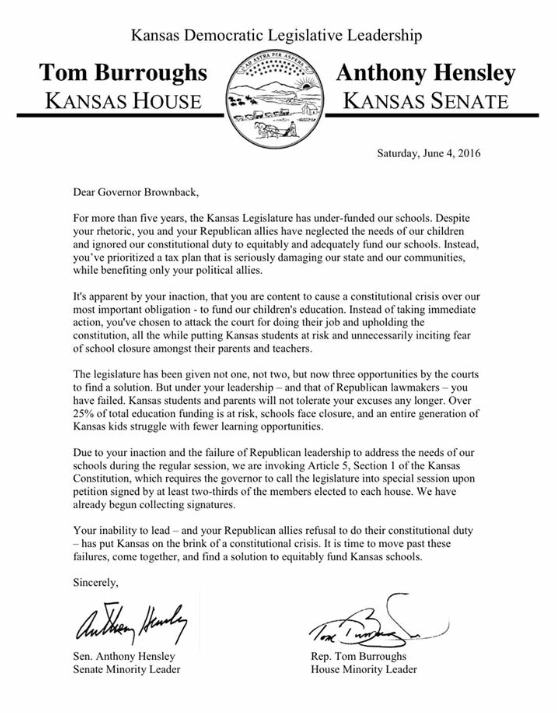
The letter sent to Governor Sam Brownback click to enlarge
TOPEKA, Kan. (AP) — Kansas Democratic lawmakers say they’ve been circulating a petition to force a special legislative session to address the school funding.
The move comes after the Kansas Supreme Court rejected the Legislature’s latest attempt to enact a constitutionally equitable school funding system. The high court has meanwhile kept a June 30 deadline for lawmakers, raising the possibility that schools could close if the date passes without further legislative action.
The Topeka Capital-Journal reports that House Minority Leader Tom Burroughs and Senate Minority Leader Anthony Hensley said in a letter sent Saturday evening to Gov. Sam Brownback that they’ve begun collecting signatures to force the governor to call a special session to find a solution to “equitably fund Kansas schools.”
Brownback’s office hasn’t given any indication of its plans.
Paste Magazine recently released its top 50 most underrated craft breweries in the U.S. and Hays’ own Defiance brewing made the list as the entry for Kansas.
To find out more about why they were selected, or to see the entire list of underrated craft breweries across the country, visit pastemagazine.com.
TOPEKA, Kan. (AP) — A 38-year-old Topeka man whose 4-year-old son was severely injured when explosives detonated in his car is scheduled to enter a plea in the case.
Jacob Daniel Schell is scheduled to enter a plea on July 8 in Shawnee County court, where he faces several charges, including aggravated battery of a child, aggravated endangering of a child and criminal use of explosives. Details of the plea weren’t available.
The Topeka Capital-Journal reports Schell’s son was injured when a sack containing explosives blew up in his lap, severely injuring the child.
The incident occurred July 5, 2015, as Schell was driving. The explosion also peeled back the metal roof of the large car.
Rural hospitals nationwide are facing a host of financial challenges, but states can still take action to keep them open, the head of a rural health group told the Governor’s Rural Health Working Group on Wednesday in Topeka.
Alan Morgan, CEO of the National Rural Health Association, spoke Wednesday in Topeka at a meeting of the Governor’s Rural Health Working Group. CREDIT MEGAN HART / HEARTLAND HEALTH MONITOR
Alan Morgan, CEO of the National Rural Health Association, said people in urban areas have a few explanations for why rural hospitals are struggling: irreversible population decline in rural areas, low-quality care and bad management practices.
In fact, he said, rural population across the nation appears to be stabilizing, rural hospitals do as well as or better than urban hospitals on quality measures, and insurance companies have struggled with the economics of serving rural populations.
However, he said, that doesn’t mean the problems of rural hospitals are an urban exaggeration. If hospitals continue to close at the current rate, about one in four rural hospitals will close in the next 10 years, Morgan said. A study released earlier this year by the NRHA and iVantage found that 673 U.S. hospitals, including 29 in Kansas, were at risk of closing in the next decade.
Gov. Sam Brownback announced formation of the working group in January to address the challenges of health care delivery in rural Kansas.
Part of the challenge is that rural residents tend to have more health problems than people who live in urban areas, Morgan said, and rural communities have been hit especially hard by increases in opioid abuse and other behavioral health issues. That translates into a disproportionate number of patients who can’t afford preventive care and use the emergency room for treatment, he said.
“We have a low-income population with great health needs,” he said.
Since 2010, hospitals also have been hit with a series of financial blows, including federal budget cuts associated with sequestration, reduced Medicare reimbursements under the Affordable Care Act and a shift toward outpatient care, Morgan said.
Until that time, most rural hospitals operated with from roughly a 2 percent profit to a 2 percent loss, he said. Now, the average is closer to running in the red by 6 percent.
Rural hospitals also disproportionately suffer from difficulty recruiting health care providers, and many are burdened by debts or old facilities that aren’t well-suited to providing the outpatient care that people use more often now, Morgan said.
“These hospitals are still structured like they were in the 1940s,” he said.
States and communities are exploring ideas to stabilize rural hospitals, Morgan said. No one has found a silver bullet to solve the problem, but he said some show promise. These include efforts to:
· Set up programs to encourage rural teens to pursue health care as a career. Providers who grew up in rural areas and do a residency there are more likely to stay.
· Expand the roles of people without a medical degree, such as paramedics, patient navigators and community workers who provide health information.
· Allow nurse practitioners, physician assistants and dental therapists to practice more independently, with a physician or dentist on call.
· Evaluate what services a community needs from its hospital.
· Increase the use of telemedicine to support rural providers.
· Offer grants to help hospitals cross the “shaky bridge” between payment models.
The one thing states shouldn’t do is wait for the federal government to come up with a model based on what works in urban areas, Morgan said.
Lt. Gov. Jeff Colyer, who leads the nine-member work group, said some of the ideas Morgan brought already are moving forward in parts of Kansas. The key will be rewarding successful initiatives and finding “blockages” in the system that prevent innovation, he said.
“Kansas is actually a pretty innovative place itself,” Colyer said.
Megan Hart is a reporter for KHI News Service in Topeka, a partner in the Heartland Health Monitor team. You can reach her on Twitter @meganhartMC
Every family has a story — the trick is finding it.
To aid in that search the Kansas Council of Genealogical Societies, in conjunction with the Ellis County Historical Society, 100 W. Seventh St., will host a genealogy conference at 8 a.m. Saturday, June 11, in the Whiskey Creek Wood Fire Grill Conference Center, 3203 Vine.
“It’s an annual conference that the Kansas Council of Genealogical Societies holds every year,” said Lee Dobratz, ECHS director. “It’s for anybody that’s interested in researching their family.”
The ECHS serves as a local contact for the genealogical society, helping spread information about the yearly event.
This year the conference will feature keynote speaker Annette Burke Lyttle, owner of Heritage Detective LLC, who has worked as a full-time genealogist since 2012.
While the official conference begins on Saturday, events have been planned for Friday as well, to give participants a taste of Hays history.
Friday’s events kick off at noon at Old Fort Hays, 1472 Hwy 183 Alt., followed by a presentation and tour at Fort Hays State University’s Forsyth Library at 2 p.m., a tour of the ECHS museum and archives at 3:30 p.m., dinner at Gella’s Diner, 117E. 11th St. at 5:30 p.m. and a narrated tour through Mt. Allen Cemetery at 7 p.m.
Each of the Friday’s events require admission to be paid at the corresponding locations and dinner is “on your own.”
Four sessions are planned for Saturday, including social history and why should a genealogist care; a path to your next research steps; prospecting for family history in unexpected places; and turn family history facts into stories you can share.
A mini-session covering the use of vintage cookbooks for geological history is also planned.
While the conference will have a research focus, Dobratz said the event is open to anyone interested in genealogy.
“Even if you’re not interested in learning more about your family, if you’re interested in learning about history this will help provide some skills and ideas on how to go about that,” she said. “It’s really just a weekend of history and research and commiserating with other people who enjoy research.”
For more on the event or to register for the conference, visit the KCGS conference page by clicking here.
DICKINSON COUNTY- Two people were injured in an accident just after 6p.m. on Saturday in Dickinson County.
The Kansas Highghway Patrol reported a 2009 Oskosh semi driven by Jarrod D. Tinnin, 20, Norman, OK., was eastbound on Interstate 70 four miles east of the Chapman exit as part of a military convoy.
The convoy started to slow and the Tinnin started to apply the brakes.
An eastbound 2012 Oskosh semi driven by Azjanee M. Cain, 23, Oklahoma City, rear-ended the 2009 semi causing a large piece of metal to come off the semi.
A 2014 Toyota passenger vehicle, not part of the convoy and driven by Joel M. Pinkston, St. Louis, MO., ran over the piece of metal.
All three vehicles came to rest on the south shoulder of Interstate 70.
Cain and a passenger in the 2009 semi Yesenia Casas, 20, Norman, OK., were transported to Abilene Memorial Hospital. No other injuries were reported.
Casas was not wearing a seat belt, according to the KHP. There is no center seatbelt available in the vehicle.








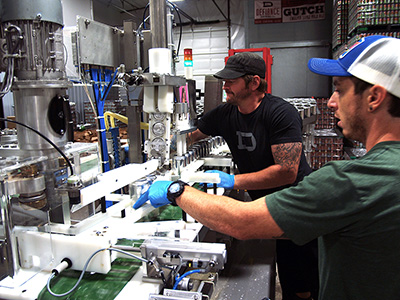
 Paste Magazine recently released its top 50 most underrated craft breweries in the U.S. and Hays’ own Defiance brewing made the list as the entry for Kansas.




 Every family has a story — the trick is finding it.