We have a brand new updated website! Click here to check it out!

Kansas again faces threat of public schools remaining closed

school fundingJOHN HANNA, AP Political Writer

TOPEKA, Kan. (AP) — Kansas again faces a threat that its public schools won’t open for the next school year.

The threat arises because of a ruling from the state Supreme Court on education funding changes made by the Republican-dominated Legislature earlier this year.

The court on Friday rejected some of the changes. They revised parts of the state’s school finance system but didn’t change the overall aid for most of its 286 local districts.

The court said the remaining flaws make the system unfair to poor districts, violating the state constitution.

Four school districts sued the state over education funding in 2010. That’s prompted a series of court rulings.

One in February from the Supreme Court directed legislators to make the funding system fairer for poor districts. Legislators enacted their changes in March.

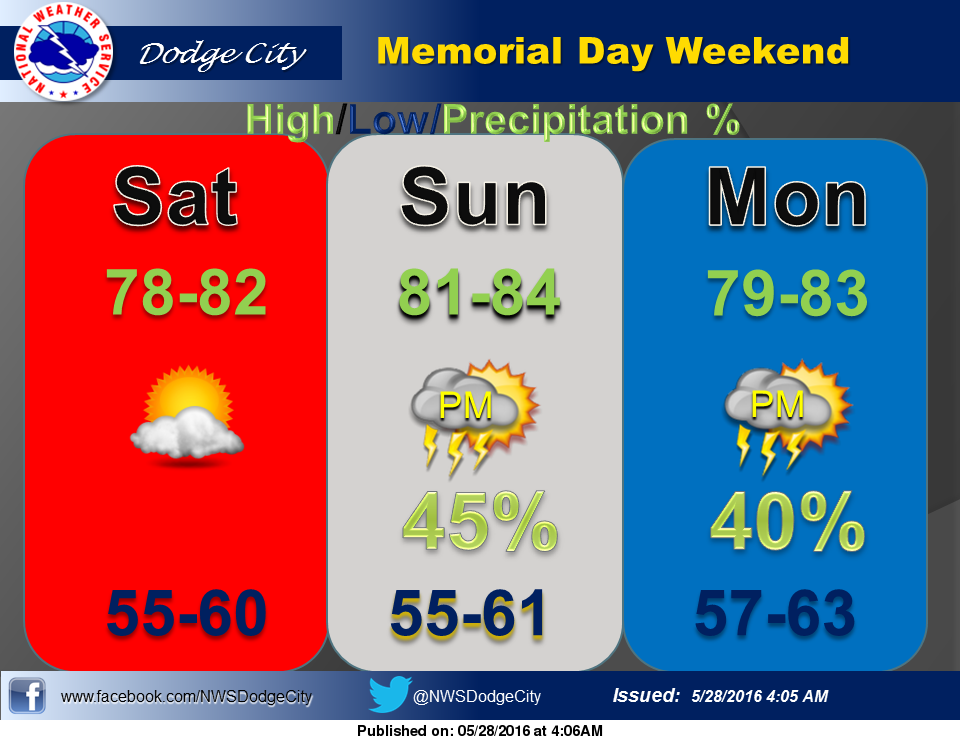
Mostly Sunny, mild Saturday

FileLBecoming mostly sunny today with high temperatures in the mid 70s. Chances for thunderstorms continue Sunday, though there is some uncertainty with area coverage of any activity. Winds look to switch to the south, with speeds again in the 10 to 15 mph range. High temperatures Sunday are forecast to be near the 80 degree mark.

Looking ahead to Memorial Day, highs are forecast once again to reach near 80 degrees, with south winds near 15 mph. At least a portion of the day looks to be dry for most locations, but thunderstorm chances will be increasing as the afternoon passes.

Today: A 20 percent chance of showers and thunderstorms before 7am. Mostly cloudy, then gradually becoming sunny, with a high near 78. Northwest wind 7 to 11 mph, with gusts as high as 21 mph.

Tonight: A 20 percent chance of showers and thunderstorms after 3am. Partly cloudy, with a low around 57. West wind 6 to 9 mph becoming south after midnight.

Sunday: A 40 percent chance of showers and thunderstorms, mainly after 2pm. Partly sunny, with a high near 81. South southeast wind 5 to 14 mph.

Sunday Night: A 30 percent chance of showers and thunderstorms, mainly before 11pm. Mostly cloudy, with a low around 59. South southeast wind 7 to 14 mph.

Memorial Day: A 40 percent chance of showers and thunderstorms, mainly after noon. Partly sunny, with a high near 79. South southeast wind 7 to 14 mph.

Kansas Water office cuts could delay projects

By ANDY MARSO

Budget cuts to the Kansas Water Office should not result in any layoffs but could delay some reservoir maintenance projects, the

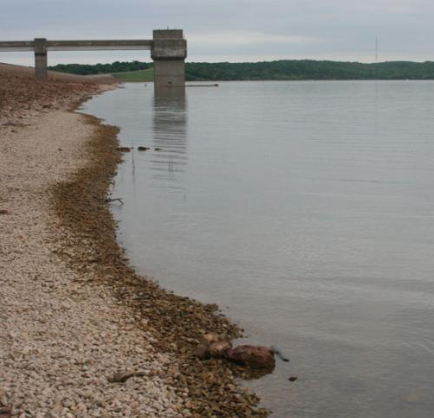
Photo by KHI News Service File Recent Kansas budget cuts may mean delays for stream bank stabilization projects that prevent sediment buildup in rivers and reservoirs. Clinton Lake, shown here, is among the reservoirs that help supply water to people living in eastern Kansas.

head of the office said this week.

Tracy Streeter, the office’s director since 2004, said he’s still examining the allotments that Gov. Sam Brownback announced last week. But he doesn’t expect his relatively small state agency to lose any staff.

“It will not affect personnel,” Streeter said. “Because the state general fund (appropriation) was reduced, we’ll use other funds to fill the gap temporarily.”

The cuts to the water office were part of more than $80 million in reductions Brownback made after the Legislature passed a budget that did not balance.

At $250,000, the water office cut was small compared to others. But for an agency with a total budget of about $1.15 million, it was proportionately the largest, at close to 22 percent.

Streeter said he had some warning the cut was coming. The water office will absorb the cut in part by using reserve money from a “water marketing fund” that increases during dry years as municipalities and private companies tap the reservoirs the office helps maintain.

The amount of precipitation this year will determine the health of the reserve fund and whether the budget cuts force Streeter’s office to take other actions.

“We might have to delay a stream bank project or two as a result of this, I don’t know yet,” Streeter said. “Right now I’m not counting on that even. We’ll probably take more of a wait-and-see (approach) and see how our water revenue performs this year.”

Streeter said he’s preparing for the reduction in state funding to be for only one year. He said it doesn’t indicate any shifting of priorities for Brownback, who has made enacting a 50-year water plan central to his tenure as governor.

But Rep. Tom Sloan, a Republican from Lawrence who has been one of the Legislature’s strongest voices on water issues, said the cut shouldn’t be interpreted any other way.

“You just can’t say water is a priority and not fund it,” Sloan said. Sloan acknowledged that the governor has formed a Blue Ribbon Task Force to look at ways to fund the state’s water projects but said the state has failed to fund its share of reservoir maintenance projects for years.

The stream bank stabilization projects that may be delayed prevent erosion that sends sediment flowing through rivers and into the reservoirs, lessening the amount of water they can hold.

Capacity can only be restored through dredging projects, like one that just started at John Redmond Reservoir, which are far more expensive than the stream bank projects. Sloan said that the eastern half of the state, which is home to most of the state’s reservoirs, has seen significant rain so far this year, which will lead to more erosion and sedimentation.

Delays to stream bank stabilization in order to balance the budget short-term would be “penny-wise and pound-foolish,” he said, but that’s the approach Brownback and Republican legislative leaders have taken as the state faces continuing revenue shortfalls following income tax cuts signed in 2012. “It’s the Band-Aid approach,” Sloan said.

“We’re no longer looking down the road saying ‘What is it that the state should be doing? What is it that sustains us as a state long-term?’”

Andy Marso is a reporter for KHI News Service in Topeka, a partner in the Heartland Health Monitor team. You can reach him on Twitter @andymarso

Kansas Rancher Testifies Before U.S. Senate Ag Committee

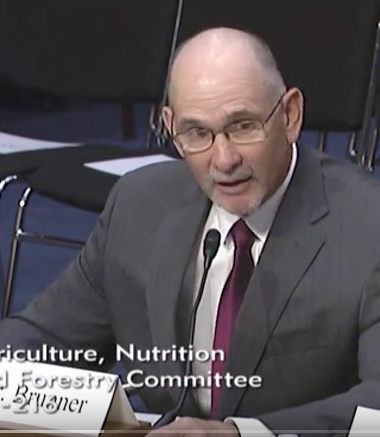
Kansan Tracy Brunner Testifies Before the Senate Ag Committee

WASHINGTON, D.C. – At this week’s hearing of the U.S. Senate Committee on Agriculture, Nutrition and Forestry, Tracy Brunner, National Cattlemen’s Beef Association President and rancher from Ramona, Kan., testified on the challenges and outlook of the U.S. beef cattle sector.

Agriculture Committee Chairman Sen. Pat Roberts, R-Kan., held the hearing to review the U.S. livestock and poultry sectors.

In his testimony, Brunner discussed the challenges facing the beef industry, including successful passage of the Trans-Pacific Partnership, the potential reissuance of the U.S. Department of Agriculture’s Grain Inspection, Packers & Stockyards Administration (GIPSA) rule, the U.S. Fish & Wildlife’s implementation of the Endangered Species Act, and the U.S. Environmental Protection Agency’s ‘Waters of the U.S.’ (WOTUS) rule.

“Tracy is not only a true leader for Kansas agriculture but also for the U.S. beef industry,” said Chairman Roberts. “Ranchers across America should be proud to have Tracy as a voice for cattlemen. I thank him for leaving the beautiful Flint Hills of Kansas to testify before the Agriculture Committee.”

Brunner is the fourth generation rancher from Ramona, Kan., and has served as president of his family corporation since its inception in 1988. A graduate of Kansas State University, Brunner manages the feedyard and the yearling grazing operation while overseeing the cattle and grain marketing decisions, commodity risk management, customer relations and financial reports. The Brunner family also operates a seed stock enterprise raising bulls and replacement heifers for many ranchers throughout the country.

Click here to watch Brunner’s opening statement.

Indian’s softball season closes at state

By Dustin Armbruster

Two five run innings by the Kansas City Piper Pirates was too much for Hays High to overcome Friday at the 4A-1 state tournament. Hays fell 10-5 to the top seeded Pirates to end their season at 10-11. Hays led off the game with a pair of singles but could not capitalize. Piper scored five runs and sent ten to the plate to take the lead for good.

Hays did get within a single run with two outs in the top of the third. The Indians loaded the bases for Tessa Stickel who launched a grand slam over the fence in right center field. The Stickel blast put Hays back into the game, trailing 5-4. The momentum though was short lived. In the bottom half of the same inning Piper added five more runs to increase their lead to 10-4.

Highlights

Stickel narrowly missed another homer to left field when the ball hit the fence just eighteen inches from the top. That double drove in the Indian’s fifth and final run of the contest.

Coach Erin Wagner

Piper’s Abby Henry who has signed to play at Washburn took the victory in the circle for the Pirates who are now 19-2. Kaitlyn Brown was tagged with the loss allowing five runs over just two-thirds of an inning. Jaysa Wichers allowed five runs over 5.1 innings pitching in relief.

Dismissal of lawsuit reversed in Kansas girl’s death

Jayden Hicks
Jayden Hicks

SALINA, Kan. (AP) — The Kansas Court of Appeals has reversed a judge’s decision to dismiss a lawsuit against the city of Salina by a family whose 12-year-old daughter died several months after being shocked while playing in a rainstorm.

The Salina Journal reports that the court returned the case Friday to Saline County District Court for further deliberations. The appeals court said the matter should not have been decided without a trial.

Attorney James Nordstrom, who represents the city of Salina, told the newspaper that he had no comment.

Jayden Hicks was 11 when she came into contact with the metal cover of an in-ground electrical junction box while playing with friends in May 2013. The box had been installed without a grounding wire and contained damaged wires.

Jayden died that December.

TMP Softball season ends in Quarterfinals

MANHATTAN, Kan.-TMP scored one run in the top of the first inning and had the bases loaded with only one out.  The stage was set for a big inning for the number eight seed Lady Monarchs against the top seed Southeast of Saline. TMP would not score again as they grounded into a fielder’s choice and struck out to end the inning.  Southeast would score a run to tie the game in the bottom of the first and would take the lead for good with two runs in the third inning.

After seeing the Lady Trojans score a run in the bottom of the fifth inning to take a 4-1 lead, TMP loaded the bases with two outs in the top of the sixth but were unable to score.  Southeast of Saline put the game away with four runs in the bottom of the inning, winning by a final score of 8-1.

TMP finishes their season with a record of 17-6.  Southeast of Saline advanced to the state semifinals against Oskaloosa, losing 10-1 to complete their season at 23-2.


Police: Kan. man arrested for alleged home invasion robbery, assault

Home-Invasion-jpgSHAWNEE COUNTY- Law Enforcement authorities in Shawnee County are investigating a home invasion robbery.

On Friday morning, police responded to report of a robbery in progress at a home in the 200 Block of SE Winfield in Topeka, according to a media release.

The homeowner described the suspect’s vehicle as a black Ford Taurus.

After a short pursuit, both occupants fled the vehicle on foot and entered a residence on Southeast Highland. The driver of the vehicle Jared Paneda, 29, Topeka, and other occupants of the residence on Highland were transported to the law enforcement center for questioning. A passenger in the Taurus was not located.

The homeowner who reported the original home invasion was uncooperative with police, refused to allow them to gather evidence or file a report.

Paneda is being held on requested charges of possession of stolen property, weapons and aggravated assault on a law enforcement officer.

The Latest: Kan. leaders battle over court’s ruling on school funding

School funding smallTOPEKA, Kan. (AP) — The Latest on the Kansas Supreme Court’s ruling on school funding (all times local):

8:40 p.m.

The Kansas Senate’s top Democrat is criticizing majority Republicans for not being more generous toward public schools while worrying about accommodating transgender students.

Senate Minority Leader Anthony Hensley of Topeka said Friday that lawmakers need to respond to the Kansas Supreme Court’s latest order on education funding by boosting aid to poor school districts.

He said they should do so on Wednesday before a brief ceremony adjourning their annual session.

Senate President Susan Wagle of Wichita plans to have her chamber vote on a resolution condemning a federal government directive saying public schools must allow transgender students to use facilities in line with their gender identities.

Hensley said lawmakers should increase education funding rather than “waste taxpayers’ dollars on an election year charade over which bathroom students can use.”

___

7:55 p.m.

An attorney for four school districts says Kansas will have to boost education funding by between $17.5 million and nearly $30 million for the 2016-17 school year to satisfy a state Supreme Court order.

Lawyer Alan Rupe said Friday that the Legislature needs to reconvene to address the problems identified by the court.

The court rejected some education funding changes approved earlier this year by legislators.

Rupe said it would cost $17.5 million to increase aid to poor school districts in keeping with the court’s latest order. He said if lawmakers want to keep other districts from losing aid, they’d have to provide an additional $12 million.

The court ruled in a lawsuit filed in 2010 by the Dodge City, Hutchinson, Wichita and Kansas City, Kansas, school districts.

___

7:35 p.m.

An attorney for four school districts says Kansas will have to boost education funding by nearly $30 million for the 2016-17 school year to comply with a state Supreme Court order.

Lawyer Alan Rupe said Friday that the Legislature needs to reconvene to address the problems identified by the court.

The court rejected some education funding changes approved earlier this year by the Republican-dominated Legislature. It said the entire school funding system is unfair to poor districts and violates the state constitution because of the flaws.

The extra funds Rupe identified would boost aid to poor districts while keeping wealthier ones from losing aid.

The court ruled in a lawsuit filed in 2010 by the Dodge City, Hutchinson, Wichita and Kansas City, Kansas, school districts.

___

7:15 p.m.

Republican Gov. Sam Brownback says the Kansas Supreme Court is putting children’s education at risk in its latest ruling on state funding.

He also said after Friday’s decision that the court has disregarded the Legislature’s “proper role” in setting education funding policy.

The court rejected some of the education funding changes legislators approved earlier this year. It said lawmakers failed to fully comply with a previous order in February to improve funding for poor school districts.

The court also renewed a threat to not allow schools to open in August if lawmakers don’t act again by June 30.

The conservative Republican governor said in a statement: “The court is engaging in political brinksmanship with this ruling, and the cost will be borne by our children.”

___

6:10 p.m.

Kansas House Speaker Ray Merrick is calling the state Supreme Court’s latest education funding ruling “disgraceful.”

The Stilwell Republican said the court’s decision Friday demonstrated that it is “the most political body” in the state and is “holding children hostage.”

The court rejected some education funding changes enacted by the Republican-dominated Legislature earlier this year.

The justices in February ordered lawmakers to make distribution of state aid fairer to poor public school districts.

They concluded Friday that lawmakers did not fully comply and that public schools must remain closed unless lawmakers act again by June 30.

Merrick said legislators acted in good faith.

He also suggested that voters consider ousting justices in November’s election. Five of the court’s seven members face yes-or-no votes on whether they stay on the bench.

___

5:30 p.m.

The Kansas Supreme Court says that if its most recent education funding ruling results in public schools closing, it will be because legislators did not comply with an earlier order.

The high court Friday rejected some education funding changes enacted by the Republican-dominated Legislature. The justices said in an unsigned order that lawmakers did not fully comply with an order in February to improve funding for poor schools.

The court refused to separate the changes it endorsed from ones it accepted, saying they were all part of a single system. The justices said that unless the problems are fixed, the state won’t have an acceptable system for distributing its more than $4 billion in annual aid.

The court said schools would be forced to close if the problems aren’t fixed not because of its decision.

___

5:07 p.m.

The Kansas Supreme Court is threatening again to close the state’s public schools and has rejected some education funding changes enacted by legislators earlier this year.

The court ruled Friday on a law that revised parts of the state’s funding formula but resulted in no change in total funds for most of the state’s 286 school districts.

The justices said legislators didn’t fully comply with an order it issued in February to make education funding fairer to poor school districts. The court said all schools must remain closed unless lawmakers fix the problems by June 30.

The court made the same threat in February, and the Republican-dominated Legislature passed the changes in hopes the court would relent.

Lawmakers were scheduled to meet Wednesday to formally adjourn their annual session.

Expensive security plan to comply with new Kan. weapons law

concealed and carry 2LAWRENCE, Kan. (AP) — The city of Lawrence is creating a security plan to comply with a state law allowing people to carry concealed guns.

The Lawrence Journal-World reports that the city attorney’s office has proposed funds in the 2017 budget to install personnel and equipment security at entrances to public buildings in anticipation of the Personal and Family Protection Act’s expiration in 2017.

The act, passed in 2013, allowed Lawrence and other cities to ban concealed weapons for four years before complying with a state law that says concealed firearms are allowed in public buildings unless the structures are equipped with security measures.

The security measures are being considered at City Hall, the municipal court, the public library and the police department’s investigations and training center.

Rape charge filed against 70-year-old Kan. cab driver

Sayed- photo Johnson Co. Sheriff

OLATHE, Kan. (AP) — A 70-year-old cab driver faces charges accusing him of raping a female passenger in Johnson County.

The Kansas City Star reports Abdul S. Sayed, of Olathe, is charged in Johnson County District Court with rape and aggravated criminal sodomy. A criminal complaint filed Thursday says the alleged assault occurred Dec. 13.

The complaint alleges that the victim was “overcome by force of fear” or was unable to give consent to sexual contact because of intoxication.

Online court records don’t list a lawyer for Sayed, who has a first appearance scheduled for Friday. His bond was set at $500,000.

Sayed was a driver for the Atlas Cab Co. at the time of the alleged assault. The company said Friday that Sayed was fired about three months ago.

Kansas Health Care Providers To Fight KanCare Cuts

BY JIM MCLEAN

Kansas Gov. Sam Brownback announced $56.3 million in cuts to KanCare, the state's privatized Medicaid program, as part of reductions aimed at covering budget shortfalls. CREDIT FILE PHOTO
Kansas Gov. Sam Brownback announced $56.3 million in cuts to KanCare, the state’s privatized Medicaid program, as part of reductions aimed at covering budget shortfalls.
CREDIT FILE PHOTO

Kansas health care providers will urge federal officials to reject Gov. Sam Brownback’s proposed Medicaid cuts and may challenge them in court.

The recently announced cuts would reduce state expenditures for KanCare, the state’s privatized Medicaid program, by $56.3 million and trigger a loss of approximately $72.3 million in federal funds. Combined, the managed care organizations that administer $3 billion KanCare program and the health care and service providers they have contracts with would be forced to absorb more than $128 million in cuts.

Of particular concern to providers is the proposed 4 percent reduction in reimbursement rates, which would amount to about $87 million of the $128 million total.

“In addition to being bad policy, the administration’s proposal to cut provider reimbursement would be inconsistent with state and federal law,” Tom Bell, chief executive of the Kansas Hospital Association, said in a recent letter to Brownback. “It would also be inconsistent with and not permitted by provider contracts in place with all Kansas hospitals. As such, we will challenge these proposed cuts in any appropriate way.”

Reductions of the magnitude being proposed will make it harder for the approximately 425,000 low-income children and families, elderly adults and people with disabilities covered by KanCare to access services, Bell said in an interview.

“The effect of these cuts will be to make providers less likely to participate (in KanCare) and ultimately make it even more difficult for vulnerable people to get the health care they need,” he said. “And why in the world would we want to do that?”

State officials must obtain approval from the federal Centers for Medicare and Medicaid Services to fully implement the cuts. But Brownback administration officials have said the reductions will take effect July 1 regardless of whether CMS has approved them.

“From our perspective, that’s fairly presumptuous,” Bell said. “I think the assumption on the part of the state is that CMS will just rubber stamp this. But our hope is that because so many people are concerned about the effect on access that CMS will take a very serious look at this. This is not your typical state plan amendment.”

Michael Randol, director of the Division of Health Care Finance in the Kansas Department of Health and Environment, said regardless of when CMS approves the cuts, they will be retroactive to July 1. If there is significant lag time between the effective date of the cuts and when CMS approves them, it could increase their impact by requiring providers to absorb a year’s worth of cuts in a matter of months.

Randol said he believes the state can legally impose the cuts pending CMS approval.

“I am confident in what we’re doing,” he said.

Julie Brookhart, a CMS spokesperson, said states can implement Medicaid changes while the agency is reviewing them.

“For a July 1, 2016, effective date, the state Medicaid agency would need to submit a state plan amendment by September 30, 2016, as the amendments can be retroactive,” Brookhart said in an email.

Still, those attempting to stop the cuts see timing as a potentially critical issue. Hospital association lawyers are assessing the chances of obtaining a court order to delay the cuts.

“We’re absolutely taking a look at that,” Bell said.

The extent to which the planned reductions in provider reimbursements affect KanCare patients’ access to care will be among the issues that CMS considers. Federal law requires that reimbursement rates be “sufficient to enlist enough providers” to ensure that Medicaid recipients get roughly the same level of services as the general population, Brookhart said.

In defending the cuts, Randol pointed to the 10 percent reduction in Medicaid reimbursement rates ordered in 2010 by former Democratic Gov. Mark Parkinson during the Great Recession. He said Brownback administration officials reviewed those cuts when crafting their plan.

“We tried to maintain some semblance of consistency,” he said.

The current situation doesn’t compare to 2010, said Kyle Kessler, executive director of the Association of Community Mental Health Centers of Kansas

“The cuts under Parkinson were the result of a recession and were temporary,” Kessler said. “That’s not what this is.”

The Brownback Medicaid cuts are the latest in a series of actions taken by the governor and lawmakers to cover chronic budget shortfalls that many believe have been caused by Brownback’s tax policies, specifically the income tax cuts and exemptions he pushed through the Legislature in 2012.

Because the budget problems appear likely to continue, Kessler said providers are concerned the proposed cuts may be permanent.

“Without a plan for restoration, the assumption has to be that they’re indefinite,” Kessler said.

Kansas hospital administrators share that concern, Bell said.

“What we’ve been told is that they are ‘indefinite,’” he said. “I think it’s hard to look at that word and not think that it may also mean permanent.”

Bell also questions whether the cuts are necessary. With a projected ending balance of $87.1 million in fiscal year 2017, Bell said the state could forgo the KanCare cuts and still finish the year with approximately $30 million in the treasury.

The Brownback news release announcing the budget reductions said they were being made to “continue to slow the growth of government” and signaled the possibility of additional cuts to Medicaid and higher education if the Kansas Supreme Court orders the state to increase funding for public schools.

Jim McLean is executive editor of KHI News Service in Topeka, a partner in the Heartland Health Monitor team.

Copyright Eagle Radio | FCC Public Files | EEO Public File