
 Listen to Mike Cooper interviewing Dr. Robert Rodriguez and Jennifer Teget from HaysMed, with the topic of “The Susan G. Komen Race for the Cure” by clicking the link above and then clicking the play button
Year: 2016
Flooding, hail, tornado reported from Southwest Kansas storm


MORTON COUNTY- Storms in southwest Kansas on Friday night brought heavy rain, hail and a reported tornado, according to the Morton County Emergency Management.
The tornado was reported south of Yarbrough heading northeast. No injuries or damage have been reported.
Power was reported out in Elkhart. Calls to law enforcement and emergency management officials in some areas of southwest Kansas were not being processed, possibly due to outages.
Over three inches of rain was reported during a period from 7-9 a.m. on Saturday in Ford County, according to the National Weather Service.

Roads in Morton County and other areas of southwest Kansas have water crossing them, according to a social media report from Emergency Management officials.
Beech: Advance health care directives important to all adults


As a cognitively healthy adult, you have the right to be informed about the state of your health and make your own decisions about medical treatment. But, what happens if you become unable to voice your own decisions?
If a person becomes incapacitated, either temporarily or permanently, advance health care planning comes into play, according to Erin Yelland, Extension specialist at Kansas State University. Forming advance health care directives allows a person to voice his or her wishes regarding future health care, in the event that person eventually becomes unable to do so.
Unfortunately, however, only one in four U.S. adults has an advance health care directive in place, said Yelland. Many people start the planning process as older adults, but this is something any person over the age of 18 should consider. At any point in life, tragedies – such as a car accident, farming accident or sudden serious disease – can happen.
The importance of this issue for young adults will be included in the “Real World 103″ presentation on April 26, 7:00-8:00 pm, at Cody Commons in the Fort Hays State University Student Union. Speakers from the Hays Area Young Professionals group, in partnership with the Ellis County Extension Community Development program committee, will share information about advance health care planning for young people over age 18 whose parents may not be aware of their preferences and decisions.
The most common advance directives include a durable power of attorney for health care and living will. A packet with a copy of the Kansas statute forms for these directives, in addition to other important health care information, is available at the Ellis County Extension Office or online at www.ksre.ksu.edu; https://www.ksu.edu/bookstore use the Bookstore to search for MF3280 “Advance Health Care Planning in Kansas.”
Durable power of attorney for health care
In your advance health care directives, you can name someone who you would like to make decisions for you in the event that you are unable to speak for yourself. The person named to make medical decisions on another person’s behalf is called a “durable power of attorney for health care,” “medical power of attorney” or “health care agent.” This is not to be confused with naming a durable financial power of attorney, which should be handled with the help of a lawyer.
Naming a durable power of attorney for health care is a much simpler process that requires completing an easy fill-in-the-blank form and getting signatures from two witnesses.
A person’s named durable power of attorney for health care can make multiple decisions on his or her behalf, including what treatment to provide, who will administer the treatment and where the treatment should take place.
Yelland added that it is important to choose a trustworthy person, perhaps a close friend or relative, and clearly communicate any medical wishes with that person.
The living will
The living will, or an instruction list about what type of care a person would like to receive at the end of life, is also an important part of advance health care directives documentation. Unlike the durable power of attorney for health care form, the living will form does not appoint someone as a voice but rather explains in writing a person’s end-of-life wishes.
Specifically, the living will addresses a person’s wish to not accept life-sustaining procedures – being placed on a ventilator, or receiving artificial nutrition and hydration – if at least two physicians deem that person, in writing, as terminal.
“If you have specific wishes, and your wishes don’t exactly align with the Kansas statute fill-in-the-blank form, it’s recommended that you consult an attorney,” Yelland said.
Like the durable power of attorney for health care form, the living will is valid if completely filled out and witnessed by two people.
Updating and storing documentation
People should review their durable power of attorney for health care, living will and other advance health care directives documentation at least once a year to make sure it still aligns with their wishes. Also review the documents after a major life event, such as a marriage, divorce or separation.
To revoke the documentation, simply destroy it and complete new state statute forms. Keep note on who has copies of the forms, so that older copies are destroyed and replaced with new ones.
Make sure the named health care agent, close family and friends, the local hospital and a primary care physician have copies of the advance directive forms. Consider keeping a copy in the glove box of the car, on the refrigerator, or somewhere open and accessible at home.
“Don’t just keep it in a safety deposit box,” Yelland said. “If something were to happen to you, there are few people, if anyone, who have access to that box and can get the documents for you. It’s also important to note that copies of original forms are valid. So even if you keep the original in a safety deposit box, for example, if your son is your agent and he comes with a copy, that will be honored.”
The “Advance Health Care Planning in Kansas” packet available from K-State Research and Extension also has a wallet card for people to carry that allows them to list places where their advance health care documentation is stored.
Finally, people should also know that each state has its own statute forms, and it is not guaranteed that another state will accept the Kansas forms.
“If you move, it’s strongly recommended that you fill out that state’s forms,” Yelland said. “If you spend a large amount of time in another state– for example, if family members live in a different state or if you have a second home or vacation property where you spend a significant amount of time– it’s important that you fill out forms in that state as well, so that you can make sure your wishes will be honored no matter what state you’re in.”
Linda K. Beech is Ellis County Extension Agent for Family and Consumer Sciences.
ECTV Forum: Debra Fisher; KS Dept. for Children & Families (West Region)

Great Migration Rally features only Kansas falconer hunting with an eagle
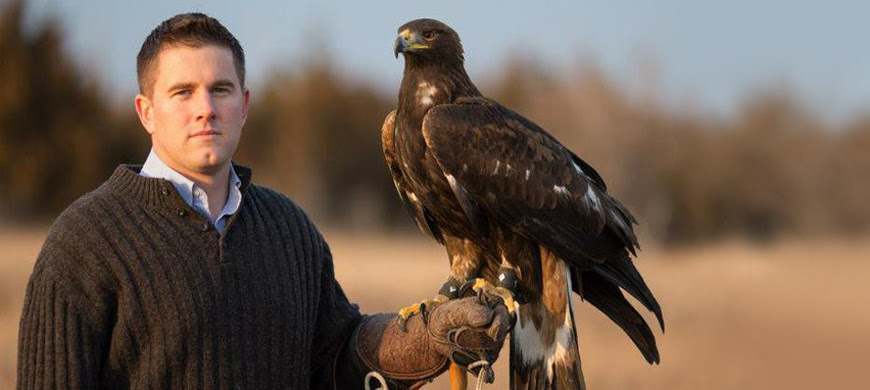

KDWPT
GREAT BEND–Fly over to the Kansas Wetlands Education Center’s (KWEC) Great Migration Rally from 9 a.m. to 2 p.m. Sat., April 30, to learn about migratory birds. Oh yeah, there will be prizes and food, too. Starting at KWEC, visitors will choose a card featuring a migratory bird worth points for prizes. They will then set off on their “migration,” driving through Cheyenne Bottoms Wildlife Area and Cheyenne Bottoms Preserve, visiting various stations. At stops along the way, participants will receive situational cards, describing hazards or advantages encountered by “their” bird that subtract or add points. Several area businesses, artists and organizations have generously donated great prizes for those who migrate the most successfully with the highest point totals.
 “It’s an event to celebrate International Migratory Bird Day,” said Curtis Wolf, KWEC manager. “The concept is to provide information about hazards birds face during migration with a fun and entertaining approach.”
This year’s Rally features Falconer Nate Mathews and his golden eagle, Isaiah. Mathews, currently the only falconer in Kansas hunting with an eagle, will share the remarkable story of Isaiah’s capture, training, loss and recovery.
Top prizes for adults are a WASPcam action-sport camera, Jansport backpack and binoculars and for the kids, a two-person tent, a pair of binoculars and fishing kit. Additional prizes include, sleeping bags, tent chairs, fishing poles, artwork, lanterns, head lamps and gift certificates from restaurants, hotels and other businesses.
Attendees will also be treated to a research drone demonstration, see Kansas birds of prey up close, make crafts, get a bird tattoo and learn about bird banding.
At two stops in Cheyenne Bottoms, visitors may use binoculars and spotting scopes to view migrating birds and discover the food they eat at a sampling station. Saints Peter and Paul Church will open for tours as the third stop on the “migration.”
At the migration destination, Camp Aldrich, Mathews and Isaiah provide their presentation, and dinner will be served before prizes are awarded.
Tickets are $5.50 for adults, $3 for children ages 5-12 and free for children under age 5. Pre-register online at wetlandscenter.fhsu.edu or by calling the KWEC, 1-877-243-9268, by Fri., April 22.
Breezy Saturday, chance of showers, thunderstorms
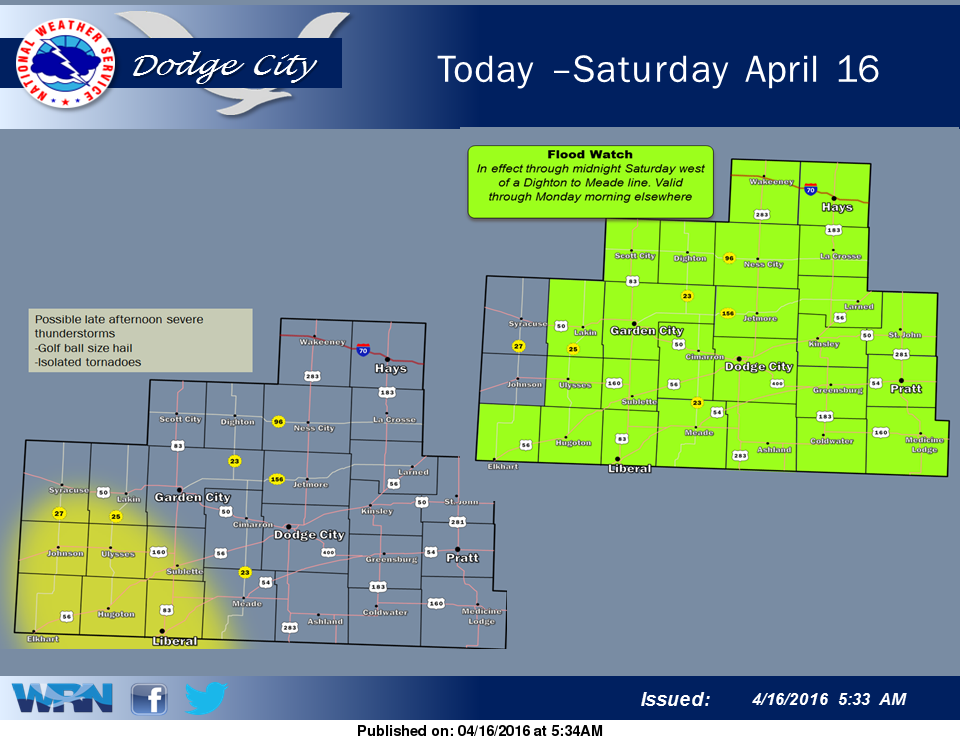
 After an extended period of dry weather, we are expecting beneficial rain to spread from west to east across the region over the weekend.
There is another chance late this afternoon for severe thunderstorms. Rainfall of 2 to 3 inches over the southwestern counties last night and early this morning will accentuate any additional rainfall that may occur later today and tonight. A higher risk of flash flooding will be present with any heavy rainfall that may occur. A Flood Warning ins in effect for areas west of a Dighton to Meade line through midnight. A Flood Watch remains in effect for the remaining area east of this line through Monday morning.
Today: Showers and thunderstorms. Some of the storms could produce heavy rain. High near 65. Breezy, with a southeast wind 18 to 23 mph. Chance of precipitation is 90%. New rainfall amounts between a quarter and half of an inch possible.
Tonight: Showers and thunderstorms. Some of the storms could produce heavy rain. Low around 52. Breezy, with a southeast wind 15 to 23 mph. Chance of precipitation is 90%. New rainfall amounts between three quarters and one inch possible.
Sunday: Showers and thunderstorms. Some of the storms could produce heavy rain. High near 60. East southeast wind 14 to 18 mph. Chance of precipitation is 100%. New rainfall amounts between three quarters and one inch possible.
Sunday Night: Showers and thunderstorms. Some of the storms could produce heavy rain. Low around 44. Northwest wind 13 to 15 mph. Chance of precipitation is 90%. New rainfall amounts between a half and three quarters of an inch possible.
Monday: A 50 percent chance of showers. Mostly cloudy, with a high near 63. Northwest wind 13 to 16 mph.
Numbers Don’t Support Kansas ‘Welfare To Work’ Claim

By MEGAN HART

Credit File photo / Heartland Health Monitor
Kansas has fewer low-income families receiving cash assistance than at any time in the last decade, but less than 10 percent are recorded as leaving the program because they found jobs.
Gov. Sam Brownback has touted his administration’s success in reducing dependency by moving families from welfare to work. However, a Kansas children’s advocacy group that released an overview earlier this week on families removed from cash assistance said the data only supports the first half of that position and that families are being pushed deeper into poverty.
Shannon Cotsoradis, president and CEO of Kansas Action for Children, said policy restrictions have reduced access to cash assistance for low-income Kansas families.
She singled out the Hope, Opportunity and Prosperity for Everyone (HOPE) Act, which lowered the lifetime limit for cash assistance from 48 months to 36 months, as accelerating the rate of families leaving the Temporary Assistance for Needy Families program. Brownback signed the HOPE Act into law in April 2015. About 200 families hit the new limit and were removed from the program in January.
“For struggling Kansans, state-administered safety net programs are an essential lifeline to help families with children meet basic needs,” she said in a news release. “Less than a year since its implementation, the HOPE Act has already harmed Kansas’ most vulnerable kids.”
Theresa Freed, spokeswoman for the Kansas Department for Children and Families, said more people are working because of the requirements. About 450 Kansans receiving TANF reported new employment in November, the most recent month with data available, she said.
“It is unfortunate when organizations choose to encourage welfare dependence,” she said in an email. “The Kansas HOPE Act is designed to empower families with the tools they need to break the cycle of poverty, giving their children hope for a successful future.”
Fewer Kansans receiving TANF
The number of Kansas families receiving TANF has been falling since 2005, with the exception of a partial rebound in 2010 and 2011. In 2005, an average of 17,118 Kansas families with 30,321 children received TANF benefits each month. So far in 2016, the monthly average is far lower at 5,506 families and 9,630 children.

It isn’t clear how many of those families left TANF because they obtained employment. In 2006, the U.S. Department of Health and Human Services reported about 41 percent of TANF cases that were closed in Kansas listed the reason as “employment.” In 2014, the most recent year with data available, only about 9 percent of closed TANF cases cited employment.
Families also can be removed from TANF if they hit federal or state time limits, fail to fulfill work requirements, break a program rule, voluntarily leave the program or are deemed uncooperative, for reasons such as missing eligibility appointments.
Freed said the records likely understate the number of Kansans who became employed, because some people who get jobs stop returning calls or request that their case be closed without providing a reason. About 20 percent of TANF closures in 2014 also are listed as for an unknown reason, she said. In 2005 it was about 9 percent.
“It is likely more have obtained employment but simply do not report that,” she said.
It isn’t clear if imprecise reporting entirely explains the decrease in closures due to employment, however. As unemployment increased from 2006 to 2010, the percentage of cases closed due to employment dropped off. The employment closures didn’t rebound as unemployment began to drop again in 2011, however, and it isn’t clear why the two measures no longer tracked closely through 2014.
Restrictions increase
Since 2011, the state has lowered the lifetime TANF limit from 60 months to 48 months, and then again to 36 months; shortened the time mothers of infants could go before resuming work or searching for a job; and increased the length of time recipients could be excluded from the program for not meeting work or child support requirements, according to a report this month from KAC.
Some other restrictions, including requiring job readiness screening and eliminating some hardship exemptions for families that hit the time limit, also took place under prior administrations. The state also made some changes that let more people remain eligible, including allowing disabled veterans to count their payments from the Veterans Administration as earned income.
More changes may be coming. Senate Bill 372, proposed in February, would lower the lifetime TANF limit again, to 24 months. DCF estimated about 420 families would be affected.
The bill, which passed the Senate 31-8, is among the measures being negotiated by a conference committee seeking to reconcile differences between House and Senate versions of several bills. The conference committee is expected to resume its negotiations when lawmakers return on April 27 for the final weeks of the 2016 session.
In recent years, many Kansans who no longer receive TANF remained below the poverty line, which is $11,770 a year for a single adult. Those who reported they were employed when they left TANF in 2014 had an average monthly income of $1,107, or $13,284 annually.
About 52 percent had no income other than TANF, and the 48 percent who did have some other source of income only received an average of $575 per month, or $6,900 per year, from work or other sources.
Still, for many that may have been a higher income than under TANF. The program only covers families in deep poverty, with a maximum of $6,228 in other income allowed for a family of three. Families that live in lower-cost counties or don’t have other income have lower limits.
Cotsoradis said studies have shown that children who have access to extra income and security through TANF and other safety net programs, such as food assistance and Medicaid, grow up to have higher earnings and are less likely to be involved in violent crimes or become teen mothers.
“Policymakers may be well intended in their desire to promote self-sufficiency among poor Kansas families, but data shows the most economically fragile Kansas children need access to the safety net,” she said. “Keeping the HOPE Act’s unnecessary restrictions in place does nothing but increase the likelihood that today’s poor children will become tomorrow’s poor adults.”
Megan Hart is a reporter for KHI News Service in Topeka, a partner in the Heartland Health Monitor team. You can reach her on Twitter @meganhartMC
Report: Strawberries Most Contaminated, Apples Second

 WASHINGTON – Conventional strawberries top the Dirty Dozen™ list of EWG’s 2016 Shopper’s Guide to Pesticides in Produce, displacing apples, which headed the list the last five years running, according to a media release.
See the dirty dozen list here
Nearly all strawberry samples – 98 percent – tested by federal officials had detectable pesticide residues. Forty percent had residues of 10 or more pesticides and some had residues of 17 different pesticides. Some of the chemicals detected on strawberries are relatively benign, but others are linked to cancer, reproductive and developmental damage, hormone disruption and neurological problems.
Strawberries were once a seasonal, limited crop, but heavy use of pesticides has increased yield and stretched the growing season. In California, where most U.S. strawberries are grown, each acre is treated with an astonishing 300 pounds of pesticides. More than 60 pounds are conventional chemicals that may leave post-harvest residues but most are fumigants – volatile poison gases that can drift into nearby schools and neighborhoods.
“It is startling to see how heavily strawberries are contaminated with residues of hazardous pesticides, but even more shocking is that these residues don’t violate the weak U.S. laws and regulations on pesticides in food,” said Sonya Lunder, EWG Senior Analyst. “The EPA’s levels of residues allowed on produce are too lax to protect Americans’ health. They should be updated to reflect new research that shows even very small doses of toxic chemicals can be harmful, particularly for young children.”
“Parents looking for help in lowering their children’s exposure to pesticides while still eating plenty of healthy fruits and vegetables can turn to the Environmental Working Group’s guide as an easy-to-use resource when shopping at the store,” said Dr. Philip Landrigan.
Dr. Landrigan is the Dean of Global Health and Director of the Children’s Environmental Health Center at Mt. Sinai School of Medicine, and was the principal author of the pivotal 1993 National Academy of Sciences study, “Pesticides in the Diets of Infants and Children,” that led Congress to pass the 1996 Food Quality Protection Act that set safety standards for pesticides on foods.
Recent studies of insecticides used on some fruits and vegetables, including strawberries, found that children exposed to high levels were at greater risk of impaired intelligence and ADHD. Research also indicates that the levels of pesticides in the bodies of elementary school children peaked during the summer, when they ate the most fresh produce. But after just five days on an organic diet, they were essentially pesticide-free.
The Dirty Dozen lists the fruits and vegetables that have been contaminated by multiple pesticides and which have higher concentrations of pesticides. More than 98 percent of strawberries, peaches, nectarines and apples tested positive for at least one pesticide residue. The average potato had more pesticides by weight than any other produce.
Avocados, on the other hand, remained atop EWG’s Clean Fifteen™ list with less than one percent of samples showing any detectable pesticides. No single fruit sample from the Clean Fifteen tested positive for more than four types of pesticides, and very few for more than one.
“Fruits and vegetables are important for your health,” Lunder said. “But for those on the Dirty Dozen, we recommend buying the organic versions if you want to avoid pesticides on your food. You can feel confident that conventionally grown fruits and veggies on the Clean Fifteen list have very little pesticide contamination.”
The Shopper’s Guide to Pesticides in Produce, updated every year since 2004, ranks pesticide contamination on 48 popular fruits and vegetables. EWG’s analysis is based on results of more than 35,200 samples tested by the U.S. Department of Agriculture and Food and Drug Administration. This year’s update found a total of 146 different pesticides on fruit and vegetable samples tested in 2014 – residues that remain on produce even after items are washed and in some cases peeled.
Morales, Volquez lead the Royals past the Athletics

By RICK EYMER
Associated Press
OAKLAND, Calif. (AP) — Kendrys Morales had three hits and got his 500th career RBI to help the Kansas City Royals win their fourth straight, beating the Oakland Athletics 4-2 Friday night.
Edinson Volquez (2-0) pitched six innings, retiring seven of the last eight batters he faced. He gave up two runs on four hits, walking four and striking out two. Eric Hosmer homered and Lorenzo Cain also each drove in a run for the Royals.
Morales walked in his first at bat and then singled in his next three appearances. He entered the game with a .182 average and three hits in his previous 18 at bats.
Stephen Vogt homered, singled twice and scored both runs for the A’s, who lost their fourth straight and fell to 1-7 at home.
Rich Hill (1-2) struggled through 4 1/3 innings, allowing three runs and nine hits.
FHSU Assoc. Provost Crawford hired as Provost of Black Hills State University in South Dakota


SPEARFISH, SOUTH DAKOTA–Dr. Chris Crawford, Fort Hays State University Associate Provost for Institutional Effectiveness and Quality Improvement has been selected as the new provost and vice president for academic affairs at Black Hills State University in Spearfish, South Dakota.
BHSU announced the hiring in a news release Friday, April 16.
According to the BHSU website, Black Hills State University, founded in 1883, is a masters-level liberal arts state university with 4,500 students and a member of NCAA Division II athletic . A second location, BHSU-RC, was recently established in Rapid City, South Dakota’s second largest city. Spearfish, population 12,500, is located in the Black Hills.
The complete BHSU news release follows.
“Crawford has a remarkable record as a higher education leader, is a prolific writer with an impressive list of scholarly publications, is committed to student success, and has successfully demonstrated his ability to think and act proactively to lead higher education units. He is noted for his strong interpersonal and communication skills as well as his collaborative approach to solving problems and creating opportunities.
“Crawford has spent most of his higher educational career at Ft. Hays State University. In the last decade he has been involved in nearly every process related to the chief academic officer, either directly or as a facilitative staff member. For nearly two years he served as interim provost successfully leading the academic unit for the institution which has 14,000 students, more than 350 faculty (plus another 250 adjuncts), and several academic support units. He also has dean and director level experience. Prior to joining the administration, Crawford taught a variety of graduate and undergraduate communications courses.
“We are ecstatic. Dr. Crawford is an extremely talented professor and administrator that has helped make his current university stand out nationally.” Dr. Tom Jackson, Jr., BHSU president, said. “With his strong academic credentials and positive demeanor, we look forward to his collegial academic leadership.”
“Crawford expressed his appreciation for the opportunity to serve as provost at BHSU and noted that he is looking forward to becoming a part of the community.
“’From the moment I stepped foot on the Black Hills State campus I felt comfortable. I received the warmest of receptions from everyone at BHSU. I’m excited and eager to address both challenges and opportunities facing the institution and the region,’” Crawford said. “’I’m so pleased to be selected to serve BHSU as provost and vice president of academic affairs, serving as an engaged partner with a great administrative team and faculty.’”
“Crawford has a Ph.D. in communication studies from the University of Kansas, a master’s degree and bachelor’s degree from Fort Hays State University. He has also earned several certifications from the NCA/Higher Learning Commission. He has published (with coauthors) more than a dozen books, nearly 50 scholarly articles in refereed journals, and many scholarly publications and presentations for professional conferences. He is a member of international, national and regional professional organizations and has received numerous awards and recognitions throughout his career.
“He has served as a consultant on over 50 professional development sessions in the last 20 years. Crawford’s areas of expertise include higher education quality improvement, organizational leadership, innovation and information technology, knowledge management, organizational communication and culture, social cognition, and argumentation and debate.
“As a professor and academic leader, Crawford is known for proactively developing new courses in the communication field. He is also recognized for his ability to skillfully and clearly communicate vision and strategy, passion, innovation, and engagement with consistency, integrity, and appreciation for the work of university employees.
“In Hays, Crawford serves on many community and campus committees. He also volunteers time to serve as moderator for a community lecture series and as a judge and tournament administrator for high school debate and forensics.
“Crawford replaces Dr. Rod Custer who is stepping away from the provost role but will remain at BHSU to lead ongoing accreditation initiatives, conduct work on a NSF science education grant, and other special projects. Custer has served as provost at BHSU since 2011.”
Tiger baseball swept by Missouri Western

By GERARD WELLBROCK
Hays Post
HAYS, Kan. – For the second time this season the Fort Hays State baseball team was swept in a three-game series at Larks Park. Missouri Western scored nine runs in the final three innings of their 13-2 win in the first game. They took the second game of the doubleheader 2-1. The Griffons (28-11, 20-8 MIAA) have won six straight and improve to 21-3 on the road. The Tigers (17-22, 11-17) have lost five straight and seven of their last eight.
Steve Johnson Postgame Interview
MWSU scored three in the second to take the early lead in the opener. Caleb Cherryholmes two-out single in the bottom of the inning scored Connor Ross to cut the lead to one. Nick Hammeke’s RBI single in the fifth closed the gap to 4-2 but Brandon Downs hit a three-run homer over the right field wall to stretch the Griffons lead to 7-2. They added a run in the seventh and five in the eighth for the eight inning run-rule win.
Freshman Logan Herd (2-4) allowed eight runs on 11 hits over 6 2/3 innings and suffered the loss.
Game 1 Highlights
The Tigers took the only lead of the series in the first inning of the second game. After two errors and a hit batter loaded the bases, Connor Ross hit into a double play which scored Caleb Cherryholmes. Alex Heuring hit a two-out home run in the third to tie the game 1-1 then Nick Gawley’s single scored David Gloade in the sixth to give the Griffons the lead for good.
D.J. Carr (3-6) allowed both runs on five hits over six innings and takes the loss. MWSU starter Evan Jones overcame a shaky start to pick up the win allowing one run on three hits over seven innings.
Game 2 Highlights
Hays High baseball sweeps Russell/Victoria

RUSSELL, Kan. – The Hays High baseball team improved to 7-3 with a doubleheader sweep of Russell/Victoria Friday. The Indians won the opener 8-1 then overcame six errors to rally for a 10-8 win in game two.
Braydon Delzeit went 3-for-4 with a home run and two RBI’s to lead the Indians 15 hit attack in the first contest. Connor Rule, Dalton Stout, Jarett Pfannenstiel, Drew Young and Palmer Hutchison all had two hits each. Delzeit hit a solo homer and Hutchison singled in a run to push the Indian lead to 4-1 in the third inning. They added single runs in the fifth and sixth and two in the seventh for the final margin. Marcus Altman gave up one run on four hits with nine strikeouts over five innings for the win.
Hays raced out to a 6-0 lead in the second game then needed three runs in the sixth for the comeback win. Jared Haynes single scored Rule and Delzeit to break a 7-7 tie. After the Broncos scored a run in the bottom of the inning, Marcus Altman drove in an insurance run with a single to push the lead to 10-8.
Palmer Hutchison pitched the final 4 1/3 innings for the win.
HHS softball swept at Great Bend

GREAT BEND, Kan. – The Hays High softball team saw their Western Athletic Conference record fall to 2-2 after after being swept in Great Bend. The Indians lost 3-1 and 5-3. The Indians, who have lost four straight, fall to 4-6 overall.
Great Bend scored single runs in the second, third and sixth inning in the first game. Madison Prough scored the Indians lone run on an error in the top of the seventh inning. Shannon Schumacher flied to center field and Mackenzie Fagan was picked off third to end the game. Katilyn Brown was the tough luck loser, alloiwng three runs, one earned, on two hits with six strikeouts and no walks.
The Panthers scored two in the bottom of the fifth after the Indians had scored two in the top of the inning to tie the game. Jaysa Wichers allowed all five runs, two earned, on five hits and suffered the loss. The Indians committed four errors in the game.