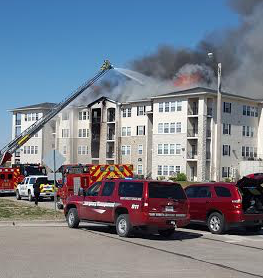
GEARY COUNTY – Investigators were working to determine the cause of a fire in a building at the Bluffs Apartment complex on the south side of Junction City on Tuesday.
Flames and smoke were pouring out of Building F, according to Rural Fire Chief Garry Berges.
Firefighters from Junction City, Grandview Plaza, Geary County, Riley County, and Manhattan worked to extinguish the blaze.
No injuries have been reported.
Check the Post for additional details as they become available.
This week, Ellis County will join the growing number of Kansas counties to enact a burn ban.
At Monday’s county commission meeting, the commission voted to approve a resolution banning all outdoor burning in unincorporated areas of the county until further notice, due to the projected dry weather and drought conditions.
In the resolution drafted by Rural Fire Director Darin Myers, the ban prohibits all outdoor burning, including trash barrels, fire pits, trash pits, fields and any other form of open burning in the county.
Anyone found to be in violation of the burn ban can be charged with a misdemeanor and, if convicted, may face a fine of up to $500.
The ban will be officially implemented when it is published in the county newspaper of record later this week.
In other business, the commission:
• Heard a presentation on and approved an agreement with Kansas WorforceONE that would allow the county commission to place a member on the board. The commission will discuss which commissioner will take a seat on the board at a later meeting.
• Completed the canvass of the Ellis City sales tax election from April 5. According to County Clerk and Election Officer Donna Maskus voter turnout was 24.48%. According to Maskus, 321 people voted yes, 17 voted no.
• Approved the Ellis County Courthouse Preservation Committee to purchase granite. The committee is raising the funds but the commission must approve the use of the funds. The county is not funding the project.
• Met in executive session to discuss property acquisition. No action was taken.
FHSU President Mirta M. Martin reads to children in the Tiger Tots Nurtury Center on campus last week.
By DIANE GASPER-O’BRIEN FHSU University Relations and Marketing
She is comfortable speaking to crowds of any size — and any age.
But Dr. Mirta M. Martin admits she has a soft place in her heart for the young ones, especially the very young ones. It’s easy to see why.
One day last week already had been a long morning for Martin, president of Fort Hays State University, when she walked through the door of the Tiger Tots preschool/daycare center in Rarick Hall at 10 a.m.
She appeared preoccupied as she opened the door, but her expression immediately changed to a big smile as 20 miniature students ages 3 to 5 years old greeted her with hearty hellos and high-fives.
For a half hour at least, Martin could unwind and let down her guard.
“I saw you at the Easter egg hunt,” piped up one youngster, in reference to the Kiwanis Easter egg hunt held annually near the Memorial Union and on the lawn of the university president’s home.
Martin chatted with the students as she sat on the floor among them, then deferred to a chair to read “The Grouchy Ladybug” to the preschoolers.
” ‘Boys and girls, let’s show Dr. Martin how well we can listen; we showed her how well we can talk,’ ” said Sara Stroup, director of Tiger Tots.
And so Martin began the story, which featured several themes and morals, including a grouchy ladybug that tried to bully other animals — to no avail.
Exhibiting patience with a capital P, Martin answered the youngsters’ questions as they interrupted her reading.
Martin interjected her own thoughts into the story as illustrations of various animals appeared at the turn of each page.
She talked about baby bunnies running through her back yard and pinched her nose shut while asking the children if they had ever seen a skunk.
“Have you seen a possum?” one little boy asked enthusiastically.
It was hard to tell who was enjoying the activity more. Martin totally got involved with the story, using hand motions to enhance the narration.
“Wasn’t that a fun story?” Martin asked the youngsters after she finished the story. “Thank you for letting me share it with you.”
The children’s excitement was invigorating, especially after the serious business a university president faces daily.
“I really enjoy their energy and their incredibly positive outlook on life,” Martin said. “They think they can do anything. It’s a good reminder to all of us what we can accomplish.”
Martin’s visit was one of several in a new reading program implemented by Tiger Tots and was a good lead-in to this week, which is National Library Week.
“We’re hoping to do this at least once a month,” Stroup said, “reaching out into the community of Fort Hays State to come visit and read in our classroom. I think it’s really good for the children.”
Ditto for Martin.
“What’s the old adage about how everything you need to know you learned in kindergarten?” she asked. “Share, be polite, say please and thank you, show empathy. These children aren’t even in kindergarten yet, but you can still learn a lot from them.”
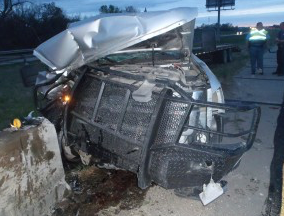
Monday crash in Saline County- photo Saline Co. Sheriff
SALINE COUNTY- A Kansas man was injured in an accident just after 6:30 a.m. on Monday in Saline County.
A 2013 Chevy pickup driven by Jason Hope, 29, Smith Center, and pulling a flatbed gooseneck trailer was southbound on Interstate 135 near Mulberry Bridge.
The driver fell asleep at the wheel, according to Saline County Under Sheriff Roger Soldan.
The pickup traveled through the median and hit a bridge rail.
Hope was transported to the hospital in Salina.
The pickup, owned by Concrete Storage of McPherson, was heavily damaged.
Hope was properly restrained at the time of the accident, according to Soldan.
Two public hearings will be conducted Wed., April 13, by the Hays Area Board of Zoning Appeals.
Dan Meyerhoff is requesting a variance to build a detached garage at 414 Autumn Lane, and Keith and Cindy Pfeifer are also requesting a variance to build a detached garage at 328 W. 33rd Street.
The BZA will also hear an update on the rewrite of the zoning and subdivision regulations–the Uniform Development Code (UDC).
The meeting starts at 8:15 a.m. tomorrow in Hays City Hall, 1507 Main.
Photo by KHI News Service File Photo In August 2011, Kansas officials announced a $188 million contract for a new high-tech Medicaid enrollment system with Accenture. They said the new Kansas Eligibility Enforcement System would replace a clunky paper-based enrollment system that sometimes took up to 45 days. The system went live in June but within months, organizations that serve Kansas Medicaid populations began reporting long waits for processed applications.
BY ANDY MARSO
Editor’s note: A backlog of Medicaid applications has caused financial strain for nursing homes and put thousands of Kansans at risk for loss of medical care.
State officials trace the beginnings of the backlog to a computer system switch. Sources who worked on the information technology project for the state and its contractor, Accenture, agreed on condition of anonymity to give KHI News Service documents and interviews to shed light on the problems that put it years behind schedule and tens of millions of dollars over budget.
State officials called a news conference when they inked a $188 million contract in the summer of 2011 for a new high-tech Medicaid enrollment system with Accenture, a Dublin-based multinational professional services giant.
They said the new Kansas Eligibility Enforcement System, or KEES, would replace a clunky paper-based enrollment system that sometimes took up to 45 days.
The new system, they said, would allow Kansans who provided the correct information through an online portal to enroll within a day or two. That hasn’t happened.
After years of missed deadlines, cost overruns and interagency squabbles, KEES still isn’t working as advertised. Medicaid applications are sometimes taking far longer than they did under the old system — some up to five months — and thousands of poor Kansans are being mistakenly denied coverage because of glitches in the system. Legislators who were frustrated by the delays ordered an audit that was published in December and revealed Accenture had promised more than it could deliver.
Aaron Dunkel, deputy secretary of the Kansas Department of Health and Environment, said it’s important to put the KEES rollout in context.
Medicaid is exceedingly complicated, he said, and the system programmers had to adjust the software on the fly as state and federal rules changed mid-project.
“For the size of the project it is and for the complexity of what it has to determine and what it has to do, I think the project overall has been very successful,” Dunkel said.
But most nursing homes rely heavily on Medicaid and have been hit particularly hard financially as residents struggle to get and maintain coverage. Cindy Luxem, chief executive of the Kansas Health Care Association, said her organization wants to know what went wrong. “Where did the train go off the tracks?” Luxem said.
“It seemed like there was a lot of finger-pointing and a lot of ‘he said, she said’ kind of issues. That shouldn’t be. An online system is something that we’re all used to and that we all use every day. Why was it so difficult here in Kansas to get that figured out?”
Internal emails and documents provided to KHI News Service by a source who requested anonymity provide more details about how miscommunication, personality conflicts and staffing problems dogged the project from the beginning.
Internal strife
When the KEES project began in August 2011, the objective was to combine two computer systems: one for KDHE to process Medicaid applications and one for the Kansas Department of Social and Rehabilitation Services (now the Kansas Department for Children and Families) to process applications for other social services like cash assistance.
Tensions surfaced almost immediately between the two agencies’ information technology leaders. Bob Hasslinger was serving as KDHE’s interim IT director, having been brought into the fold after working as a consultant on an earlier state IT project.
In a September 2011 email to several colleagues, Hasslinger responded to concerns that he was steering Accenture’s subcontractor, Oracle, toward building KEES on a different software platform without informing the rest of the KEES team.
“This is absolute Baloney (sic),” Hasslinger wrote. Hasslinger’s email was mainly directed to Ben Nelson, then the chief of information services for SRS. He wrote that he was tired of Nelson “complaining behind everyones (sic) back” and wanted to set the record straight about “the secret meetings you (Nelson) are referring to that are not true.”
Hasslinger said he was only trying to ensure that Gov. Sam Brownback’s executive committee members had information about the pros and cons of various software platforms and that everyone on the KEES team knew that.
Hasslinger also took issue with Nelson filing a formal request under the Kansas Open Records Act for information on the meetings in question. He said he’d never met with Oracle or Accenture without inviting the other team members.
“We need to focus on the fundamentals of getting this project launched and worry about an on time, in budget delivery,” Hasslinger wrote. “If in the future, you still choose to make inaccurate accusations, please do it to my face and be advised that I can document every statement I have made above.”
Nelson, who left his state job in May 2013 and has since moved to Florida, did not respond to a request for comment sent through his profile on the social networking website LinkedIn.
Hasslinger died in December 2012. A former Accenture employee who worked on KEES and spoke on condition of anonymity said differences between the two agencies involved — mainly about the design and functions of the program — continued to dog the project after Hasslinger and Nelson left.
Changing deadlines
Yancey, right, talks with Aaron Dunkel, deputy secretary of KDHE, during a December 2015 legislative hearing on an audit of the Kansas Eligibility Enforcement System used to process Medicaid applications. At left is Mike Randol, director of the Division of Health Care Finance. The audit found that the KEES rollout was delayed because the software required numerous modifications. CREDIT FILE PHOTO
Glen Yancey took over for Hasslinger as chief information officer of KDHE in December 2011.
He previously worked for the Department of Revenue, where he was involved in a Department of Motor Vehicles computer system switch that didn’t go smoothly. Problems with the rollout caused long lines at DMV offices in several Kansas counties.
Yancey worked on KEES for more than a year and was named the project’s executive director in March 2013.
By then the team had successfully implemented an online web portal for Medicaid information slightly ahead of schedule. But Accenture was struggling to work the kinks out of the eligibility determination software that was scheduled to go live before the end of the year.
An independent evaluation by a firm named Software Engineering Services the previous year reported that the project deadlines were unrealistic from the start and a lack of communication between state officials and Accenture risked putting things further behind schedule.
Accenture’s “out-of-the-box” software also required far more modifications than the company or the state anticipated.
To buy time, company officials came up with a solution: Change project deadlines, apparently without notifying high-ranking state officials.
In an email sent shortly before he became the project’s executive director, Yancey recounted a conversation between Mark Dugan, then the assistant secretary of KDHE, and Darin Bodenhamer, the state’s director of Medicaid eligibility.
When Dugan asked about delays in the KEES project, Bodenhamer said the state was hitting all of its deadlines and he didn’t know what Dugan was talking about.
In his email, Yancey warned other KEES team members that what Bodenhamer said was “factually incorrect.” Yancey attached a spreadsheet to the email showing that Accenture had changed deadlines to make it appear they were being met.
“Look at the delta between when stuff was originally supposed to be done and how the dates just keep changing,” Yancey wrote. “It’s not hard to hit a deadline if you just keep changing it until you are actually there.”
Accenture’s history
Within weeks after signing the contract to develop KEES, Accenture agreed to pay $63.7 million to settle a federal lawsuit alleging the company committed fraud and took kickbacks on other government IT projects. By then Kansas officials were locked into a partnership that promised Accenture almost $200 million.
Some of the funding for KEES went to pay state workers.
But the majority was earmarked for Accenture. KEES originally was projected to cost $138 million to build and another $50 million over five years to maintain once it was up and running.
Federal grants would be used for 85 percent of the build costs and 75 percent of the maintenance costs, in part because the system was intended to communicate with the federal insurance marketplace established by the Affordable Care Act.
The state’s auditors later determined that KEES would be about $46 million over the budget from the original contract and unlikely to produce the $300 million in savings over 10 years that state officials projected. The state’s auditors also concluded that project management improved in the years after Yancey took control of KEES.
But internal emails show that the initial transition was rocky. Soon after Yancey took over, he distributed a revised organizational chart that he said illustrated a “pivot” in KEES development. Some state workers saw their roles on the project change, some were moved to other buildings and some, like Bodenhamer, were dropped entirely.
In a series of messages to Yancey, Bodenhamer criticized Yancey’s leadership style and questioned his assertion that team morale was high. “People are afraid of you, so I have no doubt they are telling you what you want to hear,” Bodenhamer said. “When you cancel people’s meetings and demean them constantly, they become afraid.”
In another email Bodenhamer sent to Yancey and then-Medicaid Director Susan Mosier, who is now the KDHE secretary, Bodenhamer said the changes would result in a workforce going from being passionate about the project to “just being happy to have a job.” He predicted troubles ahead. “I don’t like what has happened here,”
Bodenhamer said, “and I think that this whole ‘pivot’ has been handled very poorly.”
Testing reveals problems
Yancey had about five months from the time he took the lead to get KEES up and running by the initial October 2013 deadline.
But emails show that throughout those months, IT workers from KDHE and DCF were raising alarms about the program’s inability to communicate well with the state’s Medicaid Management Information System, or MMIS. KEES was built to determine Medicaid eligibility, but the MMIS is the computer system that actually sends eligible Kansans their Medicaid cards and cuts checks to their Medicaid providers.
So even if KEES worked perfectly as a standalone system, it would be functionally useless to the state if it could not transfer applications deemed eligible to the MMIS with a high rate of accuracy.
State workers testing the system were finding that too many applications were getting lost along the way. Emails describe pressure to roll out the system anyway, with multiple state workers pushing back by asking whether it was better to be on time or to have a product that worked. The rollout was postponed and the October 2013 deadline passed.
About three months after the missed deadline, Yancey appeared before the Senate Public Health and Welfare Committee to explain the delay. He cited the challenges of getting KEES to interface with the federal ACA exchange but said he was confident the system would be up and running in a matter of “weeks or months” rather than years.
He also told the committee his team would not go live until it could “hold Kansans harmless” during the transition. “We’re going to use KEES when we can provide benefits timely and accurately to Kansans,” Yancey said.
Yancey then went back to his team and instituted a new strategy for testing the system. The results, however, remained problematic.
The original terms and conditions of the contract Accenture bid on called for KEES to have an error rate of no more than 0.1 percent in processing and delivering applications.
By April 2014, emails show Yancey was willing to settle for 1 percent. But emails sent in the wake of the new testing protocols show that the system wasn’t meeting those lowered expectations.
One email outlined about 16,000 errors in a monthly “fix” file of test applications that didn’t make it through the system — a rate of about 7 percent — and “fixes” for those errors that caused new problems.
Another broke down the monthly file in precise numbers: 15,248 errors out of 236,663 records received — an error rate of about 6.4 percent. State IT staff worked with Accenture employees to develop upgraded versions of the software — called “builds” — with patches that were supposed to fix the bugs.
But a May 6, 2014, email from Jenifer Telshaw, a KDHE employee who was the KEES business support manager, shows there were setbacks.
“I just wanted to give you a heads up,” Telshaw wrote to Yancey in an email that was carbon copied to several other KDHE employees.
“My staff is reporting that the last two builds (18 & 19) are not very good. They are finding that defects that were fixed are broken again.”
Around that same time, California health officials were reporting a major Medicaid application backlog after rolling out a similar computer program, also developed by Accenture.
Accenture offshores KEES work
Spreadsheets from the testing period show that Accenture and the state were mitigating dozens of “critical” and “high” software defects each week in early 2014. In mid-May the number of defects fixed began to wane.
Throughout July and August, it dropped off even more noticeably.
That also was when Accenture began a major shift in staffing for the KEES project. Personnel records show that testers, developers and other staff in Topeka were being rolled off the project and replaced by employees in India.
The shift coincided with a new phase of KEES. Yancey reported to federal officials that the system was built and tested, but the agency needed time for a pilot program to “verify system functional capacity” and train the state workers who would be using the program.
In the new phase, Accenture relied more on foreign labor. Twenty-four Topeka-based employees — including seven testers — were rolled off the project and only five were added. Twenty-eight India-based employees — including 21 testers — were added.
Another former Accenture employee who worked on the project and spoke on condition of anonymity said during that phase of KEES, some of his colleagues were sent to India to train the workers being added to the project.
Management’s attitude, the former employee said, was that if employees overseas got it wrong several times, it still would be cheaper than paying U.S.-based employees to get it right the first time.
Joe Dickie, a spokesman for Accenture, disputed that characterization, saying that the global company’s staffing is geared around matching the right skills to each phase of the job.
“This is a very complex program and over the course of the program lifecycle different levels of expertise and skill sets are required,” Dickie said of KEES via email.
“At any given time on the program, we may have people in a project location roll-on or roll-off and there isn’t necessarily a correlation in those changes.”
By the summer of 2014, the KEES team had eliminated most of the “critical” defects — showstoppers that could grind the whole program to a halt. But more than 100 “high” defects remained that would require workarounds, and they were being mitigated more slowly.
Rollout pressure grows
In October 2014, Telshaw emailed Yancey to let him know that it had become obvious to her that her team did not have the staff it needed to oversee the software fixes and get state workers ready to use the system with workarounds. “
At this time, the team is struggling to complete all of the necessary preparation for Go-Live and it is an even greater hardship if even one person takes off or is sick,” Telshaw wrote. “It is a major setback when someone leaves the project.”
By then the system was a year delayed and frustration was building among legislators — even those usually sympathetic to the Brownback administration.
At a January 2015 hearing Sen. Mary Pilcher-Cook, a Shawnee Republican who then was chairwoman of the Senate Public Health and Welfare Committee, requested Yancey provide detailed data about implementation dates and bug fixes.
Yancey said at the time that there still were too many correspondence errors between KEES and the MMIS and the state’s workforce also was not ready to use KEES. But amid the state’s budget crisis, lawmakers scraping for every dollar were irritated that they had spent millions on the program with little to show for it.
In March 2015, legislators voted to audit KEES.
That same month, KDHE officials approved a substantial rewrite to the contract that extended Accenture’s partnership for five years of operations help while also adding language outlining the penalties for failing to remediate defects.
In late June, the system went live and began processing Medicaid applications. Within months, organizations that serve Kansas Medicaid populations began reporting long waits.
Then came what KDHE Division of Health Care Finance director Mike Randol would later call a “perfect storm.” An administration reorganization plan in January 2016 funneled all Medicaid applications through a single “KanCare Clearinghouse” in Topeka — including some applications for elderly and disabled Kansans that previously were handled by DCF workers throughout the state.
That created a bottleneck at the same time the ACA’s open enrollment period was flooding the system with about 13,000 new applications.
KEES was not equipped to handle it, and a backlog burgeoned. Medicaid applications have slowed since open enrollment ended. But state employees say KEES remains ponderous to use and even when applications are completed, the system is not guaranteed to process and send them to the MMIS correctly.
A daily fix file for February provided by KDHE showed that the system filed 97 percent of applications without error on its best day and 88 percent on its worst day — far from the 99.9 percent envisioned in the original contract. In their bid for the contract, Accenture officials wrote that they were “proposing a fully integrated eligibility system with an online application and presumptive eligibility screening tool that increases customer satisfaction as it provides higher availability, reduces keying errors, and expedites the eligibility determination process.”
The legislators’ auditors determined that Accenture overpromised and underdelivered, agreeing to an unrealistic timeline to develop KEES and promising features that never panned out.
Accenture’s spokesman said it has not violated the contract. “We have been and are continuing to deliver according to the contract, which includes updates and amendments,” Dickie said. Yancey, Telshaw and Bodenhamer did not respond to an emailed request for comment.
Cassie Sparks, a KDHE spokeswoman, said the state is working with Accenture to improve application processing times and has added employees and redeployed others to pare down the Medicaid application backlog.
The state has not assessed any financial penalties against Accenture but is withholding its final acceptance payment of $1.85 million for the project. At a recent meeting Randol said the backlog of applications that have been pending more than 45 days in violation of federal guidelines has been reduced from nearly 7,800 to about 7,300.
“We’re hopeful we’ve kind of turned the corner, so to speak, and we’re moving downward in a positive direction,” he said. Even so, Randol couldn’t provide lawmakers with a target date for eliminating the backlog.
When asked about KEES at a recent news conference, Brownback declined to evaluate how well the program was managed. “We’ve had difficulties with it,” Brownback said. “We are working on them. We are working on getting it out and implemented. And we’re going to stay on top of it. But it’s been difficult.”
Andy Marso is a reporter for KHI News Service in Topeka, a partner in the Heartland Health Monitor team. You can reach him on Twitter @andymarso
— Jim McLean of KHI News Service contributed to this story.
WASHINGTON – U.S. Senator Jerry Moran (R-Kan.), a member of the Senate Appropriations Subcommittee for Defense and Co-Chair of the Senate Defense Communities Caucus, was recently awarded National Guard Association of the United States Charles Dick Medal of Merit, according to a media release.
The award recognizes the contributions to the National Guard by elected representatives to legislative bodies at the state and national levels.
“I am grateful to the Kansas National Guard for their service and to Major General Lee Tafanelli for his leadership to achieve the Guard’s mission to provide a ready military, emergency management and homeland security capability for our state and nation,” Sen. Moran said. “Particularly in the wake of the drought and wildfires that continue to burn across Kansas, I’m honored to receive this award from such committed and brave men and women.”
“Senator Moran has been an outstanding supporter of our Armed Forces and a leading advocate for issues of importance to the Kansas National Guard, Emergency Management and Homeland Security,” said Maj. Gen. Tafanelli, Kansas Adjutant General. “This award serves as recognition of our deep gratitude to Senator Moran for his support of the National Guard.”
Sen. Moran has emphasized prioritization of the Kansas National Guard Readiness Center at Fort Leavenworth with the National Guard Bureau and the Department of Defense for several years, and is working to address the National Guard’s training backlog of cyber units in the Reserve Component.
The medal is named in honor of Major General Charles Dick, NGAUS president from 1902 to 1909, a major general in the Ohio National Guard, a Congressman and later a Senator. Dick was responsible for the passage of the Dick Acts of 1903 and 1908 that established the foundation of the modern National Guard.
The award will be presented later this month during the annual National Guard Association of Kansas Conference.
Dr. Jamie Schwandt and his guest discuss how you can dream big, think positive and take action. In this episode, Bob Bearley talks about his experiences as a foster parent.
WAKEENEY — It may seem like just fun and games, but the Cardboard Sports Car Derby at Trego Grade School did more than get kindergarteners racing through the halls, it taught the students valuable language skills while showcasing their creative talents.
“This started the first year I started teaching in WaKeeney,” said Jane Lang, kindergarten teacher, who facilitated the event, including a march around the school and the “races,” which even brought out local police using radar to judge speed as the children ran the length of the school’s gym.
The event was the culmination of lessons the children had been learning.
“We are learning about letters and their sounds all year,” Lang said. “We have come to the point that we’re learning about ‘R’ controlled vowels.”
Those vowels include ar, er, ir, or, ur with several those sounds fitting perfectly with the name of the derby.
“What a perfect thing to do, a Cardboard Sports Car Derby,” Lang said.
She said she had the idea for the derby after visiting an arts event.
“I had seen cardboard cars featured at a art exhibit in Lawerence, Kansas, at the arts center,” she said.
She then wanted to incorporate that idea into the classroom.
“We started working on ‘r’ controlled vowels and it all just came together.”
In conjunction with the derby the students study a book that illustrates the power of imagination called “Not a Box” by Antoinette Portis.
In that story, a rabbit who has adventures with what others see as a cardboard box, but is much more for the imaginative rabbit.
To get ready for the derby, the children all received a box to take home and had a week to build their car.
While the derby featured the students racing through the gym, Lang said it’s not for a prize rather it is simply for the joy of sharing their creations.
And if the excitement shown by the children during the event is any indication, the joy of the day will make the accompanying lessons hard to forget.
Jewish Community Center in Overland Park, site of one shooting
KANSAS CITY, Mo. (AP) — The husband of one of the three people killed by a white supremacist at two Jewish sites in suburban Kansas City is suing over the sale of the shotguns used in the April 2014 attack.
The Kansas City Star reports that the lawsuit, filed late Monday afternoon in Jackson County Circuit Court by Jim LaManno, names Wal-Mart and several other entities.
Seventy-five-year-old Frazier Glenn Miller Jr. was sentenced to death last year for the shooting that killed LaManno’s wife, Terri, and two others in Overland Park, Kansas.
Miller was a felon and prohibited from purchasing guns. The lawsuit says Miller used two weapons that were purchased by a friend at a gun show and a Wal-Mart.
Wal-Mart didn’t immediately respond to an email from The Associated Press seeking comment.
The Hays Public Library will be hosting two annual contests this month, the Poetry Contest and Edible Books Contest. The Poetry Contest will be held Friday, April 15 at 7 PM in the Schmidt Gallery. The Edible Books Contest will be held Saturday, April 23 in the Schmidt Gallery.
Annual Poetry Contest- The Annual Poetry Contest has always been a patron favorite at the HPL. What better time to host this contest than April, which is National Poetry Month! Participants will need to bring four copies of their original poem; one to read and two for the judges. Prizes will be given to first and second places. The contest is open to anyone 16 and older. After the contest please feel free to read an original poem or one of your favorites during Open Mic. We invite those who have a love of poetry to come and relax, enjoy the refreshments and hear some really great original works of poetry.
Edible Books Contest- HPL is excited to once again host the Edible Books Contest! Show off your love of art, baking, and books all at once! Drop off will begin Friday at 3 PM and then continues Saturday morning at 9. Viewing of entries and voting on entries will take place from 12 PM to 2 PM. Judging and awards will take place at 2 PM. There will be an Adult Division (18+), a Young Adult Division (12-17) and a Children’s Division (K-11). Participants can be as creative as they want with their creation; the main rule being that everything must be edible.
For more information about these two contests please contact Lindsay Ricker at 785.625.9014 or visit our website at www.hayspublib.org.
Are you ready for some (spring) football? The Fort Hays State University football team’s annual spring game will have a new look this year.
A group of students from the university’s Leadership 310 class has chosen as its community project revitalizing FHSU’s student alumni association, Tigers 4 Ever. As part of its membership drive for the organization, the leadership team chose to increase awareness of the group at a spring event on campus. The event chosen was the spring football game.
The Tiger football team, coming off a season in which it played in a postseason game for the first time in 20 years, will hold its spring game on Saturday, April 16, at Lewis Field Stadium. Gates open at 11:30 a.m. and kickoff is at noon. Admission is free for the game, which has been named Spring Kickoff 2016.
The leadership team hopes to boost attendance as well as bring awareness and sign up members for Tigers 4 Ever. There will be fun activities for those who are young and young at heart.
“The leadership team is excited for the opportunity to bring awareness to Tigers 4 Ever through the spring football game,” said the group’s media liaison, Callie Christensen. “We look to boost attendance for the game through all the activities we have planned.”
Planned activities include a tug-of-war between student groups and/or athletic teams. There also will be a football skills competition after the game. How far can you kick a field goal? How long can you punt a football? How accurate are you throwing a football at a moving target? Here is your chance to find out. Other activities include catching a football shot high into the air by a football Jugs gun and catching a rubber chicken shot high into the air by a slingshot — popular at FHSU basketball games.
FHSU announcer Ken Windholz will be on hand to announce the scrimmage. The Tiger cheerleaders and Tiger Debs will be in attendance to cheer on the team. After the scrimmage current Tigers will sign autographs at Schmidt-Bickle Indoor Training Facility. As well, select members from last year’s record-setting team also will be available to sign.
There also will be free meal after the game for the first 200 fans.
Check the FHSU Facebook page and FHSU University Relations and Marketing’s twitter feed @fhsunews for updates on the game. Media inquiries concerning Spring Kickoff 2016, contact the leadership team’s media liaison Callie Christensen by email at [email protected] or by phone at (402) 440-9374.





 Two public hearings will be conducted Wed., April 13, by the Hays Area Board of Zoning Appeals.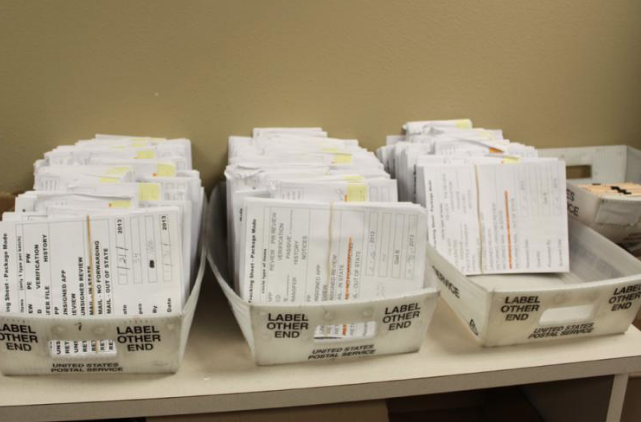










 Submitted