That fire started in Oklahoma on Monday, and has burned into Kansas, with well over 55,000 acres of very dry grassland has burned…and a lot of smoke has been carried across the state.
Please do not call 911 if you do not see flames…as fire departments are becoming overwhelmed with false calls from the smell of smoke, according to Sumner County officials.
Smoke from the wildfires has traveled hundreds of miles.
The National Weather Service says the smoke has been detected as far away as Springfield, Missouri, about 290 miles to the east, and in St. Louis, about 460 miles to the northeast of the fires.
Springfield meteorologist Mark Burchfield says the smell of smoke was “pretty strong” as he was leaving for work Thursday morning.
St. Louis meteorologist Mark Britt says the weather service posted on social media advising of the smoke.
The strong winds that are blowing the smoke also are complicating efforts to fight the fires that have consumed more than 600 square miles of largely rural land along the Kansas-Oklahoma border since Wednesday.
TOPEKA, Kan. (AP) — The Latest on the Kansas Legislature’s debate on school funding (all times local):
1 p.m.
The Republican-dominated Kansas Senate has approved a GOP school funding bill that would avoid an increase in state spending while trying to meet a state Supreme Court order to help poor school districts.
The vote Thursday was 32-5.
The measure goes next to the House. GOP leaders there hoped to take a vote on it later Thursday.
The bill was drafted this week and redistributes about $83 million of the state’s $4 billion-plus in annual aid to its 286 school districts. It guarantees that no district loses any aid already promised for the 2016-17 school year.
The court ruled last month that the state is shorting poor districts on their fair share of state aid and threatened to shut down schools statewide if the problems aren’t fixed by June 30.
12:15 p.m.
Kansas Senate Majority Leader Terry Bruce says there are many ways to meet a Kansas Supreme Court order to help poor school districts and his chamber is focusing on making the distribution of education funds fairer.
The Nickerson Republican defended a GOP school funding plan during a debate Thursday in his chamber.
The measure redistributes $83 million of the $4 billion-plus in annual aid to the state’s 286 school districts. The court ruled last month that the state shorted poor districts on their fair share of the aid.
The plan does not boost overall state spending. Senate Democratic Leader Anthony Hensley of Topeka said the state needs to provide additional dollars.
But Bruce said the court order does not require an increase in overall state spending.
11:35 a.m.
The Kansas Senate is debating whether it is moving too quickly in considering a school funding plan drafted by Republican legislators.
The Senate was debating a bill Thursday that would avoid an increase in state spending while attempting to comply with a Kansas Supreme Court order last month to help poor school districts.
The measure redistributes $83 million of the state’s $4 billion-plus in annual aid to its 286 school districts. No district would lose any aid it was promised for the 2016-17 school districts.
Senate Democratic Leader Anthony Hensley of Topeka said the chamber is likely to pass flawed legislation.
Republicans like budget committee Chairman Ty Masterson of Andover said lawmakers must move quickly because the court threatened to shut down schools statewide if lawmakers didn’t fix the problems.
10:25 a.m.
A lawyer representing four school districts suing the state over education funding is predicting that the Kansas Supreme Court will reject a school finance plan top Republican lawmakers hope to pass.
Newton attorney John Robb said the plan up for debate Thursday in the Senate doesn’t really change anything for poor districts.
The measure redistributes $83 million of the state’s $4 billion-plus in annual aid to its 286 school districts in an effort to comply with a Supreme Court order last month to help poor school districts. But the plan guarantees that no district loses any aid for the next school year and doesn’t boost overall state spending.
Robb represents the Dodge City, Hutchinson, Wichita and Kansas City, Kansas school districts. They sued the state in 2010.
___
9:34 a.m.
Top Republican lawmakers hope to pass a school funding plan that would avoid an increase in state spending while attempting to satisfy a Kansas Supreme Court order to help poor school districts.
The Senate planned to debate a bill Thursday that redistributes about $83 million of the state’s $4 billion-plus in annual aid to its 286 school districts.
If the measure passes the GOP-dominated Senate, the Republican-controlled House was expected to schedule a vote later Thursday.
The measure shifts some of the $83 million to poor districts but also guarantees that no district sees a reduction in the aid it’s been promised for the next school year.
The court threatened in last month’s ruling to shut down public schools statewide if lawmakers did not fix the problems by June 30.
$1 billion forfeited, with more money lost each day, each hour. Inaction makes the problem worse with every passing minute. Surely such a situation should spur Kansas lawmakers to action.
For two years running, Kansas has turned down the opportunity to expand Medicaid eligibility, and to have the federal government pay the full cost. This winter the tab for saying “no” topped $1 billion and continues to mount.
Duane Goossen
Did the refusal to accept these federal dollars bring some other benefit to Kansas? Will anyone pay lower taxes as a result?
No. The money is simply relinquished, gone from the state economy, a tragic, mind-blowing loss to Kansas.
150,000 more Kansans could have had health coverage for the last two years. Most of these individuals work, but their earnings are too low for them to afford health insurance, and they are not eligible for an insurance subsidy.
Some still received health services by showing up at hospital emergency rooms, but those hospitals took a loss by providing uncompensated care. Especially for rural hospitals, such losses make financial survival much more difficult.
Most states have already expanded Medicaid eligibility. Kansas remains one of 19, predominantly southern states, that have held ideologically firm against Obamacare. That’s the reason—a blind objection to anything that might be connected to Obamacare. Policy challenges over cost or implementation strategy have all been answered.
Do you want Medicaid to look more like a private insurance plan? Then set it up that way. Arkansas did. Should recipients pay something? Fine. Indiana requires that. What about incentivizing healthy behavior? Okay. Iowa took that approach. Should expansion be budget neutral, now and in the future? Sounds great. A bill proposed in Kansas does exactly that.
Kansas lawmakers could solve this in a hurry if they did their policymaking job and figured out how to make expansion work on Kansas terms. Call it KanCare expansion, if that helps, but go forward.
When Republican Asa Hutchinson became the new governor of Arkansas in 2015, he sought to continue the state’s expansion that had been previously put in place. Explaining why, he argued that turning away federal dollars that more than 30 other states were receiving would punish Arkansas. “It is perfectly consistent, it is perfectly conservative and logical to oppose Obamacare as a federal policy and yet accept federal dollars under the Medicaid program in Arkansas.”
Exactly. Hurting ourselves to protest Obamacare conjures up the old adage of cutting off the nose to spite the face.
Most Kansas citizens have arrived at that same conclusion. Whatever Kansans may think of Obamacare, independent surveys by the Docking Institute and the Kansas Hospital Association both show wide approval of expanding Medicaid eligibility.
When Gov. Brownback dismissed expansion in his State of the State address, when House Speaker Merrick removed potential yes-votes from the health committee, when Americans for Prosperity began targeting pro-expansion legislators with negative mailers, they clung to an anti-Obamacare ideology at the expense of the economic and physical health of citizens. By refusing these federal dollars, Kansas engages in needless self-destructive behavior.
More than $1 billion has already been lost to the Kansas economy. These funds cannot be recovered, but losses can be cut going forward. A bill is ready that legislators can still pass this session. If lawmakers wait, they’ll be shortchanging Kansas hundreds of millions more.
Duane Goossen is a Senior Fellow at the Kansas Center for Economic Growth and formerly served 12 years as Kansas Budget Director.
First responders on the scene of Thursday’s fatal accident- WHICHway camera view
SEDGWICK COUNTY – A Kansas man died in a 3-vehicle accident just before 8a.m. on Thursday in Sedgwick County.
The Kansas Highway Patrol reported a 2003 Ford passenger truck driven by Humberto Garcia, 58, Wichita, was southbound in the right lane of Interstate135 just north of U.S. 54.
The driver lost control of the truck and it moved from the right toward the left lane and collided with a 2007 Ford SUV driven by Joe Paul Braswell, 38, Bel Aire. The collision caused the SUV to roll.
The truck then hit the left barrier wall.
A southbound 2000 Jeep SUV driven by Kelly P. Matson, 41, Wichita, collided with the truck.
Garcia was transported to St. Francis Medical Center where he died.
Braswell and Matson were not injured.
All three drivers were properly restrained at the time of the accident, according to the KHP.
Kansas sorghum producers during a recent visit to China: Martin Kerschen, Garden Plain; KDA marketing director Kerry Wefald, Manhattan; Pat Damman, Clifton; Gary Gantz, Ness City; Lance Russell, Hays; Sarah Sexton-Bowser, Holton; Nathan Larson, Riley.
KDA
MANHATTAN — A delegation of Kansas sorghum producers, led by the Kansas Department of Agriculture (KDA), traveled to China March 12-19, 2016, to promote coarse grains, assess current trends in the market and assist with rolling out the 2015/16 corn and sorghum harvest quality reports.
“Average household incomes in China are growing, and the demand for animal proteins is increasing. These factors, along with limited arable land, create a reliance on imports from countries like the United States,” said KDA marketing director Kerry Wefald. “In 2015, Kansas farmers, ranchers and agribusinesses exported more than $403 million or 12% of total state agriculture exports to China. Of this total, $269 million were cereal grains.”
The group’s visit included briefings from the U.S. Grains Council, U.S. Embassy and USDA Foreign Agricultural Service in China along with stops at an agribusiness operation, dairy, feed mill and milk processing facility. These meetings gave the group a chance to learn more about the Chinese market and to establish business connections in China.
While in Jinan, Kansas sorghum producers Sarah Sexton-Bowser and Martin Kerschen presented their perspectives on sorghum production during the Council’s rollout of the 2015/16 corn and sorghum quality reports. The buyers and end users who were in attendance left the seminar with more information about the factors that impact U.S. crop quality, as well as increased confidence in their ability to purchase the quality grain they need from the U.S and from Kansas in particular.
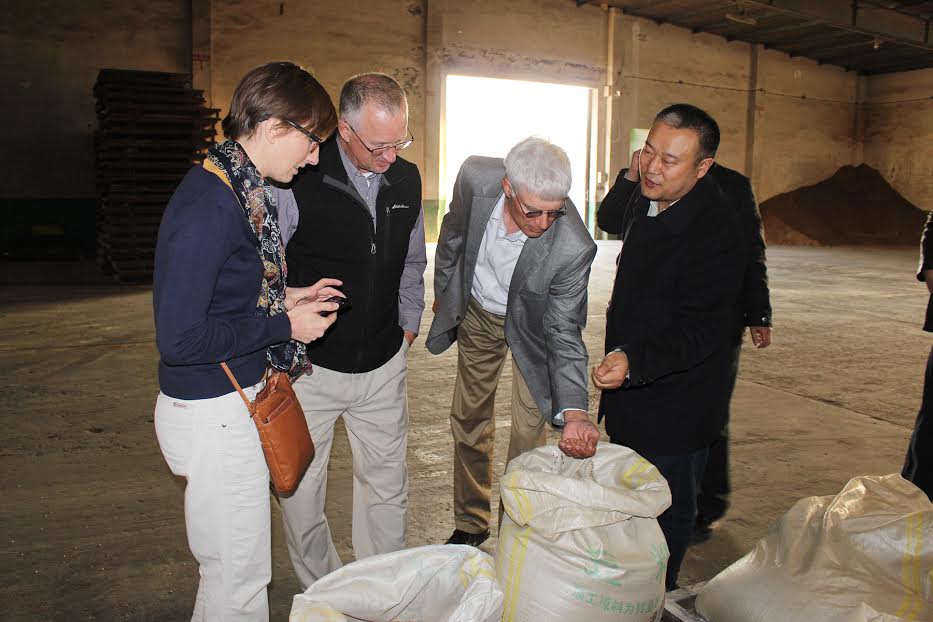
Kansas sorghum producer trade mission members inspect imported DDGS — Distillers Dried Grains with Solubles — during a tour of Changyi Liuhe Feed Mill in Weifong, Shandong Province, China. From left: Sarah Sexton-Bowser, Holton; Martin Kerschen, Garden Plain; Nathan Larson, Riley; Wang Xinbo, Changyi Liuhe Feed Mill General Manager.
“The trade mission articulated the importance of market relationships. We visited several current and prospective sorghum customers. As Kansans we raise a high quality product and appreciation for that quality was affirmed during our conversation,” said Sexton-Bowser, who is also the regional director for the United Sorghum Checkoff Program. “Additionally, the trade mission illustrated the vast market opportunities in China. Every visit brought sights of construction and growth. Through investment in relationships our quality sorghum will continue to be valued by Chinese end users.”
Kansas is the leading sorghum producer in the U.S. and China is a major market for Kansas sorghum farmers, making exports to China an important opportunity for growth for the Kansas sorghum industry. The KDA is pleased to work with the U.S. Grains Council on cooperative ventures which can expand these markets for Kansas sorghum producers in the future.
The delegation traveling from Kansas included:
• Lance Russell, Hays, Leadership Sorghum Class II graduate
• Nathan Larson, Riley, Kansas Grain Sorghum Commission board member
• Sarah Sexton-Bowser, Holton, United Sorghum Checkoff Program regional director
• Martin Kerschen, Garden Plain, United Sorghum Checkoff Program board director
• Pat Damman, Clifton, Kansas Grain Sorghum Producers Association & Commission director
• Gary Gantz, Ness City, National Grain and Feed Association director
• Kerry Wefald, Manhattan, Kansas Department of Agriculture director of agricultural advocacy
The trade mission was made possible by a State Trade and Export Program (STEP) grant, funded in part through a cooperative agreement with the U.S. Small Business Administration. The STEP grant helps Kansas non-exporters get started and existing exporters to export more. Since the grant’s inception in 2012, more than 30 Kansas small businesses have participated and achieved $9.2 million in actual export sales, which supports the KDA’s vision to encourage economic growth of the agriculture industry and the Kansas economy.
Through a new name, new management and a major remodel, the traditional Easter Eggstravaganza at Big Creek Crossing, 2918 Vine St., lives on and will happen again this year at 9:45 a.m. Saturday, March 26.
Move than 4,000 eggs will be distributed for children up to 12 years old through the BCC hallways to collect in the scramble.
Participating children will be split into three age categories – 0-3, 4-8 and 9-12 – for the scramble according to James Younger, BCC marketing director.
Participants are asked to assemble by the Easter display in the central court prior to the beginning of the event. Children will be directed where to go from there.
Within each age group, one golden egg will be hidden. The prize for finding the golden egg will be a free photo with the Easter Bunny in the BCC center court.
For everyone else, the Easter Bunny will be available from 5 to 8 p.m. Friday and 9:45 a.m. to 8 p.m. Saturday. Picture costs start at $10.
“It’s good fun and the kids like it,” Younger said. “We’ve done it for many years and are going to keep it going.”
At the podium (L to R): Rep.Troy L. Waymaster, Rep. Pete DeGraff, Rep. JR Claeys, and former Representative Basil Dannebohm
TOPEKA–For the fourth consecutive year, the Kansas House of Representatives formally declared the month of April as Parkinson’s Disease Awareness Month.
The proclamation took place on the house floor on Wednesday, March 23rd. This year, the resolution was introduced by Representative Troy L. Waymaster (R-Bunker Hill), Representative J.R. Claeys (R-Salina), Representative Ramon Gonzalez (R-Perry), and Representative Pete DeGraaf (R-Mulvane).
“Parkinson’s disease is the second most common neurodegenerative disease in our nation,” said Waymaster. “Sadly, not enough people are acquainted with the disease, the symptoms, and who it affects. My thoughts and prayers are with those who suffer. It’s my honor to introduce this resolution.”
The proclamation has special meaning to Rep. DeGraaf, who was diagnosed with Parkinson’s in 2015.
“It’s a personal honor to be co-sponsoring this proclamation. Being a Parkinson’s patient, this effort is very important to me,” said DeGraaf. “While I cannot control the fact that I have the disease, I can control how I respond. A positive attitude on my part and the support of my wife, family, and friends are essential as I move forward.”
Parkinson’s Disease Awareness Month was first proclaimed by the Kansas House in 2013 when it was sponsored by Representative Ronald Ryckman (R-Meade). In 2014, the resolution was once again sponsored by Ryckman and co-sponsored by Representative Marshall Christmann (R-Lyons). In 2015, the resolution was co-sponsored by Representative Fred Patton (R-Topeka) and Representative Gail Finney (D-Wichita).
“For four years, the House of Representatives has commemorated Parkinson’s Awareness Month. Each year we do this proclamation we are that much closer to a cure,” said Rep. Ramon Gonzalez. “Every time we have the opportunity to bring awareness to this disease is time well spent.”
Each year, the resolution has been coordinated by former Representative J. Basil Dannebohm (R-Ellinwood). In the summer of 2012, Dannebohm was diagnosed with Young Onset Parkinson’s Disease. Since that time, he has been an advocate for Parkinson’s Disease research, treatment and awareness.
“I am incredibly grateful to Speaker Merrick, Representative Waymaster, Representative Claeys, Representative Gonzalez, Representative DeGraaf, and the Kansas House of Representatives for once again taking time to recognize Parkinson’s Disease Awareness Month,” said Dannebohm. “The Kansas House joins with individuals and organizations from around the world who are committed to promoting awareness and working toward a cure.”
Dannebohm joined his former colleagues on the House floor for the ceremony. Others in attendance included: Michelle Haub, co-creator and Director of the Parkinson’s Program of Manhattan at Meadowlark Hills in Manhattan, KS; Parkinson’s patient, Matthew Schindler and his wife, Susan; Parkinson’s patient, Lisa Reser and her family; and Courtney Blankenship, a supporter of Parkinson’s disease awareness.
In 2005, an estimated 5,500 Kansans suffered from Parkinson’s Disease. By 2014, that number had increased to an estimated 14,000.
“Parkinson’s affects far too many Kansans. These folks aren’t a statistic, they’re our friends and neighbors and the attention they are bringing to this issue will someday lead to a cure,” said Representative J.R. Claeys (R-Salina).
Parkinson’s disease is a progressive neurological disorder that affects nearly one million people in the US. Although promising research is being conducted, there is currently no cure for or definitive cause of Parkinson’s disease.
TOPEKA – The state’s February seasonally adjusted unemployment rate remained at 4.0 percent, according to a report from the Kansas Department of Labor. This was unchanged from January and decreased from 4.3 percent in February 2015.
All surrounding counties–except Ness, which was unchanged–experienced an increase in unemployment:
Russell–up 1.1% to 4.9%
Trego–up 0.3% to 5%
Rooks–up 0.8% to 5.7%
Graham–up 1.6% to 5.8%
Barton–up 0.7% to 5.2%
Rush–up 0.9% to 4.5%
The preliminary seasonally adjusted job estimates from the Kansas Department of Labor and Bureau of Labor Statistics indicate Kansas nonfarm jobs decreased by 1,900 from January. Since last month, Kansas private sector jobs decreased by 1,700. The largest private sector over the month job loss was in Construction.
Over the year Kansas lost 5,400 seasonally adjusted total nonfarm jobs. Kansas lost 3,900 private sector jobs since February 2015.
“Kansas maintained its low unemployment rate of 4 percent last month, with growth in the labor force and a drop in the number of people who are unemployed,” said Kansas Secretary of Labor, Lana Gordon.
Kansas not seasonally adjusted nonfarm jobs decreased by 6,000, a 0.4 percent decrease since February 2015. Not seasonally adjusted figures show Kansas lost 5,100 private sector jobs since last year, or 0.5 percent. The state gained 6,100 total nonfarm jobs over the month, or 0.4 percent. Since January, private sector jobs decreased by 2,600, or 0.2 percent.
”February’s labor market report provided mixed data,” said Emilie Doerksen, Labor Economist, Kansas Department of Labor. “While employers reported fewer jobs on their payrolls, more Kansans actually reported working this month.”
The Bureau of Labor Statistics revised seasonally adjusted preliminary total nonfarm job estimates for January upward by 100 jobs, from 1,397,700 to 1,397,800.
The seasonally adjusted February estimates show 60,656 Kansans were unemployed and 1,452,714 were employed, for a total labor force of 1,513,370. The unemployment rate was 4.0 percent. The February labor force increased by 2,207 from 1,511,163 in January, as 2,292 more Kansans were employed and 85 fewer Kansans were unemployed over the month. The labor force participation rate, the share of working age population employed and unemployed, was 68.3 percent. The labor force was 19,155 above the 1,494,215 February 2015 estimate, with 22,209 more Kansans employed and 3,054 fewer Kansans unemployed.
The March 2016 Labor Report will be released on Friday, April 15.
LAWRENCE, Kan. (AP) — A slightly larger-than-life bronze sculpture of late James Naismith has found a home on the University of Kansas’ Lawrence campus.
The sculpture depicting the creator of basketball seated with a basketball on his knee was installed Wednesday outside the DeBruce Center. Scheduled to open this spring, that’s the site that will house Naismith’s original 13 “Basket Ball” rules of 1892.
The 57-inch-tall, 322-pound statue was created by Lawrence sculptor and University of Kansas professor emeritus Elden Tefft, who was working on it when he died last year age 95. His son then finished the work.
The elder Tefft worked from photographs of Naismith to capture his likeness and wanted a sculpture that people could interact with, sit beside and be photographed with.
According to BestColleges.com, Fort Hays State University’s online Master of Science in counseling ranks as one of the “Best Online Programs” in the country for earning a master’s in school counseling.
“After reviewing academic outcomes, affordability, and the quality of online programming at schools across the country, this recognition is well-deserved,” said Kimberly Johnson, associate editor for BestColleges.com.
Gone are the days of school counselors who just hand out college applications, help students with schedule changes or only talk to the troublemakers, says the American School Counseling Association. Today, school counselors are more involved with academic achievements, social and personal development, and with turning students into productive, well-adjusted adults. FHSU’s program concentrates on the practical needs and challenges faced by today’s school counselors.
According to BestColleges.com, “Fort Hays State’s online master’s in school counseling degree emphasizes contemporary issues in school counseling. Courses cover social and cultural foundations, counseling appraisal, and managing counseling programs.” BestColleges.com had reached out to Dr. Elliot Isom, assistant professor of advanced education programs at FHSU, for his input on the program.
Students earning a M.S. in counseling through the Virtual College can concentrate in school or community counseling. The program does require three on-campus courses, each lasting four days.
Ellis, which ranked as high as No. 4 in 2012, has fallen in the rankings in three of the last four years.
According to the study, the percentage of adults who smoke, fatal accidents involving alcohol and sexually transmitted infections are on the rise in Ellis County. Adult obesity and excessive drinking also continue to be negative factors.
Twenty-percent of Ellis County residents are current smokers, according to the study, which is tied with eight counties for the third-most in Kansas. In the 2013 and 2014 studies, 15 percent of people reported they smoked. The statewide average is 17 percent.
Ellis County saw an increase in the number of fatal accidents involving alcohol. According to the report, there were 28 driving deaths in Ellis County in 2014 — 15 of them involved alcohol. Fourteen of the 31 fatal accidents involved alcohol the year before.
The number of sexually transmitted infections reported in the county saw an increase. According to the most recent numbers, in 2013 there were 145 new chlamydia cases reported in Ellis County, an increase of 36 from the 109 reported in 2012.
The percentage of adults who are considered obese saw a slight decline in the most recent rankings to 29-percent, ranking Ellis County seventh lowest in Kansas. Ellis County has consistently reported between 29 and 30-percent adult obesity.
According to the study, Ellis County also ranked in the top 10 in the percentage of adults reporting binge or heavy drinking. Nineteen-percent of county residents reported consuming more than four, for women or five, for men alcoholic beverages on a single occasion in the past 30 days, or heavy drinking, defined as drinking more than one, women or two, men drinks per day on average. That ranks Ellis County sixth in Kansas.
Overall, Johnson County was No. 1 in the rankings while Wyandotte County, which is right next door, was ranked last of the 101 ranked counties.
Thomas County ranked second followed by Logan County. Trego County was No. 20, Gove ranked 38th, Rooks County was 40th and Rush was ranked No. 77.










 By JAMES BELL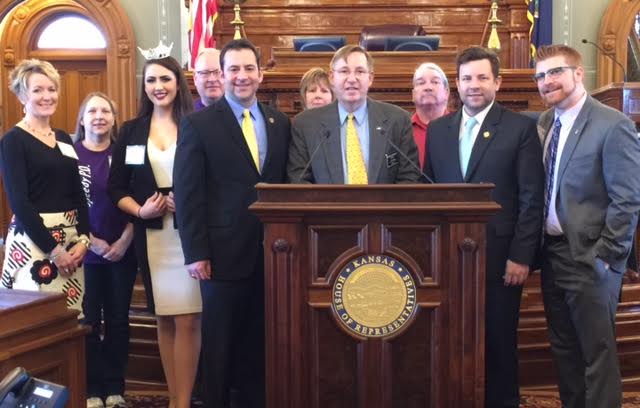


 TOPEKA – The state’s February seasonally adjusted
  All surrounding counties–except Ness, which was unchanged–experienced an increase in unemployment: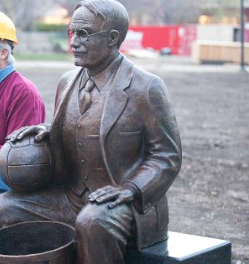



 FHSU UNIVERSITY RELATIONS AND MARKETING