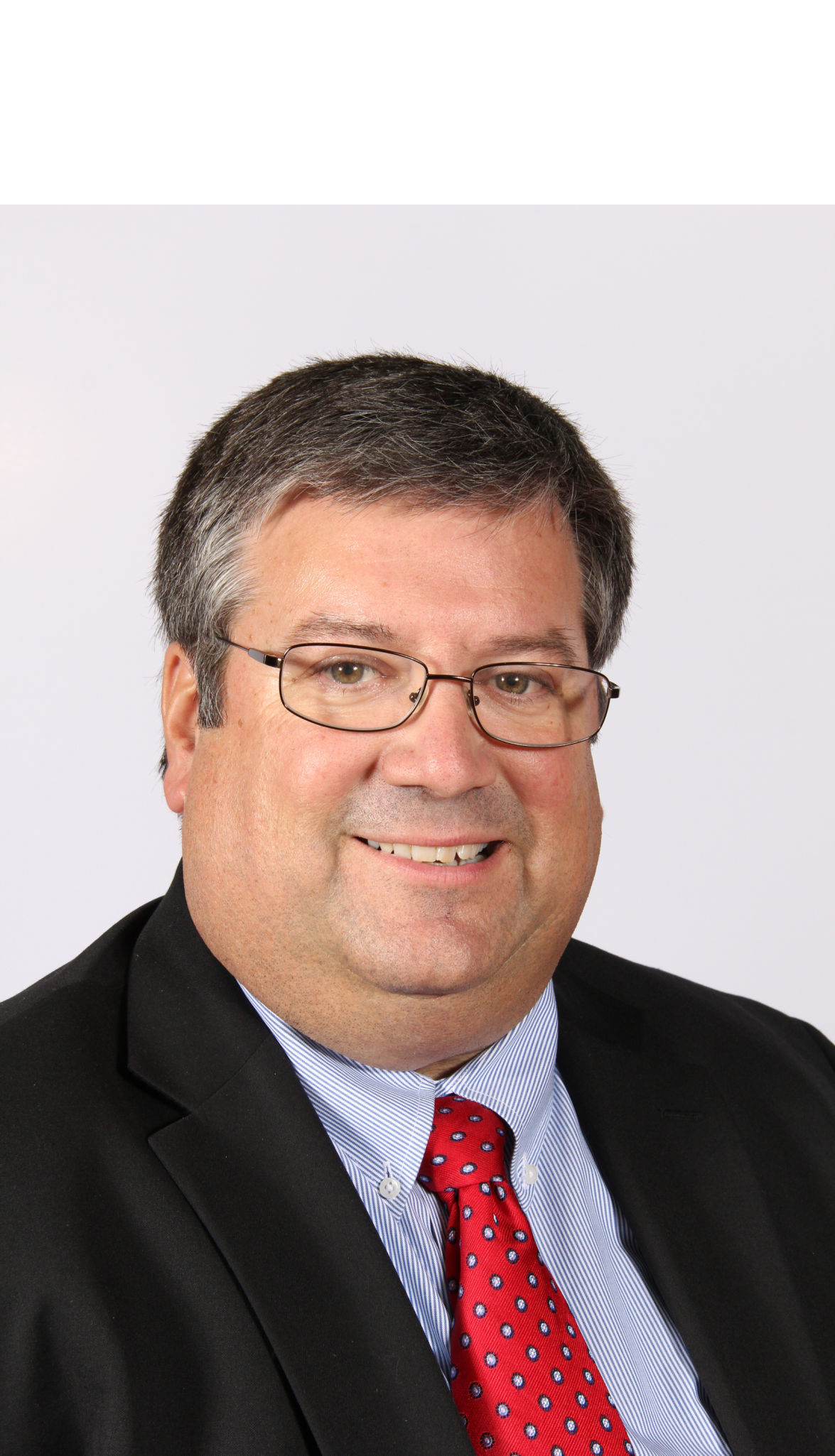
Sen. Moran, Carol Van Dyke, Matt Van Dyke, Jerry Van Dyke (Courtesy photos)
By BECKY KISER Hays Post
PLAINVILLE–Matt Van Dyke and Jerry Moran happen to have the same hometown–Plainville. They are both accomplished men.
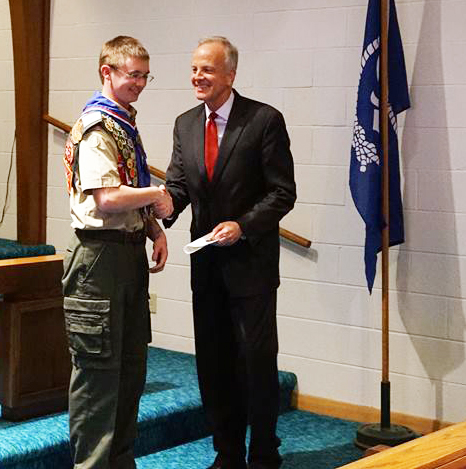
Van Dyke has met all the requirements to be an Eagle Scout, Boy Scouts of America’s highest rank. The Eagle Scout Court of Honor Ceremony for his Troop 109 was held Sunday, March 20, with remarks from Moran, one of the two U. S. Senators for Kansas.
Sen. Moran speaks during the Eagle Scout Court of Honor Ceremony.
“It was a privilege to give remarks at Matt’s Eagle Scout Ceremony in my hometown of Plainville,” Sen. Moran said in a news release. “The Boy Scouts of America teaches boys and young men the fundamental truths of duty, honor and responsibility. Since the inception of the Eagle Scout award in 1912, only two percent of Boy Scouts have achieved Scouting’s highest honor.
U.S. Sen. Jerry Moran (R-KS) congratulates new Eagle Scout Matt Van Dyke of Plainville.
“Congratulations to Matt on this notable achievement and thank you to Troop 109 for having me,” Moran added.
Rep. Ken Rahjes of Agra with Eagle Scout Matt Van Dyke, Plainville.
Also attending the afternoon ceremony at the Plainville Methodist Church was state Rep. Kan Rahjes, (R-Agra). “Matt is quite an accomplished young man. There was a nice crowd in attendance to show their support of Matt and his family and the importance of Troop 109 in Plainville,” Rahjes said.
Rahjes thanked Matt and his parents, Jeff and Carol Van Dyke for “a great afternoon of seeing the promise of a bright future for our state and nation.”
LARNED, Kan. (AP) — The Larned State Psychiatric hospital challenged with staffing troubles and leadership turnover has implemented stringent spending controls after burning through more than 60 percent of its annual budget in six months.
The Topeka Capital-Journal reports that as of Dec. 31, the hospital had spent at least $34.2 million of its $57 million budget for the fiscal year ending June 30.
The hospital has cut down on spending, increased auditor review of purchases and prohibited non-urgent expenditures. A Jan. 15 memorandum to the hospital’s administrators and program directors outlined the restrictions.
The Kansas Department of Aging and Disability Services, which oversees the hospital, says the spending rate and memo had been extensively discussed at a House Social Services Budget Committee hearing.
ELLIS–The FEMA Community Rating System Program will be discussed during tonight’s Ellis City Council meeting by Steve Samuelson of FEMA, and the Tourism Task Force will meet with the Council.
In unfinished business, the council will consider resolutions for bond financing. The meeting begins at 7:30 p.m. in Ellis City Hall. The complete March 21, 2016 agenda follows.
AGENDA March 21, 2016 REGULAR MEETING OF THE CITY COUNCIL OF ELLIS City Hall – Council Meeting Room
BILLS ORDINANCE REVIEW WORK SESSION BEGINS AT 7:00 P.M.
ROLL CALL AND MEETING CALL TO ORDER AT 7:30 P.M.
PLEDGE OF ALLEGIANCE
AMENDMENTS TO AGENDA (if needed)
1) CONSENT AGENDA
a) Minutes from Regular Meeting on March 7, 2016
b) Bills Ordinance #1993
(Council will review for approval under one motion under the consent agenda. By majority vote of the governing body, any item may be removed from the consent agenda and considered separately)
PUBLIC COMMENTS
(Each speaker will be limited to five minutes. If several people from the group wish to speak on same subject, the group must appoint a spokesperson. ALL comments from public on agenda items must be during Public Comment. Once council begins their business meeting, no more comments from public will be allowed.)
2) PRESENTATIONS OF AWARDS, PROCLAMATIONS, REQUESTS & PETITIONS (HEARINGS)
3) SPECIAL ORDER
a) Discuss FEMA Community Rating System Program – Steve Samuelson, FEMA
b) Fire Department Monthly Report – Fire Chief Denis Vine
c) Discussion with Tourism Task Force
4) UNFINISHED BUSINESS
a) Consider Approval of Engagement Letter with Piper Jaffray
b) Consider Resolutions for Bond Financing
c) Discuss Ellis Golf Club Water Usage
d) Consider Approval of Additional Street Projects
e) Consider Approval of Revisions to Personnel Policy Manual
5) NEW BUSINESS
a) Administer Oath of Office to Council Member
b) Discuss Policy on Hiring Procedures
6) REPORTS FROM CITY OFFICIALS
a) Administrative
1) Public Works
(1) Ks Asso Code Enforcement Spring Conference
(2) Department Update
2) Police
(1) Interview Board
(2) Department Update
3) City Clerk
(1) February Health Insurance Summary
(2) Department Update
4) Attorney
5) Mayor Update and Announcements
(1) Mayor Conference
(2) Reminder Work Session with KDHE March 22, 2016
(3) Reminder Special Meeting with Trades Board March 24, 2016
(4) Reminder Work Session with Cemetery Committee March 29, 2016
EXECUTIVE SESSIONS
7) ADJOURNMENT
MANHATTAN – A Manhattan man was sentenced on Monday for his role in car accident in May of 2014 that took the life of an unborn child.
Ryan Routson, 33, Manhattan, appeared in Riley County court.
He was found guilty on charges of felony aggravated battery, vehicular homicide and possession of drug paraphernalia in connection with the crash.
The Kansas Highway Patrol reported a 2002 Jeep Liberty driven by Routson was southbound on Tuttle Creek Terrace, failed to stop at a stop sign and hit a 2003 Volkswagen Golf driven by Megan L. Hartford, 32, Manhattan, that was traveling westbound on U.S. 24.
The impact caused the Jeep to roll onto its side in traffic.
Routson and Hartford were transported to the hospital in Manhattan.
During testimony, Hartford explained that she was admitted to the labor and delivery wing of the hospital and notified that evening that her 22-week-old unborn child had died.
Judge Stutzman sentenced Routson to 12-months in the Riley County Jail for the charge of vehicular homicide and 6 months in Riley County Jail for the charge of possession of drug paraphernalia. The two sentences will run concurrently (at the same time) as the charge for vehicular homicide. He will also serve 14 months of probation with the Secretary of Corrections for the charge of aggravated battery.
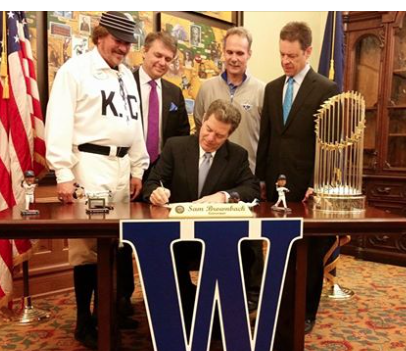
The World Series trophy made an appearance in Topeka today!- photo Kansas Governor’s office
TOPEKA, Kan. (AP) – Kansas lawmakers are honoring the Kansas City Royals for winning their first World Series since 1985.
Royals Hall of Fame director Curt Nelson held up the silver World Series trophy on Monday to the applause of legislators in both chambers.
Both the Senate and House approved resolutions hailing the team’s five-game triumph over the New York Mets in November.
Republican Rep. Scott Schwab of Olathe spoke about reliving the joy he felt as a young boy when he watched Kansas City win the Series in 1985.
He praised the Royals for earning their title while playing “the boys’ game like grown-up boys.”
Senate Minority Leader Anthony Hensley, a Topeka Democrat, also congratulated the team for its accomplishment and urged his fellow senators to support the resolution in that chamber.
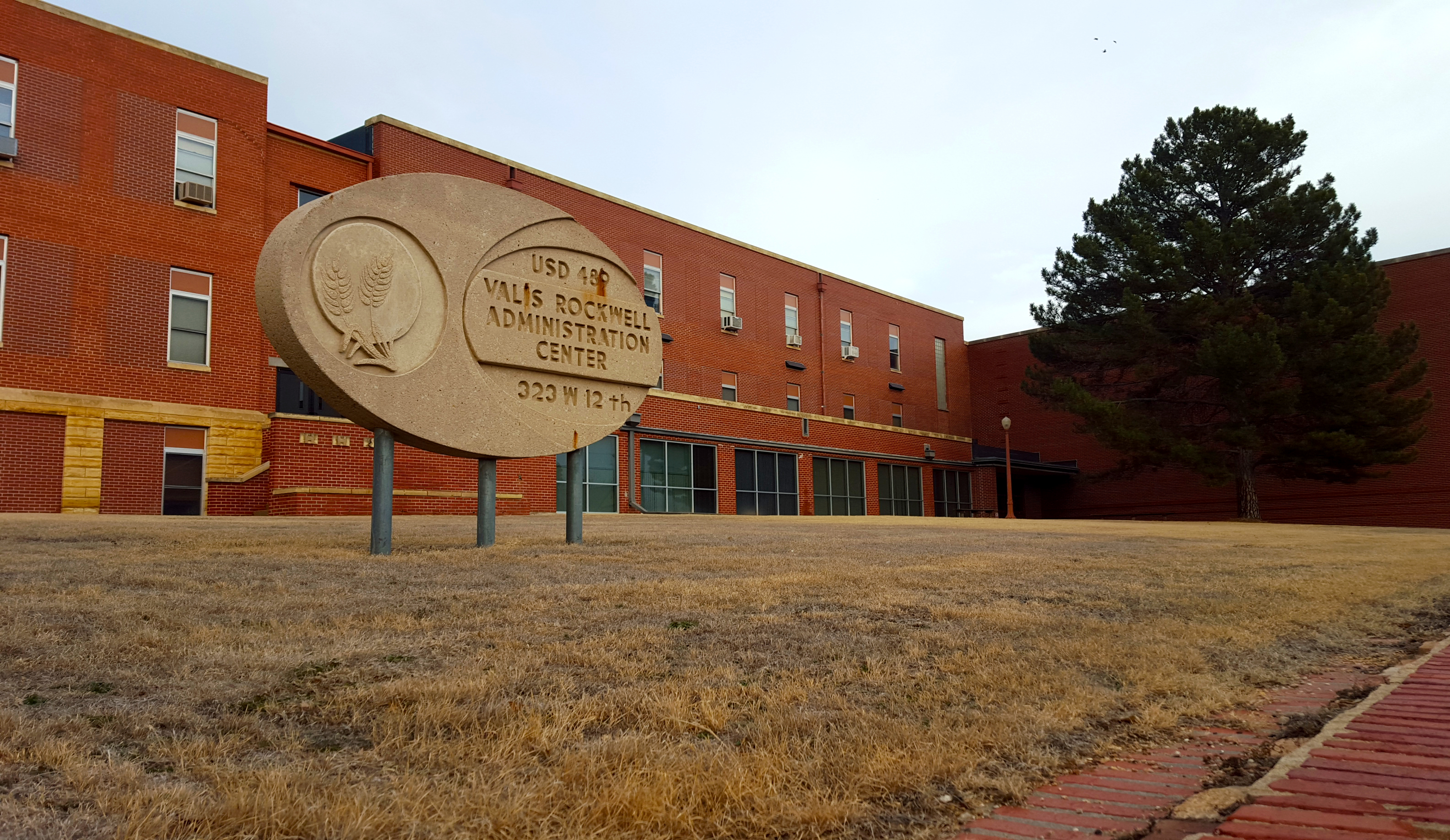
It’s decision time for the USD 489 Board of Education as the group is set to vote on a resolution calling for a bond issue election at tonight’s Board meeting set for 6:30 p.m. in the Rockwell Administration Center, 323 W. 12th St.
That resolution, if adopted, would set the $94 bond issue election for June 7.
The Board pushed back the original timeline of an election in April or May in order to collect signatures that would allow for a sales tax question to be put on the ballot at the same time as the bond question.
If passed by voters a half-cent sales tax in Hays, would significantly reduced the amount of property taxes needed to fund the bond issue.
Board members have frequently said that a bond issue election with a sales tax question included would likely be more successful.
The Commission, however, has the authority to schedule that election and will decide on a timetable at their regular meeting Thursday.
The Board hopes the sales tax question be presented with the bond issue, but the City Commission could potentially push the tax question onto ballots next year.
During tonight’s meeting the Board will also vote to approve summer school fees for the Summer 2016 term.
Anita Scheve, director of The Learning Center, spoke with the Board at their work-session two weeks ago about the best pricing structure for summer school, recommending students that qualify for the free lunch program be able to attend summer school without cost and a reduced tuition cost for reduced cost lunch program students.
Sixty-three percent of summer school students qualify for free lunch and frequently struggle to pay to tuition for the courses according to Scheve.
Further, she said, grades for summer school are left off of students’ transcripts until payment is made, causing issues for students that transfer or graduate.
The full pay schedule would require students that qualify for the reduced lunch program to pay $50 per half credit, $100 per half credit for USD 489 students and $200 for out-of-district students.
The cost to the district for summer school dropped significantly when The Learning Center took over the summer school program, so Scheve argues that the district could easily absorb the small cost that would allow for a staggered pay schedule.
The Board will also vote on the ratification of the HNEA contract for the 2015-2016 school year.
The district and Hays National Education Association negotiators successfully completed mediation after the Board declared impasse during contract negotiations. The contract agreed upon by both groups during mediation has already been approved by Hays teachers.
Tonight’s meeting will be streamed live on Hays Post and on Eagle Channel 14 by the USD 489 News team.
Photo by KHI News Service House Bill 2615 contain incentives aimed at convincing more doctors, dentists and mental health providers to deliver free care to medically indigent Kansans. Participating providers would be given protection from malpractice claims for the charitable care they provide and would earn a limited number of continuing education credits.
By JIM MCLEAN
Kansas lawmakers are close to finishing their work on a bill they hope will motivate doctors and dentists to provide more charity care.
Though the measure enjoys bipartisan support, its most ardent supporters are Republican legislators who are opposed to Medicaid expansion and need something that shows voters they’re willing to help poor Kansans gain access to health care.
“You can’t say ‘no’ to everything,” said Rep. Dan Hawkins, a Wichita Republican and chairman of the House Health and Human Services Committee. “If you’re going to say ‘no’ (to Medicaid expansion), then you have to try and find other solutions that can help. That’s what I’m trying to do.”
Different versions of the measure — House Bill 2615 — have passed the House and Senate. Next week, the House will have the option of adopting the Senate’s version or requesting the appointment of a conference committee to work out any remaining differences.
Both versions of the bill contain incentives aimed at convincing more doctors, dentists and mental health providers to deliver free care to medically indigent Kansans. Participating providers would be given protection from malpractice claims for the charitable care they provide and would earn a limited number of continuing education credits.
Following Florida’s model
Based on a recent study of Florida’s Volunteer Health Services Program, which served as a model for the Kansas bill, Hawkins believes the incentives will substantially increase the amount of free care delivered across the state.
“Based on the data we received from Florida and the demographics of Kansas, we believe that this system has the potential of generating more than $18 million in free care for the neediest Kansans,” Hawkins wrote in a column distributed earlier this month to Kansas newspapers.
The study Hawkins cited was published in October 2015 by the Foundation for Government Accountability, an organization that SourceWatch describes as a “right-wing advocacy organization” active in statehouses across the country.
Lobbyists for several organizations that represent Kansas doctors and other providers don’t share Hawkins’ optimism. While they don’t oppose the bill, several said privately that they don’t believe it will produce the hoped-for results.
Rep. Barbara Bollier, a Mission Hills Republican and retired anesthesiologist, is among the skeptics.
“I’m not opposed to it,” she said. “But it just doesn’t add up.”
More importantly, Bollier said, the bill is a poor substitute for expanding KanCare, the state’s privatized Medicaid program.
“It isn’t comparable,” she said. “Most regular people get that, and certainly the physicians do.”
The bill requires the secretary of the Kansas Department of Health and Environment to provide legislators with annual reports detailing the types of providers who sign participation agreements and the number who actually deliver free care.
Politically possible?
A closer look at the Foundation for Government Accountability study shows that the Florida program isn’t coming close to meeting the health care needs of that state’s uninsured residents.
In 2014, the most recent year for which data is available, the study said providers offered the equivalent of 28,752 visits for every 100,000 qualifying residents. That means that more than 70,000 of every 100,000 people eligible for free care weren’t able to see a doctor.
Still, the 2014 numbers were an improvement over 2012, when providers offered only 18,111 visits for every 100,000 people who qualified for services.
The report also said that no doctors signed up to provide free care in the five poorest counties in Florida.
Even if the Kansas program meets his expectations, Hawkins acknowledges many needy Kansans still won’t have access to care. But he said with KanCare expansion off the table because of opposition from Gov. Sam Brownback and Republican legislative leaders, he wanted to focus on something that was politically possible.
“There are some people out there on social media and stuff that have criticized me for this,” he said. “All I can say is, ‘Do you want me to stand and do nothing? Why would you criticize if there is a possibility of helping?’”
Only uninsured Kansans classified as medically indigent would be eligible for free care under the program. That means Kansans with annual earnings under 200 percent of the federal poverty level: $23,760 for an individual and $48,600 for a family of four.
A Medicaid expansion bill backed by the Kansas Hospital Association would expand coverage to Kansans earning up to 138 percent of the poverty level: $16,242 for an individual and $33,465 for a family of four.
The expansion bill, which KHA calls the Bridge to a Healthy Kansas, has not been scheduled for hearings in the House or Senate.
Jim McLean is executive editor of KHI News Service in Topeka, a partner in the Heartland Health Monitor team.
The funeral service for Goodland, Kansas resident Marvin D. Cullens, 83, will be held Thursday, March 24, 10:30 AM MT at the First United Methodist Church in Goodland. Interment, with military honors, will be in the Goodland Cemetery.
Friends may share their respects Wednesday, March 23, from 4:00 until 6:00 PM MT at Koons Chapel in Goodland. Memorials may be made to the Goodland VFW and can be left at the services or mailed to: Koons Funeral Home, 211 North Main, Goodland, KS 67735-1555.
WASHINGTON – A civil complaint was filed today, Monday, March 21, in the U.S. District Court for Kansas against Native American Enterprises LLC, of Wichita, Kansas; its Vice President and part-owner, William N. McGreevy and is production manager, Robert C. Conner, to stop the distribution of adulterated food, the Department of Justice announced today.
Native American Enterprises LLC (NAE), manufactures and distributes food, namely ready-to-eat (RTE) refried beans and sauces. The complaint alleges that the company’s RTE refried beans and sauces are adulterated in that they have been prepared, packed and/or held under insanitary conditions whereby the food may have become contaminated with filth or have been rendered injurious to health. According to the complaint, the insanitary conditions include the presence of Listeria Monocytogene (L. mono) in NAE’s facility and insanitary employee practices. The department filed the complaint at the request of the U.S. Food and Drug Administration (FDA).
“Insanitary conditions at food processing facilities can present significant risks to consumers and food manufacturers must take steps to minimize those risks,” said Principal Deputy Assistant Attorney General Benjamin C. Mizer, head of the Justice Department’s Civil Division. “The Department of Justice will continue to work aggressively with the FDA to combat and deter conduct that leads to the distribution of adulterated food to consumers.”
According to the complaint, FDA inspected NAE’s facility, located at 230 N. West Street in Wichita, in August 2015 and collected environmental samples and observed numerous insanitary practices, including the defendants’ failure to manufacture and package food under conditions necessary to minimize microorganism growth, take necessary precautions to protect against contamination and maintain buildings in good repair. Specifically, according to the complaint, FDA observed rain water leaking through the roof in the packaging room, directly above where NAE employees packaged RTE refried beans. In addition, FDA observed cracks and holes in the walls and floor junctures that allow water and debris to collect, prohibit adequate cleaning and could harbor Listeria, according to the complaint.
FDA inspected NAE’s facility twice in 2014. As alleged in the complaint, FDA collected environmental samples during RTE refried bean production during each of the 2014 inspections and found Listeria in the facility. In addition, as alleged in the complaint, FDA also observed a failure to maintain equipment in an acceptable condition through appropriate cleaning and sanitizing.
As alleged in the complaint, L. mono thrives in moist environments, such as food-manufacturing environments. Unless proper precautions are taken, L. mono may become established and grow, and it is difficult to eliminate once it becomes established in a food-manufacturing environment. It is capable of surviving and growing at refrigerated temperatures and in high-salt environments. The complaint alleges that L. mono is a significant public health risk in RTE refried beans and sauces.
The government is represented by Trial Attorney Heide L. Herrmann of the Civil Division’s Consumer Protection Branch and Assistant U.S. Attorney Emily Metzger of the U.S. Attorney’s Office for the District of Kansas, with the assistance of Associate Chief Counsel for Enforcement Sonia W. Nath of the Food and Drug Division, Office of General Counsel, Department of Health and Human Services.
A complaint is merely a set of allegations that, if the case were to proceed to trial, the government would need to prove by a preponderance of the evidence.
PAWNEE COUNTY – An investigator with the Kansas State Fire Marshal’s office is working to determine the cause of a Sunday grass fire in Pawnee County.
The fire reported at 4:24 p.m. just east of T Road and U.S. 183 consumed 10 acres and a small camping trailer, according Rozel Fire Chief Doug Colglazier.
There were no injuries. The Larned fire department was also paged to the fire but the crew from Rozel had it under control by they time they arrived.
Rep. Ken Rahjes, R-Agra, 110th Dist.Hello from Topeka.
We are in the final days of the 2016 legislative session, with plans to have first adjournment by Easter weekend. Then we will spend about a month in our districts and come back for the veto session which could be quick or take several days. It is a ‘5 hour energy & Red Bull’ week as there are many bills to be worked and voted on, in addition to finding answers to the budget situation and the future of school finance.
Several bills were passed out of the house last week.
SB 175 concerns Religious Liberty on Campus. It maintains that religious clubs be treated the same as other student associations and reserves the right to the same benefits, such as access to facilities, campus communications, recognition and registration on campus, and any funding stream that is also available to other student associations. The freedom to practice sincerely held religious beliefs is enshrined in the founding documents of our country, transcending ever-changing cultural trends. This is a religious liberty bill that protects campus religious groups from discrimination. Clubs should be able to establish and maintain parameters for leadership and membership as directed by their sincerely held religious belief. Doing so should not compromise their recognition from universities because that would be a violation of the constitution’s protection of the free exercise of religion. This bill reinforces Kansas’s protection of the rights of religious groups to gather as their conscience and beliefs dictate. I voted in favor of the bill and will watch closely that we do not experience dangerous unintended consequences.
HB 2468 is a bill that will maintain the ability of BB gun clubs, such as those operated by 4-H chapters, to continue to use tax-payer funded school facilities to practice target shooting after school hours, similar to other clubs or sports teams. The bill does not require local school boards to allow BB guns to be kept on campus or stored in lockers. That is a regulation left to the school board. In our area, most of these programs are conducted in buildings on the fairgrounds or armories. I voted in favor of the bill.
And a bill that took on a lot of debate was HB 2595 which declares that cities, counties and other political subdivisions cannot adopt their own nutritional labeling or regulations of food products on private businesses within their jurisdiction, such as when NYC Mayor Bloomberg imposed a ban on sugary drinks above a certain size. The bill is intended to prevent intrastate disparities in the guidelines restaurants and other food services are required to meet. The bill does not keep local entities from adopting regulations on their own food service facilities, or prevent them from offering healthy food education.
The House also gave initial approval to monumental reform of the Kansas juvenile justice system, paving the way for a system focused on hope, rehabilitation, and community based services, rather than incarceration for underage offenders in the form of SB 367. The bill moves toward rehabilitation that uses a home-based approach of community service and parental participation. Juvenile offenders who may not have family structure to support rehabilitation will be eligible to be classified as a child in need of care (CINC), rather than as an offender, which will help keep them out of juvenile correctional facilities and prevent exposure to any negative influences there that may lead to further crime.
The goal of the reform is to focus on rehabilitation for youth instead of incarceration, which statistics show can prevent them from reoffending. Incarceration will remain an option for youth who present a danger to society. Rehabilitation instead of incarceration is shown by evidence to be more effective, less costly, and keep youth offenders closer to home. I voted in favor of the bill, which will probably need to be tweaked again next year. Many are pleased that it is a start.
Visitors in Topeka this week included: Joyce & Dennie Lofgreen, from Norton, their daughter Holly and grandchildren Ava and Jillian. Also, the seniors from Northern Valley High School in Almena: Elexsa Anderson, Colten Bach, Brooke Baird, Sarah Baird, Camden Cox, Mat Florence, Briana Fuemmeler, Allison Keith, Talia Lowry, Brianna Martin, Dalton Smith and Shayna Vincent. Their sponsor and van driver was Mr. Jason Dibble and another van was driven by Richard Ames.
I visited with many people over the weekend in Hays, Nicodemus, Phillipsburg and Plainville, and hope to see you in your community in April.
Please reach out to me if you have concerns, questions or issues that need to be addressed. You can keep up on things by following and liking Ken for Kansas on Facebook. During the session I can be reached: Ken Rahjes, Kansas State Capitol, 168-W, Topeka, KS 66612; Phone: (785) 296-7676; Email: [email protected]; or 1798 E 900 Rd, Agra, KS 67621; Cell: (785) 302-8416 or [email protected].
You can also track bills and get specific information by going to kslegislature.org.
The United States needs the Trans-Pacific Partnership (TPP) to compete in world markets. The trade agreement with 11 other countries in the Pacific Rim — including Canada and Mexico – could eliminate 18,000 tariffs countries place on U.S. goods and services.
Ratifying TPP could boost annual net farm income in the United States by $4.4 billion, compared to not approving the pact, according to American Farm Bureau Federation economic analysis.
“TPP will mean more exports for everything we raise in America and Kansas,” says Barton County farmer stockman Keith Miller. Miller also serves as chair of the international trade advisory committee for the American Farm Bureau Federation. “Right now, our current trade policy puts our farmers, ranchers, workers and businesses at a disadvantage, with higher costs for American goods.”
The TPP agreement is expected to increase cash receipts and net exports from Kansas by $303.7 million and $213.7 million per year respectively, AFBF estimates.
Increased marketing opportunities for Kansas farmers and ranchers could add more than 1,600 jobs for the Kansas economy, Miller says. Eliminating tariffs and other trade barriers on Kansas ag exports to TPP-partner countries will increase trade for beef, pork, soybeans and processed food products.
Export sales make an important contribution to the Kansas farm economy. In 2014, cash receipts for Kansas ag commodities totaled $16.6 billion.
“Our Kansas cattle industry led all other ag products with nearly $9 billion in cash receipts in 2014,” Miller says. “TPP passage is expected to increase beef cash receipts by $151 million per year.”
This is driven by a $139.3 million per year increase in direct exports to TPP countries.
With TPP, Japan will eliminate 74 percent of duties on beef imports within 16 years, according to AFBF analysis. This includes reducing a tariff of 38.5 percent to 9 percent within 16 years on fresh, chilled and frozen beef cuts.
Additional AFBF analysis forecasts farm-price increases for corn (5 cents per bushel), soybeans (12 cents per bushel), wheat (2 cents per bushel) and rice (16 cents per hundredweight).
AFBF also predicts price increases for beef ($2.66 per hundredweight), pork ($2.45 per hundredweight) and poultry ($1.40 per hundredweight). In the dairy sector, prices will increase for butter ($2.81 per hundredweight), cheese ($1.68 per hundredweight), nonfat dry milk ($1.29 per hundredweight) and all milk (21 cents per hundredweight).
Ninety-five percent of the world’s consumers live outside U.S. borders. American-made products and services remain in demand, making American exports a vital pillar of our 21st century economy. When the rules are fair, Americans can out-compete anyone in the world.
Urge Congress to ratify TPP and help ensure U.S. farmers, stockmen, businessmen and workers compete in today’s global economy.
John Schlageck is a leading commentator on agriculture and rural Kansas. Born and raised on a diversified farm in Hoxie, his writing reflects a lifetime of experience, knowledge and passion.




 ELLIS–The FEMA Community Rating System Program will be discussed during tonight’s Ellis City Council meeting by Steve Samuelson of FEMA, and the Tourism Task Force will meet with the Council.






 WASHINGTON – A civil complaint was filed today, Monday, March 21, in the U.S. District Court for Kansas against Native American Enterprises LLC, of Wichita, Kansas; its Vice President and part-owner, William N. McGreevy and is production manager, Robert C. Conner, to stop the distribution of adulterated food, the Department of Justice announced today.
 PAWNEE COUNTY – An investigator with the Kansas State Fire Marshal’s office is working to determine the cause of a Sunday grass fire in Pawnee County.