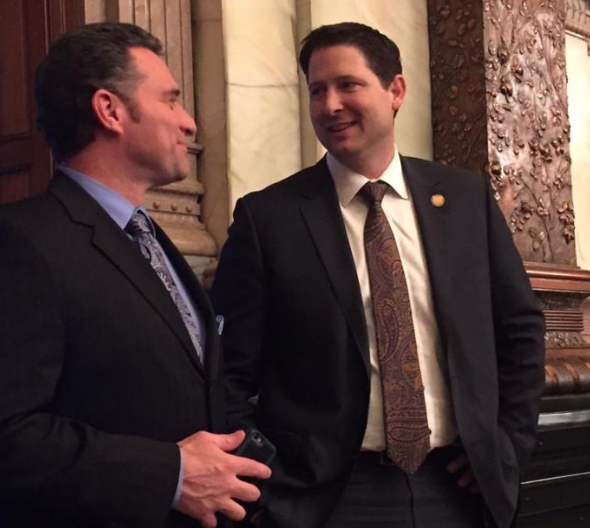
Photo by Jim McLean/KHI News Service Sen. Ty Masterson, left, who chairs the Senate Ways and Means Committee, and Rep. Ron Ryckman Jr., who chairs the House Appropriations Committee, say implementing some of the cost-cutting initiatives included in a recent efficiency study could stabilize the budget
Kansas lawmakers picked up their pace this week, approving what for the moment is a balanced budget and advancing several other proposals ahead of a scheduled mid-session break next week.
The budget bill uses a series of transfers, spending reductions and some borrowing to balance the current budget and end the fiscal year with a paltry $6 million in the treasury.
It also closes a projected $200 million shortfall in the budget year that begins July 1. The spending measure doesn’t include any additional money for Kansas schools despite a recent Kansas Supreme Court decision that said the current K-12 funding formula is inequitable and unconstitutional.
The Kansas Department of Education has estimated it will cost about $70 million this year and $38 million next year to comply with the court’s ruling. Ty Masterson, the Andover Republican who chairs the Senate Ways and Means Committee, said legislative leaders need time to study the court’s order.
“It is not necessary at this time to address anything as it pertains to the court,” Masterson said during the Senate’s debate on the budget bill. “We have an opportunity to work through that. A
nd the jury is out on what that really needs to be.” Democrats and several moderate Republicans voted against the budget, saying it doesn’t fix structural problems that have caused revenue shortfalls in recent years.
They point to the income tax cuts Gov. Sam Brownback muscled through the Legislature in 2012 as the main cause of those shortfalls. “This budget reinforces the fiscal mismanagement caused by a reckless and irresponsible tax policy,” said Senate Minority Leader Anthony Hensley of Topeka.
Masterson and other Republican leaders say that the state’s ongoing budget problems are manageable. “We’re solving problems as we move forward,” he said. Both Masterson and Rep. Ron Ryckman Jr., the Olathe Republican who chairs the House Appropriations Committee, said implementing some of the cost-cutting initiatives included in a recent efficiency study could stabilize the budget.
The study, done by the New York-based consulting firm of Alvarez and Marsal under a $2.6 million contract with the state, said Kansas could save more than $2 billion over the next five years by making a variety of management and policy changes.
In the coming weeks, lawmakers are expected to focus on 21 recommendations that the consultants say could save up to $1.7 billion. Limiting state employees to one health insurance option is among the recommendations being considered for immediate implementation.
Limiting state workers to a high-deductible plan that would require them to cover a significant portion of their medical costs with money from a health savings account could save the state nearly $124 million, according to the consultant’s report.
Parents as Teachers
Initial versions of the budget bill included a proposal to means test participants in the Parents as Teachers program so that federal welfare dollars could be used to cover its $12.3 million annual cost.
The proposal would have required those who didn’t meet the income guidelines to pay to participate. Advocates protested, saying the changes would transform what was intended to be a program to help all families address issues that could affect school performance into one used predominantly by low-income families. Budget negotiators pulled the controversial proposal out of the bill and substituted language that leaves the decision to the Kansas Children’s Cabinet.
That didn’t satisfy Sen. Laura Kelly, of Topeka, the ranking Democrat on the Ways and Means Committee. “Essentially, we’ve thrown Parents as Teachers under the bus,” Kelly said.
“We said, ‘OK, we’ll give that decision back to the Children’s Cabinet and let them decide whether they’ll use TANF (federal welfare funds) for Parents as Teachers. Possibly they won’t.
But it’s very likely that they will, in which case we destroy that program.” Masterson disagreed. If anything, he said, “We put the Children’s Cabinet in the bus, driving the bus. It’s their decision.”
Suicide prevention
Immediately before they considered the budget bill, senators tentatively approved a measure aimed at preventing teenage suicides.
The bill, which hasn’t yet been considered by the House, would require certified teachers and principals to complete suicide prevention training each year. Steve Abrams, the Arkansas City Republican who chairs the Senate Education Committee, said testimony provided by parents of children who committed suicide convinced him of the need for the bill.
“This is something that if indeed it saves even one life, it’s worth the effort,” Abrams said.
Another Medicaid expansion debate
The Senate on Thursday is expected to consider a welfare “reform” bill that could provide opponents of Medicaid expansion another opportunity to engineer the defeat of a bill backed by the Kansas Hospital Association.
Last week, Senator Mary Pilcher-Cook, a Republican from Shawnee, failed to force a vote on expansion because the amendment she offered was ruled not germane to the bill under consideration at the time.
But the welfare bill on the calendar for consideration Thursday probably is germane, said Senate President Susan Wagle, a Wichita Republican, because it includes medical assistance programs. Supporters of expansion are expecting either Pilcher-Cook or Sen. Jeff Melcher, a Leawood Republican, to force a vote on Medicaid expansion in hopes of defeating the bill and sending a message to the House where there is more support for expansion.
But in an interview Wednesday evening, Melcher said he hadn’t decided whether to raise the issue during Thursday’s debate on the welfare bill, which seeks to further tighten eligibility requirements.
“I haven’t really decided what I’m going to do,” Melcher said. “But I do think it’s important to let the public know where we stand on it (Medicaid expansion).”
After last week’s rules fight, Wagle removed Pilcher-Cook as chair of the Senate Public Health and Welfare Committee. That prompted 17 of the Senate’s 32 Republicans to send a letter to Wagle asking her to reinstate Pilcher-Cook. But Wagle said Wednesday that she wouldn’t reconsider her decision.
Jim McLean is executive editor of KHI News Service in Topeka, a partner in the Heartland Health Monitor team.
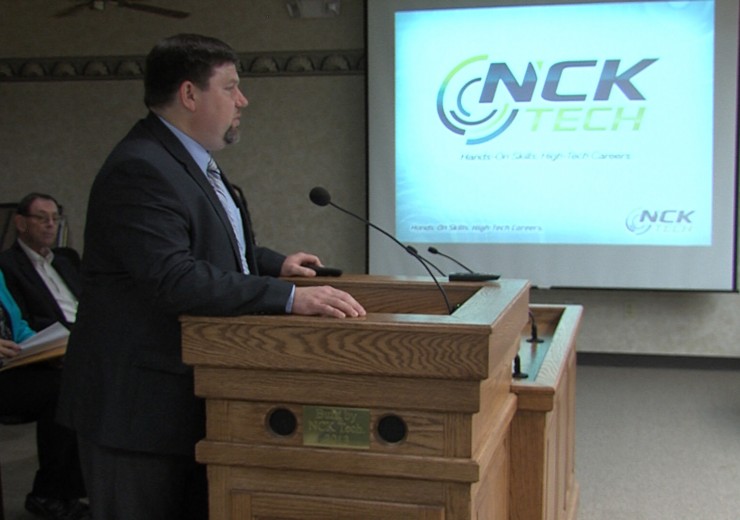
NCKTech President Eric Burks and Hays Campus Dean Sandy Gottschalk addressed the Hays City Commission Thursday night.
By BECKY KISER Hays Post
The six-year relationship between the city of Hays and NCKTech College is improving.
NCKTech president Eric Burks presented his annual report during the Thursday night city commission work session about operation of the NCKTech Big Creek Technical Training Center. The Center is housed at 101 S. Main Street in cooperation with the city of Hays.
“I almost didn’t include this because I really think these issues have been resolved,” Burks said, “but communication can always improve, so I left it there, and I really believe it’s improved at all levels.”
In exchange for utilizing the city-owned building, NCKTech, along with its students, is required to complete some projects for the city.
City Manager Toby Dougherty provides annual project lists to the college, which come from the city departments.
“We now know there is not an urgency behind these projects, and yet there is a need for them,” Burks said.
The list is reviewed by NCKTech instructors who help select the projects they think their students can handle successfully and do a good job.
“So I think the outcomes and expectations (by the city) are much more clear.”
Instructors work with department chairmen to make sure the timelines will work with other assigned work the students have. Together they figure out how the city’s projects can come to fruition.
“It is important, and I think this has been key, that (city) projects fit within the students’ skill level so we’re not taking them with more than they can handle. I really think that’s been the key overall to this being a more successful relationship,” Burks told commissioners.
NCKTech carpentry student projects completed for the city of Hays include six cedar kiosks with Plexiglass fronts for the Parks Department.
Electrical Technology students this semester will be upgrading the lighting in one room of the Public Works building and moving a disconnect for a piece of equipment. They also plan to upgrade the lighting in the conference room at the Hays Regional Airport.
The Plumbing, Heating and Air-Conditioning (PHAC) students are currently working on the air conditioning system in the concession stand at Larks Park. Next, they will be retrofitting city buildings to low-flow toilets and urinals.
Commissioners commended Burks and new campus dean Sandy Gottschalk for “improved leadership” at NCKTech. Mayor Eber Phelps also thanked the college for participating in last fall’s “Core2Campus” event for the first time.
Keith Orvis Schwindt, 82, passed away on February 17, 2016 at the Rush County Hospital in LaCrosse, Kansas. He was born on January 11, 1934 in Rural McCracken, Kansas the son of Harry and Dorothea (Pratt) Schwindt.
He was a farmer and a member of the United Methodist Church, Bazine, Kansas. He married Judy Williams on Thursday, July 9th, 1953 in the EUB Church, Alexander, Kansas.
Survivors include his wife, Judy Schwindt, Alexander; son, Rick Schwindt and his wife Rosemarie, LaCrosse; daughters, Renee Scott, Bucklin and Rashell Patten and her husband Greg, Ellinwood; brother, Dale Schwindt and his wife Gloria, Alexander; sister, Connie Rumold and her husband Bill, Westminister, Colorado; 11 Grandchildren, and 13 Great grandchildren. He was preceded in death by his daughter, Raven Ranell Dale; his brother, Herbert Schwindt; and his son-in-law, Steve Scott.
Funeral Service will be on Monday, February 22, 2016, 10:30 AM, at the United Methodist Church, Bazine, Kansas. Burial in the Alexander Cemetery, Alexander, Kansas. Friends may call at Fitzgerald Funeral Home, Ness City on Sunday, February 21, 2016 from 10:00 A.M. until 9:00 P.M.
Memorial contributions may be given to the Rush County EMS and the United Methodist Church, Bazine.
Charles C. Haynes is director of the Religious Freedom Center of the Newseum Institute.
In the days following the death of Justice Antonin Scalia on Feb. 13, conservative religious and political leaders have lavished praise on the long-serving justice as a champion of religious freedom.
Alan Spears, head of the Christian advocacy group Alliance Defending Freedom, hails Scalia as “the most vocal and passionate voice on the Supreme Court for religious freedom.” Sen. Ted Cruz warns, “We are one justice away from a Supreme Court that would undermine the religious liberty of millions of Americans.”
But surely this is either a case of selective amnesia or wishful thinking.
Justice Scalia was, of course, a devout Catholic who vigorously opposed abortion and LGBT rights at every turn. And he was, without question, an advocate of a lower wall of separation between church and state — a porous wall that would allow affirmations of God by government. All of this endeared him to religious and social conservatives.
But Justice Scalia was no defender of religious freedom.
On the contrary, Scalia authored Employment Division v. Smith, the landmark 1990 Supreme Court decision that all but erased the Free Exercise clause from the First Amendment.
Before Smith, religious Americans could invoke the First Amendment to seek relief from laws or regulations that substantially burdened the practice of their faith. Government could not deny religious exemptions without demonstrating a compelling state interest — and showing that it has pursued that interest in the manner least restrictive, or least burdensome, to religion.
Under this “compelling state interest” test — fully articulated in the 1963 Supreme Court decision Sherbert v. Verner — religious individuals enjoyed a high level of protection for the freedom to practice their faith openly and freely without governmental interference.
In the Smith decision, Justice Scalia, joined by four other justices, radically re-interpreted the Free Exercise clause by ruling that burdens on religious freedom no longer had to be justified by a compelling state interest. Although the government cannot pass laws targeting religious practice, it can pass laws that burden religious exercise if the law is “neutral” and “generally applicable.”
Consider, for example, the question at issue in the Smith case itself: Can the state of Oregon ban the use of peyote — a cactus with hallucinogenic properties — without providing a religious exemption for members of the Native American Church who ingest small amounts of peyote in worship ceremonies (a practice that may date back thousands of years).
Two Native Americans challenged the law after being denied unemployment benefits because they were fired for using peyote in their religious practice. Most legal experts expected the outcome to turn on whether or not Oregon could demonstrate a compelling reason for prohibiting peyote without exceptions. Instead, Justice Scalia used the case to sharply curtail the use of the long-standing free-exercise test.
In his majority opinion, Scalia ruled that government no longer has to show a compelling state interest for denying religious exemptions — as long as the law in question applies generally to everyone.
Thus, Oregon cannot pass a law stating that Native Americans are prohibited from using peyote, but it could accomplish the same result by prohibiting the use of peyote by everyone. Either way, a central religious ritual for some Native Americans would be illegal.
If religious groups want an exemption from a generally applicable law, said Scalia, they should seek a legislative remedy. This, of course, turns the First Amendment on its head: Free exercise of religion is protected by the First Amendment precisely because it is a fundamental right that is not subject to a majority vote. Seeking religious accommodation through legislation is especially difficult for religious minorities and unpopular faiths — and keep in mind that most of us are a religious minority somewhere in the country.
Leaders of many faiths were stunned by Scalia’s evisceration of the Free Exercise clause. After Smith, it would become difficult — if not impossible — to get relief from laws and regulations that seriously burdened the practice of religion. In the three years following Smith, more than 50 reported cases were decided against religious groups and individuals.
That’s why more than 60 religious and civil liberties groups — from the ACLU to the National Association of Evangelicals — joined together to “restore” the compelling interest test by getting Congress to pass the Religious Freedom Restoration Act of 1993.
Although the Supreme Court struck down RFRA as applied to the states, it continues to apply to the federal government (as we saw in the 2014 Hobby Lobby decision). Many states have passed their own RFRAs — mostly without controversy until recent years when opponents of same-sex marriage decided (mistakenly, in my view) that RFRA could provide religious exemptions to non-discrimination laws.
The current confusion and contention surrounding the meaning of “free exercise of religion” is the fallout from Justice Scalia’s decision in Smith. Without First Amendment protection, religious individuals and groups are left to seek accommodation through the political process — a messy, divisive arrangement that puts matters of conscience up for a vote.
If you agree that the First Amendment as applied by the Court for decades went too far in protecting free exercise of religion, then by all means celebrate Justice Scalia’s legacy on religious freedom.
But if you are appalled, as I am, that in far too many cases courts no longer treat religious freedom as a constitutional right, then hope for a replacement on the Supreme Court who will vote to overturn Justice Scalia’s disastrous decision in Employment Division v. Smith.
Charles C. Haynes is vice president of the Newseum Institute and founding director of the Religious Freedom Center. [email protected]
HUTCHINSON, Kan. (AP) — Kansas State Fair officials are considering a major redesign of the fairgrounds in Hutchinson.
The Hutchinson News reports all of the current proposals are long-range ideas but the goal is to make the fairgrounds a more modern attraction.
The suggestions include removing the century-old racetrack, while leaving the grandstand. The main entrance could move to a different location and the fair would be divided into quadrants with thoroughfares to make walking through the grounds easier.
Another proposal is to allow private businesses to permanently move to the fairgrounds, on a type of main street promoting Kansas.
Chip Overton, with Keffer/Overton Associates, presented six concepts to the fair board this week. The company is developing a master plan for the fair. The plan is expected to be finished by May.
Hays city commissioners are satisfied that the city’s Comprehensive Financial Management Policy was in compliance during 2015.
Finance Director Kim Rupp presented his annual report during Thursday night’s work session concerning the city’s compliance with the thirteen categories.
Rupp reviewed several highlights of the Enterprise Fund Management.
“Water and sewer rates underwent a full review by Springsted Inc. in 2015, revealing a need for a rate increase in both rate structures,” Rupp said. As a result of the study and a review of numerous options, commissioners adopted a schedule for hikes in customer rates for water and sewer.
“This practice ensured that the city is able to continue to maintain all enterprise funds on a self-sustaining basis, with no support from property tax or general fund sales tax revenues,” Rupp said. “A similar full financial review will be conducted annually to verify the intended purpose of the rate increases are being fulfilled.”
Sewer rates increased 17% in the Sept./Oct. 2015 billing cycles, and another 15.5% January 1, 2016 through 2020, and then finally, another 12% on January 1, 2021. Water rates will increase 10% January 1, 2016 and 2017, 5% January 1, 2018 and 2019 and finally, 3% January 1, 2020 and 2021.
Commissioner Lance Jones was absent from the work session.
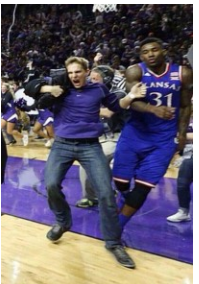
Court storming after last season’s game in Manhattan
MANHATTAN- Prior to Saturday’s 5p.m. Sunflower Showdown with the #2 Kansas Jayhawks, Kansas State University has issued a video on how to treat guests with class.
Last season, KSU Athletic Director John Currie apologized to KU officials for students storming the court after the game in Bramlage Coliseum and Big 12 Conference Commissioner Bob Bowlsby publicly reprimanded Kansas State.
No injuries resulted from the court-storming.
In May, the Big 12 Conference passed a measure under which schools could face fines or even the loss of future home games for failing to control fans who storm courts or rush fields after games.
Kansas State has 4 wins at Bramlage Coliseum against Kansas in the last 8 meetings, including back-to-back victories in 2014 and 2015. The Wildcats have not won 3 straight at home in the series since 1981-83 (4 wins).
The rivalry ranks as the 8th-longest continuously played in the country (met every season since 1921) with the 6th-most games played (282). The Jayhawks lead the series, 189-93, including 75-47 in Manhattan.
BOYS’ BASKETBALL
Beloit 78, Republic County 61
Lexington, Neb. 80, Phillipsburg 47
Northeast-Arma 77, St. Paul 40
Quinter 62, Oberlin-Decatur 44
Scott City 65, Cimarron 48
St. John’s Beloit-Tipton 80, Thunder Ridge 35
GIRLS’ BASKETBALL
Beloit 55, Republic County 41
Bishop Miege 49, St. Thomas Aquinas 35
Cimarron 43, Scott City 38
Jayhawk Linn 41, Crest 31
Lexington, Neb. 55, Phillipsburg 37
Quinter 39, Oberlin-Decatur 9
St. John’s Beloit-Tipton 40, Thunder Ridge 33
St. Teresa’s Academy, Mo. 46, St. James Academy 37
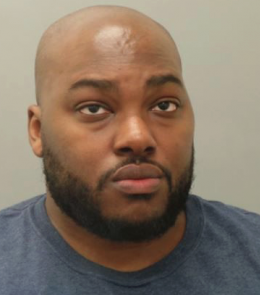
TOPEKA, Kan. (AP) — A man accused in the death of a 2-year-old boy in Topeka has been booked into the Shawnee County jail.
The Topeka-Capital Journal reports that the 31-year-old man was arrested Feb. 8 in Missouri on an outstanding first-degree murder warrant, and was booked in to the Shawnee County jail on Wednesday.
Authorities say 2-year-old Eli Clemens died on March 11, 2006, at an apartment complex. His death was ruled a homicide four months later. Topeka police have not said how the boy died.