HUTCHINSON— A Reno County jury found a Kansas man accused of injuring and abuse of a child not guilty on Wednesday.
Alexis Silva, Hutchinson, was charged with reckless aggravated battery as well as two other alternate counts of abuse of a child.
The theory for the first abuse count included shaking the child. The second included cruel or inhuman corporal punishment.
The injuries to the child, according to doctors, consisted of a fracture to the left leg of the 3 month old, but also other injuries that included bruising on both cheeks, fractured ribs and retinal hemorrhaging in one eye, doctors testified would indicate possible shaking of the child.
The crimes charged against Silva were alleged to have occurred between September and October of 2013.
District Attorney Keith Schroeder said that some information that Silva may have abused the mother of the child, but says he couldn’t present that evidence.
He said the jury just didn’t find the mother of the child credible. He says we know the abuse occurred, we just couldn’t prove who did it. “The good news is that the child is not back in the home,” according to Schroeder.
PITTSBURG, Kan. – No. 23 Pittsburg State hit their first eight shots in building an 11-point lead then held off every challenge by Fort Hays State for a 79-69 win over the fifth-ranked Tigers (20-3, 14-3 MIAA). The Gorillas (20-4, 14-4 MIAA) have now won nine straight and have won the last seven at home over the Tigers.
Tony Hobson Postgame Interview
Game Highlights
The Gorillas, who never trailed in the game, went on an early 13-4 run to go up 11. The Tigers closed within two early in the second quarter and trailed by four at the half. The Gorillas used an 11-1 second half run to go up 16 early in the fourth quarter and never let the Tigers closer than six the rest of the way.
The Tigers, who shot 39-percent for the game including 4-of-18 from beyond the arc, were led by Chelsea Mason’s 15 points and nine rebounds. Beth Bohuslavsky added 14 and Jill Faxon 11.
Mikaela Burguss, who hit her first four 3-point attempts, led the Gorillas with 21 points. Hayden Herlocker and Paige Lungwitz both scored 14, Cathy Brugman 12 and Kylie Gafford 11.
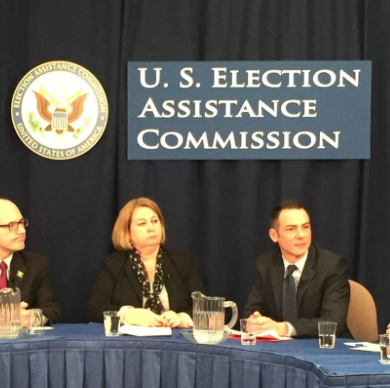
WICHITA, Kan. (AP) — More than 30 advocacy groups are asking a federal elections official to withdraw changes made to a national form requiring residents of Kansas, Alabama and Georgia to provide proof of U.S. citizenship in order to register to vote.
The groups sent a letter Thursday to the new executive director of the U.S. Election Assistance Commission says the impact would be particularly significant because 2016 is a presidential election year when people typically register in greater numbers.
EAC had no immediate comment on the groups’ demand, but executive director Brian Newby has insisted the action he took at the states’ request is within his authority.
One of the agency’s own commissioners has said Newby’s action contradicts policy and precedent.
Among those signing the letter were Common Cause, Public Citizen, and NAACP.
MANHATTAN, Kan. (AP) — A second case of mumps has been reported at Kansas State University.
The university said in a release Thursday that both students with confirmed cases of the mumps live off campus. The university says it’s working to contact people who may have had close contact with the infected students.
The university says it’s asking students to review their vaccination records to see if they have had two measles-mumps-rubella, or MMR, vaccinations.
Students are also being advised to contact a medical provider if they experience mumps symptoms, which include fever, headache and swollen salivary glands under the ears.
TOPEKA -Kansas Gov. Sam Brownback is describing the state Supreme Court as an activist court for threatening to shut down public schools if legislators don’t write a new school funding law.
Brownback was responding to the court’s ruling Thursday striking down a school funding law enacted last year. The court said the law was unfair to poor districts and shorted their state aid by at least $54 million.
The court declared that schools will shut down if a new law isn’t enacted by the end of June.
Here are other reactions to the Kansas Supreme Court’s ruling Thursday that a law enacted last year as a temporary education funding fix hurts poor districts:
“I think the decision is a good thing for schools across the state of Kansas. The Kansas constitution demands that schools be funded adequately and equitably. This decision affirms the constitutional demand for equity. … This is something fundamental for education in the state, so I think kids everywhere should be celebrating.” __ David Smith, a spokesman for the Kansas City, Kansas, district, which is a plaintiff in the legislation.
___
“They should find a way to equitability distribute the money they are spending. In our opinion, schools have plenty of money.” __ David Trabert, president of the Kansas Policy Institute, a conservative think tank influential with GOP legislators.
___
“It all comes back to the fact that districts have very differing abilities to raise revenue to fund schools because of differences in property valuation, and the court is simply saying, ‘You cannot allow those differences to exist in a way that could affect the quality of education in these different districts.’ In that sense, that has always been a key principal we have supported, and hopefully the Legislature will be able to quickly respond to this.” __ Mark Tallman, the lobbyist for the Kansas Association of School Boards.
___
“It looks like it’s politically motivated because of timing, in my opinion and the courts have now interjected themselves in the business of the people and the business of the Legislature. … I just think it’s poor timing. It looks fishy.” __ Kansas House Speaker Ray Merrick, a Stillwell Republican.
___
“It’s not a surprise. We are happy it is headed in that direction, although the fear still is, with the tone of the legislature and the governor, we just wait to see what the next ploy will be to defy what the Supreme Court says.” __ Dean Katt, superintendent of the Hays school district.
___
“It’s essentially a temper tantrum by the courts to push their political will on the Legislature. It’s kind of one of those things, ‘Give us the money or the kid gets it.'” __ State Sen. Jeff Melcher, a Leawood Republican.
___
“Once again, the Kansas Supreme Court has protected our communities, families and the individual rights of our children guaranteed in the Kansas Constitution.” __ Ryan Wright, executive director of Kansans For Fair Courts.
___
“As officials evaluate implications regarding the opinion, we will continue to advocate for a funding solution that is financially sustainable, promotes greater local funding flexibility, and ensures educational excellence for all students in Kansas.” __ Shawnee Mission school district’s written statement.
FINNEY COUNTY- Law enforcement authorities in Finney County are investigating an injury accident on Wednesday involving a semi, a passenger car and drugs.
The Garden City Police Department reported a Ford Focus driven by Luke Kobilan, 35, Colorado Springs, was southbound on the off ramp from U.S. 83 and failed to stop at the red light before turning left onto Mary Street.
The Ford was hit by a semi driven by Derrick Colter, 27, Kismet, that
was traveling north on U.S. 83 Fontage Road.
The semi struck the car on the passenger side pinning Matthew Kobilan, 29, Colorado Springs, in the vehicle.
He had to be extricated from the vehicle by Garden City Fire andRescue and EMS.
Officers responding to the accident noticed a strong odor of suspected marijuana emitting from the vehicle.
A search of the vehicle revealed several grams of suspected marijuana; Marijuana infused pain relief cream, drug paraphernalia, and a pint jar full of marijuana liquid.
The investigation revealed Luke Kobilan, Abraham Kobilan, 38, and Matthew Kobilan, 29 were passing through Garden City from Colorado Springs headed to Memphis Tennessee.
All three in the Ford Focus were transported to St. Catherine Hospital by EMS for injuries. Luke and Abraham were treated and released for minor injuries; Matthew was flown to St. Anthony’s Hospital in Denver Colorado for severe injuries.
Derrick Colter was not injured.
Matthew Kobilan was cited and released for Possession of Marijuana and Possession of Drug Paraphernalia.
Luke Kobilan was arrested and is being held in the Finney County Jail on the requested charges of Aggravated Battery, Reckless Driving, Driving Under the Influence of Drugs, Possession of a Hallucinogenic, and Possession of Drug Paraphernalia.
Abraham Kobilan was arrested and is being held in the Finney County Jail on the requested charges of Possession of a Hallucinogenic, and Possession of Drug Paraphernalia
SALINA, Kan. (AP) — A federal agency has fined a food preparation company more than $170,000 because of worker injuries that included two amputations at its Salina facility.
The Occupational Safety and Health Administration said Thursday in a release it has fined Schwan’s Global Supply Chain $172,000 for violations found after accidents last year at its Salina processing facility.
OSHA says a worker had her right hand amputated after her glove became caught in a conveyor assembly, and another worker lost a finger after coming into contact with a conveyor. A third person was burned in a separate incident.
Schwan’s said in an emailed statement that the company is committed to ensuring the safety of its employees and contractors and that it’s using the information from OSHA to improve processes.
ELLSWORTH COUNTY- Law enforcement authorities in Ellsworth County are investigation a case of hazing involving high school students from Great Bend.
The Great Bend activities bus was in Ellsworth County when the incident happened on Saturday, February 6, according to Ellsworth County Sheriff Tracy Ploutz.
The students were returning from Manhattan after participating in the Manhattan Invitational for swimming.
Ploutz says the situation went beyond hazing.
“I use the term hazing but it was pranks that got out of hand and turned into something worse,” said Ploutz.
An Ellsworth Deputy received a call from the Great Bend Police Department on Saturday. The GBPD notified the deputy the incident happened in Ellsworth County and sent the Sheriff’s Office a copy of their report.
Ploutz says his office received the report Tuesday morning and began talking with the students involved Wednesday afternoon.
“With what information we’ve gathered we are looking at three or four victims and four or five possible suspects, he said.
Ploutz also added he has a hard time labeling the incident as a fight considering how one-sided the incident was. Several victims may been assaulted on the Great Bend bus.
Ploutz says his department is still gathering information and will eventually forward the case to the Ellsworth County Attorney.
A consortium of city and rail interests has been given the go-ahead to begin preliminary engineering for a transload shipping center at Great Bend.
The Kansas Department of Transportation, which will contribute $3 million for the $6.8 million project, gave approval for preliminary engineering after reviewing the business plan and financial model proposed by the Great Bend group. The consultant HDR will do the preliminary engineering. The entities that joined together to craft the development plans include the city of Great Bend, the Great Bend Chamber of Commerce and Economic Development, Kansas and Oklahoma Railroad (K&O), and Kansas Transload Services.
“I’m extremely pleased how this group developed its proposal from concept to now beginning the preliminary engineering process and I’m anxious to get construction started later this year,” said Mike King, Kansas Transportation Secretary and Director of the Kansas Turnpike Authority.
“This facility will have great business benefits for farmers and manufacturers, allow for reduced transportation costs and provide economic development opportunities for Great Bend and the region.”
Transloading is the process of moving goods from one mode of transportation to another, or in this case, from truck to rail and rail to truck. By blending the benefits of shipping by rail and local/short haul trucking, a transload facility can provide more flexible, cost-effective solutions for customers who may not have local access to freight rail service or those who need expanded warehousing.
The transload facility will be built west of Great Bend at the airport.
“We are delighted to have the opportunity to move forward with this transload project as it will provide a boost to the economy in central Kansas. The contribution from KDOT is what made this project possible,” said Mayor Mike Allison.
“We are confident that K&O Railroad and Kansas Transload Services will develop a top flight transportation hub for Great Bend.” The state’s $3 million investment in the project will be used for rail improvements. Pat Cedeno, Senior Vice President of Marketing and Sales of Watco Companies, which owns K&O Railroad, said his company is excited about the opportunity to work with KDOT, Great Bend and Kansas Transload Services to serve the central region of Kansas through a multimodal transload facility.
“Secretary King’s vision created this tremendous opportunity for the Kansas and Oklahoma Railroad to provide car supply and rail service to the facility. We look forward to building new relationships with the community and the customers we will be serving at the facility,” Cedeno said.
Great Bend is one of two communities that emerged from a group of seven selected to make a formal presentation in August 2015 before the Transload Facility Site Analysis Selection Committee, which includes private sector representatives. The other city selected for development of a transload facility is Garden City, which has yet to receive final approval for preliminary engineering.
The Kansas Department of Health and Environment (KDHE) has rescinded a boil water advisory for the public water supply for the City of Lorraine located in Ellsworth County. The advisory was issued because of a loss of pressure due to a water main break. Inadequate pressure may result in a loss of chlorine residuals and bacterial contamination.
Public water suppliers in Kansas take all measures necessary to notify customers quickly after a system failure or shutdown. Regardless of whether it’s the supplier or KDHE that announces a boil water advisory, KDHE will issue the rescind order following testing at a certified laboratory.
Laboratory testing samples collected from the City of Lorraine public water supply indicate no evidence of contamination and all other conditions that placed the system at risk of contamination are deemed by KDHE officials to be resolved.
Has the “real live experiment” in Kansas tax policy been a success? Did it live up to its billing? If we simply judge whether it met publicly stated objectives, then no, the plan failed miserably. But in another important respect, the plan achieved exactly what many lawmakers hoped for, the squeezing down of state government.
Recall claims from four years ago when Kansas decision-makers dramatically lowered income tax rates and exempted more than 300,000 individuals from paying any tax on “business income.” Citizens were told to expect a “shot of adrenaline right to the heart of the Kansas economy,” a shot so potent, that despite tax cuts, the state budget would still balance.
Duane Goossen
After implementation of the tax cuts, all of that adrenaline talk soon turned sour. Sure, Kansas has grown economically coming out of the Great Recession, but slowly. More slowly than our region, and more slowly than the nation. In new job creation—a key measure for this experiment—Kansas ranks among the lowest 10 of all 50 states. Economic indicators show no correlation that the tax cuts helped Kansas boost its economy.
And state finances? What a mess. The revenue loss from the income tax cuts put the state budget drastically in the red. In response, lawmakers raised sales tax rates twice, which transferred more of the state’s tax burden to low-income Kansans but did not come close to correcting the budget imbalance. Lawmakers also blew through the state’s reserves and transferred hundreds of millions away from highways and children to barely eke out a budget.
But therein lies the secret to the “success” many lawmakers really sought. If you want to cut programs and force state government to be smaller, starving the revenue stream provides the easiest route.
No politician wants to look a constituent in the eye and say “I’m going to cut schools,” or “I’m going to reduce maintenance on the highway you travel.” But with a tamped down revenue stream, politicians can say, instead: “We have to live within our means.”
Indeed we do. In Kansas, if the general fund bank account has no money, then no spending can take place. At the federal level, the “starve the revenue” approach does not work as effectively because the federal government has the ability to run up deficits and borrow money to fill the gap. Kansas cannot do that, at least not directly.
So in the name of “living within our means,” lawmakers cut operational aid for schools, then froze funding in place through block grants. State employees have lost benefits, and received no raises in 8 years, leading to critical staff shortages at state hospitals and prisons. Maintenance on roads and bridges has been chopped, services for low-income Kansans cut off, Medicaid expansion turned away, and the Bioscience Authority demolished.
And it will get worse. Kansas cannot even afford the current scrunched-up level of spending. This year’s budget only balances by using large one-time transfers from other funds. All budgetary efforts now focus on downsizing and cutting back, with little thought given to how our state should invest for a better future.
Evidence shows up everywhere that the tax plan fundamentally failed to provide sound finances or deliver economic prosperity, but the governor and supporters of the tax plan brush it off. Maybe they disregard the evidence because they don’t care. After all, it appears that the real goal of Kansas tax policy went undisclosed at the front end. The architects of this plan may well be pleased with reductions of services to the state’s citizens.
If you truly bought into the argument that giant tax cuts would lead to prosperity without hurting schools and highways, you’ve been had.
Meanwhile, those wanting Kansas to spend less, regardless of the consequences, have met success.
Duane Goossen is a Senior Fellow at the Kansas Center for Economic Growth and formerly served 12 years as Kansas Budget Director.
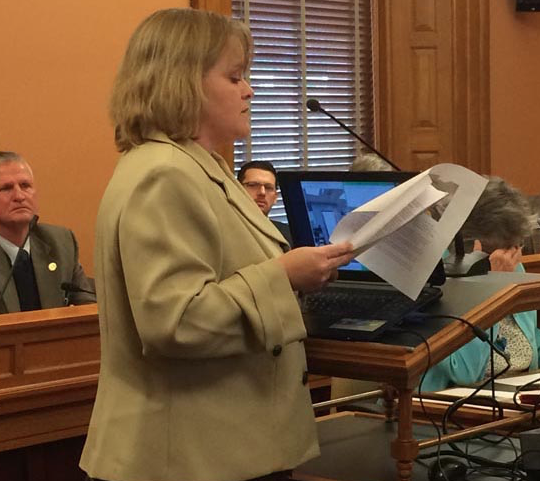
Photo by Allison Kite/KHI News Service Parent Toni Donahue spoke Tuesday to a House committee in support of a bill that would further limit use of seclusion and restraint in schools.
Kansas lawmakers are considering expanding prohibitions on schools using seclusion and restraint as punishment.
Advocates for students with developmental disabilities have called for such prohibitions for years, and last session the Legislature passed House Bill 2170 to limit seclusion and restraint.
But Tori Donahue told the House Children and Seniors Committee during a hearing this week that her son’s school district confined him in a small room by using an exemption in the law that allows emergency seclusion and restraint for students who present an immediate danger of physical harm.
“Society justifies it by instilling fear, using trigger words such as ‘safety’ and ‘danger’ to describe these individuals — which became commonly used after the passing of HB 2170,” she said.
Donahue supports a new proposal, House Bill 2534, which would require the schools to contact parents the same day an emergency seclusion or restraint is used and allow them to request a meeting with school officials to discuss it within 10 days.
HB 2534, which comes from a task force’s recommendations, also would prohibit chemical and mechanical restraint. Chemical restraint is the use of medication to restrain a child’s behavior, and mechanical restraint is the use of a device or object, including handcuffs, to restrict a child’s behavior.
Except in a case where the child could cause harm to others, educators would not be able to use emergency safety interventions on children with medical conditions that could put them in danger of mental or physical harm. Several parents of children with special needs testified in support of HB 2534, including Aldona Carney.
She said her son Neil, who has severe autism, was placed in seclusion without her knowledge when he was younger. One day, she said, she paid an unannounced visit to his school and was told he had been placed in seclusion for aggression toward staff. When she was taken to the room, which she said was no larger than a closet, she could hear Neil screaming.
She asked staff to open the door, and Neil was naked and had urinated on the floor.
“Sadly, I have no idea how many times Neil was put into the seclusion room prior to this incident because we were never notified by the school,” she said.
Donahue’s son Drake moved from the Blue Valley school district to Olathe last year. S
he said he had a behavior plan in Blue Valley and had never been subject to seclusion, but in Olathe he was. A room she estimated to be 4-feet by 5-feet adjacent to his classroom served as the “safe room.” “The district calls it a safe room, but I’m going to call it what it is. It’s a prison cell,” she said.
Some members of the Emergency Safety Intervention Task Force testified against the bill or stood neutral because it didn’t include all of the task force’s recommendations.
The task force was established when the original law passed last year and provided input for the drafting of HB 2534. The committee plans another hearing on HB 2534 at 9:30 a.m. Thursday.
Allison Kite is a reporter for Heartland Health Monitor, a news collaboration focusing on health issues and their impact in Missouri and Kansas.

 HUTCHINSON— A Reno County jury found a Kansas man accused of injuring and abuse of a child not guilty on Wednesday.