PAWNEE, Okla. (AP) — Three earthquakes have struck in the area of northern Oklahoma that was rattled last year by the largest earthquake in state history.
The U.S. Geological Survey says back-to-back earthquakes hit Monday morning near Pawnee, about 75 miles northeast of Oklahoma City. The USGS says the quakes had magnitudes of 3.2 and 3.3 and there are no reports of injuries or damage.
A third earthquake, with a preliminary magnitude of 3.7, hit the same area Monday afternoon.
In September, a 5.8 magnitude earthquake struck Pawnee and caused widespread property damage. Scientists have linked Oklahoma’s recent spate of earthquakes to oil and gas production, and state regulators have issued new regulations on the practice of injecting wastewater into underground disposal wells.
TOPEKA, Kan. (AP) — Big questions about taxes and spending will shape the Kansas Legislature’s work after its annual session opens Jan. 9.
But the biggest question might be how much GOP moderates work with conservatives and how often they seek deals with Democrats.
Lawmakers and Gov. Sam Brownback must close a projected shortfall of more than $345 million in the current budget and estimated gaps in funding for existing programs that total almost $1.1 billion through June 2019.
It’s not clear whether the Republican-controlled Legislature will increase taxes or pressure Brownback to rethink income tax cuts he championed in 2012 and 2013.
And with a Kansas Supreme Court ruling on education funding expected soon, lawmakers will face pressure to provide more money for public schools.
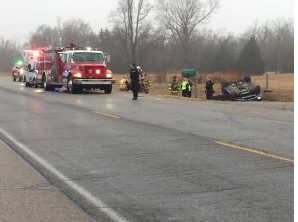
THOMAS COUNTY – Three people were injured in separate accident just after 9a.m. on Monday in Thomas County.
The Kansas Highway Patrol reported a 2008 Chevy truck driven by James Joel Leal, 43, Palmer, TX., was eastbound on Interstate 70 six miles west of the U.S. 83 Junction.
The driver lost control of the truck. It entered the west ditch and over turned.
Leal and a passenger Leal, Isaac Ray Leal, 21, Palmer, TX., were transported to the hospital in Colby.
They were both properly restrained at the time of the accident, according to the KHP.
About the same time, a 2006 Toyota BB W24 driven by Sherry Morgan, 23, Port St. Lucie, FL, was eastbound on Interstate 70 just west of U.S. 83 in the passing lane.
The driver lost control on the ice. The vehicle drifted back wards and over turned many times.
Morgan was transported to the hospital in Colby.
She was properly restrained at the time of the accident, according to the KHP.
DENVER (AP) — Broncos coach Gary Kubiak informed his players after their victory over Oakland on Sunday that he’s stepping away from the game and the team he loves. He said the grind of coaching was taking too big of a toll on his health.
The Broncos beat the Raiders 24-6 Sunday, a bittersweet capstone to a disappointing season that began with expectations of repeating as Super Bowl champs and ended without a trip to the playoffs.
Kubiak, 55, leaves with two years left on his contract and a 24-11 record in Denver, including a 24-10 win over Carolina in Super Bowl 50. Including his eight seasons with Houston, his career record is 87-77.
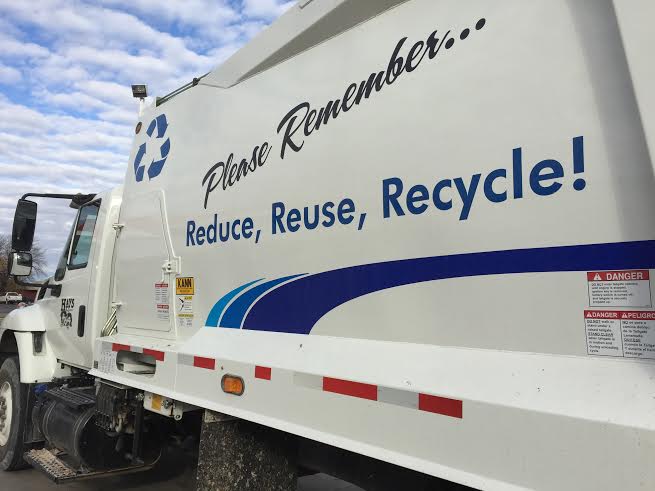
Due to the observance of the New Year’s holiday, Monday, January 2, 2017, refuse/recycling route schedules will be altered as follows:
Monday and Tuesday’s collection will be on Tuesday, January 3, 2017.
There is no anticipated change to Wednesday, Thursday, or Friday’s collection schedules.
Although collections may not occur on your normal day, collections will be completed during the week.
City of Hays customers that may have any questions regarding this notice should contact the Solid Waste Division of the Public Works Department at (785) 628-7357.
Please remember to always have refuse and recycling bags out by 7:00 a.m.
It is anticipated that heavy volumes of refuse/recyclable will be encountered around the holidays. Please make sure your bags are out by 7:00 a.m. and keep in mind that the trucks have no set time schedule.
RUSSELL–The next exhibition at the Deines Cultural Center opens January 13, 2017.
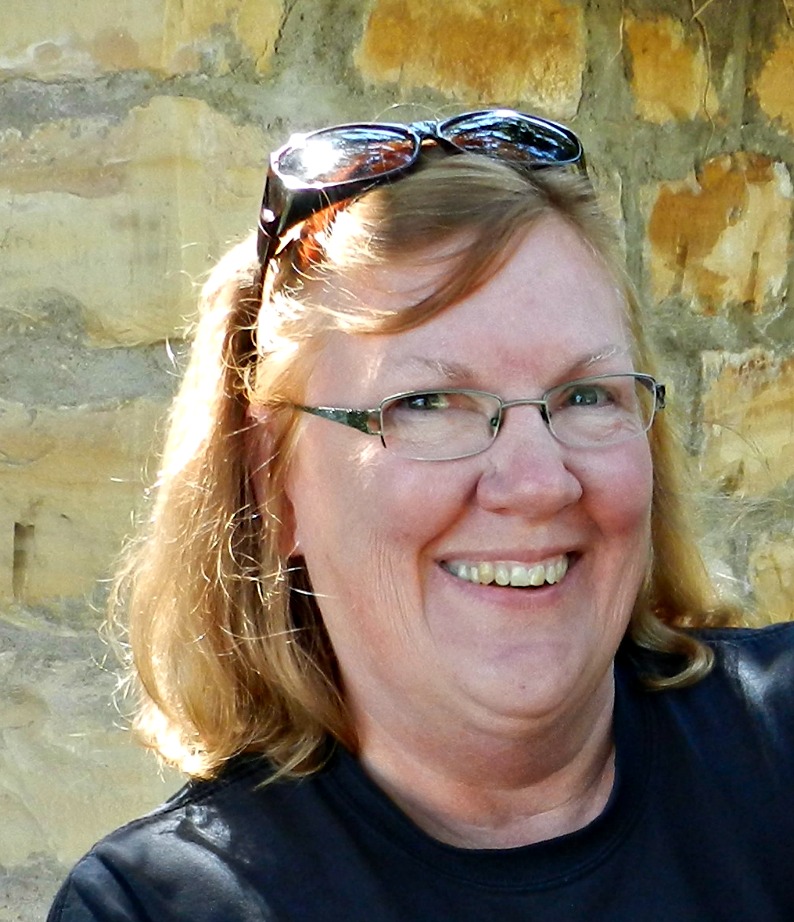
Barbara Stevens of Downs, Kansas, will show a collection of mixed media and ceramics pieces relating to her spiritual journey as an artist and a Christian.
Stevens was born and raised in central Kansas. She earned a Bachelor’s of Art from Fort Hays State University in 1971. She went on to teach art to students from 4 years of age to 84 years. She received her MLS from FHSU in 2005 in Graphic Design. Stevens ended her teaching career by being head of the art department at Cloud County Community College in Concordia, for thirteen years. She retired from that position in May, 2013, and now enjoy the luxury of time to spend on her art, with family and friends, swimming, kayaking and traveling.
Stevens says about her art :
“In March, 2012, I started experimenting with a new style of mixed media using watercolor, acrylics, colored pencil, ink, pastels, handmade stamps, & stamp ink pads and mostly an attitude of PLAY. I had never felt this level of excitement and joy in creating my 2D work before. I tried to capture that inner child who used to play at creating with no fear of “right or wrong”. I simply played with the possibilities and let the pure joy fill my heart and spirit, and hopefully yours too!
My husband and I are very interested in Native American history, and in visiting many museums I have become fascinated with the beauty of the simple forms and the incredible craftsmanship of these ancient pots. This, along with being raised on a Kansas farm in the fifties, when life was simple and centered around the church and God’s good earth, my forms have always taken on an earthy quality with the forms progressing over the years to the simple primitive forms I am making today.”
The opening reception for Barbara Stevens’ solo exhibition will be held on Friday, January 13, from 5-7 p.m. Her work will remain on display through February 18th. Admission is free and everyone is welcome. The Deines Cultural Center is located at 820 N. Main Street in Russell.
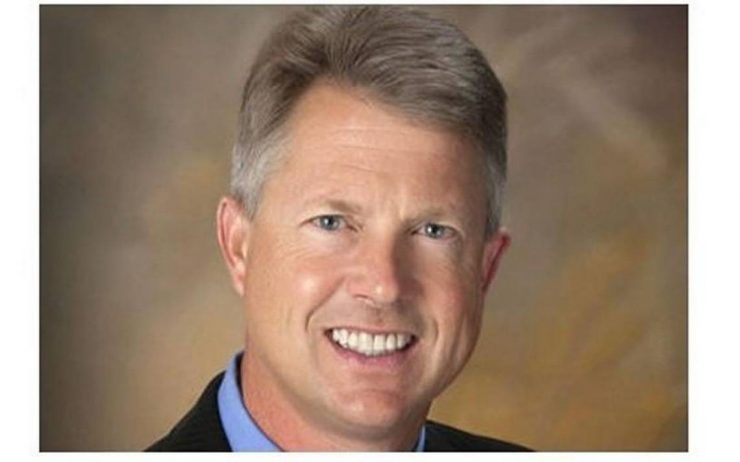
WASHINGTON, D.C. – Congressman Roger Marshall (R-Great Bend) will host a series of town halls continuing his Listening Tour through the Big First District.
Wednesday, January 3, 2018, Rep. Marshall will begin his January tour with a town hall in Grant County with additional stops in Ness City, WaKeeney, and Hill City in northwest Kansas.
Friday, Jan. 12, Marshall will be in Osborne and Stockton.
The Listening Tour will make 14 stops and conclude in Wabaunsee County on Monday, January 15. Congressman Marshall is looking forward to answering questions and discussing legislative goals for 2018 with members of the community. All citizens of the district are encouraged to attend as well as members of the press.
With these added listening sessions, Rep. Marshall will have held a town hall in all 63 counties in Kansas’ 1st Congressional District within his first term in office. After concluding this tour, he will be second in the House of Representatives for hosting the most town halls in this term, despite being in one of the biggest, based on mileage, districts in the country.
Ron Wilson is director of the Huck Boyd National Institute for Rural Development at Kansas State University.By RON WILSON Huck Boyd National Institute for Rural Development
What is that light that we see? It’s the light of a new day, a new horizon. Today we’ll learn about a remarkable equestrian facility which is bringing new light into the lives of children and adults with disabilities.
Joy Miller is co-founder of New Horizon Ranch, located near Rantoul in Franklin County. New Horizon Ranch is a therapeutic horseback riding center. It offers various kinds of equine-assisted activities and learning, psychotherapy, and summer day camp programs to individuals of all ages with physical, cognitive, social, emotional and learning disabilities.
Joy grew up in rural California. As a high schooler, she was selected for the National FFA Band which meant she came to perform at the National FFA Convention which was held in Kansas City at the time. While in Kansas City, she learned about Mid-America Nazarene University in Olathe and ultimately came there as a student.
Her faith and Christian service are important to Joy. “I thought I would be going into international missions someday, so I majored in international agribusiness so I could help developing countries,” Joy said.
While at Mid-America Nazarene, she met and married Brian Miller who had grown up in Olathe. They bought a rural property in Franklin County.
“It was revealed to us that our mission wasn’t overseas, it was right here,” Joy said. Brian worked at College Church of the Nazarene in Olathe. They moved to the farm and it seemed natural to get horses. In 2000, they attended Equifest, the equine exhibition held in Wichita at the time. There they saw a demonstration of therapeutic vaulting with handicapped children, and it intrigued them.
“We felt called to work with horses and had a heart to help people,” Joy said. “We have a passion to help the underserved.” They learned about the benefits of therapeutic riding for children with disabilities.
The year 2004 was a tumultuous time. “We had our first child that year, but shortly after that, my 16-year-old brother was killed in a car accident,” Joy said. The tragedy hit hard and their equine dreams were put on hold.
“Eighteen months later, our pastor gave a sermon with the message that, if God gives you a dream, then He’s big enough to make it happen,” Joy said. “Brian and I looked at each other and said, `It’s time,’” she said. They went to work to realize their equestrian dream of service.
Brian and Joy became Certified Riding Instructors through the Professional Association of Therapeutic Horsemanship International and Certified Equine Specialists through the Equine Assisted Growth and Learning Association. In 2006, they founded their own therapeutic riding non-profit organization on their ranch.
What to call this new enterprise? “We believe that each day with a horse is a new opportunity for the child,” Joy said. “It’s a clean slate like the start of a new day, like new light on the horizon,” she said. “And we’d been through a dark time ourselves (since my brother’s death) so it was a new horizon for us too.” Joy and Brian named their operation New Horizon Ranch.
In 2007, New Horizon Ranch started offering therapeutic riding classes for children and adults with disabilities. “Let’s use these magnificent, majestic animals and see how many lives can be helped,” Joy said.
The first class began with seven children. In 2015, nearly 200 people were directly served by New Horizon Ranch. Today the ranch offers a broad spectrum of therapeutic riding and educational activities in their rural setting near the town of Rantoul, population 242 people. Now, that’s rural.
What is that light that we see? Is it the light of a distant horizon? Or maybe, it’s the light in the eyes of a child with special needs who has successfully ridden a horse. We salute Joy and Brian Miller and all those involved with New Horizon Ranch for making a difference in the lives of children through horseback riding.
And there’s more. Belt buckles are now being used to further enrich the lives of these children. We’ll learn about that next week.
Native Kansan Karen Madorin is a local writer and retired teacher who loves sharing stories about places, people, critters, plants, food, and history of the High Plains.
This time of year is a good time to remember traditions that remind us of generations who came before us. One of the best culture keepers in this region was an Ellis County historian named Lawrence Weigel. He visited my classes each year in the early 90s to share tales about Volga German customs involving Christ Kind, Belznickel, and New Year wϋnsching (winching) traditions with high school freshmen. Nodding heads confirmed that some youngsters’ families still practiced these Old World activities.
At the same time, puzzled faces and blank looks revealed that others were clueless about such customs. My own Volga German family didn’t pass on these stories so I was thrilled to learn them. Every January 1, I think of Mr. Weigel’s anecdotes about families calling on one another on the New Year to share wishes for health, long life, good luck, peace and health, and eternal happiness after death.
As only a beloved grandfather figure can, our lecturer described a festive day of visiting, feasting, and a bit of tippling. Part of this practice involved parents teaching youngsters to recite a wish that ran something like this passage I found online, “ Ich wϋnsche euch ein glϋckseliges Neues Jahr. Langes Leben. Gesϋndheit. Fried und Einigkeit. Und nach dem Tod, ewig Glϋckseligkeit.” As families traveled door-to-door or farm-to-farm, children lucky to be the first visitor or a beloved relative earned a coin for their efforts along with a handful of nuts or sweets. I’ve listened to more than one elder tell stories of reciting this rhyme to collect spending money. Recalling such memories always brought a sparkle to their eyes and a lilt to their voices.
According to Mr. Weigel, this occasion was also a day for young men old enough to marry to court available local maidens. If I recollect correctly, he explained the Romeos announced their arrival with a shotgun blast to the sky. I’m not sure how romantic that was, but young women possessing several color-coded ribbons eagerly awaited noisy suitors. I can imagine girls biting lips and pinching cheeks to increase their rosy tint on an already cold morning. I’m guessing a certain amount of shy smiling and foot shuffling took place as well since adults and younger siblings stood nearby to supervise the show. Girls would pin their good will tokens on callers’ lapels, saving a particular color for a special fellow. I’d love to hear one of these stories firsthand.
Storekeepers certainly would’ve encouraged this custom since so many families produced much of their only holiday food rather than buying it. Despite their customers’ self-sufficient natures, demand for ammo and fripperies at the local mercantile would’ve increased merchant bank deposits during days leading up to this holiday.
This time of year on social media, I see folks sending one another this New Year greeting. I hope area families continue to share customs that crossed the sea and traveled overland with their ancestors. These are little traditions, yet they remind us of brave forebearers who left the familiar to offer descendants a better life. Many of us can honestly say this centuries old good luck wish has worked out well.
Native Kansan Karen Madorin is a local writer and retired teacher who loves sharing stories about places, people, critters, plants, food, and history of the High Plains.
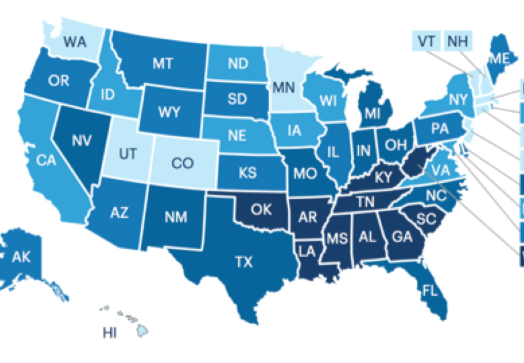
Image -AMERICA’S HEALTH RANKINGS/UNITED HEALTH FOUNDATION
Kansas was the only state where the obesity rate went up significantly in 2015, according to an annual report, and state officials are trying to figure out why and how to reverse the trend.
The state also lagged on vaccination rates and remained stuck in the middle on overall health, according to the America’s Health Rankings Report, which was released Thursday.
Kansas ranked 27th in the report, which rates the 50 states on a broad range of measures, including health behaviors, access to care, state policies and residents’ health outcomes. The state has hovered at 26th or 27th since 2013.
About 34 percent of Kansans, or one in three, were obese, according to the report. That echoes another annual report issued earlier this year by the Trust for America’s Health and Robert Wood Johnson Foundation, which also noted that Kansas also was one of only two states whose obesity rate increased significantly between 2014 and 2015.
Missouri didn’t fare much better, with 32 percent of residents classified as obese. Its obesity rate also appeared to go up, though the change was not statistically significant.
Jennifer Church, section director for community health promotion at the Kansas Department of Health and Environment, says state epidemiologists are analyzing why the obesity rate increased in Kansas when most states were holding steady and a few had decreases.
“We can’t say with any certainty why Kansas is continuing to go up,” she says. “A lot of their strategies (in states where the rate decreased) look the same as what we’re doing.”
Not all people who are obese develop other health problems, but extra weight does increase the risk of type 2 diabetes, heart disease, stroke, arthritis and cancers in the uterus, breast, colon, kidney, gallbladder and liver, according to the Centers for Disease Control and Prevention.
The report estimated the United States spends about $190.2 billion annually on health issues related to obesity, and about 200,000 people die from related causes each year.
KDHE has provided programs to encourage better nutrition for about 20 years and offers grants for communities that want to include pedestrians and bicyclists in their master transportation plans, Church says.
This coming year, however, KDHE plans to put more emphasis on underserved communities, such as lower-income neighborhoods that can be overlooked when city officials discuss adding bike trails, she says.
“It’s really clear who is disproportionately affected by obesity and tobacco,” she says.
Work remains on vaccines
Kansas also ranked in the bottom 10 states on the percentage of adolescents vaccinated against meningococcal disease and human papillomavirus, or HPV.
Missouri also was in the bottom 10 when it came to vaccinating all teens against meningococcal disease and female teens against HPV. It ranked 32nd for male teens, mostly due to extremely low rates in other states — only about one-quarter of Missouri boys age 13 to 17 had received an HPV shot.
Jennifer VandeVelde, director of KDHE’s Bureau of Disease Control and Prevention, cautioned that the report doesn’t reflect progress in 2015, however. For example, the HPV vaccination rate in Kansas for teen girls increased from about 38 percent in 2014 to about 51 percent last year, which wasn’t captured in the rankings, she says.
KDHE and the Immunize Kansas Coalition are focusing on raising awareness that teens need the HPV and meningococcal vaccinations, as well as a booster to protect them against tetanus, pertussis and diphtheria, VandeVelde says. That includes talking with health providers about using the opportunity when they treat teens to offer vaccines, she says.
“While these rates are still not as high as we would like them to be, there is marked improvement noted in just one year, and we are confident that we will continue to see marked increases under our current strategies,” she said in an email.
Meg Wingerter is a reporter for KHI News Service in Topeka, a partner in the Heartland Health Monitor team. You can reach her on Twitter @meganhartMC
Ellis County Commissioners will discuss employee input into wage and benefit decisions during their meeting today.
The commission voted Dec. 18 to rescind the county’s coverage under the Public Employer-Employee Relations Act (PEERA) as of the end of
2018. Commissioner Barbara Wasinger suggested formation of a permanent wage and benefit committee.
Other agenda items include discussion of proposed rate increases at the Ellis County Solid Waste/Transfer Station to cover increased costs. According to Public Works Dir. Bill Ring, it’s been 10 years since the last rate increase.
Commissioners will also hear a proposal to televise their meetings.
The complete Jan. 2 agenda may be seen here. The meeting starts at 5 p.m. in the Ellis County Administrative Center, 718 Main.
Many of us grew up with traditions we follow at holiday time. Time and location of family meals, when and how to open gifts, special activities such as caroling or church services, are some of the makings of holiday traditions.
In America, there are many different holiday traditions, as our “melting pot” culture has brought many nationalities and traditions together.
Feasting is a typical holiday tradition of every nation, and my family’s holiday food traditions are reflective of our melting pot of cultures, too. The Christmas eve buffet in my family includes Swedish potato sausage and ost kaka, a Swedish cheesecake dessert, borrowed from our Swedish neighbors in the Smoky Hill River valley between Salina and Lindsborg. My grandmother’s English heritage is reflected in the oyster stuffing, and my German aunt contributed dark brown bread and her delicious German potato salad made with dill pickles, green olives and tuna.
Why do we eat certain special foods at holiday time?
Roger Adams, a Kansas State University rare books librarian, has studied the history of traditional holiday foods, including the figgy pudding requested in “We Wish You a Merry Christmas,” the drink referred to in “Here We Come A-Wassailing,” the sugarplums that danced in children’s heads in “‘Twas the Night Before Christmas,” and the once-beloved but now much-maligned fruitcake- the “Rodney Dangerfield of the food world” that gets no respect.
Adams said the reason for the fruitcake’s devaluation in public opinion is because of the quality and type of ingredients that are used. Today’s recipe is nearly unrecognizable from the fruitcake of the past, said Adams, who can point to recipes found in cookbooks dating back to 1487 that are part of K-State Libraries’ Morse Department of Special Collections.
Fruitcake traces its origins to ancient Rome, where it included pine nuts, pomegranate seeds, and raisins in a barley mash. By the Middle Ages in Europe, additional dried fruits were added, as well as honey and spices.
The original fruitcake was thoroughly saturated with alcohol such as brandy or rum, which acts as a preservative to keep the ingredients from spoiling or getting rancid over time. Adams said this focus on preservation is consistent with most traditional Christmas foods, which came from the need in older times to preserve foods through the winter.
This trend is also seen in jam cookies and sugarplums – the latter of which were considered an ideal treat for children because they did not contain alcohol, unlike many other traditional Christmas foods. This is likely why they were connected to children in the 1823 poem, “‘Twas the Night Before Christmas.”
Mincemeat pie also was a preservation-focused holiday treat. Adams clarifies that the original pies did contain meat, as well as suet and dried fruits – especially raisins, which he said are a “must” in every mince pie.
The traditional puddings of England, including the figgy pudding we continue to sing about, were much different from the puddings that are popular in the U.S. today. The traditional puddings were more cakelike and often included raisins or other dried fruits – hence the figs in figgy pudding. These puddings were soaked in plenty of alcohol, usually rum. Families would gather during Advent and light the pudding cakes on fire to create a celebratory flaming dessert, like flambé.
Wassail, a warm Christmas punch, is a once-popular Christmas drink. Because of its warm serving temperature and its inclusion of alcohol, which warms the body, it was not uncommon in the U.S. as late as the 19th century to find people traveling around, visiting relatives and drinking wassail to stay warm.
Christmas is a good time to talk with older family members about the traditional holiday foods they ate when they were children. Dust off an old family or community cookbook and explore what past generations ate at Christmas. That will make holiday culinary traditions even more meaningful as family members continue to share them today.
Linda K. Beech is Ellis County Extension Agent for Family and Consumer Sciences.




 CITY OF HAYS