Police used this photo of a 2016 Toyota Scion and is for identification purposes only-
SALINE COUNTY – Police are crediting social media for helping them locate a suspect who struck two bicycle riders with his car.
Just before 11:30a.m. Thursday, three bicyclists were stopped along the north curb line in the 2000 block of Iron Avenue in Salina, according to police.
A vehicle which was west bound on Iron swerved right and struck two of the three riders and drove away.
Tyler Kirk, 18, suffered a broken left ankle and a cut on the back of his head. Joey Soulivong, 19, received minor cuts and scrapes.
This vehicle was reported to be a white two-door 2013-2016 Toyota Scion with damage to right (passenger) front end and right side.
Salina Police put out a vehicle description, given by the victims, on their Facebook page. They received a tip the same day, leading them to the arrest of 18-year-old Ryan Louthan of Salina.
Police cited Louthan for reckless driving, failure to maintain lane, accident involving an injury, duty to render aid, failure to remove debris and driving with a defective windshield.
————–
SALINE COUNTY – Law enforcement authorities in Saline County are investigating a hit and run accident and looking for a suspect and vehicle.
Just before 11:30a.m. Thursday, three bicyclist were stopped along the north curb line in the 2000 block of Iron Avenue in Salina, according to a social media report.
A vehicle which was west bound on Iron swerved right and struck two of the three riders.
One bicyclist had a broken left ankle and lacerations to the back of his head. The second rider received minor cuts and scrapes.
This vehicle is reported to be a white two-door 2013-2016 Toyota Scion. There will be damage to right (passenger) front end and right side.
If you have any information concerning who committed this crime, call Crimestoppers at 825-TIPS, text SATIPS to CRIMES (274637), or visit www.pd.salina.org and follow Crimestoppers link to submit a web tip.
SENATE HIGHLIGHTS
This week, the budget process moved along a bit further with the near-agreement on two important budget packages – one at the House-Senate Conference level (probable finalization Monday) for the remainder of the current Fiscal Year 2017 and the other at the Senate Committee (Ways and Means) level for the longer, two-year period FY 2018 and 2019. The first part is key because it means we should have a positive-ending-balance measure to send to the Governor for signature in a matter of days; the second has significance because it provides a basis for Floor consideration and amendment of a spending blueprint prior to the undertaking of a tax and revenue proposal to pay for it.
SENATE FLOOR ACTION KANCARE REFORM (Sub. For SB 69): In 2011, Governor Brownback’s administration began the process of privatizing Kansas’ Medicaid program, and ultimately created what is now known as KanCare. Medical providers and patients have requested that the legislature consider some updates and reforms to the program. Sub SB 69, allows for KanCare updates and improvements. These include standardizing provider credentialing and payment processing which will reduce the number of procedures needing prior authorization – among other modifications.
STATE HIGHWAY RIGHT-OF-WAY USE (HB2066): HB 2066 would require the Secretary of Transportation to reimburse a public wholesale water supply district for the cost to relocate water pipelines in a state highway right-of-way, excluding those water lines that cross a highway and have 90 percent or more of its water lines on private right-of-way.
REINSTATEMENT OF FORFEITED BENEFITS UNITS (HB 2080): HB 2080 would require boards of rural water districts to reinstate any benefit unit that has been forfeited due to delinquent payments upon payment of all unpaid fees and charges due to the district, in addition to any fees and charges that would have accrued since the date of forfeiture and any benefit unit reinstatement fee in an amount limited to no more than 20 percent of the water district’s current fee to establish a new benefit unit. The bill also would clarify language regarding who could serve as a director on the board of a rural water district. Any individual, firm, partnership, association, or corporation that is a participating member of the rural water district would be eligible to hold office as a director.
JURISDICITON OF SECURITIES COMISSIONER UNDER INSURANCE COMISSIONER AND CONSOLIDATION OF CERTAIN PROSECUTIONS FOR FRAUD (SB 23): SB 23 would establish the Office of the Securities Commissioner of Kansas as a division under the jurisdiction of the Insurance Commissioner and amend law by consolidating certain prosecutorial functions of the Attorney General.
SENATE COMMITTEE WORK HB 2044: Medicaid Expansion Committee Hearing and Vote
On Monday and Tuesday of this week, the Senate Committee on Public Health and Welfare held hearings on HB 2044 – Establishing the KanCare Bridge to a Healthy Kansas program and providing Medicaid reimbursement for clubhouse rehabilitation services. This bill, a Medicaid expansion bill, passed the House with a vote of 81-44 earlier this month. Monday, the Health committee heard testimony from proponents of the bill. Verbal testimony included representatives from the Kansas Hospital Association, The Alliance for A Healthy Kansas, the Wichita Chamber of Commerce, the Kansas Medical Society, and the Kansas Academy of Family Physicians, among others. Written testimony was submitted by numerous hospitals from around the state, health and community foundations, business interests, and many other Kansas residents with a vested interest in expanded Medicaid services. Proponents of the bill argued that the benefits outweigh the cost of expansion, and cited the roughly 150,000 Kansans who would be eligible for this program, should the bill pass the legislature and be signed into law by Governor Brownback. Tuesday, the Committee heard from opponents of the bill, including the Kansas Department of Health and Environment, the Kansas Policy Institute, Americans for Prosperity and the Foundation for Government Accountability. Written testimony was submitted by the CATO Institute. Opponents of the bill argued that the program is too costly, and the state cannot afford to implement the program at this time, given our current $350 million budget deficit. Another major concern regarding Medicaid expansion is tied to current momentum on the Federal level to change healthcare policy.
We are closely monitoring Congress’s actions and Senate leadership is regularly in touch with our Kansas Congressional representatives to ensure that we have all of the information necessary before voting on this bill.
Update on Senate Select Committee on Education Finance
This week, the Senate Select Committee on Education Finance began meeting to determine the best path forward regarding the creation and implementation of a new school finance formula.
As you may know, the Kansas Supreme Court ruled last month on the Gannon v. Kansas case, regarding the constitutional equity and adequacy of K-12 public education funding. The Court ruled that K-12 education funding is unconstitutional, and noted that 25 percent of all Kansas students are not meeting Rose Standards, a series of targets students must meet to be considered at “grade level.” While the Court did not specify how much, if any, additional money must be funneled into public schools to meet its standards of constitutional funding, the Court did mandate that the legislature create a new, equitable and adequate school finance formula by June 30, when the current block-grant funding formula expires. It’s important to note that at the beginning of the year, the Kansas Senate set a self-imposed deadline to pass a structurally balanced budget that would, in turn, help create and fund an equitable school finance formula – all by the end of this legislative session. We feel confident that we’ll finalize a new school finance formula prior to the end of session, led by this diverse Committee of passionate and intelligent school advocates.
Tax Committee
SB 189 passed out of committee by a vote of 11-2 calls for new tax revenue of $874 million over the next two years and will likely be considered by the full Senate this coming week. The bill would among other things make full scheduled payments to the state pension system, provide a two percent across-the-board pay raise to state employees and restore some of the cuts made last year to state universities. It also rejects a plan to sell off the state’s interest in future tobacco settlement money and keep it in the Children’s Initiatives Fund, a politically popular practice that avoids shifting the cost of such health and education programs to the general fund.
Senate Rural Ag Caucus – Kansas wind energy update
The development of wind energy in Kansas continues to bring new jobs and economic growth to Kansas with approximately $10 billion of new private investment and 13,000 new direct and in-direct jobs across our state. While some of the economic development benefits of wind energy are experienced in urban parts of Kansas, the vast majority of benefits occur across rural Kansas whether in the form of robust landowner payments for turbine leases, new and good paying operation and maintenance jobs which provide benefits and allow local residents to stay in their home communities (or near their home communities) for employment opportunities or new manufacturing or supply chain management positions. Recently, Kansas hit a milestone becoming only the second state in the nation to produce more than 30% of its power generation from renewable energy. Iowa continues to lead the nation, but Kansas certainly is a national leader in wind energy production. Further, lawmakers received information about nationally-recognized Cloud County Community College Wind Turbine Technician certification program which boasts a 100% graduate placement rate – many of those graduates hail from rural Kansas and are returning home to stable, good paying jobs with advancement opportunities. Many industry wind development leaders have a long-standing relationship with Cloud County and they value the hard-working, well-trained graduates coming out of the training program.
Recently, Kansas Governor Sam Brownback announced his goal that Kansas be powered 50% by renewable energy by January 2019 – a goal which is a mere 1800 MW and about $3.5 billion of new private investment away. Such a goal 10 years ago seemed only for future generations, but due to technology advancements, moving manufacturing to the United States and next-generation wind turbines, price is driving new investment from commercial and industrial customers and utilities which is rapidly expediting the development of renewable energy in Kansas.
Thank You for Engaging
Thank you for all of your calls, emails, and letters regarding your thoughts and concerns about happenings in Kansas. Constituent correspondence helps inform my decision-making process and is taken into great consideration when I cast my vote in the Kansas Senate. I hope you’ll continue to engage with me on the issues that matter most to you, your family, and our community.
Non-exempt committees have wrapped up their work for the year, but exempt committees (Federal & State Affairs, Assessment and Taxation, Way & Means) will still be able to meet in the coming weeks. The Senate plans to be on the Chamber floor all week debating and voting on legislation. Current information can be easily accessed through the legislature’s website at www.kslegislature.org. You are also able to ‘listen in live’ at this website. The Senate will gavel in at 10:00 a.m. Please do not hesitate to contact me with your thoughts, concerns, and suggestions. An email is the best at this point in the session.
Thank for the honor of serving you!
Senator Elaine Bowers, R-Concordia, 36th Dist.
Kansas State Capitol Building
Room 223-E
300 SW 10th St.
Topeka, KS 66612 [email protected]
(785) 296-7389 www.kslegislature.org
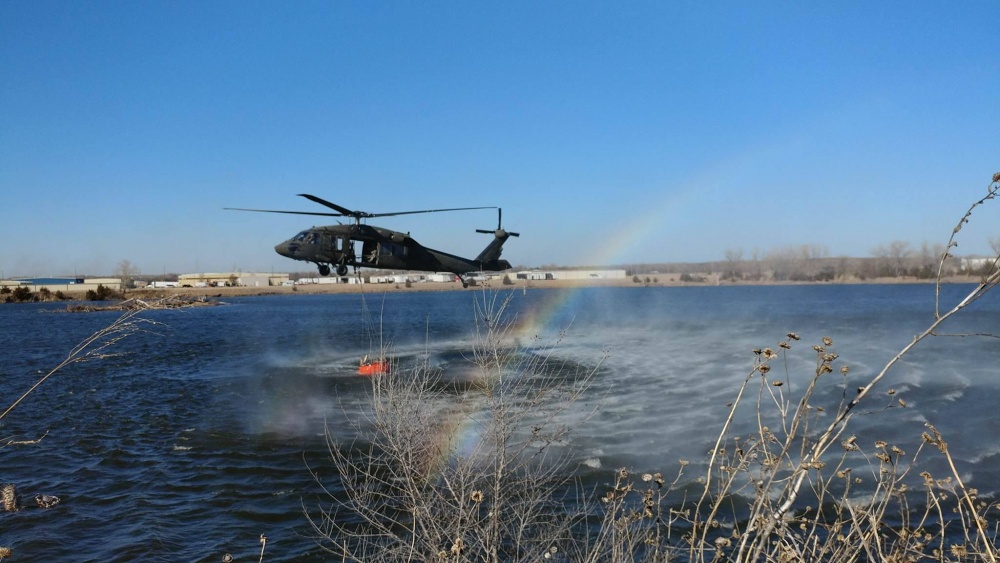
The Kansas National Guard dropped 482 Bambi buckets of water from Black Hawk helicopters, which equals approximately 289,200 gallons of water on a series of wildland fires across the state of Kansas in March 2017. (Photo by Sgt. Zach Sheely)
TOPEKA–When people think of emergencies in Kansas, floods and tornadoes may come to mind. However, that may be changing after a series of fires blackened more than 1,000 square miles of northwest, southwest and central Kansas – all within a matter of 10 days in March.
Lives were at stake in the small communities that dot the map of America’s Heartland, and the first responders’ swift and calculated response was vital to protecting them.
The dry winter, low relative humidity levels and high winds combined to form perfect conditions for a fast-moving, blistering fire. The numbers are staggering – one fatality, approximately 658,000 acres (roughly the size of Rhode Island) burned, thousands of livestock lost, and 40 homes destroyed. It’s the largest recorded fire event Kansas has ever seen.
The agencies of the Kansas Adjutant General’s Department, including the Kansas National Guard and Kansas Division of Emergency Management, partnered with numerous other local, state and federal agencies to safeguard the lives of Kansans and contain this conflagration.
In their words:
Angee Morgan, deputy director of KDEM
“I’ve been in emergency management since 1987 and we’ve never had a day in Kansas when the threat of wildland fire was that great,” said Morgan.
FEMA granted a Fire Management Assistance Grant to the state of Kansas on March 6. The FMAG provides a 75 percent federal cost share while the state pays the remaining 25 percent of firefighting costs.
“In our first phone call to FEMA, we had five fires that were not contained and were threatening cities that had evacuated,” said Morgan. “It’s extremely difficult to get the FMAG and we got it in record time. It was just unheard of.
“Our goal in emergency management is to get the right resource to fit the need at the local level to protect lives, property and critical infrastructure.”
KDEM works closely with the Kansas National Guard under the Adjutant General’s Department umbrella, and it became apparent that the local fire responders would need the aerial fire suppression help of the Kansas Army National Guard.
“The capability of fighting the fire from the air is critical because, as we saw in the Anderson Creek Fire in 2016, the terrain is different from other parts of the state,” said Morgan. “You cannot get fire trucks into some of these areas. There are no road systems in place. There are deep canyons. The ability of being able to attack from the air is vital.”
Morgan said that the communication between the civilian agencies and the Kansas Guard was seamless.
“The interaction goes very well because we work together daily,” she said. “It’s really important to have pre-disaster relationships established so we understand each other’s capabilities.”
(Photo by Sgt. Zach Sheely)
Maj. Ryan Bernard, commander of Army Aviation Support Facility #2, Salina
“We tried to get an aircraft out the door as quickly as possible based on the request from KDEM to be available,” said Bernard.
At approximately 2 a.m. on March 6, Bernard received notification that UH-60 Black Hawk helicopters with accompanying Soldiers and Bambi buckets were needed to assist with fire suppression in Rooks County, located in northwest Kansas.
Bernard, as with many Kansas National Guard Soldiers and Airmen, serves in multiple roles. He is the 1st Battalion, 108th Aviation Regiment logistics officer, an experienced UH-60 Black Hawk helicopter pilot, and the commander of Army Aviation Support Facility #2.
“At four o’clock in the morning,” said Bernard, “I notified the operations officer to start the alert roster and to give (the Soldiers) a 5 a.m. show time. Going into it, you have no idea how long the mission may last, so you have to pack a minimum of a three-day go bag.”
Initially, Bernard was the pilot in command of the lead aircraft from AASF #2 and remained the officer in charge of the fire suppression mission throughout its duration. The mission began with two Black Hawks on March 6, then grew to four with the addition of two additional birds out of Aviation Facility #1 in Topeka, to seven total aircraft by March 8, all equipped with Bambi buckets.
Bernard said the view from the air was unlike anything he had ever seen.
“Seeing the amount of land that burned from the air took my breath away,” said Bernard. “There were some areas where the landscape was black as far as the eye could see.”
Bernard said the soldiers’ mission was to contain the fire and protect property.
Each Black Hawk is piloted by two soldiers and there are two crew chiefs in the rear of the aircraft. For fire suppression missions, the helicopter uses a large bucket to dip water from a predetermined source, then haul the water to dump it where it is needed most. The Bambi bucket is affixed by a 30-foot line on the underside of the airframe and can hold up to 660 gallons of water.
The aviators of the Kansas Army National Guard gained valuable experience in aerial fire suppression during the Anderson Creek Fire of 2016 and this year, which Bernard said adds to their capability and readiness.
“From the time before Anderson Creek to now,” said Bernard, “we have a lot better idea of what we’re capable of in an emergency response. We’ve learned a great deal about ourselves and our readiness.”
The regiment fielded new UH-60M model Black Hawks in early 2016. The pilots – who often have civilian careers – have also had to train to fly the new models. National Guard helicopter pilots are required to fly a minimum of 96 hours per year, the same as their active-duty counterparts.
“We are blessed in Kansas to have the most competent, proficient and flexible aviators in the country,” said Bernard. “I truly believe that.”
Capt. Casey Atkins, operations officer AASF #2, pilot in command of UH-60 Black Hawk helicopter
“It’s special,” said Atkins, an experienced medevac and assault UH-60 helicopter pilot. “Being an aviator, you don’t get a lot of interaction with the people you’re helping, but being down in those communities and seeing their gratitude makes you feel like you are making a difference.
“That’s what you signed up to do, to be able to help people that are in need. It’s very rewarding.”
Atkins also flew aerial fire suppression missions during the Anderson Creek Fire in Barber County, which, until this year’s blaze, was the largest in recorded Kansas history. He said teamwork is paramount when coordinating response to an emergency of this magnitude. “It’s pretty spectacular watching the agencies from all the different backgrounds and training come together, with no previous experience working together, to determine the best course of action,” Atkins said. “The guys on the ground are the experts. They’re the ones who know what they need done.”
Along with the Kansas National Guard soldiers, there were civilian-operated fixed-wing aircraft and three CH-47 Chinook helicopters from the 11th Expeditionary Combat Aviation Brigade, U.S. Army Reserve Aviation Command, assisting with aerial fire suppression.
It was the first-ever domestic air mission for the U.S. Army Reserve under the Immediate Response Authority, which authorizes local Army Reserve commanders, at the request of a local civil authority, to take action to save lives, prevent human suffering or mitigate great property damage in a situation of urgency.
The Chinook is a twin-rotor helicopter that can lift heavier loads than a Black Hawk, and can utilize a larger 2,000 gallon Bambi bucket. The pairing of USAR and KSNG aviation assets was a first for the state of Kansas in an emergency response.
“We actually teamed up a Chinook and a Black Hawk together, which gives you 2,660 gallons of water,” said Atkins. “The guys from the USAR were excellent and worked with us great. They were just like we were, ready to do whatever it took to get the situation under control. It was a complete team effort.”
Atkins also credits his fellow Kansas Guard pilots and crewmembers for their professionalism and resilience.
“It’s a testament to the type of people who are in the Kansas Guard,” he said. “They’re willing to give up their time to go on state active duty in a moment’s notice, no questions asked. It shows the type of character and the type of people we employ here at the facility, as well as the Kansas National Guard.
“It’s a privilege to work with people like that.”
Spc. Orin Meyer, a UH-60 Black Hawk crew chief, Company A, 1-108th Aviation, Topeka, Kansas
“I was glad to be able to do my job,” said Meyer. “It’s an incredible experience. I was happy to be a part of that.” Meyer, who works on reconstructing bridges in Wichita, has served in the Guard for more than two years. This was his first real-world experience as a crew chief.
“I wasn’t nervous, I was excited,” said Meyer. “We train a lot and I have trust in my pilots. They have the utmost level of professionalism.”
The crew chief sits in the rear of the aircraft and is responsible for everything that happens in or to the helicopter and helps to maintain it.
On a fire suppression mission, they are the eyes of the pilots while making water dips and drops.
(Photo by Spc. Orin Meyer)
“My job is to guide the pilots down to get the bucket filled,” Meyer said. “Once it’s filled, we get the location of where we need to drop. Once I have eyes on the target and once we’re over it, I hit the release and drop the bucket load on the fire.”
Meyer also captured photos and video of what he was seeing in the air over the fires. One photo he took of an unburned house surrounded by charred landscape was used widely by news outlets.
“That was pretty neat,” said Meyer. “I was kind of in shock that everything around it had burned, but the house. And there were a lot of other houses like that that we and the crews on the ground helped save.”
Staff Sgt. Gilbert Gonzales, readiness noncommissioned officer, Company A, 1-108th Aviation, Topeka, Kansas
“It’s a feeling of elation,” said Gonzales of being activated to help with an emergency. “You’re excited, you’re pumped. This is why people join the military and the Guard, to help their community. It’s a great sense of accomplishment and pride.
“These are the things they show you in the recruiting office.”
The seven Kansas Army National Guard helicopters dropped a combined total of 482 buckets of water, which equates to roughly 289,200 gallons of water. However, Gonzales said that most of the credit should go to the firefighters on the ground.
“I want to make sure that everybody understands the ground crews did a majority of the work,” said Gonzales. “We came in and we helped close things up, but the ground crews were working their butts off.”
Please be advised that beginning Monday, March 27, 2017, Oak Street will be closed at the 25th intersection and up to the south side of the 26th intersection for an estimated 1 week.
The project is scheduled to be completed within two weeks (pending weather conditions).
Signs will be in place to direct the traveling public. The traveling public should use caution and if at all possible avoid these areas.
The city of Hays regrets any inconvenience this may cause to the public. If there are any questions, please call the Public Works Planning, Inspection, and Enforcement Division at (785) 628-7310 or the contractor, J-Corp, at (785) 628-8101.
Contact Information:
City of Hays – Public Works
(785) 628-7350
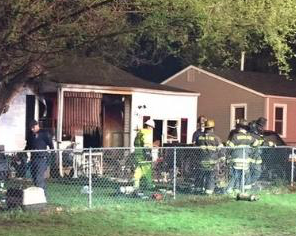
Fatal Sunday night fire in Wichita-photo courtesy KWCH
SEDGWICK COUNTY – A Kansas man died in a house fire on Sunday in Wichita.
Just after 10p.m. fire crews responded to report of the fire at a residence in the 2400 of North Poplar, according to Fire Captain Kelly Zane during the online Monday media briefing.
Upon arrival, fire crews saw smoke and flames coming from the front door of the residence.
They also located a man identified as Martin Ornelas, 58, inside the home. He was transported to Via Christi where he died.
Fire crews did rescue three pets from the home. They were given to other family members.
The cause of the fire remains under investigation, according to Zane.
Last Week on the House Floor
Last week the House and Senate honored Gerard Wellbrock, the longtime voice of Fort Hays State University athletics. Gerard was accompanied by his wife Tammy and son Garrett. Gerard was recognized for being honored as the 2016 Kansas Sportscaster of the year by the National Sports Media Association.
The House has been busy passing numerous bills. The many pieces of legislation ranged on issues from technology to healthcare to agriculture. Find a few of these bills detailed below.
Sub HB 2331: An act concerning information systems and communications; creating the representative Jim Morrison cybersecurity act; relating to digital information security for Kansas executive branch agencies; establishing the Kansas information security office; establishing the cybersecurity state fund and cybersecurity state grant fund in the state treasury, creating the Kansas information technology enterprise.
H Sub for SB 51: An act concerning controlled substances; the state board of pharmacy; relating to scheduling of controlled substance analogs, controlled substances and new drugs; emergency scheduling.
HB 2313: An act concerning the Kansas lottery; dealing with lottery ticket vending machines; repealing the lottery sunset.
HB 2232: An act concerning adult care homes; relating to electronic monitoring
SB 68: An act concerning health and healthcare; relating to hospitals; enacting the Kansas lay caregiver act.
HB 2353: An act concerning state contracts and purchases; relating to purchases of products and services from not-for-profit entities; employment of persons with disabilities.
Coming up in the Kansas Legislature
This week, watch for the Medicaid expansion bill to hit the Senate floor. If it passes through the Senate, the bill will then be sent to the Governor.
Republicans in the Senate have said they will wait to act on an education finance formula until the House addresses it first. Conversations as to how to solve this issue are underway, with many ideas being introduced. A bill has been proposed this week in the Kansas House, and we expect action on that bill to begin next week.
A tax plan to restore the revenue in Kansas has not yet been enacted. Previously in the session, the House put forth and passed a tax bill, which then passed through the Senate. The bill essentially repealed Gov. Brownback’s “march to zero” tax experiment. The Governor vetoed the bill, after which the House overrode his veto. The Senate failed to override by just three votes. A new tax plan should be coming soon from the Senate side.
It is a special honor to serve as your state representative. I both value and need your input on the various issues facing state government. Please feel free to contact me with your comments and questions. My office address is Room 43-S, 300 SW 10th, Topeka, KS 66612. You can reach me at (785) 296-4683 or call the legislative hotline at 1-800-432-3924 to leave a message for me. Additionally, you can e-mail me at [email protected]. You can also follow the legislative session online at www.kslegislature.org.
Sincerely,
Eber Phelps, D-Hays
111th Dist. Kansas House of Representatives
Serving Hays and Ellis County
TOPEKA, Kan. (AP) — Police in Topeka say they’ve arrested a woman suspected of fleeing a fiery weekend crash that killed a man.
Police say 35-year-old Jeremy Gerhardt of Topeka died at the scene of the crash late Saturday. Police arrested the 56-year-old suspect Theresa Hooper on Sunday, though it wasn’t immediately clear Monday if formal charges had been filed.
Police say officers responding to a reported crash shortly before 11 p.m. Saturday found Gerhardt’s pickup truck that had hit a bridge pillar and on fire.
Police say witnesses reported that the pickup truck had been involved in an accident with a car, which sped away.
Twila M. Ninemire, age 93, a life-long resident mostly of Trego and Graham Counties passed away at her home at Brookdale Senior Living in Hays, Kansas, Thursday morning, March 24, 2017, with loving family members and adoring staff at her bedside.
Twila was born October 4, 1923, at a farm in northern Trego County, the daughter of Claude Eugene and Mary Howard (Zeman) Howat. With her three sisters, she attended the Saline Valley School, eventually graduating from Trego Community High School in 1940. After graduation, she attended Kansas State University on a Union Pacific scholarship for two years before marrying and becoming a full-time mother and homemaker. On December 25, 1943, Twila was united in marriage to Floyd Ninemire at the WaKeeney United Methodist Church parsonage. She and Floyd settled in southern Graham County, farming and raising livestock, and creating and sustaining a family there in the Prairie Home Community.
Twila was well-known and a charismatic member of the community. She was active with her children in 4-H, Methodist youth groups, Sunday and Bible School at Prairie Home Methodist Church, and in her own right as a steadfast choir and WSCS member. Also, she was a long-time member of the Sunflower Club (her mother, Mary, being a charter member), The Tourists’ Club and in her later years was a much sought-after bowler—as much for her warmth and charm as her bowling prowess.
She was an active member of the WaKeeney First United Methodist Church and served faithfully as its treasurer for 23 years.
Survivors include four children, Gerald (Rebecca) Ninemire, of Madill, OK; Marjean Ninemire, of Glenview, IL; David Ninemire, of Philadelphia, PA; JoAnn (Wayne) Driggers, of Jenks, OK; four grandchildren, and nine great-grandchildren.
She was preceded in death by her parents; husband Floyd of nearly 50 years; three sisters, Adah Howat, Leola Marie Howat and Dorothy Cook.
Memorial service will be 10:30 a.m., Tuesday, March 28, 2017, at First United Methodist Church. There will be no visitation, as cremation was chosen. Inurnment will take place following the service at WaKeeney City Cemetery.
In lieu of flowers, the family request that memorials be made in Twila’s memory to Prairie Faith Shared Ministry. Contributions made to the organization may be sent to Schmitt Funeral Home, 336 North 12th, WaKeeney, KS 67672.
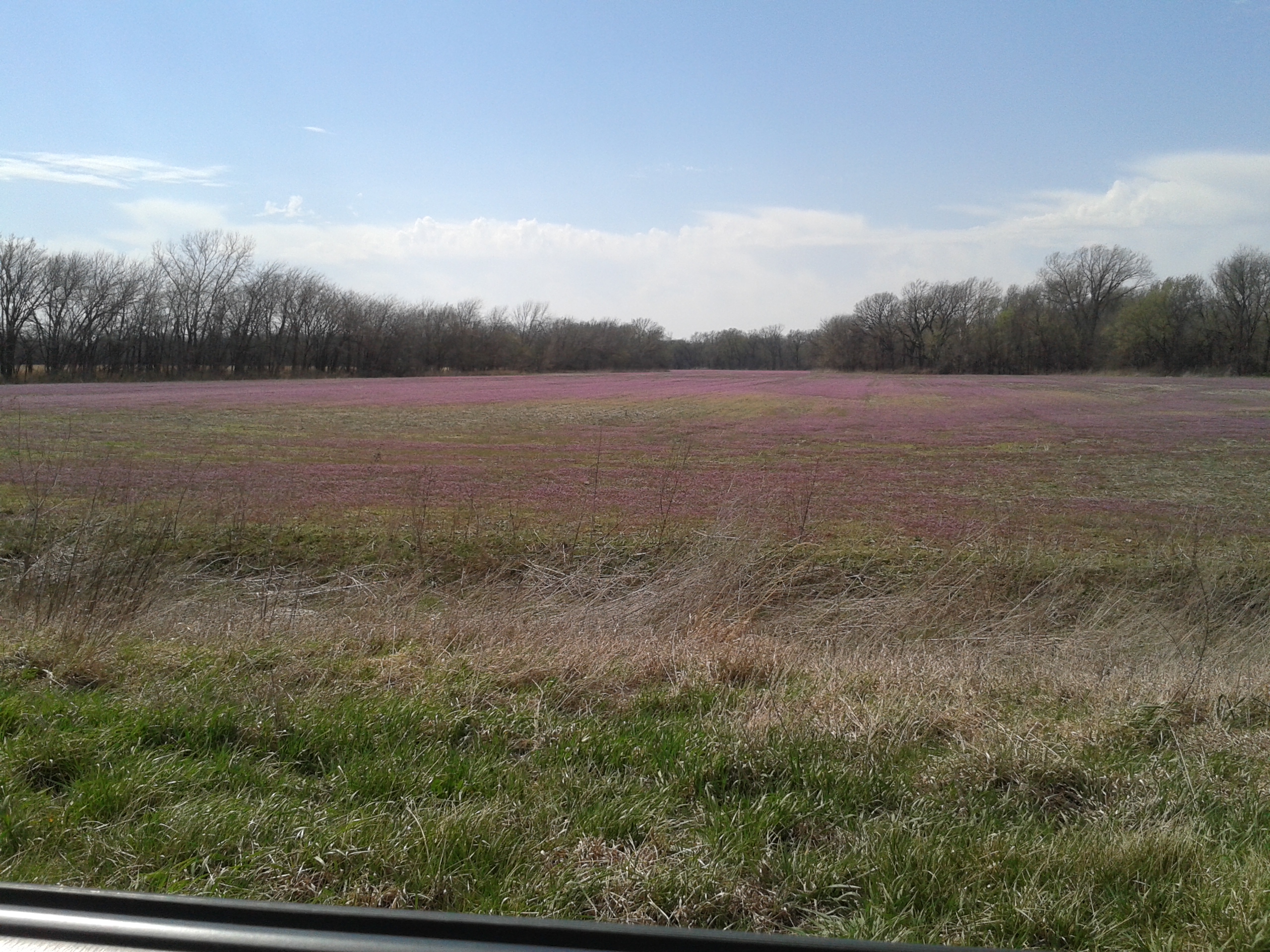
Henbit forms a carpet of purple on Kansas meadows in early spring.
A beautiful purple carpet extends across many fields in Kansas each early spring. Growing only a few inches above the ground, these purple Kansas meadows will soon be plowed. More purple patches sprout in our yards, soon to produce seeds before we start mowing grass.
John Richard Schrock is a professor at Emporia State University.
Commonly known as henbit, its scientific name is Lamium amplexicaule. It is not native to North America. Henbit originated in Asia, Europe and northern Africa. It arrived long ago, spreading west into the Great Plains. Henbit is an early spring wildflower, basking in the sunlight after the winter thaw and before tall weeds or trees grow leaves to block the sun. Back in its Mediterranean homeland, henbit even flowers during the mild winters.
The purple flowers consist of four male stamens, two long and two short. The purple carpet we see from a distance is thousands of flowers, each a ring of fused petals forming a tube nearly an inch long. Being among the first flowers in early spring, henbit is an important pollen and nectar source for bees. And if there are not enough pollinating insects, the flowers can self-pollinate.
In either case, henbit has evolved to produce seeds before being overshadowed by other plants. —Or before being plowed under!
And that is the question that should puzzle us. Since many Kansas fields with this beautiful purple henbit will soon be plowed under, how does henbit keep returning year-after-year, carpeting the meadow with color?
The answer: the soil seed bank. Not to be confused with genetic seed banks where botanists store wide varieties of important crops variants, the soil seed bank consists of the varieties of seeds that are mixed in the soil and available to eventually germinate.
It was Charles Darwin who first observed seeds germinate from soil taken from a lake bottom in 1859. Once he pointed out that soils stored seeds, this idea of soil seed banks led to research that explained why some plants would rapidly appear as weeds while other plants were slow to invade.
Some plant seeds are “transient,” germinating at the first opportunity and are present in the soil seed bank for only a short time, or not at all. But “persistent” seeds endure through many opportunities to germinate; the common weed known as lambsquarters produces seeds that remain in the soil seed bank ready to germinate for up to 40 years. And tropical lotus seeds can reside in lake bottoms for over 1,000 years and germinate!
Research on the soil seed bank is important in agriculture; it helps us understand why some weeds are more common than others. And henbit is truly an evasive weed. But because it grows so early in the spring and is plowed or cultivated out so readily that it gives us little trouble in farming, we don’t mind it as a “weed.”
Steve Gilliland
Well it’s time again for both the largest and the smallest birds in Kansas to make their spring appearances. Turkey Vultures, being of course the largest are here already. There are probably more yet to come as they make their way back from their winter digs in South America. Ruby Throated Hummingbirds, being the smallest, also winter in South America and are due back in KS around the middle of April; the earliest sighting last spring was on April 14 in Wichita.
Some years back Joyce and I had the opportunity to keep tabs on a pair of Turkey Vultures nesting in an old ramshackle building near Inman that had been a vulture nursery for years. We got within a couple feet of the female as she guarded her nest, and checked on her weekly as she hatched 2 little white balls of fluff that quickly grew into immense specimens like their parents. Despite having faces only a mother could love, vultures are an important part of our ecosystem. Often known as nature’s clean-up crew, they clean up dead wildlife and animals of all descriptions and the juices in their digestive systems are so potent they can eat diseased flesh with no repercussions. Our last visit to the old building that year found both youngsters perched on an old windmill tower near the building, curiously watching us below as mom and dad both circled above. As majestic and awesome as Turkey Vultures are as they soar effortlessly above us on the Kansas winds, there are few if any opportunities for us to interact with them, and perhaps rightly so.
But we often design our entire back yards foliage to attract hummingbirds and hang nectar feeders to cater to their “sweet tooth,” and are sometimes rewarded with “close encounters” as the little blighters become comfortable with our presence. Hummingbirds were much more prevalent in Ohio where I grew up, and we often saw 3 or 4 at once at our feeders. One feeder hung in front of a back porch near our kitchen, and the little hummers’ learned to hover outside a nearby window to get our attention when the feeder was empty. Once after filling the feeder, I slipped quietly out onto the porch and one hungry little hummer actually drank from it as I stood there motionless, holding the feeder at arm’s length.
At last week’s McPherson Spring Garden Show, Mike Daniels, owner of Brook’s Landscape LLC spoke about “Gardening for Friends,” and his main topic was hummingbirds and gardening to attract them. With wings that beat over 50 times per second, hummingbirds can make the trip across the Gulf of Mexico back to the US in 18 – 22 hours, resting on boats and oil derricks if necessary. It’s always been said that hummingbirds are attracted to the color red, but Daniels said that because of the way they see colors, any color using red in its spectrum will attract them, so orange, yellow and purple should all work as well.
Hummers’ also have a voracious appetite for insects and have actually been observed robbing trapped bugs from spider webs. They make nests from thistle down and dandelion leaves and weave it all together with spider silk from spider webs. The female usually sits on 2 jelly bean sized eggs and they can have 2 broods a year.
Daniels suggests trying to attract them with plants and using feeders as a backup. He says to keep the feeders clean and free from mold and dirt, and when mixing the nectar, boil the water and add sugar at the rate of 1 part sugar to 4 parts water to make a syrup that does not sour as quickly as plain sugar water. Hang feeders in partial shade several feet apart to help keep the males from fighting and hang them where cats can’t get to them. We’ve all heard it said that keeping feeders out too late in the fall might encourage hummingbirds to stay later than they should and miss their fall migration. Daniels told us that is not a problem, as the little guys’ God given instinct and the absence of insects will send them on their way south right on time. Hummingbirds love petunias and trumpet vine, and salvia, angelonia, morning glory, beard tongue, coral bells and bee balm are also very attractive to them; these plants will all attract butterflies as well. Stay away from insecticides and pesticides if possible and use herbicides sparingly.
Yes it’s time for the greatest and the smallest in the Kansas skies to appear once again from their winter homes far to the south. Look to the sky as the air warms on spring mornings and you’re bound to spot vultures effortlessly soaring above as they ride the rising columns of warm air known as thermals. Get you hummingbird feeders cleaned and ready and spruce up your lawn with a few new plants, and prepare to be entertained by the buzzing sound of little wings and the chattering of jousting hummingbirds as they chases each other across your back yard. What a great time to Explore Kansas Outdoors!