SHAWNEE COUNTY – Law enforcement authorities in Shawnee County are investigating a series of automobile thefts and asking the public for help to locate a suspect.
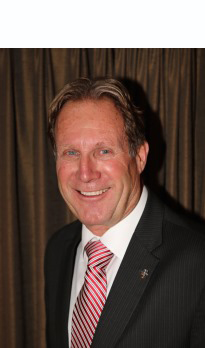
Tommy Lee Kleiner, 38, is listed as a suspect in multiple felony arrest warrants and a suspect in multiple car theft investigations, according to a media release.
He is described as 5’ 9” tall and approximately 160 pounds.
He has an extensive past criminal conviction history including aggravated battery, criminal threat, making false writing, and more.
Police advise, if see him, do not approach and contact police immediately or Call Crime Stoppers at 785 234-0007
The mobile home housing CC’s convenience store at Wilson Lake was completely burned in Monday’s wildfire. (Photos courtesy Larry Calvery)
By BECKY KISER Hays Post
RUSSELL COUNTY–Monday’s wildfire at Wilson Lake destroyed the former CC’s convenience store and at least one mobile home, the owner of which also lost a dog and horse to the flames.
Dorrance resident Larry Calvery owns the mobile home that housed Calvery Convenience since 2006, although it has not been open for several years because of the low water level at Wilson.
“It’s burned to a crisp,” Calvery said Tuesday morning after inspecting the damage. “I’ve never seen such devastation.”
Silver streaks of metal are all that is left of the pontoons on a boat.
In addition to the mobile home, Calvery’s pontoon boat and an unused camper were also destroyed. “The only thing left on the boat is the motor. The pontoons melted into silver streaks left on the ground,” Calvery said. “It’s going to be an easy cleanup. There’s nothing left to salvage.”
Calvery had hoped to reopen CC’s later this spring in a new facility. “Now, I don’t know if I will. It’s too soon to tell.”
The mobile home just east of CC’s was also destroyed. Calvery said his neighbor “Andy Phelps’ home was completely burned, and he lost one dog and one horse. He has four other horses at the vet today being treated for injuries.”
He had also planned to build a house at Wilson Lake and be living in it by how. Those plans have been delayed. “That’s the one bright spot,” Calvery said. “Otherwise, that would be gone, too.”
Calvery said the fire appeared to miss the campground and docks, although one dock was blown over by the high winds. “Marine Specialty is also OK,” he added.
The wildfire started south of Minooka Park, where Calvery reported the damage, about 2:30 p.m. Monday. It burned southeast into the Wilson State Park area. The north wind caused the fire to jump Interstate 70 and Kansas Highway 232. Residents of Wilson were told to evacuate the town early Monday evening, although no damage or injuries were reported.
I-70 between Russell and the Sylvan Grove exit was closed for a time due to limited visibility caused by the smoke.
The closed CC’s Convenience Store at Minooka Park in Wilson Lake was destroyed by Monday’s wildfire.
Silver streaks of metal are all that is left of the pontoons on a boat.
CC’s Convenience Store prior to Monday’s grass fire at Lake Wilson
The fire started south of Minooka Park, traveled south, jumped I-70 and continued into Ellsworth Co.
SALINA – Four-time World Champion Bull Rider and Pro Rodeo Hall of Famer, Tuff Hedeman and the CBR are busy making preparations for the one night only Championship Bull Riding Road Showdown in Salina to be held on March 25 at Tony’s Pizza Event Center (formerly the Salina Bicentennial Center) at 7:30 pm.
The single performance event will feature three rounds of non-stop bull riding action and in addition to great professional bull riding talent, Hedeman is bringing in everybody’s favorite barrel man and entertainer of Cheyenne Frontier Days, Cody Sosebee who will join the voice of the CBR, Chris Rankin, calling the play by play action from the announcer’s booth.
Sanctioned by CBR, the Showdown in Salina is the fourteenth stop on the CBR’s Road to Cheyenne’s twelve-month televised tour where the tour’s top bull riders test their skills against dynamic four-legged animal athletes in a three round tournament style event featuring a twenty-four man field of riders.
Hedeman, who for 30 years has made a name for himself in the production of great bull riding events will serve as “chute boss” and television commentator from the dirt in front of the Salina audience.
“We have pulled out all the stops for Salina. We will have the industry’s best bull riders, entertainment, and it’s like a rock n roll concert and a heavy weight prize fight all in one event,” said Benny Cude, CEO of CBR.
Ticket holders can look forward to a two hour adrenaline rush show powered by grand pyro introductions, full filled family entertainment combined with three rounds of highly competitive bull riding.
The Competition
You will want to get your tickets now to the CBR Showdown in Salina to get the best seats to cheer on the undisputed number one bull rider in the World, five time World Champion Sage Kimzey from Strong City, Oklahoma. Twenty-four year old Kimzey, the reigning CBR and PRCA World Champ has earned over two million dollars riding bulls and left the Wrangler National Finals Rodeo last December breaking multiple pro rodeo records.
Joining Kimzey on the dirt will be multiple World Champions including Indian National Champion Cody Jesus and the CBR’s “Mr. Consistency”, Eli Vastbinder who has been ranked in the top three on the Road to Cheyenne tour for six months as he continues to battle Kimzey for the number one ranking.
The field of 24 riders will include multiple National Finals Rodeo qualifiers including Chandler Bownds, Rorey Maier, Cody Rostockyj, Jeff Askey, and Tim Bingham and a red hot rookie from Crockett, Texas, Boudreaux Campbell.
The Format
This year’s event pits the industry’s elite riders against the best bulls in a three round tournament style format where riders may challenge as many as three bulls to win the event. The cowboy athletes will come from all corners of the country and include many highly decorated champions.
CBR Ambassador and chute boss, Tuff Hedeman selects the stock for the nationwide televised tour that is broadcast on Fox Sports Networks.
In addition to the lucrative prize money, bull riders accumulate points which qualify them for the World Finals, part of the legendary Cheyenne Frontier Days celebration held in Wyoming next July. At the end of the World Finals the contestant who has the most points will be crowned the CBR World Champion and receive a $100,000 bonus.
The Bulls
The Salina event will also feature the “other side of the ride”, CBR’s Million Dollar Bull Team Challenge. Bull owners from all around the country will bring three bulls that are featured during the rounds of competition. The bulls are competing for points based on their performance in the arena combined withthe time the bull riders stays on for a total score. At the end of the night the owner with the three highest scoring bulls will receive $20,000.
CBR has become known for their action packed performances that keep fans on the edge of their seats and with this new show debuting in Salina, the CBR Salina event is set to impress. From having great bulls matched up with super star riders, to upbeat music and enthusiastic fans, there is something for everyone at the CBR in Salina.
Tickets
The CBR Salina Showdown is on March 25 is at 7:30 pm at the Tony’s Pizza Event Center Arena, 800 Midway, Salina, KS, 67401. Tickets ON SALE NOW at the Tony’s® Pizza Events Center Box Office, BicentennialCenter.com and by calling 888-826-7469. Prices start at $17 with a variety of options available including a NEW $10 kid’s ticket for children ages 2-12.
Amid the gusty winds Monday in Hays, there was a near 60° temperature swing.
The official high in Hays on March 6 was 82°, unusually warm for late winter, but not a record high. According to the KSU Agricultural Research Center, the official high in Hays for March 6 is 88° set in 1972.
After reaching 82° Monday, the overnight low fell to 23°, a 59° plunge.
Sustained winds Monday were at 27 mph, with a maximum gust recorded at 45.1 mph. Dirt and smoke were visible most of the day.
Tuesday’s weather forecast calls for a cooler day, with winds picking up again this afternoon.
The National Weather Service office in Dodge City has issued a Red Flat Warning for the second consecutive day: A Red Flag Warning is in effect again this afternoon for gusty winds in excess of 25 mph and low relative humidity at or below 15 percent.
If you would like to see all the places we talked with constituents over the break last week, go to Ken for Kansas on Facebook.
Last Thursday, the long-awaited decision from the Kansas Supreme Court dealing with school funding adequacy was announced. The non-partisan Kansas Legislative Research Department issued a briefing document and the remedies look like the following:
The Supreme Court stated there is no one way to constitutionally fund K-12 public education and rejected the idea of a litmus test that relies on a specific funding level to reach constitutional compliance. Further, while acknowledging the cost studies are estimates, the Court stated they represent evaluations it cannot simply disregard, and the State should not ignore them in creating a remedy. The Court directed the Legislature to focus on creating a K-12 financing system that through structure and implementation is reasonably calculated to have all Kansas public education students meet or exceed the Rose standards and to be mindful of the connection between equity and adequacy. Further, the Court reiterated the Rose standards are minimal standards and the Legislature may exceed those standards.
The Court retained jurisdiction and continued the stay of the three-judge panel’s order and its own mandate to give the Legislature an opportunity to bring the state’s education financing system into compliance with the Kansas Constitution. The Court called for the State to satisfactorily demonstrate compliance by June 30, 2017, after which time a lifting of the stay would mean the State’s education financing system is unconstitutionally invalid and therefore void. The Court expressed its confidence in the State’s ability to reach compliance by that date based on the Legislature’s history of acting to cure infirmities and the long-scheduled expiration of the block grant on June 30, 2017.
The challenge ahead is what does this mean to the schools in the 110th district. The fight will be on to protect our interests and balance those with all school needs in the state. I will continue the conversation with those on the Education Budget committee that the new funding formula works for classrooms in our district as well as Johnson County. We are scheduled to be wrapped up with the session by Mother’s Day, but since the deadline for the court is the end of June we could be in Topeka until wheat harvest.
The Taxation committee will continue its work on formulating the funding arm of the budget, and now with the school funding decision out, the waiting is over and the negotiations will begin on another bill. We will see how many there will be to get something passed by both houses and the acted on by the Governor.
If you would like to contact me: Session phone number is: (785) 296- 7463 and email is: [email protected] and my cell number is (785) 302-8416.
It is my honor to serve as your representative.
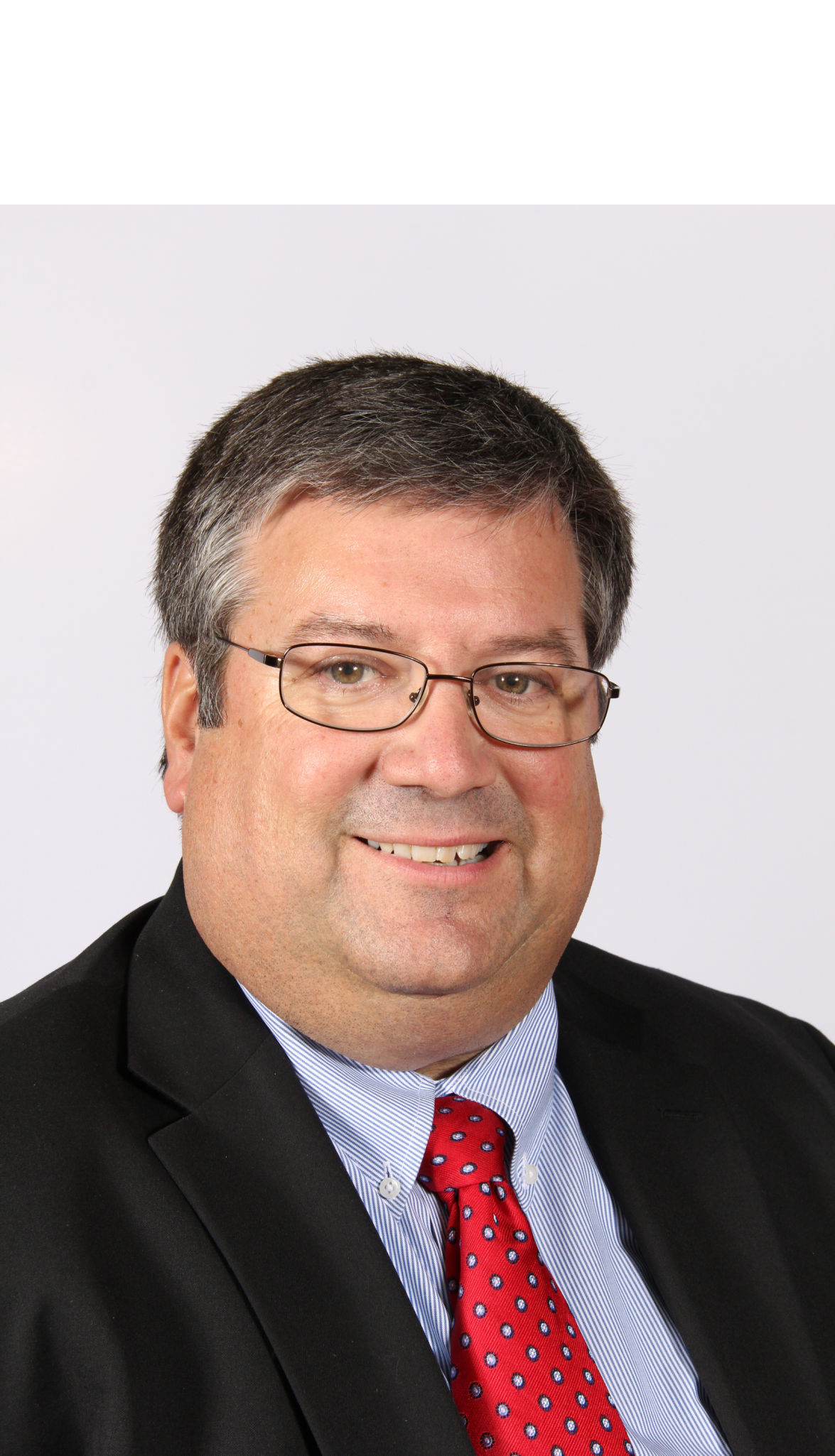
Ken Rahjes, (R-Agra), is the 110th District State Representative.
Vivian M. Kreiser, age 90, passed away on Monday, March 6, 2017 at the Scott County Hospital in Scott City, Kansas. She was born on August 5, 1926 in Middletown, Pennsylvania, the daughter of Raymond J. And Marian Conrad Davies. A resident of Scott City, Kansas since 2009 moving from Middletown, Pennsylvania, she was a assembly line worker for the Hershey Chocolate Factory in Hershey, Pennsylvania.
She was a member of the United Methodist Church in Middletown, Pennsylvania.
On June 15, 1945 she married Gerald N. Kreiser in Royalton, Pennsylvania. He passed away on April 12, 2007 in Middletown, Pennsylvania.
Survivors Include her One Daughter – Sharon Kreiser Lock of Scott City, Kansas, One Son In Law – Larry Lock of Scott City, Kansas, One Brother – Earl Davies of Wellsboro, Pennsylvania, One Sister – LaRue Meredith of Dauphin, Pennsylvania, Seven Grandchildren, Twenty One Great Grandchildren, Five Great Great Grandchildren and Numerous Nieces & Nephews.
She was preceded in death by her Parents, husband, One Son – Gerald N. Kreiser Jr., One Daughter In Law – Karen Trimble Kreiser, Two Brothers and Two Sisters.
Visitation will be at Price & Sons Funeral Home in Scott City on Thursday, March 9, 2017 from 10:00 a.m. until 3:00 p.m.
Private burial will be held at the Middletown Cemetery in Middletown, Pennsylvania at a later time.
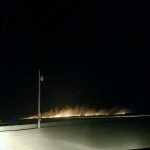
After a day of raging grass fires across parched northwest Kansas, the first fire was reported in Ellis County late Monday evening.
A large fire was reported northwest of Hays north of Hopewell Road late Monday. While crews battled the fire, area farmers reportedly came to the rescue with discs helping to create a fire line that helped slow the spread the the flames.
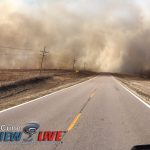
U.S. 24 and U.S. 183 in Rooks County were closed intermittently Monday as crews battled a large grass fire in that area.
Ellis County fire north of Hopewell Road
Ellis County fire north of Hopewell Road
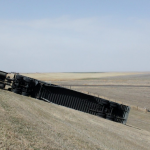
Fire crews throughout western Kansas battled fires in extremely windy conditions. The wind also caused at least four semis to be blown over on Interstate 70 between Colby and Grainfield, the Kansas Highway Patrol reported.
Multiple agencies fought fires near Damar, Stockton, Brownell, Ransom, Cheyenne County and Lake Wilson. In Ransom, the fires claimed homes and other structures.
Residents of Wilson were evacuated late Monday afternoon, but allowed to return in the evening, the KHP reported. A portion of I-70 was closed for a time after the fire near Wilson jumped into the median.
For up-to-date information on road closures and road conditions, call 511 in Kansas or 866-511-5368 outside Kansas, or check travel information online at www.kandrive.org.
Check Hays Post for details as they become available.
Click HERE for videos from Saturday’s grass fire in Rooks County.
An overturned semi near Colby. Photo courtesy the Kansas Highway Patrol
Image from Saturday’s grass fire in Rooks County. Photo courtesy Matt McCune. www.stormviewlive.com
Town Hall Meeting Week: Much of this week was spent traveling across Senate District 40 meeting with constituents. I would like to thank those for attending and appreciate your concerns and comments. Thank you goes out to Farm Bureau for organizing and hosting the town hall meetings. Farm Bureau has been a great support to the 40th Senate District for many years and thank you for organizing these meetings.
I would like to recognize the 4-Hers who were at the Capitol last week. I hope you all learned a little about how the Legislature works. Thank you to the sponsors for bringing these young people to Topeka. Northwest Kansas can be proud of our 4-Hers.
Good news is that February revenues came in ahead of projections. State revenues for February were $314 million, which are $40.6 million above estimates. The additional $40 million will cut the overall shortfall for the 2017 budget to about $280 million, from a budget shortfall of a projected $350 million in November 2016.
The last several months’ revenues have come in above estimates, which will help in making cuts and adjustments for the 2017 budget. Some of the reasons revenues came in above estimates are; 1) individual income tax payment and withholding for February came in at $86 million which was $26 million above the estimate of $60 million. 2) Corporate income tax came in at $6.1 million, $5.1 million above the estimate 3) Sales tax receipts for February were $167.6 million, $7.6 million above estimates. 4) Cigarette tax came in less than projected at $8.7 million, $1.2 million below estimates. 5) Sales tax collected on internet sales on out of state purchases, also referred to, as compensating use tax, were $31.4 million up $1.4 million from projections. The Senate has legislation pending which will hopefully increase sales tax on out of state purchases.
On Thursday the Supreme Court ruled current school funding in Kansas is inadequate. In 2010 four school districts filed a lawsuit against the State of Kansas. The court ruled the State is obligated to provide public education to K-12 students. The justices noted that in Kansas, the “base state aid per pupil,” or BSAPP, had risen from $3,600 in 1992 to $3,890 in 2002 and gradually rose to $4,400 for fiscal year 2009. However, during the recession, appropriations fell steadily, and by fiscal year 2012, the legislature had reduced BSAPP to $3,780, passing on costs of more than $511 million to local districts.
Since 2009, the Kansas State Board of Education has asked that the BSAPP be increased to $4,492. Citing data from the 2015-2016 school year, the court said that nearly half of the state’s African American students and more than a third of its Hispanic students are not proficient in reading and math. More than a third of students who receive free and reduced lunch are also not proficient in those essential subjects. Under court order, last June, the legislature approved a $38 million funding boost for poor school districts.
The Senate Republicans will meet on Tuesday, March 7, in caucus to hear from the experts about possible solutions to satisfy the courts ruling. The Senate and House have been working on a new school funding formula. The courts ruled the legislature has until June 30, 2017 to accomplish this task.
Fort Hays State University Relations and Marketing
The fifth of six free hearing screenings to be held across western Kansas by Fort Hays State University graduate students will be offered in Hugoton.
The screening will be from 10 a.m. to 2 p.m. Friday, March 10, at the Stevens County Hospital Specialty Clinic, 1006 S. Jackson. No appointment is necessary. Screenings will be conducted on a first-come, first-served basis.
Screenings, sponsored by the Kansas Masons, are provided by graduate students from the Department of Communication Sciences and Disorders and the FHSU Herndon Clinic.
“The FHSU Herndon Clinic in the Department of Communication Sciences and Disorders is very fortunate to have recently received a grant from the Kansas Masons to support adult speech, language and hearing services in western Kansas,” said Marcy Beougher, speech-language pathologist and an instructor in the department.
Each site will have four stations, each station with an FHSU graduate student providing screenings, supervised by Beougher. Screenings will take approximately 15-20 minutes.
“The screenings have provided excellent clinical experience for our students and have also been a great service for the public,” said Beougher.
“Not being able to hear effectively has been shown to lead to isolation and depression, so this truly is a very important service. We sincerely appreciate the Kansas Masons for sponsoring these free screenings for the communities of western Kansas,” she said.
A record number of screenings was reached in the last location, Hill City, with more than 70 screenings provided.
Beougher and Kori Haberman, communication sciences and disorders graduate assistant, are organizing the screenings.
The final screening is scheduled for Goodland.
For more information, visit fhsu.edu/herndon-clinic/ or contact the FHSU Department of Communication Sciences and Disorders at (785) 628-5366.
Having just left private practice as an OB/GYN, and fresh off the campaign trail, I have talked to thousands of people about healthcare issues. For more-than 25 years, the most common concern I’ve heard, and have tried to help solve, is from folks who have a preexisting health condition, and must get their health insurance outside of an employer. These folks are worried about losing the coverage they have, if they have any, and fear they won’t be able to replace it in the future.
As we in Congress work to deliver true 21st-century healthcare to the American people, I wanted to address the issue of coverage for folks with preexisting conditions; also called “guaranteed issue,” which ensures that all Americans have access to high-quality, affordable healthcare. Many of us in Congress, and our President, have agreed we must ensure this coverage, and have accepted it as our challenge.
The Affordable Care Act (Obamacare) was passed in 2010 with hopes of addressing this very issue. Unfortunately, individual health insurance policies under Obamacare can have deductibles as high as $14,000 for a family. To many of us in the medical field, it seems that more people than ever do not have meaningful health insurance. Here we are in 2017 and although people technically have access to health insurance, many cannot afford to get care because of their premium, and out-of-pocket expenses. This cuts to the very heart and soul of the current debate on what true healthcare reform looks like.
What I propose today, after having listened to and studied many ideas, are “value pools.”
What are value pools? Value pools are insurance programs set up to focus specifically on patients with pre-existing conditions. To most patients, their insurance plan would look very much like the insurance most of us were used to seeing before Obamacare. Some basic federal laws (or rules from HHS) would provide guidelines and minimum standards, but general design and administration must be at the state level.
Who would get their health insurance from a value pool? Though there are several ways to determine eligibility for these pools, we could start with having one of 33 diagnoses (as currently used by the innovative Alaska reinsurance program) and/or a letter of denial from one or more existing insurance carriers.
Why value pools? By putting folks with pre-existing conditions into a separate “like-risk” insurance group known as a value pool, they will be more likely to get the type of benefits and care they need. I believe these most-valued patients could especially benefit from a “concierge physician” who is dedicated to directing them through the confusing maze of health care. This concierge can bring each patient true value.
By separately structuring and funding value pools for patients with preexisting conditions, health insurance will be much more affordable for those without preexisting conditions. Those without preexisting conditions will once again buy from conventional commercial insurance markets. Costs will be more predictable, and we know insurance actuaries thrive on predictability.
How would value pools be funded? The patient would be responsible for paying a premium equal to the average cost of coverage in their respective commercial market. The remainder would be funded via state funds, fees assessed on private insurance carriers in the state, and federal funds.
Interestingly, 35 states have experience with similar pools. Prior to the coverage mandate, the average annual cost for the 226,000 patients enrolled in these high-risk pools was about $12,000 (Source: NASCHIP Comprehensive Health Insurance for High-Risk Individuals: A State-by-State Analysis). Also of note, the federal government is spending nearly $11,000 per-patient annually for Medicare patients (Source: CMS National Health Expenditure Data).
As we’ve listened to and visited with our state governors and state insurance commissioners, the most common themes they ask for are “flexibility and certainty.” It is Congress‘ job to give them just that.
As a business person, I look at this problem and ask how much money we, the hard-working taxpayers of this country (via the federal government) can afford to make these changes. The state will then dial the many alternatives up or down to keep within their budgets, and to spend the money as judiciously as possible.
As an example, around 12 million people are on an exchange policy now. With free market reforms and the deregulation of medicine, many (most likely over 90 percent) will move back to the free market. The total insurance premium for the remaining value group, which would be split between the patient, private insurance, the state and federal government, should be under $15,000 per year, and hopefully closer to $11-12,000 as time goes on. In this model, the deductible would be around $1000, and the plan would also include a tax credit for the premium.
Of course, these valued patients will also benefit from other free market reforms such as expanded HSAs, increased transparency, and policies that encourage innovation.
Finally, I propose a federally funded “reinsurance” program, much like many of us use in the private sector, to provide an umbrella for the state-based Value Pools.
It’s not complicated. In fact, it is simple. But it’s not easy.
Unlimited free healthcare is not, and won’t be an option. And it is dishonest and harmful to tell hard-working Americans otherwise.
There will be pains and there will be mistakes, but I believe we can keep working to ensure all Americans, regardless of their health challenges, have the opportunity to achieve this goal of quality, affordable healthcare.
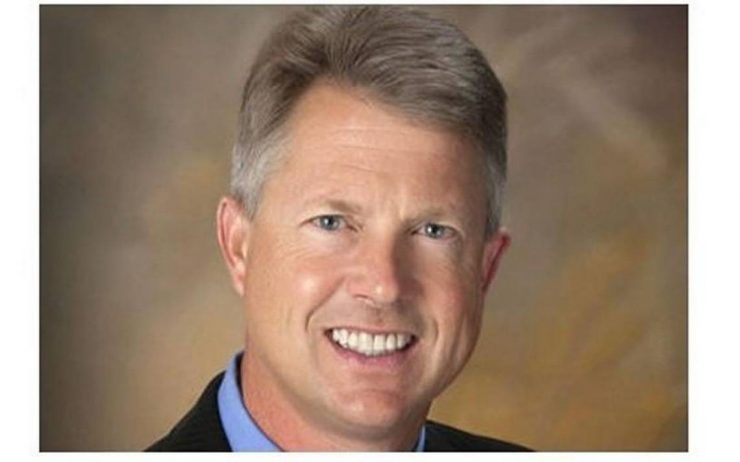
Roger Marshall, an obstetrician, is a Republican U.S. representative from Kansas.
The Hays Area Chamber of Commerce will have a Legislative Coffee at 8:30 a.m. March 11 in the basement of the Ellis County Administrative Center, 718 Main. The East doors will open at 8 a.m., with the event starting at 8:30 a.m.
These forums are a series of meetings with state legislators that provide area residents the opportunity to learn more about the legislative process and state issues. Sen. Rick Billinger and Reps. Ken Rahjes, Leonard Mastroni and Eber Phelps are scheduled to attend.
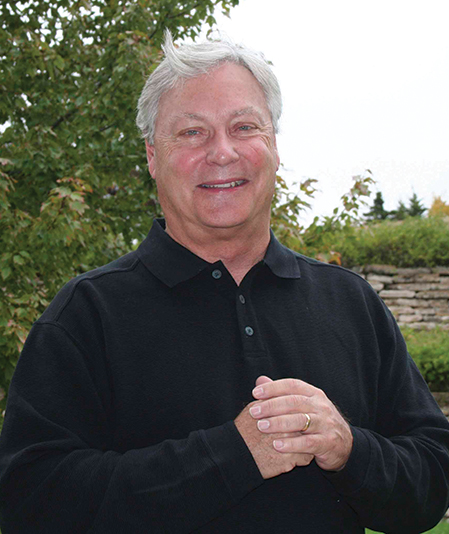
John Richard Schrock is a professor at Emporia State University.
The Kansas Supreme Court decision that funding of Kansas schools is inadequate poses a difficult problem for Kansas legislators. The ruling noted that funding was related to students’ academic success and they took aim at schools that were not adequately serving students in academics.
But one solution has been around for 15 years. And it addresses both the cost of K-12 education in Kansas and also the quality of our students’ education. That solution is school consolidation.
There have been three Kansas consolidation plans proposed.
A 2002 Legislature-commissioned study from Augenblick and Myers found Kansas has 1 percent of the nation’s pupils, 1.6 percent of the nations’s schools and 2.1 percent of the nation’s school districts.
While most states genuinely consolidated their schools long ago, Kansas barely went half way. The study found a few districts too large, but 50 school districts that were far too small. Kansas had 303 USDs at that time. They recommended dropping the number of Kansas districts to either 284 or 255.
At that same time, two Kansas superintendents proposed a model, similar to our regional hospitals and clinics, to consolidate many districts into a few regional school districts, perhaps as few as 50. In both cases, a Kansas student would not ride a bus to school over an hour. But neither plan was adopted by the Legislature.
A February 2010 Kansas Legislative Post Audit again reported the “economic efficiencies” that could be gained by school consolidation. And again the plan was shelved.
This time the Legislature is under pressure to increase both monetary support in Base State Aid Per Pupil and to improve academics. School consolidation addresses both.
The major expense in education is in the salaries of teachers and staff. Education Week just released a study of average salaries of public school teachers. Only 8 states out of 50 pay teachers lower than Kansas, one factor contributing to our rapidly growing teacher shortage. There is even a shortage of substitute teachers and “long term subs.”
Kansas has many counties with several small rural school districts where there is no chemistry or physics or foreign language teachers. Some use less-than-inspiring online programs. Others have a math teacher teach physics out-of-field. Of the 700-plus biology teachers in the state, I estimate that less than 500 are actually competent to teach biology. Teachers who add a biology endorsement for merely taking a biology test-out lack the actual college course with laboratory experience are unlikely to understand and teach accurate biology that is exciting to students.
Many Kansas counties have a bigger city-based school district and one or more rural satellite districts. Those rural districts are more likely to have out-of-field teachers or full time subs “teaching” courses. Rural schools have smaller class sizes but less lab equipment. Merging small USDs with a central regional district eliminates duplication of administrations and would put all high school students under qualified teachers. Nearly all elementary and middle school buildings would remain where they are. Secondary students would ride further to the larger high school.
The three proposed school consolidation plans focused on financial savings by removing administrative duplication. However, consolidation not only increases the number of students under a qualified teacher, but ends the inefficiencies of small high schools that graduate less than 20 students a year. By statute, schools that consolidate get to keep their higher pre-consolidation funding for several years. Intended as an incentive to consolidate, this ironically also prevents any immediate savings.
Rural Kansas continues to de-populate, losing 800-1000 small farms a year. We have seen the gradual forced consolidation of small rural school districts by bankruptcy, from 303 to 286 USDs. The resulting gerrymandered districts lack the logic—and savings—of a state plan.
I personally enjoy the atmosphere of small rural schools. When I arrive to visit a student teacher, the school has the atmosphere of a family working together—quite in contrast to some large school factories.
Local school boards and communities do not want to lose their small high school. We often see that when the high school is closed, a small rural town suffers.
But to provide Kansas students with quality teachers and a quality education today, a major statewide school consolidation is the only solution that addresses our financial crisis, the Kansas Supreme Court ruling, and the academic needs of Kansas students.
Talk to farmers, stockmen and ranchers – most will tell you how much they love their cows. Problem is, this humble and in most cases easy-going beast rarely receives the praise associated with the noble show horse or one of the so-called smartest creatures, the squealing pig.
No one extols the virtues of this contented creature that spends her days quietly grazing and eating grass. We’ve all watched movies about horses Trigger and pigs Babe, but for most of the time, cows are considered boring and ignored by Hollywood, the media and the public.
Still, cows are not whiners and they take their obscurity in stride and rarely complain about their circumstances. Except for a couple of rare occasions, animal rights activists have overlooked this wonderful beast of burden and focused their careful aim on mice, monkeys, rats and other vermin.
Everyone screams bloody murder when some shampoo company tests its latest shampoo on a furry rodent. Where is the outcry for the lifestyle of cows?
They spend days and nights under the stars without a tent or blanket and only their coat to keep them warm. They must hoof it across the pasture just to get a drink of cold water.
But hey, I’m not here to say I feel sorry for the cow community. Confident and quiet, it is not their way to ask for preferential treatment.
Spend time with a herd of cows and you’ll soon discover they are indeed spiritual beings. They live their entire lives in service to mankind.
Behind that seemingly blank stare rests a knowing glint that suggests, “Go ahead. Make fun. I spend all day eating and sleeping. You’re the one with high blood pressure and cash-flow problems.”
Cattle occupy a unique role in human history, domesticated beginning with the Stone Age. Some are raised for meat (beef cattle), dairy products (cows) and hides (both).
They are also used as draft animals and in certain sports. Some consider cattle the oldest form of wealth, and cattle rustling, consequently one of the earliest forms of theft.
Dairy cows are referred to as the foster mothers of humans because they produce most of the milk that people drink. They provide 90-percent of the world’s milk supply.
The best cows may give approximately 25 gallons of milk each day. That’s 400 glasses of milk. Cows in this country give an average of 2,000 gallons of milk per year. That’s more than 30,000 glasses of milk.
Beef cattle supply more than 30 different cuts of meat including the heart, tongue and what we grew up calling mountain oysters – a male private part. You gotta’ admit, that’s meaningful giving.
Another gift from the bovine community is leather that comes from their hides. We use it for boots, belts, baseballs, suitcases, purses, wallets, easy chairs and jackets. Yes, cattle or cows make the ultimate sacrifice for human comfort.
Another place cows shine is in the rodeo arena or as spokesmammals in advertising. Who hasn’t seen the skydiving cows on their television screen?
Another cow celebrity that’s been around for eons is Borden’s Elsie the Cow.
Snorting bulls symbolize a healthy stock market and a Hereford cow pioneered space travel. Every kid knows about the cow who jumped over the moon.
Milk, ice cream, cheeseburgers or that fine leather purse – think about it. Where would we be without our cows?
On any given day, a cow often does more for us than our friends, neighbors, in-laws or even our elected officials. Cows deserve a roaring round of applause and recognition for a job well done.
Anyway, I’d much rather thank a cow and wear a pair of leather boots than sport a mink coat and thank a varmint. I know I’d rather drink milk from a cow than milk from a mink. Enough said.
John Schlageck, a Hoxie native, is a leading commentator on agriculture and rural Kansas.





 Submitted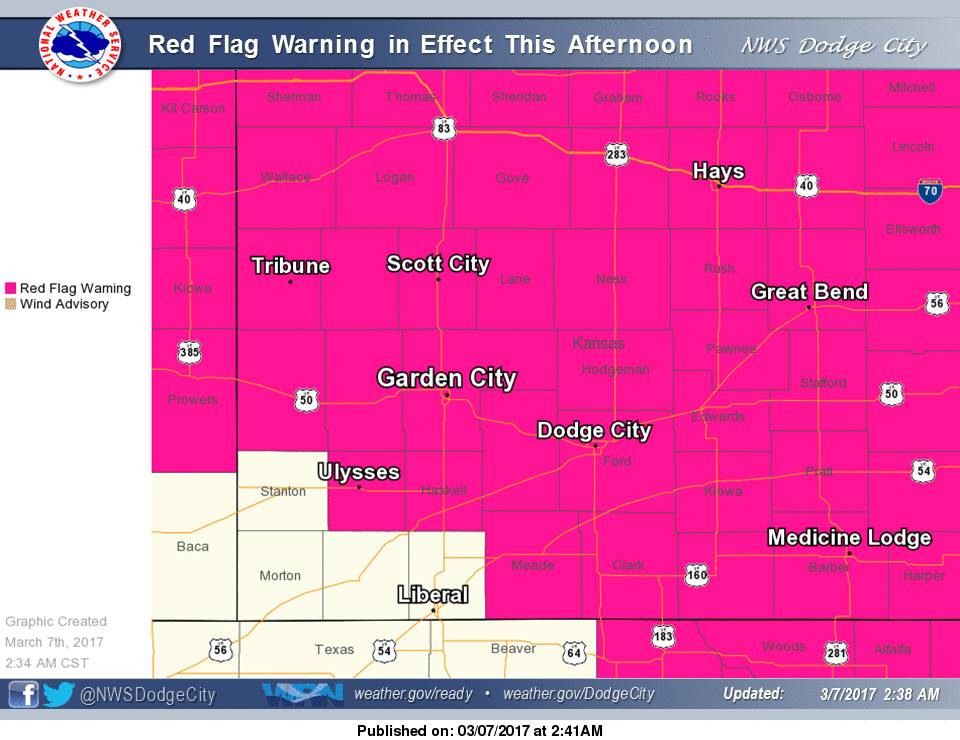


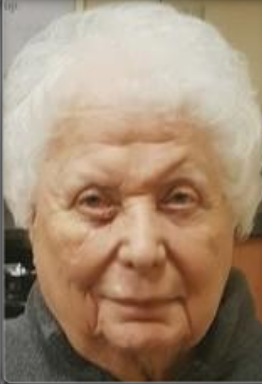
 Vivian M. Kreiser, age 90, passed away on Monday, March 6, 2017 at the Scott County Hospital in Scott City, Kansas. She was born on August 5, 1926 in Middletown, Pennsylvania, the daughter of Raymond J. And Marian Conrad Davies. A resident of Scott City, Kansas since 2009 moving from Middletown, Pennsylvania, she was a assembly line worker for the Hershey Chocolate Factory in Hershey, Pennsylvania.