GEARY COUNTY – Two drivers were hospitalized after they fell asleep in separate Sunday morning accidents in Kansas.
The Kansas Highway Patrol reported just after 7a.m., a 2006 Ford F150 driven by Matthew P. Northcutt, 30, Junction City, was westbound on Interstate 70 just west of U.S. 177.
He fell asleep and the pickup drifted into the median. The driver then overcorrected and the pickup traveled across both westbound lanes and overturned in the ditch
Northcutt was transported to Geary Community Hospital.
Just after 9a.m., a 1998 Ford Mustang driven by Bo Raymond, 31, Yankton, SD., drifted off U.S. 40 just west of Stubbs Road in Shawnee County when he fell asleep at the wheel. The Mustang overturned.
Raymond was transported to the hospital in Topeka.
Raymond was not wearing a seat belt, according to the KHP.
Western Kansas Technology Education Fair at FHSU GMC
FHSU University Relations and Marketing
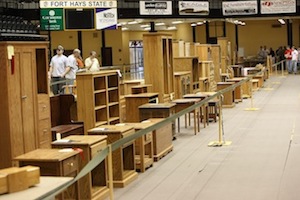
The 58th annual Western Kansas Technology Education Fair at Fort Hays State University is set for Thursday and Friday, April 27 and 28.
The event features junior high and high school students in technology education classes to bring their projects to be displayed and judged at Gross Memorial Coliseum. Students in schools all across Kansas participate in the fair.
They begin converging on GMC Thursday afternoon, delivering their projects to campus for check-in. Then on Friday morning, the coliseum is open to the public for viewing the projects, which range from wood furniture and metal works to CAD drawings and drafting.
Doors open to the public at 8 a.m., and an awards ceremony is set for about 4 p.m.
Each entry is awarded a ribbon or medal. Awards also are given for winners of several live competitions that take place during the day, including communication, metric 500 racing, tech challenge (quiz bowl) and problem solving.
Students in FHSU’s Technology and Engineering Educators Collegiate Association run the entire fair.
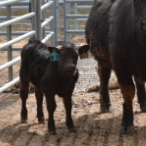
PRESTON, Kan. (AP) — Two southern Kansas farmers are rearing unusual sets of triplet calves.
The Hutchinson News reports that Delbert Ross described the recent discovery of the triplets in a pasture on the line dividing Pratt and Kiowa counties as “pretty special.”
He says it’s been at least 25 years since he’s seen triplets and that one of those calves was stillborn. He’s watching to see whether he’ll have to pull one or two of the calves to bottle rear.
On the other end of Pratt County, near Preston, another set of triplets was born in mid-March at the home of Mike and Sarah Jackson. They raise purebred Simmental cattle that their three daughters show for 4-H.
Pratt Community College agriculture instructor Lori Montgomery says it’s rare to have “live, healthy triplets.”
TOPEKA–The Kansas Creative Arts Industries Commission is now accepting applications for its two main grant categories. The deadline for application submission is May 15, 2017 and the review dates are the week of June 5, 2017. The grant period is from June. 1, 2017 to June 30, 2018. Projects should still be active as of the review date, though relevant expenses made during the entire grant period can be included, projects completed before the review date are unlikely to be funded. The programs and their sub-categories are as follows:
STRATEGIC INVESTMENT PROGRAM
The Strategic Investment Program recognizes the important role creative organizations play in building and sustaining cultural and economic vibrancy in Kansas. By funding a variety of professional and organizational development opportunities that impact cultural programming, these grants support initiatives that use the arts to enhance community vitality, revitalize neighborhoods, generate local business, create and preserve job opportunities and impact tourism. Applicants must make a compelling case as to why this particular self-identified activity or opportunity was selected, how it will have a substantial impact on their work and community, and how it will enhance the national reputation of Kansas.
Strategic Investment Program grants are awarded in three categories:
· Organizational Development: This category provides funding for professional development opportunities for Kansas based arts organizations that help strengthen business practices, increase organizational viability and promote long term sustainability.
· New and Expanded Works: This program provides funding for new or significantly expanded productions, exhibitions, programs or events by Kansas-based nonprofit arts organizations. Projects should either be an entirely new type of program for the organization designed to diversify its services or an expansion of an existing program designed to significantly enhance the quality of current offerings.
· Equipment and Technology: This program provides funding to purchase equipment, materials, and/or technology upgrades to expand or improve an applicant’s organization.
ARTS INTEGRATION PROGRAM
Arts Integration Programs support the role the arts play in all levels of education, community service, and workforce development. This program provides funding for educational institutions, arts organizations, and community service non-profits to use the arts to increase student success, foster creative thinking, develop critical job skills, and enhance community development.
Arts Integration Programs are awarded in three categories:
· Visiting Artists: This category provides funding for eligible organizations to engage and deepen the impact of arts programming on local and underserved audiences through exposure to and interaction with professional visiting arts. Presenters may book artists in any discipline, not just in performing arts. Projects should strive to integrate an arts discipline into non-arts content areas; help interpret an exhibition, performance, or presentation; and support community development goals and objectives.
· Integrated Arts Education: This category supports new or expanded educational programming that integrates arts learning into non-arts curriculum and content areas to address emerging technologies, areas of skills shortages, STEM curricula, workforce readiness, and increase student performance.
· Innovative Partnerships: This category supports innovative programming between arts organizations and non-arts organizations to impact a variety of community and/or economic development goals. Arts organizations are encouraged to partner with other community entities (hospitals, prisons, etc.) to develop arts-centered programs that address community needs such as public health, transportation, tourism, unemployment, aging, corrections, etc.
To review the application process, as well as program and category specific policies and guidelines visit KansasCommerce.gov/CAIC.
Grants will be reviewed by peer panel and awarded at the quarterly commission meeting on June 6, 2017.
All grants are made possible through a partnership with the National Endowment for the Arts and are subject to KCAIC and NEA standards and regulations.
On April 7, 26 grants in 19 communities totaling $139,582 were awarded by the Commission in the above categories.
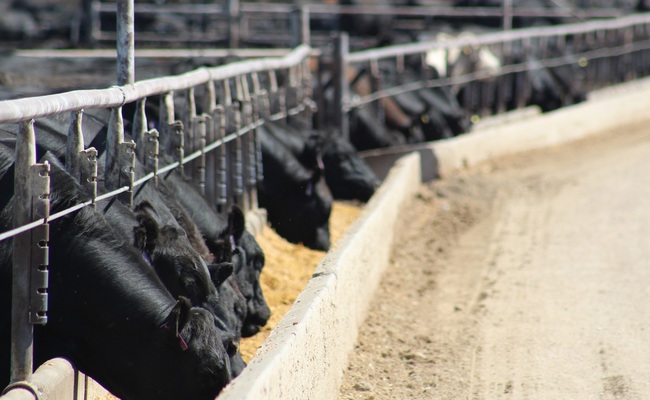
MANHATTAN — The Kansas Department of Agriculture is seeking individuals to participate in an agricultural trade mission to Argentina. Tentatively, the mission will take place July 24-30, 2017. The goal of this mission is to provide an opportunity for Kansas purebred beef cattle producers and allied industry to develop relationships with livestock producers in Argentina to increase market opportunities for U.S. and Kansas beef genetics.
The primary activity during the mission will be to interact with breeders and promote the use of U.S. beef genetics while attending Exposición Rural (Palermo), the major Argentinian livestock show. Kansas ranchers and related agribusinesses specializing in export of Angus and Hereford genetics are invited to participate.
This trade mission is funded in part by the U.S. Livestock Genetics Export, Inc. Selected participants will be eligible for travel stipends for airfare depending upon number of applicants and fund availability. Participants will be responsible for the cost of hotels, meals and other incidental expenses.
KDA strives to encourage and enhance economic growth of the agriculture industry and the Kansas economy by exploring and expanding both domestic and international marketing opportunities.
Individuals interested in participating in the trade mission should complete the application forms available on the KDA website at agriculture.ks.gov/International. The deadline for submitting applications for consideration is Monday, May 22. For more information on the trade mission, contact Billy Brown, KDA agribusiness development coordinator, at [email protected] or (785) 564-6752.
KANSAS CITY, Kan. (AP) — Police have arrested the Kansas man charged with killing the sister of a girl whose kidnapping 17 years earlier sparked a massive manhunt before she was found dead in Missouri.
Kansas City, Kansas, police say Emenencio Lansdown was arrested Sunday morning after a five-hour standoff. Lansdown shot at officers several times before ultimately surrendering around 7 a.m.
Prosecutors have charged the 41-year-old with second-degree murder and criminal possession of a firearm in the death of 34-year-old Casey Eaton of Kansas City. Kansas.
Eaton’s sister, Pamela Butler, was 10 in October 1999 when she was kidnapped while roller-skating near her Kansas City, Kansas, home. The abductor, Keith Nelson, got away, and Butler’s body was later found in Grain Valley, Missouri.
Nelson later was convicted in federal court and sentenced to death.
—————
KANSAS CITY, Kan. (AP) — Kansas City, Kansas, police and federal marshals are asking for the public’s help in finding a man accused of killing the sister of a girl whose kidnapping 17 years earlier sparked a massive manhunt before she was found dead in Missouri.
Prosecutors in Kansas’ Wyandotte County have charged Emenencio Lansdown with second-degree murder and criminal possession of a firearm.
He’s accused of fatally shooting 34-year-old Casey Eaton of Kansas City, Kansas, late Wednesday. Her body was found in a vehicle.
Eaton’s sister, Pamela Butler, who was 10 in October 1999 when she was kidnapped while roller-skating near her Kansas City, Kansas, home. The abductor, Keith Nelson, got away, and Butler’s body was later found in Grain Valley, Missouri.
Nelson later was convicted in federal court and sentenced to death.
Fort Hays State men’s track and field split up this week and competed at a pair of events this weekend. Some of the Tigers attended the Kansas Relays on Thursday-Saturday, (Apr. 20-22), while others traveled to the Tabor College Invitational on Saturday. For the week, the Tigers claimed six top-three finishes and two provisional marks.
Kansas Relays
Decano Cronin (1:50.30) and Brett Meyer (1:52.34) topped the 800 meters finishing first and second respectively. Cronin’s effort also earned a provisional as he now sits tied for seventh in the nation. Meyer also has a provisional from a previous race this year that has him ranked 21st in the nation.
Dillando Allotey picked up a second-place finish in the 200 meter dash. Allotey crossed the line in a time of 21.02, which would have been the 11th fastest time in the nation. However, due to wind calculations being too high, the time does not stand as a quality mark.
Joined by Oscar Carmona, Cronin, Meyer and Allotey teamed up to win the distance medley with a time of 10:11.35.
TJ Dozier also had a provisional mark that came up just an inch shy of his best mark this season. He finished third in the discus with a throw of 172 feet, 2 inches. His best mark this season has him 13th on the national performance list.
Tabor College Invitational Sam Dreiling and Jake Morrow finished first and second respectively in the pole vault for the Tigers. Dreiling led the way with a vault of 15 feet, 5.75 inches and Morrow had a vault of 15 feet.
The Tigers will get back in action next weekend when they partake in separate events once again. Some of the Tigers will head to Des Moines, Iowa on Thursday (Apr. 27) to compete at the Drake Relays, while the rest of the Tigers stay home for the Fort Hays State Open on Friday (Apr. 28).
The storm last week dumped several inches of rain on Ellis County and caused localized flooding problems. The excess moisture has created mold and mildew problems for some Ellis County residents. I’ve received a few calls about controlling mold growth in homes. Since some have called, I suspect that others may be experiencing problems with mold growing in warm, moist areas of homes, offices and other buildings.
(Note: this column was originally published last May after torrential rains created mold problems in the area. The information bears repeating.)
A publication from K-State Research and Extension is available free of charge to help with mold and mildew problems. For your copy, contact the Ellis County Extension Office at 601Main Street in Hays (785-628-9430) and ask for “Controlling Mold Growth in the Home.” You can also find it on the K-State Research and Extension website at www.bookstore.ksre.ksu.edu. Use the search function to search for the publication title.
Molds grow best in warm temperatures and they require moisture to survive. The moisture can come from water leaks, flooding, seepage, high humidity and condensation. Molds require oxygen to grow, but not light, so molds can continue to grow indefinitely in darkness. Molds thrive on organic materials like natural fibers (such as cotton and wool), paper, leather, wood, or surfaces coated with the slightest amount of organic matter such as food, grease and soil.
How do you know if there is mold in your home? Many times, mold can be detected first by a musty odor. Growths of mold can often be seen in the form of a stain or discoloration, ranging from white to orange or green to brown or black.
To control the growth of mold in your home, remember these three steps: 1. Clean it, 2. Dry it, and 3. Disinfect it.
Keep it clean. Regular cleaning of surfaces and household textiles will reduce the food supply molds need to survive. Use a grease-cutting solution of detergent and water to wash hard surfaces like walls, floors, tub or shower enclosures and other susceptible areas. If mold growth has already begun, scrub these hard surfaces well with a brush to remove the discoloration.
Keep it dry. Reduce the moisture produced inside the home. Turn off the humidifier if the humidity level is over 50 percent. Use exhaust fans when cooking or showering and repair any plumbing leaks. Also reduce the sources of moisture coming in from the outside. Seal cracks in the basement, slope the earth away from the house to promote drainage, and be sure gutters and downspouts are clear and working properly. Adequate insulation in walls will help to reduce condensation, and increasing the air circulation with fans in problem areas will keep the moisture level down as well.
Disinfect it. Disinfectants kill mold growing on hard surfaces such as walls and floors. One of the most effective and least expensive disinfectants is chlorine bleach. After the area has been thoroughly cleaned, disinfect with a solution of one cup of bleach to one gallon of water. The area must be kept wet with the bleach solution for ten to fifteen minutes to kill the mold. If large areas of an unfinished basement need to be disinfected, a clean garden sprayer can be used to apply the bleach solution to concrete floors and walls.
Other household items such as carpeting, upholstered furniture, leather goods, clothing and textiles, books and paper products may support mold growth and are much more difficult to clean and disinfect.
The publication “Controlling Mold Growth in the Home” contains specific techniques for preventing and removing mold growth on these items. If flooding or mold damage to home furnishings is extensive, consult a professional with experience in mold clean-up.
The U.S. Environmental Protection Agency also has a helpful website for information on mold prevention and control. For online access, see www.epa.gov/mold.
Linda K. Beech is Ellis County Extension Agent for Family and Consumer Sciences.
TOPEKA–April 26 marks Blue Cross Blue Shield’s 11th annual National Walk @ Lunch Day®. It’s a day to get up out of your chair and get moving toward better health!
Get up from your chair and on your feet! Take a walk April 26 and use the day to jump-start your own daily walking routine, helping improve your health step by step.
For 75 years, Blue Cross and Blue Shield of Kansas has played an active role in helping Kansans lead healthier lives. Those efforts continue today through National Walk @ Lunch Day. The day is designed to encourage busy people like you to take a walk during your lunch break and start a healthy routine. Walking is one of the easiest and most effective forms of exercise and, when done briskly and on a regular basis, 30 minutes of walking can:
Decrease the risk of heart attack, stroke and type-2 diabetes
Improve muscle tone and bone health
Lower the risk of dying from hypertension
Reduce stress
Blue Cross is hosting rallies and one-mile walks in 13 Kansas communities. Downtown workers, elected officials, community leaders and the public are invited to join our employees for a walk. A limited number of free T-shirts are available for participants at each location. Each of these events begins at noon – rain or shine!
We’ll be hosting walks starting at noon in each of the following communities and locations:
Dodge City – Dodge City High School, Memorial Stadium. After gathering for a short rally, there will be a walk around the track. Free T-shirts for the first 100 walkers!
El Dorado – East Park. Walkers will gather for a short rally, followed by a 30-minute walk along the park’s walking trail. Free T-shirts for the first 100 walkers!
Emporia – Emporia State University, Union Square. Walkers will gather at Union square for a rally and then walk through campus. Free T-shirts for the first 150 walkers!
Garden City – Harold Long Park. This park will host a short rally before the walk begins on the trail at the park. Free T-shirts for the first 100 walkers!
Hays – Hays Recreation Commission. The Recreation Commission, located at 1105 Canterbury Drive, will be the site of the walk. Free T-shirts for the first 100 walkers!
Hutchinson – DCI Park & Gazebo. DCI Park & Gazebo is the gathering spot from which participants will depart for a walk down Main St. to the Avenue A Park, along the park’s walking route and back to DCI Park. Free T-shirts for the first 150 walkers!
Independence – The gazebo at 6th and Myrtle. After gathering for a short rally, there will be a walk on the park’s walking route. Free T-shirts for the first 100 walkers!
Lawrence – Rock Chalk Park, Sports Pavilion. Walkers will gather for a short rally, and will then walk on the outdoor or indoor track (depending on the weather). Free T-shirts for the first 100 walkers!
Manhattan – City Park. The City Park will host a small rally and then walkers will begin the walk on the trail in the park. Free T-shirts for the first 100 walkers!
Pittsburg – Trail Head/Watco Park. The gathering spot is Trail Head Park, 11th and Broadway, for a one-mile walk on Watco Trail. Free T-shirts for first 100 walkers!
Salina – Campbell Plaza. After gathering at Campbell Plaza for a short rally, participants will embark on a one-mile walk along Santa Fe Ave. Free T-Shirts for the first 150 walkers!
Topeka – Kansas State Capitol, South Grounds. After a brief rally near the south stairs, there will be a walk around the perimeter of the statehouse grounds. Free T-shirts for the first 300 walkers!
Wichita – Wichita Regional Chamber of Commerce. The Chamber office at the corner of W. Douglas and Waco will be the gathering spot ahead of a one-mile walk along the Arkansas River. Free T-shirts for the first 250 walkers!
Visit bcbsks.com/walk for additional details about the benefits of walking and where you can meet us at each walk location.
Growing consumer interest and trust in agriculture is a lot like managing your crops; there are much higher yields when the inputs are applied during the growing season. This is where the Kansas Foundation for Agriculture in the Classroom (KFAC) comes in. KFAC’s core mission as a 501(c)(3) non- profit organization is “connecting classrooms to Kansas agriculture.”
“The Kansas Foundation for Agriculture in the Classroom is a tangible way to connect teachers across the state to great resources about agriculture,” said Cathy Musick, Executive Director of KFAC. “We’re there working hand-in-hand with Kansas teachers. We’re able to provide them with materials that enhance classroom learning with ag-based curriculum that help students connect real-life scenarios to the content they learn about every day.”
This past year KFAC provided agriculture literacy resources and training to 259 teachers which reach 6,600 students across the state. In their quest to increase agriculture literacy, KFAC offers three main delivery methods to Kansas teachers: A+STEM, Summer Conference and a Summer Institute. The A+STEM (Agriculture plus Science, Technology, Engineering and Math) is a half day in-service training for school districts. The one day Summer Conference allows KFAC “master teachers” to present workshops to their peers that demonstrate how they incorporate agriculture into their everyday curriculum. This year’s three day Summer Institute is titled, ‘Plants and Animals Have a Place in the Classroom,’ and provides lesson plans that may be used to help students reach Kansas educational standards. If you, or someone you know, is interested in attending these workshops, please head to www.ksagclassroom.org.
“It’s always exciting to see the light bulb go off for teachers as they realize how valuable the real-life connections are to the materials that they teach every day,” said Musick. “Teachers know that when these materials spark curiosity for themselves, it’s sure to do the same for their students.”
Many teachers, both in Kansas and out of state, have been excited to learn about Kansas pork and dairy farms with the innovative Virtual Farm Tours offered by KFAC, in partnership with Kansas Pork and the Kansas Department of Agriculture. These programs have given hundreds of students a unique opportunity to see the inside workings of Kansas farms and ask real farmers questions about their operations all from the comfort of their classroom.
If preserving agriculture’s place in Kansas classrooms is important to you, there are several ways you can help! One of the most visible can be seen on dusty backroads and city streets alike. The “Agri-tag” is a specialty license plate promoting agriculture that can be purchased from your county treasurer at the time you pay taxes. This provides a $35 donation to KFAC. You can also become a member of the Agriculture Advocate funding team by submitting a yearly donation, participate in KFAC fundraising efforts on Giving Tuesday, November 28th, 2017, or through Grow Green Match Day, April 21st every year.
KFAC is an organization that is funded entirely from the private sector. For more information on KFAC, how to be involved, and how to donate, please head to www.ksagclassroom.org.
The Criminal Justice Club at Fort Hays State University, in collaboration with area law enforcement, is hosting Cookies with Cops on Tuesday, April 25, from 4:30 to 5:30 p.m. in the Sunset Lounge Atrium at the Memorial Union.
This is a come-and-go event intended to promote positive relationships between the general public and law enforcement agencies. Attendees will have the opportunity to visit with law enforcement officials, bringing questions, concerns, or simply conversation to the event.
Kansas Highway Patrol Trooper Tod Hileman will have a live Facebook feed during the event to respond to questions that are posted on Facebook. In addition, cookies and beverages, including water, iced tea, and coffee, will be available.
Participating law enforcement agencies include Hays Police Department, Ellis County Sheriff’s Department, Kansas Highway Patrol, FHSU Police Department, Kansas Department of Wildlife and Parks, and the Ellis Police Department. Other agencies have been invited and could be added to the list of participants.
John Richard Schrock is a professor at Emporia State University.
As scientists march for more appreciation and recognition of science in the United States, many are overlooking that scientists themselves share a major part of the blame for the American population being science illiterate. Our public school students study barely one-third the science course work of students in other countries.
The American Association for the Advancement of Science (AAAS) is the largest group of scientists in the world and a major sponsor of the March for Science. They publish the weekly journal “Science” and I am among their 120,000 membership. But the AAAS is directly culpable for the science ignorance of Americans.
In the late 1980s, I was a science professor invited to sit on the local high school science curriculum committee. We were designing advanced courses for students who wanted to pursue more biology, chemistry, physics and earth sciences. But before the committee had finished, an administrator rushed in with a hot-off-the-press AAAS policy: “Less Science, Not More.” That simple-minded theme shut down any new advanced science sources in high schools across the country.
In the 1980s, many science teachers had been upgraded by NSF Academic Year and Summer Institute that greatly increased their science knowledge. Kansas State Teachers College was one major site, and the KSTC-trained teachers went back to their schools from Florida to Alaska and Arizona to Maine with an enthusiasm and desire to teach more science. But the AAAS “Less Science” halted this drive for more science and even gave school administrators ammunition to reduce science offerings.
I wrote to the education section of AAAS under F. James Rutherford, author of the motto, and received the reply that it was not their intention to reduce science, just that the current science should be taught better. But the AAAS was clueless about how their policy was being understood in the field. They soon released their next theme: “Science for All Americans.” This again prevented any expansion of more advanced courses because it focused science teaching on delivery to all students—basic literacy only. The smaller group of students who had an interest in advanced science were ignored.
While AAAS is comprised of nearly all scientists, their education branch is not. Instead the AAAS has followed Education School philosophies that believe that advanced science not necessary. Future citizens do not need to know more science in this Internet Age. —Folks can always look things up online.
Numerous scientists complained to AAAS about the “less science” problem in our school curricula, but AAAS has remained tone deaf. As a result, America now ranks with Afghanistan in anti-vaccination belief. Pharmacists must read simple prescription instructions to us. And each of us pays several thousand dollars more per year in higher medical costs—due to ignorance about our anatomy and physiology—in higher health care costs, medical insurance, and stupid jury decisions.
Foreign exchange students come to our public schools and find themselves well beyond grade level, while our students go overseas and find themselves far behind in science.
America has to “buy” most of its engineers and physicists from overseas, and foreign students make up the majority of U.S. college degrees in those areas. In the 1980s, we only accepted into medical school the top 1/4th of students who took the MCAT. By 2000, we were taking nearly half. Now NPR reports that only 40,000 sit for the exam to fill 30,000 MD/OD school positions. Our science pipeline is going dry.
Every American student should have a full high school year of anatomy/physiology/microbiology merely to be a good patient. —And another full year of zoology/botany/ecology in order to sensibly understand the environment. And far more advanced high school science courses should be available for students attracted into science. But we don’t even have enough science teachers to cover our current anemic curriculum.
“The future belongs to those countries that make friends with science,” said India’s Prime Minister Nehru a half century ago. Unfortunately, the U.S. is not friendly to science. The guilty parties are not just the government and public. The science community and AAAS itself shares part of the blame.
The social and health effects of isolation on some rural Kansas residents spurred three Catholic nuns to convert a storefront in Concordia into a drop-in center where women can find support and resources.
Sister Loretta Jasper cut the ribbon on the Neighbor to Neighbor drop-in center on Cedar Street in Abilene, Kansas in February. BRYAN THOMPSON / KCUR
Seven years after the center opened, two dozen women on average come through each day in the town of about 5,000 to socialize, do laundry, get a cooking lesson, or simply connect with others.
Sister Pat McLennon, who helped launch Neighbor to Neighbor in Concordia and still serves as its co-director, says the center started as a place for women in the community to teach skills to young mothers in poverty while providing enrichment activities like reading and music to their kids. But it quickly drew women of all ages, including some helping as volunteers and others fulfilling mandated community service.
McLennon says Neighbor to Neighbor serves as a complement to social service agencies that provide utilities or food assistance. The women who visit the center have come to look out for each other, sharing tips about job opportunities or just checking in.
“It’s just the neighborly way that people can help one another,” McLennon says.
Sister Loretta Jasper, a nun from the same order who works as a mental health counselor in Abilene, says some adults have difficulty coping with small-town life.
“They don’t have a safe or a healthy support system, or maybe they’re very isolated, or maybe they don’t have anyone who’s really going to listen to them,” she says.
That got Jasper wondering if Neighbor to Neighbor could be replicated in Abilene, a town of 6,600 about 75 miles southeast of Concordia. Beyond their size, the towns share other similarities including poverty level and average income.
Some of the women Jasper counsels have had children taken into state custody and are working to be reunited with them. Many are under orders to complete substance abuse or mental health counseling.
But mandated treatment programs can be restrictive.
“There are goals that need to be accomplished in order for the person to continue,” says Jasper. Job responsibilities, childcare conflicts or lack of transportation can get in the way. “And if they can’t do it, then they’re automatically removed from continued services.”
Jasper says sometimes what the women really need is to have access to support in a casual setting. The new drop-in center in Abilene, that Jasper is now heading, offers parenting classes and 12-step programs without any required commitments.
Patti O’Malley, who has been working with Jasper to bring Neighbor to Neighbor to Abilene, knows the value of such programs from personal experience. A stockbroker in town, she says she started drinking too much wine after the market crashed in 2008. She went through rehab herself. Then her teenaged son, who was also struggling with addiction, died in a car crash.
“When I lost my son, I felt like I had a choice,” O’Malley says.”It was roll up in a ball and give up, or do something with all that love that I had for my son.”
O’Malley chose the second option, and founded the Cedar House, a residential facility for women recovering from addiction. Sister Loretta Jasper chairs the board of the Cedar House Foundation, which is also providing funding for Neighbor to Neighbor.
Among the women at the sober house, O’Malley says one idea seems to resonate.
“The same word kept coming out as the word, and the word was ‘community.’” She says it’s that feeling of connection with each other that helps the women stay sober.
Risks of isolation
The need for connection is human nature, according to Carrie Henning-Smith, a rural health researcher at the University of Minnesota.
Patti O’Malley, a stock broker in Abilene and in recovery herself, founded a sober house and helped launch the drop-in center in town. CREDIT BRYAN THOMPSON /KCUR
“So, finding ourselves in situations where there are not opportunities to meaningfully engage with other people is not how we’ve evolved to live,” says Henning-Smith.
And Henning-Smith says social isolation can be downright dangerous.
“It can be as harmful to your health as smoking cigarettes, as being severely obese,” says Henning-Smith.
The danger goes beyond being a risk factor for chronic illnesses.
Suicide rates are higher in rural areas than in urban settings, due at least in part to isolation and loneliness. In fact, according to the most recent data from the CDC, the rate of suicide in counties with fewer than 50,000 residents — like Dickinson and Cloud counties, home to Concordia and Abilene respectively — was nearly double the rate in counties with more than a million people.
Abilene Police Chief Mike Mohn sees the effects of isolation firsthand.
“We do see, on the suicide part of it over the last several years, an increase in dealing with people that have concerns and problems,” says Mohn.
Mohn says the new drop-in center gives women in the community one more resource.
Neighbor to Neighbor in Abilene is already offering a daily free lunch and knitting classes, and Sister Loretta is teaching a seminar on self-management of chronic pain.
O’Malley sees the need for a place to connect and get support even among her financial consulting clients.
“I work with the public, and I work with recent widows and recent widowers, and I see what happens very quickly, the loneliness — and sometimes the deterioration that happens with that loneliness,” O’Malley says.
Researcher Henning-Smith says the health benefits of human connection alone, while difficult to quantify, shouldn’t be underestimated.
“Connecting people with each other, connecting people in community, presents opportunities for friends, for neighbors, to say, ‘Hey, have you been to the doctor? Are you keeping up with your medications?’” says Henning-Smith. “It can impact mortality risks in ways we can hardly even begin to understand.”
Bryan Thompson is a reporter for the Kansas News Service, a collaboration covering health, education, and politics across the state. You can reach Bryan on Twitter@KSNewsBryan.