We have a brand new updated website! Click here to check it out!

Plan Phases $750M More for Kansas Schools

By SAM ZEFF

Kansas lawmakers worked deep into the night on a school funding formula. A bill failed to pass out of committee. The K-12 Budget panel resumes work Monday.
CREDIT SAM ZEFF / KCUR

A Kansas legislative committee worked eight hours Thursday night and didn’t come up with a new school funding formula.

But we now know the goal for how much new money will be added to try and satisfy the state Supreme Court which has ruled school funding in Kansas is inadequate.

“Our target was a $150 million over a period of five years, to escalate up slowly to a more constitutionally appropriate number,” says Rep. Melissa Rooker, a Republican from Fairway and a driving force to find more money for public education.

By adding $150 million more each year for the next five years, lawmakers will gradually increase public school funding by $750 million. Most believe that final figure will pass constitutional muster.

Rep. Ed Trimmer from Winfield, the ranking Democrat on the K-12 Budget Committee, says that’s the minimum the Legislature has to find. “Otherwise we’ll be back here doing this same thing again after the court tells us that’s not enough money.”

There is concern by some on the committee that a five year ramp up may not be quick enough to satisfy the court. Lawyers for the plaintiff school districts that sued the state have said they would accept some phase in of new money.

“So as long as the court stays engaged and there is a commitment that gets fulfilled, we can figure out how to make it work,” says David Smith, chief of staff in the Kansas City, Kansas school district, which is one of the plaintiff districts in the Gannon school funding case.

The chairman of the committee, Rep. Larry Campbell from Olathe, said he’s aiming for the $150 million figure. But it appears some conservatives on the K-12 Budget Committee as well as some in the GOP House leadership may have a problem with that much more money.

Leadership delayed the hearing for two days in part to arm twist some Republican members into supporting putting only $75 million more into schools.

The hard ball apparently continued Thursday night as several amendments that added money into public education passed the committee on close votes. During an extended break, a number of people saw Republicans called into the office of House Speaker Ron Ryckman from Olathe. After the break, several moderate and Democratic amendments failed.

One of the swing votes on the committee was Rep. Adam Smith, a freshman from Weskan, which is right next to the Colorado border. He voted for several amendments backed by moderates and Democrats on the panel.

He says he wasn’t pressured by leadership. “Most of my interest lies with my district back home, and the people I talk to back home on the programs that are important to them that’s what I tried to support the most.”

The amendment that held up final action dealt with adding more state aid into student transportation. There wasn’t an immediate figure for what that would cost. It’s a pretty big item, so Campbell decided to wait until a dollar figure was available.

Campbell says the committee will finish its work Monday and then the bill will head to the Kansas House floor.

There are a couple of looming deadlines. First, the Legislature has its first adjournment next Friday. And if a new, constitutional funding formula isn’t on the books by June 30, the high court has said it will shut down public schools.

Sam Zeff  covers education for  KCUR.org and the Kansas News Service. Follow him on Twitter @SamZeff. 

Gov. Brownback proclaims April “Safe Digging Month” in Kansas

kansas-one-call-before-diggingOFFICE OF GOV.

TOPEKA – Governor Sam Brownback recently issued a proclamation declaring the month of April as “Safe Digging Month” in Kansas. The proclamation, in concurrence with National Safe Digging Month, reminds Kansans to call 811 before starting any outdoor that requires digging—including landscaping and home improvement projects. Calling 811 is a no-cost, convenient way to avoid injuries, property damage and outages.

The Kansas Corporation Commission, Kansas One-Call, the Kansas Pipeline Association, the Common Ground Alliance, and Governor Brownback are encouraging excavators and homeowners to call 811 before they begin digging projects to prevent injuries, property damage, and inconvenient outages. A utility line is damaged by digging once every eight minutes nationwide, and one-third of those incidents are caused by failure of the professional excavator or homeowner to call 811 before digging.

When dialing 811, callers are connected to Kansas One-Call, which notifies the appropriate utility companies of the intent to dig. Calls are taken 24 hours a day, seven days a week. Requests can also be entered at www.kansasonecall.com. Excavators and homeowners are required to make a request at least two working days in advance of beginning a digging project. Professional locators are then sent to the requested digging site to mark the approximate locations of underground lines with flags or spray paint. Once lines have been accurately marked, digging can begin.

Every digging project, no matter how large or small, requires a call to 811. There is no charge to have utility lines marked. The depth of utility lines varies, and there may be multiple lines in a common area. Some utility lines are buried only a few inches below the surface, making them easy to strike during shallow digging projects. Installing a mailbox, landscaping, putting in a fence, and building a deck are all examples of digging projects that necessitate a call to 811 before starting.

Learn more about 811 and Safe Digging Month by visiting: www.call811.com. More information about Kansas One-Call is available at: www.kansasonecall.com.

Dreaming Big – April 2017

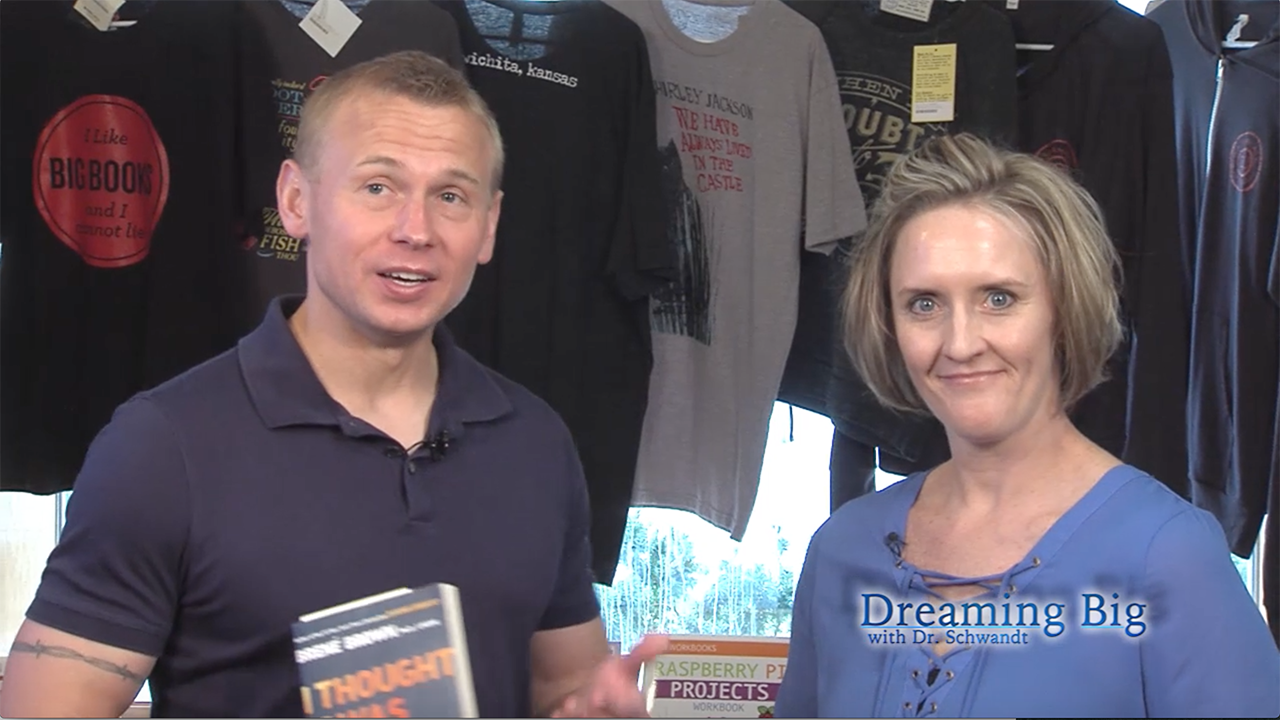
Dr. Jamie Schwandt and his guest discuss how you can dream big, think positive and take action. In this episode, Sabrina William, Director of the Management Development Center at Fort Hays State University, talks about her job, and how she has overcome obstacles in her personal life to accomplish things she would not have otherwise.

Apply for 2017 Nonresident Deer Permits online April 1-28

White-tailed_deerKDWPT

PRATT – Beginning April 1, hunters interested in obtaining a nonresident deer permit may begin the online application process by visiting www.kshuntfishcamp.com. The cost to apply is $442.50 for hunters 16 and older and $117.50 for hunters 15 and younger, plus processing fees. Deadline to apply is April 28. Permits are awarded though a random computer drawing, so applying early will not give hunters any advantage in the lottery draw.

Hunters interested in purchasing a preference point in lieu of applying may do so for $25, plus processing fees.

A total of 21,816 nonresident white-tailed deer combo permits are available for the 2017-2018 season, and hunters drawing archery or muzzleloader white-tailed deer combo permits in units 1, 2, 3, 4, 5, 7, 16, 17 or 18 are eligible to apply for a mule deer stamp ($152.50). Those who draw a mule deer stamp drawing will have a permit valid for either species/either sex. Nonresident deer permits will be distributed among the deer management units as follows:

Unit 1: 850 (50 mule deer stamps)

Unit 2: 466 (40 mule deer stamps)

Unit 3: 1,002 (20 mule deer stamps)

Unit 4: 492 (5 mule deer stamps)

Unit 5: 656 (10 mule deer stamps)

Unit 6: 538

Unit 7: 1,603 (2 mule deer stamps)

Unit 8: 1,940

Unit 9: 981

Unit 10: 1,252

Unit 11: 3,109

Unit 12: 2,076

Unit 13: 621

Unit 14: 1,856

Unit 15: 1,405

Unit 16: 2,103 (5 mule deer stamps)

Unit 17: 562 (50 mule deer stamps)

Unit 18: 304 (20 mule deer stamps)

The 2017 deer season will be open Sept. 2-10 for youth and disabled hunters; Sept. 11-24 for muzzleloader season; Sept. 11-Dec. 31 for archery season; Oct. 7-9 for the pre-rut white-tailed deer antlerless-only season; and Nov. 29-Dec. 10 for firearms seasons.

Extended firearms seasons will be open Jan.1 in Units 6, 8, 9, 10, 16, or 17; Jan. 1-7 in Units 1, 2, 3, 4, 5, 7, 11, 12, 13, or 14; and Jan. 1-14 in Units 10A, 15, or 19.

For more information on deer hunting in Kansas, visit ksoutdoors.com and click “Hunting,” “Big Game Information,” then “Deer.”

Copyright Eagle Radio | FCC Public Files | EEO Public File