Voting has begun in Lang Diesel’s third annual 4-H Video Contest.
The video with the most fan votes when the contest ends will win a grand prize, consisting of a $1,000 donation to their 4-H club and an LDI grill-out for the whole 4-H group.
Voting runs for one week only — May 1 through May 7. Each Facebook user is limited to one vote per day.
Last year was the second year for LDI’s 4-H video contest with seven videos submitted from 4-H groups across the state. Good Hope 4H group of Ellis County was last years winners. Good Hope’s video, “So God Made a 4-H’er” featured pictures of members’ favorite 4-H moments and activities. The $1,000 donation went to help with new projects and activities.
“4-H programs make a positive impact on young people and provides them leadership and enrichment opportunities that last a lifetime,” stated Shelly Macumber, Marketing Director at LDI. “At LDI, we strive to give back to the communities across Kansas in which we live and work and are thrilled to support our future leaders.”
For more information on the LDI 4-H Video Contest, visit Lang Diesel Inc Facebook page or stop by one of the 12 dealerships located throughout Kansas.
Families across the nation turn to beef as a main course on the dinner table. During Beef Month in May we celebrate the Kansas beef producers and processors who help to fill our collective dinner plates as we savor the uniquely delicious flavor of beef.
While man has appreciated the juicy meatiness of beef for centuries, modern science is responsible for helping us understand the origin of the taste we crave.
I’m talking about umami (pronounced oo-MOM-ee)– derived from the Japanese word for delicious– which describes the taste of meaty, savory goodness.
To fully appreciate umami, we need to go back– probably to junior high biology, when you drew a map of the human tongue and identified the areas of the four basic tastes: sweet, sour, salty and bitter. You were probably taught that the flavor of foods came from a combination of these four basic tastes along with other sensations such as aroma, texture, juiciness, mouthfeel and color.
Fast-forward to 1997, when a researcher at the University of Miami Medical School identified taste buds on the tongue that respond to umami, making it the bona fide “fifth taste.” Umami has been described as “meaty and savory” or “yummy” or “indescribably delicious.”
The ability to detect these five tastes has been key to our survival through the ages, directing us toward foods vital for health and growth, and away from potential poisons. Sweet means energy-giving carbohydrates. Salty indicates essential minerals. Umami signals life-giving protein. Sour says “proceed with caution” since many foods sour as they deteriorate. And bitter warns “spit it out” because many natural toxins taste bitter.
When it comes to flavor, small is big!
Dr. Harold McGee, author of On Food and Cooking, points out that big food compounds such as carbohydrates, proteins and fats are not very flavorful, but their smaller component parts (sugars from carbohydrates, amino acids from proteins and fatty acids from fats) are extremely flavorful. Sources of umami are amino acids and nucleotides– small, intensely flavorful components. Aging, fermenting, ripening and cooking are all great ways to break big compounds down into these flavorful gems.
We’ve also learned that umami compounds are synergistic– which means that the whole is greater than the sum of its parts. Combining two umami ingredients can produce EIGHT TIMES as much flavor as either one of the compounds alone. Talk about tasty!
Since May is Beef Month, it’s appropriate to note that beef comes with three natural sources of umami: glutamic acid, glutamate, and nucleotides– all of which account for its great natural flavor. It’s also no accident that beef is often paired with ingredients such as cheese, bacon, mushrooms, wine and tomatoes. These foods contain umami, too, creating the complex, delicious flavors that make the finished beef dish many times more appealing.
The meat industry is responsible for as much as $12.9 billion in economic activity in Kansas. Meat packing and prepared meat products manufacturing make up the largest share of the food processing industry in our state and this industry provides employment for over 18,700 Kansans. While we celebrate the Kansas beef industry in May, we now know that umami accounts for the delicious flavor in our favorite beef dinner.
For more information about choosing and serving beef to your family, contact the Ellis County Extension Office for the Extension publication, “Beef: Choices, Preparation and Flavor” or find it online at the K-State Research and Extension Bookstore at www.bookstore.ksre.ksu.edu.
Linda K. Beech is Ellis County Extension Agent for Family and Consumer Sciences.
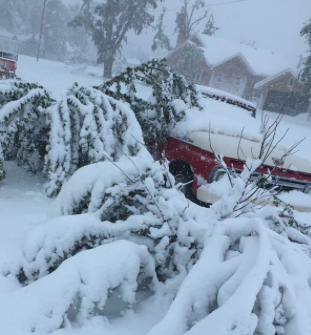
April 30 in Moscow, Kansas (Photo courtesy Jennifer Owens)
OFFICE OF SEN. MORAN
WASHINGTON – U.S. Senator Jerry Moran (R-Kan.) this week spoke on the Senate floor to highlight the snow storms that hit Kansas and surrounding states over the weekend, destroying crops and killing livestock.
“These storms are another vivid reminder of the challenges faced each day by farmers and ranchers trying to produce a crop or raise cattle,” Sen. Moran said. “In agriculture, a family’s economic situation can change at a moment’s notice. A weekend weather event causes a simple inconvenience for most people – for ag producers, it is the difference between having a crop to harvest or having nothing to sell at the end of the year.”
About 75 percent of the cattle on feed in the United States are located in the area hit by the storm. Feedlots are reporting that the death loss will be in the thousands of head. This impact comes only weeks after wildfires in Kansas destroyed ranches and killed thousands of cattle.”
The Hays Police Department will conduct training on May 10 between the hours of 2 and 7 p.m. at 1207 Hall.
Police officers will be training with special tactical equipment. This training is being done with great care and safety, the department said in a news release.
Residents may see law enforcement officers move through your area. There is no need to be alarmed. The officers are merely conducting a realistic training exercise and there is no danger to the community.
If you have any questions or concerns, you may contact the on-site supervisor (Team Commander Tim Greenwood or Team Leader Aaron Larson), or Chief Scheibler at 785-625-1030.
John Richard Schrock is a professor at Emporia State University.
After the spring prairie fires are over, the black ground turns to lush green and the cattle begin
grazing. Meanwhile, unburned fields languish as a few green grass shoots remain hidden in the
dead dry grass stems.
–So why is the grass so much more lush in the field on the burned side of the fence?
The contrast is dramatic along a fenceline where one side was burned but the other side was
left “old field.” Any veteran Kansas farmer or rancher can list the reasons:
• Burning brings most of the nutrients in last year’s dead grass down to the black layer on
the ground that then washes into the soil. But nutrients in the dead grass that stands unburned are
still in the air, unavailable to the new grass roots.
• The barren black soil rapidly warms under the sun; but the dead unburned grass shades the
old field, keeping the ground cooler into the spring.
• New blades of grass on the burned area are basking in the sunlight. But the tall dead grass
in the unburned field shades the new grass blades trying to emerge from below.
The increased plant production after burning was obvious to the earliest Kansas farmers and
ranchers. They could see the results in more harvest in crops and beef, even if the actual
measurement of biomass had to await later research.
But whether the fires are man-made prescribed burning each season, or sporadically sparked
by lightening, it is obvious that the grasslands are adapted to fire.
In this photo taken on the Konza Prairie Biological Station, it is obvious how annual burning has benefited the grass vegetation on the left. The area on the right is burned only every 20 years and is becoming shrubs and trees. Photo credit: Bill Jensen
In the photo taken on the Konza Prairie Biological Station, it is obvious how annual burning
has benefited the grass vegetation on the left. The area on the right is only burned every 20 years
and is becoming shrubs and trees.
Plants and animals that thrive under burn conditions are usually “fire positive.” The grass has its
growing tissues, called meristem, down at the ground surface, protected from the overhead
flames. That is why our lawn grass does not die when we cut the tips of the grass leaves when we
mow.
But shrubs and trees grow at their branch tips, and fire kills those growth tissues. Shrubs and
trees are mostly “fire negative.”
Animals are likewise fire-positive, fire-negative or sometimes a combination.
Our state bird, the western meadowlark is dependent on the grasslands and the fire that
maintains the grass vegetation. Fire-positive critters burrow under, slither around, or fly over prairie fires.
Red cedars are among the fire-negative plants. And cedar waxwings that feed on their blue-
coated seeds are fire negative too.
Stop the prairie fires and much of eastern and central Kansas would gradually change from
grasslands to cedar trees.
And the cedar waxwing could become our state bird.
[More information on “Prairie Fires” is available in the Kansas School Naturalist available
free upon request from [email protected].]
Attorneys for two convicted murderers argued this week that the Kansas Supreme Court should overturn their death sentences.
Carr Brothers
Jonathan and Reginald Carr were sentenced to death for the 2000 murders of four people in Wichita.
Sarah Ellen Johnson, an attorney representing Jonathan Carr, called the original proceedings 15 years ago “filled” with errors to the point where it wasn’t a fair trial.
“Did the accumulation of errors have any effect on the jurors’ verdict? I don’t see how it couldn’t have,” she said.
Attorney Debra Wilson argued that one of the errors blocked Reginald Carr from offering a complete defense.
“How reliable is a sentence of death from a jury that wasn’t given access to the information?” Wilson asked.
Attorneys for both brothers pointed to the fact that they were tried and sentenced together as one of the problems. However, David Lowden, arguing for the state of Kansas, said the issues in question would not have affected the outcome.
“Any error … pales in comparison to the strength of the evidence,” Lowden said.
Sedgwick County District Attorney Marc Bennett said some of the alleged problems at the trial were not actually errors at the time. He said legal precedent has changed.
This is the latest step in a long legal battle. The state Supreme Court previously overturned the death sentences, but they were later reinstated by the U.S. Supreme Court.
Bennett said the long time frame is to make sure the process is careful and accurate.
“It is a slow process by design. I don’t think that there is a fast track to the death chamber,” Bennett said.
Nate Henderson portrays bassist Victor Wooten during the Famous Figures competition Friday.
Cesar Chavez rallied farm workers, CoCo Channel glammed it up with her fashion and bassist Victor Wooten rocked out with a full auditorium at the Beach/Schmidt Performing Arts Center at Fort Hays State University.
Twenty-eight fifth-grade students competed Friday in the annual Famous Figures competition.
The contest is open to any fifth grader in Ellis County. The students are selected by their schools to compete in the final contest, which is coordinated by the Hays Arts Council and sponsored by the Hays Rotary Club.
Students give performances in costume that are two to three minutes long as a famous figure or historical characters.
A judging paneling then asks them a question or two in character about the figure they are portraying.
Students are scored on their material, script creativity, acting and response to questions.
Brenda Meder, executive director of the Hays Arts Council, said the event went beautifully.
“This group of kids were as respectful, professional, dedicated and motivated as any adults,” she said.
Leonardo Hernandez, fifth grader at O’Louhglin Elementary School, said he chose to portray Cesar Chavez at the urging of his mother who said he had a resemblance to the champion of the migrant farm worker movement.
“He was a lot different,” said Hernandez, who placed first in the competition. “He had a unique personality, and he helped people in need.”
Jacob Wente portrays Fred Astaire at the Famous Figures contest Friday.
Brendon Stults, fifth grader at Wilson Elementary, said he chose to portray John Elway because his family has always been Broncos fans. He said he learned new aspects of his idol’s life.
“I didn’t know he liked baseball and track as a kid,” Stults.
Jacob Wente watched videos to prepare for his roll as FredAstaire.
“I like dancing, and he just popped into my head. He is a really fun actor,” he said.
The winners of the contest are as follows:
1st Place — Cesar Chavez — Leonardo Hernandez — O’Loughlin
2nd Place — CoCo Chanel — Madighan Norris — Holy Family
3rd Place — Victor Wooten — Nate Henderson — Wilson
4th Place — Apacia of Alexandria — Jessica Feyerherm — Lincoln
5th Place (tie) — Elizabeth Blackwell – Madelyn Rozean — Holy Family
5th Place (tie) — Martin Luther – Christian Burkholder — Roosevelt
5th Place (tie) — Elizabeth Bacon Custer – Beth Bowles — Roosevelt
Additional participants included:
Grace Kelly – Hannah Klein — Roosevelt
Milton Bradley – Elijah McCulloug — Wilson
Melania Trump – Mahala Gregg — O’Loughlin
Carroll Shelby — Austin Carroll — Ellis
Laura Ingalls Wilder — Kaydawn Haag — St. Mary’s
Garret Morgan — Xavier Ellis — Lincoln
Helen Keller — EmmaRae Rupp — Victoria
John Elway — Brendan Stults — Wilson
Nastia Liukin — Brenlynn Albers — O’Loughlin
Neil Armstrong — Carter Jones — Roosevelt
Nadia Comaneci — Hailey Klein — Roosevelt
Hydna of Sicone — Addison Otte — Lincoln
Fred Astaire — Jacob Wente — O’Loughlin
Ruth Handler — Kate Pope — Holy Family
Elizabeth Polly — Ava Reed — St. Mary’s
Jerome Case — Dalton North — Ellis
Anna Pavlova — Brooke Racke — Holy Family
William Harley — Justus Nelson — Lincoln
Malala Yousafzai — Samantha Albin — Wilson
Julia Child — Brennan Moeckel — Victoria
Ginger Rogers — Evyn Cox — Roosevelt
KANSAS CITY, Mo. (AP) — Jason Hammel allowed three hits over six innings for his first win with Kansas City, Eric Hosmer sent a two-run homer splashing into the fountains behind the fence in right-center field and the Royals beat the Cleveland Indians 3-1 Friday night.
Hammel (1-3) struck out six and walked two, ending a six-start winless streak dating to Sept. 19, when he defeated Cincinnati for the Chicago Cubs. Hammel, who left the World Series champions as a free agent to sign a $16 million, two-year deal with Kansas City, failed to get out of the fourth inning in his previous two starts
Rookie Scott Alexander, Joakim Soria and Kevin Herrera combined for one-hit relief. Alexander induced three straight groundouts in the seventh, Soria struck out Brandon Guyer, Roberto Perez and Carlos Santana in the eighth, and Herrera allowed Edwin Encarnacion’s two-out double in the ninth before retiring Jose Ramirez on a groundout for his fourth save in five chances.
GARDEN CITY, Kan. – The Hays High boys golf team finished runner-up at Friday’s Garden City Invitational at Buffalo Dunes Golf Course. The Indians shot a 315, 13 strokes behind the host Buffaloes.
Tradgon McRea led the Indians with a 6-over-par 78 and finished sixth. Peyton Kieffer and Brent Koeningsman were both one shot back and finished eighth and ninth respectively while Allen Zollinger fired an 80 and placed 10th.
Team Results
1. Garden City, 302 2. Hays, 315 3. Dodge City, 324
4. Liberal, 334
5. Great Bend, 394
Individual Results
1. Cameron Riley-Liberal, 72
2. Taylor Larsen-Garden City, 72
3. Sion Audrain-Garden City, 74
4. Logan Durst-Garden City, 76
5. Dylan Ratts-Dodge City, 78 6. Tradgon McCrae-Hays, 78
7. Matthew Vogel-Dodge City, 78 8.Peyton Kieffer-Hays, 78
9. Brent Koenigsman-Hays, 79
10. Allen Zollinger-Hays, 80
HAYS, Kan. – The Hays High baseball team fell to 1-2 at the Diamond Classic following an 8-1 loss to Salina Central Friday at the Hays High Field. The Indians led 1-0 until a six-run fifth inning by the Mustangs.
Cody Peterson reached on an error and scored on a Trey Riggs groundout in the first inning. The Indians (7-6) were held without a hit until Palmer Hutchison doubled with one out in the sixth.
Cole Murphy allowed four runs on six hits over four innings with five strikeouts and two walks and takes the loss.
The Indians close out tournament play Saturday afternoon against Goddard-Eisenhower.
Saturday’s Schedule…
Player McRun and Hitting Contest, 9am
Life Prep Academy vs. Goddard-Eisenhower, 10:15am
Salina Central vs. Great Bend, 12:30pm
Hays vs. Goddard-Eisenhower, 2:30pm