We have a brand new updated website! Click here to check it out!

RAHJES REPORT: May 29

Rep. Ken Rahjes, R-Agra, 110th Dist.
Hello from Topeka.

This past weekend we observed Memorial Day, a day to pay our respects to those who made the ultimate sacrifice in defending the freedom we enjoy every day. It is a humbling experience to attend the service at the Agra Cemetery as they read the names of those who served, the 21-gun salute by members of the Sons of the American Legion and the waving of the American flags as they line the driveway. It is a scene repeated all over our nation and all of us should take time to pause and reflect on those men and women who gave their lives for a grateful nation.

The wrap-up session continues with at least a little progress made this past week. The House passed a K-12 school finance formula. HB 2410 reflects several months of extensive hearings and work by the K-12 Education Budget Committee chaired by Representative Larry Campbell of Olathe.

Fourteen amendments were offered with the following six amendments adopted: 1) Technical amendments. 2) Deleted the Applied Behavior Analysis (ABA) therapy mandate for students with an autism spectrum disorder. 3) Eliminated the Local Excellence Budget (LEB) and replaced with the former Cost of Living weighting. Further, directed $2.6 million for the Local Excellence State Aid to be shifted to the newly established School District Extraordinary Declining Enrollment Fund, which would be disbursed by the State Board of education. Districts that can show extraordinary declining enrollment since School Year (SY) 2014-15 could apply. 4) Removed references to the “Local Foundation Budget” and replaced with “Local Option Budget.” 5) Uses the current year headcount for All-Day Kindergarten Enrollment for SY 17-18. 6) Returned to the former method on military count dates.

After just over 4 ½ hours of debate, the House advanced the bill to Final Action. On Thursday, the House approved the bill with a vote of 84 to 39. I voted for the measure. The bill now awaits Senate action.

HB 2410 provides the following SGF funding: A) FY 18–$1.984 billion SGF for State Foundation Aid; $480.9 million for Supplemental General State Aid; $436 million for Special Ed Aid; $800K Mentor Teacher Program; $1.7 million for Professional Development; and $2.0 million for At-Risk Preschool. Per pupil base state aid would be increased from $3,852 to $4,006. A total of $180 million was added for this fiscal year. B) FY 19—$2.039 billion SGF for State Foundation Aid; $486.1 million for Supplemental General State Aid; $448 million for Special Ed Aid (Committee added $12 million above FY 18 level); $800K for Mentor Teacher Program; $1.7 million for Professional Development; and $2.0 million for At-Risk Preschool. Per pupil base state aid would be increased from $4,006 to $4,218. A total of $280 million was added for this fiscal year, for a total of $460 over the next two fiscal years.

The Senate Select Committee on Education Finance has met this past week and has finalized a school finance bill. The contents of SB 251 have been placed into Sub. for HB 2186. The bill awaits action by the Senate. KLRD has updated the Supplemental Notes on all school finance measures to reflect the most current action taken, which can be found at kslegislature.org. You can also find more details on the Kansas Department of Education website: ksde.org.

At the time this is being written, the discussions are continuing on a tax plan. Members have been told by leadership to expect to remain in Topeka every day until the tax and budget issues are resolved. The process is not pretty and simple, and many of us believe our founders wanted the legislative process to be deliberate, but after more than 100 days it is time to finish our work this year and prepare for the 2018 session.

Please continue to reach out to me with your thoughts and concerns. You can email: [email protected] and my personal cell number is (785) 302-8416.

It is my honor to serve as your representative.
🎥 Dixon: ‘Character of tornadoes is changing’

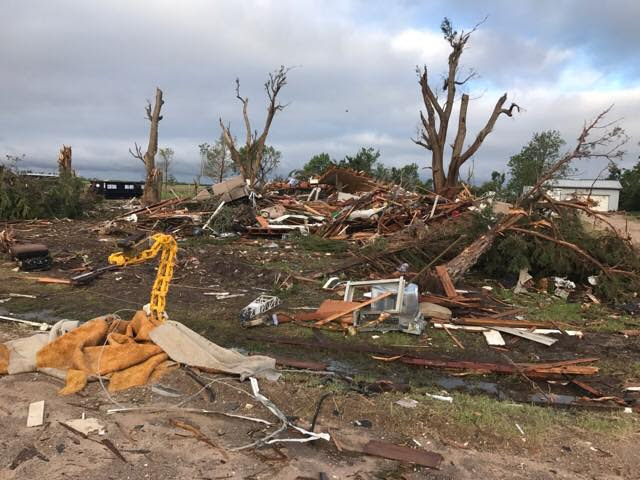
Damage from the May 16 tornado in Barton County (Photo courtesy Roger Marshall)

By BECKY KISER
Hays Post

Are tornadoes becoming more frequent and more severe?

“Depends on who you ask,” according to Dr. Grady Dixon, chair and associate professor of Geosciences at Fort Hays State University. “People’s perceptions run wild.”

“People’s perceptions are that tornadoes are becoming less intense or less frequent in certain places in the country if they haven’t had one in the last 10 years. And then other places that have had a couple of them in memorable fashion think they’re becoming more frequent,” Dixon said.

Actual research is pointing to changes in the character of tornadoes.

“In a somewhat consistent pattern, the research is starting to show that we’re not getting more, we’re not getting fewer. However, the character is changing. We tend to be getting fewer days with tornadoes but the days we have seem to be more productive,” Dixon explained. “I tend to think that’s worse because more productive days means you’re probably going to have more outbreaks, you’re probably going to expose more populated areas. This seems to be the trend from the best research out there now.”

Dixon said it’s not clear if the more productive tornado days are associated with climate change. “We don’t have an answer yet.”

“We’re better at detecting and reporting tornadoes. We’re better at alerting about them. We can detect tornadoes now that before we never knew were occurring and we didn’t have the resources to go out and look for evidence of them. It’s all improving,” he pointed out.

“The research on climate change seems to be suggesting it would cause what we’re seeing, fewer events that tend to be more prolific, but that’s not 100 percent.

“We think what will probably happen is places that did not used to see tornadoes will start seeing them more frequently. I don’t expect places like Kansas will have a significant change over the next several years,” Dixon said.

Tornadoes have occurred in every state, including Alaska and Hawaii, and have occurred in every month.

Dixon is a physical geographer with expertise in meteorology and climatology.

Click here to see Dixon’s entire interview with Mike Cooper and Community Connection.

Kansas suspect in stolen vehicle escapes after chase

Suspect vehicle of Monday morning chase-photo courtesy WIBW TV

SHAWNEE COUNTY- Law enforcement authorities in Shawnee County are looking for the driver who fled a Monday morning chase.

Just before 1:30 a.m., police responded to a report of a Chrysler 300 traveling near the intersection of 17th and Belle in Topeka with a flat passenger side front tire, according to a media release.

The driver failed to stop at two red lights. Police located the vehicle at 17th and Gage and attempted a traffic stop. The vehicle sped away and police, considering the driver had already run two red lights and could be a danger to the public, decided to pursue the vehicle.

Further south on Gage, the driver fled the vehicle on foot. The suspect is described as a black male wearing khaki pants and a blue and white tank top. A K-9 unit was unable to locate the suspect.

An investigation indicated the vehicle was stolen, according to police.

Kansas Notable Books celebrate Kansas cultural heritage

the-last-wild-places-in-kansasKS STATE LIBRARY

TOPEKA–The State Library of Kansas is pleased to announce the 12th annual selection of Kansas Notable Books. The fifteen books feature quality titles with wide public appeal, either written by Kansans or about a Kansas-related topic. The Kansas Notable Book List highlights our lively contemporary writing community and encourages readers to enjoy some of the best writing of the authors among us.

“The Kansas Notable Books Committee considered the eligible books published in 2016. I was delighted to receive the recommended list and make the final decision,” said State Librarian Jo Budler. “Our list is intended to showcase Kansas’ unique talent and history while encouraging residents to visit their library and check out the celebrated titles.”

An awards ceremony will be held at the Kansas Book Festival, on September 9, 2017 at the State Capitol, to recognize the talented Notable Book authors.

Kansas Notable Books is a project of the Kansas Center for the Book, a program of the State Library. Throughout the award year, the State Library promotes and encourages promotion of all the titles on that year’s list at literary events, and among librarians and booksellers.

For more information about Kansas Notable Books, call (785) 296-3296, visit www.kslib.info/notablebooks or email [email protected].

2017 Kansas Notable Books

Fast-Food Sonnets: Poems by Dennis Etzel Jr. (Topeka), Coal City Review Press

Ghost Sign: Poems from White Buffalo by Al Ortolani (Shawnee Mission), Melissa Fite Johnson, Adam Jameson, and J.T. Knoll (Pittsburg), 39 West Press and Spartan Press

Green City: How One Community Survived a Tornado and Rebuilt for a Sustainable Future by Allan Drummond (Suffolk, England), Farrar Straus Giroux Books for Young Readers

Hero of the Empire: The Boer War, a Daring Escape and the Making of Winston Churchill by Candice Millard (Kansas City), Doubleday

Hurt People: A Novel by Cote Smith (Lawrence), Farrar Straus Giroux

Ioway Life: Reservation and Reform, 1837-1860 by Greg Olson (Columbia MO), University of Oklahoma Press

The Last Wild Places of Kansas: Journeys into Hidden Landscapes by George Frazier (Lawrence), University Press of Kansas

Lost and Gone Forever: A Novel of Scotland Yard’s Murder Squad by Alex Grecian (Topeka), G. P. Putnam’s Sons

The Memory of Lemon: A Novel by Judith Fertig (Overland Park), Berkley Books

Mike Torrez: A Baseball Biography by Jorge Iber (Lubbock TX), McFarland & Company

A Nest of Hornets by Robert Krenzel (Shawnee), CreateSpace

Never Enough Flamingos by Janelle Diller (Colorado Springs CO), Worldtrek Publishing

Phog: The Most Influential Man in Basketball by Scott Morrow Johnson (Seattle WA) University of Nebraska Press

Presenting Buffalo Bill: The Man Who Invented the Wild West by Candace Fleming (Oak Park IL) Roaring Brook Press

The Small-Town Midwest: Resilience and Hope in the Twenty-First Century by Julianne Couch (Bellevue IA)


Cedar Bluff’s “OK Kids Day” returns June 10

cedar-bluff-family-kdwptBy DENA WEIGEL BELL
WaKeeney Travel Blog

The OK Kids Day (Outdoor Kansas Kids Day) Sat., June 10, is chock full of great activities meant to entertain and educate kids about all the great things to be experienced at Cedar Bluff State Park.

The day starts at 9 a.m. with a fishing derby in Pa’s Pond, where kids can enjoy the thrill of catching the “big one” in the stocked pond. Afterwards, there’ll be a free hot dog feed, a presentation by representatives from the Sternberg Museum of Natural History, an “Amazing Race” competition the state park way, a jet ski simulator and laser hunt, and minnow catching for the younger kids.

The free event lasts until 4 p.m. and families are invited to join in with the kids.

There will be free vehicle entry to the park all day.

Walnut Valley Senior Center offers Potato Bar June 4

a href=”https://www.hayspost.com/wp-content/uploads/2016/10/rush-center-logo.jpg”>rush-center-logoSUBMITTED

RUSH CENTER–The Walnut Valley Senior Center at Rush Center, 220 Washington Street, will serve a Potato Bar the third Sunday of each month through June 2017.

The Potato Bar meals will be served 11 a.m. to 1 p.m. for all to enjoy.

The remaining dates are:

June 4

For more information call (785) 372-1212 or (785) 222-2746.

SHPTV to broadcast Dodge City Law vs Texas Revolution indoor football June 1

SHPTV

BUNKER HILL – Smoky Hills Public Television will air the final home game of the regular season for the Dodge City Law indoor football team this week.

The game, played at United Wireless Arena, features the Dodge City Law against the Texas Revolution. The game will air on Smoky Hills Public Television Thursday, June 1 at 9:00 p.m.

Dodge City Law and Texas Revolution are both members of the Champions Indoor Football League. Dodge City enters the game leading the South Division.

MARSHALL: Doctor’s Note on the Elizabeth Dole Foundation Caring For Military Families

Dr. Roger Marshall, R-Great Bend, is the First District Kansas Congressman.

Friend,

Wishing you all a relaxing weekend as we observe Memorial Day. This year, Laina and I say a prayer of gratitude for the many individuals who have laid down their lives for our country, and the many families who have lost loved ones. Today and every day, we must remember the cost of freedom, and thank those who continue to serve.

Additionally, this week, I spoke from the floor about the military caregiver. Please see that speech below, and learn about ways to help our military caregivers, and the hidden heroes through the Elizabeth Dole Foundation Caring For Military Families.

See below for more of what we’ve been up to this week, and as always, please never hesitate to contact me and my office about ways we can help you, or questions or concerns you may have.

See the above video for my bipartisan message on the Global Week of Action on Hunger and Famine with my friend, Congresswoman Lisa Blunt Rochester.

In the House
Meeting with Ag Secretary and USTR

U.S. Department of Agriculture Secretary Sonny Perdue

This week’s committee roundtable was a great opportunity to hear directly from the Administration about their trade policy priorities, including enforcement of existing agreements.

In addition to enforcement, it is critical to Kansas farmers and ranchers that the Administration begins to fulfill it’s promise of bilateral market access in key countries like Japan.

Expanding trade opportunities is key to reviving Kansas’ rural economy. As Secretary Perdue said, ‘A healthy U.S. economy is dependent upon Agriculture. A healthy ag economy is dependent upon trade.’

U.S. Trade Representative, Ambassador Robert Lighthizer

These two individuals are key players in crafting that trade policy. That is why it was an honor to have them in front of the House Ag Committee.


Statement on the President’s Budget

While there are several provisions with which I disagree, I appreciate the President laying out a specific and bold budget proposal that balances within 10 years, and recognizes the fiscal challenges facing our country.

The proposed cuts to ag programs, which make up only 0.26% of the entire federal budget, are particularly concerning to me. In today’s depressed agricultural economy, supporting our farmers and ranchers is a must. Crop insurance costs on average $28 per American each year, and helps ensure an affordable, reliable food source – something we can’t take for granted.

I look forward to working with my colleagues in the House and Senate to prepare a final budget.

Visiting Tornado Damage in Barton Co.

May 16th Barton Co. tornado damage

The scene of tornado damage (pictured below) was all too familiar to my eyes as I visited impacted areas.

Having raced over to Hoisington shortly after its devastating destruction in 2001, and having witnessed firsthand a tornado go through our hunting cabin and surrounding neighbors (the same tornado that destroyed Greensburg), this scene of leafless trees and flattened houses brought back to reality how helpless we all are in the face of Mother Nature.

According to Barton County Sheriff Bellendir, who kept me updated, some 15 houses were left with only a foundation. One minor injury was treated on the scene.

Since the tornado, we’ve had several early evening storms, some of which contained 60 -70 mile an hour winds, hail, and sheets of ice like I’ve never seen before.

As a result of the weather, it would appear that some people will have excellent wheat crops this year, and others will have none.

As we have now suffered over the past 2 months with a 600,000-acre prairie fire, a 15-20″ snow in May, tornadoes and hail, there is no wonder why Kansas possess toughness and grit. Laina and I pray for all impacted, and will do everything we can to help.

Hays FFA member vies for state office

MANHATTAN – A member of the Hays FFA Chapter is among the 14 candidates running for a state officer position to represent more than 9,000 Kansas FFA members for the 2017-2018 term. Marie Reveles will complete an intense process of interviews, tests and public speaking demonstrations this week as part of the 89th Kansas FFA State Convention on the Kansas State University campus.

An appointed nominating committee of former state officers and agricultural education instructors interviews the candidates. On Friday, June 2, the committee will submit its nomination of 10 candidates to the state convention delegates, which consists of two members from each of the 186 chapters in the state. After hearing the candidates present a final prepared speech, the delegates will elect the six members who will serve as the 2017-2018 state officer team. The new team will be announced and installed at the final session of the convention Friday afternoon.

The committee evaluates the candidates on their applications, a written test, writing exercises, and five rounds of interviews. These include one-on-one interviews, delivering a speech, facilitating a workshop, round-robin interviews and a personal interview round.

Once elected, the officers will travel across the state promoting agricultural science education and FFA.

A four-year FFA member, Reveles has served as president for both her chapter and Northwest District. Her Supervised Agricultural Experience Program (SAE) involves working at the Smokey Hill Country Club. She plans to attend Kansas State University and become a high school agricultural education instructor.

Marie is the daughter of Javier and LaVerna Reveles. Her advisor is Curt Vajnar.

Visit kansasffaconvention.wordpress.com for the full convention schedule, award winners and live video stream of sessions will begin Wednesday, May 31. Follow convention updates on Facebook at facebook.com/ksffa, on Instagram at @ksffa and on Twitter at @KansasFFA and hashtag #ksffa.

Mary Margaret (Kroner) Giebler

Catharine, Kansas – Mary Margaret (Kroner) Giebler, age 88, died Sunday, May 28, 2017, at the Good Samaritan Society of Hays.

She was born November 13, 1928 in Ellsworth, Kansas to Katherine Werner. She married Celestine “Celly” Giebler on February 14, 1948 at Emmeram, Kansas. He died April 16, 2001.

She was adopted by her great aunt, Beata Kroner and her husband, Anton. He died when Mary was 3 years old and Beata married Ferdinand Ubert and they raised her on the farm north west of Catharine, Kansas.

She was a farmer’s wife, a homemaker, attended the Hopewell School north of Hays, and operated Mary’s Kountry Kitchen out of her home, making homemade noodles for area grocery stores for over 20 years. Mary was a member of St. Catherine Catholic Church, Christian Mothers and St. Catherine Choir. She moved to the Good Samaritan Society of Hays in 2011. She enjoyed embroidering, cooking, baking and her family and grandchildren.

Survivors include three sons, Larry Giebler, Victoria, KS; David Giebler, Hiawatha, IA; Rick Giebler and wife, Marilyn, Catharine, KS; one daughter, Shirley Brungardt and husband, Earl, Hays, KS; one daughter-in-law, Lois Giebler, Salina, KS; one half brother, Leo Behm, Canada; five half sisters, Agnes Learmonth, Christina Burrows, Matilda Caruso, Clara Hollihan, Patricia Thorburn, all of Canada; nine grandchildren, Steve Brungardt, DeAnn Baldwin (Robert), Kristi Lutters (Dan), Lacy Bruggeman (Doug), Anne Fleischer (Bill), Scott Andrews (Joy), Tessa Scheck (Justin), Tyler Giebler (Meagan), Trevor Giebler (Erin); 20 great grandchildren and 5 great great grandchildren.

She was preceded in death by her mother, her adopted parents; her husband; a daughter-in-law, Colleen Giebler; two half brothers, George and Tommy Behm; two half sisters, Leona Behm and Hilda Dyck; five step brothers, Ferdinand Jr., Elmer, Roderick, Paul and Herbert Ubert; two step sisters, Bernadette Dreher and Julia Voltz.
Services are 10:00 A.M. Thursday, June 1, 2017, at St. Catherine Catholic Church Catharine, Kansas. Burial in St. Catherine Cemetery Catharine, Kansas.

A Christian Mothers rosary will be at 6:30 P.M. Wednesday, followed by a vigil service at 7:00 P.M. Wednesday, both at Cline’s-Keithley Mortuary of Hays, 1919 East 22nd Street, Hays, Kansas 67601.

Visitation is from 5:00 to 8:00 P.M. Wednesday, at Cline’s-Keithley Mortuary of Hays and from 9:00 to 10:00 A.M. Thursday, at St. Catherine Catholic Church Catharine, Kansas.

Memorials to St. Catherine Catholic Church or Good Samaritan Society of Hays. Condolences can be left by guest book at www.keithleyfuneralchapels.com or can be sent via e-mail to [email protected]

Holiday alters refuse/recycling schedule

polycart wideCITY OF HAYS

Due to the observance of Memorial Day, Monday, May 29, 2017, refuse/recycling route collection schedules will be altered as follows:

Monday, May 29th and Tuesday, May 30th routes will be collected on Tuesday, May 30, 2017. Although collections may not occur on your normal day, collections will be completed.

There will be no change to Wednesday, Thursday, or Friday’s collection schedules.

City of Hays customers that may have any questions regarding this notice should contact the Solid Waste Division of the Public Works Department at 628-7357.

We remind you to always have your polycarts out by 7:00 AM.

It is anticipated that heavy volumes of refuse/recyclable will be encountered around the holidays. Please make sure your polycarts are out by 7:00 AM and keep in mind that the trucks have no set time schedule.

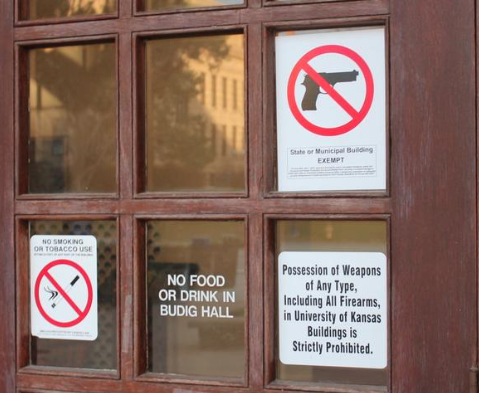
Battle Continues Over Gun Ban At Some Kan. Health Facilities

BY STEPHEN KORANDA

A Kansas Senate committee advanced a bill Tuesday that would exempt public health care facilities from a law requiring them to allow concealed handguns.
FILE PHOTO / KPR

The Kansas Senate Ways and Means Committee has advanced a bill that would allow public health care facilities to continue to ban concealed guns.

A state law taking effect July 1 will allow people to carry concealed guns into any public building that is not secured by armed guards and metal detectors.

The bill that advanced May 23, would allow guns to be banned at state-run psychiatric hospitals, publicly owned medical facilities and the University of Kansas Health System.

This bill is similar to a measure that was debated and amended last week, then sent back to committee for more work. During Tuesday’s committee meeting, some lawmakers have agreed not to offer amendments to the bill in order to increase its chances of becoming law. However, the plan still faces a hurdle because the powerful National Rifle Association is not on board.

Republican Sen. Carolyn McGinn, chairwoman of the committee, hopes that leaving the bill focused on health care facilities and state psychiatric hospitals will reduce opposition. She said it would be expensive to install security at large medical facilities.

“This is specifically tied to saving the state dollars on security at campuses that do not have just one entrance. They have multiple entrances,” McGinn said.

Democratic Sen. Tom Hawk would like to also exempt colleges and universities from the concealed weapons law, but he has agreed not to propose that if other people also do not suggest amendments.

“I’m willing to play nice with my colleagues to get this bill through,” Hawk said.

The concern for lawmakers like Democratic Sen. Laura Kelly is that expanding the bill to include college campuses could mean the plan fails or faces a veto from Gov. Sam Brownback.

“This is the most we can get,” Kelly said. “I’m not interested in having something else go down and take the hospital exemption with it.”

Kelly hopes there will be future efforts to exempt college campuses from the law but suspects that won’t happen this session.

Although the bill is being pushed as an agreement that could become law, the powerful National Rifle Association is not on board. Former Republican House member Travis Couture-Lovelady is now a lobbyist for the NRA, and he had a hand in efforts to find a compromise.

He said the NRA would agree to ban guns in select areas of the state’s psychiatric hospitals and KU health facilities. But he said the organization opposes the bill that advanced out of committee because it allows too many buildings to block people from carrying guns for self-defense.

“If you’re going to restrict law-abiding citizens’ ability to defend themselves in that building, you should provide the security to show that nobody in that building is carrying,” Couture-Lovelady said.

Simply banning guns in the health care facilities won’t stop people who are intent on violating the rule, he said.

“We believe that just putting a sticker on the door and hoping folks don’t carry in there isn’t enough. You need some kind of security,” said Couture-Lovelady.

The full Kansas Senate could take consider the bill in the coming days.

Stephen Koranda is Statehouse reporter for kcur.org, a partner in the Kansas News Service.

HAWVER: Brownback, the Kan. Legislature and the bracket debate

Martin Hawver
If there’s a major roadblock to enactment of a new tax package for Kansas this legislative session—and nobody’s doubting the state needs more of your money—it’s this “bracket” issue.

It comes down to Gov. Sam Brownback insisting that there be no more than two brackets—setting the level at which different percentages of taxable income are paid, after deductions and credits and such.

Kansas has just two income tax brackets. A married couple filing a joint income tax return falls into one of two brackets. After the deductions and such, if you have a taxable income of less than $30,000? You pay 2.7% of that to the state. More than $30,000? The rate is 4.6%.

Brownback is a two-bracket sort of guy, and he’d take just one bracket—a flat rate for everyone who pays taxes—in a minute.

Well, that one-bracket appears dead—just three of the state’s 40 senators could bring themselves to vote for it.

Brownback’s key: Simplification. One bracket is pretty simple to calculate. It’s just one arithmetic calculation. Gets a little more difficult to make it even reasonably saleable. Lawmakers know they’d have to build into a flat tax system elaborate exemptions and deductions for the poor so that they can survive and not wind up on a state-financed welfare roll.

Kansas’ two brackets? Already that’s a simplification from four years ago before the so-called “Brownback tax cuts” which reduced us from three brackets to just two brackets (and eliminated the income tax on that pesky non-wage income of limited liability companies, some sole proprietorships and the like).

This simplification is not a bad argument, but did you notice any Missouri income taxpayers wandering into Kansas, weaving and confused, not speaking clearly because of the complexity of that state’s income tax policy?

Missouri, by the way, has 10 individual income tax brackets. Ten. The brackets range from 1.5% to 6%. Nebraska? Four brackets from 2.46% to 6.8%. Colorado, just one bracket at 4.63% (but of course that state legalized pot which may make computation more difficult), Oklahoma six brackets from half a percent to 5%, and even in Arkansas, taxpayers manage to compute their way through six brackets ranging from .9 % to 6.9%.

Neat deal about that multiplicity of brackets is that you can take more money from folks who will probably be able to afford a flaming dessert anyway, and less from the folks who check their wallets to see whether they can afford one scoop or two of ice cream after dinner.

Still, this simplification argument is one that is mostly coming from Brownback’s second floor office in the Statehouse, not the third floor where the Legislature works.

Lawmakers continue to try to craft an income tax bill that will raise enough money to keep the lights on in state offices and support public schools as the Kansas Supreme Court has directed. It’s taken the Legislature into extra innings to put together that plan, and it hasn’t worked yet.

Several legislators suggest adding in sales taxes on some services, and have tried to single out specific targets—say, hiring a private detective or boarding your dog. That’s a major philosophical issue, putting sales tax on something you can’t hold in your hand or drive or eat—while inconveniencing the smallest number of potential voters.

Issue there? What if sales taxes on services creep outward during the next few years. Lawyers, accountants, doctors—those folks aren’t interested in adding a sales tax to their bills either.

So, we’re looking at brackets again. Set them too high and the poor pay more than they can afford, set them too low and the upper-income folks can consider their state income tax bill like a cheap tip.

Gonna see how this one works out…

Syndicated by Hawver News Company LLC of Topeka; Martin Hawver is publisher of Hawver’s Capitol Report—to learn more about this nonpartisan statewide political news service, visit the website at www.hawvernews.com

Copyright Eagle Radio | FCC Public Files | EEO Public File