TOPEKA— Kansans who have a tax bill in delinquent status now have a new option to pay their past due tax debt quickly and simply online.
The Kansas Department of Revenue recently launched a web portal that allows taxpayers to use a credit card or electronic fund transfer to pay their bill. The portal can be accessed 24/7 at https://debtpay.kdor.ks.gov/iia.
Previously, taxpayers had to pay by credit card over the phone, or send in a check to pay their bill. Now, the web portal allows them to set up a payment plan that is always accessible. The web portal conveniently supports popular PC web browsers as well as mobile devices.
“This project is a part of our larger agency wide focus on making government services easier for Kansans to access,” said Revenue Secretary Sam Williams. “The people we serve now have better accessibility to pay at their convenience and set up a payment plan that works realistically for their finances.”
The portal takes payments for both individual and business tax debts. The system has been live since July 14. Hundreds of customers have already used the portal to pay off debts and establish payment plans.
To use the portal, taxpayers should reference information found on the collection notice they received in the mail. Individuals will use their social security number, while businesses will use their Federal Employer Identification Number to login. The case number found on the notice and the zip code from the address of the notice are also required.
The new portal is only for use by taxpayers who owe back taxes. Taxpayers who are not in delinquent status can Webfile via a different portal on the KDOR website, https://www.ksrevenue.org/iiwebfile.html.
KDOR’s Taxpayer Assistance Center is also available to help customers through walk up (120 SE 10th Street Topeka, Kan) or call in (785-296-6121) service.
ELLIS COUNTY – Two people were injured in a motorcycle accident just after 7:30 Wednesday in Ellis County.
The Kansas Highway Patrol reported a 2003 Harley Davidson motorcycle driven by Lavonnae B. Evans, 64, Bellville, IL., was eastbound on Interstate 70 four miles west of Hays when the rear tire blew. The motorcycle came to rest on the eastbound shoulder.
Evans and a passenger Richard E. Wulff, 62, Maryville, IL., were transported to Hays Medical Center. They were both wearing helmets.
WICHITA, Kan. (AP) — A federal judge has given her approval to a deal in a lawsuit filed against the Wilson County sheriff over his jail’s policy of allowing inmates to receive and send only postcards in the mail.
U.S. District Judge Julie Robinson preliminarily approved on Wednesday the class action settlement that would allow inmates to receive letters at the southeast Kansas jail. The jail houses an average of 40 people daily.
The American Civil Liberties Union of Kansas and the Social Justice Law Collective sued Sheriff Pete Figgins last year alleging the policy violated the free speech and due process rights of prisoners and the people who write to them.
A fairness hearing on the settlement is set for Oct. 25 in the federal courthouse in Kansas City, Kansas.
BROWN COUNTY- Two people died in an accident just before 2p.m. Wednesday in Brown County.
The Kansas Highway Patrol reported a 1996 Chevy Suburban driven by Michael Patrick James, 52, Horton, was northbound on U.S. 73 four miles south of U.S. 36.
The vehicle went left of center and struck a 2011 Toyota Siena driven by Delywn A. Boldt, 80, Upland, NE., just right of center.
James and a passenger in the Toyota Patricia Boldt, 80, were pronounced dead at the scene.
Delywn Boldt was transported to KU Medical Center.
Passengers in the Toyota Luke Boldt, 15, Leland, NC, was transported to Children’s Mercy and Jack Boldt, 15, Leland, NC, was transported to the Hospital in Horton.
Luke Bolt was wearing a seat belt improperly, according to the KHP. James was not wearing a seat belt.
Perry Lee Isley, 59, is among offenders who have spent time in the program since 2005 at the State Hospital in Larned-photo Kan. Dpt. of Corrections
TOPEKA, Kan. (AP) — A federal judge has dismissed a lawsuit filed by Kansas sex offenders confined indefinitely in a state program for post-prison mental health treatment.
U.S. District Judge J. Thomas Marten ruled this week that the suit failed to provide details to support claims that the treatment the offenders are receiving at Larned State Hospital in western Kansas is so inadequate that their confinement is unconstitutional.
Kansas law allows the courts to order sex offenders held indefinitely for treatment after they’ve served their prison sentences.
The 25 men who filed the lawsuit in 2014 are among more than 250 offenders confined in the program. Only a relative few have been released since it began in 1994. The U.S. Supreme Court declared the program constitutional in 1997 because of the promised treatment.
A young child had to be revived by a lifeguard after being pulled from the Hays Aquatic Park on Wednesday afternoon.
Emergency personnel were called to the Hays Aquatic Park, 300 Main St. Hays, around 4 p.m. Wednesday for the report of an unresponsive individual — a possible drowning.
According to Hays Assistant Police Chief Brian Dawson, a lifeguard entered the water, pulled a child out of the pool and revived the child using CPR.
Dawson said a parent transported the child to Hays Medical Center.
No other details on the incident were made available Wednesday evening.
RILEY COUNTY -Law enforcement authorities are investigating a suspect for alleged Felony DUI again.
Just after 4:30 a.m. Wednesday, police arrested Benjamin Joseph Oleary, 36, Leonardville, according to a booking report from the Riley County Police Department.
Oleary has three previous Felony DUI convictions, according to the Kansas Department of Corrections.
He was operating a vehicle without the breath alcohol ignition interlock device, according to a police report. Oleary is being held on a $4,000 Bond.
Corporal Brandon Huntley demonstrated the drone on Wednesday afternoon
HARVEY COUNTY – Law enforcement authorities in Harvey County used a drone to find a missing man on Tuesday.
Just before 11:30p.m. Tuesday, deputies received a call in reference to a missing 91-year-old man at a residence two miles north of Walton, according to Harvey County Sheriff Chad Gay.
The terrain and the vegetation in the quarter section they were searching made the job almost impossible, according Harvey County Sheriff’s Department Corporal Brandon Huntley.
After 3 hours of ground search, Huntley decided to use the department’s Drone to search. The Drone identified a hot spot. Deputies directed emergency crews to the location. After approximately 30-minutes, Hesston EMS transported to victim to Newton Medical Center where he is recovering.
Huntley said the victim was missing for over 9 hours. He is expected to make a full recovery. The department purchased the drone as a life-saving tool. It is the first time the sheriff’s department has successfully used the drone.
By DIANE GASPER-O’BRIEN FHSU University Relations and Marketing
Fort Hays State University long has been on the cutting edge of initiatives that benefit students.
This summer, FHSU launched a predictive analytics reporting program called PAR, geared for student success by learning a little about students even before they reach campus.
PAR is a product of the software tool Starfish and is an expansion to the Tiger Early Alert program that Fort Hays State has been using the past five years.
“Tiger Early Alert allows faculty and staff to report concerns of student progress during the semester, but that system is reactionary,” said Dennis King, FHSU assistant vice president for student affairs in charge of enrollment management and retention.
“The addition of PAR will allow us to do many things,” he added. “For instance, we will be able to set up students’ pathways where they take courses that are complementary to the degree they are pursuing, based on past students with similar backgrounds.”
King said he believes FHSU is the only school in Kansas implementing this system to date.
Through the PAR system, Fort Hays State will be able to study analytics based on student characteristics from the past eight years. King has been attending conferences the past two years “looking for this type of product,” and the enrollment management committee invited several companies to campus.
“None of those were quite the fit for us,” said King, who knew he had to be patient to find what worked best for FHSU. “With the investment of time and money, we wanted to get the right fit. Then we found Hobsons.”
PAR features a student success matrix that helps document multitudes of combinations of characteristics to help analyze traits for success.
“PAR gives decision makers a strategic view of what’s happening in their student population,” said Jan Poston Day, director of Partner Success for Hobsons out of Washington, D.C.
King agreed.
“This is going to put a great amount of knowledge and information in advisors’ hands to help the students,” he said.
Starfish is owned by Hobsons, a global management company with a branch geared specifically to education.
Hobsons helps students identify their strengths, explore careers, create academic plans, match to best-fit educational opportunities and reach their education and life goals.
Representatives of Hobsons were on campus in June for a two-day training period for FHSU faculty and advisors. Since then, King, Associate Provost for Academic Affairs Dr. Tim Crowley and Larry Rupp from FHSU Technology Services have had biweekly conference phone conversations with Hobsons staff in an effort to streamline the implementation process.
Day explained that the program is tailored to what each university needs.
“The technology can help identify not just an individual student but students who share the same risks,” she said. “We’ve found some interesting pockets of risks at different universities. The more you know the risk factors or success promoters before they arrive you can effectively channel those students into a program that will help them.”
“It’s all about guiding students through a pathway to success,” said Jean Russell, a Hobsons account manager from Arizona. “There is no right or wrong answer for anything. It’s what works best for you.”
When faculty return to campus for the fall semester, King and the enrollment management committee will be aided by a graduate student in the enrollment management office who will help with training and work with departments on how to use Starfish.
“This is a tool we are very excited about,” King said. “This piece will give advisors and faculty help in assisting students before the start of a semester, tools to help students have success along the way rather than waiting until the end of a semester to see what worked and what didn’t.”
SHAWNEE COUNTY- Law enforcement authorities are investigating a robbery and assault at a home improvement store.
On June 7, a man entered Menards, 6401 SW 17th Street, Topeka and stole merchandise, according to a media release from police. He then physically assaulted one of Menards Employees and left in a white Ford Escape.
Anyone with information on this suspect is asked to Email the TPD Criminal Intelligence Unit ([email protected]) or TPD Detective Steve Adkins ([email protected]) or call him at #785 368-9033.
The Sternberg Museum is joining the City of Hay’s sesquicentennial celebration with a Summer Science Day.
From 10 a.m. to 2 p.m. Thursday, the museum will have special displays, presentations, and activities exploring the topic of weather.
Interact with museum and FHSU scientists to learn about weather phenomena, the effects of weather on plants and animals, and the differences between weather and climate.
There will be activities for all ages.
There is no additional costs for special programming, but normal admission fees apply.
The museum and exhibits are open all day, but special programming is from 10 a.m. to 2 p.m. only.
There are probably days designated for just about everything, but Monday was a day honoring all creatures that slither and hiss.
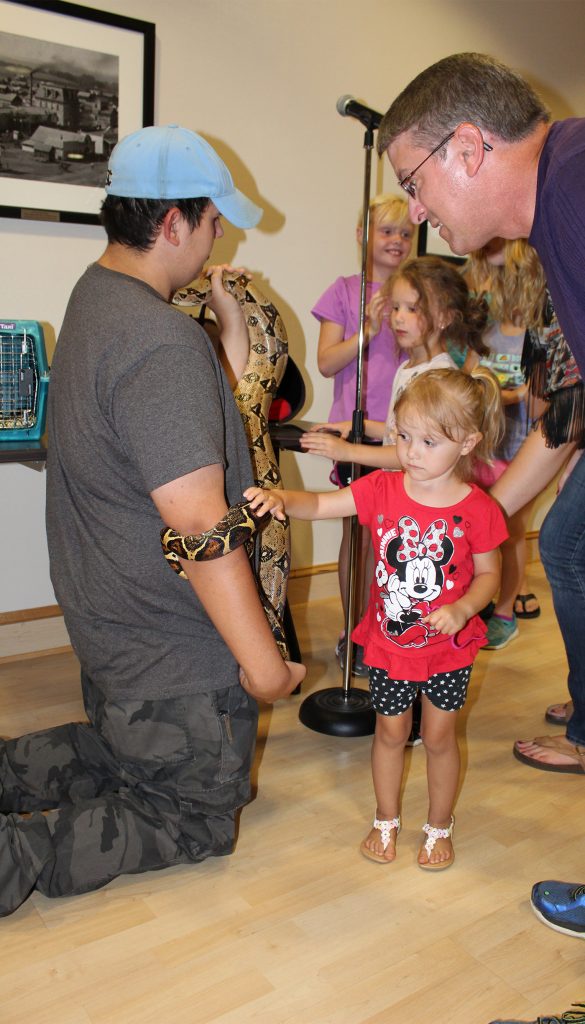
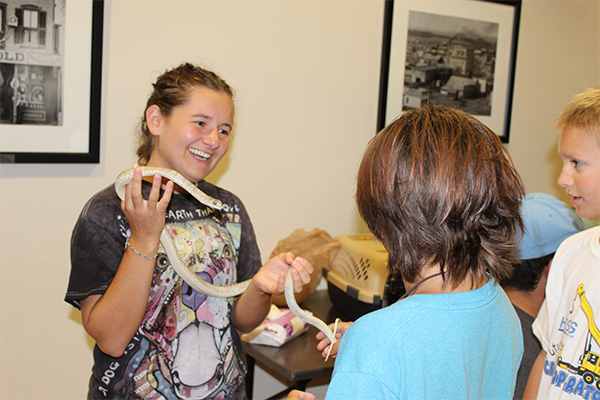
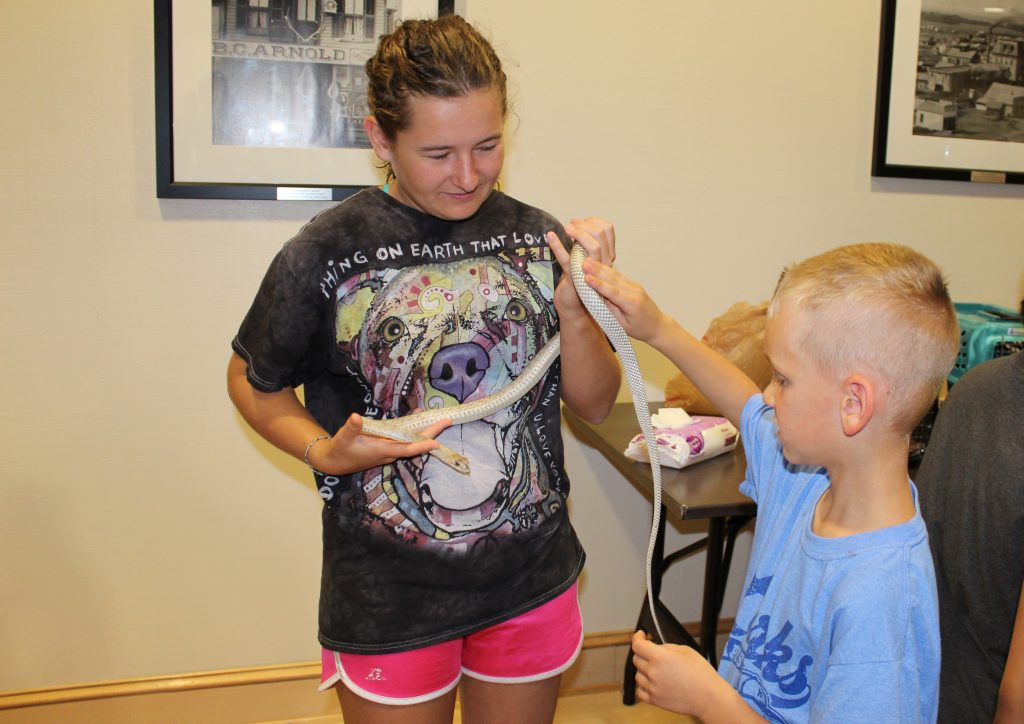
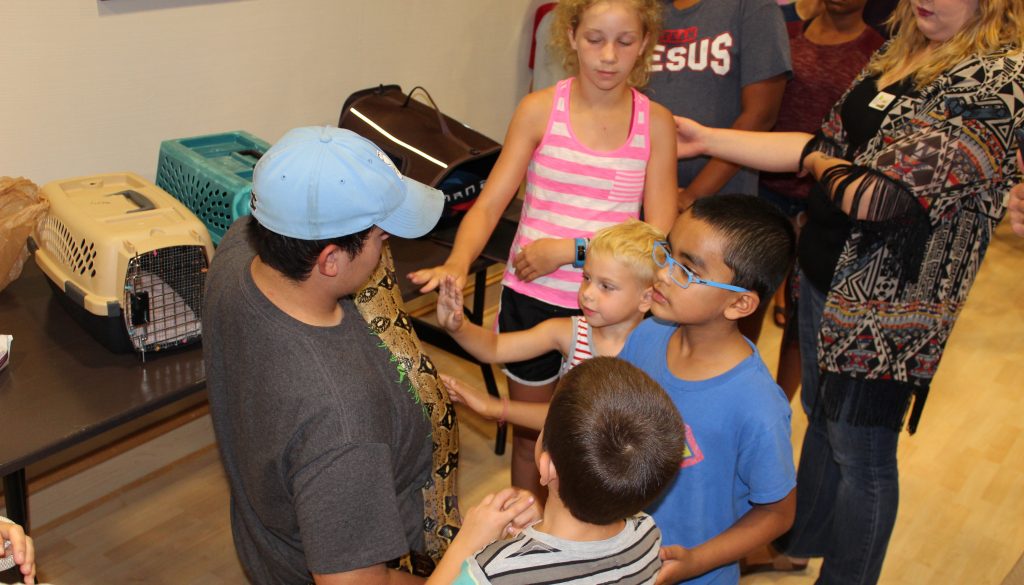
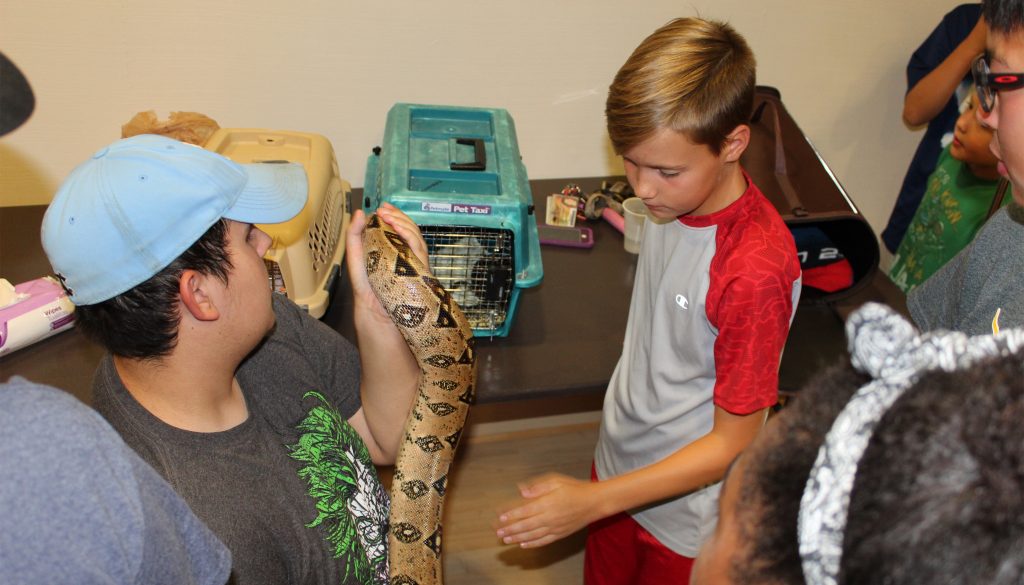
More than 130 people crowded into the Schmidt Gallery at the Hays Public Library Monday night to see and touch snakes as the library honored Snake Day.
Guests were greeted by three species of native snakes from the Sternberg Museum collection and a boa from a private collection.
The native species were Buddy, a plains rat snake; Whipper Snapper, a coach whip; and Cooper, a speckled king snake.
Buddy is a rat eater and is a constrictor. Whipper snapper thrashes or drowns its pray. Cooper eats other snakes including rattlesnakes and is a constrictor.
The last snake was a non-native species, a 6-foot Colombia red tail boa constrictor named Zeus,
The species is native to South America, including the countries of Colombia, Ecuador, Peru and Venezuela.
“Zeus is a lot stronger than Buddy or Whipper Snapper,” Jackson Stanton, museum volunteer and snake owner, said. “If he would wrap around my hand, I would not be able to physically pull him off by myself, and he has done that a couple times. My fingers were purple by the end of it.
“They are incredibly strong snakes. They are almost 100 percent muscle.”
Zeus, who weighs 16 pounds, eats rats, rabbits, guinea pigs and squirrels.
The pattern that goes through Zeus’ neck also goes through his eye, which helps him blend into his native habitat.
“Most of the snakes we have had out eat mice and rats, so if we got rid of all the snakes, imagine if they were all gone off the face of the earth,” Ian Trevethan, Sternberg outreach coordinator, said. “Think about this, an average field mouse reproduces and has babies every three weeks, and then those babies are ready have babies. Then three weeks later you have a whole bunch more mice If nothing was eating the mice like snakes, we would be up to our ears in mice and mouse poop and disease would be bad.
“We should thank the snakes around us for that because they do a really, really important job in nature.”
Unfortunately, when rattlesnakes or other venomous snakes come in contact with people, it can result in some unfortunate circumstances.
Stanton said, “Rattlesnakes don’t want to bite people. It is hard to make that venom. They don’t want to bite us. They want to get away from us as a fast as they can. Snakes aren’t bad. They aren’t inherently bad. Snakes are terrified of humans. We are giant monsters to them. They don’t want to bite us. They don’t want to have any interaction with us whatsoever.”
If you see a snake in the wild, it is best to leave it alone, the speakers said.
“As long as you don’t bother them, they are pretty chill. I suggest you stay a distance a way and let them go on their merry way,” Rachel Unruh, Sternberg student employee, said.
There are four types of venomous snakes in Kansas the prairie rattlesnake, timber rattlesnake, copperhead and massasauga rattlesnake.
The prairie rattlesnakes and massasauga rattlesnakes can be found in the Hays area.
Poisonous snakes can be easily misidentified, which can lead to dangerous bites. Juvenile rattlesnakes can be easily confused for the nonvenomous hog nose snakes. Children try to pick up the snakes and get bitten.
“The moral of this story is if you see a snake, even if you think it is a harmless hog nose, leave it alone, just in case it is a baby rattlesnake or some other type of snake,” Trevethan said.
Baby rattlesnakes can’t control their venom, so you may receive more venom from a baby than an adult.
The snakes that were shown at the library all have been handled and fed by humans and are used to human contact, but a wild snake might play dead, try to mimic a rattlesnake and shake its tail or it might bite.
Children also made crafts and were offer snacks by the library staff.
With several more days of sweltering heat expected this week health officials are warning people to stay hydrated and to find a place to stay cool.
Weather officials say the heat will continue through the end of the week with 100 degree temperatures expected through Friday for north central and northwest Kansas.
Lillian Slater, Assistant Director for Ellis County EMS said they encourage people to avoid the heat if at all possible.
Slater said they are urging people to, “stay hydrated, take rest breaks, don’t go out during the heat of the day (and) try not to be out there for long periods of time between 11:00 a.m. and 5:00 p.m., when it’s the hottest.”
Someone who has been out in the heat too long and may be experiencing heat related issues may suffer from excess sweating, a change in mental status, a warm feeling and an increased heart rate, according to Slater.
Slater said if you or someone you know begins to suffer from heat related symptoms you should call Emergency Medical Services.
“If they’re to the point that their skin is hot or they have an altered mental status this is something that they are going to have to be evaluated for in an emergency room,” Slater said.
Slater also recommended cooling the person down with water or wet towels.
During the hot weather it is also a good idea to check on those who are at most risk of suffering from heat related issues; the young and the elderly.
Slater said some of the older people are more likely to be on medication that makes them susceptible to have problems with the heat.
“As we age none of our systems work as well as they did when we were younger so they are going to have more trouble reacting to heat,” Slater said.
Children are also vulnerable during periods of extreme heat and if left in the car on a hot day can lead to a, “horrible situation in just a very short period of time,” said Slater.
Extreme heat can also manifest itself as another health issue or other issues can lead to an increase vulnerability to the heat.
“If they are taking diuretics, or taking some of the cardiac drugs or hypertensive drugs, diabetic drugs or even the psychiatric drugs, can contribute to heat stroke,” said Slater.
Slater also said the heat will affect those who are not used to it differently than those have become acclimated to it. She with sports starting next month football players are at risk of suffering an exertion heat stroke.
For those people without adequate air conditioning Slater said you need to find shelter during the hottest times of the day.