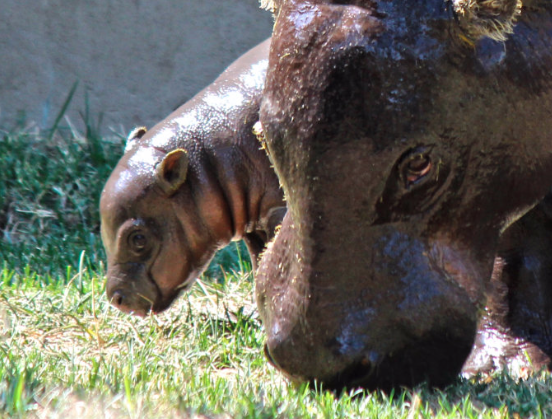
SEDGWICK COUNTY The baby Pygmy Hippo born at Tangankika Wildlife Park in Goddard now has access to the entire exhibit.
On Friday, the park’s Pygmy hippos, Posie and Pluto, announced the birth of their first baby. This is the first baby pygmy hippo born at Tanganyika, according to a media release.
The new baby is believed to be a girl, but it won’t be known for sure until he/she is a little older and then can also be named. The baby weighs approximately 13 pounds and is currently the size of a shoebox.
Tanganyika Wildlife Park’s are the first and only pygmy hippos in Kansas, and the first to give birth in Kansas.
“For Tanganyika as a breeding facility, this is a huge milestone,” the Park’s Assistant Director Matt Fouts said. “This marks Tanganyika’s 40th successful breeding program for rare and endangered species.”
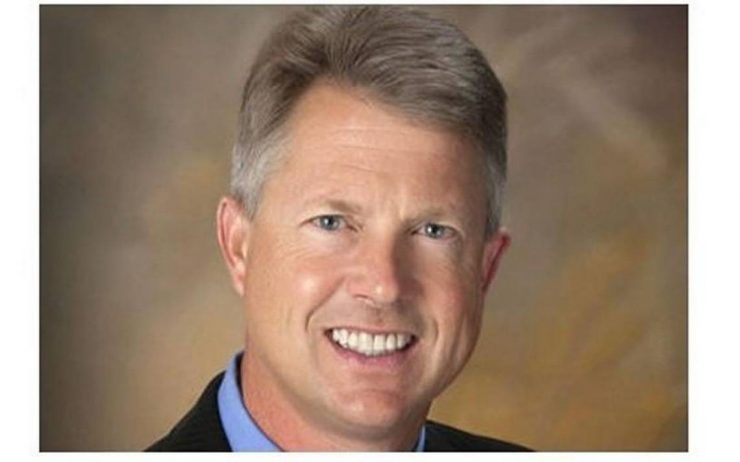
Dr. Roger Marshall, R-Great Bend, is the First District Kansas Congressman.Hello from Lakin! As I write this, I am in the midst of my July Listening Tour. We’ve had some great discussions so far, and I look forward to continuing them through the weekend.
Between stops yesterday, I stopped in Clark County at the Giles family ranch. I visited soon after the wildfires, and decided to come back through to see how they were progressing. They lost homes, hundreds of livestock, fences and forage in the wildfires earlier this year, and are beginning the rebuilding and regrowing process.
There’s a long way to go, but it was great to see the green pastures coming back through what was charred ground only months ago.
I am continually moved by he resilience and grit of folks in our state. The Giles family is a terrific example of that spirit.
As always, if you have any questions, concerns or know of ways my office can be of assistance, don’t hesitate to contact us.
Kansas is an export-dependent state. We supply food, feed, aircraft and parts to countries all over the world. As I’ve traveled the state over the past six months, I have heard repeatedly that we must find ways to open markets for U.S. producers.
The good news is that this Administration is focused on opening markets.
Our global, rules-based trading system has brought tremendous benefits to American businesses, farmers, workers and consumers. As global commerce has expanded, we have found that when there is a free and level playing field American producers can match any competitor.
In the District
Lyons Roundtable
Business Roundtable in Lyons
I always value the opportunity to sit down with business and community leaders in my district to hear directly from them what is and is not working with our federal government.
While visiting with business and community leaders in Rice County, I heard about the negative impact of overregulation in many industries, the sky rocketing costs of health insurance, and the need for federal infrastructure investments.
These people are working hard to grow their businesses and communities in rural Kansas, and I value the opportunity to support their efforts with my work in Congress.
Little River
Visit to Little River grocery store
Like most rural towns in my district, Little River understands the impact and importance of a local grocery store. This afternoon I had the opportunity to tour the community’s grocery store and speak with community leaders. The community worked together to keep the grocery store alive and ensure the business will be there for generations to come.
Little River is a great example of local investment and small town success.
My statement North Korea’s ICBM test
We will not tolerate a North Korea with the capability to attack the US. This is now our problem. The time for “strategic patience” is over.
John Richard Schrock is a professor at Emporia State University.
When F.D.R. proclaimed that “We have nothing to fear but fear itself,” we had not yet developed nuclear warfare. Today, with nuclear armaments expanding in North Korea and the increasing threat of non-governmental terrorists securing or building nuclear bombs, there is good reason to be very worried.
We came closer to nuclear annihilation in the Cuban missile crisis under President Kennedy than most of us realize. In the bio-documentary of Robert McNamara, “Fog of War,” we hear the taped committee discussion where Kennedy faces two replies from the Soviet Union. J.F.K. wisely follows the civilian advice to respond to the less militaristic message. As a high school student at that time, I joined the rest of America in sighing relief that all ended well.
But we came much closer to an exchange of nuclear missiles and worldwide devastation than we knew. William J. Perry, the U.S. Secretary of Defense from 1994 to 1997 was a young photo analyst at the time. In his book “My Journey at the Nuclear Brink,” he reveals the pure luck that prevented a civilization-ending war. The Soviet fleet that approached our Cuban blockade included submarines equipped with nuclear torpedoes. Because underwater communication was difficult, the Soviet submarine captains had been given full authorization to decide whether to open fire. When our fleet attempted to force a submarine to the surface, the submarine captain gave the order to fire nuclear torpedoes at our destroyer. It was only by chance that the fleet commander, Vasili Arkhipov, was aboard that submarine and countered the order—and prevented World War III.
But the U.S. had risky commanders as well, including General Curtis LeMay whose advice to go ahead and bomb the Cuban missile sites was rejected by Kennedy. Only long afterward did we learn that the Soviet commanders manning those Cuban missiles, similar to the submarine captains, had been given discretion to launch without further orders. We now know that had General LeMay’s plan been enacted, there is little doubt that some of those nuclear missiles—including warheads targeted at Washington, DC—would have gotten through.
To a hammer, every problem looks like a nail. In the cases of Generals Douglas MacArthur and Curtis LeMay, every problem had a military solution with nuclear options included. There are notable exceptions, including Dwight Eisenhower and George Marshall. But our history has shown the wisdom of a civilian Secretary of Defense.
We laugh at the naive “duck-and-cover” school exercises of the early Cold War era. But although the deadly and long-lasting effects of nuclear blasts and fallout radiation are now better understood, they are nearly completely missing from the modern school curriculum.
The actual effects of nuclear warfare are barely perceived by a public that would simply rather not know. Ironically, one of the more accurate portrayals was filmed in Lawrence, Kansas. “The Day After” aired in November, 1983 on ABC stations. Although it was seen by over 100 million people, there is little evidence today of any residual appreciation for the civilization-ending impact of a full scale nuclear war. The decades-long “nuclear winter” and other effects of these weapons remain beyond the comprehension of supposedly well-informed modern citizens.
Nor do today’s generals really understand the destructive force of nuclear warfare. Thanks to the test ban treaty, we no longer have any generals who have witnessed a nuclear bomb. Harold Agnew, a physicist from our Manhattan Project, explains “…you don’t know what heat is until you’ve seen the heat from a ten megaton, fifteen megaton hydrogen bomb. The most impressive thing about the heat is it doesn’t stop, it just gets hotter and hotter and you start to really worry even though you’re twenty some miles away….” Agnew believed that if generals felt the intensity of that distant inferno firsthand, they would never order a thermonuclear bombing. No audio-visuals, no modern media in 3-D, could ever replace the feel of that heat penetrating your body. But today’s generals whose only imagery of the H-bomb is from conventional weapons and abstract videos made this a more dangerous world.
So, where is a school curriculum that helps our next generation understand these things—if there is to be another generation?
Listen to Mike Cooper interviewing Dr. Aron Splichal, Radiologist in the Vien Clinic at HaysMed, by clicking the link above and then clicking the play button
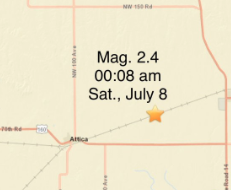
HARPER COUNTY – A small earthquake shook south-central Kansas early Saturday. The quake just after midnight measured a magnitude 2.4 and was centered approximately a mile northeast of the unincorporated Harper County community of Crystal Springs.
The is the first earthquake reported in Kansas since June 27.
A 3.6 magnitude quake hit near Medford, Oklahoma, on Friday. Medford is 78 miles south of Wichita.
The USGS reported 18 Kansas earthquakes in June, 9 in May, a dozen in April, 7 in March and 6 in February.
There are no reports of damage or injury from Saturday morning’s quake.
TOPEKA – First launched last year with the passage of 2016 HB 2622 (K.S.A. 74-32,303), “Kansas DegreeStats” (www.ksdegreestats.org) is an interactive online tool which reviews cost and earnings data from real graduates for each undergraduate degree program offered at a public university or college in Kansas. A unique resource for prospective students, Kansas DegreeStats has now been updated with new data and expanded to include each undergraduate degree program offered at one of the twenty-six public colleges located across the state, along with employment data for graduates working in both Kansas and Missouri.
While there are several other states which publish earnings data, there is no other state which provides data on the actual costs experienced by graduates, and no other resource available which combines detailed degree-level cost and earnings data in one place. Kansas DegreeStats also allows for side-by-side comparison of up to three degrees, whereby a perspective student can compare cost and earnings data between multiple degrees at the same institution, or between the same degree program at multiple institutions.
Updated with cost data from 2015 and 2016 graduates, the tool now includes data on more than 1,100 undergraduate degrees and reports on the typical Resident Tuition, Fees, Room and Board, and Books and Supplies costs for each degree program, the typical length of time students took to complete each degree program, and the funding sources which contributed to this investment – including Scholarships and Grants received, Loans, and the Personal Investment made by those who graduated from the program.
Through partnerships with the state labor agency in both Kansas and Missouri, combined (Kansas plus Missouri) Wage Information about a program’s graduates is also reported for each undergraduate degree program in Kansas, both upon entry into the regional workforce and after five years of employment. Over thirty percent of undergraduate degree programs report graduates making more than $34,000 upon entry in the workforce, with a dozen degree programs reporting graduates making more than $60,000 upon entry. More than half (52%) of all undergraduate degree programs with wage information listed report graduates earn more than the state average wage ($42,020) after just five years.
Information about “How to Use This Site” has also been made available as part of this interactive tool, along with technical notes and additional information about each data point (published under “About”). Kansas DegreeStats has been built to enable and facilitate sharing: search results can be downloaded and saved, each DegreeStats page has a unique URL address so it can be copied and shared, and the DegreeStats of each undergraduate program can be printed as a single print page.
For more information, contact Breeze Richardson at (785) 430-4237 or [email protected].
ATCHISON—Benedictine College has recognized those students who have distinguished themselves academically during the last semester. Those recognized were on the President’s List or the Dean’s List for the spring semester, which ended in May.
Of the 1,924 full-time undergraduate students on the Atchison campus, 557 made the Dean’s List and 132 made the President’s List. To make the Dean’s List, a student must carry a minimum of 12 credit hours and a grade point average of 3.5 or above for the semester. To make the President’s List, a student must have a perfect 4.0 grade point average for the semester with a minimum of 12 credit hours.
Makayla Crawford of Victoria was named to the Dean’s List.
Laura Krug of Hays was named to the Dean’s List.
Bethany Kuhn of Hays was named to the Dean’s List.
Jordan Pfannenstiel of Hays was named to the Dean’s List.
Founded in 1858, Benedictine College is a Catholic, Benedictine, residential, liberal arts college located on the bluffs above the Missouri River in Atchison.
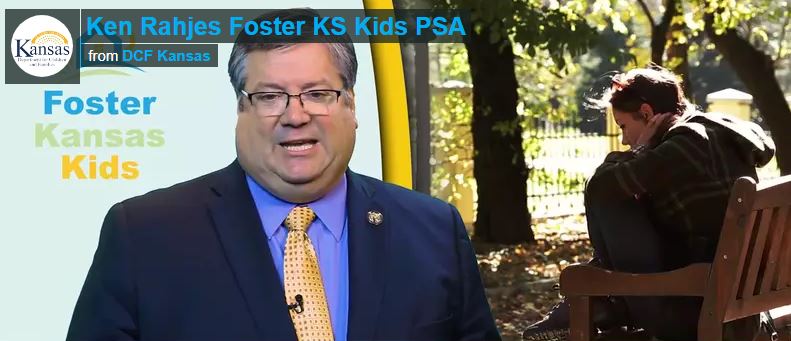
TOPEKA – Lieutenant Governor Jeff Colyer and 25 legislators from across the state, including 110th Dist. Rep. Ken Rahjes, (R-Agra), have come together to show bipartisan support for family foster home recruitment in Kansas.
The Kansas Department for Children and Families (DCF), in conjunction with Foster Kansas Kids, invited all Kansas legislators to participate in public service announcements (PSAs), urging Kansans to consider opening their homes and hearts to children in need of temporary placement.
“The number of children in foster care is growing, not just in Kansas, but across the nation,” DCF Secretary Phyllis Gilmore said. “I am thrilled by the number of legislators who answered the call to help spread the word about the need for foster homes in Kansas—regardless of political affiliation.”
Gov. Sam Brownback speaks May 3 about the need for foster families in Kansas at a foster care event at the Kansas State Capitol, Topeka.
This initiative is part of the Foster Kansas Kids campaign, which launched in May. The campaign is designed to recruit potential foster families, provide support to current foster families and increase the public’s awareness about the need for temporary, stable homes for children coming into care in Kansas.
The PSAs will be aired across the state starting in July. They will also be posted on the Foster Kansas Kids Facebook and Twitter pages. The participating legislators will be provided packets of information about foster care recruitment. They will also be given links to their personal PSAs to promote within their communities, on their websites and social media pages. The unique PSAs are available on the DCF Vimeo page.
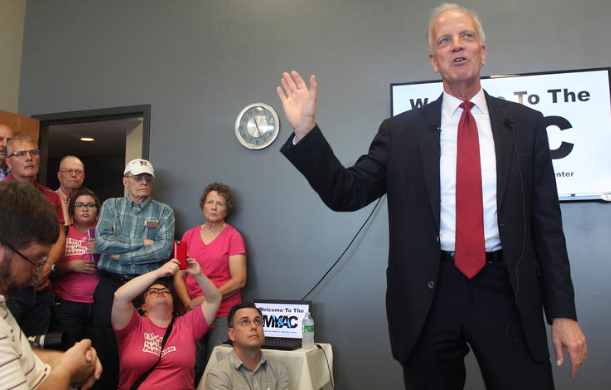
U.S. Sen. Jerry Moran speaks at a town hall meeting Thursday in Palco. Several people traveled more than 100 miles to attend the meeting, where Moran discussed the GOP bill to repeal and replace the Affordable Care Act. JIM MCLEAN / KANSAS NEWS SERVICE
U.S. Sen. Jerry Moran is opposed to a bill crafted in secret by Republican leaders to repeal and replace the Affordable Care Act.
But speaking to an overflow crowd at a town hall meeting Thursday in northwest Kansas, Moran said he is open to supporting a revised version if GOP leaders can address his concerns.
“I would be anxious to see if that bill can get to the point in which I think it’s beneficial for Kansas,” Moran said.
Among other things, Moran said he is concerned about the effect of nearly $800 billion in proposed Medicaid cuts on rural health care providers and Kansans with disabilities. And he said he doesn’t like how the bill treats Kansas and other states that have not expanded eligibility for their Medicaid programs.
“It takes money out of a state that didn’t expand Medicaid and provides it to states that did expand Medicaid to extend the time that Medicaid expansion receives the higher reimbursement rate,” the GOP senator said. “That troubles me.”
More than $680 billion would be diverted to expansion states from non-expansion states by 2025, according to the Kansas Hospital Association. Kansas’ share of that loss would total about $21 billion.
Approximately 120,000 Kansans would lose their health insurance under the bill due to the Medicaid cuts and higher out-of-pocket costs for private coverage, according to estimates compiled by the Urban Institute.
Several people traveled more than 100 miles to attend the meeting, which was in a community center in the tiny community of Palco.
Margy Stewart, a retired college English instructor, traveled from her ranch in the Flint Hills to thank Moran for opposing the initial draft of the ACA replacement bill and to urge him to stand firm.
“His (Moran’s) leadership in the Senate really wants this win,” Stewart said. “I want him to think more about Kansans and less about pleasing his leadership.”
Moran was asked several times why Republicans were so intent on repealing a law that has expanded health coverage to millions of Americans. Audience members also asked why Senate members can’t work together to craft a bipartisan bill to fix the ACA.
In response, Moran said while he also would prefer that approach, Democratic leaders aren’t willing to make the substantial changes needed to fix Obamacare.
“It takes two parties who want to come together, and it takes the American people to demand that,” Moran said.
Though he’s open to supporting a compromise measure, Moran said he isn’t optimistic that GOP leaders can alter the bill so that it’s acceptable to both moderates and conservatives in their caucus.
“It’s almost impossible when you’re trying to do it with 51 votes in the United States Senate, in which there is not significant consensus in what the end result ought to be,” he said.
Jim McLean is managing director of the Kansas News Service, a collaboration of kcur.org, Kansas Public Radio and KMUW covering health, education and politics. You can reach him on Twitter @jmcleanks.
WICHITA — Nearly 1,850 students completed degrees at Wichita State University in spring 2017.
Undergraduate students who have attained a grade point average of 3.9 out of a possible 4.0 received the summa cum laude award; those with an average of 3.55 received the magna cum laude award; and those with an average of 3.25 received the cum laude.
WSU enrolls about 14,500 students and offers more than 50 undergraduate degree programs in more than 150 areas of study in six undergraduate colleges.
The following northwest Kansas students earned degrees:
Colby
Emilea J Finley, Bachelor of Science, Field Major Chem/Biochemistry, Cum Laude
Goodland
Jarod A Lake, B.S. in Mechanical Engr, Mechanical Engineering, Cum Laude
Tanya R Weiss, Bachelor of Fine Arts, Art Education Emphasis PK-12
Hays
Tarryn K Andrews, Doctor of Physical Therapy, Physical Therapy
Amber S Price, Master of Arts in Teaching, Master of Arts in Teaching
Sara R Schoenthaler, Bachelor of Arts, Engl Language and Literature, Magna Cum Laude
Sarah E Wiesner, Bachelor of Arts, Psychology, Cum Laude
Kensington
Taylor P Kuhlmann, Doctor of Physical Therapy, Physical Therapy
Logan
Troy Babcock, Bachelor of Arts in Education, PreK-12 Physical Education, Cum Laude
Norton
Brae M Bigge, Bachelor of Science, Field Major Chem/Biochemistry, Magna Cum Laude
Laura J Keen, Master of Education, Counseling
Spencer A Shirk, Doctor of Physical Therapy, Physical Therapy
Oakley
Hayley A Ribordy, Bachelor of Arts, Performing Arts BA
Russell
Kelly A Bachar, BS in Nursing, Nursing-RN-to-BSN
Natasha L Homeier, Bachelor of Fine Arts, Performing Arts BFA
Saint Francis
Erick Estrada-Olave, Bachelor of Science, Medical Laboratory Sciences
Sharon Springs
Hallie M Kuhlman, Bachelor of Science, Dental Hygiene, Summa Cum Laude
Arely Navarrete, Bachelor of Arts, Political Science, Cum Laude
WaKeeney
Jacob G Weber, B.A. in Athletic Training, Athletic Training
RUSSELL COUNTY – A man from Russell died in an accident just after 11:45p.m. Friday in Russell County.
The Kansas Highway Patrol reported a 2016 Ford F350 driven by David Wayne Taylor, 53, Rock Springs, WY, was eastbound on Interstate 70 just east of Bunker Hill Road approximately ten miles east of Russell.
The vehicle struck a pedestrian identified as Jeffery Lynn Harris, 47, working along the side of the roadway.
Harris was pronounced dead at the scene and transported to Brocks North Hill Chapel.
Taylor was properly restrained and not injured. The KHP released no additional details.
Ron Wilson is director of the Huck Boyd National Institute for Rural Development at Kansas State University.
By RON WILSON Huck Boyd National Institute for Rural Development
“Our biggest export from rural Kansas isn’t wheat or corn – it’s our young people.” That statement describes one of our rural communities’ major dilemmas, which is the outmigration of youth. Today we’ll learn about an initiative in north central Kansas which is helping make young people aware of the opportunities they have locally without having to move away.
Doug McKinney is executive director of the North Central Regional Planning Commission which serves 12 counties in north central Kansas, plus providing other services beyond that region. The commission’s main office is centrally located in the region, in Beloit.
Doug explained that he and other community representatives were invited to a Kansas Department of Education forum in Topeka in December 2016. State Commissioner of Education Randy Watson invited school districts and others to come to this forum on the topic of summertime career exploration and leadership development. The one-day forum featured a school district in New York state that used summer programming to address several problems found in that school district.
“In New York, they had a lot of issues with juvenile delinquency and low graduation rates,” Doug said. “Our issues are different from theirs, but we did see how special programming in the summertime could address community needs.”
Several partners in this region of Kansas then got together to plan a special initiative to be held in the summertime. Led by Jeff Travis, the Beloit school superintendent, the other partners included Eric Burks, president North Central Kansas Technical College (NCK Tech); Heather Hartman, Mitchell County economic development director, and Doug from the North Central Regional Planning Commission. A K-6 technology teacher, Cris Adams, and high school counselor Stephanie Litton coordinated the program.
The partners designed what was called Career Exploration and Leadership Development week for middle-schoolers. Sessions included hands-on activities related to science, health care, law enforcement, agriculture, and entrepreneurship. (Full disclosure: I was a presenter at one session where we discussed rural entrepreneurs.) The weekly schedule included three days of speakers, lunch, and tours.
In the spring, students were offered the opportunity to participate in this innovative program. Sessions were held during three weeks in June. During those three weeks, the students learned about science and biology from Kansas Wildlife, Parks and Tourism; robotics and machining skills from NCK Tech; and much more from specific businesses. The students visited Brush Art in Downs, Cunningham Cable and Telephone, Brady’s Lakeside in Glen Elder, Ringneck Ranch at Tipton, and Agmark, Agco, Kettle, and Carrico Equipment in Beloit. Several employers emphasized the extensive need for skilled technical workers. The students were even guests of the local Rotary club.
“The goal is for them to learn about career opportunities right here in their own backyard,” Doug said. Exposing youth to local opportunities may serve to help them start careers locally or come back to the community at a later age or stage of life. “We hope they will remember this place when they’re older and wiser, say, at age 25,” Doug said with a smile.
In year one of the program, 14 youth participated. Most were from Beloit but there were also students from neighboring rural communities such as Glasco, population 498, and Simpson, population 86 people. Now, that’s rural.
Informing rural youth about local career opportunities can make their education more productive as well as provide the possibility that they can build a career or return to the community later on.
“The Smoky Hills Educational Service Center, which serves our region, says this is unique,” Doug said. “We are doing a more formal evaluation, but the feedback from parents says that this was a topnotch experience.”
The greatest export from rural Kansas is not wheat or corn, it is our young people – but this group of partners is helping their young people become aware of opportunities locally. We salute Doug McKinney and all the partners who are part of this innovative effort who are making a difference by opening doors for young people. When it comes to the next generation of business leaders in our rural communities, perhaps we can grow our own.
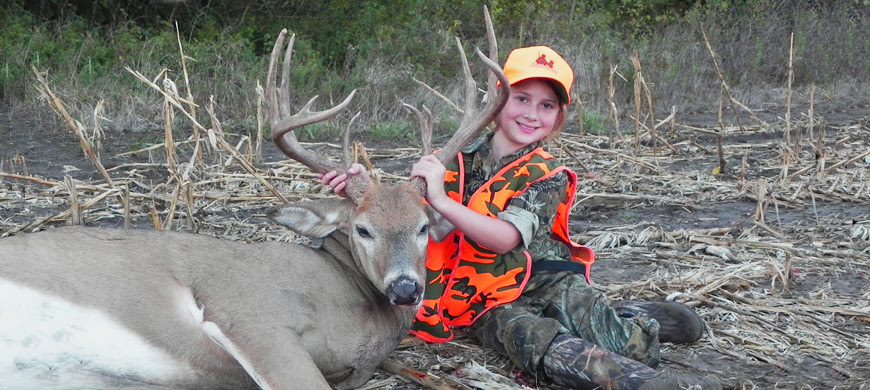
PRATT – Exclusive access to land not normally open to hunting and above average success rates. Sound like an expensive hunting lease? Well, it’s not. The Kansas Department of Wildlife, Parks and Tourism’s Special Hunts program provides hundreds of such hunts each fall, and there’s no charge. All you have to do is apply.
The program offers hunting opportunities with limited access to public and private land, providing the potential for high-quality hunts and greater harvest rates. Because each hunt is open to a limited number of hunters, applications must be made online, and random drawings will determine who is selected. The application period opens July 15, 2017, and the deadline for First Draw Hunts (hunts occurring in September and October) is 9 a.m., Aug. 14, 2017. The application deadline for Second Draw Hunts (hunts occurring in November, December, January and February) is 9 a.m., Sept. 25, 2017.
Any resident or nonresident hunter may apply. When applying online, hunters will select hunts by species, date and category, which include Open Hunt, Youth Hunt, or Mentored Hunt. All applicants are eligible to apply for Open Hunts, regardless of age or hunting experience. Youth Hunts require parties to include at least one youth 18 or younger, accompanied by an adult 21 or older who may not hunt. Mentored Hunts are open to both youth and novice hunters supervised by a mentor 21 or older who may also hunt. There are more than 500 individual hunting opportunities available for the 2017-2018 hunting seasons.
A random computer drawing will be conducted within one week of the application deadline. Successful applicants will be emailed their hunt permit, as well as area maps and other pertinent information. Hunters are responsible for purchasing necessary licenses and permits required by law.
Special hunts occur on wildlife areas, state parks, private land parcels, a national wildlife refuge, U.S. Army Corps of Engineers areas and even city- or county-owned properties. Hunts are divided by species, equipment and hunt type. Most of the hunts are for deer and upland game, but opportunities are also available for waterfowl, doves, turkey and furbearers.
For more information on the Special Hunts Program, visit ksoutdoors.com and click “Hunting,” then “Special Hunts Information.”