

Month: July 2017
Hittin’ the historic roads of Trego County

 By DENA WEIGEL BELL
WaKeeney Travel Blog
Summer vacation is here and it’s time to hit the road and explore the beautiful Great Plains of Western Kansas!
There are many wonderful places to visit in Trego County—the Smoky Valley Scenic Byway, Cedar Bluff State Park, and Downtown WaKeeney—but did you know when you travel across Trego County to see these great places you are actually traveling on historic landmarks, too?
Smoky Hill Trail
When the very first travelers began crossing the Great Plains they were mostly on their own. No maps, no guidebooks, no hint of where the next turn would take them. Word-of-mouth was their guide in those days, and the unmapped, 500-mile route they typically followed was called the Smoky Hill Trail. It was fraught with danger. Word of deadly animal encounters, dehydration, and hostile native people protecting their land soon gave the route a bad reputation and people traveling west determined a longer, northern route was a better option.
 The Butterfield Overland Trail
Seeing opportunity in the increasing desire to “Go West,” an entrepreneur from Atchison, KS named David A. Butterfield set out to establish a faster route to Denver. He mapped a route across the Great Plains in 1865 and built several “home stations” along the route (Trego County claims six of those stations; Bluffton, Stormy Hollow Station, White Rock Station, Downer Station, Ruthton Station and Castle Rock Creek Station). Soon he was advertising passage on his Butterfield Overland Despatch (BOD) stagecoach for $175 a person and fifty-cents to a dollar for a meal.
Trego County claims a 21-mile stretch of what was billed as the “fastest route to the Colorado goldmines,” and modern-day historians can visit commemorative guideposts placed along the trail’s route in the 1960s at points where today’s north/south roads intersect the BOD trail. The guideposts extend beyond our county’s borders from Ellsworth, KS, to the state line, providing modern-day adventurers the opportunity to follow in the path the early pioneers took across our state, with the exception of the first 63-miles.
US Highway 40
 For those who love easy drives along scenic country roads, consider taking the road less traveled and turn your car down US Highway 40.
The once paved road was once the main artery between Ogallah, WaKeeney, and Collyer, Trego County’s largest towns. Now, it provides travelers an opportunity to slow down and enjoy the sights, surrounded by shade trees in some spots and wide open landscape in others.
Built in 1926, Highway 40’s route roughly followed the same course as the Butterfield Overland Despatch Trail. Its construction marked a seminal moment in history for travel across America when larger, more reliable cars allowed more people to hit the road than ever before, and transcontinental movement was more accessible to everyone.
During America’s “Golden Age of Automobiling” in the 1950’s, Highway 40 carried more traffic than any other transcontinental highway in the United States, even gaining recognition as a Blue Star Memorial Highway in 1951.
 Interstate 70
Today, the road most traveled is Interstate 70, a road first envisioned on the battlefield of World War II.
During his time leading the troops in Europe, Kansas native President Dwight D. Eisenhower saw the value of an interconnecting, paved road that could support military movements, trade, and public transportation needs. He commissioned his teams to map the fastest and most easily conversed routes possible and they found the Great Plains’ landscape fit the requirements perfectly. In 1956 construction began on “the Main Street of Kansas,” and ever since it’s played a huge role in our county’s communities.
 Stop by Eisenhower Park at WaKeeney’s West Exit #127 to enjoy our monument to the president who brought American travelers to our city’s front door.
Enjoy the Journey, and the Destination
People say that it’s not only the destination, but also the journey that makes a trip worthwhile, and those words ring true when traveling over the historic roads of Trego County. You will find that whichever route you choose you’ll be riding in the footsteps of people who helped develop this great nation over the last 150-years.
This summer set out on a trip through time to explore the historic roads of Trego County!
Area Veteran Service Representative schedule for July

 KCVA
KCVA
Area Veteran Service Representative schedule for July 2017
Wednesday 5 July
WaKeeney Vet Cemetery, 9-10:00 AM
Ness City Veterans Building, 11-12 PM
LaCrosse Rush Co. Courthouse, 1-2:30 PM
Thursday 6 July
Beloit City Hall, 10-11:30 AM
Mankato City Hall, 1-2:30 PM
Monday 10 July
Osborne Veterans Building, 10-11:30 AM
Russell City Hall, 1-2:30 PM
Tuesday 11 July
Stockton Courthouse, 10-11:30 AM
Plainville Veterans Building, 1-2:30 PM
Tuesday 25 July
Dighton Public Library, 1-2:30 PM
Clients are seen on a first come served basis. No appointments taken.
Douglas Storie, VSR
Kansas Commission on Veterans’ Affairs
Veteran Service Representative
207 E. 7th Suite C
Hays, KS 67601
Phone: 785-625-8532
FAX: 785-650-0392
E-mail: [email protected]
MADORIN: Great Plains miller invasion is bear feast


Most of us living in western Kansas open our mailboxes or newspapers to find multitudes of miller-moths hiding in dark crevices. After slapping at the annoying creatures, we scrub away miller dust their wings deposit. If they escape, they squirt orange fluid that scientists call meconium, which gives an idea of its ingredients. Most people can’t find anything good to say about this insect invasion except, “Thank goodness they don’t eat fabric, wood, or carpets.”

In pre-miller life, these invaders were army cutworms that can wreak havoc in winter wheat fields and alfalfa patches. In high population years, cutworms assume the “army worm” custom of massing in Biblical plague formations to travel over fields or highways.
After they mature in spring, they tunnel into soft earth to pupate. Following a three to six week period underground, they emerge as flitting moths, capable of squeezing through door and window cracks where they slink into inviting darkness.
Fortunately, they don’t hang around all summer. These are high elevation, cool weather, wildflower-nectar and evergreen pollen loving creatures. They migrate from the heat saturated plains into the high, cool reaches of the Rockies. By August, nature balances her scales, and army cutworm moths that survived this journey soon find themselves providing winter fat stores for furry, four-legged eating machines.
Grizzlies and black bears love miller-moths. Recall that these insects love dark crevices. Vast mountain rockslides offer innumerable hidey-holes for migrating throngs. Bears follow insect hordes to boulder and scree-strewn slopes where they then feast upon the winged creatures. Though bears typically feed in isolation, enormous amounts of available calories incline them to dine in mass upon these rock fields. According to researcher Hillary Robison who observes bears in and around Yellowstone Park, “It’s kind of like a salmon stream. We’ve seen bears feeding within several hundred yards of each other. . . .”

People with sensitive noses notice unpleasant odors coming from dead moths. The scent results from a high fat content that turns rancid when miller-moths die. This lipid concentration is what draws grizzlies to rocky mountainsides and triggers their focused digging into crannies. The bruins work so hard turning over stones to find these insects that they wear down their three to four inch claws as they eat up to 40,000 moths a day to store calories for winter survival.
Robison’s research examines how far Yellowstone moths travel from Great Plains farmlands and reveals an unexpected connection between the Great Plains and bear survival in Yellowstone. Of interest to Yellowstone tourists, silvertips looking for moths in high elevations each summer won’t be inclined to trouble park visitors at lower elevations. According to Robison, “If they are spending a month up in these Yellowstone moth sites in the summer, they could eat close to half their needs for the year.”
While I don’t like moth dust, orange splats on the woodwork, or having winged hordes fly out of my newspapers, I have a new appreciation for these metamorphic wonders. I enjoy knowing miller-moths that hovered about my yard light fatten grizzlies for winter hibernation.
Native Kansan Karen Madorin is a local writer and retired teacher who loves sharing stories about places, people, critters, plants, food, and history of the High Plains.
Kan. School Funding Case: Districts Seek $600M More; State Requests Dismissal

FILE PHOTO / KPR
By CELIA LLOPIS-JEPSEN
Lawyers for Kansas and for dozens of school districts suing it filed briefs Friday at the Kansas Supreme Court, in what could be the final leg of a seven-year legal battle over school finance.
The state argues legislation passed early this month ratchets up annual state aid to schools by nearly $300 million over the next two years, and that should be enough to end the Gannon v. Kansas case once and for all.
The plaintiffs, meanwhile, lay out a case for increasing funding by another $600 million on top of that. If that argument succeeds, it could prompt a special legislative session to appropriate more money — and hammer out the details of how to pay for it.
Each side has one week to submit reply briefs picking apart each other’s claims. Oral arguments are scheduled for July 18.
In their brief, the state’s lawyers homed in on the Legislature’s decision to increase funds targeted at helping students who struggle academically. They also pointed to extra financial support for early childhood education and all-day kindergarten.
“This substantial new funding benefits underperforming subgroups directly,” the brief says, and argues the extra dollars for kindergarten further free up existing budgetary resources that school districts had been diverting to cover kindergarten expenses.
Instead, schools can now spend those resources on initiatives for struggling students, the lawyers said.
Providing schools with the means to address Kansas’ persistent achievement gap was a key task for lawmakers, identified by the Kansas Supreme Court in a March ruling.
The justices wrote then that one-quarter of Kansas public school students were falling short of basic math and reading skills, and they noted the disproportionate effect for Hispanic and African-American children and students from low-income families.
The March decision was the latest in a string of court rulings that have largely sided with plaintiffs’ claims that Kansas is neither putting enough money into education nor distributing it in such a way that children with disadvantaged backgrounds have educational opportunities on a par with those who attend schools in wealthier areas.
Lawyers for the school districts hope the justices will agree with them yet again and find the state has fallen short of the mark this time, too.
It cites recommendations from the Kansas State Board of Education calling for a nearly $900 million increase in state aid over a two-year period.
The new law “wholly ignores the estimates of several expert bodies as to what it actually costs to provide Kansas schoolchildren with a constitutional education,” the brief says.
The state board’s recommendation also included more state aid per pupil, plus higher increases for special education and teacher mentoring and training programs than those included in the new law.
Lawyers also pointed backward in time to make their argument. A decade ago, the Legislature agreed to a basic funding level of $4,492 per student, to take effect in fiscal 2010. The plan fell by the wayside after the 2008 financial crisis sparked steep budget reductions and sweeping 2012 tax cuts ate into state revenues.
“Now, seven years later, the State is only providing a base of $4,006 per student,” the brief says, adding that $4,492, adjusted for inflation, would be $5,035 today.
The state, however, argues that its appropriations for K-12 in the new law are based on an analysis of spending levels at 41 schools districts with notable academic achievement relative to their demographic characteristics. Additionally, the new law provides for future increases by tying funding to inflation rates.
These decisions are “eminently rational,” the state’s lawyers wrote, and help demonstrate that the law complies with the Kansas Constitution.
Article 6 of the Constitution tasks the Legislature with making “suitable provision” for education.
The state also rejects the plaintiffs’ allegations that state aid is distributed unfairly and puts children in poorer school districts at a disadvantage. Lawyers argued the new law includes sufficient measures to bolster the resources of poorer districts.
Celia Llopis-Jepsen is a reporter for the Kansas News Service, a collaboration of kcur.org, Kansas Public Radio and KMUW covering health, education and politics. You can reach her on Twitter @Celia_LJ.
Downtown sewer repair will lead to street, land closures
 City of Hays
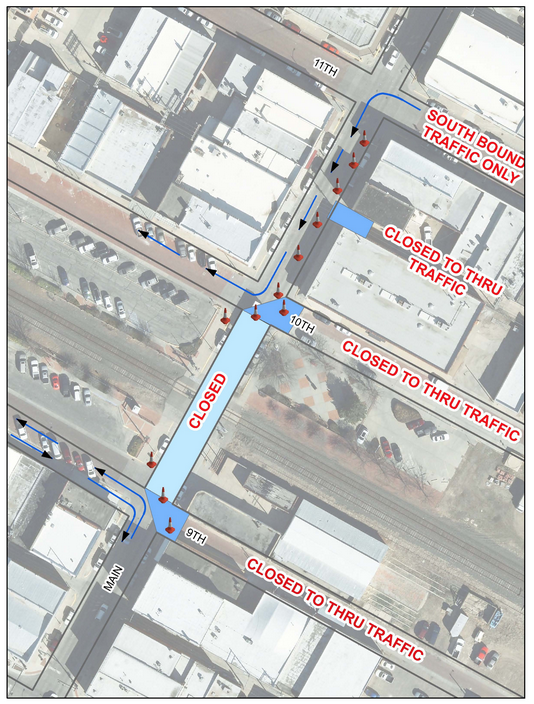
Beginning Wednesday, crews will begin work on repairing the sanitary sewer line from Ninth Street to 11th Street on Main Street. Maintaining sewer infrastructure is crucial to the sanitary sewer system in order to prevent blockages and sewer structure deterioration.
Traffic control devices will be in place to direct the traveling public, and 10th Street to 11th Street will be reduced to one lane of traffic southbound only. The road from Ninth to 10th will be closed for vehicle traffic on Main Street. Businesses in the area will be notified. This project is expected to be completed by July 21.
Click on the image above for a map of the project.
SCHLAGECK: Develop dialogue


More often than we’d like to admit we sometimes shoot ourselves in the foot when talking about the challenges we face in farming and ranching. These conversations with friends, neighbors and family take place at the local café, filling station, after church or Friday evening ball games.
During these visits, farmers and ranchers sometimes conclude that consumers and non-aggies don’t like them. Or, their urban acquaintances don’t listen to them or care one iota about raising crops or caring for livestock.
Most people don’t need to know much about farming today. They probably think about agriculture less than 30 seconds a year and 20 seconds of that time is based on misinformation.
Why should they?
Do farmers and ranchers wonder what a Detroit automaker does? Who he or she is? And what about their family?
While non-farm and ranch people harbor misconceptions about agriculture, believe me, they like farmers and ranchers. They admire this profession.
It’s important to bridge this informational gap between farm and ranch producers and consumers. But navigate this divide skillfully.
No one wants to be educated or preached to. Humans like to engage in conversations. They like give and take. Usually, if a person is knowledgeable about a profession like raising cattle, another person who doesn’t know about the livestock industry may be curious and willing to listen.
And while no one understands agriculture like farmers and ranchers, we must encourage and foster dialogues with those who know little about this profession. This includes people outside our comfort zone – someone we may not talk to about what we do like city cousins, foodies, medics, lawyers, etc.
Take the opportunity to conduct such conversations on a flight to another state or country. Develop dialogue with people at a professional meeting, just about anywhere and with anyone who isn’t savvy about agriculture.
Times continue to change and so do attitudes and opinions. Forty years ago, people expressed little interest in agriculture.
As a fledgling photo journalist in the mid-1970s, I can’t remember someone asking me about agriculture at a social event. This just didn’t happen even though many of my friends knew I worked in journalism and wrote about farming and ranching.
Agriculture wasn’t hip, cool or fly back then. Today the tables have turned and people are quite interested in where their food comes from. They don’t hesitate to walk up to you, cocktail in hand and ask, “Tell me about antibiotics, beef production, GMOs.”
Talk to them. Tell your story. Exude passion about your chosen profession.
But remember – ask them about their profession, who they are and what makes them tick.
Then, listen.
Develop relationships and build on those dialogues. Before we can expect someone to listen to us talk about how important international trade is to our bottom line, we must listen to them tell us about their home and garden, their chosen career or whatever else they choose to talk about at the time.
There is a voice that doesn’t use words – listen.
John Schlageck is a leading commentator on agriculture and rural Kansas.
Declaration of Independence: ‘We hold these truths to be self-evident …’
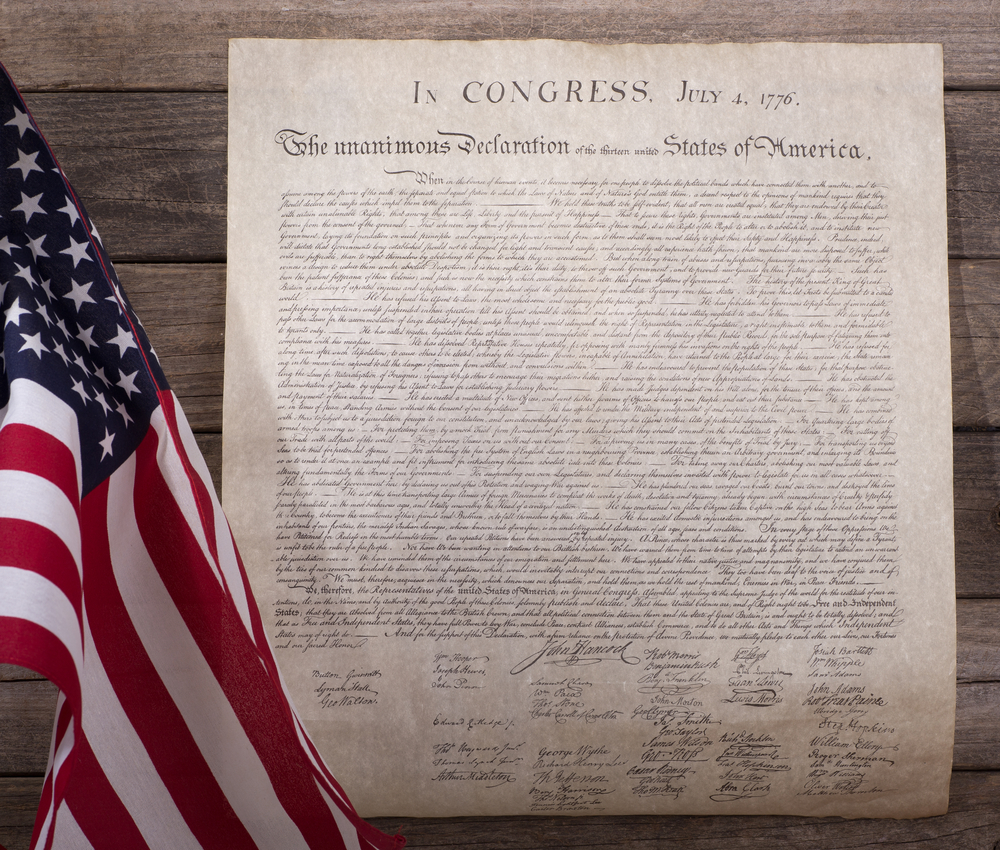

IN CONGRESS, JULY 4, 1776
The unanimous Declaration of the thirteen united States of America
When in the Course of human events it becomes necessary for one people to dissolve the political bands which have connected them with another and to assume among the powers of the earth, the separate and equal station to which the Laws of Nature and of Nature’s God entitle them, a decent respect to the opinions of mankind requires that they should declare the causes which impel them to the separation.
We hold these truths to be self-evident, that all men are created equal, that they are endowed by their Creator with certain unalienable Rights, that among these are Life, Liberty and the pursuit of Happiness. — That to secure these rights, Governments are instituted among Men, deriving their just powers from the consent of the governed, — That whenever any Form of Government becomes destructive of these ends, it is the Right of the People to alter or to abolish it, and to institute new Government, laying its foundation on such principles and organizing its powers in such form, as to them shall seem most likely to effect their Safety and Happiness. Prudence, indeed, will dictate that Governments long established should not be changed for light and transient causes; and accordingly all experience hath shewn that mankind are more disposed to suffer, while evils are sufferable than to right themselves by abolishing the forms to which they are accustomed. But when a long train of abuses and usurpations, pursuing invariably the same Object evinces a design to reduce them under absolute Despotism, it is their right, it is their duty, to throw off such Government, and to provide new Guards for their future security. — Such has been the patient sufferance of these Colonies; and such is now the necessity which constrains them to alter their former Systems of Government. The history of the present King of Great Britain is a history of repeated injuries and usurpations, all having in direct object the establishment of an absolute Tyranny over these States. To prove this, let Facts be submitted to a candid world.
He has refused his Assent to Laws, the most wholesome and necessary for the public good.
He has forbidden his Governors to pass Laws of immediate and pressing importance, unless suspended in their operation till his Assent should be obtained; and when so suspended, he has utterly neglected to attend to them.
He has refused to pass other Laws for the accommodation of large districts of people, unless those people would relinquish the right of Representation in the Legislature, a right inestimable to them and formidable to tyrants only.
He has called together legislative bodies at places unusual, uncomfortable, and distant from the depository of their Public Records, for the sole purpose of fatiguing them into compliance with his measures.
He has dissolved Representative Houses repeatedly, for opposing with manly firmness his invasions on the rights of the people.
He has refused for a long time, after such dissolutions, to cause others to be elected, whereby the Legislative Powers, incapable of Annihilation, have returned to the People at large for their exercise; the State remaining in the mean time exposed to all the dangers of invasion from without, and convulsions within.
He has endeavoured to prevent the population of these States; for that purpose obstructing the Laws for Naturalization of Foreigners; refusing to pass others to encourage their migrations hither, and raising the conditions of new Appropriations of Lands.
He has obstructed the Administration of Justice by refusing his Assent to Laws for establishing Judiciary Powers.
He has made Judges dependent on his Will alone for the tenure of their offices, and the amount and payment of their salaries.
He has erected a multitude of New Offices, and sent hither swarms of Officers to harass our people and eat out their substance.
He has kept among us, in times of peace, Standing Armies without the Consent of our legislatures.
He has affected to render the Military independent of and superior to the Civil Power.
He has combined with others to subject us to a jurisdiction foreign to our constitution, and unacknowledged by our laws; giving his Assent to their Acts of pretended Legislation:
For quartering large bodies of armed troops among us:
For protecting them, by a mock Trial from punishment for any Murders which they should commit on the Inhabitants of these States:
For cutting off our Trade with all parts of the world:
For imposing Taxes on us without our Consent:
For depriving us in many cases, of the benefit of Trial by Jury:
For transporting us beyond Seas to be tried for pretended offences:
For abolishing the free System of English Laws in a neighbouring Province, establishing therein an Arbitrary government, and enlarging its Boundaries so as to render it at once an example and fit instrument for introducing the same absolute rule into these Colonies
For taking away our Charters, abolishing our most valuable Laws and altering fundamentally the Forms of our Governments:
For suspending our own Legislatures, and declaring themselves invested with power to legislate for us in all cases whatsoever.
He has abdicated Government here, by declaring us out of his Protection and waging War against us.
He has plundered our seas, ravaged our coasts, burnt our towns, and destroyed the lives of our people.
He is at this time transporting large Armies of foreign Mercenaries to compleat the works of death, desolation, and tyranny, already begun with circumstances of Cruelty & Perfidy scarcely paralleled in the most barbarous ages, and totally unworthy the Head of a civilized nation.
He has constrained our fellow Citizens taken Captive on the high Seas to bear Arms against their Country, to become the executioners of their friends and Brethren, or to fall themselves by their Hands.
He has excited domestic insurrections amongst us, and has endeavoured to bring on the inhabitants of our frontiers, the merciless Indian Savages whose known rule of warfare, is an undistinguished destruction of all ages, sexes and conditions.
In every stage of these Oppressions We have Petitioned for Redress in the most humble terms: Our repeated Petitions have been answered only by repeated injury. A Prince, whose character is thus marked by every act which may define a Tyrant, is unfit to be the ruler of a free people.
Nor have We been wanting in attentions to our British brethren. We have warned them from time to time of attempts by their legislature to extend an unwarrantable jurisdiction over us. We have reminded them of the circumstances of our emigration and settlement here. We have appealed to their native justice and magnanimity, and we have conjured them by the ties of our common kindred to disavow these usurpations, which would inevitably interrupt our connections and correspondence. They too have been deaf to the voice of justice and of consanguinity. We must, therefore, acquiesce in the necessity, which denounces our Separation, and hold them, as we hold the rest of mankind, Enemies in War, in Peace Friends.
We, therefore, the Representatives of the united States of America, in General Congress, Assembled, appealing to the Supreme Judge of the world for the rectitude of our intentions, do, in the Name, and by Authority of the good People of these Colonies, solemnly publish and declare, That these united Colonies are, and of Right ought to be Free and Independent States, that they are Absolved from all Allegiance to the British Crown, and that all political connection between them and the State of Great Britain, is and ought to be totally dissolved; and that as Free and Independent States, they have full Power to levy War, conclude Peace, contract Alliances, establish Commerce, and to do all other Acts and Things which Independent States may of right do. — And for the support of this Declaration, with a firm reliance on the protection of Divine Providence, we mutually pledge to each other our Lives, our Fortunes, and our sacred Honor.
New Hampshire:
Josiah Bartlett, William Whipple, Matthew Thornton
Massachusetts:
John Hancock, Samuel Adams, John Adams, Robert Treat Paine, Elbridge Gerry
Rhode Island:
Stephen Hopkins, William Ellery
Connecticut:
Roger Sherman, Samuel Huntington, William Williams, Oliver Wolcott
New York:
William Floyd, Philip Livingston, Francis Lewis, Lewis Morris
New Jersey:
Richard Stockton, John Witherspoon, Francis Hopkinson, John Hart, Abraham Clark
Pennsylvania:
Robert Morris, Benjamin Rush, Benjamin Franklin, John Morton, George Clymer, James Smith, George Taylor, James Wilson, George Ross
Delaware:
Caesar Rodney, George Read, Thomas McKean
Maryland:
Samuel Chase, William Paca, Thomas Stone, Charles Carroll of Carrollton
Virginia:
George Wythe, Richard Henry Lee, Thomas Jefferson, Benjamin Harrison, Thomas Nelson, Jr., Francis Lightfoot Lee, Carter Braxton
North Carolina:
William Hooper, Joseph Hewes, John Penn
South Carolina:
Edward Rutledge, Thomas Heyward, Jr., Thomas Lynch, Jr., Arthur Middleton
Georgia:
Button Gwinnett, Lyman Hall, George Walton
🎥 Ellis County 4-Hers preparing for fair

Ellis County 4-Hers are gearing up for the annual Ellis County Fair, which will be July 15 to 23.
Elk and either-species deer permit applications accepted online through July 14

 KDWPT
KDWPT
PRATT – The application deadline for limited elk and either-species deer firearm permits is July 14, 2017. Kansas residents are eligible to apply online for one of 12 Either-species Elk permits and 15 Antlerless-only Elk permits allocated for Unit 2a (Ft. Riley). And resident hunters who want to hunt mule deer with a firearm can apply for limited Either-species Deer permits valid in the East or West zone. A hunter who does not wish to hunt this year may purchase a preference point that will count toward a firearm Either-species/Either-sex Deer permit in a future drawing or a bonus point for limited elk permits.
Elk permit applicants only pay the application fee ($12.81) when applying. Successful applicants will be notified by mail and the permit fee will be collected. Unsuccessful applicants will automatically receive a bonus point. Anyone who receives a limited Either-sex Elk permit is not eligible to apply again. Anyone who receives a limited Antlerless-only Elk permit may not apply again for a five-year period. All deer and elk permit applicants can view drawing results online two to four weeks after the application deadline.
To apply or learn more, visit www.ksoutdoors.com and click on “Hunting,” then “Applications and Fees,” or call (620) 672-0728.
SEASONS
Elk seasons for Ft. Riley are: Muzzleloader and Archery – Sept. 1-Sept. 30, 2017; Firearm Season for Either-species elk – Oct. 1-Dec. 31, 2017; Firearm antlerless, first segment – Oct. 1-31, 2017; Firearm antlerless, second segment – Nov. 1-30, 2017; and Firearm antlerless, third segment – Dec. 1-31, 2017.
The firearm deer season is Nov. 29-Dec. 10, 2017. Either-species, Either-sex Deer permits allow the holder to take a mule deer or white-tailed deer, buck or doe.
PERMIT FEES
Deer Firearm Either-species/Either-sex permit: General Resident – $52.50; Resident Landowner/Tenant – $32.50; Resident Youth (15 and younger): $22.50; Nonresident Tenant – $97.50; Preference Point – $11.50
Elk Firearm Either-sex: General Resident – $302.50; Landowner/Tenant – $152.50; Resident Youth (15 and younger) – $127.50; Nonresident Tenant – $152.50; Bonus point – $12.81.
Elk (antlerless): General Resident – $152.50; Landowner/Tenant – $77.50; Resident Youth (15 and younger) – $52.50; Nonresident Tenant – $77.50
Sunny, hot Independence Day with a chance for thunderstorms
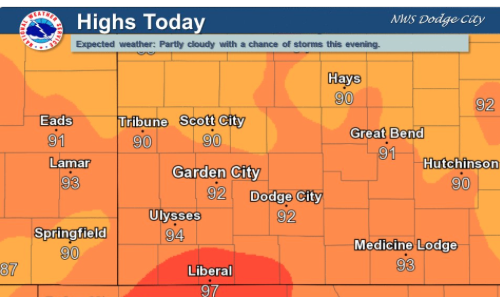

Independence Day Mostly sunny, with a high near 89. Southeast wind 5 to 8 mph.
Tuesday Night A 20 percent chance of showers and thunderstorms before 1am. Partly cloudy, with a low around 65. East southeast wind 3 to 8 mph.
Wednesday Sunny, with a high near 92. South southeast wind 5 to 7 mph.
Wednesday NightMostly clear, with a low around 66. East southeast wind 5 to 7 mph becoming south southwest after midnight.
ThursdaySunny, with a high near 97.
Thursday NightA 20 percent chance of showers and thunderstorms after 1am. Partly cloudy, with a low around 68.
FridayA 20 percent chance of showers and thunderstorms after 1pm. Mostly sunny, with a high near 94.
Friday NightA 40 percent chance of showers and thunderstorms. Mostly cloudy, with a low around 66.
SaturdayA 30 percent chance of showers and thunderstorms before 1pm. Mostly sunny, with a high near 89.
1 hospitalized after pickup breaks an axel on I-70 in NW Kansas

SHERMAN COUNTY – One person was injured in an accident just before 8:30p.m. Monday in Sherman County.
The Kansas Highway Patrol reported a 2012 F150 pickup driven by Harmandeep Sidhu, 35, Jackson, MS, was traveling on I-70 just east of Goodland. The driver lost control, drove into the south ditch, struck an embankment that broke an axel on the truck.
Sidhu was transported to the hospital in Goodland. He was properly restrained at the time of the accident, according to the KHP.
Kan. man accused in abduction, murder of estranged wife held on $1M bond


TOPEKA, Kan. (AP) — A Kansas man has been ordered jailed on $1 million bond on charges that he abducted and killed his estranged wife.
A Shawnee County judge set the bond Monday for 38-year-old Pedro Enriquez during the man’s brief court appearance on charges of first-degree murder, aggravated kidnapping and aggravated battery.
Enriquez is to appear in court next on Thursday, and it was not immediately clear whether he has an attorney who can speak on his behalf.

Enriquez is accused of abducting 33-year-old Viviana Vazquez on June 7 from a Topeka home, where their 10-year-old son says he saw Enriquez drag her outside by the hair. Viviana Vazquez’s body was found the next day.
Enriquez was arrested Friday in Jefferson County.