CITY OF ELLIS
ELLIS–The Ellis City Council will meet in a work session Tue., Aug. 15 at 7 p.m. in Ellis City Hall, 815 Jefferson.
The sole agenda item is discussion of the Capital Improvement Plan.
CITY OF ELLIS
ELLIS–The Ellis City Council will meet in a work session Tue., Aug. 15 at 7 p.m. in Ellis City Hall, 815 Jefferson.
The sole agenda item is discussion of the Capital Improvement Plan.
 What did the volcano say to his girlfriend?
I lava you.
Join fans of 99 KZ Country on Facebook: https://www.facebook.com/99KZCountry
 KDWPT
KDWPT
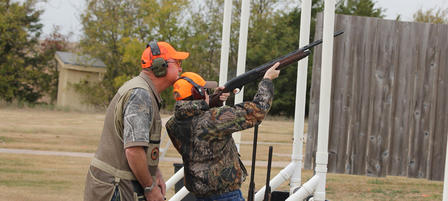
ELLIS – If you’re interested in introducing your child to the world of shooting sports, hunting, fishing and other outdoor-related activities, head out to Hays on August 19 for the 20th Annual Youth Outdoor Festival.
Hays area businesses, conservation groups and shooting sports groups have teamed together to offer a free day of target shooting and outdoor activities for youth 17 and younger and your family is invited to attend. The event will be held Saturday, August 19 from 9 a.m. to 3 p.m. at the Hays City Sportsman’s Club, located 1/4 mile north of I-70 Exit 157.
Youth will learn the ins and outs of trap and skeet shooting, archery equipment, air rifles and BB guns, muzzleloaders, small-bore rifles, and more. There will also be a casting competition, paintball target shooting, and a furharvesting demonstration.
Youth will be closely supervised at each station by experienced volunteer instructors, and all equipment will be supplied. Hunter Education certification is not required, however, youth are required to be accompanied by an adult.
There is no cost to attend and families can register onsite the day of the event.
A free lunch will be provided courtesy of Eagle Communications and the Hays Chapter of Pheasants Forever. Youth will also have chances to win prizes, including guns, fishing tackle and other outdoor equipment.
For more information, contact Kent Hensley at 785-726-3212 or Troy Mattheyer at 785-726-4212.
 Average national price flat, but Labor Day weekend price jump is likely
Average gas prices across Kansas rose 1 cent per gallon to $2.23 this week, AAA Kansas reported Monday. This is a much slower rate of increase than the two previous weeks, which saw consecutive 6- and 5-cent increases.
“Although we’re still experiencing relatively affordable gas prices across Kansas, compared to the national average and compared to recent years, strong gasoline demand has driven our continued increase in prices at the pump this summer,” said AAA Kansas spokesman Shawn Steward. “We expect gas prices to continue their rise through the busy Labor Day holiday travel weekend.”
At 12 cents less than the national average, Kansas gas prices are still 12th lowest in the country, Steward said.
This week’s Kansas cities with the state’s gas price extremes are:
HIGH: Hoxie – $2.50
LOW: Columbus – $2.07
Price trends in AAA Kansas’ 10 regularly reported Kansas cities (see chart) were mixed, with five cities experiencing increases, one remaining the same, and three (Kansas City, Kan., Lawrence and Wichita) decreasing. Topeka saw a 6-cent per gallon increase, while Salina (5 cents) and Emporia (4 cents) also saw moderate price jumps, AAA Kansas noted.
National Perspective
Today’s national average price for regular unleaded gasoline is $2.35 per gallon, which is flat on the week, nine cents more than one month ago, and 22 cents more than last year. Compared to seven days ago, gas prices are more expensive in 27 states, cheaper in 12 states and flat in 12 states. The West Coast, Rockies and Midwest regions are seeing the bulk of the increases at the pump.
“Prices at the pump continue a slow, upward climb as the summer season draws to a close,” said AAA Kansas’ Steward. “As we get closer to Labor Day and demand and production rates grow, drivers will likely see some of the highest prices at the pump this year.”

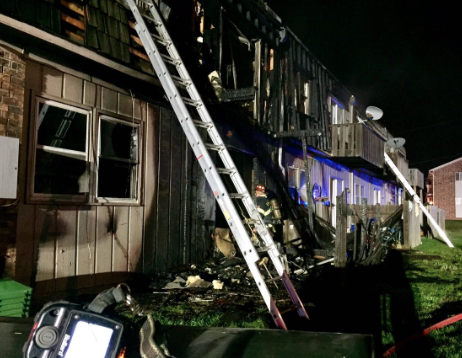
JOHNSON COUNTY – Officials are working to determine the cause of a fatal fire in Johnson County.
Crews responded just before 3a.m. Tuesday to the fire at an apartment complex in the 8800 Block of Broadmoor Court in Overland Park, according to a social media report.
Two children died in the fire. Two others escaped. The children’s mother was transported for treatment and two men were hurt when they jumped out of a second-story window
Heat exhaustion also sent one firefighter to the hospital and another was treated at the scene.
The unit where the children were found dead didn’t have a working smoke detector. The children’s names weren’t immediately released.
-The AP contributed to this report
 KDOT
KDOT
TOPEKA–On Aug. 21, a total solar eclipse will occur as the moon passes directly in front of the sun, darkening the sky. With increased traffic anticipated across the state as people travel to view the eclipse, the Kansas Department of Transportation, Kansas Turnpike Authority, and Kansas Highway Patrol advise travelers to plan ahead and enjoy the eclipse safely.
According to the U.S. Department of Transportation, approximately 200 million people live within driving distance of the eclipse’s path of totality. While only the northeast corner of the state will be in the path of totality for the solar eclipse, the rest of Kansas will still experience part of the astronomical event.
With an increase in traffic and travel time expected, travelers should be patient, avoid distractions, and practice safe driving habits.
“We understand the excitement around the solar eclipse, and we encourage Kansans and our travelers to enjoy this rare opportunity. We do, however, want you to remain safe as you take the opportunity to witness this occurrence,” said Lt. Adam Winters, KHP public information officer.
Travelers across the state are encouraged to follow these tips to drive safely on the day of the eclipse:
It is also important to be prepared in case of emergencies and create a travel safety kit. Some items to consider for a travel kit may include:
Check the weather and plan accordingly – make sure to dress properly and be fully prepared for potential weather incidents when driving long distances. For information on road conditions, check out www.kandrive.org or call 5-1-1 in Kansas or 1-866-511-KDOT (5368) in the U.
 CITY OF HAYS
Please be advised that beginning Tuesday, August 15, 2017, the west 150 feet of Pershing Court will be closed for reconstruction. Ash Street will remain open to northbound traffic. Access to Pershing Court will be allowed from Fort Street.
This project is in conjunction with the 2017 Street Maintenance Program.
This section is scheduled to be completed within four weeks (pending weather conditions).
Signs will be in place to direct the traveling public. The traveling public should use caution and if at all possible avoid these areas.
The City of Hays regrets any inconvenience this may cause to the public. If there are any questions, please call the Public Works Planning, Inspection, and Enforcement Division at 785-628-7310 or the contractor, J-Corp, at 785-628-8101.
By BECKY KISER
Hays Post
Early this year, the Kansas State Department of Education, in a request by the Kansas Highway Patrol, asked the state’s 286 school districts to voluntarily take part in a school bus safety awareness project. The purpose of the project was to raise awareness about illegal passing of school buses by motorists.
Hays USD 489 was one of 57 districts to volunteer between Jan. 23 and March 3, 2017. In those 30 school days, 40 motorists illegally passed stopped Hays school buses.

“We don’t want any children getting off the bus to get hurt,” said Russ Henningsen, USD 489 Director of Transportation. “It’s state law traffic must stop in both directions when a stopped school bus is displaying its flashing red lights and stop sign arm.”
The only exception is on a divided highway, such as Interstate 70, when only same-direction traffic overtaking the bus is required to stop. USD 489 doesn’t make any stops on I-70, according to Henningsen.
“Basically, anywhere in the city limits of Hays including Vine Street, if the stop sign is out, motorists in both directions must stop,” Henningsen explained. Once the bus is no longer displaying its flashing red lights and stop arm, traffic may proceed.
The Hays school buses also routes outside city limits on Highway 183 and near the airport on east Highway 40, where traffic is traveling much faster. “We don’t make any stops on Highway 183, but on Highway 40, we have no choice. We have to make a couple stops there.”
“A lot of people run our stop signs out there,” Henningsen reported. Most of the incidents of illegal passing reported to the state this year by USD 489 occurred on Highway 40.
“No matter if it’s city, state, or county roads, they all apply under state law. In town, our bus drivers are going 20 to 30 mph. On the highway that can be up to 50 mph, so it’s a lot more dangerous out in the county than it is in Hays.”

When a bus driver sees a vehicle about to go around the bus, “we get very nervous about the children’s safety,” he said.
“We want to be as safe as we can transporting very precious inventory. The students are either very happy to be getting home or excited to arrive at school and may not be paying attention to vehicles on the road.”
With the fall semester starting later this week in Hays, Henningsen reminds motorists to also watch for students walking and riding their bikes to and from school.
Henningsen wants to make sure drivers are aware of the Kansas law. “We all need to be extra careful to help the kids out. It’s a very serious issue.”
He reminds drivers Hays school buses must also stop before a train crossing. “Twice in one week two different buses were rear-ended at a railroad crossing and we do have the four-way flashing lights on to warn drivers before we stop.”
Hays school buses are typically on the road from 6:30 a.m. to 8 a.m. picking students up for school and again in the afternoon from 3 to 4:30 p.m. delivering them back home. During regular school hours they may be driving students between schools or on field trips, and in the evenings traveling for sporting events. “We’re running around at all times,” Henningsen said. “It is more than just going to and from school.”

Drivers who are caught going around a stopped school bus will be fined.
“We’re in communications with the Kansas Highway Patrol, Ellis County Sheriff and Hays Police Department after one of our drivers sees a violating motorist. They work with us to find violators,” Henningsen said. The bus drivers sometimes are able to pass along a vehicle description or even a tag number. They’ll fill out a state-provided form and pass it along to local law enforcement.
“Hays police will either call or go to the offender’s residence and talk to them about being reported for not stopping. If it happens a second time, the violator is often issued a ticket,” Henningsen said. There are areas along the Hays bus routes where the bus stop arms are commonly ignored and USD 489 sometimes asks HPD to watch for violators in action.
“People are in too much of a hurry, distracted by cell phones and they’re just not taking their time,” Henningsen believes.
According to state law, violations are punishable by a fine and court costs in excess of $420.


Right now, Kansans who live anywhere near Wakeeney can only shake heads and wring hands. As they survey profound destruction wreaked upon homes and farms by gust-driven ice missiles the size of baseballs, they reveal the tenacity of prairie residents. They don’t lament, “Woe is me.” Instead, they count their blessings.
More than one battered resident has remarked that they lost property, but no one died. Even in instances where people lost livestock or pets, they express gratitude that family members are well. I can relate. I was relieved to hear my own mom’s voice telling me she was okay after that monster storm battered her house and yard.

Via radar, I watched that white mass layered in purples, pinks, and reds as it cut a swath across Western Kansas. I called Mom to be sure she knew it was coming. She didn’t need me to tell her. Her Nex Tech device alerted her to danger so she was heading for shelter.
Knowing she was protected inside her home comforted me. At Brownie Scout camp decades before, we faced an evacuation through golf-ball size hail. I recalled welts and bruises ice balls rising on young campers and couldn’t imagine facing even larger wind-driven projectiles. After I saw storm-damaged vehicles, windows, and roofs, it was clear anything alive and outside suffered trauma during that assault.
A friend posted the storm in real time on Facebook so I imagined everyone experiencing that icy barrage felt like they were entombed in a continuously battered barrel. It had to be the closest to war that citizens who’d never served in the military experienced. Mom confirmed this when I contacted her following the storm.
Afterwards, the real ordeal began. As people inventoried damages, they found shattered windows, punctured roofs, damaged siding and fences, destroyed lawn furniture, naked trees, and vehicles pocked with more dents than a golf ball has. Some even discovered that the knife-like wind flipped trailer s, trucks, and grain bins topsy-turvy. It stripped fields of ripening grain to toothpick-like stalks.
While those viewing devastating photos bemoaned their friends and loved ones’ fates, I saw so many grateful responses. Caveats such as “Others had it much worse,” or “It can all be cleaned up,” echoed through social media.
A friend with his own troubles helped Mom patch her broken windows. A cousin with carpentry experience drove over two hours the next morning to seal a roof so punctured it could function as a colander. He found a reliable repair company to restore her property. His guidance is a blessing because he has insights the rest of us don’t.
My friend on the farm who noted that others had things much worse than she did brightened lives when she posted a story about her Great Pyrenees pup that found a storm-battered dove and carried it to her. She protected it and watched to see if it would mend enough to fly away. Distant and close friends smiled when she reported it flew off despite significant feather loss.
Right now, it’s hard to think about normal for folks living in this battered region. But like that dove, life will take off.
Native Kansan Karen Madorin is a local writer and retired teacher who loves sharing stories about places, people, critters, plants, food, and history of the High Plains.

We’re into months of candidates and near-candidates and possible candidates shuffling around ahead of the June 1, 2018, filing deadline, formally naming campaign treasurers and starting campaigns.
It’s going to be an unusually busy fall this year as the statewide officeholders decide whether to keep their jobs or seek higher offices, plus 125 Kansas House seats (and so far, just one Senate seat, that of May 1 sworn-in Sen. Richard Hilderbrand, R-Pittsburg) are up for grabs in the 2018 elections.
With all that political gamesmanship under way, there is a key date in the new calendars that will likely have a dramatic effect on those campaigns, and whether some Kansans decide to spend the summer mowing instead of campaigning: Friday, April 20, 2018.
No, it’s not the national marijuana day—that 4:20 celebration—it’s also the date when the state’s best economic experts, the Consensus Revenue Estimating Group, predict whether the state will have enough revenue on hand to finish out what will be the remaining two-plus months of this fiscal year and enough money to pay for expenditures budgeted for the coming fiscal year which starts July 1, 2018.
Not exactly what most Kansans consider the date that the earth either shakes or doesn’t. But to a surprisingly large degree, it is an earth-mover.
Enough money? Everything is good.
Not enough money? Then there must be, just before the primary election, cuts in spending on things that most Kansans want money spent on. Like social services, roads, law enforcement and corrections…you name it, someone out there wants it done with his or her tax money.
Or…there could be just-before the Legislature adjourns increases in taxes. That’s not anything an incumbent wants to campaign about or read on his/her opponent’s campaign cards, is it?
And that final estimate of revenues will be made just three days after what is likely to be the biggest influx of state income taxes in years. Key, remember, is that the massive income tax increases voted by this spring’s Legislature became effective retroactively to Jan. 1, 2017, and Kansans have been essentially given until April 17, 2018, to pay those taxes without penalty.
That extra time before penalties kick in means that if you don’t have adequate paycheck withholding you must come up with a big check for the state by April 17. Plus, folks who have LLCs or other businesses that for the past four years have been exempted from state income tax on “non-wage income” will be writing checks to the state on that date also. These last-minute payments essentially shake the state’s ability to monitor monthly how revenues are coming in.
Practically, if you have to pay taxes above your withholding, or try to remember just where you pay those income taxes if you’re coming off a four-year tax holiday, you aren’t going to be paying this year’s retroactive taxes early.
It’s that time-value of money deal. If you can earn another month or two of interest on your non-wage income, you’ll do it. That’s just marginally smart business. You pay your bills on the deadline, not early.
So those April receipts? Three days after the no-penalty payment deadline, they get ground into that Consensus Revenue Estimate that essentially decides what the governor and Legislature do to balance the budget. And, of course, whether voters are going to be inconvenienced and probably recall just who inconvenienced them when they see the name on the ballot.
Right now, before we know how this year’s tax increases work out, there are a lot of issues for candidates to talk about.
Those issues might change on April 20, 2018.
Syndicated by Hawver News Company LLC of Topeka; Martin Hawver is publisher of Hawver’s Capitol Report—to learn more about this nonpartisan statewide political news service, visit the website at www.hawvernews.com

From 11 a.m. to 2 p.m. Monday, Aug. 21, Fort Hays State University’s Sternberg Museum of Natural History will be the place to be to view the 2017 Solar Eclipse. Brought to you by Sternberg, the Fort Hays State University Foundation, The Meckenstock Group and Dock’s Boat & RV. The staff at Sternberg will have a variety of eclipse-related activities and exhibits set up for children and adults, and viewing glasses will be available for purchase. Smokin’ Co. BBQ and Taco Riendo will be on hand offering their lunch specialties and Ice Cream Express will be on site for cool desserts.
Click HERE for the Facebook event page.
Check back for updated fun facts, videos and explanations of the once-in-a-lifetime celestial event!
The umbra (or dark inner shadow) of the moon will be traveling from west to east from almost 3,000 miles per hour (in western Oregon) to 1,500 miles per hour in South Carolina.
•The last total eclipse in the United States occurred on Feb. 26, 1979. The last total eclipse that crossed the entire continent occurred on June 8, 1918.
• The last time a total solar eclipse occurred exclusively in the U.S.was in 1778. — NASA
——————
Why is it not safe to look at the sun even when only a small part of it is visible?
The rods and cones in the human retina are very sensitive to light. Even a thin sliver of the sun’s disk covers thousands of these light-sensitive cells. Normally during daylight conditions, the iris contracts so that only a small amount of light passes through the lens and then reaches the retina. This level of indirect sunlight is perfectly OK and the eye has evolved over millions of years to safely see the daylight world under most circumstances.
The problem is that the sun’s surface is so bright that if you stare at any portion of it, no matter how small, it produces enough light to damage individual retinal cells. It takes a few seconds for this to happen, but afterwards you will see a spot as big as the solar surface you glimpsed when you look away from the sun at some other scenery. Depending on how long you gazed at the sun and how badly the retinal cells were damaged, this spot will either fade away in time or remain permanent.
You should never assume that you can look away quickly enough to avoid eye damage because every person is different in terms of their retinal sensitivity, and you do not want to risk being the one who damages their eyes just to try to look at the sun. If you want to see what the sun looks like, use a properly-equipped telescope. Or why not just go online and view thousands of pictures taken of the sun by telescopes and NASA spacecraft! — NASA
Videos courtesy NASA

Seems some people outside of agriculture routinely try to define the family farm. These same folks tend to question corporate farming whether family owned or not.
Let’s look at a Kansas family farm. In our state, many are based on owner operation. This means the rights and responsibilities of ownership are vested in an entrepreneur who lives and works the farm for a living.
The second key to defining the family farming system would include independence. Independence implies financing from within its own resources using family labor, management and intellect to build equity and cash flow that will retire the mortgage, preferably in the lifetime of the owner.
Economic dispersion is the next important step in defining what a family farm should entail. Economic dispersion would include large numbers of efficient-sized farms operating with equal access to competitive markets worldwide.
No family farm would be complete without a family core. This family-centered operation must have a family who lives in harmony within the workplace. All family members share responsibilities and the children learn the vocation of their parents.
The ideal family farm would be commercially diversified. Production of diversified commodities would help reduce price risks and maximize the use of farm resources. In turn, this would provide greater self-sufficiency to produce crops and livestock.
One final attribute necessary in defining today’s family farm would be the acceptance and use of innovative technology. This not only enhances farm labor, but also helps boost production.
Family farming carries with it a commitment to specific, independent values. These values become a part of the community and include conservation, frugality, responsibility, honesty, dignity in work, neighborliness, self-reliance and concern and care for future generations.
While it’s rare indeed that one family farm may possess all of these attributes, together they have created a system of agriculture that has been a part of our rural culture since our state’s beginning.
Today, detractors of this profession are making it increasingly difficult for this vital industry to progress and prosper. That’s why it’s more important than ever to share information about our skills and attributes with those unfamiliar with our calling.
John Schlageck, a Hoxie native, is a leading commentator on agriculture and rural Kansas.

SHAWNEE COUNTY – Law enforcement authorities are investigating a suspect for a series of car burglaries.
On Sunday night, police made a traffic stop on a vehicle in the 400 Block of SW 33rd Street in Topeka, according to Lt. Jennifer Cross.
They arrested Olin D. Ashton II, 29, Topeka, for burglary, theft, criminal damage and an outstanding warrant. They also recovered property related to five identified victims.
A subject with Ashton fled the scene. He has been identified and continues to elude authorities.