We have a brand new updated website! Click here to check it out!

Crash that injured NW Kansas woman under investigation

Wednesday crash in Saline County -photo Saline Co. Sheriff

SALINE COUNTY — Law enforcement authorities are investigating the cause of an accident that injured a northwest Kansas woman just before 6p.m. Wednesday in Saline County.

A 2014 GMC Sierra driven by Ashalee Tankersley, 25, Colby, was westbound on Interstate 70 in Salina, according to Saline County Sheriff Roger Soldan.

The vehicle entered the median and traveled off the Mulberry Creek Bridge between the Ohio and Ninth Street exits.

Tankersley, who was not wearing a seat belt and unconscious, was transported to Salina Regional Health Center for treatment of a broken leg.

Alcohol is believed to be a factor in the crash, according to Soldan.

2017 Fly Kansas Air Tour includes overnight in Hays

Kansas Air Tour highlights STEM careers

KDOT

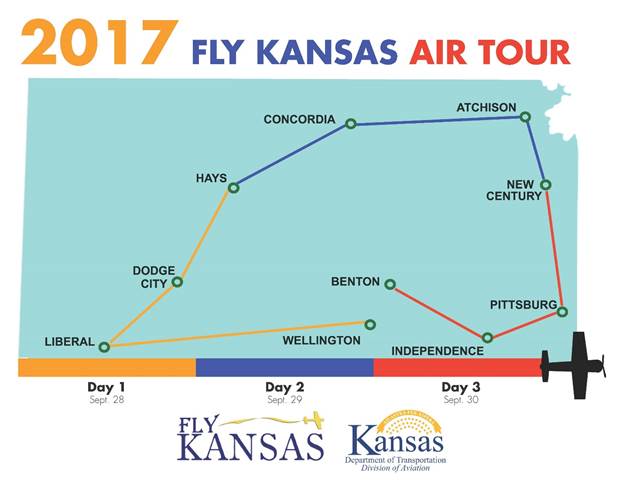
The 2017 Fly Kansas Air Tour lifts off from Wellington on Sept. 28 for a three-day, 10-city celebration of Kansas aviation.

This year’s tour, presented by the Kansas Commission on Aerospace Education and the Kansas Department of Transportation, promotes STEM (science, technology, engineering, math) education and highlights the benefits of local airports to their communities, Kansas, and the nation. The tour focuses on raising awareness on the importance of community airports and introducing aviation to young people.

Over 50 pilots along with their aircraft are expected to participate in the tour and engage with students across the state. More than 500 students are expected to visit their local airports during the tour. From tales of legendary fliers such as Amelia Earhart at the memorial airport in Atchison to information about all types of aviation careers, students will have this opportunity to learn all about aviation in the state of Kansas.

This is the fourth consecutive year for the revived tour, which first took place in 1928. The goal of that first tour was to promote the fledgling aviation industry in Kansas. “The air tour is an opportunity to promote Kansas aviation and share the message that aviation is open to all,” said Ed Young, President of the Kansas Commission on Aerospace Education and Fly Kansas Foundation.

“This is a great opportunity for us to connect students with aviators,” said Merrill Atwater, KDOT’s Division of Aviation Director. “Kansas has such a rich history of aviation and it is important for us to celebrate this industry and who we are as Kansans.”

The public is encouraged to visit the local airports during the tour stops to see the airplanes up close, talk to the pilots and learn about the role of aviation in Kansas.

The following is the tour schedule:

THURSDAY, SEPTEMBER 28


Wellington

8 a.m.             Aircraft Arrival

10:30 a.m.     Departure


Liberal

12:30 p.m.     Aircraft Arrival

2:30 p.m.       Departure


Dodge City

3:30 p.m.        Aircraft Arrival

4:30 p.m.        Departure


Hays

5:30 p.m.        Aircraft Arrival


FRIDAY, SEPTEMBER 29


Hays

10:00 a.m.     Departure


Concordia

11:00 a.m.     Aircraft Arrival

1:00 p.m.        Departure


Atchison

2:15 p.m.        Aircraft Arrival

4:00 p.m.        Departure


New Century

4:30 p.m.        Aircraft Arrival


SATURDAY, SEPTEMBER 30


New Century

9:30 a.m.       Departure


Pittsburg

10:30 a.m.     Aircraft Arrival

12:30 p.m.     Departure


Independence

1 p.m.             Aircraft Arrival

3 p.m.             Departure


Benton

4 p.m.             Aircraft Arrival

• UPDATED with corrected schedule 9/21/17

Police: 11-year-old arrested after threat at Kansas middle school

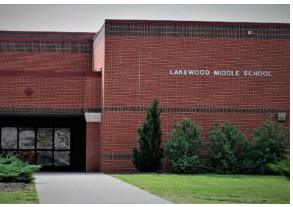
Lakewood Middle School in Salina

SALINE COUNTY — Law enforcement authorities are investigating a threat at a Kansas middle school and arrested a student.

On Wednesday morning, an 11-year-old student told a staff member at Lakewood Middle School, 1135 Lakewood Circle in Salina, he was going to go home and retrieve a pistol to kill them and everyone else in the building, according to Salina police Sgt. James Feldman.

A school resource officer and a Salina Police Officer picked the boy up outside of the building.

Police released no additional details.

Colby Community College will host domestic violence conference

Colby Community College is teaming with Options Domestic Violence Services and Northwest Kansas Corrections Oct. 11 to host a free conference that addresses domestic violence issues. Registration is required by Oct. 4 for the event, which will go from 8:30 a.m. to 4 p.m. in the Cultural Arts Center on the CCC campus.

The sessions are presented by certified health professionals, local experts in the domestic violence field, and survivors of domestic violence. Participants will hear topics that focus on batterer’s intervention, changing the thinking and behavior of batterers, community involvement, and strangulation. The day concludes with an interactive experience for attendees to better understand the lives of domestic violence victims.

Continuing education credit is available. Registration for the conference can be done online, or by contacting Ashley Hecker at (785) 625-4202 or [email protected].

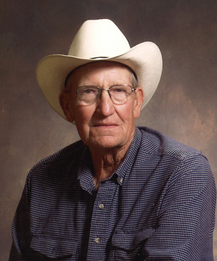
Delmar Emil Chrisler

Delmar Emil Chrisler, 81, of Natoma, Kansas, passed away Monday, September 18, 2017 at his daughter’s home in Victoria, Kansas.

Delmar was born June 5, 1936 in Hays, Kansas, the son of H. Don and Leona (Jantzen) Chrisler. He grew up in Ellis County near the Saline River and the Fairport area. He graduated from Natoma High School and then attended Ft. Hays State University. Delmar served his country in the U.S. Army. After his service he returned to the Fairport area.

Delmar was united in marriage to Myra Ann Pfortmiller on June 1, 1963 in Natoma. This union was blessed with four daughters; Michele, Kimberly, Tammy Jo and Brenda. They made their home on the farm near Fairport. Myra preceded him in death on December 2, 2013.

Delmar was a farmer and rancher most all of his life. Also in his lifetime, he was a cattle truck driver, steer wrestler, rodeo clown, the owner and operator of the Plainville Livestock. Delmar was a man who took pride in his farm and especially his daughters and grandchildren.

Delmar’s surviving family include his four daughters, Michele Meier (Kenneth) of Victoria, Kansas, Kimberly Pfanenstiel (Curt) of Victoria, Kansas, Tammy Jo Hammersmith (Todd) of Gorham, Kansas and Brenda Miller (Joe) of Austin, Texas; brother, Gene Chrisler (Dorene) of Natoma, Kansas; five grandchildren, Scott Chrisler, Jasper Chrisler, Gus Pfanenstiel (Ciera), Brooke Pfanenstiel and Cooper Pfanenstiel; and two great grandchildren, Gage and Riggens Pfanenstiel.

Delmar was preceded in death by his parents, wife Myra, brothers, Eldon “Huck” Chrisler and Ralph Chrisler; and sister, Ellen Ruth Strang.

Celebration of Delmar’s Life will be held at 10:00 AM Friday, September 22, 2017 at Pohlman-Varner-Peeler Mortuary of Russell. Burial will follow at the Fairport Cemetery. Visitation will be held from 9:00 AM to 8:00 PM, Thursday, September 21, 2017 at Pohlman-Varner-Peeler Mortuary of Russell, with the family present to greet friends from 6:00 PM to 7:00 PM. A Memorial has been established with the Fairport Cemetery Fund. Contributions and condolences may be sent to Pohlman-Varner-Peeler Mortuary, who is in charge of these arrangements.

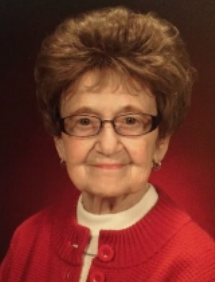
Doris Crippen

Doris Crippen, long-time resident of Hill City, Kansas, passed away peacefully September 17, 2017, at Evergreen Care Center in Owasso, Oklahoma, at the age of 87. She was born January 27, 1930, in Hays, Kansas, to the late Jess and Theresa (Feit) Binder.

Doris grew up in Hays and later married Donald E. Crippen, July 15, 1951. They were married for 55 years before Don passed away October 9, 2006. Their marriage was blessed with three sons: Galen, Jerry, and Jeff. Doris was a full-time mom while completing her degree in education at Fort Hays Kansas State College.

After graduation Doris taught special education and first grade at Hill City Elementary School for many years. Her love, kindnesss, and genuine compassion for her students is her legacy as an educator. Others who were fortunate enough to know her recognized those same heartfelt traits. Often when she saw former students, they mentioned how much they loved her telling “Rin Tin Tin” stories to them. In her spare time and after retirement she enjoyed playing bridge or pinochle, solving crossword puzzles, and drinking coffee or tea with her friends.

Doris was preceded in death by her parents Jess and Theresa Binder Martin and her husband, Don.

Survivors left to cherish her memory are her children: Galen Crippen and his wife Sheryl of Sharon Springs, Kansas; Jerry Neeb-Crippen and his wife Ursula of Cologne, Germany; and Jeff Crippen of Owasso, Oklahoma; her eight grandchildren: Jason Crippen and his wife Katie of Wichita, Kansas; Matthew Crippen and his wife Tara of Wichita; Robert Crippen of Phoenix, Arizona; Juliane Neeb-Crippen and Janita Neeb-Crippen of Cologne, Germany; Hannah Lemon and her husband Tom of Kansas City, Kansas; Todd Crippen and his wife Valerie of Kansas City, Kansas; and Nicholas Crippen of Manhattan, Kansas; her six great grandchildren: Brennan Crippen, Ellie Crippen, Serena Crippen, and Ben Crippen all of Wichita; Rose Lemon and Meredith Lemon of Kansas City, Kansas; her sister Mildred Rosell of Seattle, Washington; and eleven nieces and nephews.

Doris was a loving wife, mother, grandmother, sister, aunt, trusted confidant and true friend and will be greatly missed by all who knew and loved her.

Click HERE for service details.

INSIGHT KANSAS: Elect a zealot to higher office?

Who was Phill Kline? And what does his landslide defeat in 2006 mean for the governor’s race in 2018?

Anti-abortion zealot Phill Kline was elected attorney general in 2002 and then deployed his office in conducting highly publicized, wide-ranging inquisitions involving abortion.

H. Edward Flentje is professor emeritus at Wichita State University.

Kline threatened healthcare professionals with prosecution for failing to report suspicions of under-age sexual abuse. He pursued court orders forcing state agencies to release private data on sexual abuse and the termination of pregnancies. And he sought search warrants for women’s medical records. In his fanatic pursuits Kline circumvented court orders, submitted false statements to courts, and abused the administration of justice.

Most all of Kline’s wild charges were dismissed or blocked in court, and later the Kansas Supreme Court suspended Kline’s law license for “his lengthy and substantial pattern of misconduct.”

Kansas voters tossed Kline from office when he sought reelection in 2006, giving him the lowest vote total for a Republican candidate for attorney general in over four decades. His Democratic opponent won that race by 140,000 votes.

Does Kline’s grandstanding with unsubstantiated charges, court infractions, and zealotry in the conduct of state office remind us of anyone?

Kansas Secretary of State Kris Kobach, currently a front-runner in seeking the 2018 Republican nomination for governor, has commandeered his office to mount a well-publicized, obsessive crusade, in Kansas and across the nation, to find and prosecute voter fraud.

Kobach claims that illegal voters number in the thousands or even millions nationally, but he has successfully prosecuted only a handful of cases in Kansas, mostly U.S. citizens convicted of voting in two states. His first prosecution of a non-citizen occurred last April. That contrasts with more that 1.2 million Kansans who voted last November.

Kobach has championed proof-of-citizenship laws to stop non-citizens from voting, but those laws have been challenged on grounds of disenfranchising voters and are now stalled in federal courts. In 2013 Kobach ordered local election officials to institute a convoluted two-tier voting structure designed to prevent voters registered on federal forms from voting in state and local elections. That placed thousands of potential voters in suspension. In 2016 a federal judge blocked Kobach’s orders and ruled that 18,000 of those in suspension be registered. In another challenge his two-tier plan was permanently halted.

Kobach has taken his voter fraud campaign national by signing on as vice-chair of President Trump’s “Election Integrity Commission” and as a columnist with Breibart, an ultra-right media outlet. In his first Breibart column he claimed without evidence that illegal voters had stolen a U.S senate race in New Hampshire.

Kobach’s litigious tactics have also run afoul of the courts. He has been reprimanded and penalized for deception in defending the proof-of-citizenship law. A federal magistrate judge fined Kobach $1,000 for deceptive conduct and “patently misleading representations.” Kobach appealed only to have another federal judge uphold the fine based on Kobach’s pattern of misleading statements to the court. More recently a third federal judge scolded Trump’s voter fraud commission, which Kobach continues to head, for failing to provide public access to agenda materials.

In 2006 Kansas voters rejected the reckless zealotry of Phill Kline and his conduct in public office. In 2018 they will have to determine whether Kobach’s fanatical quest to prove illusive voter fraud disqualifies him for elevation to higher office.

H. Edward Flentje is professor emeritus at Wichita State University.

Police identify Kansas man who died in motorcycle crash

SEDGWICK COUNTY —  A Kansas man died in an accident just after 3p.m. Wednesday in Sedgwick County.

A 1991 Harley Davidson motorcycle driven by Arthur Pilant, 61, Wichita, was northbound on McClain, according to officer Charley Davidson.

The motorcycle rear-ended a 2003 Ford pickup that was stopped waiting to turn on Minisa Street.

Pilant was transported to a local hospital where he died. The 39-year-old pickup driver was not injured.

Pilant was not wearing a helmet, according to Davidson.

It is the 24th fatality accident in Wichita in 2017.

Jibowu’s changed perspective

By Nikki Sherrill

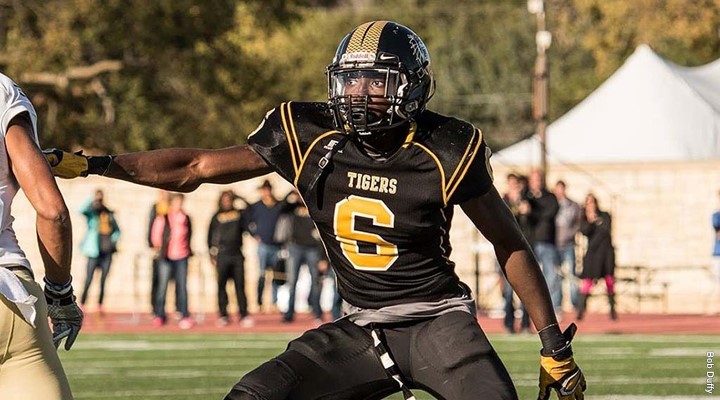
At the age of eight, life as Doyin Jibowu knew it, changed. Jibowu was born in Nigeria and lived with his mother and brother, while his father moved to Colorado, separating the family by thousands of miles. However, when his mother won the visa lottery, Jibowu, along with his mom and brother, picked up their lives as they received a chance at the American life. Now, the whole family was back together and established their new lives in Denver. Jibowu, as he knows it, calls Colorado home, even though eight years of his early life were spent in Nigeria.

“I was younger so I wasn’t able to create any special relationships there before moving, but my parents still have a lot of connection and family back there. I hope to get back there a few times just to see how the family is doing and how it has changed,” said Jibowu.

The so-called “normal” Jibowu remembers from his life in his home country, is drastically different than what he experiences here. The things many take for granted here are things that others only can dream of having.

“I joke around saying I was raised in the jungle, but growing up in Africa is probably the best thing to ever happen to me. I remember driving around on the bus with my mom and brother and living in a one bedroom apartment and that is something that makes you appreciate what you have now,” said Jibowu.

One moment in particular stands out to Jibowu as he truly realized how different life is in the different parts of the world he has called home.

“One time I was riding home with my mom and there was an explosion. When I was a kid, that was normal to have a bomb go off. I look back on that now and think, that wasn’t normal. If that happened here, it would be all over the news, but back home there it happens and people move on. I feel like sometimes people don’t really appreciate how good we have it here,” he said.

Although Nigeria taught Jibowu many different life lessons, only the United States taught him about his passion for football. When he was in elementary school, Jibowu started playing football at recess, the kind where everyone plays and having fun is the only victory. Soon after, he signed up for flag football when he gained more interest in the sport. It wasn’t until his older brother put on the pads that Jibowu gained the urge to suit up himself and play under the lights.

“Football became something I would do for fun, I didn’t think I was terrible at it so I tried it out. My brother played tackle football before me and I always looked up to my brother. I thought it was the coolest thing that he played. He would always bring home the pads and the helmet and I would try it on and I just thought it was awesome and something I hoped I could do,” he said.
Being a young, mobile kid, football wasn’t the only activity Jibowu went after.

“In high school I played lacrosse and recreational basketball. I even tried wrestling. But, I felt like, in football, I could really use all of my abilities and I could maximize my potential. In basketball I wasn’t the tallest, in soccer I wasn’t the most nimble and in wrestling I wasn’t built the right way so I knew football was best for me,” he said.

Up until his senior year, football was just about having fun and being around friends. Playing collegiate ball never even seemed like an option for Jibowu as he didn’t even realize there was more to college football than Division I. After a few offers came, the possibility became real. Jibowu started to feel the stress of how he would pay for his education after high school, and what options he had.

“I was talking to my dad about it and he said “you are too young to be this stressed out. Let things take care of themselves.” After that I just went out and had fun and played my hardest and now here we are in Hays, Kansas,” he said.

Jibowu credits the coaching staff for his decision to come here and have it be the right fit. With the program trending upward, Jibowu found the timing to be perfect and all the pieces started to fall into place for the Tigers.

“I knew this program was beginning to build into something great. I always wanted to be a part of the building of something as opposed to coming in at the finished product. I had never been a part of a winning program, so that was a big draw for me to come to Fort Hays State,” he said.

One of the opportunities Jibowu took early on at FHSU was the chance to redshirt. Although this step might seem negative, he accepted it as a way to get his feet under him and prepare mentally and physically for his eventual time to happen.

“Redshirting was the best thing for me because I sat behind those older guys and watched them progress and saw how the upperclassmen did it in my position. I also could pick up on the system and really study it, which was a huge advantage. I was able to develop more physically, which helped to avoid injuries and be stronger overall. It truly helped me be more prepared for when it came my time to play,” he said.

After his redshirt year, Jibowu had a breakout season in 2015, his first time competing on the field. He was an All-MIAA performer, started all 12 games for the Tigers as a defensive back where he accumulated 91 tackles, ranking him 17th in the conference. That season was an eye-opener for Jibowu, as he started to fully understand football at this level.

“The first game at UCO we were down by twenty and that was my first college experience. You watch it on TV all the time with college football where teams are down big and then come back, which is the greatest thing. There is always something crazy going on in college football. You don’t really understand that until you are living it yourself. After that game I was on the field thinking ‘this is actually college football’ and it was a great feeling,” he said.

In his second season on the field, Jibowu didn’t have as strong of a season personally as his first, but the year was not a failure to him.

“I didn’t have as good of a season as I did the year before, but it was the first time we had reached a bowl game and actually won. While personally it wasn’t a better season for me, last season was a better one for the team. As long as the team is successful I am going to be happy. I could have zero stats but if the unit is successful, I am playing my role,” he said.

Now in his junior season for the Tigers, and with success in many aspects under his belt, Jibowu focuses on the season at hand. So far, Fort Hays State is off to a 3-0 start and ranked No. 18 in the latest national poll. Jibowu currently has 13 tackles to his name, along with two pass break ups. The Tigers are outscoring their opponents 114-37 three contests in. The early season success is no surprise to those close to the program, including Jibowu.

“Success is a process. To build success you have to start at the bottom and slowly put it together, which is what Coach Brown has done. You have to go through the tough times to get to the good parts. We really are a group of kids that want to succeed. You don’t just have a good season out of nowhere, it happens in a process,” he said.

With the success and strength of the program excelling with each passing year, the Tigers are poised to have another record-breaking, historic season. The process and building of this program has been apparent to all close to it, but now Jibowu knows everybody else can see that success happening.

“The sky is the limit with this team. I was here when this program was at the bottom and now we are towards the top,” he said. “I try to tell the younger guys what we have built and show them what they can be a part of. You don’t earn respect in one season and we have continued to earn that respect. I want us to fully reach our potential. We have come close while I have been here, but I know we can fully reach it this year.”
Organization designed to protect your investments reveals hack

NEW YORK (AP) —The Securities and Exchange Commission says its corporate filing system was hacked last year and the intruders may have used the nonpublic information they obtained to profit illegally.

The disclosure comes two months after a government watchdog said deficiencies in the agency’s computer systems put the information they contain at risk. It also follows a massive hack at the credit reporting agency Equifax.

The SEC issued a statement late Wednesday that said the breach was discovered last year but the possibility of illicit trading was only discovered last month. The statement did not explain why the hack itself was not revealed sooner.

The SEC files financial market disclosure documents through its EDGAR system, which processes over 1.7 million electronic filings in any given year.

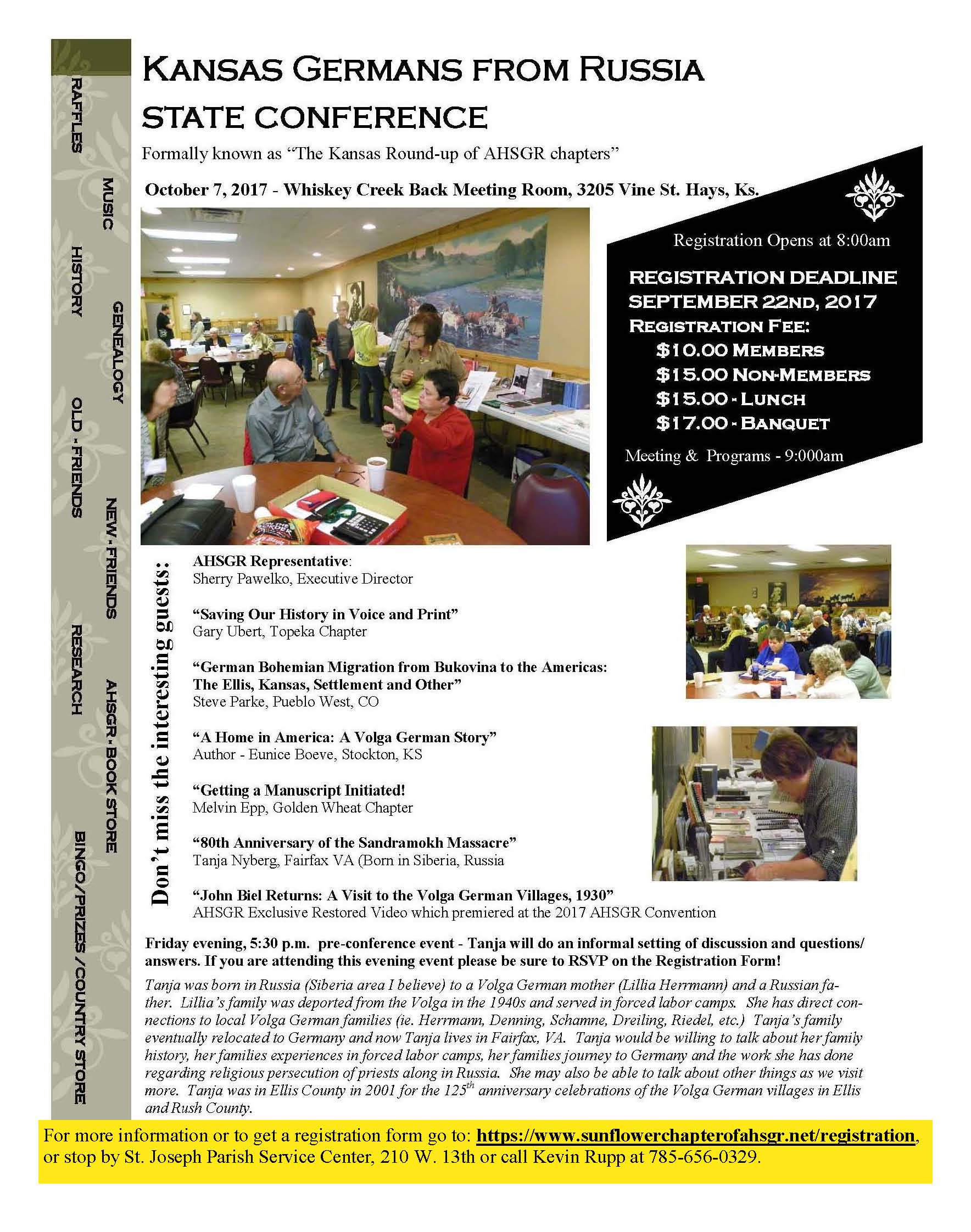
Kansas Germans from Russia State Conference set for next month

The annual Kansas Germans from Russia State Conference, formerly known as The Kansas Round-up of AHSGR Chapters, will be Oct. 7 in Hays.

Among this year’s guest speakers are Steve Parke. His presentation is called “German Bohemian Migration from Bukovina to the Americas: The Ellis, Kansas Settlement and Other.”

Author Eunice Boeve, Stockton, will present “A Home in America: A Volga German Story,” and the banquet speaker will be Tanja Nyberg. Nyberg was born in Siberia, Russia, and will discuss the 80th anniversary of the Sandramokh Massacre.

The deadline for registration is Friday, Sept. 22.

You can find more information and register at the sunflowerchapterofahsgr.net/registration.

Saturday’s event starts at 9 a.m. with registration at 8 a.m. in the Whiskey Creek Back Meeting Room, 3205 Vine.

COLUMN: State block grants with less money will not solve health care

Allen
By NEAL ALLEN
Wichita State University

The newest Senate Republican attempt to repeal and replace the Affordable Care Act will cut government funding for health care, give states responsibility for spending that smaller amount, and hope that states will figure out how to deliver better results at lower prices.

The record of Kansas state government during the Brownback tax cut “experiment” of the past five years is a cautionary tale for those hoping states will deliver us from our current national health care difficulties.

The Graham-Cassidy bill that is progressing toward a vote before the Sep. 30 budget deadline, along with shifting Medicaid funding between states and relaxing federal regulations on health insurers, converts Medicaid into a block grant by state. Combined with changes in the formula for calculating Medicaid spending, the long-term effect will be to give states more responsibility for the health care of their citizens, with dramatically less money.

The bill’s supporters claim that states will find new and improved ways to deliver health care if given control of the new, cheaper version of Medicaid. Knowledge of local conditions, combined with a push provided by reduced funding, would then lead to better care at lower prices.
While Republicans in Washington are considering this approach to cut federal health care spending, Kansas conservative Republicans created a similar situation as the result of massive cuts to corporate and individual income taxes in 2012 and 2013.

This reduction in state revenue forced state agencies and local public schools to attempt to “do more with less,” and find efficiencies and innovative policies that would deliver better outcomes at lower costs.

Did Kansas state government succeed in this attempt? The voters of Kansas certainly don’t think so. They replaced dozens of Brownback-supporting state legislators with moderate Republicans and Democrats. Public schools are just now recovering from the Topeka-initiated budget cuts, and state government continues to be unable to perform basic functions like maintain computer interfaces for social services and maintain order at prisons.

If merely cutting funding doesn’t motivate states to deliver better services, then possibly shifting Medicaid responsibility from the federal government to states might help. But this argument ignores the fact that state governments and the federal governments are run by the same class of Republican and Democratic politicians.

We can see this in our recent Kansas Governors, all of whom have served in Washington. Sam Brownback served in the U.S. House and Senate. Kathleen Sebelius moved from the governorship to being Obama’s first Secretary of Health and Human Services. Mark Parkinson now advocates in Washington for nursing homes and their residents.

If there is a fundamental problem with the people we elect in Washington, then the same problem exists in Topeka or Oklahoma City or Boston.

The Graham Cassidy bill is bad for the country because it will lead to millions of people losing their health insurance. There is no magic solution to be found in state capitals to make the hard choices go away. Making long-term cuts in Medicaid spending and shifting more responsibility to the states is merely a means of U.S. Senators and House members avoiding making the hard choices themselves.

We have seen the effects of this kind of reform here in Kansas with the Brownback tax cut experiment over the last five years, and the effects on state services do not give reason for hope for states to save us from hard choices on health care.

Neal Allen, Ph.D., is an Associate Professor of Political Science at Wichita State University.

Marie A. Schmidtberger

Victoria, Kansas – Marie A. Schmidtberger, age 87, died Wednesday, September 20, 2017 at Via Christi/St. Francis Health Center in Wichita, Kansas.

Services are pending at Cline’s-Keithley Mortuary 412 Main Street Victoria, Kansas 67671.

Copyright Eagle Radio | FCC Public Files | EEO Public File