Month: September 2017

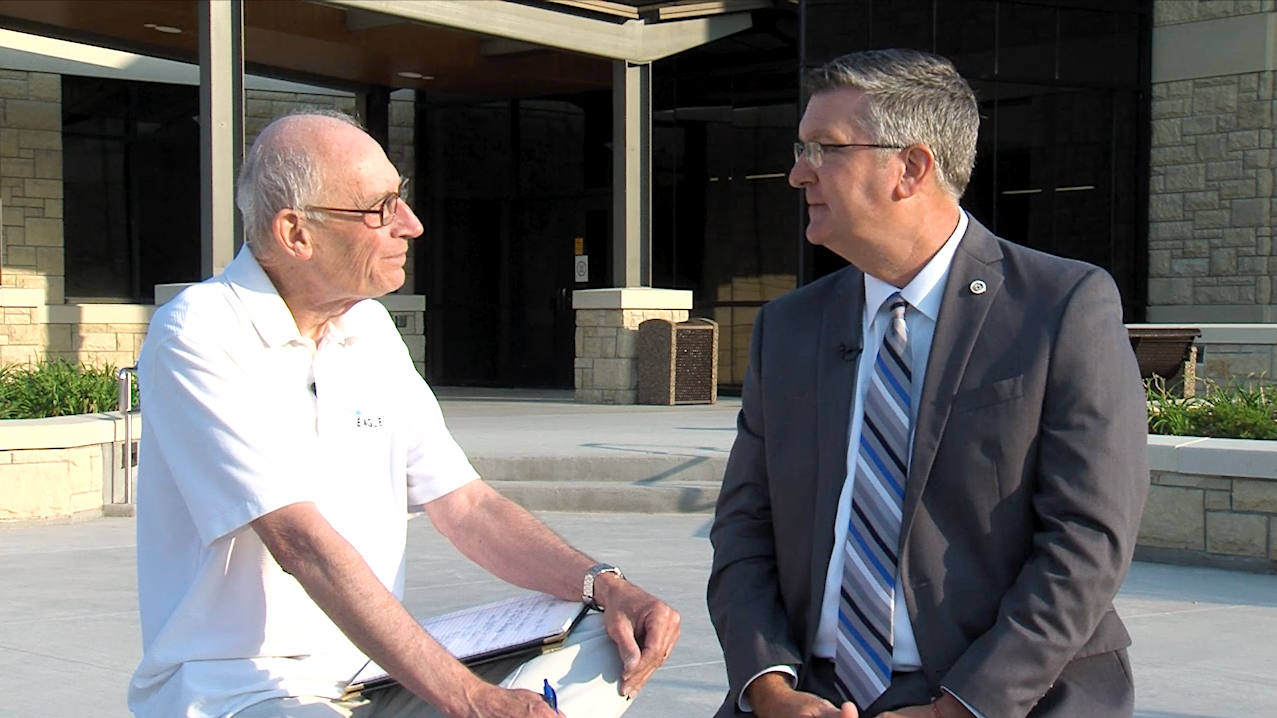
🎥 Community Connection: Joey Linn Ph.D. & Kim Stewart; FHSU
DOYLE: Data collection necessary tool to close pay gap


At Women’s Foundation, we believe in using research and data to identify real problems and develop meaningful policy solutions.
That’s why we are disappointed that the federal Office of Management and Budget (OMB) is stopping the pay data collection aspects of the EEO-1 form that sought to reduce the gender pay gap. Data collection is a necessary tool to increase transparency and inform policy solutions to close the pay gap.
When it comes to the gender pay gap, working women have waited long enough. We will continue to work for change to end the gender pay gap for women and their families through both market-based approaches like our Pay Equity Best Practice Guidelines and practical policy solutions.
Women earn an average of only 77 cents in Kansas and 78 cents in Missouri for every dollar men make for the same work, according to Women’s Foundation research. Both states fall behind the national gender pay gap of 80 cents. Women are not expected to achieve gender pay equity until 2059.
The Women’s Foundation promotes equity and opportunity for women of all ages, using research, philanthropy and policy solutions to make meaningful change. More information about the organization can be found at www.Womens-Foundation.org.
Wendy D. Doyle, is President and CEO of Women’s Foundation, Kansas City, Missouri.
HAWVER: Things starting to heat up for Kan. Legislature

The end of summer in the Statehouse means that it’s just four months until the start of the election-year 2018 session of the Kansas Legislature; the issues are already piling up that lawmakers and statewide elected officials are going to have to deal with in the same year many of their names and voting records will be on the ballot.
Oh, and that little fire that Gov. Sam Brownback may have cooled slightly with his 10 percent (El Dorado Prison) and 5 percent (all other corrections officers) raises has damped that prison pay issue but sparked statewide calls for pay raises for state workers who now-quite randomly received pay raises of either 2½ percent or maybe 5 percent. That’s one issue heating up.
And, as a sidebar to that prison pay, at least one state agency is offering 2½ percent pay raises to employees who haven’t already given up their civil service employment protection rights which essentially reduces them to day workers who can be fired or laid off or not returned to work on the whim of his/her supervisors.
Get the idea that this summer was a relatively simple one for lawmakers, if you manage to ignore the biggest income tax increase in state history that for most Kansans amounted to just a little more Kansas income tax withholding from their paychecks each week and those Kansas Limited Liability Company owners getting ready for their first income taxes on non-wage income in four years.
Medicaid coverage? The expansion proposal that passed both chambers last session but was vetoed by Brownback? It’ll be back, under a new governor who isn’t a fan of allowing maybe 110,000 more Kansans to have health coverage but is going to have to pencil it out: Conservative voters vs. hundreds of millions of dollars of state revenue for the new guy in the job as Lt. Gov. Jeff Colyer takes the reins and budget responsibilities from exiting Brownback.
Individual legislators? Well, the picnics are over and it’s State Fair Week in Hutchinson, but while lawmakers will have some events they can attend, they won’t have to wear their nametags and most—if they want to—can be just “that guy/gal with a pronto pup” wandering the fairgrounds.
Don’t forget, also that now that school has started, the Kansas Supreme Court may in the coming weeks issue its decision on state aid to K-12 schools and whether it is adequate to provide good education for the state’s public schoolchildren. Will that take new money that the state doesn’t have—or shift more of the cost of schools to local school districts? Nobody’s sure; this whole issue of “adequacy” becomes complicated because it essentially shifts responsibility to turning out those bright, ready for more education or entering the workforce children to the school districts.
But…remember those new legislators, about 50 who were brand new to the job last session after winning elections, probably didn’t have much of an idea of all the little scraps they were going to be dragged into, and it is quiet so far, but there is Statehouse halltalk about some not interested in seeking re-election. The job just turned out to be a lot different than the one they believed they were running for, and the complexity of issues in even the simplest of bills can turn out to make what seemed like a nice idea into a bullet point on an opponent’s campaign literature in the next year.
Summer’s over…but the winter is already shaping up to be interesting.
Syndicated by Hawver News Company LLC of Topeka; Martin Hawver is publisher of Hawver’s Capitol Report—to learn more about this nonpartisan statewide political news service, visit the website at www.hawvernews.com
🎥 September events in Hays
 By BECKY KISER
Hays Post
Whether you’re looking for heart-pounding races at the RPM Speedway or the more sedate surroundings in the Ellis County Historical Society Museum and its two new exhibits, you can find it all in Hays during September.
Melissa Dixon, Hays Convention and Visitors Bureau executive director, has the highlights.
v
For details and an updated community calendar, call the Hays Welcome Center at 785-628-8202 or check the CVB website www.visithays.com.
Obamacare Premiums Mixed For Kansas Consumers
By JIM MCLEAN & ALEX SMITH
The Affordable Care Act marketplace will be a mixed bag for Kansas consumers seeking health insurance for 2018.

CENTERS FOR MEDICARE AND MEDICAID SERVICES
Some will pay more for coverage, some less. And some will purchase new plans for which there is no price-point comparison.
In Missouri, insurers are proposing some hefty rate hikes.
The Kansas Insurance Department said the “range of average rate revisions” for individual and small-group plans on and off the ACA marketplace will be from 8.8 percent lower to 29 percent higher. That means that some consumers could see premium increases of more than 29 percent, but it’s impossible to say how many, said Julie Holmes, the department’s director of health and life insurance.
“It’s going to depend on who buys from which company,” Holmes said. “There are just so many variables.”
If there are substantial price spikes, many consumer who purchase Obamacare coverage may not be adversely affected. That is because the federal subsidies they receive to keep coverage affordable will also go up.
“So, they will be insulated,” Holmes said.
More than 80 percent of the Kansans who purchase coverage on the Obamacare marketplace qualify for some level of subsidy, according to the U.S. Department of Health and Human Services.
More consumer choice in Kansas
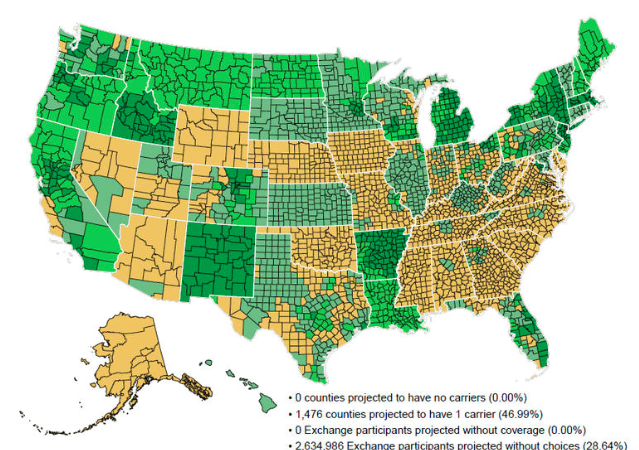
While the exit of some insurers from the ACA marketplace is limiting competition and choice in many states, most Kansans seeking coverage will be able to choose from 38 plans offered by three insurers.
“A lot of states are not in that favorable a position,” Holmes said.
Minnesota-based Medica will offer plans throughout the state in 2018, while Blue Cross and Blue Shield of Kansas will offer plans in all counties except Johnson and Wyandotte. Centene, a St. Louis-based company that specializes in Medicaid managed care, will offer plans in those two counties, following Blue Cross and Blue Shield of Kansas City’s decision in May to exit the Obamacare marketplace.
In several states — including the neighboring states of Nebraska, Oklahoma and Iowa — only one insurer is offering Obamacare plans, according to U.S. Department of Health and Human Services, the federal agency that oversees the marketplace. In Missouri, consumers in the Kansas City and St. Louis metropolitan areas have choices, but only one insurer is offering plans in most counties in the state.
Higher increases in Missouri
Rate proposals released Friday by the Missouri Department of Insurance are on average 36 percent to 42 percent higher than rates for similar 2017 plans.
“I’m not that surprised it’s that high, given the volatility that’s been going on with the Affordable Care Act,” said Timothy McBride, health economist at Washington University in St. Louis. “We’ve also seen some dropouts of some plans, which reduces the competition, which tends to increase the prices.”
Both Cigna and Anthem Blue Cross Blue Shield, the two companies returning to sell on the marketplace, listed the uncertainty about cost-sharing payments that help consumers cover the cost of insurance as justifications for their proposed rates.
Earlier this year 25 western Missouri counties had been left “bare” when Blue Cross and Blue Shield of Kansas City decided to exit the marketplace. In June, Centene Corp. stepped in to fill that void and offer plans in those counties.
This is the first year for Missouri consumers to have access to marketplace rate information before open enrollment and to provide feedback on proposed rates.
Unlike some states, Missouri’s Department of Insurance does not have the authority to deny an insurer’s request for a rate increase.
McBride said public input and rate review still could influence insurance rates.
“We’re new at this game, so we don’t know how well it’s going to work,” McBride said. “But it has helped in other states.”
Insurers may adjust rates before open enrollment, which begins Nov. 1 and continues through Dec. 15.
Obamacare politics persist
Kansas Lt. Gov. Jeff Colyer, a Republican preparing to step into the governor’s office when the U.S. Senate confirms Gov. Sam Brownback’s nomination to a State Department post, used the numbers released by the insurance department to intensify his criticism of Obamacare.
“The 29 percent increases for health insurance are another rung on the Obamacare ladder of failure, just months after this broken system forced a major insurer to leave the Kansas City market,” said Colyer, who also is running for the GOP gubernatorial nomination in 2018.
“I urge Congress to keep their promise to repeal Obamacare and allow us to work with our stakeholders to create Kansas solutions for Kansas families,” Colyer said.
Colyer’s statement is based on false assumptions, said Sheldon Weisgrau, director of the Health Reform Resource Project, an initiative funded by several regional health foundations that support the ACA.
“The lieutenant governor’s implication that the ACA marketplace plans will increase in price by 29 percent is false,” Weisgrau said, noting that the insurance department said that rate revisions would vary widely.
Rather than continue to “spread misinformation about the ACA,” Weisgrau said Colyer should encourage Congress to fix problems that are destabilizing the Obamacare marketplace.
“He (Colyer) should also insist that the Trump administration join these efforts and stop working to undermine the marketplace,” Weisgrau said, referring to the president’s repeated threats to halt payments to insurance companies intended to help them cover the cost of lowering out-of-pocket costs for consumers.
Uncertainty about the administration’s commitment to maintaining those cost-sharing payments has destabilized the marketplace and prompted companies to either withdraw or raise rates, Holmes said.
“It definitely has contributed to instability,” Holmes said. “The carriers are holding their breath waiting to see if the administration is going to authorize those payments.”
A U.S. Senate committee is set to begin hearings this week on a potential bipartisan plan to stabilize the Obamacare marketplace.
Jim McLean is managing director of the Kansas News Service, a collaboration of KCUR, Kansas Public Radio and KMUW covering health, education and politics. You can reach him on Twitter @jmcleanks. Alex Smith is a health reporter for KCUR. You can reach him on Twitter @AlexSmithKCUR.
NW Kansas towns make list of ‘most underrated’ in the state

 Several northwest Kansas communities recently were recognized by an online ranker among the state’s “most underrated.”
OnlyInYourState.com listed Russell, Bird City, Oberlin and Stockton on the list of 11.
Click HERE for the entire article.
First Amendment: Times-Palin ruling good for free speech, press

So Sarah Palin does not get to move forward with a defamation lawsuit against The New York Times for linking material on a Palin political website to shooting incidents targeting politicians.
The link appeared in a Times editorial published June 14 after a shooting incident in Washington, D.C., where the shooter opened fire on an early-morning softball practice involving members of Congress and legislative aides.
It was plain, flat wrong to draw such a direct connection. Palin said so immediately, and the Times quickly published a correction. Two corrections, in fact, with the second more specifically repudiating any connection with Palin.
The dismissal of the lawsuit does not mean the Times “got away” with publishing fake news. Nor does it mean open season for journalists on controversial public officials and public figures.
It does mean that laws protecting the First Amendment were upheld and remain in force: Specifically, the law that says public officials must prove not just error but actual malice — knowing falsity or reckless disregard for truth — to successfully pursue a defamation lawsuit.
The decision has significant implications for political reporters and public figures, of course, but also for the rest of us who may occasionally share critical opinions about officeholders or public figures. We write under the same protection — and without it, I suspect far fewer would take pen or keyboard in hand.
Let’s say this again (important to do in an era when many are questioning whether “real news” even exists): Nothing in the Sarah Palin ruling condones error. But the judge’s decision does recognize that without protection for inadvertent error, political discussion — which the nation’s founders saw as vital to a self-governing democracy — would grind to a halt for fear of instant legal action and ruinous financial penalty.
The decision Tuesday, made in the Southern District of New York, rests on a 1964 U.S. Supreme Court decision that, with some irony, also involved The New York Times. In Times v. Sullivan, a case involving a political ad, the Court said that a simple factual error is not enough for a public official to collect defamation damages, when weighed against the value to society of robust, energetic political debate.
The offending Times editorial published this June referenced a map that appeared on Palin’s political action committee website, and wrongly implied that the material incited political violence. The Times correction stated that “no such link was established” between incitement and violence.
The stirring, 26-page opinion by U.S. District Judge Jed Rakoff is a textbook explanation of why political speech — even, at times, if it is erroneous — is and ought to be protected.
“Nowhere is political journalism so free, so robust, or perhaps so rowdy as in the United States,” Rakoff wrote. “In the exercise of that freedom, mistakes will be made, some of which will be hurtful to others. Responsible journals will promptly correct their errors; others will not.
“But if political journalism is to achieve its constitutionally endorsed role of challenging the powerful, legal redress by a public figure must be limited to those cases where the public figure has a plausible factual basis for complaining that the mistake was made maliciously, that is, with knowledge it was false or with reckless disregard of its falsity” — which, in Rakoff’s view, Palin did not have.
An old journalism bromide says that getting it right is more important than getting it first.
In Rakoff’s decision, he noted, “What we have here is an editorial, written and rewritten rapidly in order to voice an opinion on an immediate event of importance, in which are included a few factual inaccuracies somewhat pertaining to Mrs. Palin that are very rapidly corrected… Negligence this may be; but defamation of a public figure it plainly is not.”
The Times initially got it wrong. But the judge has it right, from the start.
Gene Policinski is chief operating officer of the Newseum Institute. He can be reached at [email protected], or follow him on Twitter at @genefac.
Sunny, hot Labor Day
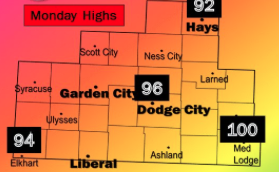

Labor Day Sunny, with a high near 92. West northwest wind 6 to 11 mph becoming northeast 13 to 18 mph in the afternoon.
Monday Night A 30 percent chance of showers and thunderstorms after 1am. Increasing clouds, with a low around 58. Northeast wind 11 to 15 mph.
Tuesday A 20 percent chance of showers and thunderstorms before 1pm. Mostly cloudy, then gradually becoming sunny, with a high near 76. North wind 9 to 11 mph.
Tuesday NightClear, with a low around 45. North wind 5 to 10 mph becoming light after midnight.
WednesdaySunny, with a high near 79.
Wednesday NightMostly clear, with a low around 49.
ThursdaySunny, with a high near 84.
Trump expected to end program that protects young immigrants

WASHINGTON (AP) — President Donald Trump is expected to announce that he will end protections for young immigrants who were brought into the country illegally as children. But that will come after a six-month delay.
People familiar with the plans said the delay in the formal dismantling of the Deferred Action for Childhood Arrivals, or DACA, program would be intended to give Congress time to decide whether it wants to address the status of the affected young immigrants.
But it was not immediately clear how the six-month delay would work in practice and what would happen to people who currently have work permits under the program, or whose permits expire during the six-month stretch.
Police find child’s remains in concrete structure at Kansas home


SEDGWICK COUNTY— Law enforcement authorities are investigating after police found the remains of a child.
According to media release, officers were called Saturday to a residence in the 2000 block of south Vine in Wichita after a property owner discovered a suspicious concrete structure emitting an odor.
Police removed the structure and found the remains of a child, about 3 years old, inside the concrete.
A 40-year-old man and 36-year-old woman, residents of the property, were arrested earlier last week. They are being held in the Sedgwick County Jail on charges associated with a child custody case, according to police.
There is a tentative identification of the child. Confirmation is being coordinated through the Sedgwick County Medical Examiner, according to police. No additional details were released late Sunday.
Kansas man hospitalized after I-70 rear-end crash

SHERMAN COUNTY— A Kansas man was injured in an accident just before 6p.m. Sunday in Sherman County.
The Kansas Highway Patrol reported a 2011 Subaru passenger vehicle driven by Christopher M. Vance, 26, Hutchinson, was eastbound on Interstate 70 six miles west of Goodland. The vehicle rear-ended a semi in the passing lane.
Vance was transported to the hospital in Goodland. The semi driver from Colorado was not injured.
Chiefs owner sued, accused in $300M investment scandal
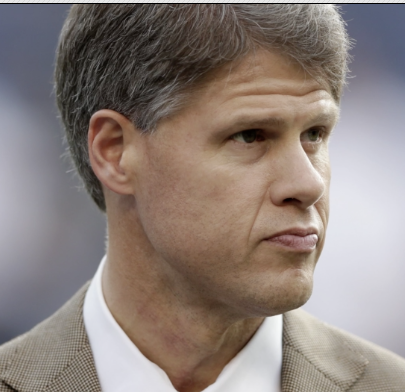

KANSAS CITY, Mo. (AP) — The owner of the Kansas City Chiefs is being accused in a lawsuit of improperly receiving hundreds of millions in state investment money through a kickback deal with New Mexico officials.
The Kansas City Star reports Sunday the New Mexico State Investment Council filed the lawsuit late last month against Clark Hunt and HFV Asset Management over the politically influenced investment deals.
Hunt didn’t comment to the newspaper on the lawsuit Sunday morning. Hunt’s father, Lamar, founded the Chiefs franchise and is in the Pro Football Hall of Fame.
The lawsuit says Hunt made a deal 12 years ago with two men with political connections who promised to steer New Mexico investment money to a hedge fund in exchange for payments. Hunt was a partner in the hedge fund.
New Mexico awarded $300 million to the hedge fund and paid millions in management fees. The lawsuit said one of the investment funds lost $13 million during the period.
“Hunt sought to gain unfair advantage by paying for influence over the process,” New Mexico officials said in the lawsuit.
The accusations are tied to the pay-to-play scandal that took place during administration of former New Mexico Gov. Bill Richardson.
New Mexico has already negotiated more than $30 million in settlements related to the pay-to-play investment scandal.