TOPEKA, Kan. (AP) — Kansas public school officials are launching a project to overhaul the way education is delivered in the state.
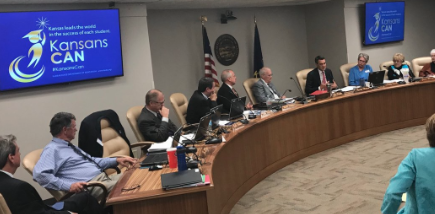
The Kansas State Board of Education members were briefed about the program Wednesday. The “Kansans Can” vision is an initiative to completely change the way K-12 education is taught in Kansas over the next 10 years.
Officials say the project involves tearing apart a 100-year-old structure in which public education is organized around grade levels that are generally determined by a student’s age.
Seven school districts are expected to have new, individualized structures in place by August 2018.
State Education Commissioner Randy Watson says the project grew out of a statewide listening tour in 2015. People said they want schools to teach character development, citizenship and work ethics.
On Nov. 7, 2017, the voters will go to the polls to vote on the USD 489 school board’s proposed $154 million tax increase on property owners.Before making a decision, voters should consider a few things.
First, the school board is seeking to put a proverbial anchor around the necks of property owners by increasing their taxes for the next 30 years!Think about that for a moment.I have a 30-year-old child who lives in Hays and owns property with her husband.If voters approve this $154 million tax increase, she will pay for it until she is 60.This proposed tax increase will last an entire generation of people.
Second, the negative impact on our local economy which is already suffering from low agricultural and oil prices and decelerating retail sales seems to be lost on the educationalists (not a real word, just a made-up term which attempts to characterize the “no amount of money is too much to spend on our children” crowd) who came up with the plans.More importantly, they failed to inform the public that with a negative tax multiplier of 3, private spending will be reduced by $3 for each dollar rise in taxes.According to academic research brought to light by Hays City Commissioner Henry Schwaller IV, that equates to a negative local economic impact of $452 million.
Let me use a biblical analogy.The $154 million tax increase passes; it triggers a local economic downward death spiral; it begets tax increases on property owners for the next 30 years; which begets less spending by consumers on cars, at restaurants and retail stores; which begets seniors on fixed, limited incomes forced to restrict their spending; which begets even less sales tax revenues for the city of Hays (which are already decreasing) to fund its budget; which begets city spending cuts or even more property tax increase (only choices available); which begets lower real estate valuations and a housing rents pricewar; which begets even less spending by consumers locally, less sales tax revenue, higher property taxes due to lower valuations, etc.The $154 million tax increase thus effects an economic downward spiral until some sort of bottom is reached in the next 30 years.
Third, it’s not as if people didn’t tell the school board they wanted more frequent less expensive bond proposals.The school board’s own polling informed them that 60% of the community desires this.Also 58% of those polled said they were willing to spend no more than $0-$10 per month so, dismissively, the school board decides to raise taxes by about $17 per month on the average valued house in Hays.Unfortunately, in what appears to be the norm, the school board, the out-of-town architects, the school administrators and vision team members simply chose to ignore the wishes of the community.And the school board’s slick four colored “informational” brochures purposely leave out the facts that the condition of the schools that truly are needs (two new elementary schools simply are wants, not needs) can be addressed with far less money than the school board is willing to consider.
It’s no secret that the “educationalists” are counting on those who are opposed to the gargantuan $154 million tax increase to stay at home on election day. The only question remaining is will the voters prove them correct?Will property owners who believe that such a massive tax increase in their taxes is a tad too much make the classic mistake on election day and stay at home because they naively believe voters will never trust the school board to spend the $154 million wisely?Or has the school board once again failed to grasp and appreciate the depth and breadth of the opinions of the community at large who believe that new brick and mortar and right size classrooms doesn’t equal better educational results and who tried to tell the school board that smaller and frequent is the way to go.
In the end, this much is certain.If the $154 million tax increase passes, people will pay increased property taxes for the next 30 years.Nothing like economically tying the community’s hands behind its back for an entire generation.
In addition to being a craft brewery that cans and kegs their own beer, Defiance Brewing Co. will host its first live music event on Oct. 27.
Ashley Raines & The New West Revue will be the performing artists at the event, and Jared Englert of Defiance said this is a way for the brewery and Tap Room to be more of a presence in the community.
“We just want to be more of a local presence and just kind of try it out and see what could happen since we have the space for it,” he said. “Friday nights are a fun night out there, and we figured some live music and good food would add to that.”
Taco Riendo will have their food truck parked outside so patrons can enjoy authentic Mexican food along with craft beer and live music.
The event will run from 7 to 10 p.n. Friday, Oct. 27, and will feature 10 beers on tap. Defiance Brewing will also extend their Tap Room hours, opening from 3 to 11 p.m.
Defiance Brewing is located at 2050 East Highway 40.
A Red Sox fan walked into a Boston pub and spots a guy wearing a New York Yankees cap. “Drinks for everyone here, bartender!” shouts the Red Sox fan. “Except for Mr. Yankees!”
The Yankees fan smiles and says, “Thank you!”
Infuriated, the Red Sox fan orders another round of drinks for everyone except Mr. Yankees, who, again, thanks the man. This goes on for a while, until Mr. Red Sox asks the bartender, “What’s the matter with that guy? I’ve ordered rounds of drinks for everyone but him, and all he does is thank me. Is he nuts?”
“No, he’s not nuts,” says the bartender. “He owns the place.”
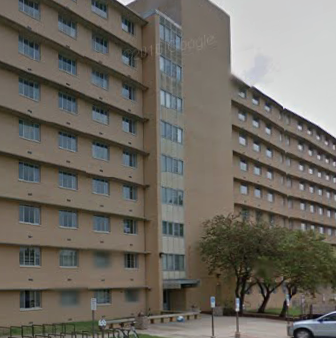
LAWRENCE, Kan. (AP) — Authorities say two University of Kansas students have been arrested on suspicion of rape at a residence hall.
The Lawrence Journal-World reports that the KU Public Safety Office says campus police made the arrests Saturday. KU Police Deputy Chief James Anguiano said in a news release that a female student reported that she was sexually assaulted by two acquaintances, at different times, early Saturday in her room at Cora Downs Residence Hall.
Anguiano says the suspects were taken to the Douglas County Jail following interviews and an investigation. Jail booking logs show that two 19-year-old men were booked on suspicion of rape following their arrests by KU police.
Every November, upland bird hunting becomes to Kansas what biscuits are to gravy. Each year Jeff Prendergast, Small Game Specialist with the Kansas Dept of Wildlife, Parks and Tourism (KDWPT) at Hays coordinates production of a statewide Kansas Upland Bird Hunting Outlook. This year’s 2017 report states “Overall, good cover and habitat conditions appear to have mitigated poor weather, thereby maintaining stable bird numbers for this fall. Winter habitat will remain good with lots of cover available for birds to utilize.”
Steve Gilliland
This year several local farmers have told me they are seeing lots of pheasants and more quail than they’ve seen for years. Concerning pheasant hunting specifically, the 2017 report states “Pheasant hunting in Kansas should be fair to good this year. Excellent conditions in 2016 combined with high overwinter survival led to another increase in the pheasant survey this year and returned the index to the pre-drought average.
The best areas this year will likely be in the northern half of the Kansas pheasant range.” As for quail, the report predicts “Quail hunting in Kansas should be good to locally great in 2017. Precipitation patterns observed over the past 5 years has altered vegetation, increasing both the quality and quantity of habitat, allowing for a modern quail boom. The bobwhite survey in 2017 was the highest recorded since the survey began 20 years ago.” If you would like to read the 2017 Kansas Upland Bird Hunting Outlook in its entirety, broken down region-by-region, email me and I’ll send you the file.
Elk on the Maxwell Game Reserve
Over the years, the opening day of Kansas pheasant season has spawned many traditional family pheasant hunts, and several years ago I was honored to be part of one such hunt, the Schmidt Family pheasant hunt. In the mid 1960’s, Elmer Schmidt began hosting an annual family pheasant hunt on opening morning of pheasant season. Those first hunts consisted of Elmer and his brothers, brothers-in-law and nephews. As time passed, sons and sons-in laws, and eventually grandsons joined the mix; often the group numbered in the high twenties.
The day always started with a full course hot breakfast at Elmer’s farm next to Lake Inman. Even in later years after Elmer moved to town, the day still began with an extravagant breakfast at his place, and pheasants were still cleaned each year in his driveway. The year I joined them the group consisted of one son, a son-in-law, several grandsons, a handful of nephews and a few friends who had become part of the opening-morning clan over the years.
Elmer has been gone since 2004, but his son David still lives in the home place next to Lake Inman, and that year lunch was prepared and served in his shop by his wife Elaine and their daughters. Fastened to the inside wall above the door was a group of pheasant tail feathers, the results of the last several year’s “Longest Feather” contest.
After lunch, each hunter choose the longest tail feather from his mornings harvest, and stood in line as each feather was carefully and skillfully compared against its rivals until the absolute longest pheasant tail feather of the morning was found and fastened in its place amidst the others. Besides fresh pheasant and fresh quail breast for the dinner table, this camaraderie and these traditions are what Kansas pheasant hunting is all about.
Elk on the Maxwell Game Reserve
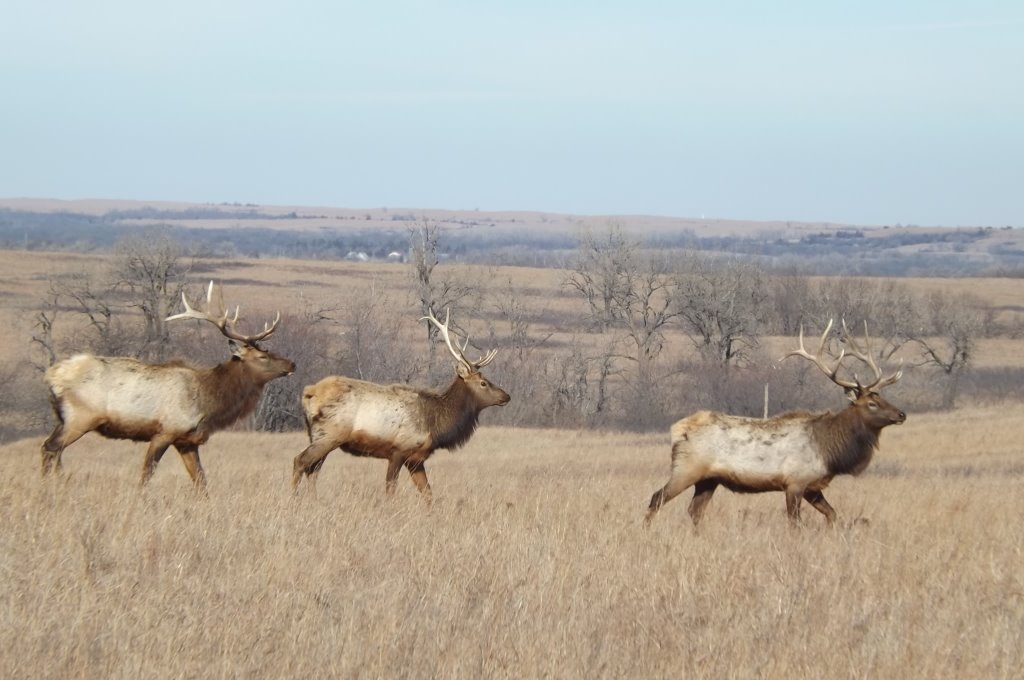
Kansas is probably as little known for its elk hunting as it is widely known for its pheasant hunting, but according to Matt Peek, wildlife research biologist with KDWPT, there are a fair number of wild elk roaming Kansas. Elk were common in Kansas during pre-settlement days. Later a herd was started in Maxwell Wildlife Refuge, and in the 1980’s elk from Maxwell and several other sources were introduced onto Cimarron National Grasslands and onto Fort Riley. Today the Ft Riley herd numbers about 250 and can be hunted only with one of about 25 tags issued each year. The herd at Maxwell can number 100 depending on the time of year and is closed to hunting.
The elk herd on the Cimarron Grasslands is a free range herd whose number is always changing and no hunting is allowed on the Grasslands. Over the last 10 to 15 years, solitary animals or small bands have been spotted in most western KS counties. In recent years, elk have been harvested legally in Anderson and Coffey counties, and most recently elk were road-killed in both McPherson and Saline counties. Peek estimates the number of elk outside Maxwell, Fort Riley and the Cimarron Grasslands to be a couple hundred, and says they are “Very scattered and are comprised of individuals and small herds that move around a lot, sometimes in-and-out of Kansas into neighboring states.” The good news is that all those animals can legally be harvested with a tag purchased over the counter. Check out the KDWPT website for season dates.
So there you have it, from quail to elk, Kansas outdoors never disappoints. Just when you think you’ve experienced every hunting opportunity Kansas has to offer, something new pops up! Continue to Explore Kansas Outdoors.
Steve Gilliland, Inman, can be contacted by email at [email protected].
Dramatic stories of natural catastrophes fill newsfeeds almost daily. Earthquakes, floods, fires, hail storms, tornados, and hurricanes dominate headlines, reminding us that humans hold little power over weather and geological activities. Discussion of recent events led to an emotional discussion during art class the other day. Eventually our group wondered how people who lived here before us handled such phenomena when they occurred during their lives?
Native Kansan Karen Madorin is a local writer and retired teacher who loves sharing stories about places, people, critters, plants, food, and history of the High Plains.
Depending on how far back we’re talking, we agreed that many of those individuals lived migratory lifestyles. It made me think about what I know about native people of the Great Plains. Using human, horse, and dog power, they transported tanned hides and wooden supports used to construct temporary homes with them as they followed wildlife herds. These creatures provided not only food, but also materials used to construct homes, tools, bedding, and clothing. Their Walmart had hooves.
The nature of these transient beasts meant they constantly moved, seeking grasses that thrived across this region from Texas to Canada. Herds large enough to darken the plains for miles quickly devoured this solar generated calorie resource. When the grass was gnawed to the ground, they moved shifted locale, leaving it to regrow before their next pass through the area. As a result, humans whose lives depended on the great, shaggy beasts packed up and trekked after them.
While some imagine the hardships of such a life, researchers tell us it was beneficial. Food was fresh, and tribes usually abandoned camp long before human wastes fouled water and soil that sustained them. As part of nature’s cycles, they understood the waxing and waning of the moon as well as the always changing seasons. They knew where their food and resources came from and how to preserve them for later use. They were more in touch with the realities of existence than modern urban dwellers.
Like us, they were susceptible to natural disasters. Oral histories and records kept on animal skins reveal accounts of apocalyptic events. The difference is that their mobility encouraged a high degree of adaptability. Reconstructing a hide tipi required resources and labor, but it didn’t require a lifelong mortgage to replace it. Because they moved where game moved, fire meant a lost season of grass in one locale, not a lost herd that had to be rebuilt–if finances permitted.
When such events occurred, whole tribes moved on, lending support to the weakest in the group. They maintained their cyclical behaviors until cultural conflict made that impossible. Equivalent catastrophes today often isolate individuals or families who then depend on strangers or impersonal government entities to help them rebuild lives. Not only do people lose homes and possessions, businesses, farms, vineyards, and ranches succumb to raging floods and flames. Lifetime dreams vanish overnight.
While technology and civilization provide temperature controlled climates inside four walls, it’s worth considering what modern humans give up to enjoy such comfort. Unless we consciously contemplate our relationship with nature and its pros and cons, it’s easy to think we’re the masters of the universe. That is until a natural disaster reminds us we aren’t in control of anything but how we respond to what happens to us.
Native Kansan Karen Madorin is a local writer and retired teacher who loves sharing stories about places, people, critters, plants, food, and history of the High Plains.
TOPEKA, Kan. – The TMP-Marian volleyball team is the No. 1 seed for the 3A State Tournament in Emporia and will open pool play Friday at 9:30 am against Wellsville. The Monarchs will also face Beloit and Cheney in pool play Friday.
The Monarchs advanced the state tournament for the second straight year after winning their own 3A Regional Tournament Saturday at Al Billinger Fieldhouse.
Class 3A State Volleyball Pairings
Friday, October 27– Pool I (Top Bracket)
Seed 1: Hays-TMP-Marian, 38-2
Seed 8: Wellsville, 29-11
Seed 4: Cheney, 34-5
Seed 5: Beloit, 34-5
COURT A
8:30 AM Cheney (4) vs. Beloit (5)
9:30 AM Hays-TMP-Marian (1) vs. Wellsville (8)
10:30 AM Cheney (4) vs. Wellsville (8)
11:30 AM Hays-TMP-Marian (1) vs. Beloit (5)
12:30 PM Beloit (5) vs. Wellsville (8)
1:30 PM Hays-TMP-Marian (1) vs. Cheney (4)
Friday, October 27– Pool II (Bottom Bracket)
Seed 2: Seneca-Nemaha Central, 40-3
Seed 7: Silver Lake, 32-6
Seed 3: Hesston, 37-3
Seed 6: Erie, 33-6
COURT B
8:30 AM Hesston (3) vs. Erie (6)
9:30 AM Seneca-Nemaha Central (2) vs. Silver Lake (7)
10:30 AM Hesston (3) vs. Silver Lake (7)
11:30 AM Seneca-Nemaha Central (2) vs. Erie (6)
12:30 PM Erie (6) vs. Silver Lake (7)
1:30 PM Seneca-Nemaha Central (2) vs. Hesston (3)
All matches will start no sooner than the time listed on printed schedule.
Saturday, October 28
Saturday bracket posted on KSHSAA website at the conclusion of pool play on Friday.
Saturday Semi-final matches will begin at 10:00 am.
Consolation & Championship Matches will begin 15 minutes after last semi-final match has concluded.
SHAWNEE COUNTY —Law enforcement authorities are investigating an armed robbery and searching for the suspects.
Just before 9:30p.m., a man and his 16yr-old-son were walking in the area of SE 37th and Adams in Topeka, according to Topeka Police Lt. Steve Roth.
A dark colored Saturn passenger car pulled up and got their attention. A heavy set black male teen passenger got out of the car armed with a revolver handgun and demanded everything from the victim.
The victim swatted at the gun then he and his son ran from the scene.
The suspect fired three shots; one of the rounds struck the victim, causing a non-life threatening injury. The suspect fled the scene and is at large.
The car was driven by a black female teen, and a third occupant was a white male teen in the back seat. Anyone with information regarding this incident is encouraged to contact the Topeka Police Dept. or Crime Stoppers.
WYANDOTTE COUNTY —A Kansas man died in an accident just after 5p.m. Sunday in Wyandotte County.
The Kansas Highway Patrol reported a 2012 Chevy Impala driven by Dalen C. Jefferson, 31, Kansas City, was westbound on Interstate 70 off ramp at 57th Street at a high rate of speed.
The driver failed to stop at a red light, entered the intersection and the Impala collided with a northbound Chevy Tahoe driven by Estela Carrasco, 39, Kansas City, at it was heading through the intersection.
Jefferson was pronounced dead at the scene. A passenger in the Impala Jayden Fleming, 7, Kansas City, was transported to Children’s Mercy.
Carrasco was transported to KU Medical Center. All three were properly restrained at the time of the accident, according to the KHP.