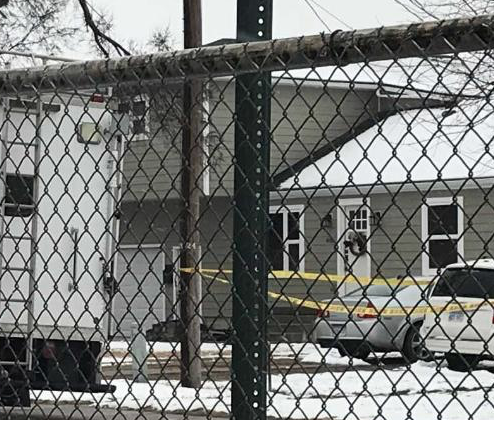
Investigators on the scene of in Rooks County Monday-photo courtesy KWCH
ROOKS COUNTY ‑Law enforcement authorities are investigating a death in Plainville.
Just before 5 a.m. Monday, local law enforcement responded to the residence of 411 Commercial Street in Plainville, according to the Kansas Bureau of Investigation.
Upon arriving at the location, law enforcement discovered a female victim identified as Alexis Garcia, 24, of Plainville.
The Plainville Police Department, Chief Troy Rudman, requested KBI investigative assistance at that time.
The Kansas Attorney General’s office is reviewing the case at the request of the Rooks County Attorney, according to Jennifer Montgomery with the Attorney General’s office.
Authorities have not reported an arrest and released no additional details.
TOPEKA, Kan. (AP) — Kansas lawmakers suffering sticker shock over a report saying that improving the state’s public schools could cost an additional $2 billion a year began Monday to consider setting less ambitious educational goals than the ones that led to the big price tag.
The out-of-state consultants behind last week’s study provided new, lower estimates tied to more modest goals for improving the state’s high school graduation rate and students’ performance on standardized tests. Some Republican lawmakers who were stunned by last week’s report appeared less anxious after the consultants testified during a committee meeting Monday.
Legislators are facing a Kansas Supreme Court mandate to increase spending on public schools after it ruled in October that the current education funding isn’t sufficient under the state constitution. GOP leaders commissioned the consultants’ report, with some Republicans hoping it would show that the state already was spending close to enough money.
Instead, the report released Friday came with a potentially big price tag: a 44 percent increase in school districts’ more than $4 billion a year in operating funds. But the cost was tied to increasing the statewide graduation rate from 86 percent to 95 percent and vastly improving student scores on standardized tests, and legislative lawyers suggested the goal was to hit both targets by 2022.
The consultants, Texas A&M University professor Lori Taylor and Jason Willis, a director at the San Francisco-based nonprofit education research agency WestEd, said the state could take a decade or longer to hit those goals. Or, they said, the state could set other targets, such as a graduation rate of 90 percent or 92 percent.
“It’s time for that really broad discussion of: ‘What is it that we want to have?'” said state Sen. Molly Baumgardner, a conservative Louisburg Republican and chairwoman of a special Senate school funding committee. “What are realistic outcomes for us?”
For example, the consultants said, setting the target graduation rate at 92 percent could cost the state as little as $228 million more a year, depending on how ambitious it was about improving students’ test scores.
Baumgardner’s committee and a House school funding panel met together for more than two hours Monday to review the consultants’ report and question them. Senate Majority Leader Jim Denning, a conservative Kansas City-area Republican, said the big potential costs resulted from “lofty” goals and questioned whether the state should “chase” a 95 percent graduation rate.
Hitting the goal would give Kansas the highest graduation rate in the nation. State officials promised the federal government last year that it would hit the mark — but by 2030.
The state Supreme Court also is concerned with how well students perform. Four local school districts sued the state over education funding in 2010, and the justices have ruled that legislators are failing to finance a suitable education for every child. The court has said one of its biggest concerns is helping underperforming students.
“People will always talk about how much we want to do until we get the bill,” said Kansas Association of School Boards lobbyist Mark Tallman.
Senate Minority Leader Anthony Hensley, a Topeka Democrat, said as he left the meeting that he believes lawmakers could satisfy the court by phasing in a $300 million increase in funding over a few years and committing to future increases to keep up with inflation.
But Senate President Susan Wagle, a conservative Wichita Republican, still predicted after the meeting that the state could need a big tax increase to satisfy the court’s demands. She issued a statement far more pessimistic than comments even from other Republicans.
“The bottom line is that Kansans cannot afford what the court is demanding, and we cannot afford what the new study is recommending,” Wagle said.
Margaret Elizabeth Ridgway, age 97, of Ellis, passed away on Friday, March 16, 2018 at the Good Samaritan Society, Ellis. She was born on February 7,1921, at home in WaKeeney, KS, to Beryl (Hanks) and W.C. Wollner and was the third of four children. A cum lauded graduate of Trego community High School, she was a member of the National Honor Society. While in high school, she worked as an usher at the Kelly Theatre in WaKeeney.
She worked as a writer and copy editor at the Western Kansas World in WaKeeney where she met her future husband, Roy LuVerne Ridgway, who was a Linotype operator there. Margaret and LuVerne married in 1941 and made their home at the Ridgway farm in Trego County which was homesteaded by Cleggett Castille Ridgway, LuVerne’s grandfather in 1878. Their only child, Richard, was born in 1944.
The Ridgway farm raised Richard, wheat and beef cattle. After Richard was in school, Margaret worked as a dental assistant to Dr. F.A. Brown in Ellis for several years. Margaret and LuVerne had many friends in the area and made many new ones during their winter trips to Casa Grande, AZ, traveling in and enjoying their Fifth Wheel camper. After a sudden illness and hospitalization, LuVerne died in 1995. Margaret continued to manage and live on the Ridgway farm keeping it as her husband would have kept it.
She was an active member of the Ellis United Methodist Church, the Y.M.P. Club and the P.E.O. and volunteered at long-term-care facilities in Ellis and WaKeeney up until the time she moved into the Meadowlark assisted living facility at the Good Samaritan Center in Ellis in 2010.
She is survived by her son, Richard and daughter-in-law, Krispen of St, Paul, MN, her granddaughter, Erin Zolotukhin-Ridgway (Andrei) and great grandson, Maxim of St. Paul, MN, her grandson Benjamin. Ridgway (Eugenie Chao) of Tacoma, WA.
Funeral services will be 10:30 AM on Tuesday, April 3, 2018 at the Ellis United Methodist Church. Burial will be in the Ogallah Cemetery.
Arrangements in care of Keithley Funeral Chapel 400 E. 17th Ellis, KS 67637.
In lieu of flowers, memorial gifts may be made to the Ellis United Methodist Church or the Good Samaritan Foundation to benefit the Ellis Good Samaritan Center.
Condolences may be left by guest book at www.keithleyfuneralchapels.com or by email at [email protected]
By SHAELIN SWEET FHSU University Relations and Marketing
Fort Hays State University junior Jasmine Turley, Beloit, was recently selected as a 2018 Newman Civic Fellow through Campus Compact, a Boston non-profit organization devoted to advancing the public purposes of higher education.
Turley, who is majoring in biology, credits her peers, professors and the campus community for her success.
“FHSU has given me innumerable opportunities to grow in my role as a leader,” said Turley. “Outstanding mentors like Curt Brungardt, Brett Bruner, Amanda Fields, and Keegan Nichols helped pave my way.”
During her three years at FHSU, Turley has been extensively involved and has served in multiple leadership positions, including as a new student and family orientation leader, Student Government Association senator, Allocation Committee member, vice-chair of the Kansas Board of Regents Diversity and Inclusion Task Force and co-chair for the SGA Legislative and Political Action Committee.
“Being a leader means being a voice for those who don’t have one, and I try to keep my voice loud and proud,” said Turley. “Being an activist is different. As an activist, you still make your voice as loud as you can, but you join it with the multitude of other voices crying out for the same cause.”
“You become a part of something bigger. I am forever grateful to my campus community for giving me the opportunity to be a part of something bigger,” she said.
The Newman Civic Fellowship is a one-year experience emphasizing personal, professional and civic growth. The fellowship provides a variety of learning and networking opportunities, including a national conference of Newman Civic fellows in partnership with the Edward M. Kennedy Institute for the United States Senate.
By BOB GARDENER Executive Director of the National Federation of State High School Associations and GARY MUSSELMAN Executive Director of the Kansas State High School Activities Association
Many parents are trying to live the dream through their sons and daughters – the dream of landing a college athletic scholarship by specializing in a sport year-round. Unfortunately, most of these dreams are never realized. The odds of a sports scholarship paying for even a portion of a student’s college education are miniscule.
The College Board, a not-for-profit organization comprised of 6,000 of the world’s leading educational institutions, reports that a moderate cost for college students who attend a public university in their state of residence is $25,290 per year. The annual cost at a private college averages $50,900.
Meanwhile, the most recent data from the NCAA reveals that the average Division I athletic scholarship is worth only $10,400. More significantly, the same study shows that fewer than two percent of all high school athletes (1 in 54) ever wear the uniform of an NCAA Division I school.
Even if the dream is realized, parents likely will spend more money for club sports than they ever regain through college athletic scholarships. Thanks to the costs of club fees, equipment, summer camps, playing in out-of-state tournaments and private coaching, youth sports has become a $15 billion-per-year industry.
There is an option, and it’s a financially viable one: Encourage your sons and daughters to play sports at their high school.
In education-based high school sports, student-athletes are taught, as the term implies, that grades come first. The real-life lessons that students experientially learn offer insights into leadership, overcoming adversity and mutual respect that cannot be learned anywhere else. Unlike club sports, coaches in an education-based school setting are held accountable by the guiding principles and goals of their school district. And the cost of participating in high school sports is minimal in most cases.
While there is a belief that the only way to get noticed by college coaches is to play on non-school travel teams year-round, many Division I football and basketball coaches recently have stated that they are committed to recruiting students who have played multiple sports within the high school setting.
In addition, by focusing on academics while playing sports within the school setting, students can earn scholarships for academics and other talents—skill sets oftentimes nurtured while participating in high school activities. These scholarships are more accessible and worth more money than athletic scholarships. While $3 billion per year is available for athletic scholarships, more than $11 billion is awarded for academic scholarships and other financial assistance.
Without a doubt, your sons and daughters will have more fun, make more friends and be better prepared for life beyond sport by participating in multiple sports and activities offered by the high school in your community.
Martin HawverWhile K-12 finance, a budget and taxes are all consuming oxygen in the Statehouse, gun legislation is locked and loaded and ready for a House-Senate shootout in which just one major policy change is apparently ready to be approved. But there is another piece of gun legislation which might move to center stage.
The apparently agreed-to issue is to prevent people who have been convicted of misdemeanors for domestic violence within the past five years from having guns, along with those who are under court order to stop stalking, harassing or threatening an “intimate partner, child or child of an intimate partner.”
Now, that may be as far as legislators are ready to go this year. No prohibition of those bump stocks which turn a semi-automatic rifle into a machine gun that can fire off multiple bullets with just one trigger pull, no new limits on carrying concealed weapons on college campuses.
And…so far, no action in either chamber on what could become the center point of gun safety, the so-called “red flag” law, which some other states have enacted after a series of mass shootings. That red flag business is interesting, and there are versions of the bill in both the House and Senate which haven’t gotten hearings yet.
Key to the red flag is that if friends or relatives or other close acquaintances notice a dramatic change in the behavior of a gun owner—maybe a tragedy has happened or there has been an emotional or other significant change in behavior—they can make a complaint to a judge and the judge can order that the person’s guns and ammunition can be seized.
It’s just a temporary deal, with the subject of the complaint getting the chance for a quick evaluation to determine whether he/she does present a danger to himself or others, and if there is no problem, the person gets the guns and ammo back. That’s something that can happen within a couple weeks.
It’s a “prove you aren’t dangerous” standard that proponents believe will prevent suicides or other dangerous use of weapons. The red flag is just a way to improve the chances that a tragedy can be prevented. But it’s not making any progress yet and might not this year.
It’s not quite as simple as Kansas-made gun silencers or bump stocks or those throwing stars that some are OK with people carrying around as long as they don’t threaten anyone with them.
Pre-emptive gun bills are a little tougher to sell because, well, they’re pre-emptive, messing with the constitutional right to bear arms. If that crazy guy next door wants his guns, it’s OK as long as he/she doesn’t hurt anyone…until they do.
With a red flag law, that Second Amendment right to have guns gets interrupted, and that’s a tough choice for responsible gun owners who aren’t a danger to anything except targets and maybe a rabbit or deer or two. A major change in mental capacity or emotional stress probably means more than if, after an icky divorce, an ex-spouse with that major change just acts out by buying a red convertible or maybe those shirts designed to be worn untucked.
Every time someone who even Second Amendment activists don’t think should have a gun shoots him/herself, or others, well, it just puts more anti-gun stories in the newspapers and on TV and threatens some wider gun restrictions.
See the problem here? It’s how to essentially mess around with a constitutional right that the writers of the Constitution didn’t think of more than 200 years ago. If they’d thought of adding the word “safe” or “competent” or something similar, well, things would be a lot different.
But they didn’t, and things aren’t.
So, let’s watch this one.
Syndicated by Hawver News Company LLC of Topeka; Martin Hawver is publisher of Hawver’s Capitol Report—to learn more about this nonpartisan statewide political news service, visit the website at www.hawvernews.com
Hello from Topeka and it was great to see moisture over much of the area the first of the week. Although we can use more, we thank the Good Lord for providing much needed precipitation.
At the end of last week, the much-anticipated report was received on funding from K-12 education. There were some numbers that were not correct in coming up with the total dollars the study said was needed, but by all indications it shows it could be as much as $2 billion dollars over the next several years. We will know more as the next few days progress on what the legislature will do in sending a response to the Kansas Supreme Court, I think it is going to be difficult to find the votes for a major tax increase this year. There continues to be speculation of additional income taxes or property taxes levied to provide additional money. As a member of the tax committee, there have been several proposals but not much support for anything currently.
One of the bills which has been given a lot of attention was SB 405, which is clarifying animal conversion units for poultry facilities with dry manure systems. The bill would establish the animal unit measurement calculation for chicken facilities that use a dry manure waste system as the number of laying hens or broilers, multiplied by 0.003. The bill would also require a confined chicken facility to obtain a federal permit if the facility uses a dry manure system and confines 125,000 or more broilers or 82,000 or more laying hens. It may not be a perfect bill, but it is a first step if communities want to pursue poultry operations. It passed by a vote of 84-37, I voted yes.
Also last week, the Agriculture Committee heard testimony on SB 263, which would allow the Kansas Department of Agriculture to cultivate and research the uses of industrial hemp. Principally, the research would be conducted in effort to analyze its required soils, growing conditions, harvest methods, and the potential for an industrial hemp market in Kansas. Additionally, a pilot program in Russell County would be established to study its effect on economic development and the development of industrial hemp products. Representatives Willie Dove, Steven Johnson, and Troy Waymaster expressed their support, as well as the Department of Agriculture, the Sierra Club, small businesses, and private citizens. Data was included that showed hemp uses 66% less water than corn, requires virtually no pesticides or fertilizers, and has great potential to improve agricultural and economic activity in rural Kansas. Opponents argued that the provisions of the bill would lead to the legalization of marijuana, while others asserted that this bill would not go far enough concerning hemp.
In March of 2017, the House passed HB 2182 on a vote of 103-18. HB 2182 differs from SB 263, in that SB 263 solely allows the Department of Agriculture, either alone or in coordination with a state institution of higher education to grow, cultivate, and research industrial hemp. Earlier in February, the Senate approved this bill with a final vote count of 36-3. The committee passed SB 263 this week and has yet to be considered by the full house.
The Kansas House recognized the Kansas Small Business Development Center’s 2018 Businesses of the Year with House Resolution 6051. The resolution was sponsored by 75 members of the House. The resolution noted that the mission of the Kansas Small Business Development Center (SBDC) is to, “increase economic prosperity in Kansas by helping entrepreneurs and small business owners start and grow their businesses through professional consulting and training, and the identification of appropriate resources. The Kansas SBDC choose seven Emerging Businesses of the Year, seven Existing Businesses of the Year, and two Exporting Businesses of the Year award recipients.
The 2018 Kansas SBDC Emerging Businesses of the Year are: BellaRose Boutique and Tanning Salon, LLC in Burlington, owned by Lindsay Beyer; Lost Creek Supply in Kensington, owned by Kaid Baumann; Angel Competition Bikinis, LLC in Lenexa, owned by Karah and Lauren Beeves; HMC Performance Coatings in Tonganoxie, owned by Shawn and Amie Bristol; Root Coffeehouse in Pittsburg, owned by Lindsey and Trent King; Advantage Marketing in Wichita, owned by Cori Kohlmeier and Amy Hoefer; and Sugar Creek Country Store in St. Marys, owned by Dan Hohman.
The 2018 Kansas SBDC Existing Businesses of the Year are: Radius Brewing Company, LLC in Emporia, owned by Justin Bays, Jeremy Johns and Chad Swift; KYVZ Radio in Atwood, owned by Joe Vysourek; KC Restoration, LLC in Olathe, owned by Bill and LeAnn Luemmen; KEAdvisors in Lawrence, owned by Keith Ely; LaHarpe Telephone Company, Inc. in LaHarpe, owned by Harry Lee, Joyce Lee and Carol Higginbotham; T & B Towing, LLC in Liberal, owned by Ty Rader; Overstock Art, LLC in Wichita, owned by David Sasson; and Wabaunsee County Signal-Enterprise in Alma, owned by Lori Daniel.
The 2018 Kansas SBDC Exporting Businesses of the Year are: Double D Family Mat Shop, Inc. in Park, owned by Dale and Dena Goetz; and Northwind Technical Services, LLC in Sabetha, owned by Mike and Marlene Bosworth.
My office is now on the 5th floor at 512-N. The phone number stays the same. Please feel free to reach out with concerns and questions, I will do my best to respond it a timely manner. My phone number is (785) 296-7463 and email is: [email protected], my cell number is (785) 302-8416. You can also check out kenforkansas.com.
John Schlageck writes for the Kansas Farm Bureau.The personal letter may soon go the way of the dinosaur or the Edsel automobile – extinction.
Maybe because of the time it takes to write a hand-written letter, this type of communication isn’t as popular as it once was. That’s why people who receive such letters cherish them so.
The best letters are hand-written with a fountain pen. Sometimes the handwriting is smooth with the letters beautifully shaped and spaced.
My mother wrote letters filled with such penmanship. Legibility marked her every word.
As Mom grew older, her writing became a bit less beautiful. I used to become a little melancholy when I’d see the envelope she’s addressed to me arrive in the mail. But once I opened the envelope and began reading, my mood changed to joy.
My mother wrote a wonderful letter – filled with news about what Dad and she were doing. Whether they’d received rain. Father Walshe’s Sunday sermon or the condition of her garden.
It was jam-packed with details and provided me with updates about my family and their animals. I learned about my aunts and uncles, neighbors I grew up with, or how many quarts of tomatoes she’d finished canning for the upcoming winter.
Once upon a time, a letter was sent as a personal message from one person to another. It’s unfortunate more of us don’t communicate this way anymore.
I consider it a real gift to receive a letter written in conversational form intended just for me.
A couple weeks ago, I received such a letter from a friend in Sedgwick County, Kent Winter, who farms northwest of Wichita near Andale. The envelope was also penned in Winter’s hand.
The letter opened with (salutation), “Good morning John,” and continued in his easy, flowing style. The message of the letter focused on Kent’s oldest son, Alan, and news of his education in the seminary at St. Michael’s Abbey in Silverado, Calif. Alan continues in the preliminary phase of becoming a member of the Norbertine Order.
Consider the news about his son Kent related to me in just this one paragraph. Think about how much else I learned in his entire message to me.
Personal letters are special. I have a box of them tucked away in my birch- wood desk in the study of our home. Another bunch of contemporary letters clutter one of the kitchen drawers where our portable phone sometimes hides out.
A treasured letter will last a lifetime. Letters are a form of communication that allow the writer to reveal some of his/her most personal thoughts. These thoughts may be critiqued and scrutinized time and time again before some letters are even mailed.
In a letter the subject matter is specific. Individual topics may be addressed. The writer’s personal self surfaces in a hand-written letter.
Often, people write from their hearts, as well as their minds, in their letters. What may appear trite to a disinterested third party makes sense to the person who receives the personal message.
Personal letters may not make sense to anyone else, but the two parties involved usually understand every word, sentence, paragraph and page. And, oh, how wonderful it is to sit down in your favorite chair and read through a personal letter intended just for you.
If you are one of those people who enjoy receiving a hand-written letter, think of how one of your close friends or loved ones might enjoy hearing from you in the same form.
Write to someone you know and care about soon. Let’s keep this personal form of communication alive.
Better yet, lets revitalize a treasured tradition.
Doing laundry probably tops the list of the most frequent household tasks, so anything to make the chore easier is certainly welcome. While single-load liquid laundry packets offer lots of ease and convenience, these highly concentrated doses of detergent can be harmful if swallowed or splashed in the eyes of children.
This week is National Poison Prevention Week (March 18-24, 2018), a time when the American Cleaning Institute reminds parents and caregivers to store liquid laundry packets up and out of the reach of children.
The packets have been called “pretty poisons”– a term poison control centers use for look-alike products that look like something good to eat or drink to a child but which can be harmful if tasted, swallowed, or gotten on the skin or in the eyes. The packets often resemble candy or juice, and are the perfect size for a young child to grab and put in his mouth.
The health risks have been around nearly as long as the laundry packets themselves. Tide, for example, began selling its pods in February 2012. About a year later, federal consumer safety officials were compelled to warn families that children find such packets appealing.
In a study reported in Pediatrics, laundry detergent packets were identified as the biggest contributor to hospitalizations and serious medical issues among any other kind of detergent poisoning. Last year, poison control center received 10,585 reports of children 5 or younger being exposed to the packets. In the first two months of 2018, so far there have been reports of 1,194 exposures by young children, according to the American Association of Poison Control Centers. (Note: The term “exposure” means someone has had contact with the substance in some way; for example, ingested, inhaled, absorbed by the skin or eyes, etc. Not all exposures are poisonings or overdoses.)
While unintentional misuse by children five and under accounts for the majority of laundry packet cases, a recent trend among teenagers ingesting the packets— and uploading videos to social media— has caused significant concern among poison control centers.
In January and the first half of February 2018, poison control centers handled 191 cases in which teenagers were intentionally exposed to the detergent packets. The American Association of Poison Control Centers reports there were 53 such cases in 2017 and 39 cases in 2016.
The companies that make the packets use different formulas, but one thing is clear: they contain more than just soap. Highly concentrated detergent and a variety of chemicals are inside, depending on the brand. A dissolvable covering holds it all together. The chemicals can cause severe burns to the mouth, esophagus or respiratory tract, and some very young and very old patients with cognitive issues have been rushed to emergency rooms or even died as a result of eating the packets.
Manufacturers of laundry packets have taken steps to improve the product’s safety such as making the packaging opaque so children cannot see inside the packets and adding a bitter taste to the packet’s film covering. In addition, the packets have been revamped to withstand the pressure of a child squeezing it and prominent warnings are now stamped on packaging along with contact information for the Poison Control Centers, in case of accidental exposure.
An American Cleaning Institute national survey revealed 61 percent of parents stored laundry packets in sight or in reach of young children. That is why they created the PACKETS UP safety initiative to help reduce accidents related to liquid laundry packets.
Families can prevent possible poisonings by following a few easy- but critical- safety measures. Laundry packets should be stored in their original packaging, with the label intact, and placed up high, out of reach and out of sight of toddlers and young children. It also is important to use laundry packets as directed and be sure to seal and put the package away immediately after use. Consumers can find more information at the ACI website: www.PACKETSUP.com.
Contact the Hays or Great Bend offices of the Cottonwood Extension District for a free PACKETS UP cling containing a safety reminder from the American Cleaning Institute.
Don’t let a “pretty poison” cause a tragedy for your children. Put packets up for accident prevention.
Linda K. Beech is Cottonwood District Extension Agent for Family and Consumer Sciences.
Three militia members accused of plotting to bomb a mosque and apartment complex in southwest Kansas go on trial Tuesday in Wichita.
Ambiyo Farah said Liberal, Kansas, “is not innocent anymore.” An alleged plot to bomb a mosque and an apartment where Somali refugees live has roots in the meatpacking town. FRANK MORRIS
Their alleged plot laid bare tiny pockets of the ugliest, potentially violent, racism in a region that’s seen immigrants drawn to tough meatpacking jobs for decades.
The raw hate exposed in the alleged plan shocked some of the refugees who were targeted, reminding them of violence they fled in Somalia and sparking an exodus from one of the prairie towns.
It also prompted more people to talk with admiration of the workforce that keeps the meatpacking industry, and the region’s economy, alive. They’ve reached out to the would-be targets of domestic terrorism.
“We all give each other a chance here,” says LeVita Rohlman, who directs the Catholic Agency for Migration and Refugee Services in Garden City. “Even when things go wrong. I believe that this community stands united.”
The plot took root near Dodge City, at the easternmost point of a the Kansas meatpacking triangle formed with Liberal and Dodge City. All three Great Plains cities have for generations drawn immigrants for the smelly, dangerous work of transforming cattle into steaks and hamburger. It’s work that few U.S.-born Americans take on.
Just outside Dodge City, Patrick Stein lived in an old trailer home in Wright, Kansas, next to a rusting Quonset and a grain elevator. Neighbors say that Stein came from a respected family in town, but that he kept strange hours.
When FBI agents raided his home October 14, 2016, they found a high-powered rifle on the couch, ammunition and what appeared to be methamphetamine pipes. They also found a piece of paper with the address of an apartment complex in Garden City that authorities say was target for an act of domestic terror.
Cultures mix in the meatpacking triangle
Prosecutors say a plot to kill Muslims was discussed with an informant in this Quonset hut in Wright, Kansas. CREDIT FRANK MORRIS
In Dodge City, Garden City and Liberal, people of European descent are now in the minority. Immigrants from Africa, Asia, and Latin America, are a key part of workforce.
One of Stein’s old neighbors in Wright, Chelsea Bradville, lives in a home decorated with taxidermy and patriotic figurines. A pickup sporting a large black assault rifle decal sits out front. Bradville, like many in the meatpacking triangle, harbors an abiding respect for immigrants doing the hard work at area slaughterhouses.
“It’s very intensive labor, and there’s a lot of the community that doesn’t want to do that, you know, and they do,” says Bradville. “They’ll do the hard work, and make it.”
That thinking is pretty widespread. Old West towns like Dodge City lay claim to authentic gunslinger credibility and a history of destitute farmers toughing it out through the Dust Bowl years.
The modern story of the region speaks to a place where just about anyone, from anywhere, can make a living and gain a toehold on the American dream. Earl Watt publishes The High Plains Daily Leader and the Southwest Daily Times in Liberal.
“Opportunity may take you elsewhere, but this is a place where you get a chance to get started,” promises Watt. “If life bottoms you out, come on out, get restarted here. You’ll get that chance. We’ll get you back on your feet. That’s what defines us more than anything else.”
Southwest Kansas might have been defined something more sinister, domestic terrorism. Instead, authorities contend, a deadly scheme was foiled through the work of someone Stein believed to be a natural compatriot in an anti-Muslim crusade.
‘Only good Muslim, is a dead Muslim’
Early in 2016, an acquaintance of Stein’s contacted the FBI and became a paid confidential informant. That led him to record conversations with Stein and during meetings with two other men — Curtis Allen and Gavin Wright — who had allegedly joined his makeshift, anti-government, anti-Muslim militia.
They called themselves the Crusaders. According to the indictment, Stein seemed to relish mass murder.
“The only good Muslim is a dead Muslim,” Stein allegedly said in one recorded conversation. “If you’re a Muslim, I’m going to enjoy shooting you in the head.”
That, according to court records, included 1-year-olds. Stein regularly referred to Somalis as “cockroaches,” prosecutors contend, and compared himself to an exterminator.
The recordings allegedly chronicle the Crusaders discussing bomb types, and ordering supplies to make explosives, some of which were shipped to Gavin Wright’s modular home dealership in Liberal.
Curtis Allen was allegedly put in charge of writing a manifesto to be released after the group launched its bombing campaign. That document would fame the terror attacks as patriotic defense of the U.S. Constitution and, the three supposedly hoped, inspire other groups to wage war on Muslim immigrants. They allegedly decided to time the attack for just after the November 2016 election, so as not to hurt Donald Trump’s chances.
Their lawyers had sought to make sure juror were drawn not from more urban Wichita, but from more reliably conservative voters in the state’s southwestern corner. A judge rejected that request.
Allen had been convicted of domestic battery, and wasn’t supposed to have guns. But court documents say that when agents searched his home they found almost two dozen firearms and thousands of rounds of ammunition.
‘Why are you trying to kill me?’
The men eventually settled on 312 West Mary Street in Garden City, a closely spaced cluster of eight one-story apartment buildings. More than 100 people, primarily east African immigrants, live there. One apartment serves as a mosque.
According to court documents, the Crusaders discussed parking trucks loaded with explosives at the corners of the complex, placing bombs disguised as trash receptacles, and laying explosives in the duct work.
They spoke of shooting survivors, after leveling the buildings.
Ifrah Farah, a Somali immigrant who proudly states that she’s been in the United States four years, lives in a sparsely decorated apartment at the edge of the complex.
“I would like to ask the bad guys, ‘Why? What am I doing? Why are you trying to kill me? Am I Somali? Or, am I Muslim? What?’” she said.
The Plot Unravels
On October 11, 2016, police in Liberal arrested Allen, not long after his girlfriend called 911 to report that he had beaten her.
The next day, Stein had a meeting with an undercover FBI agent. The agent had been introduced by the FBI’s confidential source within the Crusaders group, as some kind of underworld figure, who could get him explosives. Stein had a long wish list: C-4 high explosives, machine guns, rocket-propelled grenades.
Ifrah Farah wonders why Muslims in the region would be targeted by terrorists, as federal prosecutors allege. CREDIT FRANK MORRIS
“If I could get ahold of a warthog (an A-10 Thunderbolt ground attack aircraft) or an Apache helicopter I would be after that, too,” said Stein, according to court records.
Stein and the agent discussed trading cash and methamphetamine for explosives and machine guns.
At the meeting, the FBI employee let Stein fire fully automatic weapons. Then the agent and Stein drove to 312 West Mary Street, to scope the place out.
Garden City gets it right
Two days later, FBI agents arrested Stein when he delivered them 300 pounds of ammonium nitrate fertilizer, the same raw material Timothy McVeigh used to bomb the Murrah Federal Building in Oklahoma City in 1995.
In the Oklahoma City bombing, McVeigh was inspired by “The Turner Diaries,” a novel that glorified the idea of a race war. McVeigh had hoped his act would inspire others to take up arms against the federal government.
After Stein’s arrest, the FBI called Garden City Police Chief Michael Utz. He, in turn, called local immigrants.
“When the terrorist plot was uncovered, I reached out to the president of the African Community Center, and I said, ‘I need your help,’” Utz recalled. “He said, ‘What do you need, chief?’”
Utz wanted help convening a quick meeting with African immigrant leaders to tell them about the bomb plot before it hit the news. The next day, he was back to reassure other refugees.
“We made it a point to let the community know, that the three individuals involved in this conspiracy, were in custody, that the community was safe.”
More meetings, along with public demonstrations, supporting the immigrants followed. By most accounts, they worked.
Sitting in on his couch, in that Mary Street apartment complex, Abdulkadir Mohamed said Garden City has grown closer since government exposed the alleged the bomb plot.
“The FBI, CIA, and law enforcement work together. That’s what I believe. That’s why I’m really happy. And I appreciate what they do here. Because, I’m still alive,” said Mohamed.
Mohamed is optimistic about the future of Garden City.
Abdulkadir Mohamed says Garden City has responded positively to news that authorities believe a bomb plot was aimed at Somalis. CREDIT FRANK MORRIS
But 60 miles south of Garden City, in Liberal, the disclosure of the bomb plot had the opposite effect.
“Liberal is not innocent, anymore,” said Ambiyo Farah, an 18-year-old college student in Liberal whose family fled civil war in Somalia over a decade ago. “It’s like Somalia now, you know, there’s a threat on you.”
Farah says that she’s one of the few from her native country still living in Liberal. Nearly 200 Somalis have fled the small city. That’s clear at what used to be a thriving African grocery store.
“This is the place, or it used to be the place, but now it’s a ghost town. There’s no one here,” Farah said while standing at a corner storefront in downtown Liberal. A, where a sign over the locked door reads International African Grocery.
“It used to be really beautiful,” recalls Farah, looking at the building. “Someone standing here, dressed their African clothing, just to welcome you, say hi. Give you something if you had a kid with you, but there’s no one here now.”
Down the block, ripped up carpet and insulation litter what used to be a storefront mosque.
Farah said many Somalis from Liberal moved to Garden City, joining a larger, and more secure Somali community there.
“A lot of people … have a misperception about what my religion is,” says Farah “If you don’t believe what they believe in, you’re an automatic threat. You’re here to take something, or you’re here to hurt somebody.”
GEARY COUNTY — Law enforcement authorities are investigating a pair of armed robberies and have a suspect in custody.
Carwell- photo Geary Co.
Just before 10p.m. March 12, a person reported being approached by two black men in the alley behind El Tapatio restaurant, 300 West 6th Street, according to a media release.
The victim advised one of the men had a gun and demanded money. The victim ran several blocks to his home after giving the suspects his cell phone.
At approximately the same time, dispatch received a 911 call from a second victim that had been walking in the same area being approached by two black men, one with a gun and both wearing dark clothing. The subjects demanded money and took the second victim’s wallet and cell phone. The suspects ran west through the alley after the incident. It’s believed these incidents happened within several minutes of one another.
On March 14, police arrested James Tyshawn Carwell at a residence in the 500 Block of West 18th Street on suspicion of two counts of Aggravated Robbery stemming from those robberies.
He is being held at the Geary County Detention Center on $100,000 bond.
Detectives continue to work this case to identify the other subject involved. Anyone with information is asked to contact the police department TIPS line at 785-762-8477 or leave a webtip at Gearycrimestoppers.com. You can remain anonymous and be eligible for a cash reward.
KANSAS CITY, Mo. – After not competing at the collegiate level in more than two years, Madison Wolf started the 2018 outdoor season where she left off. The Bennington, Kan. native was named MIAA Women’s Outdoor Field Athlete of the Week on Monday (March 19) after winning the javelin throw competition at last week’s ESU Spring Invitational.
Wolf automatically qualified for the 2018 NCAA Division II Outdoor Track and Field Championships after a heave of 167-3, besting teammate and runner-up Alexcia Deutscher by more than 10 feet. Sitting in second entering her sixth and final throw, the graduate student hurled the spear more than 11 feet past her previous long throw of the day. Wolf currently tops the performance chart in NCAA Division II and owns the eighth-longest toss across all NCAA ranks so far this season.
Wolf, a three-time All-American in the discipline, will now have the opportunity to make it four All-American honors at this year’s National Championships in May.

 The out-of-state consultants behind last week’s study provided new, lower estimates tied to more modest goals for improving the state’s high school graduation rate and students’ performance on standardized tests. Some Republican lawmakers who were stunned by last week’s report appeared less anxious after the consultants testified during a committee meeting Monday.