We have a brand new updated website! Click here to check it out!

Trump names former Kan. congressman Sec. of State

WASHINGTON —Rex Tillerson is out as secretary of state. President Donald Trump tweeted Tuesday morning that he’s naming CIA director Mike Pompeo to replace Tillerson.

Pompeo is to be replaced at CIA by Gina Haspel, Pompeo’s deputy at CIA. She would be the first woman in that role.

Tillerson had just returned from a shortened trip to Africa hours before Trump’s announcement. Trump offered no explanation for the change.

Pompeo was elected to the 4th District congressional seat in Kansas during the tea party wave of 2010. He is now fourth in line of presidential succession behind the vice president, speaker of the house and president pro temper of the senate.

Ellis considers sales tax refund for retailers

ELLIS – The Ellis city council is considering a sales tax refund program for retailers.

During the March 5 meeting, council member Dena Patee talked about two such programs in Elk City, Oklahoma.

The Elk City sales tax program refunds 50 percent of the sales tax paid by the retailer during the first year of operation and 25 percent in the second year of operation.  The downtown revitalization program provides for Elk City to match up to $2,500 for exterior improvements to existing buildings.

Ellis city council members will consider drafting a similar plan during it 2019 budget sessions.

The complete meeting minutes follow.


ELLIS CITY COUNCIL REGULAR MEETING

Minutes

March 5, 2018


CALL TO ORDER

Mayor David McDaniel called the meeting to order at 7:30 p.m. Present were Council members Bret Andries, Holly Aschenbrenner, Jolene Niernberger, Dena Patee, and Bob Redger.  Also present were Public Works Director Alan Scheuerman, City Clerk Amy Burton, Police Chief Taft Yates (arrived 8:30 p.m.), and City Attorney Olavee Raub.  Council member Susan Eaton was absent.

PLEDGE OF ALLEGIANCE

AMENDMENTS TO AGENDA

Mayor David McDaniel added the reading of a Proclamation from Governor Colyer to Section 2 of the agenda.

PUBLIC PRESENT

Annette Ellis, Mark Ellis, Nancy Wright, Joleen Fisher, Mark Flax, Joe Day, Barbara Perkins, Verda Flinn, Steve Ferland, Glen Keller, Gary Luea, Pauleen Edmonds, Charlene Weber, Travis Roland, and Dustin Vine.

CONSENT AGENDA

Council member Bob Redger moved to approve the consent agenda containing the Minutes from the Regular Meeting on February 19, 2018, Bills Ordinance #2040, and the Manual Journal Entries for December 2017.  Council member Jolene Niernberger seconded the motion. The Council approved the consent agenda 5-0.

PUBLIC COMMENTS

None

PRESENTATIONS OF AWARDS, PROCLAMATIONS, REQUESTS & PETITIONS (HEARINGS)

Campground: Award

Mayor David McDaniel recognized members of the Campground Committee and presented Travis Roland, Alan Scheuerman, Charlene Weber, and David McDaniel with a Citizen’s Award for their act of service.  Committee members Mike Grogan and Taft Yates were not present.

General Government: Proclamation

Mayor David McDaniel read a Proclamation from Kansas State Governor Jeff Colyer recognizing March 4-10, 2018 as Flood Safety Awareness Week.

SPECIAL ORDER

General Government: Policy

Mark Flax expressed his dissatisfaction with the City’s handling of the grass field north of the tennis courts.  The property is owned by USD 388.  He questioned why the City doesn’t require the school district to follow the codes regulating grass height that other residents must abide by.  Mr. Flax reviewed each of the definitions stated under Code Section 8-402 and discussed what he believes are inconsistencies in the Code.  Mr. Flax also stated the tall grass is a fire hazard to properties in the area.  Council agreed to review the ordinance at the next meeting.

UNFINISHED BUSINESS

Tourism: Contract

Joleen Fisher, Hays Daily News, presented the proposed digital advertising package as recommended to Council by the Tourism Committee at the last meeting.  At that meeting, Council had questions regarding the package that Committee members were unable to answer.  Ms. Fisher entertained questions from Council regarding how digital advertising works and the target audience the package hopes to reach.  The ad campaign will run from May 1 – August 31 for $250 per month.  Council member Bob Redger moved and Council member Dena Patee seconded a motion to approve the digital advertising package from the Hays Daily News in the amount of $1,000, with funds to come from the Tourism Fund.  The motion carried 4-1, with Council member Holly Aschenbrenner opposed.

General Government: Violations

Mark and Annette Ellis, representatives for the property at 211 E. 11th Street, updated Council on the status of remedying the twenty-five code violations cited at the property.  Ms. Ellis stated nine of the violations have been addressed, but they are waiting on material to arrive to continue the work.  The couple asked for an additional 45-day extension to bring the property into compliance.  Council member Holly Aschenbrenner moved to grant an extension of 14 days to address the remaining violations at 211 E. 11th Street and for Mr. and Mrs. Ellis to appear at the March 19, 2018 meeting to update Council on the progress.  Council member Bob Redger seconded the motion.  The motion carried 4-1, with Council member Jolene Niernberger opposed.

NEW BUSINESS

General Government: Violation

Public Works Director Alan Scheuerman presented two structures that he believes should be deemed dangerous and unfit for human use or habitation.  The structure at 719 Washington has holes in the roof on two sides, and the garage at 209 E. 11th is shifting off plumb.  City Attorney Olavee Raub explained the Council can declare the structures dangerous and unfit and proceed through the hearing process and possible demolition, or Council can instruct Mr. Scheuerman to cite a Chapter 8 environmental code violation and give the property owners 15-45 days to remedy the violations.  The property can still be deemed dangerous and unfit if the property owner doesn’t take action.  It was the consensus of Council to have Mr. Scheuerman proceed by issuing a Chapter 8 code violation on each of the two structures.

General Government: Policy

Council member Dena Patee shared information received from Elk City, Oklahoma regarding two of their economic incentive programs.  Their sales tax program refunds 50% of the sales tax paid by the retailer during the first year of operation, and 25% for the second year of operation.  Their downtown revitalization program provides for Elk City to match up to $2,500 for exterior improvements to existing buildings.  Certain parameters must be met to participate in either program.  Council would like to revisit drafting a similar plan for the City during the 2019 budget sessions.

REPORTS FROM CITY OFFICIALS

Public Works

Public Works Director Alan Scheuerman presented the Comparative Water Report for the period January 10th – February 10th.  The percentage of water accounted for continues to decrease.  Mr. Scheuerman did note a substantial leak on 11th Street that Public Works has been in the process of repairing.

Flatlander Dirtworks will be in town towards the end of the week to remove the houses at 1309 Fauteux and 208 W. 12th Street.

Public Works: Training

Council member Jolene Niernberger moved and Council member Holly Aschenbrenner seconded a motion to allow Mr. Scheuerman to attend the Kansas Association of Code Enforcers meeting in Manhattan on April 4th – 6th.  The motion carried 5-0.

Personnel: Entry/Exit

Tyler Watson has resigned his position in the Sanitation Department effective March 2, 2018.  Cameron Reed was hired to replace Mr. Watson.  He began employment February 22, 2018.

Police

Police Chief Taft Yates presented the Monthly Activity Report for February and the March Staff Calendar.

City Clerk

City Clerk Amy Burton presented the December 2017 and Year-End Financial Statements consisting of the Statement of Accounts, Treasurer’s Report, and Security Deposit Worksheet.

Minutes from recent meetings of the Planning Commission/Board of Zoning Appeals and the Water Advisory Committee were included for review.

Attorney

City Attorney Olavee Raub provided a status update on the real estate contracts with the Ellis Golf Club and the land owners for the Water Exploration Project.

The City has an ongoing case regarding the placement of a fence.  Both the City and the resident have hired independent surveyors, but there are differences within each of the surveyor’s reports.

Mayor Update and Announcements

Mayor David McDaniel reported that he and Public Works Director Alan Scheuerman recently attended a FEMA Floodplain Mapping meeting in Hays.  The project will take 3-4 years to complete but will supply cities within Ellis County updated floodplain maps.

Council member Holly Aschenbrenner updated Council on the Community Block Party event tentatively scheduled for June 9th.

ADJOURNMENT

Council member Bob Redger moved and Council member Bret Andries seconded a motion to adjourn the meeting.  The meeting adjourned at 8:56 p.m.

Russell Community Theater announces 2018 season

RUSSELL – Russell Community Theater has announced its 2018 slate of plays.

“Cheating Cheaters”, written by John Patrick and directed by Bob Roe, opens the season April 17-21, 2018 at the RCT Playhouse located at 5th and Kansas in Russell.

Theresa and Angelica have been impersonating nuns and begging for donations in order to send their orphaned niece to art school. A cat burglar plans to steal their ill-gotten gains, and a suspicious policeman arrives to investigate the sisters. What might be the beginning of big trouble turns out to be the beginning of big opportunities.

When the young art student turns up unannounced, the sisters decide to clean up their act. But before the adventure is over, the aunts realize their niece is not quite as innocent as she seems – and they’ll all reap the rewards of her secret talents!

“The Nerd”, written by Larry Shue and directed by Mitch Eaton, will entertain audiences as the annual Dinner Theater production at the Russell Elks Lodge this summer.

Willum has often told his friends about the debt he owes to Rick, a fellow GI whom he never met but who saved his life after he was seriously wounded in Vietnam.

Willum is delighted when Rick shows up unexpectedly at his apartment but his delight soon fades as it becomes apparent that Rick is a bumbling oaf with no social sense, little intelligence and less tact.

As Rick stays on and on, his continued presence leads to one uproarious incident after another.

The season wraps up at the RCT Playhouse in October with “A Bad Year for Tomatoes”, written by John Patrick and directed by Mitchell Hunsley.

Myra Marlowe, fed up with the pressures of her acting career, leases a house in a tiny New England town. Her long time agent is finally letting her relax a bit, but her nosy neighbors are a different matter.

In an attempt to gain some privacy, she invents a crazy sister who is “locked in an upstairs room”. Complications arise when the local handyman develops feelings for “Sister Sadie” and the church ladies decide it is their duty to save Sadie’s soul.

A desperate announcement from Myra brings on the sheriff and an accusation of murder!

Russell Community Theater is a 501(c)(3), not-for-profit, corporation that was organized in 1986. Its ultimate governing body is its stockholders. The theater’s Board of Directors is elected annually by the stockholders. The sole purpose of RCT is to produce theater for the community and surrounding area. The theater is supported financially solely through the sale of tickets to its productions and by gifts from those supportive of community theater and the arts generally. RCT has a performance space at the corner of 5th and Kansas Streets, Russell. It also has offices, a warehouse, and scene shop located at 839 Main, Russell. For more information, call 785-483-4057. Please find us on Facebook.

Health insurance options to control costs

Western Kansas Human Resource Management Association will hold its meeting from noon to 1 p.m. Wed., April 11, at the Fort Hays State University Robbins Center (Eagle Communication Hall), One Tiger Place.  Registration is from 11:15 to 11:30 a.m., with a short business meeting starting at 11:30 a.m.

The program for the April meeting will be “Strategic Health Insurance Options to Control Costs” presented by Julie Yarmer, Freedom Claims Management.  The program will be submitted for HRCI and SHRM continuing education credits.

If interested in attending as a guest, RSVP to wkhrma.shrm.org no later than noon on April 6.

WKHRMA is an affiliate chapter of SHRM (Society for Human Resource Management), a local professional organization for persons engaged in personal or human resource management.  For more information on WKHRMA, visit wkhrma.shrm.org.

State Sen. Bowers selected to participate in Dept. of Defense program

Sen. Elaine Bowers, R-Concordia, 36th Sen. District

OFFICE OF SEN. BOWERS

TOPEKA- State Sen. Elaine Bowers (36th District, R-Concordia) has been selected to participate in the Joint Civilian Orientation Conference (JCOC) hosted by the U.S. Secretary of Defense. The JCOC program is the oldest and most prestigious public liaison program in the Department of Defense.

As a JCOC participant, Senator Bowers will spend several intense days from June 10-16, 2018 at military installations, engaging with senior military officials and U.S. service members. In addition to participating in tactical training exercises, Sen. Bowers will gain a better understanding of the roles and mission of the U.S. Armed Forces; their skills, capabilities, and equipment employed in defense of the nation.

The JCOC program is directly linked to the Department of Defense’s new initiative, This Is Your Military. The goal of the initiative is to educate and accurately inform the American public on the military’s relevance, innovativeness, and how it is a force for good. The program also seeks to introduce the American public to those who currently serve and to dispel common misperceptions about the military.

“We are extremely excited and proud of Senator Bowers for being selected to participate in the JCOC program,” Senate President Susan Wagle said. “It is so important to understand and appreciate the sacrifices that those in the U.S. Armed Forces make daily to keep our nation safe. This is a great program and we are lucky to have Senator Bowers represent us this summer at JCOC.”

Participants of Joint Civilian Orientation Conference walk the flight line to board a C-2A Greyhound at Naval Station Norfolk, Va., Aug. 19, 2016. (Photo courtesy DOD)

The objective of the JCOC public liaison program is to help bridge the growing military-civilian divide by:

  • Educating and informing participants about the strength and readiness of the U.S. Armed Forces through personal observation of Army, Marine Corps, Navy, Air Force, and Coast Guard operations.
  • Providing a better understanding of the rewards of military service.
  • Providing the American public opportunities to obtain a better understanding of national defense policies and programs through the eyes of opinion leaders who have spent time with their military.

Maska resigns as HHS girls’ basketball coach

Hays High will be looking for a new girls basketball coach after the USD 489 Board of Education accepted the resignation of Kirk Maska at their meeting Monday night.

Maska coached the Indians for nine seasons, going 77-110. This past year’s team got off to an 8-1 start and was state ranked before finishing 13-8, losing to Ulysses in the first round of the McPherson 4A Division I sub-state.

Hydrant flushing Tuesday in east Hays

HFD

The city of Hays Fire Department will be inspecting and flow testing fire hydrants on Tue., March 13, 2018 in the area from Canterbury Dr. to Commerce Parkway between 13th St. and 22nd St.

This is part of a coordinated effort by the city of Hays to inspect all fire hydrants in the city and flush all water mains annually.

Kansas corn farmers concerned about Renewable Fuel Standards

Eight of the ten ethanol plants in Kansas are in the First Congressional District of western Kansas.

OFFICE OF REP. MARSHALL

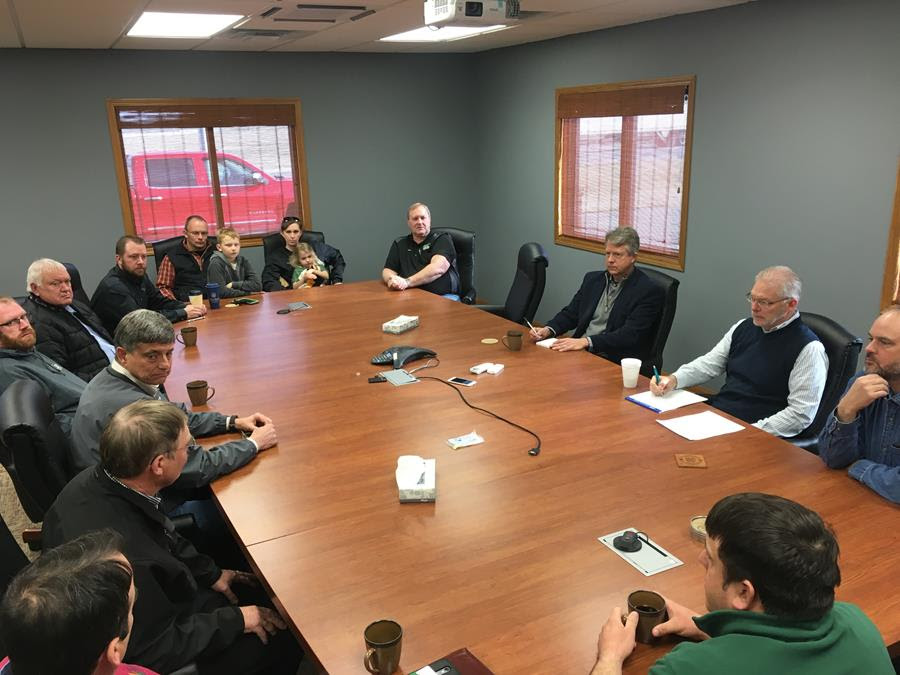
LYONS – On Saturday, First District Congressman Roger Marshall, R-Great Bend, met with ethanol producers and agriculture industry leaders at the Kansas Ethanol LLC facility, Lyons, to discuss the preservation of the Renewable Fuel Standard (RFS) and current Renewable Identification Numbers (RINs) structure. In the discussion, producers made it clear that a cap on RINs would have serious implications on the Big First.

“At the moment we’re at about a 12-year low in farm income,” said first generation Reno County farmer Geoff Burgess. “This coming season we’re just getting started, and it’s already projected to be a 6.7 percent reduction further. It’s gonna hurt demand for corn and drive our prices down even more, and that will be really hard to swallow. There’s a lot at stake here.”

It’s been recently reported that the administration is considering capping the price of RINs. Multiple studies indicate a RINs price cap would reduce ethanol demand by more than 750 million gallons and cost corn farmers as much as 25 cents per bushel.

“Back in 2000, we had roughly 3.4 million acres of corn. Last year we were at 5.3. We have basically gone from a corn importer to a corn exporter just due to the amount of corn that is being produced in our area. With that being said, for us, not having the ethanol plant as an end user in our area would be huge,” Dustin Campbell, from Team Marketing Alliance, said.

Based on current corn prices, a cap on RINs would mean a $4 billion decline in farm income at a time when producers earnings are already struggling to break event. This hit to our Kansas farmers would devastate our communities.

“I’m a fifth-generation farmer – came back to take over the farm when my father died. We’ve grown substantially in size, and a lot of it’s due to the ethanol plant. We’ve got a steady, reliable market that pays at levels we can make profitable on our farm,” said Matt Splitter, who farms in Rice County and sits on the board of the Kansas Association of Corn Growers and Central Prairie Coop.

Ethanol not only benefits Kansas farmers but provides a higher-octane, cleaner-burning fuel alternative for drivers across the country.

“The car makers are saying they want a higher octane fuel, and that’s the value of ethanol because it boosts the octane value of fuel,” said Kansas Ethanol CEO and President Mike Chisam. “We’re willing to work with (the refiners), and I think it’s in the best interest of both industries to work together to figure out a solution to all of this.”

With ten ethanol plants in the state and eight of them in Congressman Marshall’s district, Kansas is in a position to be a top ethanol exporter and leader in renewable fuel production. Tom Willis, CEO of Conestoga Energy, the largest ethanol producer in the state, was unable to attend the meeting but still expressed his concerns from possible RINs cap to the Rep. Marshall.

“This proposal would hit Kansas agriculture hard, lowering corn and sorghum prices when our farmers are already under water,” Willis said.

As members in the administration work to negotiate with oil refiners and ethanol producers, Rep. Marshall made it clear to the producers he met with that he shared their concerns with a RINs cap.

“These discussions between ethanol producers and refiners must lead to a win-win solution that support jobs across our energy industry,” Congressman Marshall said.

HAWVER: Key report on Kan. school funding is this week

Martin Hawver
This is the week that the Legislature gets the $200,000-plus consultant review of just what she believes it ought to cost to operate the state’s 286 public school districts.

Former Kansan and now Texas A&M professor Dr. Lori Taylor is apparently conservative on spending and is dissecting school spending based largely on labor costs and costs for students who require extra services such as instruction in proficiency in the English language, disabilities and other health issues.

That report is aimed two ways—first, of course, to determine just what public K-12 education ought to cost and how much the state should spend to provide equal educational opportunities to all its students, the second to determine whether previous cost studies are still responsible standards for the Kansas Supreme Court to use in deciding whether a new school finance plan provides adequate state money to public education.

The court, recall, has held unconstitutional the current school finance formula law, based largely on past studies that another state consultant says are too old and not a good basis for determining state aid to schools.

These consultants were hired by the Legislative Coordinating Council (LCC), which essentially runs the business of the Legislature and is dominated by the Republican leadership of the House and Senate, most of whom aren’t interested in spending much more money on K-12 education or raising taxes this House election year. The two Democrats on the seven-member council voted against hiring the consultants, preferring instead to just adequately fund a previous school finance plan that had been held constitutional by the court.

Nobody has seen that new cost estimate yet—probably won’t until after dark Thursday with a committee explanation in daylight Friday—but betting is that the LCC’s consultant is going to come up with a spending plan far less than the popularly rumored in the Statehouse estimate of at least $600 million or more in new money for schools.

But part of that contracted-out study shoots holes in the two previous K-12 finance studies on which previous constitutional plans were based, and thereby weakens the arguments based on those plans forwarded by supporters of more spending on public schools.

Hmmm…weaken the arguments of the school districts seeking more money and present a new plan based on fresh statistical information that conservatives hope will sway the Supreme Court’s decision on a new finance plan. That’s one strategy if leaders believe that schools are adequately funded by the state, making new taxes unnecessary this election year.

So, what is that Friday report going to do to the Legislature?

Either give lawmakers who don’t want to spend more of your state tax money on K-12 education a new study to indicate to the court that the state is spending enough, or maybe a dab less than enough, but not a budget-busting amount…or, come up with a new plan that changes the formula by which lawmakers tell the State Department of Education to distribute about half of the state’s general fund to schools.

And, of course, there is still that option merely to take a previous formula which the court has held as constitutional and just fund it. Simple, but likely to require either sharp cuts in state spending on everything else or raising your taxes again, with the slim election-year possibility of increasing local school district property taxes.

Meanwhile, everything that costs any money, either little changes for the current fiscal year or for the upcoming fiscal year, are pretty much on hold.

We ought to know by Friday just what happens, and maybe why.

Syndicated by Hawver News Company LLC of Topeka; Martin Hawver is publisher of Hawver’s Capitol Report—to learn more about this nonpartisan statewide political news service, visit the website at www.hawvernews.com

Submit your nomination for Hays Post’s Teacher of the Month honor!

Hays Post and Eagle Communications seeking nominations for the next Teacher of the Month!

From October through April, Hays Post will solicit nominations from through the area from parents, students and colleagues. Fill out the form below to nominate your favorite educator!

This recognition is made possible by the support of Midwest Energy, Diamond R Jewelry, Top Notch Cleaners, Hickok’s Steakhouse and Ultimate Massage.

The winning teacher will receive a gift certificate, courtesy of Hickok’s Steakhouse! Submissions will be accepted through 5 p.m. Monday.

[contact-form to=”[email protected]” subject=”Teacher of the Month”][contact-field label=”Your name” type=”name” required=”1″][contact-field label=”Your email” type=”email” required=”1″][contact-field label=”Teacher’s name” type=”text” required=”1″][contact-field label=”Teacher’s school and grade” type=”text” required=”1″][contact-field label=”Tell us why you are nominating this teacher” type=”text” required=”1″][/contact-form]

MADORIN: Dot-connecting possibilities

Native Kansan Karen Madorin is a local writer and retired teacher who loves sharing stories about places, people, critters, plants, food, and history of the High Plains.

Those who play connect the dots find the experience relaxing or agitating, depending on the outcome. Some see relationships between one idea and another despite having too little information to clearly link them. To complicate matters, lack of resources can limit time or money investments even though strong interest in a subject exists. I know this sense of tension well, especially after reading recent articles about Clovis Caches found in America.

I suspect few care much about Clovis culture let alone have a burning interest in stashes of stone tools ancient inhabitants concealed and didn’t retrieve. While made of common, not precious, materials, these relics equal buried treasure for those who love archeology and connecting to ancient humans.

The term Clovis Culture came into existence when a sharp-eyed New Mexican noted artifacts formed using a particular bi-faced fluting between Clovis and Portales. Since that discovery, scientists identifying stonework designed with this pattern characterize them as Clovis points. Scholars attribute the style to bison antiquus and mammoth hunters who lived at the end of the Pleistocene era about 13,000 years ago.

The article that started my exploration mentioned the Busse Cache that contained Clovis bifaces made of Niobrara or Smoky Hill Jasper. Anyone who’s walked country roads or plowed fields in Northwest and North Central Kansas has seen this frequently ochre-hued, silicified stone even if they didn’t know what to call it. Researchers have identified prehistoric quarries containing outcroppings of this desirable knapping material in Trego, Gove, and Graham Counties in Kansas and Fremont County Nebraska. That tidbit has me trying to connect points in history based on limited knowledge.

Interestingly, these western Kansas excavations produced desirable knapping material early hunters used for thousands of years. Oklahoma archeologists have found it in sites from east to west. To entice further, prehistoric mammoth and bison bones found during work on roads, bridges, dams, or other such dirt shifting activities occupy shelves and dark corners in regional museums and personal collections.

This combination makes me wonder how many Pleistocene hunters wandered this way in search of game and resources to make dinner-capturing tools. After all, the Great Plains supported modern bison and native cultures who depended on them for survival. This information increases my curiosity about how often their ancestors roasted a mammoth haunch under prairie skies.

Keep in mind state borders are fairly modern concepts so migratory people would’ve wandered from one watershed to another without worrying about taxes, land ownership, or other recent complications. Nearly a decade ago, Dan Busse in Northeastern Colorado worked a field and noted a fingernail-size bit of Smoky Hill jasper that wasn’t native to his area. Upon further investigation, he dug up a hunter’s pack of fluted Clovis-style stones. Among them are several manufactured from Niobrara or Smoky Hill jasper, commonly found in western Kansas and Nebraska.

Add to this data information about KU professor Rolfe Mandel’s 2014 dig near Tuttle Creek. His team specifically searched for evidence of Clovis and pre-Clovis inhabitants in what is now Kansas. Their efforts are in the hands of lab analysts who work to verify their findings.

Though few Clovis Cache finds are documented in the U.S., such articles offer hope that any day now a Kansan could be turning over soil and make a discovery like a landscaper in Boulder, CO. He recently found a stash of 80 artifacts used to butcher prehistoric camels and horses in his yard.

Though I doubt I’ll find such treasure, the combination of connecting dots leads me to expect I’ll soon read about the person who does.

Native Kansan Karen Madorin is a local writer and retired teacher who loves sharing stories about places, people, critters, plants, food, and history of the High Plains.

SCHLAGECK: Terribly dry

John Schlageck writes for the Kansas Farm Bureau.

Unless something changes in the moisture situation, Barb Downey and husband, Joe Carpenter will not burn their grassland in the Flint Hills this season. The ranch couple report no (moisture) run-off event in more than a year on their native grassland in Riley and Wabaunsee counties.

Every spring across the vast, open Flint Hills grasslands, fires blaze for miles. The flames lick at the blue Kansas sky as the brown, dry grass crinkles, crackles and bursts into orange.

Cattlemen like this east-central Kansas couple understand that controlled burning remains a range management tool that helps maintain the economic viability of the Flint Hills. Fire remains an essential element of the ecosystem.

Long before civilization came to the prairie, fires were ignited by lightning storms and the charred prairie restored the health of the native grasses. Native Americans set the first prairie fires. They used the fire to attract bison for easier hunting.

Controlled burning by those who live on the tall-grass prairie of the Flint Hills is an annual event designed to mimic nature’s match. It’s part of a tradition – part of the culture of the communities and the people who inhabit this region of our state.

This annual pasture burning only occurs for a few days each year. It is not a procedure that is drawn out and lasts for weeks. Weather conditions dictate the length of the burning seasons most years.

Not every cattleman burns his pastures every year. Instead, individual ranchers and landowners survey and decide each spring, which pastures will benefit and produce a healthier, lush grass for livestock after burning. Often neighbors plan and burn together, giving them more hands to ensure a safe, controlled burn.

Because of continued dry conditions, Downey and Carpenter fear they would not be able to control the burn this season.

“It’s so dry and the winds blow nearly every day,” Barb says. “At the ground level, there’s no humidity in the thatch in our native grasses.”

Downey believes her Flint Hills region remains in an extended drought. She’s not counting on moisture any time soon unless this weather pattern turns around drastically – and right away.

For weeks the ranchers have watched forecasts the serve up the possibility of rain in the seven to 10-day forecasts. By the time that period passes, there’s nothing. No moisture for the bone-dry Flint Hills.

“The overriding reason we will not burn our grasslands this spring is because we’re going to need every little bit of forage we can get our hands on,” Barb explains.

“We don’t care if it’s last year’s grass. At this point we need forage of any kind for our livestock.”

Downey is the fourth generation in the ranching business. Her daughter represents the fifth. Decades of experience have provided this cattle family with the know-how and knowledge to plan for their cattle enterprise.

The current drought conditions began on their Riley and Wabaunsee county ranch back in 2005. Except for a couple of years of adequate moisture, drought has been a way of life for more than a decade.

“Twenty twelve marked the peak of this extended drought here in the Flint Hills,” Barb says. “Right now, we’re already worse this year than in 2012.”

Continued dry conditions indicate burning this March or April would ensure little, if any, pasture regrowth. Downey and Carpenter are already operating in “drought-crisis mode.” Irrigated land that would ordinarily soon be planted to corn will be planted to forage this spring.

“We’re beyond the idea of burning,” Barb says. “Conditions today remain too dry. We’re not even receiving what I call ‘band-aid’ rains or brief showers, to help us along.”

Some of the older cows will be culled earlier this year on the Downey and Carpenter ranch. They continue to look at options to lighten the feed load for their herd.

“We’re planning for the worst, and hoping for better times ahead,” Barb says. “Without continued moisture and soon – we’re headed for trouble.”

John Schlageck, a Hoxie native, is a leading commentator on agriculture and rural Kansas.

Copyright Eagle Radio | FCC Public Files | EEO Public File