We have a brand new updated website! Click here to check it out!

Election hacking puts focus on paperless voting machines in Kansas

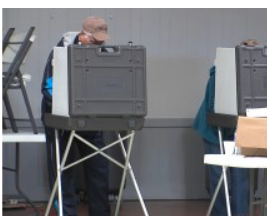
ATLANTA (AP) — As the midterm congressional primaries heat up amid fears of Russian hacking, an estimated 1 in 5 Americans will be casting their ballots on machines that do not produce a paper record of their votes.

That worries voting and cybersecurity experts, who say the lack of a hard copy makes it difficult to double-check the results for signs of manipulation.

“In the current system, after the election, if people worry it has been hacked, the best officials can do is say ‘Trust us,'” said Alex Halderman, a voting machine expert who is director of the University of Michigan’s Center for Computer Security and Society.

Georgia, which holds its primary on Tuesday, and four other states — Delaware, Louisiana, New Jersey and South Carolina — exclusively use touchscreen machines that provide no paper records that allow voters to confirm their choices.

Such machines are also used in more than 300 counties in eight other states: Kansas, Arkansas, Indiana, Kentucky, Mississippi, Pennsylvania, Tennessee and Texas, according to Verified Voting, a nonprofit group focused on ensuring the accuracy of elections.

In all, about 20 percent of registered voters nationwide use machines that produce no paper record.

Many election officials in states and counties that rely on those machines say they support upgrading them but also contend they are accurate. In many jurisdictions, the multimillion-dollar cost is a hurdle.

The focus comes as states gear up for the first nationwide elections since Russian hackers targeted 21 states ahead of the 2016 presidential contest. U.S. intelligence agencies have said that there is no evidence any vote tallies were manipulated but that Russians and others are intent on interfering in American elections again.

Last week, the Senate Intelligence Committee issued a report that recommended replacing machines that don’t produce a paper record of the vote.

Some states already have taken that step or are doing so.

Virginia last year banned paperless touchscreen machines two months before the state’s gubernatorial election. This year, Kentucky ordered that all new machines produce a paper trail.

Congress has allocated $380 million to help states with election security upgrades, but that is just a fraction of what would be needed to replace all paperless machines.

Louisiana is soliciting bids to replace the state’s nearly 10,000 such machines ahead of the 2020 election, though all the money has yet to be allocated. Funding also is an issue in Pennsylvania, where Democratic Gov. Tom Wolf has ordered that counties planning to replace their electronic voting systems buy machines that leave a paper trail.

“It’s important because everybody needs to have confidence in the voting process,” Wolf said. “And given what is alleged to have happened in 2016, I think there’s some concern that maybe people aren’t as confident as they should be.”

The rest of the country uses either paper ballots that are filled out by hand and then read by an optical scanner, or a touchscreen machine that prints out a ballot so voters can verify their selections before inserting it into another machine to record their votes.

Since 2016, 46 Texas counties have upgraded their electronic machines, according to the secretary of state’s office. Of those, only 11 went to systems with a paper trail.

San Jacinto County north of Houston is among those that continued with a paperless system when it bought new touchscreen machines. County election administrator Vicki Shelly said that voters have not raised concerns and that she is confident in the new equipment.

“There’s a lot of checks and balances,” she said.

In Georgia, the cost to switch to paper-based machines in the state’s 159 counties ranges from $25 million to more than $100 million, depending on the technology adopted. The state is eligible to receive a little over $10 million from the federal government.

Georgia Secretary of State Brian Kemp has said extensive security measures and cyber defense upgrades make the state’s current system reliable. Those measures include outside security monitoring, regular checks for system vulnerabilities and a backup of voter data that is stored in a secure location.

Amanda Strudwick, a 43-year-old nurse from Decatur, said she has to take Georgia election officials at their word.

“If somebody wants to screw it up, they can do it,” she said at an early voting center in metro Atlanta. “That does not mean opting out of voting. Too many people have fought throughout history for my right to vote.”

Concerns over Georgia’s voting machines have been prominent in the race for the state’s next election chief, with both Democratic and Republican candidates saying the equipment should be replaced.

GOP candidate Josh McKoon released a campaign video showing him taking a baseball bat to a voting machine. During a recent debate, he said close elections such as the 2017 Atlanta mayor’s race require a recount that involves paper records, not just running the tallies on the voting machines a second time.

“Having the paper ballot that can be read and verified for the voter is essential,” he said.
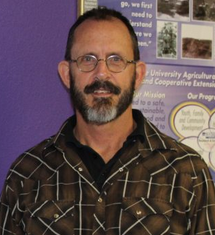
WINKEL: Growing your veggies in straw

Rip Winkel

Over the last couple of weeks, I have heard “straw bale gardening” being mentioned several times. So when I saw this article come out this week from KSU (Manhattan) I thought I would pass it on as I am sure this will be of interest to many of you.

Straw Bale Gardening
There has been growing interest in straw bale gardening.  What better place to try this than in Kansas where straw is so abundant.  First, some pointers.
∙    The bales mentioned here are referring to the “small” straw bales that are about 2 feet

high and 3 feet long.
∙    Place the bale on edge so the twine doesn’t rot. (On the small bales, there are usually two

strands of twine that keep the bale together running length-wise. Place the bale so that

you can see the twine on the side, horizontally.)

    ∙    Bales can be placed anywhere including concrete or asphalt.  Just make sure there is

plenty of sun and watering is convenient.

Bale Conditioning
∙    Water the bales and keep them wet for 3 days.  The bale will start to heat up as it breaks

down.
∙    On days 4, 5 and 6, sprinkle fertilizer on the top of each bale with 1 cup of ammonium

sulfate (21-0-0) or ½ cup of urea (46-0-0).  Water the fertilizer in.  This speeds the

decomposition process.
∙    On days 7, 8 and 9, continue to sprinkle fertilizer on each bale but cut the amount in half.
∙    Stop fertilizing on day 10 but keep the bale moist.
∙    Check for heat on the top of each bale for each day after day 10.  When the temperature

drops to below 100, the bale can be planted.

Planting
    ∙    Pocket Method: Make a hole for each plant several inches deep and fill with growing

medium.
∙    Flat Bed Method: Cover the top of the bale with 3 to 4 inches of growing medium.
∙    The growing medium can be well-aged manure, compost or potting soil.

Number of Plants per Bale
∙    Cantaloupe:        2
∙    Cucumber:         3-4
∙    Peppers:        3-5
∙    Squash (winter)    2
∙    Squash (summer)    2-3
∙    Tomatoes        2-3


Watering
Watering will be the most challenging aspect of management.  The straw will dry quickly.  A drip irrigation system on a timer can work well but may take some time to set up.  Gardeners may also use soda bottles or milk jugs to water by poking drip holes in the lid, filling with water and then turning upside down next to the target plant.
This information was taken from an excellent publication from Washington State University that includes much more detail as well as images.  See https://cru.cahe.wsu.edu/CEPublications/FS109E/FS109E.pdf

Try it, and have some fun!

Rip Winkel is the Horticulture agent in the Cottonwood District (Barton and Ellis Counties) for K-State Research and Extension. You can contact him by e-mail at [email protected] or calling either 785-682-9430, or 620-793-1910.

Hays BOE to take up school fees, talk accreditation Monday

By CRISTINA JANNEY
Hays Post

After dropping student fees by $45 last year, Hays school officials are recommending to keep them the same for the 2018-19 school year.

The workbook/material fees dropped from $135 per student per year to $90 this school year after the district received an influx of funding from the state.

Shanna Dinkel, assistant superintendent is set to review the district’s first accreditation report to the Kansas Department of Education under its new accreditation system. The system looks at education aspects such as civic engagement, student’s social and emotional growth and post-secondary education or employment after graduation.

The board will continue to discuss long-range facilities planning. At its last meeting, the board decided to issue a survey to the community that addressed the district’s last bond attempt in November 2017, which failed.

The district will take up multiple housekeeping issues, including a property insurance contract, worker’s compensation contract, copier lease bids, renewal of the Kansas Association of School Boards membership, board meeting calendar and school calendar.

The proposed 2018-19 school calendar has school starting Aug. 15 and releasing on May 17. The proposal adds Jan. 7 as a student day instead of a teacher contract day.

In Case You Missed It: Eagle Morning Show 5/14-5/18

It was another busy week on the KAYS Eagle Morning Show. Here’s what you missed!

Monday

Cortney Dale – Bob Schwarz Financial

Cortney came by the show to remind of the Medicare educational seminar that would take place on Tuesday, May 16th.

Catholic Schools Report – TMP Principal Chad Meitner

Mr. Meitner stopped by the show to talk about TMP graduation and some other things.


Tuesday

County Commission Report: County Administrator Phillip Smith-Hanes, County Commissioner Barb Wasinger join Eagle Radio News Director Jonathan Zweygardt to recap the commission meeting


Wednesday

Protect & Serve: Fort Hays State Police Department Lt. Cliff Denny

Hays Arts Council Executive Director Brenda Meder


Thursday

Fort Hays State University Associate Professor and registered/licensed dietitian Glen McNeil


Friday

Downtown Hays Development Corporation Executive Director Sara Bloom 


Here’s what’s coming up next week on the Eagle Morning Show:

  • Sternberg Museum Outreach Coordinator Ian Trevethan
  • USD 489 Superintendent John Thissen
  • Cottonwood Extension District Ag Agent Stacy Campbell

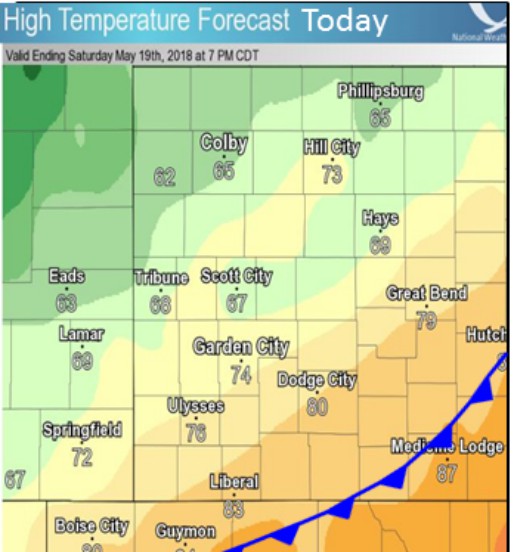
Partly sunny, cooler Saturday, chance of rain


Today
A 20 percent chance of showers and thunderstorms. Partly sunny, with a high near 69. Southeast wind 6 to 14 mph becoming north northwest in the afternoon.

Tonight
A 20 percent chance of showers and thunderstorms. Mostly cloudy, with a low around 51. North northwest wind 13 to 16 mph.

Sunday
Partly sunny, with a high near 68. North northwest wind 9 to 13 mph.

Sunday Night
Partly cloudy, with a low around 50. North northeast wind 5 to 8 mph.

Monday
Mostly sunny, with a high near 80. South southeast wind 5 to 13 mph.

Monday Night
Partly cloudy, with a low around 62.

Tuesday
Mostly sunny, with a high near 84.

Tuesday Night
A 20 percent chance of showers and thunderstorms after 1am. Mostly cloudy, with a low around 64.

Wednesday
A 20 percent chance of showers and thunderstorms. Mostly sunny, with a high near 87.

Kansas Child Welfare Agency Sees Administrative Turnover As Hope For Turnaround

Some 20 administrators in the Kansas agency managing child welfare and state assistance have been promoted, fired or shifted to other posts since November.

DCF Secretary Gina Meier-Hummel addresses staff and community members at the agency’s regional office in Leavenworth. The secretary and her staff have visited 18 of the 36 DCF offices so far as the agency undergoes a top-to-bottom review.
MADELINE FOX / KANSAS NEWS SERVICE

Gina Meier-Hummel was tapped to take over the Department for Children and Families nearly six months ago and says now that the changes have been aimed at strengthening the agency as it confronts a rising caseload of children in care.

The agency also dismissed two staff members in the Wichita regional office earlier this spring in response to “concerning trends” in the region.

Several children have died in the Wichita region in recent years after DCF was alerted to their cases. They included: Evan Brewer, whose body was found encased in concrete in 2017; Conner Hawes, who drowned in a fish pond in his foster parents’ backyard the same year; and Anthony Bunn, who died earlier this month from injuries believed to be the result of abuse.

Meier-Hummel announced plans for a top-to-bottom review when she took over the office. Some of that is being done from outside the agency. The Annie E. Casey foundation is auditing how cases are first identified by the child welfare system.

But the secretary has also been hitting the road to see things for herself. She and her staff have taken questions and concerns at 18 of DCF’s 36 regional offices.

Meier-Hummel said staffing changes come both from a desire to reshape the overwhelmed agency and from concerns about some staff members’ actions.

“Part of it is wanting to make sure we have the right people in the right position and doing the right work,” she said. “But … as we’ve looked at other things, we’ve made changes because we do have concern or we’re worried about somebody not being ethical or somebody not being proactive enough.”

Some shifts have come from what her team has learned in local office visits, she said. The agency has also surveyed DCF employees and noted comments sent to her through an anonymous tip system. And administrative teams have reviewed each region by talking to staff and going through cases and staffing patterns.

In the meantime, the agency grapples with a staffing shortage. Last month, DCF announced it was opening up investigative child protection positions to people without a social work license. Meier-Hummel said at that time that a third of child protection positions were vacant, and some had been for more than a year.

But the secretary said she’s not letting concerns about vacancies stop her from removing staffers.

“If we think they can be coached up and supported to a level that we expect, then we’ll work with them to do that,” Meier-Hummel said. “If not, we’re not going to shy away from letting them go. We can’t be hampered by the workforce.”

DCF is also exploring new ways to be more nimble with its existing staff.

Kansas City regional director Tammy Thomas said they plan to use recently approved budget increases to pay for 12 new staff positions in the area. Some will form a “float” team that can travel from county to county based on the area’s needs.

For example, if Atchison County needs more staff to deal with a spike in welfare applicants, the team could set up there to help and later move on to Leavenworth or Wyandotte counties to handle child welfare cases.

The structure of DCF’s regional offices, though, will stay largely the same, Meier-Hummel said. She said she doesn’t plan to close any DCF offices, or open any new ones.

Madeline Fox is a reporter for the Kansas News Service. You can reach her on Twitter @maddycfox.

New interim president named for Kansans For Life

Mary Wilkinson

By ALAN WELDON
Kansans for Life Chairman of the Board

WICHITA – Kansans for Life announces that Mary Wilkinson, KFL Vice President, has succeeded Joe Patton, KFL President, as Interim President of Kansans for Life. The Executive Board is thankful to Joe Patton for his service to KFL.

Wilkinson has been involved in the pro-life movement for 30 years, getting her feet wet during the “Summer of Mercy” in Wichita, and serving as President of Kansans for Life Wichita affiliate. She also serves on the KFL Political Action Committee, both statewide and locally in Wichita.

Patton is one of the founders of Kansans for Life and has served as volunteer president of Kansans for Life for the past year and a half. Patton will continue as a volunteer to organize a coalition to lead the statewide effort to pass a constitutional amendment to ensure the people’s right, through their legislators, to continue to pass pro-life laws in Kansas.

Patton stated, “I have enjoyed working with KFL and am honored to have served the pro-life community as President during this time of transition with the passing of a great pro-life leader, David Gittrich. I will cherish many memories from the past year and a half. The organization will have continued success under the capable direction of its new President, Mary Wilkinson. Mary has my full support and I am confident under her leadership Kansans for Life will be in good hands. I am more passionate today than I have ever been about the pro-life cause. I will continue to be involved in the pro-life movement because we have all been called to secure the foundation of all human rights, the right to life.”

Wilkinson said, “It is my honor and privilege to serve as Interim President of Kansans for Life, an organization that I have worked with for three decades. There is no more important work today than saving the lives of the weak, the helpless, the vulnerable, created in God’s image. KFL stands ready to continue to educate, to elect pro-life leaders, and to pass laws that save lives. I look forward to serving KFL and working together with all pro-life Kansans in this important election year.”

MORAN: Import taxes on uncoated groundwood paper will hurt U.S. newspapers, publishers

OFFICE OF SEN. MORAN

WASHINGTON – U.S. Senator Jerry Moran (R-Kan.) this week joined a bipartisan group of colleagues in introducing the Protecting Rational Incentives in Newsprint Trade Act of 2018 (PRINT Act). This legislation, which has been endorsed by printers and publishers including the Kansas Press Association, representing more than 600,000 American jobs, would suspend import taxes on uncoated groundwood paper while the Department of Commerce examines the health of – and the effects on – the printing and publishing industry.

“A local newspaper is important to every community in Kansas, yet every Kansas newspaper is facing significant challenges to stay in business,” said Sen. Moran. “Increasing tariffs on newsprint means that printing a newspaper becomes more expensive, resulting in less local news, weather and sports reaching mailboxes and front porches in Kansas. I will continue working with my colleagues to encourage the Department of Commerce to consider these consequences before moving forward with implementing these tariffs.”

“Publishers already face economic headwinds due to the migration of advertising from print to digital,” said President & CEO of News Media Alliance David Chavern. “We simply cannot absorb extra costs from import taxes. Newspapers will close or be forced to raise prices for readers and advertisers. We are already seeing some papers cut back on news distribution and cut jobs. These tariffs are killing jobs and high-quality news in local communities. We are grateful that Senator King, Senator Collins and the original co-sponsors of the bill showed leadership and stepped up to protect small publishers in local communities across America.”

The Department of Commerce initiated antidumping and countervailing duty investigations in late 2017 into the Canadian uncoated groundwood paper industry on behalf of a single domestic paper mill – this paper is used by newspapers, book publishers and numerous other commercial printers in the United States. The import taxes are as high as 32 percent on some products, and that cost is passed on to printers, book publishers and newspapers that are already under severe economic stress.

Nearly all of the U.S. paper industry opposes these import taxes, including the large trade association representing the industry, the American Forest and Paper Association, because the Department of Commerce’s action threatens to decimate the paper industry’s customers and injure printers and publishers.

The PRINT Act is also sponsored by Senators Susan Collins (R-Maine), Angus King (I-Maine), Roy Blunt (R-Mo.), Doug Jones (D-Ala.), Deb Fischer (R-Neb.), Claire McCaskill (D-Mo.), Roger Wicker (R-Miss.), Johnny Isakson (R-Ga.) and Shelley Moore Capito (R-W.Va.).

Specifically, the PRINT Act would:

  • Require a study by the Department of Commerce of the economic wellbeing, health and vitality of the newsprint industry and the local newspaper publishing industry in the United States;
  • Require a report from the Commerce Secretary to the president and Congress within 90 days that includes both the findings of the study and any recommendations the secretary considers appropriate;
  • Stay the effect of proceedings of the Department of Commerce and the International Trade Commission in regards to uncoated groundwood paper until the president certifies that he has received the report and that he has concluded that such a determination is in the economic interest of the United States; and
  • Halt the collection of deposits for uncoated groundwood until the president has made such certifications.

Click here for full text of the PRINT Act.

Man sentenced for role in Kan. man’s torture, killing

WICHITA, Kan. (AP) — A man who participated in the torture and killing of a Wichita man over a $185 meth deal has been sentenced to 73 years in prison.

Morris-photo Sedgwick Co.

57-year-old Willie Morris was sentenced Friday for first-degree murder and several other charges in the November 2016 death of 33-year-old Scottie Goodpaster Jr.

Morris was one of five people charged in Goodpaster’s death.

Goodpaster’s mutilated body was found in a Harvey County field. A court affidavit indicated Goodpaster was tortured and a woman was forced to watch.

The document indicates the violence stemmed from money lost in a methamphetamine deal.

The four other defendants remain in the Sedgwick County Jail.

KU student convicted of hacking computer to change grades

LAWRENCE, Kan. (AP) — A former University of Kansas student has been convicted of four felonies after he hacked into the university’s computer system to change his grades.

Twenty-year-old Varun Sarja of Olathe pleaded guilty Thursday to two counts of identity theft and two counts of unlawful computer acts. Fourteen other charges were dropped.

Sarja used a keystroke logger to steal professors’ passwords to get into the computer system.

Douglas County District Court Judge Kay Huff says Sarja will likely receive probation because he has no prior criminal history.

Sarja will be required to allow law enforcement to verify that his electronics no longer contain the keystroke logger program.

Sarja was a freshman studying engineering during the 2016-17 school year when he successfully changed F grades to As.

Jets sign FHSU’s Nathan Shepherd to 4-year deal

FLORHAM PARK, N.J. (AP) — The New York Jets have signed defensive lineman Nathan Shepherd, the team’s third-round draft pick out of Fort Hays State , to a four-year deal worth the slotted amount of $3.4 million.

The 6-foot-4, 315-pound native of Ontario, Canada, was the first Division II player selected in this year’s draft.

Shepherd began his college career at Simon Fraser University in British Columbia in 2011 and became a starter after redshirting his freshman season. He then left school for financial reasons and worked various jobs for the next two years before walking on to Fort Hays State’s team in Kansas.

He was the Mid-America Intercollegiate Athletics Association defensive player of the year as a senior and finished his three-year career at Fort Hays with 168 tackles, including 27 for loss, and 10 sacks.

The announcement Friday leaves the Jets with just two unsigned draft picks: quarterback Sam Darnold, the No. 3 overall selection; and tight end Chris Herndon, a fourth-rounder.

Photo courtesy FHSU University Relations

HPD Activity Log May 17

The Hays Police Department responded to 10 animal calls and conducted 11 traffic stops Thu., May 17, 2018, according to the HPD Activity Log.

MV Accident-Private Property-Hit and Run–400 block W 6th St, Hays; 1:45 AM
Lost Animals ONLY–2700 block Thunderbird Cir, Hays; 6:06 AM
Open Door/Window–400 block Main St, Hays; 7:53 AM
MV Accident-City Street/Alley–200 block W 27th, Hays; 8:49 AM
MV Accident-Co Road/St Hwy–3700 block Vine St, Hays; 8:58 AM
Suspicious letter/package–2000 block MacArthur Rd, Hays; 4/13
Abandoned Vehicle–400 block W 11th St, Hays; 9:40 AM
Juvenile Complaint–1700 block Western Plains Dr, Hays; 5/16 9 PM; 5/17 11 AM
Bicycle – Lost,Found,Stolen–300 block E 16th St, Hays; 11:30 AM
Juvenile Complaint–2000 block  E 21st St, Hays; 5/16 9 PM; 5/17 11 AM
Animal At Large–2200 block Downing Ave, Hays; 11:50 AM
Warrant Service (Fail to Appear)–2500 block  Vine St, Hays; 1:25 PM
Juvenile Complaint–3700 block Hillcrest Dr, Hays; 2:43 PM
Burglary/residence–1600 block E 28th St, Hays; 3:34 PM
MV Accident-City Street/Alley–Hays; 4:08 PM
Lost Animals ONLY–600 block E 6th St, Hays; 4:56 PM
Runaway Juvenile–1500 block US 183 Alt Hwy, Hays; 4:56 PM
Civil Dispute–100 block W 4th St, Hays; 5:11 PM
Disorderly Conduct–300 block W 8th St, Hays; 9:23 PM
Bicycle – Lost,Found,Stolen–1900 block Lincoln Dr, Hays; 10:22 PM

Copyright Eagle Radio | FCC Public Files | EEO Public File