We have a brand new updated website! Click here to check it out!

BOWERS: Senate Scene 2018 Wrap-up

36th Dist. Sen. Elaine Bowers (R-Concordia)

Legislature Adjourns Sine Die on May 4th

On May 4th, the Senate wrapped up the end of Veto Session on the 90thday and adjourned the 2018 Legislative Session.  The last 90-days session was in 2011.  The House has sent 66 bills to the Governor and the Senate has sent 52 bills for a total of 118 bills for the 2018 Legislature. At present, 40 Senate bills have been approved by the Governor, two are on his desk, and 10 await his signature. In the House, 56 bills have been approved by the Governor and 10 await his signature. There were a total of 208 Senate bills introduced in 2018, with an additional 199 Senate bills carried over from the 2017 Session. The 2019 Legislative will convene January 14, 2019 at 2:00PM.

Revenue Update – Department of Revenue

  • Total FY 2018 revenue receipts are 20 percent, or more than $1 billion higher than last year
  • Tax receipts for April are $293.1 million above April 2017, with individual income tax accounting for $239.2 million of that total. Sales tax receipts for the month are $202.9 million, or $10.7 million above last April
  • April tax receipts came in 7.6 percent or $66.1 million above newly revised consensus revenue estimates, for a total of $932.2 million in tax collections during the month

Session End – Floor activity

The last two weeks of session were spent working conference committee reports and concur and non-concur votes in the Senate chambers.  Nearly 50 reports were heard and reported out.

Tax Bill – 

S Sub HB 2228– Senate Substitute for House Bill 2228 was the mega tax bill put together by the Senate and House Tax conference committee and would’ve made changes to income, sales, and motor fuel tax provisions.  The bill passed in the Senate and failed in the House. The bill would’ve removed a restriction under current law preventing Kansas taxpayers from itemizing deductions for state income tax purposes unless they also itemize deductions for federal income tax purposes (de-coupling) and accelerate the restoration of certain federal itemized deductions for state income tax purposes provided by income tax reform enacted in 2017.  It would’ve also allowed for itemized deductions for medical expenses, mortgage interest, and property taxes paid equivalent to 75 percent of the federal allowable amount in tax year 2018 and 100 percent in tax year 2019.  It included nonrefundable income tax credits contributed to the Eisenhower Foundation.  

Final Budget 

H Sub SB 109– House Substitute for Senate Bill 109, was approved and will appropriate $380 million more in the current fiscal year, $700 million more than was expended in the previous fiscal year. The legislation includes a 5 percent raise for employees who were not included in the 2017 pay adjustment law and a 2.5 percent raise for employees who received a pay increase last year. The budget also includes a 5 percent adjustment for correctional staff and a 2 percent raise for judges. The bill excludes state university staff, Kansas Highway Patrol, Kansas Bureau of Investigation, and the Kansas Legislature. House Sub. for SB 109 also includes $15 million to replace funds cut from state universities, and other priorities that have been neglected such as water projects and state hospitals.  

FY 2018– The Conference Committee recommends expenditures of $16.3 billion, including $6.7 billion from the State General Fund.  It will add $31.1 million, including $40.5 million from the State General Fund, to fund the spring human services consensus caseload estimate. There will be an additional $3 million for the Medicaid regular medical program for the teaching hospitals associated with the Wichita Center for Graduate Medical Education program.  It will add $1 million for the tiny-k program, $1.4 million for information technology modernization and $1 million from the Problem Gambling and Addictions Grant Fund for additional substance abuse treatment services.

FY 2019- The Conference Committee Recommends expenditures of $16.8 billion, including $7 billion from the State General Fund.  It will add $68.6 million, including $76.9 million from the State General Fund to fund human services consensus caseload estimate.  It will restore approximately 64 percent of the 4 percent remaining FY 2017 allotment at $15 million, add $7 million, including $8.4 million from the State General Fund to adopt the spring 2018 education consensus estimate for the Department of Education.  It will also add $5.2 million from the Children’s Initiatives Fund for early childhood programs. This includes Pre-K Pilot ($4.2 million) and Parents as Teachers ($1 million). H Sub for SB109 will add $1.4 million for disaster relief, $2.7 million for information technology modernization, $22.1 million for an increase in nursing facility reimbursement rates, $1 million from the Problem Gambling and Addictions Grant Fund for additional substance abuse treatment services, $5.5 million, including $3.3 million from the State General Fund to increase payments for foster care kinship placements from an average of $3 per day to an average of $10 per day.  It will also add $27.7 million to provide salary adjustments equivalent to two steps on the Statewide Pay Matrix for employees who did not receive a salary adjustment as part of the 2017 Salary Initiatives, one step for employees who did receive a salary adjustment, two steps for uniformed corrections officers, two steps for non-judge employees with the Kansas Judicial Branch, and a 2 percent salary adjustment for judges and justices.  The Department of Administration budget includes $300,000 for the demolition of the grain mill elevator in Clyde in the 2018 budget and the Department of Education budget includes funding for a juvenile transitional crisis center pilot program at the Beloit Special Education Cooperative for 2019.  H Sub for SB 109 will now go to Governor Colyer’s desk.

S Sub HB 2028– Senate Substitute for House Bill 2028 would establish the Kansas Telemedicine Act. The bill also provides for coverage of speech-language pathologist and audiologist services via telehealth under the Kansas Medical Assistance Program (KMAP), if such services would be covered under KMAP when delivered via in-person contact. This is an important bill for Kansas especially rural Kansas for both providers, hospitals and patients.

HB 2642-House Bill 2642 would maintain an exemption for attributions on certain social media providers (Twitter characters), remove the requirement to include the name of the chairperson or treasurer of a political or other organization in an attribution, establish new penalties for late-filed candidates’ campaign finance report, address lobbyists’ reporting format and penalties, and require the Office of the Secretary of State to publish precinct level primary and general election results for certain races.

H Sub SB 336– House Substitute for Senate Bill 336 amends statute in the revised Kansas Code for Care of Children governing access to information concerning a child alleged or adjudicated to be in need of care and child fatalities. It requires the Kansas Department of Children and Families (DCF) to release within seven days information about abuse or neglect of a child who has died. The information released would include a summary of previous reports of abuse or neglect of the child, as well as DCF recommendations. Under H Sub SB 336, law enforcement agencies would be required to release video after a shooting death within 20 days of a request being made by an heir of the person who died. 

HB 2539 – House Bill 2539 would require every candidate for the office of Governor, Lieutenant Governor, Secretary of State, Attorney General, State Treasurer, or State Commissioner of Insurance to be a qualified elector of Kansas by the deadline for filing. The bill would also require the candidate to be at least 25 years or older. It would also require a candidate for Attorney General to be licensed to practice law in Kansas. It also allows State verification of the voter’s signature by the county election official on an application for an advance ballot not be required if the voter has a disability preventing the voter from signing.

HB 2579– House Bill 2579 creates and amends law regarding compensation for wrongful conviction and imprisonment. A claimant entitled to damages would receive $65,000 for each year of imprisonment, as well as no less than $25,000 for each additional year served on parole or post-release supervision.

H Sub for SB391– House Substitute for Senate Bill 391 would establish the Joint Legislative Transportation Vision Task Force. It will consist of forty-four members including members of the legislature and private industry.  The committee will report back to the legislature in 2019 with evaluations on the 2010 Transportation Works Program, current conditions of roads and bridges, funding and future projects.   

SB 217– Senate Bill 217 would update several statutory references in accordance with enacted 2016 SB 449 and Executive Reorganization Order No. 41. The bill would replace the term “mentally retarded and other handicapped persons” in statutes with “individuals with intellectual or other disabilities” in accordance with current law.

SB 307– Senate Bill 307 would make amendments to the Kansas Amusement Ride Act. It defines Limited-use amusement ride as an amusement ride that is owned and operated by a nonprofit, community-based organization and is operated for less than 20 days a year, at only one location each year. An “Amusement ride” would specifically exclude: antique amusement rides, limited-use amusement rides, registered agri-tourism activities, any ride commonly known as a hayrack ride, or a ride commonly known as a barrel train and Amusement rides owned by an individual and operated solely within a single county for strictly private use. It also defines water slide as a slide that is at least 30 feet in height and uses water to propel the patron through the ride. The bill would require an attendant to be stationed at each water slide 15 or more feet in height – water slides under 30 feet in height would not be subject to the requirements of the Amusement Ride Act. However, all slides 15 feet or more in height would still be required to have an attendant stationed at the slide while in operation.

SB 331– Senate Bill 331 would add to the list of designated state parks the Flint Hills Trail State Park located in Miami, Franklin, Osage, Lyon, Morris, and Dickinson counties, and Little Jerusalem Badlands State Park located in Logan County. SB 331 would also establish the Flint Hills Advisory Council, which would study and assess the development, staffing, maintenance, and promotion of the Flint Hills Nature Trail.  

Law Enforcement Memorial and Valor Awards

The Annual Law Enforcement Memorial was held at the Statehouse on May 4th on the Capitol grounds. No Kansas law enforcement officers lost their lives in the line of duty over the past year, but four officers from previous years were inducted into the memorial. National Law Enforcement Memorial Week is May 13-19.

The Kansas Association of Chiefs of Police held their Annual Valor Awards ceremony in Wichita on May 9th. Fifty-six men and women serving with sheriff departments, city police departments and the Kansas Highway Patrol across Kansas were recognized for their actions of bravery and heroic efforts in 2017.  Kade Odell from the Republic County Sheriff’s office, William Schwindamann, Leslie Jeter, Roberta Price with the Marshall County Emergency Management office, Police Chief Todd R. Ackerman, Todd D.R. Packett, James M. Leis and Timothy N. Anderson of the Marysville Police Department were all recognized with the Bronze, Silver and Gold awards from Senate District #36.   

Norton County Honor Hunt – Disabled Veterans

The Norton County Honor Hunt organization is accepting applications for the December 7th-10th, 2018 event.  The three-day event held every December is in conjunction with the start of deer season in Kansas.  The organization selects veterans who are at least 30% disabled and reside in the state of Kansas.The trip is an all-expense paid rifle or muzzleloader deer hunt throughout Norton County.  There is no requirement on previous hunting experience and this isn’t a “trophy hunt” but a way to show respect and hospitality to our men and women who protect our country.The hunt includes all meals from Wednesday evening to Friday evening, hotel, deer processing and packaging, hunting license and deer permit and gun and ammunition (if needed). For additional information, contact Tara Vance, Executive Director of the Norton County Community Foundation at 785-874-5106 or 785-874-8115.  Their website is:  www.nortoncountyhonorhunt.com

Governor’s Office of Appointments

The Office of Appointments assists the Governor with the appointment of over 1,000 individuals to serve on Kansas’ boards and commissions. All qualified and service-minded Kansans are encouraged to participate in our state’s government by offering to serve on a board or commission or by recommending qualified candidates.  Additional information can be found at https://governor.ks.gov/serving-kansans/office-of-appointments.  If you are interested in the opportunity to serve or would like to nominate someone, please call the office at 785 368-7097 or email to [email protected].

From the State Library

Summer Reading – Libraries Rock!  

Traditionally, summer reading programs in libraries are designed to encourage elementary-aged children to keep reading during summer vacation. Increasingly, teens and adults are included in these programs as well. This year’s theme, Build a Better World encourages children and families to read for pleasure through activities and programs centered around building, construction, and community. Starting June 2, the State Library of Kansas will post a new kids’ digital book of the week every Friday morning on our Summer Reading page https://kslib.info/srp.   Each book stays linked on that page for easy access throughout the summer. Teens and adults can find downloadable audio and ebooks by visiting https://kslib.info/digitalbooks.  No login is needed as long as you access the books from the SRP (Summer Reading Program) page. All of the books promoted are used in the internet browser. There is no need to set up apps or download files to enjoy these books.

NFWL/NRA Bill of Rights Essay Scholarship Contest 

The National Foundation for Women Legislators and the National Rifle Association are co-sponsoring the 21st Annual NFWL/NRA Bill of Rights Essay Scholarship Contest for college-bound female high school juniors and seniors.   The contest’s six winners will each receive a $3,000 college scholarship and an all-expenses-paid trip to NFWL’s Annual Conference November 13-17, 2018 in Washington, DC where they will network with, be mentored by, and speak to hundreds of women lawmakers from across the United States.  For more information and to apply online go to www.womenlegislators.org or call my office for additional information.

Off Session Contact Information

The 2019 Kansas Legislative Session will begin January 14, 2019, when we will be back in our offices in Topeka.  Over the summer and fall, I can be reached at my legislative email at [email protected], my work email [email protected].  My work address in Concordia is 212 E. 6th St., Concordia, KS  66901 and if you are in Concordia, drop by.   My daytime work number is 785 243-3325 x2 or email me questions, concerns or ideas for legislative bills for the next session.  It is an honor to serve you in the 36th Kansas Senate District and please feel free to contact me anytime.


Senator Elaine Bowers

Kansas State Capitol Building

Room 223-E

300 SW 10thSt.

Topeka, KS  66612

[email protected]

[email protected]

785 243-3325x 2 or 785 296-7389

www.kslegislature.org

A trashed kitchen only begins to tell the troubles of Kansas adoption and foster care

The DuBree family has adopted more than a dozen foster children, and come to see that state officials can only help so much.
(Photo illustration by Kansas News Service)

By MADELINE FOX
Kansas News Service

Janelle DuBree didn’t need statistics to see that foster kids are traumatized. The evidence was spilled, smashed and smeared all over her kitchen and down the hallway.

Two of the younger girls she took in, on one of their first nights in her Emporia home, raided the kitchen around 2 a.m. Eggs were cracked and trailed everywhere — on the floor, the countertops, the side of the refrigerator. Her carpet was soaked in bright red Hawaiian Punch.

DuBree adopted the girls, now 7 and 9, from a place where food wasn’t always available. So when it was plentiful, they took out and ate everything they could.

Another of DuBree’s daughters, adopted out of Texas in September 2007, was abused in her birth home and subsequent foster homes.

Psychiatrists said that left her often unable to trust anyone. She still frequently runs away from home — especially in the summer, which triggers bad memories.

“That’s a pretty common story,” said Jim Orwig, a therapist who works with foster children and their families in southeast Kansas.

Kids wounded by significant trauma use whatever tools they can — hoarding food, running away, withdrawing emotionally — to impose order and a sense of safety on their lives.

Even in a safe, adoptive home, it can be hard to shed those defensive instincts. The state and its contractors promise parents help — psychiatrists, counseling, case workers coaching families through heart-breaking challenges.

But it simply can’t keep up.

A road map for kids in care

When kids land in foster care, a case planning conference for everyone involved in the child’s life — foster parents, attorneys, case workers, DCF, maybe a therapist or someone from the kid’s school — aims to hash out what they need.

That becomes a road map for the child’s stay in foster care.

The state helps adoptive families, too. They don’t get the money and coaching devoted to foster homes. But since 2013, the Department for Children and Families has insisted contractors make sure adoptive parents get various forms of backup, at least until the child turns 18.

The agency acts as go-between. Adoptive and foster parents call its abuse hotline when they see behavior that, on the surface, doesn’t make sense.

That’s a chance to steer the family to a mental health therapist, or point it toward local adoption support groups. The call might prompt the dispatching of a DCF worker trained to walk a family through crisis — and spare everyone the prospect of moving a child to yet another home.

“I would call asking, ‘How do I handle this? How do I handle that?’” DuBree said.

“DCF literally broke that contract with us”

DuBree and her truck driver husband, Will, have seen plenty of challenges. They adopted 16 children from the Kansas and Texas foster care systems, bringing their total to 19 kids.

One of the DuBrees’ adopted sons helps another style his hair in the family’s dining room. The DuBrees have 19 kids total, including a son of Janelle’s from before their marriage, a daughter the couple had together and Janelle’s nephew, whom they adopted after her brother’s death. (Photo by Madeline Fox, Kansas News Service)

With their adopted daughter working through the trauma of sexual abuse by a foster father, though, phone calls for advice, and even regular therapy and medication, weren’t enough.

When the girl ran away in October 2016, the DuBrees secured a bed for her at a residential psychiatric facility. They figured taking her there would give her the intense help and supervision they couldn’t offer.

DuBree also told DCF her daughter had run away, exactly where she was, and about the services they were planning for her when they got her home. Police picked her daughter up and put her into protective custody.

Within a few days, the DuBrees stood before a judge, expecting to have the girl returned to their home. Janelle DuBree said the family didn’t bring a lawyer to court because she and her husband were expecting it to be a formality. They’d get the girl back, and then bring her to the residential facility.

Instead, DCF took the girl into custody and placed her in a Topeka foster home that wasn’t equipped to provide the kind of mental health care she needed.

Six months passed. On one front, the DuBrees were working to get the adopted daughter out of foster care. On another, they fought to get the care she needed.

The girl’s case plan, that road map of necessary services, included medication, individual therapy and family therapy.

From the month after she was taken into care, that plan included concerns that she wasn’t getting mental health services in the DuBrees’ Emporia home. But their insurance records show regular therapy appointments and medication refills in the year before she was taken into foster care.

In Topeka, she was far away from the therapists she’d seen in Emporia. And when Janelle DuBree checked insurance records during her daughter’s foster care stay, they showed only two therapy appointment charges, an intake session and a missed appointment fee.

The DuBrees began taking her back to Emporia on family visits for the same therapy services she’d gotten before DCF removed her.

Near the end of the girl’s stay in foster care, DuBree noticed that her daughter’s medication hadn’t been refilled for months — meaning she had essentially quit an antipsychotic medication cold turkey without a doctor’s order.

DuBree called the contractor handling the girl’s stay in foster care.

The girl’s prescription was picked up by her social worker in March, just before she was returned to the DuBrees’ Emporia home in April.

Janelle DuBree sits in her living room. She and her husband, Will, have adopted 16 kids out of the foster care systems in Kansas and Texas since they married in 1999, most of them in groups of siblings.
(Photo by Madeline Fox, Kansas News Service)

Janelle DuBree said she reads DCF’s policy manual every time it’s updated. She highlighted the section outlining post-adoption finalization services, and its promise of services to “assure the stability of the adoption” as needed for as long as the children stay in that family. That policy wasn’t in place for most of the DuBrees’ adoptions — including their older daughter’s — but DuBree says it outlines what the state welfare agency should provide to parents.

“DCF literally broke that contract with us,” DuBree said.

“It could still happen right now”

Foster parents are supposed to make sure kids are getting the services outlined on their case plan. If they don’t, DCF Secretary Gina Meier-Hummel said, that becomes the contractors’ responsibility.

In a successful case, she said, everyone works together to make sure kids are getting their needs met. For example, if a foster parent can’t take children to their appointments, the social worker might chauffeur.

It’s not very hard for a kid to slip through the cracks.

Yet the system faces more cases than it can keep up with. Between a skyrocketing number of kids in care — more than 7,500 as of March — a shortage of social workers and shuffle between contractors and subcontractors, it’s not very hard for a kid to slip through the cracks.

Could the same thing the DuBrees encountered happen again?

“Yeah, absolutely. It could still happen right now,” Meier-Hummel said. “Are we heading to a place where I think it’ll be less likely to happen? Yeah, I think in the future it will be much less likely.”

The agency has asked for more money to ease some of the strains on the foster care system. Some funds would go toward family preservation — things such as drug counseling, anger management, parenting classes — so kids don’t have to be pulled into foster care in the first place.

Other money would raise salaries for DCF’s social workers. That could make it easier to hire new people and keep experienced hands in the agency.

Meier-Hummel said DCF is also talking with other state agencies and community organizations to strengthen community mental health services, again so kids can be taken care of closer to home.

But the agency head said the system still needs work. A lot. In the meantime, it’s getting more stressed, as the number of kids in care steadily rises.

A family picks up the pieces

Access to services in times of crisis can be essential for treating symptoms. But Orwig, the therapist, said those services have to be more consistent to address the root problems. Foster kids need to be able to form a trusting relationship with someone they know they will see regularly.

“It’s kind of like parenting — a consistent relationship with somebody who really cares about the kids,” he said.

Neat, happy endings don’t come easily. The DuBrees got their troubled, adoptive daughter back a year ago. Since then, she’s been in and out of hospitals and treatment centers.

The girl needed intensive treatment before her stint in foster care, DuBree said. More than six months in foster care without medication or regular counseling only made things worse.

“One of the worst things DCF can do is take that child out of the home,” DuBree said, “take that stability away from that child.”

Madeline Fox is a reporter for the Kansas News Service, a collaboration of KCUR, Kansas Public Radio, KMUW and High Plains Public Radio covering health, education and politics. You can reach her on Twitter @maddycfox. 

Postal Service: More financial loss as mail delivery slumps

By HOPE YEN
Associated Press

WASHINGTON — The U.S. Postal Service is reporting another quarterly loss. That’s because strong gains in package deliveries were outweighed by an unrelenting decline in mail volume and the costs of its health care and pension obligations.

The financial report released Friday comes amid sharp criticism from President Donald Trump, who says the Postal Service is being scammed out of billions by Amazon and other online retailers.

The Postal Service is seeking greater freedom to raise stamp prices to help cover costs. It warns of a weak financial situation that demands attention to allow for much-needed investments in package delivery in the e-commerce age.

The Postal Service report shows a net loss of $1.3 billion between January and March, larger than a $562 million loss in the same period last year.

Bruner receives Outstanding Dissertation Award

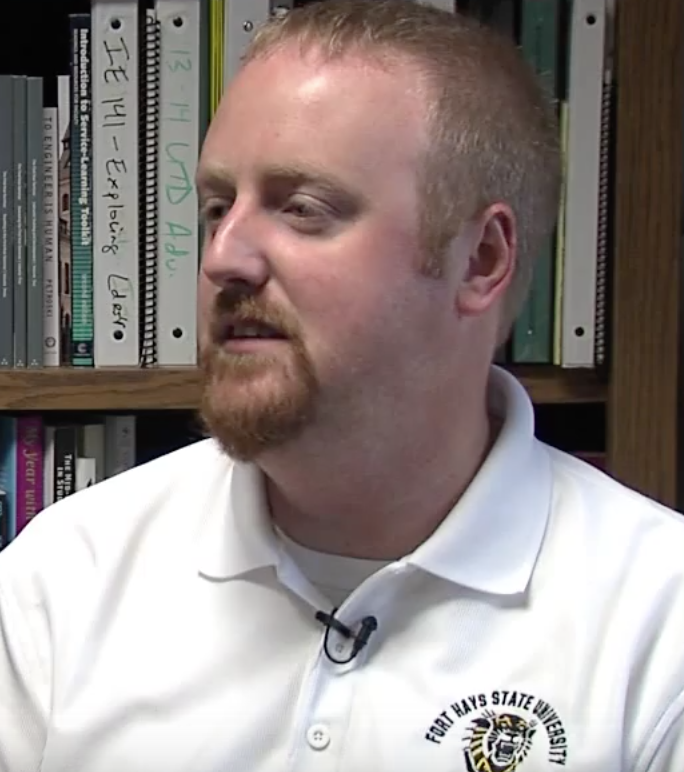
Dr. Brett Bruner

FHSU University Relations

Dr. Brett Bruner, director of transition and student conduct at Fort Hays State University, was recently awarded the 2018 Bill Neuenswander Outstanding Dissertation of the Year Award from Baker University.

The award recognizes an outstanding doctoral graduate who has defended his or her dissertation in the previous calendar year and whose work is deemed by a faculty committee to be of exceptional merit.

Bruner’s dissertation, “The Impact of a First Year Living-Learning Community on First-Generation College Student Academic Success and Persistence,” was nominated by Dr. Tes Mehring, interim provost at Baker University. Mehring served as Bruner’s advisor and the chair of the dissertation committee.

One school year later, guns on Kansas campuses draw little notice

Wichita State student Daylan Andrews conceals his gun with his jacket while on campus. (Photo by Stephan Bisaha, Kansas News Service)

By STEPHAN BISAHA
Kansas News Service

For the past school year, guns have been allowed at public colleges in Kansas.

But the concealed nature of campus carry, alongside a year with no major gun-related incidents at Kansas universities, has meant most students and faculty haven’t really noticed the guns — or a difference.

“I kind of just forget that that’s a thing since I’m not a gun owner,” said Cammye Anderson, a senior at Wichita State University. “I’d be nervous if someone just pulled one out and was like, ‘Yeah, I just carry this around.'”

Universities had four years to prepare before campus carry went into effect in July. The law allows nearly anyone 21 and older to carry a concealed firearm at public colleges in the state. This spring, the Kansas Legislature considered dropping that minimum age to 18. Yet in the end, the law remained unchanged.

Schools largely resisted campus carry before it went into effect. Surveys of faculty and students found strong disapproval for the law; many were afraid guns on campus would make schools more dangerous. A Wichita State professor retired in protest of the law. Another at the University of Kansas started wearing a bulletproof vest.

But the year has, other than a couple of guns accidentally left in bathrooms, been quiet.

“We’re not the Old West where we meet each other on the ends of the street and shoot each other up,” said Warren Glore, an information technology project manager at Wichita State and National Rifle Association instructor.

The past year is proof, he said, that campus carry works.

“Absolutely nothing has happened to point to the gun people and say, ‘See, I told you so,’” he said.

Police at universities across Kansas said there were no serious incidents involving guns since the start of the school year. That didn’t surprise them.

“What we were expecting is what we got,” said Capt. Corey Herl of Wichita State’s police department.

Police also said there’s no evidence to back up predictions that campus carry would act as a deterrent.

A drop in reported crime at the University of Kansas was held up as proof by some right-leaning outlets that campus carry was effective. But the university’s public safety office said the fall-off was no different than the typical fluctuation from year to year and that it is impossible to credit campus carry.

Emporia State University’s chief of police, Chris Hoover, said that it’s been a “typical” year, as far as crime on campus.

“I’ve been in this job for almost 20 years and I honestly haven’t noticed anything major,” Hoover said.

An analysis of Wichita State’s daily crime log found the number of reported crimes shifted no more than it had in previous years.

The quiet year and lack of guns in the open have caused the issue to fade for many on campus, though some students and faculty remain heavily opposed.

Opponents see guns as having unnecessarily made universities more dangerous. They say one year without a major issue isn’t proof their fears are unfounded, pointing to recent school shootings like the one at a Parkland, Florida, high school that left 17 killed.

“It hasn’t happened yet,” said Xan Matteka, a sophomore at Wichita State. “But how are we supposed to know it couldn’t happen tomorrow? Because it could.”

Schools can still designate some spots and large sporting events on campus as gun-free. A location needs “adequate security measures,” such as metal detectors at a building’s entrances, to ban guns.

Some faculty aren’t convinced universities have the resources to keep guns out of all the places that should be, such as some labs with sensitive equipment.

“You don’t want to have a gun close to, let’s say, a propane tank in a lab,” said Mehmet Bayram Yildrim, an engineering professor at Wichita State. “If it accidentally shoots and hits one of those, it can cause great danger to everyone in the lab.”

Some professors also worry the presence of guns — or just the possibility of guns being present, as it’s a violation of campus carry to show a gun — will stifle vigorous academic debate.

“I’ve lost some of that sense of freedom to just speak out and be a professor and talk,” said Peer Moore-Jansen, the chair of Wichita State’s Anthropology Department.

Jansen said he’s not paranoid or expecting shootings to become commonplace. But college life is full of stress and pressures that some students can’t handle. He said adding guns only makes the situation more dangerous.

“Some of the concerns that we have are really intangibles, until they become real very suddenly.”
“Some of the concerns that we have are really intangibles,” Jansen said, “until they become real very suddenly.”

Wichita State senior Daylan Andrews carries a .45-caliber pistol at school.

To keep his gun concealed, he never takes off his red flannel jacket while on campus. It quickly gets uncomfortable on hot days — his skin chafes as sweat runs beneath the metal pistol tucked into his waistband. But Andrews says comfort isn’t the point.

“I’m not carrying it just because it makes me giggle on the inside,” Andrews said. “That’s not what it’s about.”

Rather, he says it is about protecting himself and those around him.

“It’s about responsible usage,” Andrews said, “and showing other people that you care.”

Stephan Bisaha reports on education for KMUW in Wichita and the Kansas News Service, a collaboration of KMUW, Kansas Public Radio, KCUR and High Plains Public Radio covering health, education and politics. Follow him on @SteveBisaha.

Sponsored: Seeking appliance installation professional

Full Time Help Wanted – APPLIANCE INSTALLATION

We are a well-established family-owned and operated appliance sales & service company, and seeking a full-time Appliance Installation person.

Must be able to work Monday thru Saturday and be able to lift heavy items. You will need to have a current driver’s license with a clean driving record and submit to a background check and pre-employment drug screening.
We offer medical, dental and life insurance, a 401 K retirement plan, paid holidays & vacation time, and a fantastic employee discount, after a 30-day probation period.

If you think you would like to join this great team, stop in and apply today!

GENUINE APPLIANCE CENTER
1224 E. 27th Street, Hays, KS
785/625-3278

Wichita police say officer saved 2 women caught in fire

WICHITA, Kan. (AP) — Wichita fire officials are investigating how two women caught fire at a city restaurant. And they are praising an officer who came to their aid.

Officer Charley Davidson says an officer was driving by Rostizeria Los Reyes Friday night when a woman who was on fire ran out of the building. He stopped and used his hands to extinguish the flames.

The woman said her sister was inside the restaurant. Davidson said the officer broke a window to get into the business and found the second woman. He again used his hands to extinguish the flames.

Both women — ages 51 and 57 — were taken to a local hospital with serious injuries. The officer had minor injuries. No one else was in the building at the time.

Kansas man who stole from his disabled brother avoids prison

HUTCHINSON, Kan. (AP) — An Olathe man convicted of stealing more than $43,000 from his mentally disabled brother must pay restitution but will not serve prison time.

The Hutchinson News reports 66-year-old Kenneth Leamon McDonald was placed on three years’ probation, with an underlying prison term of nearly three years.

McDonald has been removed from the brother’s financial accounts.

Assistant Attorney General Paul Brothers contested a claim by McDonald that he spent nearly $43,000 on expenses while visiting his brother in Hutchinson. Brothers says McDonald spent the money in Johnson County, near his home.

His 63-year-old brother, Larry, has lived at TECH group homes in Hutchinson for years.

Chancellor, president picked for New Mexico State University

LAS CRUCES, N.M. (AP) — A two-person leadership team will replace Garrey Carruthers when he retires as New Mexico State University chancellor and president.

The NMSU regents on Friday announced the surprise dual selections of Dan Arvizu as chancellor and John Floros as president.

Arvizu is a former senior U.S. Department of Energy official while Floros is dean of the Kansas State University agriculture college and K-State Cooperative Extension.

Flores will focus on operations of the university’s main campus in Las Cruces. Arvizu will oversee the entire NMSU system and be tasked with addressing the big-picture vision and strategy of the overall system, regents said.
They were among the top five candidates in a national search for the next chancellor.

The Las Cruces Sun-News reports that regents Chair Debra Hicks said she discussed the possibility of splitting the job titles with both men after the regents agreed Monday to take that approach.

Regent Vice Chairwoman Kari Mitchell said it has been apparent for some time that NMSU eventually would have to take the new leadership path to address challenges facing the university such as declining public funding.

“We were compelled to start thinking about how the university would overcome those challenges, given the fact the university has struggled in some of those fronts over the last decade,” she said.

JH Builder’s Club Donate to Jana’s Campaign

TMP-M

Alexis Bohm, eighth grader and Builder’s Club President, presented a $200 check to Curt and Christie Brungardt from Jana’s Campaign.

“We can stretch $200 dollars to do a lot of good at Jana’s Campaign! I know she (Jana) would be so proud that almost 10 years later people in her community are still thinking about her,” Brungardt said.

Builder’s Club had a bake sale among other things to raise the money.

Enter your favorite outdoor photos in KDWPT photo contest

KDWPT

PRATT – Entries are being accepted for the 2018 “Wild About Kansas” photo contest hosted by the Kansas Department of Wildlife, Parks and Tourism. If you’ve snapped a neat photo or two related to Kansas wildlife, outdoor recreation, hunting, fishing, or local landscapes, consider participating the 6th annual contest by 11:59 p.m. on Oct. 14, 2018. Here’s how to enter.

1. Visit ksoutdoors.com, click “Publications,” then “2018 Wild About Kansas Photo Contest.”

2. Read the category descriptions and rules.

3. Click on and complete the “2018 ‘Wild About Kansas’ Entry Form.” (You will receive a conformation code upon completion).

4. Copy your confirmation code into the subject line of a new e-mail.

5. E-mail your photos with category information to [email protected].

Participants who find themselves on the receiving end of a 1st, 2nd, 3rd or honorable mention award can expect to see their photo(s) in the 2019 Jan/Feb photo issue of Kansas Wildlife and Parks Magazine.

For the best chances of success, make sure your photos are:

-1MB or larger

-Taken in Kansas

-Appropriate for the category (photos of domestic animals will not be considered)

For more information, visit ksoutdoors.com/Services/Publications/Magazine/2018-Wild-About-Kansas-Photo-Contest.

FHSU earns three rankings in April

FHSU University Relations

Programs offered through the Fort Hays State University Virtual College received three recognitions in April from various agencies as among the best and most affordable online programs offered by U.S. colleges and universities.

TheBestSchools.org
No. 2, The Best Online Bachelor’s in Network Administration Programs
Fort Hays State University earned the No. 2 spot on TheBestSchools’ list of the best online bachelor’s in networking administration degrees.

FHSU offers both a Bachelor of Arts and a Bachelor of Science in information networking and telecommunications with a concentration in computer networking and telecommunications. These degrees prepare students for work in corporate, education, law enforcement, health care and other computer and network positions.

Both programs are 124 credit hours and include 39 credit hours of core and concentration class. Courses include foundations of information networking, research methods in informatics, internetworking I, internetworking II, internetworking II and network architecture and data communications.

To view this ranking, visit https://bit.ly/2HWvoOV.

MastersProgramsGuide.com
No. 14, 50 Best Online Master’s Programs That Do Not Require The GRE
FHSU’s Master of Liberal Studies earned the No. 14 spot on MastersProgramsGuide’s list for its accreditation, affordability and accessibility.

The 31 credit-hour-program includes 10 credit hours of core class such as introduction to graduate liberal studies, information literacy and origins and implications of the knowledge society. Additionally, students can choose from 12 concentration options to customize the degree program to fit their career goals.

“Located in the College of Arts, Humanities, and Social Sciences, the MLS degree program provides a bridge to interdisciplinary learning at its best,” said MasterProgramsGuide.com.

To view this ranking, visit https://bit.ly/2rqFuMN.

BestValueSchools.org
No. 23, The Top 32 Best Value Schools of 2018
BestValueSchools listed FHSU as one of the best value schools in the nation based on its affordability and wide variety of degree options.

FHSU offers more than 50 degree programs at the undergraduate and graduate levels through the Virtual College. Degree programs include accounting, computer science, finance, health studies, general studies, management, organizational leadership, philosophy, marketing and medical diagnostic imaging.

To view this ranking, visit https://bit.ly/2rr9pUV

About the FHSU Virtual College 
Distance education at Fort Hays State began in 1911 when faculty voted to offer courses free by mail so that one-room school teachers across western Kansas could afford to gain the continuing education required to teach. The distance education department created then evolved continuously with changing technology and culture until, in 1997, the Department of Continuing Education and Instructional Technology became the FHSU Virtual College. 

Copyright Eagle Radio | FCC Public Files | EEO Public File