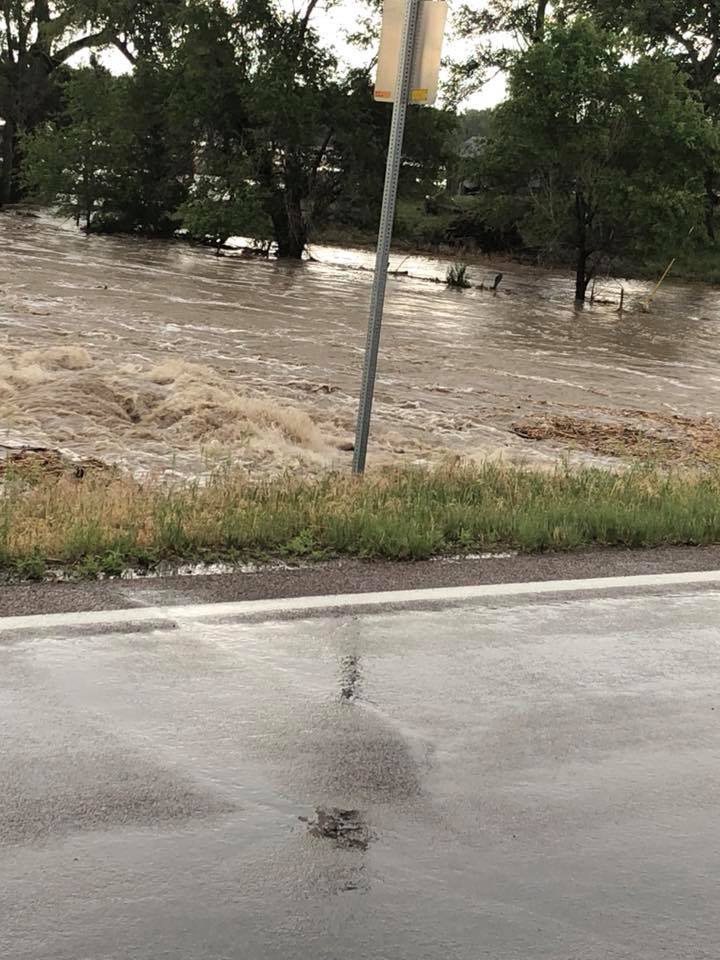
Hill City in Graham County reported major damage today after a storm dumped more than 6 inches of rain over the area.
Graham County. Photo Courtesy of the Graham County Sheriff.
Bush Creek and the Solomon River swelled last night moving buildings, trailer homes and propane tanks off their foundations. One double-wide trailer was moved 100 feet by the water and vehicles were washed as far as a quarter mile downstream, Graham County Sheriff Cole Presley said.
All of the families who lived along the river have been displaced, Presley said, but he did not know how many people were affected.
Complete damage assessments have yet to be made, but he said damage was already easily over $1 million.
He urged people to stay out of the Hill City area as residents try to clean up after the flood.
Several major road closures in the county have been reported, including:
• Graham County Road C at 283 west
• Highway 24 east from Hill City is closed to all but local traffic
• Kansas Highway 18 is closed to all but local traffic from Damar to Bogue
Presley urged residents to watch the sheriff’s Facebook page for further storm reports and road closures.
Graham County. Photo Courtesy of the Graham County Sheriff.
He expressed concerns about additional rain forecast for today. Although the National Weather Service is forecasting today’s storms to be fast-moving, Presley said even another inch of rain could cause further damage and flooding. He said the county still considers itself in an emergency mood.
He said this is the most flooding the area has seen in 50 years.
The Kansas Department of Wildlife and Parks had to come to the aid of a group of boaters Monday night at Cedar Bluff during the storm in Trego County.
A group of boaters were in the water when the storm hit and were unable to get back to their boat without assistance, Kathleen Fabrizius, Trego County Emergency Management director, said.
“Thanks to Wildlife and Parks staff and game wardens they were able to get a boat out there. There were people outside of the boat who could not get back to the boat, and there were no lives lost thanks to a lot of heroic efforts on the part of Wildlife and Parks,” she said.
No one has been reported injured as a result of the storm in that county either.
Fabrizius reported the wind had caused roof and tree damage and one storefront was damaged in WaKeeney. Four semis also were blown over on Interstate 70 a mile west of WaKeeney. She said as of this morning, she believed the semi’s had been cleared from the roadway.
Residents reported water in basements after the storm Monday dumped more than six inches of rain in Trego, Gove and Graham counties, but no roads were closed as of Tuesday morning in Trego County.
Fabrizius said she was extremely concerned about a forecast for further rain and severe thunderstorms tonight in the area. Because the ground is saturated, further rain could cause more flooding.
She urged drivers to not cross roads that are covered with water. They may not know how deep the water is or if there is a passable roadway underneath the water. She also suggested residents pay attention to weather reports today through media or a weather radio.
“Be careful and stay safe,” she said.
Mike Haase, director of Emergency Management in Logan and Gove County, said despite rainfall totals as much as 10 inches in the area, the county has not reported any major damage as of this morning. Water approached several houses and water was out of the banks of several creeks, but the area did not receive the wind damage that other counties received.
No injuries were reported.
Haase urged residents with non-emergency concerns to call the administrative line at 785-938-2250 so that emergency lines could be kept clear.
Logan and Gove counties were not reporting any road closures as of this morning.
Darin Myers, Ellis County Emergency Management director, reported no damage in Ellis County due to the storm.
The 2800 and 2900 block of 130th Ave., Ellis Road, Saline River Road as well as 130th and 140th on Wiles Road are closed today due to high water flooding of the Saline River.
Emergency officials were considering closing some roads in Ellis last night, but water levels went down before that was necessary.
Myers said this morning he did not think more rain today would be an issue in the county as levels in waterways have already started to lower and likely will wash through before the next major rain is expected.
However, Myers also urged drivers to not pass through flooded roadways.
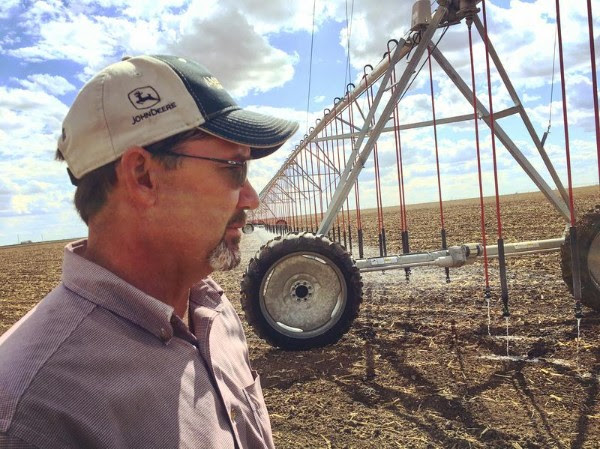
Dwane Roth relies on high-tech gear to water his crops only as much as he absolutely needs to. (Photo by Ben Kuebrich, Kansas News Service)
By BEN KUEBRICH Kansas News Service
GARDEN CITY – Flying east to west over Kansas, the land transforms from lush green to desert brown. Rectangular farm plots fill in with emerald circles, the work of center-pivot irrigation.
Outside Garden City, in the middle of one of those circles, Dwane Roth scoops up soil to reveal an inconspicuous PVC pipe. It’s a soil moisture probe that tells Roth exactly how much water his crops need. The device is one of many new technologies designed to help farmers make the most of every drop.
“All that you have to do is open up your app,” said Roth. “It’s going to tell you, you don’t need to irrigate or you’re going to need to apply an inch within six days.”
For generations, farmers like Roth have looked not to the heavens for the rain to nurture their crops, but to wells, pumps and sprinklers that heaved water up from the Ogallala Aquifer — America’s largest underground reservoir. They transformed the semi-arid region into some of the nation’s most productive farmland.
But the water’s running out.
“Those shallower wells, there’s no more water left in them,” said Roth.
If pumping continues at current rates, most of southwest Kansas will exhaust its water reserves within 25 to 50 years. That could dry up the agriculture at the heart of the region’s economy.
The threat of that impending crisis drives farmers, Roth among them, to adopt technology that helps preserve their wells without hurting the bottom line.
Other farmers are rallying together to self-impose strict local pumping limits.
But yet another faction fears conservation efforts can’t stave off the inevitable. They think the region needs a more radical solution. And soon. They want to create a giant canal to pump new water west — even if it means spending billions.
Pushing pumping limits
In 2013, Sheridan County farmers created the state’s first local enhanced management area, or LEMA, to set strict, enforceable limits on how much farmers could pump.
After Sheridan County had success with limits on irrigation, less strict measures spread to the surrounding area.
A 2017 study showed that farmers within that water district pumped 25 percent less water, in part from switching from corn to less thirsty crops such as sorghum and wheat. Notably, they made similar profits to nearby farmers who didn’t face pumping limits.
After Sheridan County had success with limits on irrigation, less strict measures spread to the surrounding area.
After that success in Sheridan County, the entire surrounding water district adopted limits. Its water restrictions are less severe, but it expands the conservation approach into parts of 10 counties in northwest Kansas.
“We’ve put in some restrictions which should lessen the decline rate,” said Ray Luhman, the manager of Groundwater Management District 4, which contains Sheridan County. “But, you know, we’re not anywhere near anything that would stabilize the water table.”
A LEMA has been proposed for southwest Kansas as well, but getting farmers to agree on its terms has been hard.
Pumping limits, in general, have been called into question. Some farmers in the expanded LEMA around Sheridan County, for instance, say the pumping restrictions violate their water rights and court fights may lie ahead.
The Great Canal of Kansas
Clayton Scott also uses the latest water technology on his farm in Big Bow, Kansas.
Yet he said that just using water carefully won’t be enough.
He thinks any pumping limits severe enough to preserve the aquifer would dramatically cut back the region’s harvest. That would push up local grain prices, and without cheap grain, livestock feed yards would close, and meatpacking plants would follow.
At its core, the western Kansas economy is built on irrigation.
A 2015 study calculated that losses in irrigation could cost some 240,000 Kansans their jobs and wipe out $18.3 billion of yearly economic activity, or about 10 percent of the state economy.
Scott and others in the region have their eyes on a more drastic solution to the water problem. Kansas could invest in a 360-mile series of canals and pumping stations to bring in water from the Missouri River.
Water from the Colorado River is channeled through Arizona, much the way some people think it should be diverted from the Missouri River across Kansas. (Photo courtesy U.S. Bureau of Reclamation)
He knows it sounds extreme, but Arizona has already built a similarly-sized aqueduct. The Central Arizona Project diverts water from the Colorado River and there’s been extensive research into building a similar canal across Kansas.
“Arizona looked at their situation and decided, ‘We have no other choice,’ ” Scott said. “They estimate almost a trillion dollars of benefit to the economy of Arizona.”
Arizona’s aqueduct has always been controversial. The federally funded canal remains at the center of multi-state disputes of water usage.
Experts say that a generation later, the legal and regulatory hurdles of building a long-distance canal through Kansas only look more daunting.
Water from the Colorado River is channeled through Arizona, much the way some people think it should be diverted from the Missouri River across Kansas.
Pricey pipeline
Still, Kansas and surrounding states have been considering aqueducts for a long time. A 1982 study came up with a plan to bring water from the Missouri River to a reservoir near Utica, Kansas, but nothing ever came of it. At the time, though, losing the Ogallala seemed like a distant prospect.
In 2011, while western Kansas was in a drought and farmers struggled to pump enough water to keep their crops alive, the Missouri River was flooding. Scott says that sparked renewed interest in a canal.
“It’s a long-term solution,” Scott said. “We can harvest the high flows of water off of the eastern rivers and bring them out here into the western High Plains, offset the droughts … and bring things into more of a balance.”
In 2015, the Kansas Water Office and the U.S. Army Corps of Engineers re-assessed that 1982 study. The agencies estimated that, depending on the capacity of the canal, it would now cost between $5 billion and $20 billion to build.
Because the water would have to be pumped uphill as it goes west, it could take more than $500 million a year in energy costs alone, for the largest-capacity canal. With interest costs from construction, the yearly tab could exceed $1.5 billion.
At the time, the head of the water office said, “this thing we studied is unlikely to happen.” The costs would simply run too steep.
The proposed path of a Kansas aqueduct. (Image courtesy SW KS Groundwater Management Dist.)
A canal project would have other barriers. Although the Missouri river sometimes floods, it also experiences lows, and levels would have to be maintained to permit barge traffic. There would also be challenges displacing people in the path of the aqueduct. While a highway can be redirected to avoid a town, a canal’s path is more constrained by topography.
“This thing we studied is unlikely to happen.”
At the same time, environmental issues could come both from taking water from the Missouri and in the path of any aqueduct. Upstream and downstream states on the waterway already tangle over how to manage the water. An effort to siphon away water would further complicate the situation.
Scott knows the project would be massive, and massively controversial, but that’s why he’s talking about it now — before the Ogallala runs dry.
An uncertain future
At a conference in April, Kansas Secretary of Agriculture Jackie McClaskey said public support for an aqueduct is unlikely unless Farmers show first that there’s no other way to water their crops.
“Until we can show people that we are utilizing every drop of water in the best way possible,” said McClaskey. “No one outside of this region is going to invest in a water transfer project.”
Clayton Scott says he isn’t looking for the rest of Kansas to bail out the farmers out west.
Scott imagines the canal would be a federal project, similar to Arizona’s aqueduct. Water users would repay the costs of construction and maintenance through a water use fee.
He also contends that an aqueduct could help a broader region.
Scott says an aqueduct could extend out to Colorado’s Front Range to supply booming cities such as Denver and Colorado Springs that draw water off of the dwindling Colorado River. If they drank from Kansas’ aqueduct instead, that would leave more water to trickle down the Colorado, which extends out into water-starved southern California.
A canal, advocates contend, could supply water at a fraction of the price that southern California farmers pay now and help alleviate shortages in that region.
Scott’s interest in water transfer is common in southwest Kansas but far from universal. For example, Roth isn’t convinced.
“It’s impractical and it’s one heck of a distraction.”
“It’s impractical and it’s one heck of a distraction,” said Roth. “Right now we need to concentrate on local conservation with what we do have, what we can do right now.”
Ray Luhman, Northwest Water district manager, thinks the state should consider all options, including channeling water across the state.
“The conversation needs to be had,” Luhman said. “But to, let’s say, mortgage your future on a project maybe 20 to 30 years from completion? We also need to look to something in the interim.”
Ben Kuebrich reports for High Plains Public Radio in Garden City and the Kansas News Service, a collaboration of KMUW, Kansas Public Radio, KCUR and HPPR covering health, education and politics. Follow him on @Ben_Kuebrich.
.@State_IRF Ambassador-at-Large Sam Brownback on the 2017 International #ReligiousFreedom Report: “Our goal is to protect the freedom of conscience for all people … We’ve seen some progress. But there’s so much more work to be done.” pic.twitter.com/LSY8eYeBoY
The Trump administration says ethnic cleansing targeting Rohingya Muslims in Myanmar has not stopped despite growing condemnation from the international community.
In November, the United States declared that violence against the Rohingya in Myanmar’s Rakhine state constituted ethnic cleansing, and the U.S. imposed sanctions. U.S. Ambassador Sam Brownback said Tuesday as he unveiled the State Department’s annual report on international religious freedom that the violence is continuing.
The report estimates that about 680,000 people fled Myanmar to neighboring Bangladesh to escape the violence.
The report covering 2017 also highlighted other U.S. concerns about religious freedom abroad, including some 80,000 to 120,000 political prisoners are being held in prison camps in North Korea, some for religious reasons.
“Protecting and promoting global respect for #ReligiousFreedom is a priority of @POTUS Administration… we are committed to promoting religious freedom around the world – both now and in the future.” – @SecPompeopic.twitter.com/V3pR3Foklg
It says hundreds of thousands of Uighur Muslims in China have been forcibly sent to re-education centers.
___
9:10 a.m.
The Trump administration is estimating that 80,000 to 120,000 political prisoners are being held in prison camps in North Korea.
That’s according to the State Department’s annual report on international religious freedom. It says some of the prisoners are being held for religious reasons. The report adds that prisoners are held “under horrific conditions” in remote areas. Yet it also notes that North Korea’s constitution guarantees “the right of faith” to citizens.
The report covering 2017 also says that “hundreds of thousands” of Uighur Muslims in China have been forcibly sent to re-education centers in China.
Secretary of State Mike Pompeo is formally unveiling the report Tuesday.
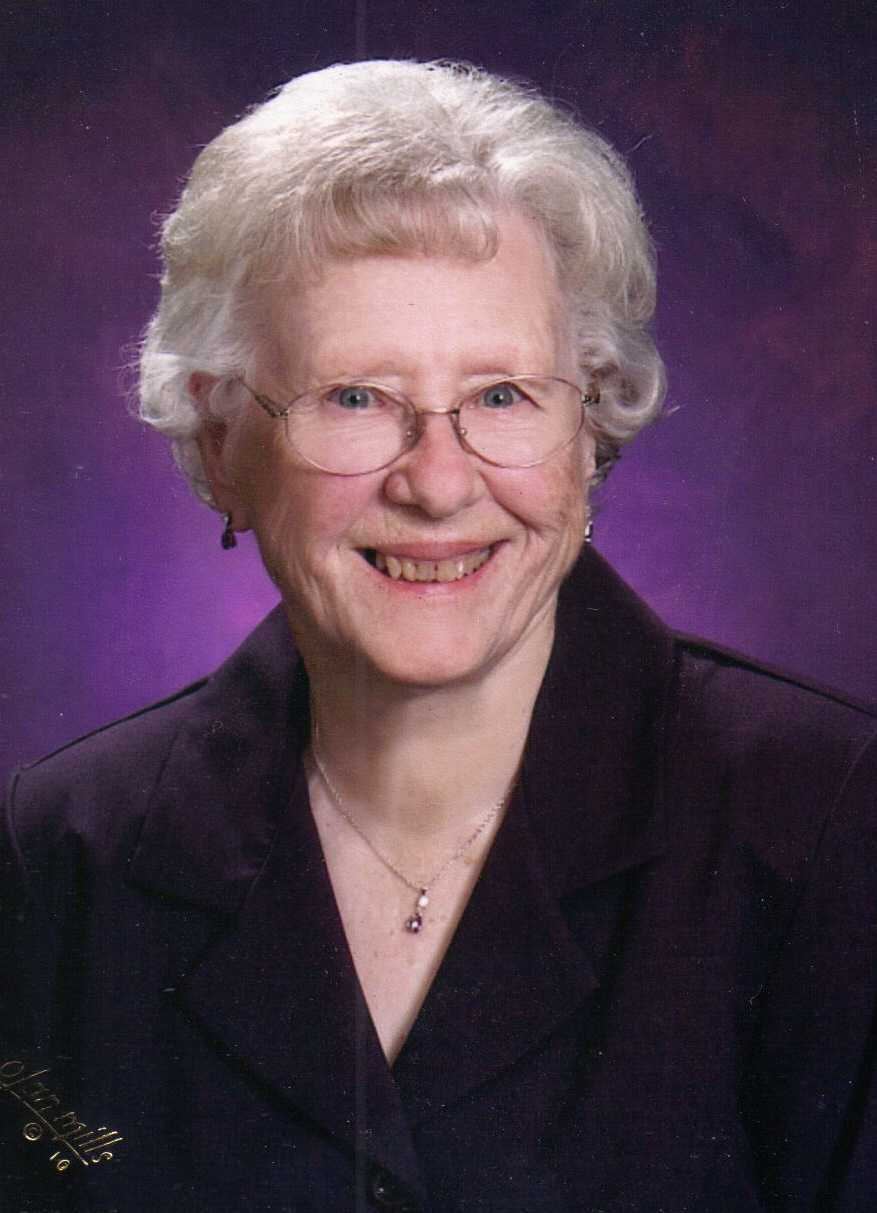
Former Almena resident Eileen Cramer passed away May 26, 2018 in Rice, MN at the age of 99. She was born Sept. 3, 1918, the daughter of Ralph & Jennie (Dailey) Dixon.
Survivors include her son, Ron of Fallbrook, CA; 3 daughters, Judy Whitney of Grand Rapids, MN, Bonnie Fox of Rice, MN and Patty Englert of Belton, MO; 9 grandchildren, 21 great grandchildren & 4 great great grandchildren.
A graveside service will be held Sat. June 2 at 2:00 p.m. in the Mt. Hope Cemetery, Almena with Rev. Larry Danforth officiating.
Visitation will be from 5:00 to 9:00 p.m. Friday at the Almena United Methodist Church, Almena.
Online Condolences: www.olliffboeve .com
Olliff-Boeve Memorial Chapel is in charge of arrangements.
Doug Williams has been appointed interim director of the Ellis County Coalition for Economic Development. He assumes the duties of Aaron White, who recently left the organization after seven years at its helm. Williams will lead the operations until a long-term replacement is found.
Williams is a lifelong entrepreneur and has been involved in a wide variety of business interests during his 30 year career. He spent the first 14 years of his career in the real estate business as a broker/owner of a RE/MAX franchise. During that time, Williams was involved in numerous real estate investment projects and gained considerable experience and knowledge in creatively structuring and financing transactions. He was 1985 Realtor Associate of the Year for the Hays Board of Realtors and the President of the Hays Board of Realtors in 1986.
In 1991, Williams founded System Solutions Inc., a company involved in the sale of IBM information systems. The company began with two employees and grew to 75 employees at the time it was sold to Rural Telephone Service in 1997. Williams then started InfiniTec, Inc. and Medical Business Resources. Infinitec, Inc., a computer software company, was the primary software provider for over 70 of the 105 county governments in Kansas. Infinitec, Inc. was sold to Wheatland Electric Cooperative in 1999. Medical Business Resources, a physicians billing service, was sold in 2003. In 2005, Williams re-entered the real estate business in Hays. He was the 2010 President of the Hays Board of Realtors and 2016 Hays Board of Realtors Realtor of the Year.
“The coalition is critically important to the long term growth and prosperity of our community, and I know that the Board of Directors and I are committed to work towards making that happen any way we can,” Williams said.
Williams has attended advanced courses in the areas of entrepreneurship, business ownership, and salesmanship. These courses include The Wharton Business Schools Entrepreneurship Class, IBM Sales School, and the Owner-Presidents course at The Harvard Business School. In 1997, he was the first recipient of the Harley L. Rhoads Small Business Achievement Award presented by the Hays Chamber of Commerce.
“We want to sincerely thank Aaron for his dedicated service to the Coalition over the last seven years,” said Ron Fields, board chairman. “Aaron was a valued contributor to the economic growth and development of Ellis County.
“The Coalition has reached an important transition point, and it is well-positioned to advance the economic expansion of this region,” he added. “Doug Williams brings a wealth of experience and long-established relationships to the organization. He will guide the Coalition during this interim phase to continue all current projects.”
The Coalition is a not-for-profit organization aimed at advancing the economic health and vitality of Hays and the surrounding communities. Long known for its efforts to promote a robust local economy through business creation, retention, expansion, and recruitment, the Coalition has offered instrumental support toward numerous community successes. A few of those include the arrival of Hobby Lobby, a soon-to-be constructed convention center, development of innovative job training initiatives, and BriefSpace, a co-working space and business incubator that will be opening soon in downtown Hays. The Coalition also administers a housing redevelopment program and training programs designed to offer skilled-trade training to area workers.
DISCLOSURE: Ron Fields is director of converged media at Eagle Communications.
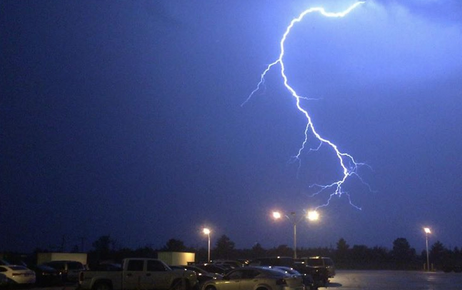
From the Enersys parking lot. Photo courtesy Stephen Pate
From the Enersys parking lot. Photo courtesy Stephen Pate
From the Enersys parking lot. Photo courtesy Stephen Pate
With spotty rain still persisting Tuesday morning, northwest Kansas awoke to several inches of rain in gauges today.
In Graham County, major flooding was reported after Monday night’s storm. There was a report of 6.92 inches of rain from Hill City. Eastern Gove and western Trego counties also had reports of more than 6 inches of precipitation.
In Ellis County, a report south of Ellis saw 2.27 inches of rain in the gauge. While the amounts tapered to the east, most of the county received at least 1.5 inches of rain. Western Russell County also received about 1.5 inches of rain, while the eastern half of the county only received about a half inch.
Farther west in Thomas County, there was a report of 2.38 inches from Colby.
The chance for more thunderstorms continues today, with the chance of precipitation late this afternoon at 70 percent. Click HERE for the complete extended forecast.
Madeline Lela Schoenthaler, age 94, of Ellis, Kansas passed away Friday, May 25, 2018 at the Good Samaritan Society, Hays, Kansas. She was born June 17, 1923 in Ellis County, Kansas to John and Minnie (Schwab) Huck.
She graduated from Ellis High School in 1941 and from the Salt City Business College in Hutchinson, Kansas. On October 21, 1945 she married Raymond F. Schoenthaler. He preceded her in death on March 22, 2007.
Madeline was a homemaker and enjoyed flower gardening, cooking and baking especially her delicious pies. She was a member of Christ Lutheran Church where she was very active in church activities including the quilting group. She was also a member of PEO.
She is survived by a son, Terry Schoenthaler and wife Pat of Ellis; a daughter-in-law, Linda Schoenthaler of Hays; a brother, Clayton Huck of Ellis; four grandchildren, Chad Schoenthaler and wife Kimberly of Mission Hills, Kansas, John T. Schoenthaler and wife Keriann of Gilroy, California, Scott Schoenthaler and wife Brianna of Salina, Kansas and Amy church and husband Bryan of Hays as well as twelve great grandchildren, Emma, Bode, Madison, Noah, Sophia, Jonah, Myja, Gabby, Dominic, Alyssa, Aydan and Anthony.
She was preceded in death by her parents; a son, Lynn Schoenthaler; and a great granddaughter, Timberlynn.
Funeral services will be 10 AM Wednesday, May 30, 2018 at Christ Lutheran Church 106 E. 8th in Ellis. Burial will follow in Mt. Hope Cemetery.
Visitation will be Tuesday 5 PM – 8 PM with a prayer service at 7 PM and Wednesday 9 AM until service time all at Christ Lutheran Church.
Services in care of Keithley Funeral Chapel 400 E. 17th Ellis, KS 67637.
Memorial contributions are suggested to Christ Lutheran Church, Hospice at HaysMed or the Ellis Public Library.
Condolences may be left by guest book at www.keithleyfuneralchapels.com or by email at [email protected]
Harriette M. Cronn, 89 passed away May 25, 2018. She was born in Hays, Kansas on January 27, 1929 to Harry Gottlieb and Alma Pearl (Robinson) Klenk.
Harriette attended elementary school through eighth grade at Happy Hollow School in southern Graham County. She graduated from Trego Community High School in 1946. Harriette graduated from Fort Hays State College in 1951. She was a member of Kappa Phi and Sigma, Sigma, Sigma Sororities.
Harriette was united in marriage to Arden Lewis Cronn on June 17, 1950 in Kansas City, Kansas. After graduating from college, she taught school for one year in Norton, Kansas. She and Arden moved to the Klenk family farm in 1952. There she lived the remainder of her life as a wife, mother and homemaker. The family included six children.
Harriette was a member of Prairie Home United Methodist Church where she played the piano for Sunday church services until she was 84 years old. She was the pianist for Bible School and programs in which her children were involved during their childhoods. Harriette was also a member of GFWC Locust Club, FHSU Half Century Club and Big Creek Golf Club.
Harriette was preceded in death by her husband Arden October 18, 2015, parents and her sister, Darlene.
Those left to mourn Harriette include her children Paula (Antonia De La Guerra) Cronn, Salt Lake City, Utah; Barbara (Wayne) Roberts, Hays, Kansas; Harry (Amanda) Cronn, WaKeeney, Kansas; Catherine (Jay Abasolo) Cronn, Northglenn, Colorado; Susan (Michael) Carew, Thornton, Colorado; and Julie (Craig) Leiker, Roswell, Georgia. Twelve grandchildren: Brice (Krissi) Cronn; Elizabeth (Aaron) Jantz; Rebecca (Jay) Corwin; Evan (Rachel) Cronn; Haley (Jason) DaVee; Eriq Roberts; Stephanie (Shannon Gray) Roberts; Adam Carew; Jacob Carew; Sarah (Trevor Ballinger) Carew; Amber Leiker and fiancé Tyler McGlawn; Molly Leiker. Nine great grandchildren: Courtland; Jase; Emmalynn Cronn; Miller and Hudson Jantz; Mabyn and Kysen Corwin; Hadley and Eleanor Da Vee. Several nieces, nephews and cousins.
It’s likely to be one of those years—first in (practically) 24 years—that Kansas Democrats might want to carry a note into the primary election voting booth to remember the name of their favorite gubernatorial candidate.
For most of the last 24 years, it’s been just checking the box on the only Democrat in the race. Made it pretty simple, and you didn’t have to remember the name, just the office.
Martin Hawver is publisher of Hawver’s Capitol Report
Democrats had their last “official” primary election race for governor back in 1998, but it was the late Rev. Fred Phelps, of Topeka, and now-Rep. Tom Sawyer, D-Wichita, who were on the ballot back then, and the votes were about 15,000 for Phelps for all the reasons that the anti-gay Topeka minister preached about…and anyone else on the ballot…Sawyer.
Before that, it was the 1994 five-way Democratic primary which saw 7-term former U.S. Rep. Jim Slattery, D-Kan., and running mate Carol Sader take the primary easily, later losing in the general.
But this year, for the first time in 20 years, it’s going to be a three-way; four, if you count a high schooler who has officially filed for office. Nobody’s heard from two other Democratic potential candidates, Salinan Robert Klingenberg and Olathe doctor Arden Anderson. While there are two clear leaders—Sen. Laura Kelly, D-Topeka, and former state Rep. Josh Svaty, of Ellsworth and later Topeka—just how they come out is uncertain.
And, nobody yet knows just what the candidacy of former Wichita Mayor Carl Brewer will have on what most are predicting to be the split between Kelly and Svaty. There’s always the upset, and either Kelly or Svaty could do something or say something that immediately costs her/him the election, but both are careful and in interviews appear to quietly think through their answers before they utter a response.
Yes, it’s going to be considerably different for Democrats than the good old days of the summer of 1998.
Is it going to be the former lawmaker Svaty who has roots in rural Ellsworth, which is west of Salina, and running with businesswoman Katrina Lewison of Manhattan? Or maybe the current senator with Topeka roots, and running mate Lynn Rogers of Wichita who sits just to her left in the Senate chamber? Or Brewer of Wichita where he was elected, then elected again as mayor, and his running mate former Gardner (that’s Johnson County) Mayor Chris Morrow?
Is geography a big part of the decision? Any chance a Democratic nominee from your area gets your local roads repaired, or at least at the top of the list for repairs? Maybe it’s not geography, though it doesn’t hurt…
If it comes down to experience, well, that comes down to experience doing what?
Is it experience running a government that deals closely with its constituents—we’re thinking the mayors here—or does it come down to experience in state government? That’s probably the Kelly and the Svaty teams. Svaty served four and a half terms in the House before Gov. Mark Parkinson named him Secretary of Agriculture in 2009, and he was out the day that Republican Gov. Sam Brownback took office. Things have changed a lot in the last eight years.
Kelly? Four terms in the Senate, starting under Democratic Gov. Kathleen Sebelius and later Parkinson. And she’s been there in the eight-year Brownback/Gov. Jeff Colyer regime. The question, for Democrats, is whether she can use the Brownback/Colyer years to her advantage.
Wonder how this is going to work out…who remembers what…and their names…
Syndicated by Hawver News Company LLC of Topeka; Martin Hawver is publisher of Hawver’s Capitol Report—to learn more about this nonpartisan statewide political news service, visit the website at www.hawvernews.com
When the family was moving cross-country the Mom and Dad each needed to
drive one of their two cars. Their eight-year-old son worriedly asked,
“How will we keep from getting separated?”
“We’ll drive slowly so that one car can follow the other,” the Dad
reassured him.
“Yes, but what if we DO get separated?” the son persisted.
“Well, then I guess we’ll never see each other again,” the Dad answered
back jokingly.
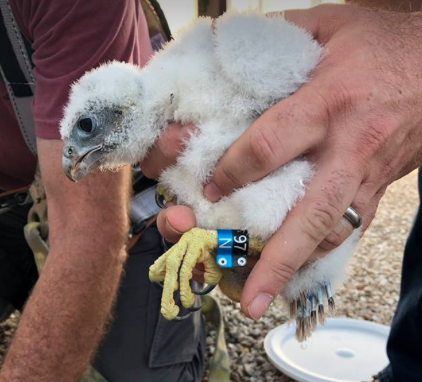
TOPEKA, Kan. (AP) — Four fluffy, white peregrine falcon chicks that hatched less than a month ago in Topeka are growing and healthy.
photos courtesy Westar Energy
Officials on Monday but bands on the four chicks, which hatched on a nest near the top of the 12-story Westar Energy building. The Topeka Capital-Journal report s this is the first time four eggs hatched. Usually one to three eggs have hatched.
It’s the eighth consecutive year the falcons nested in a box Westar provides.
The chicks’ parents are falcons named Nemaha and Boreas. The chicks’ genders are not yet known.
Several Westar employees and wildlife specialist helped with the banding Monday. The goal is to allow wildlife experts to track the birds as they grow older.
Brad Loveless, environmental specialist for Westar, said the falcons are about 20 days old.