We have a brand new updated website! Click here to check it out!

News From the Oil Patch: Kan. crude up $20+ over last year

By JOHN P. TRETBAR

The government reported the highest monthly US crude production ever, a whopping 10.47 million barrels per day in March, up nearly 15% year on year. Texas production jumped 25%. Here in Kansas, the U.S. Energy Information Administration report lists 97 thousand barrels per day, nearly five percent lower than last year at this time.

The Kansas Corporation Commission reports 143 intent-to-drill notices filed during the month of May (706 so far this year). That’s two more than the month before, but down four from May of last year. Barton County reported three new intents filed last month. Ellis County notched six. There was one in Russell County and four in Stafford County.

Operators in Kansas produced more than 2.2 million barrels of crude oil in February, just over 5.6 million barrels for the first two months of the year. The Kansas Geological Survey said the two-month total in Barton County was 277-thousand barrels plus. Ellis County’s total was over 431-thousand barrels. Production in Russell County increased to 256-thousand through February, and in Stafford County, operators produced a two-month total of 164-thousand barrels.

Over the last two years, the average price for a barrel of Kansas Common crude in McPherson has increased more than $23. The May monthly average at CHS in McPherson was $60.17/bbl. That’s more than $21 higher than the average in May of last year, which was more than two dollars over the May average the year before. The peak monthly average price for Kansas Common dates back to June of 2008, when the former NCRA refinery shelled out an average of more than $124/bbl.

London Brent reached its largest premium over U.S. futures prices in more than three years, suggesting U.S. exports are becoming more competitive. The spread between Brent and U.S. crude stands at more than ten dollars a barrel, its widest since 2015.

Amid U.S. demands to offset China’s $335 billion trade deficit, that country’s Ministry of Commerce has granted import licenses to eleven new private or “teapot” refiners, bringing the total to 28. China has called off refinery production to clear the air in the refining hub hosting a major trade show. Reuters reports that Exxon may have been late to the “teapot party,” but made up for it with a huge marketing blitz at the show. Their booth was manned by the global crude marketing manager and a dozen traders and marketers. They also hosted dinner for 200 prospective customers and traders. Observers note this as a dramatic departure from Exxon’s traditional, more private, sales pitches.

A firm is starting up an oil-sands project in eastern Utah in hopes of tapping into an estimated 30-billion-barrel reserve there. The Grand Junction Sentinel reports the company Petroteq is touting a new way to separate bitumen from sand, using no water, no high temperatures and no high pressure, without producing greenhouse gases. According to the newspaper the process extracts up to 99% of all hydrocarbon contents and recycles up to 99 percent of the benign solvents it uses. The company says the leftover sand can be returned to the ground, or used for construction or fracking.

The North Dakota Public Service Commission approved a pipeline conversion project to deliver more crude oil to the Dakota Access Pipeline. The Bismarck Tribune reports Hess Corporation will convert about 19 miles of gathering pipelines in McKenzie County to transmission lines. The company plans the addition of three booster pumps as well as new pipeline monitoring systems.

In Colorado, activists are circulating a petition for a ballot initiative to change state law, requiring setbacks of 25-hundred feet, between oil and gas development and occupied structures, playgrounds and water sources. That’s five times the current setback rule. The group has about nine weeks left to collect more than 100-thousand signatures needed to place the question onto the ballot. Big oil is spending big bucks to fight the initiative which they say, if passed, would cost thousands of jobs and billions of dollars in economic impact. KMGH-TV7 reports an industry-friendly PAC opposing the measure has collected millions from big oil firms. The state’s largest, Anadarko, wrote a check for more than two million dollars. Nobel Energy and Extraction Oil and Gas added another four million. The industry as a whole since January has given more than eight million dollars.
HAWVER: Kansas tax revenues show dramatic uptick

Martin Hawver
On Friday while most news media were watching to see who is filing for whatever state office, the Kansas Department of Revenue released a near-shocking report on receipts into the State General Fund (SGF)—the checking account for state government.

That little-read document shows that last year’s income tax increase is working to put the state back into budget balance. And that builds on the previous year’s sales tax increase that is finally kicking in and making state government more economically stable than Kansans have seen in the past seven years (yes, you can go ahead and call it the Gov. Sam Brownback/now-Gov. Jeff Colyer era).

What was the report? It was May revenues from all sources, and it showed that in May, the state received $542.9 million in taxes, $101 million more than predicted, and a dramatic $92.5 million of that unexpected cash was from personal income taxes.

Last year, recall, and who doesn’t, there was that massive income tax increase, retroactive to Jan. 1, 2017, six months before lawmakers overrode Brownback’s veto of the measure designed to raise $1.2 billion over two years.

It was that measure that eliminated the income tax exemption for so-called “non-wage income” (often LLC or self-employment income) that some 330,000 Kansans had enjoyed for four years.

Well, there’s one month—June—remaining in this fiscal year, and the income tax increase appears in the first 11 months of its life to have raised individual income tax receipts by about $1.077 billion. That’s not the $1.2 billion estimate, but there’s a month left, and, well, the tax law has been in effect long enough for some to have probably found a kink or two in it that can be exploited to save a few bucks.

So, what’s the good news…that the tax increase has apparently worked in boosting state revenues?

It’s early yet, but it appears that the state may, probably not in the upcoming fiscal year but at least the year starting July 1, 2019, have enough money to finance a new highway plan, and, probably under court order, increase the funding for public schools.

That revenue report—strange what sorts of behavior you can track when different taxes are split out by specific levy—also shows, for example, that Kansans probably spent a fair amount of time on the porch smoking. Yep, in May Kansans paid $11.9 million in taxes ($1.29 a pack) on cigarettes, about $2 million or 19 percent more than predicted. Now that’s more money for the state, but you gotta figure that long-term, Kansans would be better off if they hadn’t smoked more than predicted in May. Best nuance from the Revenue Department’s report on cigarettes probably was that Kansans smoked less this May than they did last May…

Another of those nuances from the report was that Kansans increasingly like to buy stuff over the Internet or in other states to bring home. While sales tax revenues in May were a sizable $189 million, about what was expected, Kansans spent more on “compensating use” taxes. Those are essentially sales taxes paid on purchases out of state, or over the Internet, where just a portion of those purchases by Kansans carried the state’s sales tax. The news there? While it’s nice that some of those out-of-state and Internet taxes were collected (about $32.3 million in May and $372 million since last July), it’s still revenue that didn’t go through Kansas merchants’ cash registers, which keeps stores open and increases retail sales jobs.

So, Kansas is apparently moving back toward a budget that won’t call for year-after-year cuts in spending. Or…lawmakers might start the tax-cut era again…

Syndicated by Hawver News Company LLC of Topeka; Martin Hawver is publisher of Hawver’s Capitol Report—to learn more about this nonpartisan statewide political news service, visit the website at www.hawvernews.com

Former Kan. man accused of 150 rapes, held on $1M bond

Millsap
photo-courtesy Allegheny County

DICKINSON COUNTY — Law enforcement authorities are investigating a series of alleged sex crimes and have made an arrest.

Detectives from the Abilene Police Department traveled to McKeesport, Pennsylvania to serve an outstanding arrest warrant on an a suspect wanted in connection with numerous sex crimes, according to Sheriff Gareth Hoffman.

Detectives arrested 44-year-old Eric Millsap, of McKeesport, PA, on a warrant from Dickinson County District Court for over 150 counts of rape.

The crimes are alleged to have occurred between 2006 and 2015 when Millsap lived in Abilene and Dickinson County, Kansas.

Millsap is currently being held in Allegheny County Jail, in Pittsburgh, PA in lieu of S1,000,000 bond.

The Abilene Police Department was assisted in the apprehension of Millsap by the McKeesport Police Department.

SCHLAGECK: Protect yourself from the sun

John Schlageck writes for the Kansas Farm Bureau.
The next time you take a few minutes out of the sun, dust off one of those old family albums. You know the ones that date back to the ‘30s, ‘40s and even the late ‘50s.

If your family farmed, you’ll see photos of your relatives attired in wide-brimmed hats. Look at their shirts. They wore loose-fitting, long-sleeved, light-colored garments.

Now fast-forward to the photographs of the mid – ‘60s. Clothing styles changed. You don’t see too many long-sleeved shirts any longer. Broad-brimmed hats have been replaced with baseball caps proclaiming seed, feed, tractors, and organizations – just about any company logo under the sun.

Today’s farmer no longer wears the clothing of yesteryear – clothing that afforded protection from the sun’s harmful ultra-violet rays. Instead he or she wears a smaller, softer, snug-fitting cap that will not blow off and bump into machinery. Farmers prefer their hats to be inexpensive or free, and they like them colorful.

While the ball cap is comfortable and affordable, it does not protect the temples, the tender, delicate ear tips and the back of the neck. The baseball cap doesn’t extend far enough to offer protection needed to guard against the sun.

Health specialists in the agricultural field have been tracking skin cancer and the sun’s harmful impact on farmers and other segments of society since 1983. While reports of deaths from skin cancer remains small, the number of tumors has increased significantly according to family physicians that treat farmers in rural communities.

Ultra-violet rays are one of the leading causes of cancer on farms today, researchers say. But with early diagnosis, treatment is possible. Farmers and ranchers should insist on inspection for skin cancer as part of their regular check-up.

Without protective measures, sun will eventually result in skin cancer. Dermatologists recommend that anyone working or playing in the sunshine protect their skin completely by wearing clothing and a wide-brimmed hat.

The American Cancer Society will tell you there is a skin cancer epidemic. The number of cases is rising faster than any other tumor being studied today.

One reason skin cancer may be on the rise is due to more leisure time and more exposure to the sun. If anyone wanted evidence of this, they need only look at the thousands who attend the “Country Stampede” in Manhattan in late June. Ball caps, shirtless guys and gals wearing two-piece bathing suits parade everywhere.

How can we stem the tide?

Youngsters and young adults must be aware of possible skin cancer. If they learn about the sun’s dangerous rays at an early age and practice prevention, skin cancer can be avoided in later years.

Farmers, ranchers – just about anyone who works or plays in the sun should avoid direct exposure during the midday sun. This period is roughly from 10 a.m. until about 4 p.m. in the Midwest.

If you can’t wear a wide-brimmed hat and protective clothing, apply at least a Number 30 sun protective lotion. Today’s farmers and ranchers would be well-advised to take a page out of their family albums – to return to those days of floppy, wide-brimmed straw hats and long-sleeved, baggie cotton shirts.

Who knows, maybe they could start a new fashion craze as well as protect their skin from the damaging rays of the sun.

John Schlageck, a Hoxie native, is a leading commentator on agriculture and rural Kansas.

One traffic lane at Vine St. railroad crossing Tuesday

CITY OF HAYS

Please be advised that beginning Tuesday, June 5, 2018, traffic will be reduced to one lane for both northbound and southbound traffic at the Vine Street railroad crossing. This work is expected to be completed by the end of the day.

Signs will be in place to direct the traveling public. The traveling public should use caution and if at all possible avoid this area.

If there are any questions, please contact the Union Pacific Railroad at (800) 848-8715.

BOOR: Dealing with tip blight in juniper trees

Alicia Boor
I have received many calls recently from individuals worried about their juniper trees. The trees appear to be turning brown at the tips of the branches, sometimes throughout the tree. This gives the tree an unhealthy look, and people are concerned about the overall health of their evergreens. The trees that I have looked at have all had the same disease in common, which is Kabatina tip blight.

Kabatina tip blight is a fungal disease that infects the trees in the autumn, mainly in windbreaks or ornamental plantings. Visible symptoms are not apparent until late winter or early spring. The terminal 2 to 6 inches of the diseased branches first turn dull green, then red or yellow. The tips fall off the tree in late May or Early June. Blighting is restricted to the branch tips and is often associated with small wounds on branch tips caused by insect feeding or mechanical damage.

There are no fungicides labeled for control of the fungus, but the good news is that rarely will the disease kill the tree. However, there are some cultural practices that you can implement to help reduce the severity of Kabitina tip blight. Proper spacing of plants to help with airflow is important when planting new trees. Avoid wounding plants in the spring or fall will also help reduce infection. It is also recommended to practice good watering techniques such as watering in the early morning so that the foliage will dry quickly, reducing the time the fungus can spread.

Overall, Kabatina tip blight is more of an aesthetic issue, and should not harm your tree. Keep them well watered and practice a few good techniques to lessen the spread, and your tree will be fine.

Alicia Boor is an Agriculture and Natural Resources agent in the Cottonwood District (which includes Barton and Ellis counties) for K-State Research and Extension. You can contact her by e-mail at [email protected] or calling 620-793-1910

SCHROCK: Turning around science literacy in America

John Richard Schrock is a professor at Emporia State University.
Science, technology and engineering in America is now dependent on foreign students. Data from a Pew Research Center analysis of ICE data secured through a Freedom of Information Act request found that between 2004 and 2016, almost one and a half million foreign students graduating from U.S. universities were authorized to remain in the U.S. for employment in science. More than half were from Asia. While some citizens know of the H1B visa program for hiring highly skilled foreign workers, these students work under the federal Optional Practical Training (OPT) program. Between 2008 and 2016, new foreign student enrollments on F-1 visas doubled and OPT employments went up fourfold!

Compared to all other developed countries, the American public and American students not majoring in a science field, are simply science illiterate. What could turn this around?

-The American public school curriculum must increase science coursework from five percent to 20 percent of the K–12 curriculum.
-External testing that drives rote teaching-to-the-test must end. Teachers in science fields must pose questions and lead students in problem solving, a strategy that has been reduced by external testing.
-Elementary students beginning in first grade should have substantial class time with elementary science teacher specialists. Youngsters become hooked on science in these early years, but current elementary teachers are mostly science-ignorant and cannot build on students’ natural questions and enthusiasm.
-Science must return to hands-on classwork. Multisensory experiences are the basis for understanding natural phenomena and grasping the meaning of science concepts. No experience, no meaning. Distractions, especially computers and social media, do not belong in the science classroom. -“Technology” in science consists of microscopes and chemicals and physics equipment. Real well-equipped labs must be re-established. Explanations require experiences. Again, science technology has little to do with computers and cellphones.
-Field trips must be restored. As fewer students come from rural backgrounds or have field experiences, the school must provide more experiences with nature.
-Forty states and the District of Columbia only train shallow one-size-fits-all secondary “science” teachers who take only one to three college courses in each discipline. Only eleven states train high school biology or chemistry or physics or earth science teachers in-depth. Those specific field endorsements require from 30 to 45 credit hours of college coursework and labs in a field. All states should move immediately to educating secondary science teachers in-depth in specific science disciplines.
-Secondary science teacher programs should be housed and managed in the biology, chemistry, physics and earth science departments at U.S. universities. This is the case in many foreign countries, where science teachers are trained alongside science researchers. Science education programs operated by Schools of Education waste time on teaching fads and provide the most minimal science requirements.

U.S. science literacy began to decline in the 1970s and has resulted in the most science illiterate population among developed countries. We currently do not have enough well-educated science teachers to teach our current anemic curriculum. It will take decades to scale up science teacher production by nearly five times. It will take increased salaries for science teachers. -And more respect for teachers.

But one last item is a key indicator. The U.S. must go metric, and go metric now! Metric is the language of physics and chemistry and much of biology. And our students never learn to speak this language of science.

Going metric is easy. But if we cannot even get off of the barleycorn system (three barleycorns laid end-to-end equal an inch), we have little chance of making these other substantial changes in science education that are vital to eventually producing a science literate society.

The flow of foreign students into American universities began a decline this last year. Journal metrics show a dramatic rise in Asian authors and a slow decline from America. If we do not bolster science in K–12 schools immediately, the U.S. will gradually lose first-world status in science.

John Richard Schrock is a professor at Emporia State University.

Street seal coating June 5 schedule

CITY OF HAYS

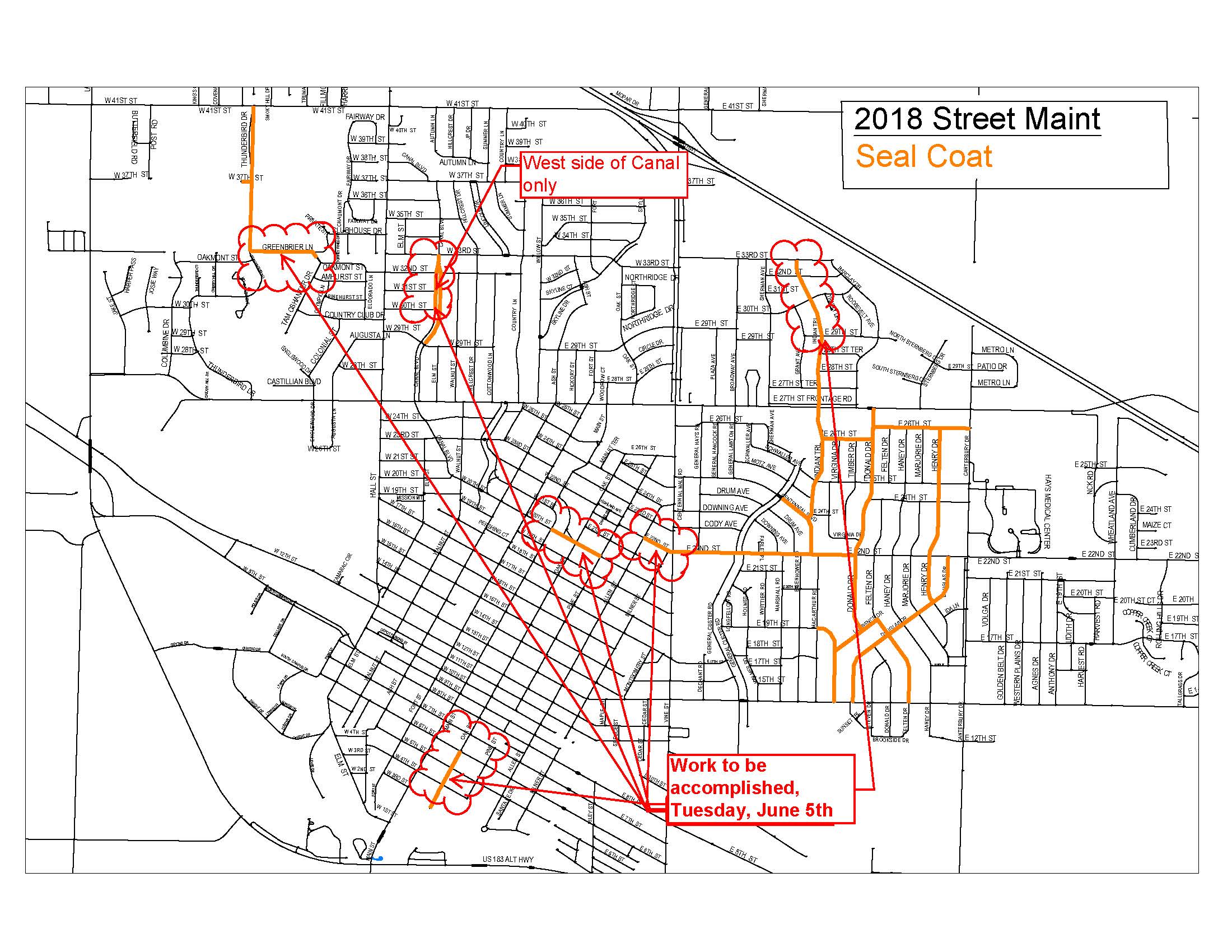
Seal coating began Monday, June 4, on various streets throughout Hays. See the map below for Tuesday, June 5, street locations. 

Seal coat is a spray applied in two coats with a dry time of 2 to 3 hours per pass, so the streets being sealed will be temporarily closed during this time.On the date scheduled for treatment, all cars need to be moved from the street by 8:00 am. Streets being sealed will be closed from approximately 8:00 a.m. until 5:00 p.m. Access can be achieved in cases of emergency. Parking on adjacent streets is recommended during the daytime. Parking in driveways is OK if you DO NOT plan on moving the vehicle between 8:00 a.m. and 5:00 p.m.

The seal coat treatment should not be driven on until it has set up (dried). It will stain surfaces such as concrete, carpet, or flooring if tracked from construction areas.

Please have all lawn watering devices turned off the evening before the scheduled date.

Please help keep the streets clean and dry for a smooth and lasting project.

Traffic control will be set in areas of work being completed and picked up by the end of the work day. This project is scheduled to be completed within two weeks (pending weather conditions).

The city of Hays regrets any inconvenience this may cause to the public. If there are any questions, please call the Office of Project Management at 785-628-7350 or the contractor, Circle C Paving, at 316-570-4652.

Sheriff: Reward offered in Kan. drive-by shooting that injured child

JACKSON COUNTY — Law enforcement authorities are investigating a drive-by shooting that occurred May 20 near Mayetta, Kansas and offering a reward, according to Sheriff Tim Morse.

Just before 2a.m. Sunday, May 20, the Jackson County Sheriff’s Office received a 911 call from a residence in the 13000 block of 166th Road north of Mayetta.

Deputies and investigators arrived at the scene and found multiple rounds that had been fired into the residence. Jackson County EMS transported a minor child from the residence to an area hospital who had been struck by a bullet.

The injury was not life threatening. A reward is being offered for information leading to the capture and conviction of person(s) responsible.

If anyone has any information regarding the incident, you are asked to contact the Jackson County Sheriff’s Office at 785-364-2251.

Trout helps lift Angels to win over Royals

ANAHEIM, Calif. (AP) – Mike Trout had three hits, including a tiebreaking RBI single in the eighth inning, and the Los Angeles Angels beat the Kansas City Royals 9-6 on Monday night.

Trout scored three runs and drove in two, Justin Upton and Albert Pujols also had two RBIs, and Jefry Marte hit a solo home run to help the Angels improve to 4-0 against the Royals this season. Los Angeles has scored at least five runs in each of those wins.

Tim Hill (1-2) couldn’t handle the bouncing comeback up the middle from Trout, and the ball had enough on it to carry to center field and allow Maldonado to score for the 7-6 lead. Upton and Pujols each added run-scoring singles to add to the lead.

Cam Bedrosian (2-1) pitched a perfect eighth to get the win. Blake Parker got the last three outs, striking out Jorge Soler with a runner on first for his fourth save and the Angels’ third win in four games.

After Soler’s two-run double pushed the Royals’ lead to 5-2 in the fifth, Upton homered for the second straight game to pull the Angels within two in the bottom of the inning.

Marte added his third homer to start a three-run sixth. Trout drove in Shohei Ohtani, who hit a pinch-hit single, to tie the score 5-5. Pujols gave the Angels a 6-5 lead on a single that scored Trout for his 1,949th career RBI.

However, Salvador Perez tied it with a solo home run to left-center in the seventh.

Mike Moustakas, Alcides Escobar and Jon Jay each had an RBI for the Royals.

TRAINER’S ROOM

Angels: With Kole Calhoun (strained oblique) on the 10-day disabled list, manager Mike Scioscia said he is comfortable rotating between Chris Young, Michael Hermosillo and Kaleb Cowart in right field. “We can mix-and-match a little bit, and just hopefully hold the fort down until Kole gets back,” Scioscia said.

UP NEXT

Rangers: RHP Brad Keller (1-1, 2.13 ERA) will make his first career road start Tuesday. Keller gave up one run in three innings of an 11-8 win over Minnesota in his first start on Wednesday, and the 22-year old has a 2.19 ERA in 11 relief appearances on the road this season.

Angels: LHP Andrew Heaney (2-4, 3.66) has lost two of his last three starts, giving up five runs and eight hits in five innings of a 6-2 defeat at Detroit on Thursday.

Kansas man dies after thrown from motorcycle

CLAY COUNTY — A Kansas man died in an accident just before 8p.m. Monday in Clay County.

The Kansas Highway Patrol reported a 2008 Harley Davidson motorcycle driven by Gary D. Riekeman, 60, Abilene, was Southbound on Kansas 15 eleven miles south of Clay Center.

The driver lost control of the motorcycle. It left the roadway to the west ditch and the driver was thrown from the bike.

Riekeman was pronounced dead at the scene and transported to Neal Swensen Funeral Home. He was not wearing a helmet, according to the KHP.

HPD Activity Log June 4

The Hays Police Department responded to 11 animal calls and conducted 17 traffic stops Mon., June 4, 2018, according to the HPD Activity Log.

MV Accident-Personal Injury–500 block W 7th St, Hays; 7:20 AM
Animal At Large–1900 block Vine St, Hays; 7:25 AM
Criminal Damage to Property–200 block E 9th St, Hays; 9 AM
Dead Animal Call–12th and Elm St, Hays; 10:28 AM
Violation of Restraining Order/PFA–2200 block Canterbury Dr, Hays; 6/3 9 PM; 6/4 8:41 AM
Animal At Large–400 block W 24th St, Hays; 1:55 PM
Criminal Damage to Property–1200 block Tamarac Cir, Hays; 2:27 PM
Suspicious Person–3400 block Vine St, Hays; 2:46 PM
Theft (general)–2500 block Sherman Ave, Hays; 4:02 PM
Water Use Violation–3000 block Thunderbird Ct, Hays; 5:26 PM
Found/Lost Property–2900 block Broadway Ave, Hays; 5:45 PM; 5:55 PM
Drug Offenses–Hays; 6:32 PM
Mental Health Call–3700 block Vine St, Hays; 6:40 PM
Animal Call–1300 block E 33rd St, Hays; 7:57 PM
Welfare Check–4600 block Roth Ave, Hays; 8:25 PM
Criminal Trespass–4600 block Roth Ave, Hays; 9:17 PM
Disturbance – General–3400 block Vine St, Hays; 10:52 PM
Civil Dispute–Hays; 11:10 PM
Assist – Other (not MV)–3200 block Vine St, Hays; 11:41 PM
Suspicious Activity–2300 block Hall St, Hays; 11:45 PM

Royals select five players on first day of MLB First-Year Player Draft

KANSAS CITY, Mo. – The Kansas City Royals made five selections on the first day of the 2018 First-Year Player Draft, including University of Florida right-handed pitcher, Brady Singer, with their top pick, 18th overall in the first round.

Singer went 11-1 with a 2.27 ERA (24 ER in 95.0 IP) and 98 strikeouts in 14 starts as a junior and was named the 2018 SEC Pitcher of the Year while leading the conference in wins and ERA.

With the 33rd overall pick, which the Royals received as compensation for Lorenzo Cain signing with Milwaukee, Kansas City selected another right-handed pitcher from the University of Florida, Jackson Kowar, who went 9-4 with a 3.21 ERA (33 ER in 92.2 IP) and 91 strikeouts in 15 starts as a junior this season. In 2017, Kowar earned his first career save in Game 2 of the College World Series Finals vs. LSU, recording the final five outs to clinch the first national title in school history.

With the 34th pick, which the Royals received as compensation for Eric Hosmer signing with San Diego, Kansas City selected Daniel Lynch, a left-handed pitcher from the University of Virginia. The 21-year old went 4-4 in 13 starts with a 3.96 ERA (39 ER in 88.2 IP) and 105 strikeouts (10.6 K/9) as a junior this season.

In the Competitive Balance Round A, the Royals selected Kris Bubic, a left-handed pitcher from Stanford University, with the 40th selection overall. Bubic went 8-1 with a 2.62 ERA (25 ER in 86.0 IP), 101 strikeouts (10.6 K/9) and a .199 opponents’ average as a junior this season. He was named the Cape Cod Pitcher of the Year in 2017, going 4-1 with a 1.65 ERA.

In the second round (58th overall), the Royals selected Jonathan Bowlan, a right-handed pitcher from the University of Memphis. He had 104 strikeouts in 85.0 innings (11.0 K/9) as a junior this season, including a school-record 18 strikeouts vs. South Florida on April 28, the most strikeouts in a NCAA Division I game this year. He is the son of Mark Bowlan, who threw the only perfect game in Memphis history in 1987.

Five selections within the first 58 are the most by Kansas City since 1999, when it owned six of the top 58 picks in the Draft. In 1992, they had five of the top 44. The Draft continues tomorrow with rounds 3-10 starting at 12:05 p.m. CT.

Copyright Eagle Radio | FCC Public Files | EEO Public File