
 Listen to Mike Cooper interviewing Cardiologist Dr. Jeff Curtis, MD; and Dr. Samuel “Jerry” Durham, Cardiothoracic and Vascular Surgeon; from the DeBakey Heart Institute at HaysMed, by clicking the link above and then clicking the play button
Month: June 2018
Are billions needed for a cross-state canal to save western Kansas?


By BEN KUEBRICH
Kansas News Service
GARDEN CITY – Flying east to west over Kansas, the land transforms from lush green to desert brown. Rectangular farm plots fill in with emerald circles, the work of center-pivot irrigation.
Outside Garden City, in the middle of one of those circles, Dwane Roth scoops up soil to reveal an inconspicuous PVC pipe. It’s a soil moisture probe that tells Roth exactly how much water his crops need. The device is one of many new technologies designed to help farmers make the most of every drop.
“All that you have to do is open up your app,” said Roth. “It’s going to tell you, you don’t need to irrigate or you’re going to need to apply an inch within six days.”
But the water’s running out.
“Those shallower wells, there’s no more water left in them,” said Roth.
If pumping continues at current rates, most of southwest Kansas will exhaust its water reserves within 25 to 50 years. That could dry up the agriculture at the heart of the region’s economy.
The threat of that impending crisis drives farmers, Roth among them, to adopt technology that helps preserve their wells without hurting the bottom line.
Other farmers are rallying together to self-impose strict local pumping limits.
But yet another faction fears conservation efforts can’t stave off the inevitable. They think the region needs a more radical solution. And soon. They want to create a giant canal to pump new water west — even if it means spending billions.
Pushing pumping limits
In 2013, Sheridan County farmers created the state’s first local enhanced management area, or LEMA, to set strict, enforceable limits on how much farmers could pump.

After Sheridan County had success with limits on irrigation, less strict measures spread to the surrounding area.
After that success in Sheridan County, the entire surrounding water district adopted limits. Its water restrictions are less severe, but it expands the conservation approach into parts of 10 counties in northwest Kansas.
“We’ve put in some restrictions which should lessen the decline rate,” said Ray Luhman, the manager of Groundwater Management District 4, which contains Sheridan County. “But, you know, we’re not anywhere near anything that would stabilize the water table.”
A LEMA has been proposed for southwest Kansas as well, but getting farmers to agree on its terms has been hard.
Pumping limits, in general, have been called into question. Some farmers in the expanded LEMA around Sheridan County, for instance, say the pumping restrictions violate their water rights and court fights may lie ahead.
The Great Canal of Kansas
Clayton Scott also uses the latest water technology on his farm in Big Bow, Kansas.
Yet he said that just using water carefully won’t be enough.
He thinks any pumping limits severe enough to preserve the aquifer would dramatically cut back the region’s harvest. That would push up local grain prices, and without cheap grain, livestock feed yards would close, and meatpacking plants would follow.
At its core, the western Kansas economy is built on irrigation.
A 2015 study calculated that losses in irrigation could cost some 240,000 Kansans their jobs and wipe out $18.3 billion of yearly economic activity, or about 10 percent of the state economy.
Scott and others in the region have their eyes on a more drastic solution to the water problem. Kansas could invest in a 360-mile series of canals and pumping stations to bring in water from the Missouri River.

(Photo courtesy U.S. Bureau of Reclamation)
He knows it sounds extreme, but Arizona has already built a similarly-sized aqueduct. The Central Arizona Project diverts water from the Colorado River and there’s been extensive research into building a similar canal across Kansas.
“Arizona looked at their situation and decided, ‘We have no other choice,’ ” Scott said. “They estimate almost a trillion dollars of benefit to the economy of Arizona.”
Arizona’s aqueduct has always been controversial. The federally funded canal remains at the center of multi-state disputes of water usage.
Experts say that a generation later, the legal and regulatory hurdles of building a long-distance canal through Kansas only look more daunting.
Water from the Colorado River is channeled through Arizona, much the way some people think it should be diverted from the Missouri River across Kansas.
Pricey pipeline
Still, Kansas and surrounding states have been considering aqueducts for a long time. A 1982 study came up with a plan to bring water from the Missouri River to a reservoir near Utica, Kansas, but nothing ever came of it. At the time, though, losing the Ogallala seemed like a distant prospect.
In 2011, while western Kansas was in a drought and farmers struggled to pump enough water to keep their crops alive, the Missouri River was flooding. Scott says that sparked renewed interest in a canal.
“It’s a long-term solution,” Scott said. “We can harvest the high flows of water off of the eastern rivers and bring them out here into the western High Plains, offset the droughts … and bring things into more of a balance.”
In 2015, the Kansas Water Office and the U.S. Army Corps of Engineers re-assessed that 1982 study. The agencies estimated that, depending on the capacity of the canal, it would now cost between $5 billion and $20 billion to build.
Because the water would have to be pumped uphill as it goes west, it could take more than $500 million a year in energy costs alone, for the largest-capacity canal. With interest costs from construction, the yearly tab could exceed $1.5 billion.
At the time, the head of the water office said, “this thing we studied is unlikely to happen.” The costs would simply run too steep.

A canal project would have other barriers. Although the Missouri river sometimes floods, it also experiences lows, and levels would have to be maintained to permit barge traffic. There would also be challenges displacing people in the path of the aqueduct. While a highway can be redirected to avoid a town, a canal’s path is more constrained by topography.
“This thing we studied is unlikely to happen.”
At the same time, environmental issues could come both from taking water from the Missouri and in the path of any aqueduct. Upstream and downstream states on the waterway already tangle over how to manage the water. An effort to siphon away water would further complicate the situation.
Scott knows the project would be massive, and massively controversial, but that’s why he’s talking about it now — before the Ogallala runs dry.
An uncertain future
At a conference in April, Kansas Secretary of Agriculture Jackie McClaskey said public support for an aqueduct is unlikely unless Farmers show first that there’s no other way to water their crops.
“Until we can show people that we are utilizing every drop of water in the best way possible,” said McClaskey. “No one outside of this region is going to invest in a water transfer project.”
Clayton Scott says he isn’t looking for the rest of Kansas to bail out the farmers out west.
Scott imagines the canal would be a federal project, similar to Arizona’s aqueduct. Water users would repay the costs of construction and maintenance through a water use fee.
He also contends that an aqueduct could help a broader region.
Scott says an aqueduct could extend out to Colorado’s Front Range to supply booming cities such as Denver and Colorado Springs that draw water off of the dwindling Colorado River. If they drank from Kansas’ aqueduct instead, that would leave more water to trickle down the Colorado, which extends out into water-starved southern California.
A canal, advocates contend, could supply water at a fraction of the price that southern California farmers pay now and help alleviate shortages in that region.
Scott’s interest in water transfer is common in southwest Kansas but far from universal. For example, Roth isn’t convinced.
“It’s impractical and it’s one heck of a distraction.”
“It’s impractical and it’s one heck of a distraction,” said Roth. “Right now we need to concentrate on local conservation with what we do have, what we can do right now.”
Ray Luhman, Northwest Water district manager, thinks the state should consider all options, including channeling water across the state.
“The conversation needs to be had,” Luhman said. “But to, let’s say, mortgage your future on a project maybe 20 to 30 years from completion? We also need to look to something in the interim.”
Ben Kuebrich reports for High Plains Public Radio in Garden City and the Kansas News Service, a collaboration of KMUW, Kansas Public Radio, KCUR and HPPR covering health, education and politics. Follow him on @Ben_Kuebrich.
First Responders Appreciation Barbecue will be Saturday

 The annual First Responders Appreciation Barbecue will be 11 a.m. to 2 p.m. Saturday at Frontier Park’s east shelterhouse.
The event is sponsored by Ellis County Knights of Columbus councils.
All active and retired first responders and their families are invited. Hamburgers, hot dogs, brats and refreshments will be served.
In case of bad weather, the event will be moved to Immaculate Heart of Mary Church activity center.
Hays lands 2018-19 boys/girls basketball, wrestling state championship tourney

KSHSAA
TOPEKA –The Kansas State High School Activities Association has selected the following venues to host respective championship events for the winter season during the 2018-19 school year:
Boys and Girls Basketball (March 6-9)
1A – Dodge City, United Wireless Arena
2A – Hays, Gross Memorial Coliseum (Fort Hays State University)
3A – Hutchinson, Hutchinson Sports Arena
4A – Salina, Tony’s Pizza Event Center
5A – Emporia, White Auditorium
6A – Wichita, Charles Koch Arena (Wichita State University)
Bowling (February 28 – March 1)
5-1A – Wichita, Northrock Lanes (Feb 28)
6A – Wichita, Northrock Lanes (March 1)
Boys Swimming and Diving (February 14-16)
5-1A, Topeka, Capitol Federal Natatorium at Hummer Sports Park
6A, Topeka, Capitol Federal Natatorium at Hummer Sports Park
Wrestling (February 22-23)
3-1A – Hays, Gross Memorial Coliseum (Fort Hays State University)
4A – Salina, Tony’s Pizza Event Center
5A – Wichita, Hartman Arena
6A – Wichita, Hartman Arena
Debate (January 11-12)
3-1A – Fort Scott High School
4A – Fort Scott High School
5A – Garden City High School
6A – Garden City High School
In Case You Missed It: Eagle Morning Show 5/29-6/1
It was another busy week on the KAYS Eagle Morning Show. Here’s what you missed!
Tuesday
Hays Area Chamber of Commerce Membership Coordinator Kara Berry
Kara joined the Eagle Morning Show on the phone as she does every week to let us know what’s on the agenda this week for the Chamber. You can see all the events on the Chamber website.
Thursday
Director of Hays City Band/FHSU Music Professor Dr. Peter Lillpopp
Dr. Lillpopp was on the show to talk about the Hays City Band’s summer schedule.
- Dr. Lillpopp says playing in a community band made him passionate about community bands
- Anyone is encouraged to join the Hays City Band even if you haven’t played an instrument in a while
- Three dates for concerts
- Hays Downton Pavillion: June 19th 7:30pm
- VFW in Wakeeney: June 19th 7:30pm
- Washington Grade School in Ellis: June 26th 7:30
- Rehearsals are every Monday in June
- For more information you can contact Dr. Lillpopp by phone: 785-628-5353 or email: [email protected]
Friday
Hays Public Library – Kansas Room Librarian Marissa Lamer
Marissa was on the show to talk about upcoming events at the Hays Public Library:
- Herb Study: Mosquito Repellent Bars, June 5th @ 5pm
- Preserving Family Recipes, June 14th @ 6pm
- Beauty & the Beast sing-along for all ages, June 4th @ 5:30pm
Here’s a look at what’s coming up next week on the Eagle Morning Show:
- Vance Chartier – Kansas Merci Boxcar
- Ellis County Sheriff’s Office
- Ann Leiker – Center For Life Experiences
- Dr. Tisa Mason – Fort Hays State University President
- Greg Kandt – Aquacise
ACLU Sues, Alleges Kan. School District Violated Students’ Free Speech Rights

By ANDREA TUDHOPE
The American Civil Liberties Union of Kansas is suing the Shawnee Mission School District for allegedly violating students’ free speech rights.

photo by ANDREA TUDHOPE
Students complained in April after administrators in several schools allegedly censored students during the nationwide walkouts protesting gun violence. Among other incidents, students said a Hocker Grove principal pushed a student for mentioning school shootings in a speech and an administrator at Shawnee Mission North confiscated a student journalist’s camera.
After the district vowed to address the issue, the ACLU of Kansas rescinded its threat to sue.
At a SMSD board meeting in May, interim Superintendent Kenny Southwick provided an update on his investigation into the matter. He said he’d been conducting one-on-one interviews with students and parents and promised to bring First Amendment training to the summer administrator retreat.
“Our understanding was that their investigation would lead to a corrective action plan, an acknowledgement that rights were violated, and, if appropriate, discipline for certain staff and employees,” said Lauren Bonds, legal director for the ACLU of Kansas.
Bonds said what happened instead is concerning. According to her clients, she said Southwick has used one-on-one meetings to “retroactively justify some of the actions and conduct at the walkout.”
Furthermore, Bonds said, Southwick has allegedly taken a position on behalf of the district that students’ rights under the First Amendment and the Kansas Student Publications Act were not violated.
“I don’t see a lot of value in administrator training if they’re going to say everything they did was in accord with the constitution,” Bonds said.
Bonds said she’s not surprised by how the matter has been handled.
“We have raised a number of First Amendment concerns — whether on behalf of employees, parents — with the district that have been largely ignored or dismissed,” Bonds told KCUR.
The lawsuit filed Thursday aims to ensure that in the future, students will be allowed their rights to free speech and free press without risk of retaliation or discipline. It also seeks money damages from the district.
In a written statement, district spokesperson Shawna Samuel said though the district cannot comment on pending legal matters, SMSD “has been and continues to be in communication with the ACLU, who is representing the three students, about its concerns regarding student speech.” And, that it has “successfully resolved most parent and student concerns.”
Andrea Tudhope is a reporter for KCUR in conjunction with the Kansas News Service. Follow her on Twitter @_tudhope.
Kansas Separating Grants For Foster Care, Family Preservation Services
By MADELINE FOX
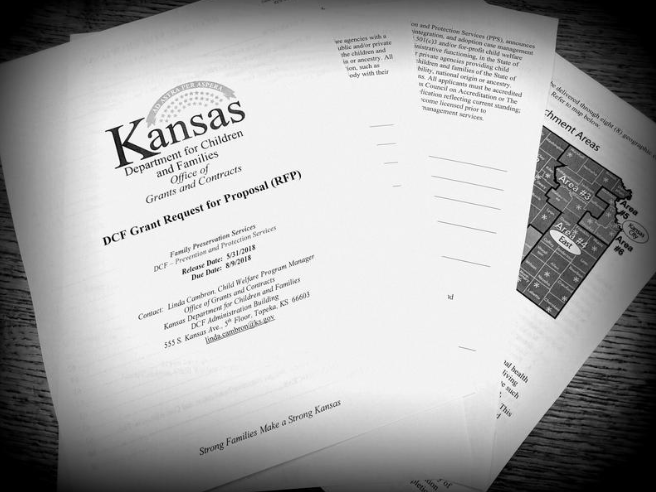
The Kansas child welfare agency is splitting foster care from family preservation services.
The Department for Children and Families put out its call for separate grantees Thursday.
The state’s two current contractors — KVC Kansas in the Kansas City metro and eastern region, and St. Francis Community Services in Wichita and the western region — have been managing foster care and services aimed at keeping struggling families together.

SCOTT CANON / KANSAS NEWS SERVICE
Under the new grant structure, no one agency will handle both in the same region, and DCF will have closer oversight over how state dollars are used than under the old contract system.
Family preservation services will be divided across the four current regions: East, West, Kansas City and Wichita. Foster care will be split into eight smaller areas.
DCF also says the new grants will allow family preservation to be more tailored, with services lasting anywhere from six weeks to 12 months. Contractors and child welfare workers have expressed frustration with the current one-size-fits-all approach that limits agencies’ caseloads and keeps families on a one-year timeline.
Kansas privatized its foster care system in 1997 after a lawsuit revealed widespread problems and bad outcomes for children. Since then, the state has directly contracted with several agencies for foster care and family preservation, which in turn subcontract some services.
Now separating family preservation and foster care will “eliminate perceived conflicts of interest,” DCF said in a news release.
Christie Appelhanz, executive director of the Children’s Alliance of Kansas, which DCF contracts to provide training to foster families, said the new structure could be a step in the right direction.
“The reason we privatized child welfare was for innovation and healthy competition,” she said. “With additional contractors, I think we will better get to that point for kids and families.”
It might, she said, also level the playing field for smaller providers. Providers that couldn’t compete with agencies handling all child welfare services in a region before could now make a play for state grants to manage just family preservation, or just foster care, in that area.
KVC spokeswoman Jenny Kutz said the agency is considering DCF’s new request for proposals, but can’t yet speak to which regions and services they will apply to manage, if any. KVC has been a contractor for DCF since the agency privatized foster care 20 years ago.
Janis Friesen, spokeswoman for the other current contractor, St. Francis, said it won’t be releasing any information about its proposals before submitting them to DCF, citing the competitive nature of the bidding process.
“We have a long history of serving the State and its children and families, and we hope to continue doing that wherever possible,” she said in an email.
One “elephant in the room,” as Appelhanz described it, is whether more faith-based organizations will throw their hats into the ring for the state grants after the legislature passed a controversial bill allowing adoption and foster care subcontractors to turn away families who don’t fit with their religious beliefs.
DCF Secretary Gina Meier-Hummel and Gov. Jeff Colyer said the new law would keep religious providers in Kansas and attract additional providers not yet operating in the state.
Opponents of the religious exemption questioned its timing, as it came up for debate in the same year DCF’s child welfare contracts were expiring.
“I do have concerns about the timing of this [bill], that it may impact which providers receive consideration for contracts,” Joni Hiatt, director of the advocacy organization Foster Adopt Connect in Kansas, said ahead of the final vote on the measure last month.
DCF’s new request for child welfare proposals specifically requires that grantees serve everyone referred for services, regardless of “race, religion, color, sex, disability, national origin or ancestry.”
DCF said it will also be soliciting bids for a single electronic system to match kids with foster homes and store records for youth in care statewide.
Currently, each provider has its own system, making it difficult for the state to have accurate data on where there are available beds.
Hiatt with Foster Adopt Connect called the plans for a central placement system a “huge step forward,” saying in an email that it will, “remove the financial incentive for the agencies to only place children in their own licensed homes for monetary reasons.”
Madeline Fox is a reporter for the Kansas News Service. You can reach her on Twitter @maddycfox.
Kan. store owner admits selling fake Coach purses, Rolex watches

OLATHE, Kan. (AP) — The owner of a suburban Kansas City store pleaded no contest to selling fake designer merchandise at her store.

65-year-old So Wun Pak pleaded no contest Thursday to a felony charge of counterfeiting merchandise worth between $1,000 and $25,000. The fake merchandise included Coach purses and Rolex watches.
A judge then found her guilty and scheduled sentencing for July 26.
Pak was charged last November after authorities searched her Mission business, Sue’s Accessories, and confiscated a large amount of merchandise.
In exchange for plea, Johnson County prosecutors dismissed a charge of deceptive commercial practices.
GOP candidates with same name seek Kansas congressional seat

TOPEKA, Kan. (AP) — A Kansas congressman is crying foul after a candidate who shares his name signed up to run against him in the Republican primary.

Rep. Ron Estes won a tougher-than-expected special election last year for the Wichita-area seat formerly held by U.S. Secretary of State Mike Pompeo.
The other Ron Estes from Wichita on the August primary ballot describes himself online as a father of two and a first-time candidate. Campaign finance records show he and his wife have made multiple contributions to Democrats though both are registered Republicans.
The incumbent’s campaign sees the filing as an attempt to deceive voters. The challenger didn’t immediately return messages Friday seeking comment.
The state plans to list the incumbent as Rep. Ron Estes and the challenger as Ron M. Estes.
No death penalty in fatal shooting of Kansas police captain

KANSAS CITY, Kan. (AP) — A man charged with fatally shooting a Kansas City, Kansas, police captain will not face the death penalty.

Wyandotte County prosecutors announced Friday they will not pursue the death penalty for 22-year-old Jamaal Lewis. He is charged with capital murder in the death of 46-year-old Robert David Melton.
On Friday, Lewis waived his preliminary hearing and pleaded not guilty.
In return for dropping the death penalty, attorneys agreed not to pursue a defense of mental disease or defect for Lewis.
The trial is scheduled for Nov. 5.
Melton was shot in July 2016 while assisting other officers searching for suspects in a drive-by shooting. Melton was hit when the suspect fired several shots through window of his patrol vehicle.
Man sentenced for DUI crash that killed Kansas woman, 2 children

JUNCTION CITY —A Geary County District Court Friday sentenced Steven W. Johnson, 45, Houston, TX., has been sentenced to 14-years in prison for a November 2016 fatal crash.

Johnson was the driver of an International truck that was eastbound on Interstate 70 at a location east of Grandview Plaza. The truck entered into the median and onto the westbound lanes where it struck a Ford 500 driven by Jessica Michelle Thompson, Junction City.
Thompson and her daughter, 5-year old Leah Michelle Thompson were pronounced dead at the scene. Her son, Jaydon Allan Thompson, 6, was transported to Wesley Medical Center in Wichita where he died.
Johnson was charged with three felony counts each of Murder in the Second Degree – Reckless, three felony counts of Involuntary Manslaughter – DUI, and misdemeanor charges including one count each of DUI and Possession of Phencyclidine. But following negotiations between the prosecution and defense there was a plea agreement in which Johnson pleaded guilty to one count of second degree murder – reckless and to a pair of Involuntary Manslaughter charges.
Battling through emotion the families of the victims and Johnson testified in court before the sentence was announced.

Jessica Thompson’s mother, Michelle Martin, testified that family was everything for her daughter and everything was family. ” They’re gone, they’re never coming back. No parents should have to bury their loved ones one day before Thanksgiving.”
The husband and father of the three victims, Joey Thompson, was among those who testified, and remembered his son telling him when he grew up he wanted to play for the Dallas Cowboys. Joe Meador, the victim’s father and grandfather, remembered his daughter telling him she would always love him and asking him what he wanted for Christmas the last time he saw her. He added looking back, he knows what he wants for Christmas but can never have it.
Members of Steven Johnson’s family testified in support of him and also expressed sincere condolences to the victim’s families. Steven Johnson, in his comments before the court offered his condolences and apologized to the victims’ family, and “everyone affected by this terrible tragedy.” He stated, ” My actions were inexcusable.” He added he was sincerely sorry for the pain he had caused. Facing the family of the Jessica, Leah and Jaydon Thompson he concluded by saying “I can never apologize enough to you all. Sorry!”
Hays FFA member completes service as Kansas FFA Secretary


MANHATTAN — Marie Reveles, from the Hays FFA Chapter, completed her term as State FFA Secretary after helping lead the 90th Kansas FFA Convention May 30–June 1, on the Kansas State University campus. Reveles represented more than 9,000 Kansas FFA members during her 2017-2018 term.
After being elected State FFA Secretary in June 2017, Reveles traveled across the state sharing her passion for leadership, service and agriculture. She was one of six officers who presented workshops and speeches challenging high school students to serve their community in the spirit of this year’s convention theme, “I Can. We Will.”
When asked about her year as a state officer, Reveles said, “I have been blessed to have this year to serve the amazing members of the Kansas FFA Association. I have grown from all of the members’ overwhelming passion and love for learning and agriculture.”
Reveles marked the completion of her year of service by presenting her retiring address titled “Smile” at the opening session of the convention, Wednesday, May 30. To read the full text of her address, visit kansasffaconvention.org.
Reveles will be a sophomore majoring in agricultural education at Kansas State University next fall. Her other activities include Sigma Alpha and the College of Ag Ambassadors.
In addition to Reveles, the 2017–2018 FFA state officer team included: President Eli Ohlde, Clifton-Clyde Chapter; Vice President John Kennedy, Jackson Heights Chapter; Treasurer Quentin Umphenour, Jayhawk Linn Chapter; Reporter Riley Sleichter, Abilene Chapter; and Sentinel Skyler Denio, Hoxie Chapter.
Marie is the daughter of Javier and LaVerna Reveles. Her advisor is Curt Vajnar.

NW Kan. FFA Members earn Ford scholarships
 MANHATTAN — Local FFA members were among the 60 Kansas students awarded $1,000 Ford Trucks/Built Ford Tough Scholarships during the third session of the 90th Kansas FFA State Convention, May 30–June 1, 2018, on the Kansas State University campus.
The Built Ford Tough FFA Scholarship Program recognizes FFA members’ talents and accomplishments while encouraging their future academic achievements.
“We’re proud to recognize these student leaders for their commitment to FFA and the leadership they display in their chapters and their communities,” said Marie Reveles, Kansas FFA State Secretary. “We appreciate this financial support from Ford Trucks/Built Ford Tough which will further these students’ educational goals.”
This year’s recipients are from: Abilene — Elise Jones; Anderson County — Tessa Jirak, Shylie Scheckel; Arkansas City — Lindsay Noland; Atwood — Cauy Hayes; Buhler — Jacob Milburn, Lawson Schultz; Burlington — Cody Collins; Central Heights — Tyler Roberts; Centralia — Josh Hasenkamp; Centre — Max Svoboda; Chapman — Lindsey Anderson, Jamie Rock; Cheney — Sam Reno; Cherryvale — Colben Dodson, Natalee Morris; Cheylin — Rachel Keltz; Clay Center — Garrett Craig; Colby — Hayden Reinert; Columbus — Dylan Helwig; Ellinwood — Katelyn Reh; Ellis — Jaylinn Pfeifer; Ell-Saline — Bryce Lange; Erie — Katie Malone; Fort Scott — Kaleb Guilfoyle; Garden City — Abigail Murrell; Girard — Jessica Brynds; Goodland — Blaine Sederstorm; Haven — Connor Peirce, Sydnee Shive; Hillsboro — Callyan Lacio; Holcomb — Emma Mangels; Holton — Mason Chanay; Horton — Krstin Becker, Callie Hoobler; Humboldt — Hunter Nickell; Inman — Alyssa Leslie, Elizabeth Wood; Iola — Isaiah Wicoff; Jackson Heights — Judd Nelson; Labette County — Shyanne Jones; Louisburg — Kaitlyn Urban; Manhattan — Kyndall Norris; Marais des Cygnes Valley — Kali Holt; Marmaton Valley — Emily Smart; Marysville — Michaela Forst; McLouth — Emma Jolley; Minneapolis — Courtney Walker; Ottawa — Travis Lutz; Paola — Garrett Davidson; Riverton — Devin Elliott; Pleasant Ridge — Ariana Horton; Pleasanton — Logan Mattingley; Renwick — Peyton Niemann; Republic County — Amanda Baxa; Southwestern Heights — Emily Headrick; St. Francis — Mattisen Witzel; Tonganoxie — Rebekah Martin; Wellington — Abby Lowe; Wichita Southeast — Serenity Radford.