We have a brand new updated website! Click here to check it out!

Cattle Trace pilot program for disease traceability announced in Ellinwood

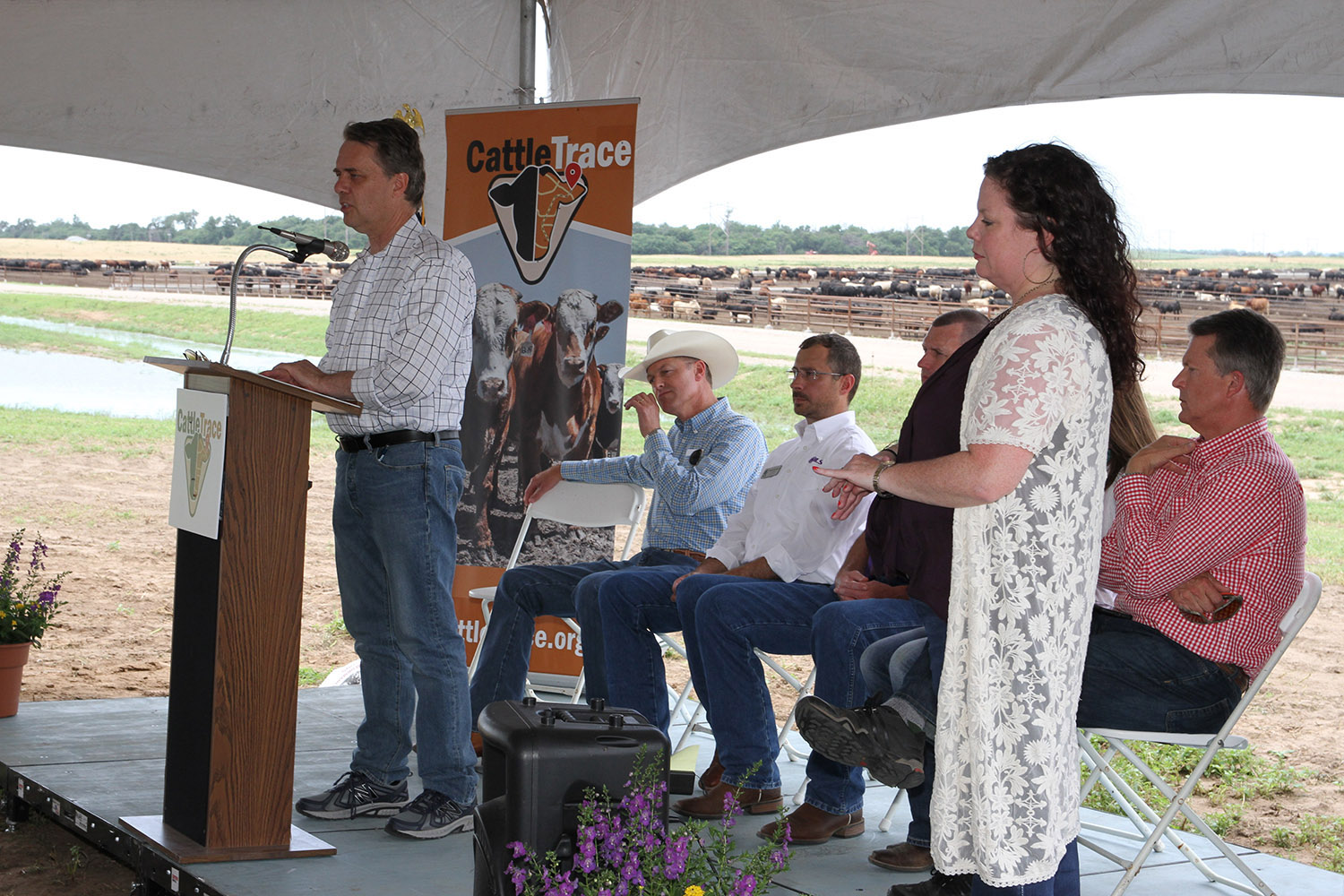
Governor Colyer addresses the crowd at Barton County Feeders to announce the creation of Cattle Trace, a pilot project to develop and test a cattle disease traceability system.

KDA

MANHATTAN — Governor Jeff Colyer and Secretary Jackie McClaskey joined leaders from the Kansas livestock industry on Saturday, June 30, at Barton County Feeders in Ellinwood to announce the Cattle Trace pilot project. Cattle Trace is a public-private partnership which will develop and test a purpose-built cattle disease traceability infrastructure in Kansas that will guide discussion and development of traceability on a national scale.

“Kansas is home to the finest beef producers and operations in the nation,” said Colyer. “We are proud that the Kansas beef industry has taken the lead in this important project that will enhance our ability to protect cattle health here and across the nation.”

Cattle disease traceability is an important component in the overall biosecurity of the U.S. beef cattle industry, playing a significant role in resuming and maintaining commerce in the event of a disease outbreak. The development of a viable end-to-end cattle disease traceability system is a top priority in the beef industry in Kansas and nationwide.

“KLA members have long recognized the importance of traceability for animal disease purposes to help protect their livelihoods and the industry,” said Kansas Livestock Association Chief Executive Officer Matt Teagarden. “We are excited to be part of this effort to move traceability forward for Kansas producers and ultimately the entire U.S. livestock sector.” KLA members amended policy in December 2017 to support mandatory cattle disease traceability for all ages of cattle. This policy shift provided momentum across Kansas to take action.

The Cattle Trace steering committee gathered at the announcement of the new pilot project (from left): Matt Teagarden, chief executive officer of Kansas Livestock Association; Justin Smith, animal health commissioner; Brandon Depenbusch, vice president of cattle operations for Innovative Livestock Services; Jackie McClaskey, Secretary of Agriculture; Mary Soukup, assistant secretary, Kansas Department of Agriculture; Cassandra Kniebel, project director, Cattle Trace; Brad White, director of the Beef Cattle Institute at Kansas State University; Kansas Governor Jeff Colyer, M.D.

From end-to-end, each step of the beef cattle supply chain exists in Kansas, positioning the state well to test an expanded system capable of informing and guiding development of an enhanced traceability system on a national level.

“We have the opportunity to develop a cattle disease traceability system on our terms. The capabilities of Cattle Trace will enable us to do the right thing for animal health and biosecurity, and for the entire U.S. beef cattle industry,” said Brandon Depenbusch, vice president of cattle operations for Innovative Livestock Services, a member of the Cattle Trace steering committee. ILS will be one of at least ten feed yards that will participate in the pilot project in addition to livestock markets, cow-calf ranches and beef processors.

In early 2018, the Cattle Trace collaborators began working to develop a purpose-built infrastructure to track cattle movement through the supply chain. Cattle Trace will utilize ultra-high frequency technologies to collect the minimal data necessary, including an individual animal identification number, a GPS location, and date and time, in order to track animals in the event of a disease outbreak. Tag readers will be located at livestock markets, feed yards and beef processors. Movement data collection will begin in fall 2018, and the project will continue for approximately two years.

“We know for a traceability system to be effective, it needs to be simple, fast, and affordable to make its adoption within the industry as seamless as possible,” said Brad White, director of the Beef Cattle Institute at Kansas State University. “We are working to build a system to test today and one that will serve the U.S. beef cattle industry in the future.”

Cattle Trace is a collaborative partnership between Kansas State University, the Kansas Livestock Association, the Kansas Department of Agriculture, USDA, and individual producer stakeholders. It is being jointly funded by public and private resources.

“The development of Cattle Trace is a direct result of proactive leaders in the Kansas beef industry recognizing an opportunity to develop a traceability system that works for producers,” said Secretary McClaskey. “We have seen tremendous leadership from industry partners ready to step up and take an active role on this critical issue.”

For more information about the Cattle Trace project, go to cattletrace.org or contact the program coordinator, Cassie Kniebel, at [email protected] or 785-564-7446.
Police catch Kansas felon accused in May altercation

SHAWNEE COUNTY — Law enforcement authorities are investigating a suspect on felony charges.

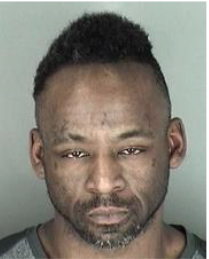
Ware -photo Shawnee Co.

Late Friday, police located and arrested 37-year-old Justin Martinez-Morocc Ware in connection with an alleged altercation on May 25, in the 1600 Block of SW Polk in Topeka, according to Captain J.N. Harden.

Ware is being held on suspicion of Aggravated Assault, Felon in Possession of a Firearm and Felony Obstruction, according to Harden.

Ware has previous convictions for robbery, Aggravated Battery, Criminal Damage to Property and Aggravated Battery with a weapon.

🎥 Fireworks allowed in Hays today through July 4

By BECKY KISER
Hays Post

It’s going to start getting noisy in Hays at 10 a.m. today in anticipation of the July 4th holiday.

The Hays city code allows fireworks to be discharged on July 2, 3, and 4 between the hours of 10 a.m. and 11 p.m. Fireworks may be sold in Hays during all hours on those dates.

According to Ryan Hagans, interim fire chief, all consumer fireworks legal for sale and use in Kansas are permitted to be sold and used in the Hays city limits. Bottle rockets and skyrockets are prohibited by state law.

City commissioner Shaun Musil reminds residents that persons using fireworks are responsible for cleaning up all debris.

“Please be smart and clean up your mess from fireworks, and be safe because there’s many people that absolutely hate fireworks,” Musil noted. “I think the last few years we’ve had very good luck with people taking care of them but please think about your neighbors when you’re shooting fireworks off.”

Those found in violation of the city code may be fined up to $500 and 30 days in jail.

The Wild West Festival Fireworks Spectacular is scheduled for 10 p.m. July 4.

Portion of 17th Street closed Monday

CITY OF HAYS

Beginning Monday, July 2, 2018, 17th Street in Hays will be closed between Allen Street and Pine Street for waterline work and will be reopened by the end of the work day. This work is part of the Allen Street Reconstruction Project.

Signs will be in place to direct the traveling public. Motorists should use caution in these areas.

The city of Hays regrets any inconvenience this may cause to the public. If there are any questions, please call the Office of Project Management at 785-628-7350 or the contractor, Paul-Wertenberger Construction, at 785-625-8220.

Hays school board to discuss establishing Chromebook pilot program

By CRISTINA JANNEY
Hays Post

The Hays school board is set to vote Monday on program to study the use of Chromebooks in the district.

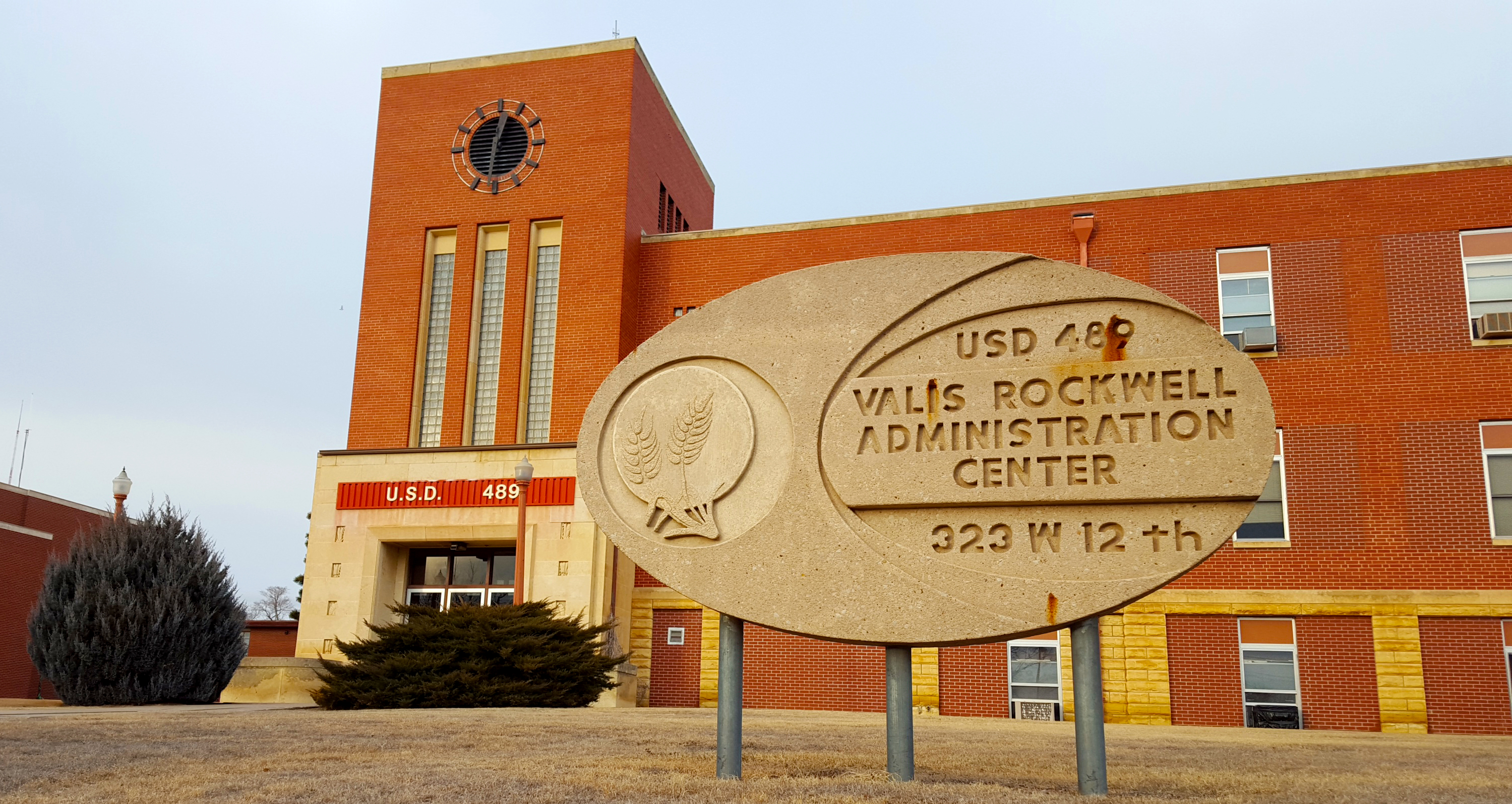
The board will meet at 6:30 p.m. at the Rockwell Administrative Center.

The program would include purchasing Chromebooks for students at the Learning Center, a middle school class and an elementary school class.

The total cost for 70 Chromebooks, licensing and teacher training would be $22,543.

The board recently approved the purchase of Dell computers for high school students. During that debate, some board members expressed frustration the technology committee did not present an option with Chromebooks. Several board members thought Chromebooks might be a cheaper option.

Board member Greg Schwartz asked at the board’s June 25 meeting, why the pilot program included Chromebooks with touch screens.

Superintendent John Thissen said the students are currently using computers with touch screens and Chromebooks with touch screens would be a more equitable comparison.

Schwartz said he wished to see the pilot program use the less expensive option in the Chromebooks that did not have touch screens.

The board will also vote on a number of annual reorganization motions. The board will vote on the president and vice president as well as a variety of appointments.

The board is also set to vote on student handbook revisions. Thissen said during the June 25 meeting there were not significant changes to the handbooks.

In other business, the board will:

• Discuss the establishment of the district mileage reimbursement rate.

• Discuss Kansas Association of School Boards policy recommendations.

Kathryn L. Miller

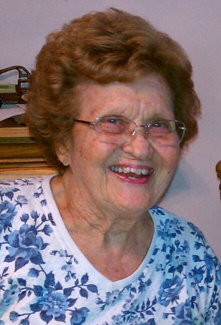
Kathryn L. Miller, 90, a lifelong resident of the Bison, Kansas, area died June 28, 2018, in Wichita after a long battle with Alzheimer’s disease.

Kathryn was born in Otis, Kansas, to Fred, Sr., and Agnes (Funk) Jones at the family farm on March 10, 1928, where she was raised with her siblings. After attending college, Kathryn became a one-room schoolhouse teacher for 1st-8th grade students, teaching for 13 years. A devoted farmer’s wife, Kathryn helped run the farm for decades before moving on to other ventures. Kathryn’s later pursuits included tax preparation, helping run Miller Custom Homes, managing the local Texaco gas station, and working as a real estate broker. She also enjoyed travelling in later years to destinations varying from Cozumel, Mexico, to Alaska. She was renowned for her delicious cooking and her brilliance as a grandmother.

Kathryn married Virgel Miller on May 23, 1953. He preceded her in death in July 2016 after 63 years of marriage.

Survivors include three daughters: Kay Boyd (Austin) of Wichita; Renee Nicholson (Leonard) of Hoisington; and Teresa Miller of Wichita; six grandchildren: Melissa Baier of Wichita; Kelsey Beckman of Wichita; Josh Nicholson (Melissa) of Hoisington; Jeremy Baier (Jenna) of Bloomington, IL; Derek Nicholson (Brittni) of Hoisington; and Cameron Beckman (Shannon) of Wichita; and five great-grandchildren: Azalea and Jersey Baier; Abel Nicholson; Presley Beckman and another one on the way. She is also survived by a sister, Nila Hartman, of Fort Collins, Colorado; sister-in-law, Maureen Jones, of Dodge City; and many much loved nieces and nephews.

She was preceded in death by her parents; brother, Fred Jones, Jr.; and brother-in-law, Nelson Hartman.

A viewing will be from 4:00-8:00 p.m. on Sunday, July 1, 2018, with the family receiving visitors from 6:00-8:00 p.m. at Janousek Funeral Home, La Crosse.

A viewing will also be held from 1:00-1:50 p.m. on Monday, July 2, 2018, with a celebration of life beginning at 2:00 p.m. at Janousek Funeral Home. Interment will follow at La Crosse Cemetery.

In lieu of flowers, memorials are suggested to the Walnut Valley Senior Center or the Alzheimer’s Association.

Arrangements are being handled by Janousek Funeral Home, 719 Pine Street, P.O. Box 550, La Crosse, Kansas 67548.

Exploring Outdoors Kansas: I’d say these guys deserve a shot!

Steve Gilliland

Between my nieces and other high school kids at church, I’m familiar with the term “Going to Nationals,” and it usually means national livestock judging, national scholars bowl etc. But to a group of 7 Nickerson High schooler’s, “going to nationals” carries a slightly different meaning, as they are going to compete in the first ever USA Clay Target League National Championship tournament at Mason, Michigan, where they will shoot against nearly 2000 other high school trap shooters.

Trap shooting is the fastest growing sport in the US, with an average of 3 states adding high school teams each year. Two years ago 13 Kansas high schools had trap shooting teams, last year there were 36 high school teams here in the state and this year there are 59 Kansas high school trap shooting teams with over 1250 shooters. Thirteen Kansas colleges now offer trap shooting scholarships, some of them “full rides,” and about 21,000 colleges nationwide have trap shooting teams.

Clay target shooting comes in 3 forms; sporting clays, skeet and trap. Sporting clays is shot on a course set up in a woodland setting where shooters move from station-to-station and is the nearest to actual hunting conditions. Skeet shooting is done on a dedicated range where clay targets are thrown high or low across in front of the shooters. Trap shooting is done on a range where clay targets come from a “trap house” (thrower) at various angles in front of the shooters and are always going away from them.

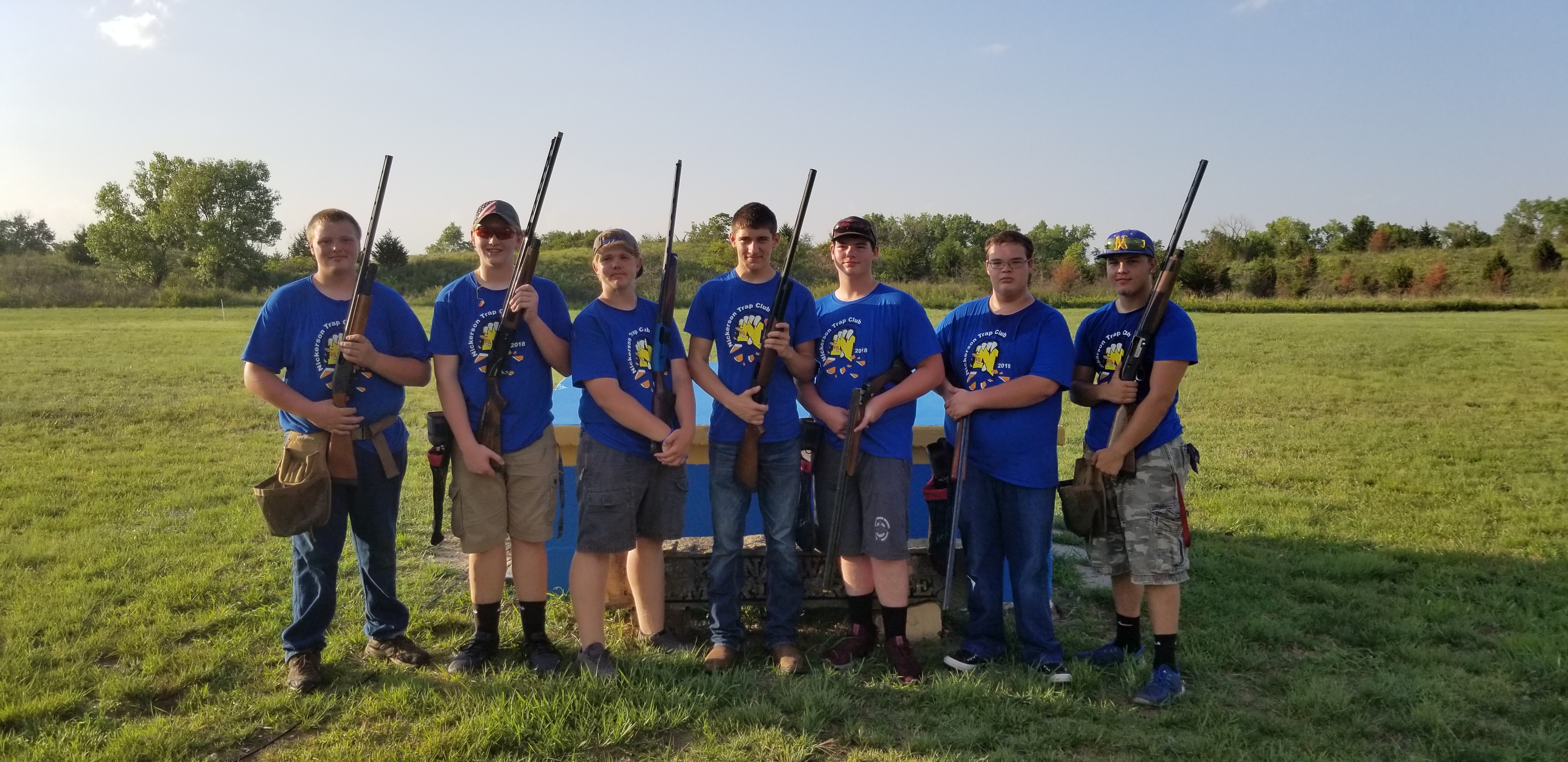
From left: Jordon Schmidt, Joe Tuxhorn, Chris Oden, Clayton Edwards, Matthew Meadows, David Graham, Eric Malecki.

The USA High School Clay Target league allows team members to be 12 years old through 12th grade.

Currently in its third year, the Nickerson Trap Club has 21 members, 19 boys and 2 girls, and the 7 that qualified for the national tournament are high school boys. Chris Oden, David Graham, Joe Tuxhorn, Mathew Meadows and Eric Maleckie are the 5 primary shooters and Clayton Edwards and Jordan Schmidt are the alternates. The 3 coaches are Travis Oden, Jeff Harbert and Larry Meadows. All 7 guys and all 3 coaches are also hunters, and it sounds as though that’s a common denominator among most team members.

I asked the guys why they got into trap shooting and got responses like “I like shooting guns,” “Because it doesn’t interfere with other team sports during school,” and “It’s safer than most team sports.” But the response overwhelmingly echoed by all shooters was “Because anyone can do it; it’s a co-ed sport and it doesn’t matter who you are or where you come from. You don’t have to be a jock and it’s a sport you can enjoy for the rest of your life.” That sounds like my kind of fun!

Coach Larry meadows told me “Trap shooting is all about hand / eye coordination. He said “you can’t teach that, but you can coach people how to get better at it.” New or inexperienced shooters are started by positioning them mush closer to the trap house where the targets come from. The coaches watch over their shoulder as they shoot and tell them which way to adjust when they miss targets. Coaches suggest how they stand, how they hold their shotgun and position themselves and how to line up on targets, but in the end, Meadows says each shooter has to find what works best for them. As new shooters get better, they are moved back to the normal shooting line.

At the Michigan tournament, there will be both team and individual competitions. 288 teams of 5 will participate in the team event and 1200 in the individual competition. The course is massive and made up of 44 trap houses stretching for ¾ of a mile. Team shooters will begin by shooting 2 rounds of 25 targets each, take a break then shoot 2 more rounds, 100 targets total. After all teams have completed the first go-around, the top scoring teams will advance. That will repeat, eliminating teams each time until the championship is decided.

YOU FOUND IT! Click the picture for a chance to win Wild West Festival VIP tickets!

During my evening spent with the Nickerson shooters, it was mentioned numerous times just how safe the sport of trap shooting is. At each practice 1 coach assumes the role of range safety officer and strict safety rules are enforced. It’s estimated that this year alone nationwide in the USA High School Clay Target League there have been 28 million trigger pulls without injury! Also noteworthy is that although Nickerson High is financially helping the team get to the tournament, until now the team has been totally self-supported. Getting to participate in this national tournament required the guys to qualify, and they did so by qualifying among the top 5% of teams in the nation; if that doesn’t sufficiently impress you, maybe you should take up knitting!

Continue to Explore Kansas Outdoors.

Steve Gilliland, Inman, can be contacted by email at [email protected].

George Crawford III

George Crawford III, age 46 of Ellis, passed away Friday, June 29, 2018 in Ellis.

Funeral services will be 10 AM Wednesday, July 4, 2018 at St. Mary’s Catholic Church in Ellis.

Visitation will be Tuesday 6 PM – 8 PM with a combined Knights of Columbus rosary and parish vigil service at 7:30 PM all at the church.

Arrangements and a complete obituary are pending with Keithley Funeral Chapel 400 E 17th street Ellis, KS 67637

Frances I. Berkgren

OAKLEY — Frances I. Berkgren, 82, died Saturday, June 30, 2018 at Logan County Hospital – Oakley, KS.

Services are pending with Kersenbrock Funeral Chapel in Colby.

Vera M. Saddler

COLBY – Vera M. Saddler, 94, died Monday, July 2, 2018 at Prairie Senior Living Complex – Colby, KS.

Services are pending with Kersenbrock Funeral Chapel in Colby.

Frances Irene Berkgren

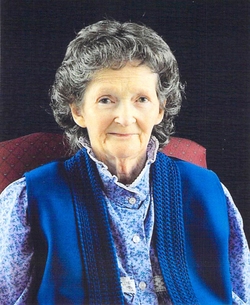
Frances Irene Berkgren, 82, was born September 2, 1935 at Pinoak, Pennsylvania to Earl and Irene Louie Hagerty Stephens. She and her brother, Frank, were the second set of twins in the family. The other set of twins are John and Joan. Frances graduated from Cranberry High School, Cranberry, Pennsylvania in 1953. She graduated from Vennard College, University Park, Iowa in 1968. She worked at various mission fields, including Bethany Children’s Home in Kentucky, and the Salvation Army Home and Hospital in Cleveland, Ohio. Frances had a special place in her heart for the American Indians, having worked at Brainerd Indian School, Hot Springs, South Dakota and All Tribes Indian School, Bernalillo, New Mexico, and worked with missionary friends in South Dakota and New Mexico. She also enjoyed going to Mexico to help the missionaries.

Frances met her first husband, Rev. Harry A. Zufall, at Brainerd Indian School. They were married Nov. 20, 1970 at Morgantown, West Virginia. They ministered together in South Dakota, New Mexico, and pastored churches in Pennsylvania and Oklahoma. Rev. Zufall passed away at Miltonvale, Kansas May 26, 1983.

Frances was married to Harold Berkgren Nov. 21, 1987 at the Clay Center Bible Methodist Church (Alabama Conference). Harold passed away Nov. 1, 2008.

She enjoyed playing the piano, organ, keyboard, and cow bells. She also enjoyed being a Senior companion. She enjoyed crocheting baby afghans and writing poetry.

Frances was preceded in death by her parents, baby sister Dorothy Maxine, sister Evelyn Audine Kerr and brothers Roland Earl, Williard Arden, twin brother Frank Roger, baby sister Maxine Dorothy, and beloved sister Joan Ruth Sheffer. She is survived by brother John Edwin and wife Chris, Kennerdell, Pennsylvania and sister in law Miriam Stephens, Reading, Pennsylvania, and several nephews and one niece.

Frances passed away Saturday, June 30th at Logan County Hospital

Funeral Services will be at 10:30 a.m., Thursday, July 5th at the Wesleyan Church in Oakley, Kansas. Visitation will be from 3pm – 5pm Wednesday, July 4th at the Wesleyan Church. Memorials to Logan County Hospital Hanson Apartments.

Summer Reading Camp combats the summer slide

Mandy Meagher, Wilson kindergarten teacher, works on a project with one of her Summer Reading Camp students.

By CRISTINA JANNEY
Hays Post

Thanks to a grant, 120 students in the Hays school district were able to shore up their reading skills during the summer.

A grant from the Dane G. Hansen Foundation allowed USD 489 teachers to choose 10 students from each school in grades K-2 for a free Summer Reading Camp. The students attended classes two hours per day three days a week through the month of June.

Free transportation and snacks were also offered to the children.

The children practiced independent reading, read in groups, had an author visit, went on trips to the Hays Public Library, worked on phonics and practiced writing skills.

One of the goals of the program was to help all the children in program get their own library cards, so they could go back to the library and check out their own books.

A student takes advantage of individual reading time.

Teacher Aubrey Brooks of Roosevelt Elementary School said students tend to lose some of their skills during the summer.

“A lot of times during the summer the kids slide a little,” she said. “They slide back a little. We really think this is going to keep what they have done during the school year — to keep up those skills and move forward a little bit.”

Brooks said she has seen growth in children — some increasing their skills by a reading level. Practice is the best way to learn reading, and Brooks said the program has created an environment for the children to do that.

“The problem with the summer is children aren’t always reading and practicing their skills, and this is a way to make sure that is happening,” Brooks said. “This makes sure they are still using those skills and practicing their reading and their writing.”

Mandy Meagher, Wilson kindergarten teacher, said she is also trying to promote reading and writing practice among her students.

Students work on a writing assignment during Summer Reading Camp.

“It takes lots and lots of practice. Reading and writing are both skills you have to learn just like riding a bike or playing the piano,” she said. “The more you use those skills and  practice those skills, the better you become. Just giving these kids that extra opportunity to practice those skills with a little bit of guidance will help them continue (to grow) and help them for first grade.”

Meagher said she thought the smaller groups and individual approach has helped the children in the program grow their skills. She said she wished the district could offer it for every child.

This is the first year for the program, and Brooks said she and the other teachers hope they receive the grant next year.

“This has been really wonderful for the kids,” she said. “The kids love it. They really want to come. We make it engaging for them. Our philosophy is that we want to make it exciting — reading and writing we want to make it exciting for the kids, so it is something they want to do.”

Brooks suggested parents continue to encourage their children to read and write during the summer.

“A blank piece of paper and a pen is enough,” she said. “It doesn’t need to be guided writing—just whatever they feel to get used to it and get comfortable with it. And to find a love of reading. That is something through this program and through the school year we try to get children to do so that they feel like they can go on an adventure and make reading exciting and see it in a positive way.”

Students take a survey about what they liked about the Summer Reading Camp.

Meagher said she agreed.

“The best thing you can do from the time they are a baby to the time they are older is to read to them because hearing those words and the fluency and the vocabulary helps them gain. Hearing those books is very important for their development and for them to be ready for school.

“I told my kindergarten class three things I wanted them to do everyday before they left. I wanted them to read a little bit. I wanted them to write a little bit, and I wanted them to have fun and be safe. If they spend just a little time everyday, it will continue that growth because both of those skills just need continual practice.”


Road project underway in Ellis

ELLIS — The Ellis County Public Works Department crews will begin a cold in place asphalt recycling project this week on Ellis Avenue in Ellis.

Crews will begin working at the Fairground Road and Ellis Avenue intersection and continue north on Ellis Avenue for 1 mile ending at the intersection of 18th Street and Monroe Street in Ellis.

The 1-mile stretch will be closed to through traffic during while crews work on the project. Motorists traveling in the affected closure area should use alternate routes of travel until the project is complete.

The project is expected to take one to two days to complete.

Copyright Eagle Radio | FCC Public Files | EEO Public File