TOPEKA – Governor Jeff Colyer and the Kansas Department of Health and Environment (KDHE) announce that Vital Statistics certified records are now available through the State of Kansas’ iKan app. The application allows residents to request birth, marriage, divorce and death certificates from their computer or mobile device, eliminating the need to visit a physical office in person.
In March, Governor Colyer introduced the iKan app to allow users to interact with multiple State services in a single self-service, intuitive experience from their mobile phones, tablets and computers. At the initial launch, the app allowed Kansas residents to remotely renew their vehicle registration. The app, which now includes Vital Statistics records, makes it easy to request official documents from anywhere with an internet connection and using technology most people carry with them everywhere.
“In today’s rapidly changing world, it is becoming increasingly important that we ensure government keeps pace with innovation and that we are taking advantage of technology to provide the best possible experience to those we serve. By quickly giving Kansans access to this important information, we are taking steps to do just that,” said Governor Colyer. “I’m excited to add another State agency to the list of iKan participants.”
Kansas Department of Health and Environment (KDHE) Secretary Jeff Andersen, added “iKan has already partnered with State government to facilitate vehicle registrations and other services. Today’s announcement is great news for Kansas and will make obtaining vital records much easier, while also decreasing lines and wait times in government offices.”
iKan is made available through PayIt, a Midwest-based technology firm specializing in the simplification of government transactions across the country, including taxes, utilities, court records, and more as part of their cloud-based platform. PayIt has provided the myKTag app for the Kansas Turnpike since 2014.
Once a Vital Statistics record is requested using iKan, depending on the delivery method selected, the requestor will be notified by text when the record is available for pick up or have it delivered within seven to 10 business days. Cost for a record and the processing fee through the app is $20. To download the app, search “iKan State of Kansas” on your iPhone and Android devices.
WICHITA, Kan. (AP) — A federal judge imposed on Wednesday more than $26,000 in sanctions against Kansas Secretary of State Kris Kobach as punishment for his “contemptuous behavior” during a voting rights case that challenged the state’s proof-of-citizenship registration law.
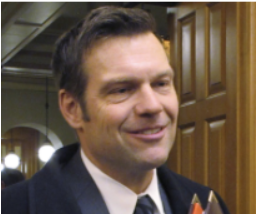
Kobach CREDIT FILE PHOTO / KANSAS NEWS SERVICE
U.S. District Judge Julie Robinson found Kobach in contempt in April stemming from a 2016 preliminary injunction. The decision handed down Wednesday specified the amount of attorney fees and expenses awarded after considering arguments from the parties.
Robinson ruled in June that Kansas cannot require documentary proof of U.S. citizenship to register to vote, finding such laws violate the constitutional right to vote. That decision struck down the Kansas proof-of-citizenship registration law and made permanent the earlier injunction that had temporarily blocked it.
In issuing the latest sanctions, Robinson said Kobach failed to ensure local election officials sent voter registration postcards to people who registered when applying for a Kansas driver’s license or when using a federal form, regardless of documentary proof of citizenship, after she issued her initial order. She also noted that until recently the county election manual advised local election officials that people needed to submit citizenship paperwork to register to vote.
Kobach did not respond to cellphone, text, and email messages left with his spokeswoman, and his cellphones were not accepting any more messages.
Dale Ho, director of the American Civil Liberties Union’s voting rights project, said Kobach remains the only person for whom he’s sought a contempt citation during a federal lawsuit. He said Kobach had engaged in “willful bad behavior.”
“The court sent a message that it’s unacceptable to defy court orders, as Mr. Kobach has done, unacceptable to give voters incomplete or misleading information, which Secretary Kobach has done,” Ho said. “The whole purpose of fines like this is to deter conduct like that.”
Ho added: “Something I’ve learned from this case is that Secretary Kobach does not own up to his behavior and take responsibility for it.”
Robinson wrote in her ruling that the services provided by the attorneys representing the voters in the case were “undoubtedly multiplied” by Kobach’s conduct that led to the contempt finding.
Instead of responding to the ACLU’s initial efforts to informally resolve the compliance issues, Kobach insisted for months that he need not comply at all. Almost five months later, Kobach took the position that he had taken the very compliance measures he initially disclaimed. That “needless gamesmanship” led to another round of letters, meetings, written filings and ultimately a three-hour contempt hearing in March, according to the decision.
“The Court will award the reasonable value of counsel’s services directly caused by Defendant’s contemptuous behavior,” Robinson wrote.
Robinson awarded $24,658 in attorneys’ fees and $1,557 in expenses as a sanction for the contempt found by the court in its April order.
The amount of sanctions fell short of the more than $50,000 initially sought by the ACLU after the judge reduced the claim due to lack of details in records, the excessive number of attorneys working on the tasks and duplication of work.
As for the reduction in the ACLU’s proposal, Ho said the original amount was calculated based on the time ACLU attorneys spent on their contempt motion. He said in such cases, attorneys typically will reduce the totals before the judge considers it, but the ACLU decided to let the judge decide the issue.
CHICAGO (AP) – Alex Gordon hit a two-run homer and drove in four, helping the Kansas City Royals pound the sloppy Chicago White Sox 10-5 on Wednesday night.
Gordon also walked and scored during Kansas City’s five-run fifth. Brett Phillips added two hits and Ryan O’Hearn singled in a run in his second major league game as the last-place Royals posted consecutive wins for the first time since they won three in a row from July 20-22, matching their season high.
Jakob Junis (6-11) pitched 5 2/3 innings of four-run ball in his first win since May 18. The 24-year-old right-hander was 0-8 with a 6.67 ERA in his previous 10 starts.
Chicago lost for the sixth time in seven games. Yoan Moncada broke out of a slump with his fifth career leadoff homer, two hits and two walks, but he also committed one of two costly errors for the White Sox.
With one out and runners on first and second in the fifth, lumbering Kansas City catcher Salvador Perez hit a hard grounder to third. Yolmer Sanchez threw to second looking to start a double play, but the ball went off the top of Moncada’s glove and into right field.
Whit Merrifield jogged home to make it 4-1 Royals. Lucas Duda, Rosell Herrera and Phillips followed with run-scoring hits, and a wild pitch brought home another run before Alcides Escobar lined to right for the final out of the inning.
Another error – this one on a bad throw by pitcher Dylan Covey (4-7) – helped set up Gordon’s two-out, two-run double in the third. Covey was charged with seven runs, four earned, and five hits in 4 1/3 innings, dropping to 1-5 with an 8.89 ERA in his last six starts.
Gordon’s drive to right off Tyler Danish made it 10-1 in the sixth. It was Gordon’s first homer since July 10 and No. 7 on the year.
Junis, who is from Rock Hills, Illinois, about two hours west of Chicago, allowed six hits, struck out five and walked three. He surrendered five homers in 5 2/3 innings in a 6-3 loss to Chicago on April 26 in his first career appearance against the White Sox.
Junis was pulled after Leury Garcia’s two-run single in the sixth. Garcia also had an RBI single in the eighth against Glenn Sparkman.
UP NEXT
Royals right-hander Brad Keller (4-4, 3.43 ERA) and White Sox right-hander Reynaldo Lopez (4-9, 4.57 ERA) pitch in the series finale Thursday afternoon. Keller, who turned 23 on Friday, has won each of his last two starts. Lopez is 0-4 with an 8.72 ERA in his last four games.
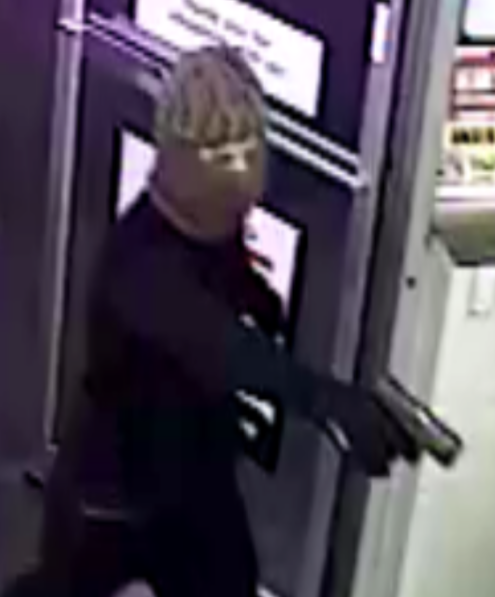
TOPEKA, Kan. – Police are attempting to identify suspects from three recent robberies in Topeka.
Security camera images courtesy Topeka Police
The first occurred just before midnight on July 19, at a KWIK shop in the 2600 Block of SW 21st Street.
The second, an attempted aggravated robbery and aggravated assault occurred on just after 9:30a.m. on July 20 at Dollar General, 3401 SW Topeka Boulevard.
On July 30 at 10:46p.m., police reported an armed robbery at the Kwik Shop in the 1400 Block of SW 17th Street.
Anyone with information is asked to contact police.
MANHATTAN — The Division of Conservation at the Kansas Department of Agriculture is pleased to announce the availability of funds to assist landowners with their efforts to mitigate the impact of drought.
The Livestock Water Supply Financial Assistance Initiative will provide financial assistance for livestock water supply wells, pipeline and tanks installed after June 1, 2018, and before the announcement of the Environmental Quality Incentives Program (EQIP) Drought Initiative by NRCS on July 24, 2018.
The State Conservation Commission took action on July 31, 2018, to approve the initiative for these qualifying drought mitigation efforts that took place prior to the NRCS EQIP Drought Initiative. Eligible areas will be the same as for the federal initiative.
Additional program details can be found at agriculture.ks.gov/DOC-assistance. Applications must be made through local conservation districts, and questions should be addressed to local conservation districts as well. Contact information for districts can be found at agriculture.ks.gov/conservation.
TOPEKA—The Information Network of Kansas (“INK”) Board of Directors has approved a $300,000 grant request by Governor Jeff Colyer, M.D. to complete a Statewide Broadband Mapping project.
The project, which will be undertaken by non-profit Connected Nation in partnership with the Governor’s Office, will prepare a statewide broadband map of wireline and wireless coverage. This map will provide the Statewide Broadband Expansion Planning Task Force, created when Governor Colyer signed Sen. Sub. for House Bill No. 2701 into law, with a snapshot of broadband coverage in the state. The map will assist the Task Force in its efforts to identify and close broadband coverage gaps in Kansas.
“Access to quality broadband services is vital for Kansas communities to compete for jobs and people, and we can’t improve what we don’t measure,” said Governor Colyer. “Producing this statewide broadband map positions our state for long-term growth in the rapidly expanding digital economy and helps us ensure that all Kansans are benefiting from these new opportunities.”
Connected Nation will produce a granular statewide broadband availability map through a data collection process in collaboration with the state’s broadband service providers, for use by the general public and the Task Force. Connected Nation will also collect public feedback on the initial draft of the map and will deploy engineers into the field to validate service availability (or the lack thereof) based on the feedback received in order to improve the map over time.
“Just as roads, bridges, water systems, and the electrical grid serve as critical infrastructure today, so, too, is fast and reliable broadband access,” said Brent Legg, Vice President of Government Affairs at Connected Nation. “Unfortunately, information collected on broadband at the federal level isn’t accurate or granular enough to effectively guide policymaking and get broadband to the areas that need it. Governor Colyer recognized this need, and thanks to INK’s grant, we will now have the resources to identify and map the areas that still lack service across Kansas.”
In addition to tackling a number of broadband-related issues, the Task Force will evaluate and provide input to the mapping process based on preliminary feedback and results of Connected Nation’s work later this year.
“As Co-Chairs of the Statewide Broadband Expansion Planning Task Force, we strongly commend Governor Colyer for his initiative with this grant application and are excited to hear about the funding of the vital statewide broadband mapping project. This map will assist the Task Force as we work to expand broadband infrastructure and increase statewide access to broadband services for our fellow Kansans,” stated Senator Rob Olson and Representative Joe Seiwert, who also both chair their respective legislative chamber’s telecommunications issue committees.
Governor Colyer selected Rich Felts, President of Kansas Farm Bureau (KFB), as his at-large appointment to the Task Force.
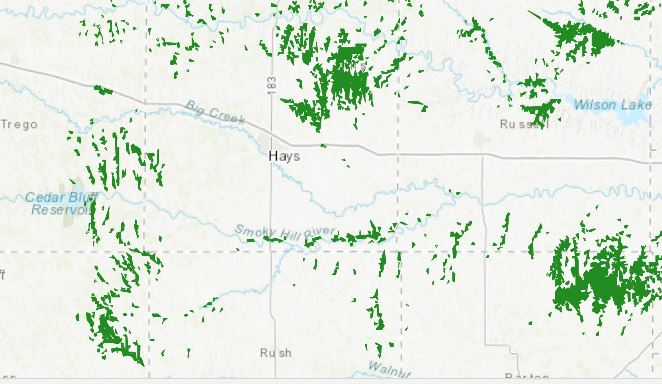
Mobility Fund II Initial Eligible Areas map
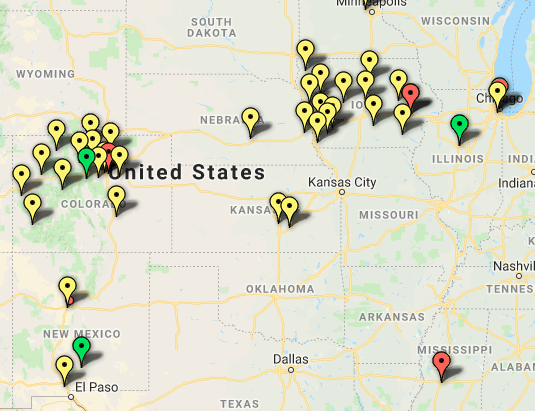
KFB was recently granted a waiver from the Federal Communications Commission (FCC) to challenge its Mobility Fund Phase II (MFII) eligibility map, which will determine where $4.53 billion in subsidies for LTE broadband service buildout will be directed across the country over the next 10 years. KFB is working with their members and Kansans from all over the state to conduct speed tests to show the need to increase the number of eligible areas in Kansas (see www.kfb.org/ConnectingKansas).
“Kansans in every county of the state know where the shortcomings on broadband connectivity reside,” KFB President Rich Felts said. “Having an up-to-date map that accurately reflects areas that lack connectivity in both wired and wireless broadband will allow for future broadband development to improve public safety, and enhance agricultural technology, education, telemedicine and economic vitality.”
In June, the Governor’s Office received another grant from the INK Board in the amount of $225,000 to conduct professional mobile service drive testing and file its own challenge to expand eligible areas under the FCC’s MFII program. Alongside KFB, the Governor’s Office will dispute areas that are currently considered ineligible for MFII buildout support. If the challenge is successful, it could potentially unlock millions of dollars in MFII support for LTE service buildout in rural Kansas. The Governor’s Office will be working with Connected Nation to administer the drive-testing process in targeted areas believed to have limited or no cellular service today.
Also in June, Governor Colyer appointed Stanley Adams as Director of Broadband Initiatives at the Kansas Department of Commerce to work on continuing to identify broadband needs and solutions across Kansas—focusing heavily on broadband access issues facing many rural areas across the state.
“It’s critical that we have good data to understand where gaps in broadband coverage exist, with a level of detail sufficient to develop effective strategies that will result in all Kansans having access to the high quality broadband services needed to grow our economy and enhance our competitiveness” stated Mr. Adams.
The first draft of the statewide broadband availability map will be ready by December 31. Challenges to the FCC’s MFII eligibility map are currently due on August 27, although FCC Chairman Ajit Pai has signaled that the agency may extend the deadline to November 27.
SEDGWICK COUNTY— Law enforcement authorities are investigating a teen suspect for a weekend shooting that injured a woman on the balcony of her apartment.
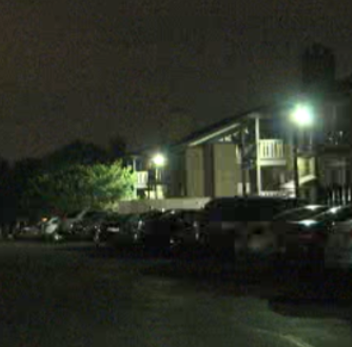
First responders on the scene of the Monday morning shooting -photo courtesy KWCH
Just after 1:15 a.m. Monday, police responded to report of a shooting at an apartment in the 2300 Block of North Woodlawn in Wichita, according to Officer Charley Davidson.
A 36-year-old woman told police she was on the balcony of her apartment, heard multiple gunshots and was shot in the leg. She then saw two suspects fleeing the area on foot, according to Davidson. She was transported to a local hospital with non-life-threatening injuries.
On Tuesday, police arrested a 16-year-old boy who lives in the area, according to officer Charley Davidson. He is being held in juvenile detention for aggravated assault, aggravated battery, criminal possession of a firearm by a juvenile, carrying a concealed weapon and possession of marijuana.
Police released no additional details are not looking for other suspects in the case, according to Davidson.
————
SEDGWICK COUNTY — Law enforcement authorities are investigating an aggravated battery that sent a woman to the hospital.
Just after 1:15 a.m. Monday, police responded to report of a shooting at an apartment in the 2300 Block of North Woodlawn in Wichita, according to Officer Charley Davidson.
A 36-year-old woman told police she was on the balcony of her apartment, heard multiple gunshots and was shot in the leg. She then saw two suspects fleeing the area on foot, according to Davidson. She was transported to a local hospital with non-life-threatening injuries.
One suspects is described as an unknown black male, medium build, shoulder length hair and a light complexion. The second suspect is described as an unknown black male with a light complexion, according to Davidson. Police released no additional details. Anyone with information is asked to call Wichita Police.
TOPEKA, Kan. (AP) — The leading Democratic candidate for Kansas governor is under attack for her past backing of tough voter identification policies as her party prepares for the possibility that the champion of those measures, conservative Kris Kobach, will win the Republican nomination.
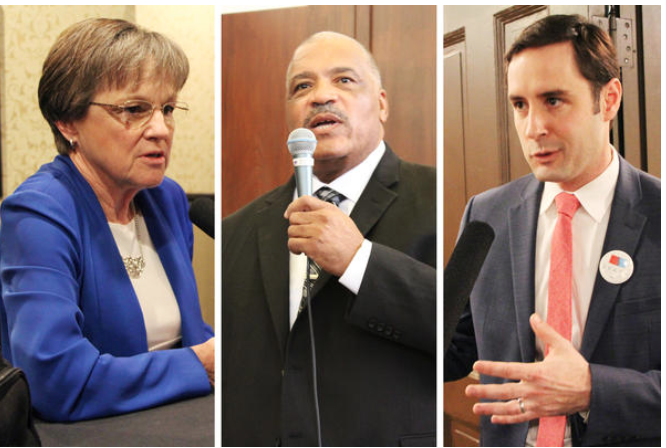
State Sen. Laura Kelly, former Wichita Mayor Carl Brewer, and former Kansas Ag Secretary Josh Svaty are all competing to be the Democratic gubernatorial candidate. photo Kansas News Service
Democrats have regularly criticized Kobach, the Kansas secretary of state, over policies they believe suppress voter turnout. No state had gone further in requiring prospective voters to provide papers documenting their U.S. citizenship when registering, until a federal judge struck down the law in June as a violation of voting rights.
But the Kansas law had strong bipartisan support when the Legislature approved it in 2011, and one of the yes votes came from state Sen. Laura Kelly, of Topeka. That vote has dogged Kelly in the final weeks before the Aug. 7 primary, with her two main rivals — who were not lawmakers at the time — hoping Democratic voters turn away from her because of it.
“How can we have as the standard-bearer for the party someone who voted with Kris Kobach, really, on his signature issue?” one of them, former Kansas Agriculture Secretary Joshua Svaty, said during an interview after raising the issue in forums.
The measure that Kelly and two-thirds of the Democrats then in the Legislature backed imposed the proof-of-citizenship requirement, starting in 2013. The state is appealing the ruling that struck it down.
Only a few other states have attempted to impose a proof-of-citizenship requirement. Alabama and Georgia have such laws but they are not currently being enforced and Arizona has a more lenient version, according to the American Civil Liberties Union, which opposes them and has fought Kobach in court.
Kelly was a sponsor in 2016 of a bill that would have allowed people born in Kansas to check a box on registration forms, with the state verifying their status, so that citizenship papers would not be necessary to register. It died in committee without a hearing.
“I’ve always been a supporter of voting rights and expanding access to it, but I also saw the need to make sure that our elections were secure,” she said in an interview. “Kobach just went way beyond the authority given to him.”
Kelly’s main Democratic rivals are Svaty and former Wichita Mayor Carl Brewer. Svaty was a House member from 2003 to 2009, leaving to become agriculture secretary. Brewer has never served in the Legislature,
Brewer, seeking to become Democrats’ first black nominee for governor, says he could better stand up to Kobach.
“I just don’t think they did their homework,” Brewer said of legislators who supported the voter ID policies.
Kobach is trying to unseat Gov. Jeff Colyer in a contentious Republican primary race. Many Democrats expect Kobach’s solid base on the right to allow him to win the GOP nomination in a seven-candidate field.
He regularly cites the voter ID policies as one of his biggest accomplishments.
“He spent eight years banging this drum,” said Micah Kubic, executive director of the ACLU of Kansas, a frequent Kobach antagonist. “It is what his entire public record is built on.”
President Donald Trump has cited Kobach as a source for his unsubstantiated claim that millions of immigrants voted illegally in 2016 and Kobach was a vice chairman of Trump’s since-disbanded voter fraud commission.
Kobach argues that tough voter ID policies prevent election fraud, even though he has cited only a few dozen registrations by non-citizens and even fewer attempts by them to vote. U.S. District Judge Julie Robinson ruled in June that the proof-of-citizenship policy disproportionately affects qualified voters.
In the first three years the Kansas proof-of-citizenship requirement was in effect, about one in seven registration applications was blocked — nearly half of them from people under 30, according to court documents. Between 2013 and 2016, more than 35,000 Kansas residents were unable to register. The state has about 1.8 million registered voters.
Kobach’s actions in lawsuits over his policies also have led to him being cited for contempt of court twice, and in an extraordinary rebuke, Robinson ordered him to undergo six extra hours of legal education.
Kelly and other prominent Democrats have argued that lawmakers who voted for his voter ID policies couldn’t guess that Kobach would enforce them as aggressively as he did. They also accuse him of abusing his authority.
But Kobach scoffed at such arguments during a recent interview. He said most Democrats voted for his policies because they were popular and changed their views later when the national Democratic Party — the “mother ship” — attacked them.
“There was absolutely nothing in the implementation of the law that was surprising,” Kobach said. “They’re just trying to scrape the bottom of the barrel for something that sounds like an excuse.”
And longstanding critics of the voter ID policies such as the ACLU and civil rights leaders argue that lawmakers were warned clearly about how they would create obstacles for prospective voters. But some of them aren’t holding the past vote against Kelly or other Democrats who now promise to work to reverse them.
“I’m just glad they’re remorseful now,” Kubic said.
ST. LOUIS (AP) – A certificate of inspection for the Missouri tourist boat that sank last month, killing 17 people, shows that it was on the lake at a time when the wind speed far exceeded allowable limits.
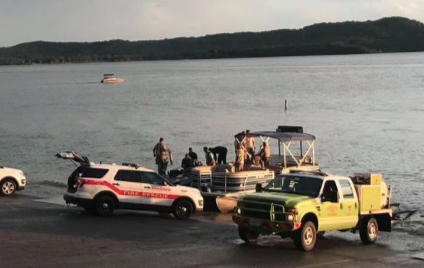
First responders on the scene of the lake accident near Branson -photo courtesy KYTV
The Coast Guard on Wednesday announced it has convened a formal Marine Board of Investigation into the accident involving a Ride the Ducks of Branson boat. The vessel sank July 19 at Table Rock Lake.
The lake was calm when the excursion began, but weather turned violent and the boat sank within minutes.
The Coast Guard’s certificate of inspection issued in 2017 prohibited the boat from being on water if winds exceed 35 mph or wave height exceeds 2 feet.
Investigators said the wind speed at the time of the accident was more than 70 mph.
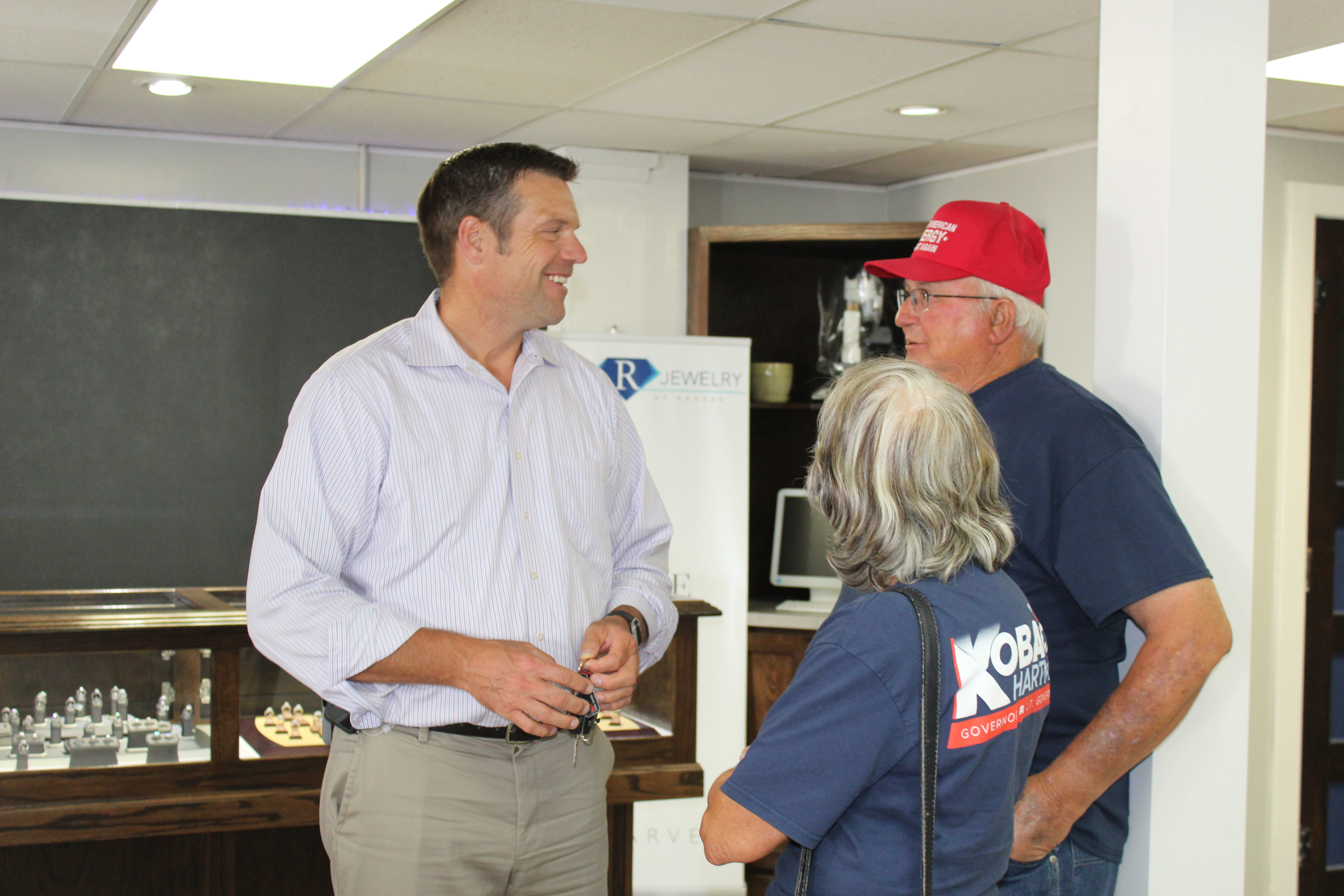
Republican Kris Kobach speaking to voters Tuesday at Diamond R Jewelry in Hays.By CRISTINA JANNEY Hays Post
Republican candidate Kris Kobach has pledged to cut taxes and reduce government spending if he is elected governor.
Kobach and running mate Wink Hartman were in Hays on Tuesday at Diamond R Jewelers for a campaign stop ahead of the Tuesday primary.
Kobach said his position on taxes separates him from a crowded ticket of Republicans, which also include Gov. Jeff Colyer, Insurance Commissioner Ken Selzer, Jim Barnett, Patrick Kucera, Tyler Ruzich and Joseph Tutera Jr.
Kobach is the only candidate in the race who signed a no-tax-increase pledge.
“Our objective is to cut taxes,” he said. “We are the high-tax state in the five-state area. It is ridiculous. Our sales taxes are eighth highest in the country. Our income taxes are highest in the region. Our property taxes are 15th highest in America. We are taxing our citizens to death here in Kansas. It has got to stop.”
Kobach claimed because of a combination of sales and income tax hikes in 2015 and 2017, the average Kansas family of four is paying $900 more in taxes.
“That’s money you save for the kids’ college. That’s a vacation. That’s food on the table. That’s a lot of things that the state of Kansas is now taking out of your pocket,” Kobach said. “Wink and I have a different attitude. It’s your money. It’s not the state’s money. We should be doing every single thing we can to try to get that money back to you, not thinking of ways to spend money.”
When federal tax reform was passed, the state saw a windfall of tax revenue. The Legislature chose not to pass that windfall back to Kansas residents. Kobach said he would use that additional revenue to implement a tax cut.
Brownback and Colyer made the mistake of making the tax cut in 2012, but not cutting the budget, Kobach said.
One way he would cut the budget is to reduce the state workforce through attrition. Kobach touted the cuts he made in his own department during his two terms as Secretary of State. Kansas ranks third in the nation for state and local employees per capita. He said that indicates there is room to cut.
Kobach said he would charge Hartman with helping find cuts in the state’s budget.
Kris Kobach’s running mate Wink Hartman with Diamond R Jewelry owner Dustin Roths.
“Under his direction, I will go to each department, each secretary,” Hartman said. “I will go through budgets, and we will cut unnecessary and wasteful spending without sacrificing service for the people of Kansas. You have got to be very careful.”
Kobach said he hoped tax cuts would draw new businesses to Kansas, but he said he would also work to contain or slow the growth of utility rates in the state. Kansas’ average electric rate is 13.4 cents per kilowatt-hour, but the surrounding states’ average 10.9 cents per kilowatt-hour.
Kobach also talked on illegal immigration, which has been not only a major point of his gubernatorial run, but a major issue in his stint as Kansas Secretary of State. He pushed for a law that required proof of citizenship in order to register to vote in Kansas, but that measure was challenged by the ACLU. The provision was struck down on appeal in May.
Kobach is now pushing to end in-state tuition for undocumented Kansas residents.
To qualify for the program, students have to have lived in the state since they were young children and graduated from a Kansas high school. As of fall 2017, 670 were using the program within the Kansas Regents system.
“The average college student graduates with $28,000 in debt,” he said. “Why is the state spending money to subsidize illegal aliens, paying two-thirds of their tuition when we have all this debt that Kansas kids are burdened with and many can’t even afford to go to college because of that debt? We should be taking that subsidy, those millions of dollars, and subsidizing Kansas kids, maybe not raising their tuition every single year. We could use that money to help our own kids to attend college.”
Kobach wishes to eliminate the last three sanctuary cities in the state.
“Some politicians are uncomfortable talking about the problems of illegal immigration,” he said. “They are too politically correct. They don’t want to make anyone angry. I don’t care. That is not me. I am happy to make people angry, because if you do the right thing, you are going to make some people angry.”
Kobach said he supports the president and his efforts on trade. Kobach pointed out he lives on working farm and has crops in the ground right now.
“It is counterproductive if people in the United States shoot darts at the president’s back while he is going into the negotiations with the Chinese, so I think we need to say we are behind him whatever the president does in these negotiations, we are with him,” Kobach said, “because if we don’t, we weaken the United States’ position.”
Also to help farmers, Kobach would seek to put a 2 percent lid on increases in ag property tax appraisals and limit reappraisal to once every three years, instead of every year, which is the current state policy.
Water is another issue that will need to be addressed to keep Kansas ag successful. Kobach said he supports local enhanced management areas, also known as LEMAs, which have been successful in other areas of the state.
Kobach also emphasized his pro-Second Amendment and pro-life stances.
He said he had goal of Kansas being the No. 1 state in the nation for protecting run rights, citing a slight slippage in the state’s ranking in a pro-gun poll for a law that prohibits carrying guns in medical facilities.
Kobach also told the crowd he supported term limits.
“We are one of the only states in the region that does not have term limits, and we need them,” he said. “Contrary to some people on the left, term limits don’t result in disaster for states or don’t result in legislators who don’t know anything. It results in new blood coming in — fresh blood, good ideas.”
SAN FRANCISCO (AP) — President Donald Trump’s executive order threatening to withhold funding from “sanctuary cities” that limit cooperation with immigration authorities is unconstitutional, but a judge went too far when he blocked its enforcement nationwide, a U.S. appeals court ruled Wednesday.
In a 2-1 ruling, the 9th U.S. Circuit Court of Appeals agreed that the order exceeded the president’s authority.
“Absent congressional authorization, the administration may not redistribute or withhold properly appropriated funds in order to effectuate its own policy goals,” Chief Judge Sidney Thomas wrote for the majority.
But he also said there wasn’t enough evidence to support a nationwide ban on the order and sent the case back to the lower court for more hearings on that question.
An email to a spokesman for the U.S. Justice Department was not immediately returned.
U.S. District Judge William Orrick said in November that the order threatened all federal funding and that the president did not have the authority to attach new conditions to spending that was approved by Congress.
The ruling came in lawsuits filed by two California counties — San Francisco and Santa Clara. The executive order potentially jeopardized hundreds of millions of dollars in funding to the two counties, Orrick said, citing comments by Trump and U.S. Attorney General Jeff Sessions as evidence of the order’s scope.
The Trump administration said the order applied to a relatively small pot of money that already required compliance with immigration law.
Government attorney Chad Readler had told Orrick that the order applied to only three Justice Department and Homeland Security grants that would affect less than $1 million for Santa Clara and possibly no money for San Francisco.
During arguments before the 9th Circuit in April, Thomas asked what the court was supposed to make of statements by Trump and his administration about wanting to withhold money from sanctuary cities.
Thomas also questioned whether the order would be constitutional if it applied to all types of funding, as the lower-court judge found.
Readler said the order was much narrower, and the judges should not focus on comments by the president or other administration officials.
The executive order is part of a push by the Trump administration to crack down on cities and states that generally don’t comply with U.S. immigration authorities.
The administration has sued California over three laws aimed at protecting immigrants in the country illegally. It also has moved to block a key public safety grant from going to sanctuary cities and states.
The Trump administration says sanctuary jurisdictions allow dangerous criminals back on the street. San Francisco and other sanctuary cities say turning local police into immigration officers erodes the trust needed to get people to report crime.
It helps, the latest Kansas campaign money tallies show, to be rich or have wealthy friends.
Next best thing, run as an incumbent.
Even as candidates scramble to raise, and spend, campaign dollars, early voting is already underway in the Kansas primary. SCOTT CANON / KANSAS NEWS SERVICE
Campaign finance reports for the first half of this year show dollars spent nearly as quickly as candidates could corral them — filling airwaves, plastering billboards and stuffing mailboxes with flyers.
Several candidates for governor in the first election since Sam Brownback left the office earlier this year find themselves nearing next Tuesday’s primary on a path to burn through nearly all they’ve raised.
Fund thyself
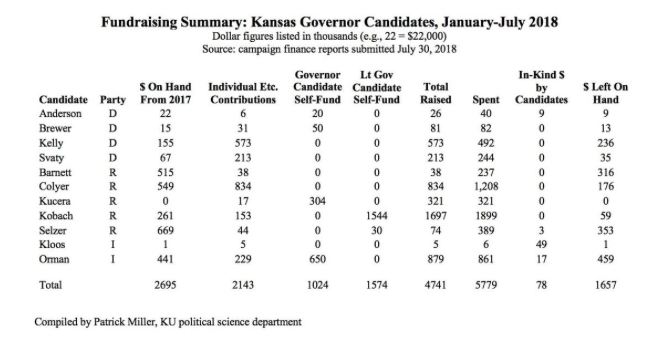
Republican Secretary of State Kris Kobach led the candidates for governor in money raised from Jan. 1 to July 26 with $1.7 million. Nearly all of it, $1.5 million, came from his running mate, Wichita businessman Wink Hartman. Most of that came as loans.
In fact, University of Kansas political scientist Patrick Miller said, about 55 percent of the cash raised by all the contenders in the governor’s race came from the candidates themselves.
“Which is extraordinary and bizarre for a governor’s race,” Miller said.
Although wealthier candidates historically often fund much of their own campaigns, Miller said it is far more rare for the No. 2 candidate on a ticket to pick up the tab.
“I’ve never seen a gubernatorial campaign like that anywhere, ever,” Miller said.
The influx of cash has given Kobach the ability to spend more during the period on campaign costs such as advertising. A single ad buy on July 13 rang in at $533,000.
“As a businessman,” Hartman told the Associated Press in a statement, “I know how important it is to invest in great leadership. And as a conservative, I know how critical investment is to the cause.”
Republican former state Sen. Jim Barnett, a physician, previously loaned his campaign more than $500,000. Self-described “entrepreneurial evangelist” Patrick Kucera’s fundraising was almost entirely made up of more than $300,000 from himself. Republican Insurance Commissioner Ken Selzer and former Democratic Wichita Mayor Carl Brewer have also put their own money into their campaigns for governor.
Independent candidate Greg Orman dropped more than $650,000 on his race.
Incumbent Republican Gov. Jeff Colyer raised the most from donors who aren’t also candidates. His report showed $834,000 during the latest filing period. Colyer made headlines for loans extended at critical points in the 2014 campaign, when he was lieutenant governor and then-Gov. Brownback was running for reelection.
There were no candidate loans in Colyer’s latest fundraising totals.
“I am humbled that our message of strong, optimistic, competent conservative leadership has resonated so well with Kansans,” Colyer said in a statement.
Colyer has also been pouring money into large advertising buys in advance of the primary.
On the Democratic side, state Sen. Laura Kelly led in fundraising with $573,000.
“I’m honored to have the support of such a broad and diverse group of Kansans,” Kelly said in a statement.
Former Kansas Agriculture Secretary Josh Svaty raised $213,000 and Brewer brought in $81,000.
“Nothing about the reports surprise us,” a Svaty campaign spokesman, Mike Swenson, said. “We have known all along that we would not raise as much money as the Kelly-Rogers campaign. They are both sitting state senators in the middle of their term.”
Easy come, easy go
The reports suggest several campaigns aren’t stockpiling for a general election.
Kobach on the GOP side, along with Brewer and Svaty on the Democratic side, all have used most of their money. Kobach had $59,000 left in his war chest. Svaty maintained $35,000 and Brewer had just $13,000.
That compares to Colyer with $175,000 and Kelly with $236,000.
“I am a little bit surprised by the number of candidates who have basically spent themselves into being broke,” Miller said.
PACs just getting started
Political action committees have started lining up behind some of the candidates for governor.
Colyer has garnered the support of more than two dozen organizations. He received donations of up to $2,000 from groups spanning a wide range of sectors.
The donors range from the Kansas Livestock Association, health care and pharmaceutical PACS to the Kansas Beer Wholesalers advocacy group.
Selzer got money from two insurance PACs and the Livestock Association.
On the Democratic side, Kelly had the support of a dozen PACs, including some that supported Colyer. Kelly also attracted PAC support from unions and transportation workers, as well as the Kansas Livestock Association.
The Kansas Livestock Association also donated to Svaty’s campaign.
Other groups are also starting to show up in the 2018 campaign, some of which are not constrained by the same spending limits as PACs. One is working on behalf of Orman by criticizing Kelly and Colyer, according to a story by the Wichita Eagle. That could reflect a calculation that the independent’s chances would be better in a three-way race with Kobach and Svaty.
Miller expects fundraising, and PAC activity, to pick up following the primary.
“Most of the money in this campaign,” he said, “is probably ahead of us, not behind.”
Out-of-state money
Money has poured into the Kansas races from across the country. Orman and a former Google executive running for secretary of state both have seen considerable out-of-state donations.
For Orman, some of that money came from Minnesota, where he was raised.
Democratic secretary of state candidate Brian McClendon pulled in contributions from Silicon Valley.
“Certainly, McClendon having lived in California and worked there, has a lot of connections,” Miller said.
McClendon raised $509,000, although $150,000 came from himself.
McClendon far outraised the best-funded Republican candidate for secretary of state, House Speaker Pro Tem Scott Schwab, who gathered $65,000, including $25,000 of his own money.
Democrats have not performed well in statewide races in recent years and have failed to win elections for offices such as attorney general, insurance commissioner or secretary of state.
“It’s one of the few times recently,” Miller said, “where we’ve seen a Democrat in a down-ballot race actually raise real money.”
Stephen Koranda is Statehouse reporter for KPR, a partner in the Kansas News Service. Follow him on Twitter @kprkoranda.

 OFFICE OF GOV.