Jana’s Campaign, a Hays-based nonprofit with the single mission of reducing gender and relationship violence, hosted their annual Empty Place at the Table Gala at the Rose Garden Banquet Hall in Hays on Saturday, Oct. 20.
This year marked the tenth anniversary of losing Jana Mackey to an act of relationship violence. The event focused on celebrating the legacy that lives on in her name and all of the work that has been accomplished in her honor. The 210 attendees raised more than $70,000 – the most successful gala in the history of the organization – more than doubling the amount raised in 2017.
“This event raises awareness and needed funds for the prevention education we provide,” says Kim Cebula, executive director of Jana’s Campaign. “It is a special year and the support we received is phenomenal, it means we can serve more teens and young adults, preventing them from being in violent and unhealthy relationships.
The evening featured a festive cocktail hour, dinner and live entertainment, along with both a silent and live auction. Businesses throughout the community and country donated unique items and experiences to support the event. (For a full list of sponsors and auction donors visit the EPATT page at www.janascampaign.org.)
A special performance by the Hays High Chamber Singers, featuring a video appearance of a young Jana singing the Lord’s Prayer, brought many family and friends to tears, while providing others a glimpse of the young woman who was taken from us.
The organization celebrated impacting over 56,000 students in 516 middle and high schools across eight states. They also shared they have hosted attendees from 320 colleges and universities at their regional campus safety summits. All of the numbers reflect work completed since 2013, when Jana’s Campaign formalized their data collection processes.
“To honor Jana with a room full of people who understand why prevention of gender-based violence is so important and who are fully committed to making a difference is unbelievably inspiring,” shared Christie Brungardt, Jana’s mom and organization co-founder. “We will be able to accomplish great things with the funds raised at the gala this year.”
Dr. Roger Marshall, R-Great Bend, is the First District Kansas Congressman.
Friends,
This week we have much to be thankful for. I, for one, am thankful for the hardworking men and women of our law enforcement institutions and their efforts to catch the perpetrator who sought to harm our nation’s public servants. This behavior will not be tolerated, and I am confident that law enforcement officials will bring them to justice. Moving forward, we must maintain order and respect for one another regardless of political affiliation. We cannot let fear and anger overcome our humanity.
I am also thankful for the recent rise in real wages for low-income workers. This week’s economic reports show that wages for the bottom 10% of full-time wage and salary workers have averaged 4.9% annual growth over the past four quarters. The number of applications for unemployment benefits dropped last week, especially amongst women. For the last two decades, the share of prime-aged women participating in our labor force has been in decline, but we have begun to see a reversal of this trend over the past three years. Our strong economy has brought labor-force participation among women aged 25 to 54 up to 75.2%.
Current-dollar personal income increased $180.4 billion in the third quarter, with personal savings resting at $999.6 billion. Deregulation and tax reform are bringing millions of jobs and opportunities back to those who need them most!
Disaster Relief
Last Friday, President Trump announced a Federal Disaster Declaration for counties in Kansas impacted by the major weather events over Labor Day weekend. The severe storms consisting of straight-line winds, and flooding which hit Riley, Clay and Marshall Counties, damaged people’s homes, buildings and businesses, and the local infrastructure. The President’s disaster declaration allocates federal funds, on a cost-sharing basis, to aid in the recovery and reconstruction of these communities. This will certainly help in the rebuilding process, but it is critical that we also recognize our state and local emergency response teams who assisted during the storms and floods, and have continued to help residents and property owners during this challenging time of clean up and repair.
Bringing Order to the Border
On Thursday, President Trump firmly stated that the Honduran migrant caravan will not be allowed to enter the country illegally. Secretary of Defense, James Mattis, is expected to order 800 American troops to reinforce vulnerable areas along the border. Regardless of political affiliation, it is clear that our current immigration laws are broken. As elected officials, we must set aside partisan bickering and develop a solution to this urgent crisis. I have sympathy for those working to enter the U.S., but we are a country of laws that must be upheld. Without national security and clearly defined borders, our country would cease to exist.
A Prescription for Hope
This week, President Trump signed the most significant measure against a single drug crisis in history! Having been classified as a national Public Health Emergency earlier this month, I am thrilled to see we are tackling the Opioid Crisis head-on. H.R. 6, known as The Substance Use-Disorder Prevention that Promotes Opioid Recovery and Treatment (SUPPORT) for Patients and Communities Act, fights drug trafficking on our borders, improves access to treatment centers, and educates prescribers, as well as veterans, on the addictive properties of certain drugs. Of course, there is still much work to be done on the state level, but this is a major leap towards creating healthier American communities.
World Polio Day
October 25th was World Polio Day: a fantastic opportunity to renew our promise to every child who suffers from this debilitating disease. This year’s theme, Bold Steps to End Polio, focused on the tremendous progress that has been made in creating a polio-free world. Developing countries such as Nigeria have gone two years without new diagnoses, while others such as Afghanistan and Pakistan only encountered 22 cases in the past year. The World Health Organization, in conjunction with its partners in the United Nations Children’s Fund, Rotary International, the Bill & Melinda Gates Foundation, and U.S. Centers for Disease Control, will continue working alongside governments and frontline health care workers to annihilate polio for good.
The Fort Hays State University Science and Mathematics Education Institute Science Café presents “Thought Experiments Leading to the Theory of Relativity” Monday, October 29 at 7 p.m. in The Venue at Thirstys, 2704 Vine Street.
This presentation will walk through some of the simple thought experiments about Special and General Relativity that lead to the ideas of time dilation, length contraction, gravitational lensing, and more.
Speaker is Dr. CD Clark III, Associate Professor of Physics at FHSU.
Science Cafe is free and open to the public. It’s sponsored by the FHSU Science and Mathematics Education Institute.
Les KnollIs there something good in every thing that is bad? Of course not, but I see the potential for a lot of good coming out of our really bad politics. The differences between our two political parties could not be more contrasting. It’s right there for all to see and that’s the good part.
Unfortunately, there are many who are not open minded, who have been indoctrinated and not privy to the truth, but most voters can clearly distinguish good politics and government, from bad. That’s why Trump became our president.
It is my opinion, the majority of voters, a few weeks away, during the midterm elections, will not vote Democrat. There will be a red wave, not a blue one, and I will explain why I am going out on this limb with my prediction.
The division among Republicans and Democrats has never been worse, therefore, voters too are divided. The old days of some sort of compromise or coming together between left and right appears to be a thing of the past. There are no compromises.
The upcoming election will determine what kind of America most people in this country want. On the one hand there are those who want to make this country great again as in the past, while on the other hand some want a different country entirely. It’s imperative voters know the differences.
For starters, Democrats lean toward socialism. We became the greatest country on earth in large part with an economy based on capitalism, not a socialistic government controlling everything.
Speaking of division, who wants an America where one particular party does everything possible to divide us based on race, gender, sexuality and, of course, the haves and the have nots? Add to that Christianity on the right versus secularism on the left. A united country insures progress while a divided one causes chaos, and Democrats want chaos in order for government to take over everything.
Most of us can clearly see what the Democrat Party is all about, and it’s not a pretty picture. They don’t even try to hide unconscionable mob like mean spirited behavior, or an agenda that would stand this country on its head. What they are all about is right there for God and the whole world to see.
The Democrat Party and its base has never been more radical. Too bad so many seniors still vote Dem not realizing their party has completely changed from what it was years ago. For some cockamanie reason they support all the extreme left wing agendas when in reality they are actually conservatives.
Since Obama became president, Democrats have lost some 1200 elections at all levels of government for being too far to the left. Now the party is going even further left. That’s another big reason I am optimistic about Republican chances. We’re not a country that believes we should be way out in left field.
Do we as voters want a political party in control of our government that promotes violence, orchestrated protests, lacks civility, etc. The hit job on Trump’s nominee to the Supreme Court crossed the line. Brett Kavanaugh’s personal life and his family were put through the ringer like no other nominee before in American history. The accusations by Dems about Kavanaugh never showed one scintilla of evidence. There was perjury by accusers as Kavanaugh was never given our most precious right of due process and presumption of innocence.
How does the left justify ruining a man’s life and his family mostly due to the unadulterated hatred of Trump? Who among us wants to vote to support hate? Besides the totally disgusting behavior toward Kavanaugh due to Trump hatred, Dems are fearful of two other things as Kavanaugh takes the bench on the Supreme Court. The man is a constitutionalist and will not rule in favor of laws created by liberal judges in lower courts, laws that belong to congress and we the people, not the bench.
Thirdly, Kavanaugh’s pro life beliefs scared the living daylights out of Democrats who then went on to make his confirmation a matter of life or death, if you get my point. Point is, most voters will want to save lives of unprotected unborn babies as opposed to run away abortions. Trump chose Kavanaugh in part to protect the unborn.
Democrats make no bones about destroying a Trump presidency. How much worse can it get in this country when a political party openly tries, in every which way possible, to overthrow a duly elected presidency. For what? For starters, we currently have one of the best economies ever. There is no evidence of Russia collusion by Trump, in fact, indisputable evidence of collusion by Democrats.
Let’s get this straight voters. As things stand now, there is nothing to warrant impeachment. Who in their right mind wants to support an agenda to take out our president for no good reason? The desire for Hillary to be president is not a good reason.
Do voters want to sit through years of schemes to impeach Trump. I don’t think so. And, it would be insane to vote in support of their other agendas. Open borders would ruin us literally as a country where illegals are favored over American citizens, where foreigners get to choose our government leadership in congress, even our 2020 president.
Do we want a political party in control of our government that is anti law enforcement? Eliminating ICE is ludicrous. Promoting sanctuary cities to protect illegals, even criminals, is insanity. Talk about putting foreigners ahead of American citizens!
Tell me it isn’t so! Dems are campaigning on the promise to roll back the Trump tax cuts and tax reforms. How outrageous can you get? Why would any voter in their right mind vote to ruin a good thing that benefits all Americans? Trump is making America great again with his policies and the promises he made to Americans.
One of the worst things to ever occur in this country’s history to a president of these United States is the media’s failure to report the great many successes and accomplishments of President Donald J. Trump. Far too many Democrat voters are completely in the dark about how America is becoming great again. And, sad to say, many don’t even care.
Our economy is booming! Unemployment at historic lows. The lowest unemployment numbers in American history for African Americans and Hispanics. Good job opportunities for women and young people. More jobs available than people to fill them.
Add to those positives, consumer confidence is at an all time high, companies are returning to America from foreign countries, wages are up, food stamp enrollment down dramatically, GDP growth at an astounding 4%, stock market at historic highs, etc.
Trump is doing something about our trade deficits, ISIS threat to our national security, stifling Obama regulations eliminated, restoring American world leadership, and of course, working hard to secure our borders.
Voting to throw away all these positives would be nothing short of insanity. The Washington Examiner on October 12 published an astounding 289 Trump accomplishments of less than two years by this administration.
There are many reasons Democrats can’t afford to lose this election and not take over control of Congress. Perhaps the biggest are the ongoing investigations in congress of massive corruption. Should Dems take control, they will bring the investigations to a halt even though there is indisputable proof of Obama, Hillary, the FBI and DOJ doing everything possible morally and illegally to destroy a Trump presidency. Dems will want the corruption in our government swept under the rug.
That being said, look for shennanighans like never before in an election. There could be any number of things, but at the top of the list will no doubt be voter fraud.
Perhaps a better title for this letter to the editor should be “How to vote and why.” Truth be known, I feel a moral responsibility to make my case to readers in this writing for an election that many claim is the most important in our lifetime.
Kris Kobach says his proposal to reform Kansas Medicaid could save the state $2 billion.
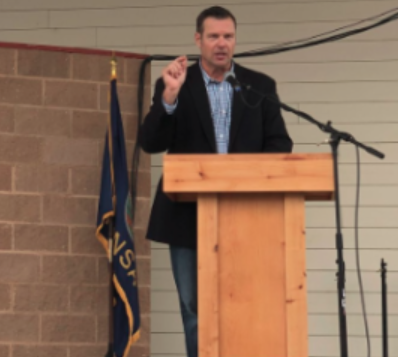
Kobach during the debate at the Kansas State Fair-photo courtesy Kobach for Governor
At campaign events, the Republican nominee for governor touts the benefits of combining Medicaid with direct primary care, an unconventional payment system that avoids the bureaucracy of health insurance.
But the people who gave Kobach the idea say they haven’t calculated that direct primary care would save $2 billion for Kansas Medicaid. And Kobach’s campaign hasn’t provided an alternative source for that number.
On top of that, health experts say the idea oversimplifies one of the state’s largest and most complex expenditures. While direct primary care is a familiar idea in Kansas in private practice, no one knows whether it could work with Medicaid’s complex structure and recipients’ specialized needs.
Direct primary care, sometimes called “concierge medicine,” allows patients to pay doctors a monthly or yearly fee for unlimited primary care. That often includes office visits, phone calls and texts.
Direct primary care clinics offer patients discounts on procedures, medications and lab tests. They typically don’t take insurance, which saves doctors the hassle and overhead costs of dealing with insurance companies. The Kansas Department of Health and Environment says about 30 doctors use the system in Kansas.
For years, lawmakers have considered bringing direct primary care to KanCare, the Medicaid program that serves 425,000 of the state’s most vulnerable residents. Now, Kobach and his independent opponent, Greg Orman, have included the proposal in their campaign platforms.
“If we had successful direct primary care for our KanCare system, the $3.2 billion that we’re spending for 400,000 people would go down to $1.3 billion for the same 400,000 people,” Kobach said at a July candidate forum in Garden City. “There is an opportunity to realize great savings in our KanCare system.”
Kobach’s other statements on the subject are frequent, but lack detail. His campaign website doesn’t include a section on his proposals for health policy. At an October press conference, Kobach told the Kansas News Service he would introduce a direct primary care pilot program to one county or region before expanding it to Medicaid across the state and, he promised, reaping $1.9 billion dollars in savings.
“If it works well in that setting, then we would hopefully expand it, “ Kobach said. “You’d have to go statewide with it to save that kind of money.”
Despite repeated requests from the Kansas News Service, the Kobach campaign hasn’t provided a source for that number. A spokeswoman said Kobach based the idea off of work by Steve Anderson, a former state budget director under former Gov. Sam Brownback, and Josh Umbehr, a direct primary care physician. But neither Anderson nor Umbehr say they calculated anywhere near $2 billion in potential savings.
The back of an envelope
Umbehr has long been an advocate for direct primary care, speaking about the subject across the country and making appearances on local and national media.
He’s run a direct primary care clinic in Wichita since 2010 and says the payment system saves his business time and money.
Wichita direct primary care doctor Josh Umbehr. CREDIT FILE PHOTO / KANSAS NEWS SERVICE
“We cut out a lot of middlemen,” Umbehr said. “We can lower that price and offer that directly to our patients.”
When his father, lawyer Keen Umbehr, ran for Kansas governor as a Libertarian in 2014, Josh Umbehr was his running mate. Their platformpromised to save the state $1 billion by combining direct primary care with Medicaid.
In 2015, Josh Umbehr testified about the idea in front of a Kansas House of Representatives committee, attracting interest from lawmakers. A month later, the committee introduced a bill creating a direct primary care pilot program as part of broader Medicaid reforms. But that legislation stalled.
Now, Umbehr is advising the Kobach campaign on the issue. He also practices medicine in the Hartman Oil Building — the same place where Wink Hartman, Kobach’s running mate, headquarters his oil company.
Umbehr and Anderson remember calculating the potential Medicaid savings of direct primary care over a meal at a Wichita restaurant in 2013 or 2014.
Anderson said they took the discounted prices that Umbehr charged at his clinic and applied those discounts to KanCare procedures and expenses — minus the cost of nursing home care.
“Three hundred knee replacements, for example,” Anderson said. “And then there would be a calculation, what that costs us, and then what it would have cost under Josh’s system.”
He remembers getting the data from a state spreadsheet and doing the math on the back of an envelope.
“It’s a really big, nine-by-nine envelope,” Anderson said.
Anderson said he hasn’t spoken to Umbehr in years, and admits his memory of that day, and even which year it happened, is spotty. But Anderson remembers coming to the conclusion that direct primary care could save not $1 billion in Medicaid costs, like Umbehr claims, but more like $450 million to $600 million.
“It’s a rough estimate,” Anderson said.
Umbehr told the Kansas News Service that KanCare could save $1 billion by combining direct primary care with a wraparound insurance program to handle other medical expenses. He said cheaper primary care would also decrease non-primary care expenses, such as hospitalizations and emergency room visits.
“We’re pulling all of those things in-house and decreasing the cost of them by 95 percent.” Umbehr said.
‘It’s just inaccurate’
Former Kansas Medicaid director Robert Day says both Anderson and Umbehr did the math wrong.
“These people are idiots. They know nothing about health care financing or costs,” Day said. “To make the statements they make, it’s just blatantly — it’s so untrue and unfactual that it staggers the mind they would even say something publicly like that.”
Day, who worked for Republican and Democratic governors from 1999 to 2008, said the savings from a private direct primary care clinic can’t be applied to Medicaid. It’s a complicated program, he said, that doesn’t work like regular health insurance.
The elderly and disabled comprise only 25 percent of people receiving Medicaid or the related Children’s Health Insurance Program in Kansas. But they account for 70 percent of KanCare’s spending.
Any savings from direct primary care would most likely not apply to the elderly and disabled, Day said, because their needs are so different from those of the general population.
“Most of the costs of that population is in long-term and nursing home care,” he said. “So they’re not physician-driven costs.”
In 2016, the state spent $1.1 billion on two categories of service primarily for the elderly and disabled: adult care homes and home and community-based services. In the same year, it spent $315 million on two categories of service that include primary care procedures: physician services and outpatient care.
Day said KanCare couldn’t save anywhere near what Anderson, Umbehr and Kobach are claiming, because it doesn’t spend $450 million, $1 billion or $1.9 billion on primary care in the first place.
“It’s just inaccurate,” Day said. “It shows a complete lack of understanding of the Medicaid program.”
Uncertain benefits
Other health policy experts were skeptical about whether direct primary care could adequately serve the specialized needs of Medicaid recipients when so many are elderly and disabled.
“There’s been no program to even test or look at, at this point,” said Cindy Samuelson, a vice president of the Kansas Hospital Association. “So it’s really hard to answer those questions of what the true impact might be.”
While direct primary care might save time and money by reducing paperwork, Samuelson said interacting with the bureaucracy of Medicaid, especially KanCare’s three managed care organizations, might negate any of those benefits for doctors.
Given those complications, she says it’s unclear whether there are enough doctors who are willing to try both direct primary care and Medicaid.
“Would the program even be something that providers are interested in?” Samuelson said.
That uncertainty highlights the need to run a pilot program before drawing any conclusions, said Kari Bruffett, vice president for policy at of the Kansas Health Institute.
“A pilot could help assess how direct primary care might work for various populations in KanCare,” Bruffett said in an email. “It could also be used to assess beneficiary interest, provider interest and capacity, and whether direct primary care could work either as an alternative to or an option within a managed care model.”
The Kansas Department of Health and Environment, which manages Medicaid, told the Kansas News Service it hasn’t yet done a cost analysis of using direct primary care for Medicaid. But it’s open to a pilot program if it’s supported by a future governor and legislature.
“Anything innovative like that, we would like to think it warrants exploration,” said Secretary Jeff Andersen.
Andersen agreed that physician availability, negotiations with managed care organizations and other details were uncertain. “Those are things that have to be worked out, but it’s all doable.”
So far, the Kobach campaign hasn’t answered questions about those details, nor has it provided another source for Kobach’s claim of $1.9 billion in savings, despite repeated inquiries. In an email, a spokeswoman forwarded this statement, attributable to Kobach:
“Direct Primary Care would result in significant savings. We will be looking at all kinds of measures to increase the efficiency of our Medicaid delivery and to improve the satisfaction of Medicaid patients. Direct Primary Care accomplishes both. The patients love it, and the doctors love it, too.”
GREAT BEND — Kim Guesnier, Great Bend, and Laura Luft, La Crosse, recently joined the Golden Belt Community Foundation Board of Directors as a way to be directly involved in serving the central Kansas community.
Christy Tustin, GBCF executive director, said both women will be assets to the board and the four counties it serves – Barton, Pawnee, Rush and Stafford.
“We welcome Kim and Laura who will bring educational, financial and personal experiences to our board while representing all four counties,” Tustin said. “Donors and non-profit agencies will benefit from their contributions.
“Board members help shape local philanthropy today and far into the future,” Tustin added. “While each county is unique, they share similarities with their neighbors. Board members will build on each county’s strengths.”
A board committee nominates members who serve a three-year term, with the option of renewing once for a second term.
Kim Guesnier
Guesnier learned about the GBCF and its contributions to the community from her parents, Merlin and Nelva Grimes.
Guesnier
“This Foundation was near and dear to them,” Guesnier said. “When I was asked to serve on the board, my mother encouraged me to do so. I didn’t hesitate.”
Guesnier’s mother lives in Great Bend; her father passed away last November. They spent their 62 years of marriage in Great Bend.
“In addition to my mother’s encouragement, I want to serve on the Foundation board because I am aware of all the good it does in the community,” Guesnier commented. “I love central Kansas. It is a good place to live and raise a family.”
She and her husband, Bernie, have four grown children and five grandchildren.
Guesnier earned an associate’s degree from Barton Community College, and bachelor’s and master’s degrees from Fort Hays State University. She was a special education teacher for 35 years – four years at Hays and the rest at Barton County Special Services.
“I still miss my students but enjoy seeing many of them living and working in the community,” Guesnier said. “I want to demonstrate to others that living and working in central Kansas is fulfilling.
“I hope my background in education will benefit the Foundation board. I want to help my hometown and surrounding communities grow and prosper.
Laura Luft
Since one of the bigger challenges facing central Kansas is securing the funding to meet local needs, Luft wants to help meet this challenge.
Luft
“The Foundation has created a vehicle to help put great ideas into motion,” Luft explained. “At the same time, it is building a solid financial base for many years to come. As a board member, I want to do my part to increase awareness and participation in the Foundation throughout central Kansas.”
Luft and her husband, Richard, are “small-town Kansas kids and incredibly thankful for this background.”
Richard was raised in Rush County, along with his parents and grandparents. He graduated from Otis-Bison High School and operates the family farm at Bison.
“Even though we lived and worked in the Dallas area for nearly 24 years, our hearts were always home in Kansas,” the new board member said. “When we decided to move back here in 2011, we did so with a strong personal commitment to be more than just residents. “We want to be active in helping our community thrive for the next generations. The Foundation is an exciting opportunity to do that.”
Luft graduated from Southeast of Saline High School at Gypsum and Bethany College in Lindsborg. Her professional career started in the Dallas area where she was a personal financial planner with Waddell & Reed. She held several corporate business finance positions during the past 28 years.
Currently, Luft is a finance director with DXC Technology, which is based in Washington, D.C.
“The key skills in my professional life center on financial planning, leadership and driving projects to completion,” she noted. “These all carry over in helping the Foundation be successful. In addition, a board member’s most important trait is a passion for our communities. I see this in every member of this great board.”
At $22.5 million in total assets and more than 180 funds under management, the Golden Belt Community Foundation has been connecting people who care to causes that matter since 1996. Golden Belt Community Foundation exists to provide non-profit organizations in central Kansas with a permanent source of support and to serve as a vehicle for charitable giving for donors. GBCF serves the counties of Barton, Pawnee, Rush, and Stafford.
For more information about Golden Belt Community Foundation, call (620) 792-3000 or visit their website at www.goldenbeltcf.org.
GEARY COUNTY — One person died in an accident just after 7p.m. Friday in Geary County.
The Kansas Highway Patrol reported a 2000 Ford Explorer driven by Heather A. Hurley, 30, Salina, was eastbound on Interstate 70 one mile east of Grandview Plaza.
The driver lost control of the SUV overcorrected and overturned.
A 2017 Peterbilt semi driven by Bryan G. Hedrick, 40, Eudora, was behind the SUV and struck debris from the accident.
Hurley was pronounced dead at the scene and transported to Penwell Gable Funeral Home.
Hedrick was not injured. Hurley was not wearing a seat belt, according to the KHP.
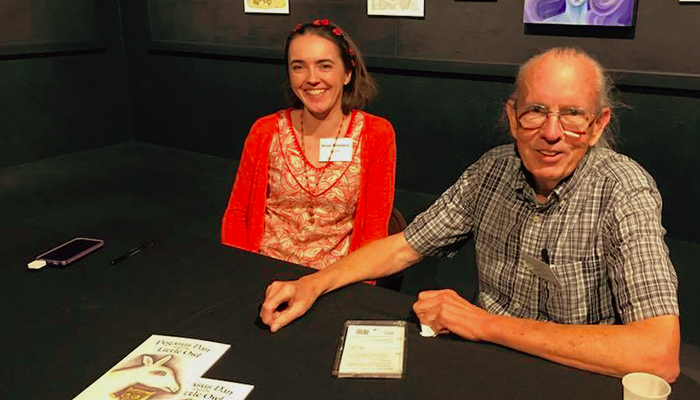
Thibodeau and Joy / photo courtesy Hays Arts Council
By CRISTINA JANNEY Hays Post
Children can join a baby owl and a young Pegasus, who eats rainbows for dinner, as they fight the forces of the evil night Night Mare in Hays librarian Nicole Thibodeau’s new book “Pegasus Dan and the Little Owl.”
For her first her first book, Thibodeau teamed up with Ellinwood artist Robert Joy.
Last week, Thibodeau and Joy were on hand at the Hays Arts Center for a book signing.
All the books on-hand at the HAC sold out. However, an exhibit of Thibodeau and Joy’s artwork is on display at the HAC until the end of October. Books can be purchased online through Amazon for $12.
The book is a tale of tolerance that Thibodeau, 38, said was inspired by her uncle. Her uncle was gay, and Thibodeau said he was misunderstood by his family. He recently died, and Nicole went to California to help her mother with her uncle John’s estate.
“It was a very moving experience, and it really inspired me to search for bringing more narratives into the world that are about inclusion and overcoming fear,” she said. “That was the narrative of this story and what this story is about.”
The main character in the story is a young Pegasus named Dan, who lives in a treehouse in an enchanted forest. Dan’s parents tell him not to trust the night creatures in the forest below.
One day, Dan is flying to school and he hears a noise. He swoops down to find a little owl whose wing is caught under a branch. He realizes she is a night creature.
“He says, ‘Just this once I would like to help you, but will you promise not to hurt me with your talons?’ She says, ‘I promise.’ He lifts up the branch and she flies away,” Thibodeau said.
Dan thinks about the little owl all day at school and hopes her wing is doing OK.
“He flies home at the end of the day and tells his parents he helped a night creature in the forest below. They look very worried and they tell him to be careful that the night creatures can be dangerous,” she said.
Dan has rainbows for dinner and goes to bed.
He wakes up to the sound of a crash and finds his father fighting the evil Night Mare, a horse.
“The little owl flies into the window, and she hoots, and the Night Mare vanishes into the night,” Thibodeau said.
Dan’s father thanks the owl, and Dan and the little owl are friends forever.
The little owl in the book was inspired by a baby owl that baby owl fell out of a tree in Thibodeau’s backyard. After a friend who works at the Sternberg examined the owl, he deemed it healthy enough to go back into the tree.
“It is about friendship, because he is afraid at the beginning because he doesn’t know any night creatures,” Thibodeau said. “Then he gets to know one and she helps him out. It is the overcoming of fear and learning about different kinds of creatures, which could be in our world different kinds of people.
“I also feel in this time in our society it is so important to generate more narratives that are bringing more people together and increasing the amount of compassion.”
Painting and drawings by Nicole Thibodeau and Robert Joy at the Hays Arts Center
Thibodeau said she did not think the book was appropriate for very young children because of the length of the story. She recommended it for first- through third-graders.
“Pegasus Dan and the Little Owl” was self-published. Thibodeau became acquainted with Robert Joy through an area art show. Joy and Thibodeau corresponded through the mail, and Joy sent her intricately hand-decorated envelopes with her letters. Photos of some of these made it into the back of the book.
Thibodeau is a library assistant in the young adult department at the Hays Public Library. She received her bachelor of arts in studio art from Bethany College in Lindsborg and her MFA from FHSU. She also received instruction at the Art Student’s League in New York, Lacoste School of the Arts in France, as well as from Studio Art Centers International in Florence, Italy. Additionally, she earned a master’s degree in English from FHSU.
Thibodeau has written and hopes to publish other children’s books. She is also a poet and visual artist.
“It is rewarding to create,” she said. “That is my favorite thing.”
HAYS – TMP quarterback Carson Jacobs threw a season-high five touchdown passes and the Monarchs took advantage of four Lyons Lions turnovers in a 45-12 win Friday at Lewis Field.
The Monarchs took advantage of a pair of Lyons fumbles on their first two offensive drives and scored a pair of touchdowns to go up 16-0.
Jacobs found Jace Wentling for a 23-yard score that put TMP up 8-0 after the two-point conversion with 10:24 to play in the first. Then about two and a half minutes later, following the second Lyons fumble Kaleb Hagans scored from a yard out and after the two-point conversation the Monarchs led 16-0.
Lyons got their only offensive touchdown of the game on their next offensive possession on a 64-yard touchdown run from Ismael Reyes cutting the TMP lead to 16-6.
The Monarchs offense would continue its season-best performance adding three more second quarter touchdowns with Jacobs finding Wentling for a second time from 47 yards out, Jack Johnson from 15 yards out and Alex Schwartz for 32 yards.
The Monarchs lead 39-6 as the first half was coming to an end and attempted a field goal but a low snap forced Jacobs to try and throw for the first down but instead threw and interception to the Lions Trenton Troyer who scored on a 62-yard touchdown return to make the score 39-12 at halftime.
TMP added one more touchdown in the third quarter, this time Jacobs found Bryce Hickman for a 21-yard touchdown giving the Monarchs the 45-12 lead.
TMP post game coach interview
Game highlights
Jacobs finished 15-22 for 240 yards with five touchdowns and one interception. All new career-highs.
Alex Schwartz lead the Monarchs with five receptions for 64 yards and one touchdown.
Kaleb Hagans finished with 61 yards on the ground on 14 carries.
TMP finished 3-6 for the second season in-a-row. Lyons finishes 0-9 and have lost 29 straight games.
LENEXA – Earlier this month, the U.S. Environmental Protection Agency (EPA) announced over $9 million available nationwide in rebates to replace older diesel school buses through EPA’s Diesel Emissions Reduction Act (DERA) funding. The new and retrofitted buses will reduce pollutants that are linked to health problems such as asthma and lung damage.
School buses travel over 4 billion miles each year, providing the safest transportation to and from school for more than 25 million American children every day. However, diesel exhaust from these buses has a negative impact on human health, especially for children, who have a faster breathing rate than adults and whose lungs are not yet fully developed.
The 2018 School Bus Rebate Program will offer over $9 million to public and private fleet owners for the replacement of old diesel school buses with new buses certified to EPA’s cleanest emission standards. EPA will award selected applicants up to $20,000 per bus for scrapping and replacing old buses.
Applicants can apply for rebates between $15,000 and $20,000 per bus to replace buses with engine model years of 2006 and older with new buses powered by 2017 or newer model year engines. Eligible replacement school buses may operate on diesel, gasoline, battery, or alternative fuels such as natural gas or propane.
Eligible entities include:
Regional, state, or tribal agencies that have jurisdiction over transportation and air quality, including school districts and municipalities
Private entities that operate school buses under a contract with an entity listed above
Fleets with up to 100 school buses may submit one rebate application listing up to 10 buses for scrappage and replacement
Fleets with more than 100 school buses may submit up to two rebate applications, each listing up to 10 different buses for scrappage and replacement
Selections are made through a lottery process, with at least one selectee from each state/territory represented in the applicant pool. The deadline to apply is Nov. 6, 2018. For more information, visit: https://www.epa.gov/cleandiesel/clean-diesel-rebates.
This is the sixth rebate program to fund cleaner school buses offered under DERA appropriations, which has supported nearly 25,000 cleaner buses across the country for America’s schoolchildren. For more information about the DERA program, visit: www.epa.gov/cleandiesel.

 Jana’s Campaign, a Hays-based nonprofit with the single mission of reducing gender and relationship violence, hosted their annual Empty Place at the Table Gala at the Rose Garden Banquet Hall in Hays on Saturday, Oct. 20.

 Listen as the ‘Voice of the Chiefs’ Mitch Holthus recaps last week’s win over Cincinnati and previews this Sunday’s game with rival Denver.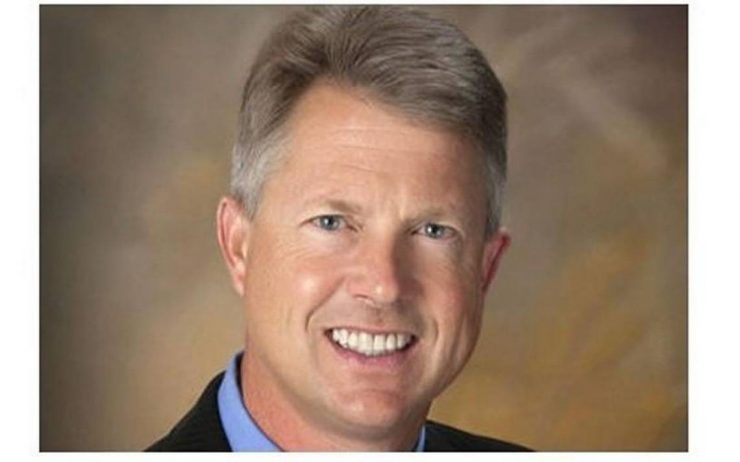










 Today
Today